Tag: alcohol addiction help

  • The Secret Of Getting Into An Alcoholic’s Mind

    The Secret Of Getting Into An Alcoholic’s Mind

    ARTICLE SUMMARY: Is a friend or a loved one experiencing alcohol problems? Are you looking for a way to understand his/her behavior? This article gives you the basics on alcohol addiction.  If you want to get deeper inside the mind of an alcoholic, this is a good place to start.

    TABLE OF CONTENTS:

    First, What’s The Big Deal?

    The Big Deal about alcohol is that it negatively affects about 8% of the adult population in the U.S. Over consumption is one of the leading causes of preventable death. And alcohol is associated with a growing list of really bad diseases of the body and mind.

    So, how did your loved one become addicted to it in the first place?

    [banner variant=”article-1″]

    It might be consoling to know that a certain population of people have and will always be prone to alcoholism. Alcohol has played a significant part in religious, cultural and social practices in many societies. As it became rapidly produced and distributed, alcohol became one of the widely spread and most available substances across the world. This mass production of alcohol lead people to start using it more frequently, leading them from casual users, to abusers, and eventually people dependent on its psychoactive effects.

    About 17.6 million people, or one in every 12 adults, suffer from alcohol abuse or dependence, which means that these individuals have lost control over their alcohol consumption.

    And as we mentioned earlier, alcohol consumption impacts both the incidence and course of and the course of many health conditions. According to the World Health Organization, 5.9 percent of all global deaths in 2012 were caused by alcohol consumption. The Big Deal is that alcohol is legal…but it’s not going away. How can you help your loved one? What understanding do you need to have?

    The Secret Of Getting Into An Alcoholic’s Mind

    The secret of getting into an alcoholic’s mind is to understand how alcohol affects the brain. Both moderate and heavy drinking can lead to behaviors that would never occur in a sober state. Alcohol belongs in the category of drugs called depressants, which means that drinking alcohol results in depressing, or slowing down brain processes. As a result of this alteration, alcohol abusers can behave uncharacteristically and aggressively.

    [banner variant=”article-2″]

    Still, not all alcoholics are alike. They experience different subsets of symptoms. We do know that heavy drinking may have extensive and far–reaching effects on the brain, ranging from simple “slips” in memory to permanent and debilitating conditions that require lifetime custodial care.

    And while researchers have not yet found conclusive evidence that any one variable can consistently and completely account for the brain deficits, they do know that alcohol impairs the way the brain normally works. So, a person who drinks heavily over a long period of time may have brain deficits that persist well after he or she achieves sobriety. Exactly how alcohol affects the brain and the likelihood of reversing the impact of heavy drinking on the brain remain hot topics in alcohol research today.

    [banner variant=”sidebar-1″]

    Is Alcoholism Treatable?

    Yes.

    Those who have drinking problems can solve their addiction issues with the help of health care professionals such as addiction counselor. According to studies  on Alcohol Use Disorders, alcoholics requires medical help and treatment to address physical and mental aspects of the problem. Treatment helps recovering alcoholics reduce their drinking and report fewer alcohol-related problems.

    [banner variant=”sidebar-3″]

    There is no one-size-fits-all solution when it comes to alcohol addiction problems. What might work someone, may not be a good fit for another person. This is why it is important to research all available options and chose what you think will work the best. There are various treatment options for alcohol abuse problems such as:

    1. Behavioral Therapy: Lead by healthcare professionals, behavioral therapy techniques are focused on helping those addicted to alcohol in changing their behavior through counseling.

    2. Medication Therapy: Three medications are currently approved in the United States to help people stop or reduce their drinking and prevent relapse:

    • Disulfiram
    • Naltrexone
    • Acamprosate

    These medications can be prescribed only by a primary care physician or a doctor and can be used alone or in combination with counseling.

    3.Support Groups: Alcoholics Anonymous and other 12-step programs provide peer support for people quitting or cutting back on their drinking. Combined with treatment, mutual-support groups can be very beneficial for those who struggle with drinking issues.

    So who can you see for help?

    [banner variant=”article-5″]

    If you know someone who’s experiencing alcohol addiction issues, you can refer them to:

    • Alcohol Counselor
    • Licensed Psychologist and/or Psychiatrist
    • Medical Doctor
    • Social Worker

    Here are some online resources which can help you find professional help:

    When in need of a treatment facility, use SAMHSA’s treatment service locator.

    Obstacles to Treatment

    The main thing which makes alcohol addiction so hard to address is the stigma attached to it. We think that drinking too much is a sign of weakness or a moral problem. Someone should just stop quitting if it’s hurting them, right? But a drinking problem is a medical problem.

    People who are addicted to alcohol have gone through profound – and most reversible – brain changes. But you cannot underestimate how the brain changes its function when someone is drinking.

    Additionally, there are huge obstacles to quitting the drinking cycle. They range from the cost of treatment to a person’s support network to the way that they feel about themselves. Here are some of the most common obstacles to successful alcohol addiction treatment:

    1. Being In Denial

    Denial is probably the greatest enemy to anyone’s recovery journey. False statements such as: “I can choose to stop whenever I want,” or “I can handle my drinking,” are the most commonly heard statements among alcoholics in denial. This is why a professional interventionist or addiction counselor might be the only way to break through to a loved one. Professionals are trained in messaging and planning for objection. Plus, they help pull you through during a tough time.

    Accepting loss of control over alcohol consumption is not a sign of weakness. On the contrary, it is a sign of consciousness. Help can only be given to those who ask for it. So, for the alcoholic mind, realizing that they have an alcohol problem is the first step on the way to change.

    2. Lack Of Devotion And Commitment

    In order to really “change”, the desire to be different needs to come from inside. You cannot wish someone to be different than they are; they must want to change. So, one of the other things that can get in the way of getting better is a person’s own mindset.

    Indeed, psychologists and psychiatrists say that awareness of a problem does not always signify change. Commitment during treatment are vital to be able to get through withdrawal and maintain sobriety. Recovery does not work unless an alcoholic works it: for themselves, by themselves.

    3. Lack Of Good Aftercare Plan

    Alcohol recovery is an ongoing process. So, treatment does not end once a person leaves rehab. The real battle begins when s/he needs to make change last. so, the transition from rehab to home should be done only after a person is adequately prepared. Sometimes, this can be months or years later. You need to understand and accept this.

    The main idea here is that an aftercare plan is needed if you want to see someone change for good. This plan outlines a strategy designed to help individuals deal with all the challenges that await them. So, when they leave rehab, they are ready to return home.


    Top 5 Things To Avoid When Getting Into An Alcoholic’s Mind

    1. Avoid self sacrifice. You can only help an alcoholic loved one as much as they let you.
    2. Avoid giving criticism; it can only lead to conflict. Your alcoholic loved one needs to recognize the problem , perhaps with support from a profession.
    3. Avoid enabling your loved one alcohol addiction. Enabling a loved one’s addiction can hurt you both.
    4. Avoid discussing anything with your alcoholic loved one when s/he is under the influence; they can become violent.
    5. Avoid any kind of negative talk. Instead, focus on looking for treatment alternatives for yourself and your loved one.

    An Extra Tip To Getting Into An Alcoholic’s Mind

    The last thing you need to keep in mind regarding your loved one’s alcohol addiction problem is this: understanding more about the alcoholic brain is not going to make him/her stop. But getting to the bottom of how alcohol influences on the brain might give you more acceptance of the situation that you are currently in. Always remember that in order for an alcoholic to recover, medical help and treatment are required. The only thing you can do is be a part of your loved one’s recovery journey and give them all the support they need along the way.

    Questions?

    Have any more questions? We’d love to hear from you!

    If you still have questions regarding getting into an alcoholic’s mind after reading this article, we welcome you to post them in the comments section. We will try to provide personal answers as quickly as we can, or refer you to someone who can help.

    Reference Sources: Integrated Approaches to Drug and Alcohol Problems: Action on Addiction, 109.p
    NIAAA: Alcohol Facts and Statistics
    NIAAA: Treatment for Alcohol Problems: Finding and Getting Help
    AAFP: Medications for Treating Alcohol Dependence
    NIAAA: Alcoholism and the Brain, An Overview
    NIAAA: Alcohol Alert, Alcohol’s Damaging Effects on the Brain
    Alcohol Research Current Reviews: Alcohol’s Effect on Brain and Behavior
    [banner variant=”article-6″]

    View the original article at addictionblog.org

  • Alcohol Addiction and Abuse

    Alcohol Addiction and Abuse

    ARTICLE SUMMARY: Alcoholism the #1 addiction in America. The social acceptance of drinking can often lead to denial. But if left untreated, a drinking problem has severe consequences.

    ESTIMATED READING TIME: 5-10 minutes.

    TABLE OF CONTENTS:

    New studies reveal that NO LEVEL OF ALCOHOL CONSUMPTION improves health. In other words, alcohol is not good for you.

    No Healthy Amount

    Most people drink for one of two reasons:

    1. People drink alcohol to cope with stress.
    2. People drink alcohol because of social influences.

    Indeed, alcohol is socially acceptable. Most of us drink it in various forms, including beer, wine, and hard liquor. And many of us think that there are health benefits associated with consuming up to two drinks per day. However, recent studies are finding that no level of alcohol consumption improves health. So, a drinking problem can occur… even if you think you’re drinking within reasonable limits.

    “Abuse” Definitions

    According to the Dietary Guidelines for Americans,1 moderate alcohol consumption is defined as having up to 1 drink per day for women and up to 2 drinks per day for men. However, the Dietary Guidelines do not recommend that people who do not drink alcohol start drinking for any reason. This is simply because alcohol is not good for you!

    Not everyone who drinks is an alcoholic. In fact, about half of all Americans are active drinkers. But if your life is negatively affected by alcohol on a consistent basis, you may have a problem.

    So, what does it mean to “abuse” alcohol? The National Institute on Alcohol Abuse and Alcoholism (NIAAA) has a website Rethinking Drinking that defines what problem drinking is. And it’s not based on how much you drink, exactly. They say,”

    The more drinks you drink on any day and the more heavy drinking days over time, the greater the risk—not only for an alcohol use disorder, but also for other health and personal problems.

    Still, you can begin to suspect a drinking problem when…

    Men: You drink more than 4 drinks on any day OR you drink more than 14 drinks per week.
    Women: You drink more than 3 drinks on any day OR you drink more than 7 drinks per week.

    Image credit: NIAAA Rethinking Drinking

    So, if you are drinking like this, are you an alcoholic? According to the NIAAA, about 1 in 4 people who exceed these limits already has an alcohol use disorder (also called “alcoholism”). The remaining 3 in 4 people are at greater risk for developing these and other problems. Again, individual risks vary. People can have problems drinking less than these amounts, particularly if they drink too quickly.

    Use this NIAAA form to verify a drinking problem.

    DRINKING TOO MUCH + TOO OFTEN = TOO RISKY

    Definitions of a standard drink:

    Beer

    Beer is an alcoholic drink typically made from water, barley, hops, and yeast. Many people think that beer is safer to drink than wine or liquor. The Centers for Disease Control (CDC) describes the real story about beer on this alcohol FAQ page:

    Q: Is beer or wine safer to drink than liquor?
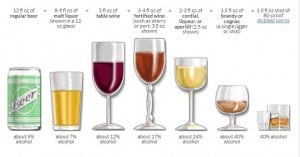
    A: No. One 12-ounce beer has about the same amount of alcohol as one 5-ounce glass of wine or 1.5-ounce shot of liquor.

    In fact, one beer may be your limit for the night, if you’re a man…and half a beer may be all you need if you’re a woman. It is the amount of alcohol consumed that affects a person most, not the type of alcoholic drink.

    But beer is a part of American culture. It can be hard to ignore the billboards and advertising around beer. There are drinking games based on beer, sporting events usually always have beer available, and beer is a part of post-work get together. Plus, the trend for microbrewed, craft beers is on the rise. However, even people who drink during social activities or who only drink craft beer can develop an alcohol use disorder.

    So, how do you know if you’re addicted to beer, or not?

    Signs of a problem may include continuing to drink when everyone else has stopped or feeling the need to drink during uncomfortable or boring situations. Basically, a drinking problem causes disruption in your life. So, if you’re facing beer addiction you may have difficulty making it to work on time, keeping up with schoolwork, or recovering from drinking the next day. To get help for a beer addiction now, please send us a message or give us a call.

    Wine

    Wine is made from fermented grapes. It is mostly sold as white wine or red wine with a variety of flavor profiles based on the type of grape used. For example, popular white wines include Sauvignon Blanc, Chardonnay, Pinot Grigio, and Riesling. Popular red wines include Cabernet Sauvignon, Merlot, Pinot Noir and Syrah / Shiraz.

    The percentage of alcohol in wine can vary widely; therefore, read the labels and adjust accordingly. When compared to beer, wine has a more concentrated amount of alcohol. Still, an average 5 oz. glass of wine is equivalent in alcohol content to 12 oz. of beer. An overpoured glass of wine, however, could contain much more alcohol than a standard drink.

    Wine is often consumed with meals. It has a status as a “classy” drink that can make it harder to spot a problem. Drinking wine may be a problem for you if any of these things are true:

    • Drinking wine causes trouble with your relationships, school, or work.
    • You can’t control how much wine you drink.
    • You’ve tried quitting drinking but cannot.
    • You feel anxious, irritable, or stressed when you aren’t drinking wine.

    If you or someone you care about has been drinking wine more frequently than intended or using it to combat anxious or depressive feelings, there may be a deeper issue at play. The earlier you get help for a wine addiction, the better! Wine problems are medical in nature and can be treated professionally.

    Liquor

    “Liquor” is the term used for hard alcoholic drinks or spirits like tequila, vodka, gin, rum and whiskey. Liquor has a much higher volume of alcohol than beer or wine: approximately 1.5 ounces of distilled spirits contain about 40% alcohol. Additionally, the type of spirit, recipe, and size of serving glass can impact the quantity of hard liquor in the drink. A mixed drink can contain from one to three or more standard drinks.

    Liquor can impact and speed up the development of a drinking problem. This is due to the way we metabolize alcohol. The Indian Health Service explains it like this…when a person drinks an alcoholic beverage, about 20% of the alcohol is absorbed in the stomach and about 80% is absorbed in the small intestine. The rate the alcohol is absorbed depends upon a few factors:

    1. The higher the concentration of alcohol, the faster the absorption.
    2. Carbonated drinks tend to speed up absorption of alcohol.
    3. Whether the stomach is full or empty. Food can slow down alcohol absorption.

    Basically, increased absorption of alcohol into the bloodstream can cause quicker intoxication. It’s like comparing oral vs. injection routes of drug administration. The quicker a drug hits your bloodstream and crosses the blood-brain barrier, the more addictive. Plus, the lower liquid content of shots make them easier to consume, leading to a higher risk of alcoholism.

    Regardless of the type of liquor consumed, alcohol of any kind possesses serious addiction potential. But you can get help for a liquor addiction now. Continue reading for more ideas.

    Binge Drinking

    Drinking too much at once is called “binge drinking”. As noted by the CDC, it is the most common way people drink too much in the U.S. But what does it mean to binge drink?

    The National Institute on Alcohol Abuse and Alcoholism defines binge drinking as a pattern of drinking that brings a person’s blood alcohol concentration (BAC) to 0.08 grams percent or above. Guidelines follow.

    Men: You binge drink when you consume 5 or more drinks on a single occasion and usually occurs within about 2 hours.
    Women: You binge drink when you consume 4 or more drinks on a single occasion and usually occurs within about 2 hours.

    While most people who binge drink are not alcohol dependent, binge drinking is the most common, costly, and deadly pattern of drinking too much. It causes injury and serious risk to health. It occurs frequently, with one in six adults binging about four times a month. And in many cases, prolonged binge drinking can develop into alcoholism.

    Mixing Alcohol with Drugs

    Because drinking is easily accessible, people often mix alcohol with other drugs. However, alcohol is both a central nervous depressant AND a stimulant… thereby posing a serious risk to your health when you mix it. For example, when mixed with benzodiazepines, opiates, or Rx painkillers, alcohol can trigger overdose effects. Alcohol on its own can be dangerous, but combining it with other substances can quickly prove lethal.

    When It Becomes Addiction

    Addiction occurs somewhere in a person’s drinking history. It can happen fast, within the span of a few months. Or, addiction can occur over the course of years. So when do you know you’ve crossed the line and become addicted to alcohol?

    Alcoholism (a.k.a. alcohol addiction) is marked by a craving for alcohol. This craving occurs after the first drink and compels you to drink more. Craving also occurs when you’re NOT drinking; it can drive you back to alcohol. People who are addicted also are unable to stop drinking, especially in the face of personal or social harm.

    Signs of an alcohol addiction include:

    • Alcohol dependence.
    • An increased tolerance (needing to drink more to feel drunk).
    • Frequently drinking more than intended.
    • Spending time getting alcohol, drinking it, or recovering from its effects.
    • Wanting to stop drinking but being unable to.

    High-Functioning Alcoholism

    Not all alcoholics are bottom of the bottle drinkers.

    In the early 2000’s researchers officially recognized a subset of drinkers called “high-functioning” alcoholics. Study author Howard B. Moss, M.D., NIAAA Associate Director for Clinical and Translational Research said, “We find that young adults comprise the largest group of alcoholics in this country, and nearly 20 percent of alcoholics are highly functional and well-educated with good incomes.”

    The problem with high-functioning alcoholism is that it can go undiagnosed. As people are able to keep their jobs, and experience relatively few harms…they often do not seek help. If you think you might have a drinking problem, ask for help. Here are some suggestions that we have for you:

    • Ask your friends and loved ones to support you.
    • Talk to a doctor or nurse if you are having a hard time cutting down on your drinking.
    • If one type of treatment doesn’t work for you, you can try another. Don’t give up!
    • Call 1-800-662-HELP (1-800-662-4357) for information about treatment.
    • To explore treatment options, visit the NIAAA Treatment Navigator.

    Statistics

    Alcohol use is a leading risk factor for disease burden worldwide, accounting for nearly 10% of global deaths among populations aged 15–49 years, according to the 2016 Global Burden of Diseases report. This 2011 study breaks down the most common disease categories that are entirely or partly caused by alcohol consumption, which can include:

    • Cancer
    • Cardiovascular disease
    • Diabetes
    • Infectious diseases
    • Liver and pancreas disease
    • Neuropsychiatric diseases (including alcohol use disorders)
    • Unintentional and intentional injury

    Why wait for things to get worse?

    Reach out and get help today.

    When to Get Help

    Getting help for a drinking problem early is best!

    So, if you think that you have a problem with alcohol, it’s best to assume that you do.

    Then, reach out for help.

    You are not alone!

    Many people who struggle with alcohol addiction find it difficult or impossible to quit on their own. There are many programs designed to get you the help you need. Or, you can increase your chance of a full recovery with the help of an alcohol rehab center. Get in touch with one today….and increase your chances for success and an alcohol-free life!

    View the original article at

  • Binge Drinking

    Binge Drinking

    ARTICLE SUMMARY: Drinking too much alcohol in one drinking session is known as “binge drinking”.  But bingeing is not same as alcoholism. How? We review here.

    ESTIMATED READING TIME: Under 10 minutes.

    TABLE OF CONTENTS:

    Binge Drinking Definition & Levels

    Binge drinking is known as drinking too much alcohol in a single setting. How much drinking qualifies for a “binge”?

    The amount of alcohol consumed at one drinking session that qualifies as a binge drinking is significantly more than a person would normally drink. More specifically, the National Institute on Alcohol Abuse and Alcoholism (NIAAA) defines binge drinking as a pattern of drinking that brings blood alcohol concentration (BAC) levels to 0.08 g/dl or above. This usually happens after:

    • 4 drinks for females
    • 5 drinks for males

    …in a timeframe of 2 hours.

    To give more context, the Substance Abuse and Mental Health Services Administration (SAMHSA) considers binge drinking as 4 or more alcoholic beverages for women on one occasion or 5 of more alcoholic beverages for men (at the same time or within few hours) on at least 1 day in a month.

    Finally, binge drinking is not yet classified as disorder by the American Psychiatric Association (APA). As of now, this type of drinking refers to a behavioral pattern that can be a risk factor for developing alcohol dependence.

    Is Binge Drinking the Same as Alcoholism?

    No. Binge drinking is not same as alcoholism. However, prolonged binge drinking may lead to alcoholism.

    In fact, most people who binge drink are not dependent on alcohol. Still, binge drinking is considered to be the most costly and deadly pattern of consuming alcohol. Excessive alcohol use such as binge drinking can put your health at serious risk. Binge drinking is connected with many health conditions including:

    • Becoming alcohol dependent.
    • Demonstrating violent/aggressive behavior.
    • Developing cancer of the mouth, throat, esophagus, liver, colon, or breast.
    • Developing chronic diseases like high blood pressure, heart disease, or liver disease.
    • Having memory or learning problems.
    • Risky sexual behavior.
    • Unintentional injuries like falls, burns, car crashes, or alcohol poisoning.

    Why People Binge Drink

    Reasons for drinking vary…and can be quite different. Some people start bingeing to as stress-relief. Some binge drink out of curiosity, while others drink excessively because they are already having alcohol problems. Moreover, reasons for binge drinking when you are in college are different than the reasons for drinking when you are older.

    Some of the more common reasons for drinking too much at once include:

    Boost in self-confidence. People who are shy or introverts may find it difficult to communicate with other. Alcohol has the ability to help you feel disinhibited, and thereby, can boost your self-confidence. So, when you are under the influence you might easily mix with others.

    Changing your image. Men might binge drink to display dominance, strength, or a macho image. Moreover, some people claim that they feel sexy when they drink. This goes for both genders.

    Curiosity. One of the common reason for binge drinking is wanting to know how and what it ‘feels’ like. This mostly happens after someone brags about his/her wild night out.

    Forgetting problems. Most studies and surveys that investigate the reasons for drinking list this reason as in the Top 10. Letting go of stress, and forgetting your problems through binge drinking, may be okay for one night. But, if you start using binge drinking as a coping mechanism, and not dealing with the underlying issues, you may become dependent on alcohol.

    Fun. Most people want to forget their problems, let go of their thoughts, and just enjoy. Binge drinking is a common event on parties. Also, drinking games such as Beer Pong, Pennies, and Never Have I Ever are based on binge drinking and having fun.

    Peer pressure. Acceptance issues are most common among students in high school and college. If binge drinking can help you ‘fit in’, then so be it… this is the thought that can go through our minds. Unfortunately, this thought pattern can result in health, school, and work problems.

    Rebellion. Rebellion is a psycho-social developmental phase that most teens and college students go through. They use binge drinking as a way to rebel against their parents in order to break the rules, and show independence.

    Socialize. Some friends bond with each other because of their drinking habits. Sometimes, if you want to become a part of a certain group of people, the ‘only’ way to get in is through drinking. No one wants to be the cast out, so many individuals have decided to raise their glass than to be left out.

    The list of reasons why people binge drink is not limited to this… but scientists and experts also add that the family history of alcoholism – and genetics – plays a huge part in why some choose this pattern of drinking.

    One in four Americans aged 12 or older are binge drinkers. And 4 out of 5 binge drinks are consumed by men.

    How Many People Binge Drink?

    About 25% of Americans binge drink.

    According to the 2016 National Survey on Drug Use and Health, a number of 65.3 million people aged 12 or older were binge drinkers in the past month. This number corresponds to about 1 in 4 people.

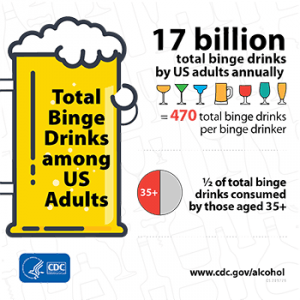
    Moreover,  the Annual Total Binge Drinks Consumed by U.S Adults of 2015 announced that 1 in 6 adult Americans binge drinks about 4 times in a months, consuming about 7 drinks per drinking session. This makes a grand total of of 17.5 billion total binge drinks in a year, or 467 drinks per binge consumer.

    Moreover, the same analysis reports that binge drinking is popular among younger adults aged 18 -34 years, but more than a half of the total binge drinks are consumed by people aged 35 or older. Additionally, the Centers for Disease Control and Prevention reports that about 4 in 5 binge drinks are consumed by men,. The U.S. states with the most binge users are Arkansas, Mississippi, Kentucky, and Hawaii.

    Furthermore, Alcohol and Public Health: Alcohol-Related Disease Impact (ARDI) stated that during 2006 to 2010, excessive alcohol use was responsible for about 88,000 deaths. More than half of these deaths happen due to binge drinking.

    Excessive alcohol use was responsible for around 88,000 deaths between 2006-2010.

    Binge Drinking Among College Students

    Drinking among college students has become a tradition that most of students see as a rite of passage into the higher education experience. However, most enter into college life with well-established drinking habits that started in their teen years, usually around the age of 13. Then, binge drinking peaks in young adolescents aged 18 to 22, and slowly decreases.

    So, how many college students are current binge drinkers?

    According to SAMHSA’s NSDUH survey of 2014 , about 60% of college students drank alcohol in the past month, while 2 of 3 students engage din binge drinking.

    But binge drinking may cause serious problems to the health of these young lives…

    A survey published in the Journal of Studies on Alcohol and Drugs reported that about 1,825 college students between the ages of 18 and 24 die from alcohol-related unintentional injuries, including motor-vehicle crashes. Moreover, National Institute on Alcohol Abuse and Alcoholism reported that about 696,000 college students are assaulted by another student who has been drinking, while about 97,000 students report experiencing alcohol-related sexual assault or date rape.

    Additionally, this study reports that 1 in 4 college students had academic problems (missing classes, poor exams and papers, low grades, and/or fall behind in class) due to alcohol use. Also, binge college drinkers who had at least 3 drinking sessions per week were 6 times more likely to perform poorly on a exam or a project, and 5 times more to miss a class than students who drank but never binged.

    Tragically, NIAAA  reported that 20% of college students meet the criteria for alcohol use disorder.­

    It’s better to drink in moderation,than to binge drink.

    Don’t start to binge drink just to fit on your college campus, choose what’s best for you!

    For more information, visit College Drinking Prevention.

    When Binge Drinking Is a Problem

    Binge drinking may become a problem when you start bingeing too often and/or drinking too much.

    But it can be hard to tell the difference or to spot a real drinking problem. For example, some people may drink a lot in one session, but don’t have a drinking problem. The main point is that you have a drinking problem when drinking affects your life and causes negative consequences.

    Some main signs of having a drinking problem include when you:

    • Black out or have trouble remembering what you did while drinking.
    • Cannot cut back on drinking.
    • Continue to drink despite negative effects on your health.
    • Drink more than you intend.
    • Engage in dangerous activities such as violence or driving drunk.
    • Experience a strong urge for drinking.
    • Experience withdrawal symptoms when you quit/cut down.
    • Have an increased tolerance for alcohol.
    • Have tried but cannot quit drinking on your own.
    • Have problems at work/home/school due to drinking.
    • Have problems with family and friends because of your drinking.
    • Lose interest in hobbies and activities because you want to drink.

    If you have some of these signs, you may need to reach out for help. DON’T WAIT!

    Drinking too often + Drinking too much = RISKY DRINKING!

    Get Help for a Drinking Problem

    Do you think that you may have a drinking problem? Get help as soon as possible!

    Don’t be afraid, just reach out…

    It can be hard to quit alcohol on your own, but don’t lose hope… today’s treatment programs customize the experience to match your needs.

    So, where should you look for help?

    1. Find a therapist.

    Talk therapy is one of the most efficient for treating alcohol problems. You can learn how to find a therapist to talk through the issue by seeing this Psychology Today article here.

    2. Find an addiction specialist.

    Doctors who have specialize in addiction medicine can provide addiction diagnosis, prevention, intervention, screening, and treatment. Find a specialist certified by the American Board of Addiction here.

    3. Find a psychotherapist.

    You can ask for help from a psychotherapist for your drinking problems. This includes one-on-one therapy, family therapy, or couples therapy.  You can find a therapist via the American Psychological Association’s online therapist finder here.

    4. Ask help from a psychiatrist. 

    Psychiatrist are proven doctors that can help you deal with alcohol dependence. Find a qualified psychiatrist on the American Psychiatric Association (APA) website.

     5. Call our helpline. 

    If you have a hard time dealing with excessive alcohol use, call the number you see on our website. Our addiction recovery specialists can talk to you about your drinking problems, and can help you find a way to deal with it.

    Reference Sources: SAMHSA: Alcohol
    NIH: What is a standard drink? 
    NCBI: Undergraduate drinking and academic performance: a prospective investigation with objective measures. 
    CDC: Binge Drinking 
    NCBI: Annual Total Binge Drinks Consumed by U.S. Adults, 2015 
    CDC: Alcohol and Public Health: Data and Maps 
    NCBI: Defining “Binge” Drinking as Five Drinks per Occasion or Drinking to a 0.08% BAC: Which is More Sensitive to Risk? 
    NCBI: Binge Drinking: A Confused Concept and its Contemporary History 

    View the original article at

  • Drunk Driving

    Drunk Driving

    ARTICLE OVERVIEW: This article provides a brief review of the consequences you face if you get arrested for drunk driving. 

    TABLE OF CONTENTS:

    What’s the Drunk Driving Limit?

    Alcohol is a depressant. It works by slowing down the activity of the central nervous system. When you drink, information and activity across the brain is delayed. Plus, alcohol impairs cognitive and psychomotor skills. For these reasons, drinking and driving increases the risk of:

    • Car accidents
    • Injuries
    • Vehicular deaths

    So, what’s the official limit for drink driving?

    According to the National Highway Traffic Safety Administration (NHTSA), it is illegal to drive with blood alcohol concentration (BAC) of 0.8 g/dL or higher in all 50 states, the District of Columbia, and Puerto Rico. This means that your BAC needs to be lower than 0.8 g/dL if you drive. If you’re over that limit, you’re considered to be “alcohol-impaired”.

    Alcohol Impairment >= 0.8 g/dL BAC

    However, the current limit is up for debate. There is evidence that driving impairment may occur at lower BACs. This article published in the British Medical Journal  challenges us to accept even this alcohol limit for drunk driving. The authors think that 0/8 g/dL is high, and it needs to be much lower.

    Also, there is a zero tolerance for alcohol levels in drivers who are minors, under the age of 21. You can find more info about the state policies on underage drinking and driving here. Zero tolerance is also required for operators of a commercial motor vehicle, school bus drivers, and child care vehicle drivers.

    Levels of alcohol impairment are determined by a driver’s BAC at the time of arrest.

    DUI vs. DWI

    Drunk driving is known as both DUI or DWI. Both acronyms describe the illegal act of operating a motor vehicle while alcohol and/or drugs impaired. The main difference lies in the meaning of the letters:

    • DUI= Driving Under the Influence
    • DWI= Driving While Intoxicated

    NOTE: In some states, the term ‘Driving While Intoxicated’ is referred to as “Operating While Intoxicated,” or OWI.

    These terms may sound identical, but some states classify these two conditions as separate crimes. If you live in a state that classifies them separately, a DUI is considered  a lesser level of impairment, and is charge more leniently than a DWI. In other jurisdictions, DUI is only used when the driver is alcohol-impaired, while DWI is only used when the driver is under the influence of drugs. Other states have created a zero tolerance policy which means that there is no distinction between DUI and DWI. These states mandate that any BAC over the legal limit is a crime.

    Drunk Driving Dangers

    Driving after drinking can cause direct harm and can end in death. Getting behind the wheel after few drinks can be dangerous not only to you, but also to the other drivers and pedestrians.

    Approximately one-third of all traffic crash fatalities in the U.S. involve a drunk driver.

    Roughly, over 10,000 people die every year due to driving under influence. But death is not the only danger that you are facing when DUI. Some legal consequences may include:

    … and more.

    Drunk Driving Accident Statistics

    Statistically speaking, young men aged 21 to 35 are the critical target group for drunk driving. They are most likely to drive drunk. The Centers for Disease Control and Prevention reported that in 2010, 4 million U.S. adults reported that had at least one episode of drunk driving. 81% were men, and 32% were young men aged between 21 to 34.

    In 2016, more than 1 million drivers were arrested for DUI of alcohol or narcotics. To confirm these numbers, the Federal Bureau of Investigation found that in 2016, 1,017,808 drivers were arrested for driving under the influence of alcohol or drugs. However, this is only 1% of the 111 million self-reported episodes of DUI among U.S. adults each year.


    Finally, the financial impact is devastating: impaired driving crashes costs our American society $44 billion annually.

    An estimated 28% of all traffic fatalities occur due to drunk driving.

    Drunk Driving Death & Fatalities Statistics

    The National Highway Traffic Safety Administration reported just over 10k fatalities in motor vehicle crashes involving drivers with BACs of 0.8 d/dL or higher in 2016. To put it another way, 28% of all traffic fatalities in 2016 were due to alcohol impairment.

    1 person dies every 50 minutes due to alcohol-impaired driving.

    The top 5 states with the highest number of drunk driving fatalities in 2016 included:

    • Texas 3,776
    • California 3,623
    • Florida 3,174
    • Georgia 1,554
    • North Carolina 1,450

    Check out all state statistics in this NHTSA pamphlet on Traffic Safety Facts.

    Moreover, this NHTSA report looks into the innocent victims of drunk driving accidents. In 2016, a total of 1,233 children were killed in motor vehicle crashes, and of these fatalities, 214 children died in alcohol-impaired driving crashes. 45% of the time, the child’s own driver was under the influence of alcohol.

    Also, CDC reports that from all motor vehicles deaths:

    • 1.3% were children aged 0 to 20 who died due to drunk driving.
    • 6.7% were young adults aged 21 to 35 who died due to drunk driving.
    • 3.1% were adults aged 35+ who died due to drunk driving.

    Men are more likely than women to be driving in fatal accidents. In 2016, 21% of males were drunk in these crashes, while only 14% were females.

    Find state-specific fact sheets made by CDC here.

    About one in three traffic deaths in the United States involves a drunk driver.

    You know what?

    This cause of these deaths is preventable.

    Indentify a designated driver or plan a safe way home when you plan to drink.

    Drunk Driving Laws

    Laws about drunk driving are set up differently by state. This is why penalties and sentences vary in every state. Commonly, laws involve a combination of the following:

    • Enormous fines
    • Jail time
    • Loss of your driving license
    • Mandated treatment

    For instance, in North Carolina, there are five levels of DWI misdemeanor:

    • Level I being the most serious with a fine up to $4,000 and a minimum jail sentence of 30 days to a maximum of two years.
    • Level V being the least serious with a fine up to $200 and a minimum jail sentence of 24 hours and a maximum of 60 days.

    Another example is California with fours days in jail for the first offense, 90 days for a second offense, and 120 days for a third offense. Texas mandates three days of jail for the first offense, 30 days for the second, and two years for the third.

    Moreover, vehicular assault or vehicular manslaughter brings severe outcomes in most of the states. For example, a person convicted of vehicular manslaughter may face anywhere from zero to 10 years in prison in California. This state recognizes two different charges: Gross Vehicular Manslaughter While Intoxicated (facing 4-10 years in state prison), and Vehicular Manslaughter While Intoxicated (up to one year in the county jail or about 16 months in the state prison).

    Additionally, different states are more or less aggressive in their DUI and DWI arrest quota. A collection of 2014 DUI arrest research reported the following results after one year of tracking:

    • California had 214,828 arrests
    • Florida had 61,852 arrests
    • New York had 25,169 arrests
    • Texas had 90,066 arrests.

    Consequences of Driving Drunk

    What’s the price for having few drinks on a night out and then driving?

    If you get arrested, some legal consequences may include:

    • Going to jail.
    • Going into court-ordered alcoholism treatment.
    • Losing the custody of your children.
    • Losing your driving license.
    • Losing your job.
    • Paying a fine.

    Moreover, if your DUI arrest is combined with a manslaughter conviction, some consequences include the loss of:

    • Custody of children, and parental rights.
    • Employment in certain fields.
    • Government financial aid for college.
    • Jury rights.
    • Professional practice licensing
    • Public housing benefits.
    • Traveling abroad rights.
    • Voting rights.

    Drunk Driving Help and Treatment

    During a DUI court hearing, the defendant will  usually be required to be evaluated by a qualified court-appointed counselor for an alcohol use disorder assessment. The job of the counselor is to review the court’s records, to conduct the screening process, and to appoint the appropriate alcohol treatment options.

    The counselor will take into account:

    • BAC at the time of arrest.
    • History of substance use treatment.
    • The alcohol-impaired offenses.
    • Possibility of other drug use.
    • Possibility of presence of any other mental health disorders.

    A treatment referral will be made of one or a combination of the following:

    1. Medical detox.
    2. Outpatient rehab program.
    3. Inpatient rehab program.
    4. Support groups.

    Once the counselor’s observation is completed, the judge can refer the convicted driver to a host of many rehab programs, starting from a few sessions to structured programs that can last several weeks or months. In some severe cases, the court can order the driver to an inpatient program, while in other cases, the court may appoint only local community services, such as Alcoholic Anonymous meetings. Also, the judge may put the driver on probation.

    Court-ordered alcohol rehab is a concern for its effectiveness. Is rehab effective when it isn’t voluntary? Many studies have well established that recovery and willingness to change must come from within the individual. However, the National Institute on Drug Abuse supports the fact that court-appointed rehab can outcome with as positive results as those who enrolled into rehab on their own. Also, the persons who enrolled into rehab under legal pressure have higher rates of attendance, and stay in rehab for longer period.

    Your Questions

    Did we answer all the questions you have about a DUI or DWI? If not, feel free to post your specific question in the comments section at the end. We will try to answer to all legitimate inquiries personally and promptly.

    Reference Sources: NCBI: The Effectiveness of Drinking and Driving Policies for Different Alcohol-Related Fatalities: A Quantile Regression Analysis 
    CDC: Sobering Facts: Drunk Driving State Fact Sheets
    NHTSA: Drunk Driving
    CDS: Impaired Driving: Get the facts
    US Department of Transportation: Drunk Driving By the Numbers 

    View the original article at

  • The Genetics of Alcoholism

    The Genetics of Alcoholism

    ARTICLE OVERVIEW: Scientists still have not identified the combination of genes thought to increase risk of alcohol problems. In this article, we outline the possible risk factors and share some tips on how to protect yourself if you are genetically predisposed to becoming an alcoholic. Then, we welcome your questions at the end.

    ESTIMATED READING TIME: 10 minutes.

    TABLE OF CONTENTS:

    Alcohol Addiction and Genetics

    Alcohol is the #1 drug in the world. It’s consumed everywhere, from places of work to places of worship. But what can be causing alcoholism? And do your genes have something to do with it?

    Maybe.

    Genes are passed on by our parents, and some of those genes contain predisposition towards alcohol use disorder (AUD) and alcoholism. But just how much those genes influence us is still up for debate. According to the study Genetics and Alcoholism alcoholism is a complex genetic disease, with variations in a large number of genes affecting risk. So, what puts some people more at risk than others?

    Most of us can see that alcohol use disorder run in some families. For example, if you have a drinking problem and create a Family Map, you can probably identify multiple people across many generations that also struggle with alcohol. Further, among people who drink too much, those who are genetically predisposed have a higher risk of developing alcohol use disorder.

    However, even though people can have ‘the alcoholic gene’, it doesn’t mean that they will become alcohol dependent. Social and environmental factors play a huge role in becoming an addict.

    In sum, it is true that our genetic structure determines human traits such as physical characteristics (eye and hair color) and behavioral characteristics, including aggression and depression. But the truth is that there are many factors that create the perfect environment for alcohol problems. And our genes DO NOT INFLUENCE US AS MUCH AS WE THINK.

    Main Genetic Studies

    It ihas been established that genetics is responsible for alcohol use disorder about 50% of the time. However, genetic expression is more complex field then we think. How genetic material can influence the ‘final product’ of one person is still unknown. So, what landmark studies back this up?

    There are numerous studies that work on identifying the genes that can lead to alcoholism. The DRD2 gene was the first gene that showed promise of revealing the connection of alcoholism and genetics. Also, researchers at  the University of California in San Francisco UCSF are studying the fruit flies to find the genetic traits of alcoholism claiming that drunken fruit flies behave in the same way humans do when they drink.

    According to this study funded by the National Institute on Alcohol Abuse and Alcoholism (NIAAA), Genetic Research: Who Is At Risk for Alcoholism? researchers concluded that many twin, adoption, and family studies conclusively demonstrated that genetic factors account for 50 to 60 percent of the variance in risk for developing alcoholism.

    And to move the field forward, the NIAAA started the Collaborative Studies on Genetics of Alcoholism (COGA), a large–scale family study designed to identify genes that affect the risk for alcoholism and alcohol–related characteristics and behavior. COGA holds data on more than 2,255 extended families and more than 17,702 individuals that struggle with alcoholism.

    If you like to learn more about the main studies that contributed to this topic check out this collection of studies: A Brief History Of Research on the Genetics of Alcohol and Other Drug Use Disorders. 

    Certain combinations of genes that hold alcohol dependency material may increase your risk of developing alcoholism. 

    The “Alcoholic Gene”

    Do you believe that only one gene is responsible for inheriting alcoholism?

    You are wrong!

    There are hundreds of genes in one’s DNA that can increase the risk of developing an alcohol use disorder. Each gene plays a different role in your personal traits, and certain combinations of these genes may hold the key of alcoholism. The study Genes Contributed to The Development of Alcoholism claims that the genes most strongly implicated are those encoding the key enzymes of alcohol metabolism: ADHs and ALDHs.

    Moreover, COGA lists several genes that are connected to the development of alcoholism. These can include:

    DNA Regions with Susceptibility Genes. Genetic analysis has provided evidence that regions on 3 chromosomes contain genes that increase the risk for alcohol use disorder. Regions on chromosomes 1 and 7 have the strongest evidence, while regions on chromosome 2 have more modest evidence.

    DNA Regions with Protective Genes. In cases where one sibling is dealing with alcoholism while the other is nonalcoholic, there is an evidence of a protective gene found in the region of chromosome 4. This means that variants of a gene or genes in this region may reduce risk of becoming alcohol dependent.

    DNA Regions Related to Symptoms of Alcoholism. Signs and symptoms that are used to diagnose alcohol use disorder are very diverse, and range from biological symptoms to social symptoms. However, each individual who deals with AUD holds a unique set of symptoms. Therefore, a diagnose for AUD does not have a strict uniform phenotype. This fact complicates genetic analyses, but COGA researchers have created more defined phenotypes that are focused on the level of severity of alcoholism. These data provide evidence of DNA regions on chromosome 16 associated with higher risk for more severe drinking problems.

    DNA Regions Associated with Co–Occurring Disorders. Many people diagnosed with depression also develop alcoholism. Depression and alcoholism are linked to a gene/or genes found in the region of chromosome 1.

    DNA Regions Linked with Electrophysiological Measures. Reduced electrophysiological variables, such as EEGs (that measure brain activity) and ERPs (are brain waves elicited as a response to specific stimuli) seem to be a heritable phenotypes found in many cases of alcohol use disorder.

    Candidate Genes. Some genes encode components of various brain chemicals such as dopamine and serotonin that allow communication among cells. If some of these routes of communications are disturbed, the person may be prone to using substances.

    You can find more information on genes that put you at risk of becoming alcohol dependent here:

    Main Findings

    Just to clarify, there is still no clear evidence of what genes you need to have to be prone to becoming alcohol dependent. Specialists create theories that need to be more thoroughlt tested and elaborated upon. Additional work is required.

    All theories and studies into the genetics of alcoholism share a common finding: alcohol changes in an addict’s brain activity.

    Many substances affect the ‘reward circuit’ of the brain by releasing larger amounts of dopamine. This circuit regulates the ability to feel pleasure, and encourages a person to repeat the action that cause pleasure. If a person repeats the action over and over again, the brain starts to change, adopting the action as a normal and losing the ability to resist intense impulses (cravings).

    And it is this change in brain function that makes it difficult to quit drinking. Here’s an explanation from the National Institute on Drug Abuse (NIDA) about how the brain responds to drugs like alcohol.

    Genetics are only 50% responsible for the development of an alcohol use disorder.

    Environment vs. DNA

    Only 10% of people who consume alcoholwill go one to develop physical or mental dependency on alcohol.

    So, how do genes affects alcohol addiction?

    Genetics only make up half of the whole alcohol problem. Environment plays a huge role in becoming dependent. For instance, some people cannot deal with stress, and are unable to cope with hard relationships or work. So, as a coping mechanism they choose drinking. Also, people who are exposed to substances for longer time, are more likelyto become dependent. Moreover, a traumatic event may be the cause for one individual to turn to alcohol.

    Some of the numerous environmental factors can include:

    • Attitudes and beliefs.
    • Bad parenting.
    • Culture background.
    • Financial status.
    • Life qualities.
    • Physical abuse.
    • Peer pressure.
    • School factors.
    • Sexual abuse.

    … and many more.

    The SAMHSA’s National Survey on Drug Use and Health report of 2016 estimated that 15.1 million people aged 12 or older had alcohol use disorder in the previous year. This means that 1 in 18 Americans had drinking problems. But, can we blame genetics for all these cases?

    Of course not.

    If you are genetically prone to developing alcohol use disorder, it doesn’t necessarily mean that you will become an alcoholic. As you begin to understand the genetics of addiction … you need to know that alcoholism is not an inevitability. Having genetic predisposition to alcohol problems simply means that you are at higher risk of a problem. And while drinking begins as a choice, many studies suggest that alcoholism is largely connected with an individual’s control.

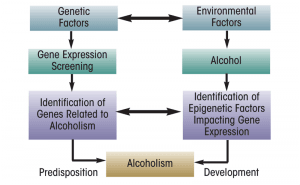
    So, the choice to raise a glass is yours. You make the decision to try alcohol, or not. Even though you may hold a high genetic risk of AUD, most people are first driven to try alcohol by a nonhereditary factor, which is usually environmental in nature. Here’s a diagram of the relationship between genes and environment that might provide you with a visual aid to understand the interplay:

    Alcoholism Genetic Risk Factors

    Many factors play a role in developing a drinking problem. These factors interact differently for different people. So, the same factors might lead to alcoholism in some, and not in others. The risk factors are divided into two categories:

    External factors:

    • Age
    • Cultural norms
    • Education
    • Employment status
    • Environment
    • Family
    • Social norms
    • Religion

    Internal factors:

    • Drinking history
    • Genetics
    • Personality
    • Personal choice
    • Psychological conditions

    For example, findings published by the NIAAA show that children of alcoholics are about four times more likely to develop alcoholism than the general population. These children are also at high risk for many other behavioral and emotional problems. Genes are not the only factor in these cases, how alcoholic parents act and treat their children play a huge role in developing drinking problems. Some aspects that may increase the risk for alcoholism include:

    • An alcoholic parent is depressed or has other psychological issues.
    • Both parents drink alcohol and/or use other substances.
    • Conflicts because of alcohol use lead to aggression and violence in the family.
    • Parent’s alcohol use is severe.

    To repeat, a combination of these risk factors may be the cause of alcohol use disorder for some, but not for others. This fact makes it difficult to predict who might become alcoholic, and who will not.

    Avoiding a Problem

    So, how can you protect yourself from a drinking problem? How can you avoid alcoholism if it runs in your family? The first thing you need to do in order to protect yourself is to learn your family history regarding alcoholism. Make a Family Map with an addiction counselor or other behavioral health professional…or you can learn how to make a family map here.

    If you are among millions of people who have a parent, grandparent, or other close relative with drinking problems, there is a way to protect yourself by lowering these risks:

    Avoid underage drinking. Underage drinking is illegal at the first place. Second, studies show that the risk of developing alcohol use disorder is higher among people who started drinking at early age.

    Drink in moderation. Adults who choose to drink should drink in moderation. Not only because of the risk of alcoholism, but also because alcohol may cause many health problems.

    Consult with a health care professional. Never hesitate to ask for help! Discuss your issues with professionals. They can help you find a suitable treatment or groups that can help you manage your alcohol problems.

    The good news? Many children of alcoholics do not develop drinking problems. Awareness and action are key!

    What’s Your Risk of Alcoholism?

    Do you think that you may be at risk of developing alcohol use disorder? How can you be sure? The National Institute on Alcohol Abuse and Alcoholism outlines general guidelines.

    For women, problem drinking is:

    • Drinking more that 1 standard drink daily.
    • Drinking more than 7 drinks weekly.
    • Drinking more than 3 drinks on any single day.

    For men, problem drinking is::

    • Drinking more than 2 drinks daily.
    • Drinking more than 14 drinks weekly.
    • Drinking more than 4 drinks on any single day.

    Moreover, there are also two ‘at-risk’ drinking patterns that can lead to alcohol use disorders:

    1. Binge drinking – It is a drinking pattern that levels up the blood alcohol concentration (BAC) to 0.8 g/dl or above, which is usually happening after 4 drinks for women, and 5 drinks for men in a one drinking session of about 2 hours.

    2. Heavy drinking is a binge drinking on 5 or more days in one month period.

    Did you find yourself in some of these patterns?

    Don’t wait until it’s too late, reach out for help!

    Top 10 Alcohol and Genetics Facts

    If drinking problems run in you family, don’t worry… It doesn’t mean that you will become addicted to alcohol. After all, even though you may have the ‘alcoholic gene’, alcoholism does not need to be your destiny. You are just at risk.

    Below is a list of 10 facts about alcohol and genetics:

    1. Genetics is about 50% responsible for developing alcohol use disorder.
    2. One gene is not responsible for causing alcohol problems. A certain combination of hundreds of genes in individual’s DNA can increase the risk of developing alcoholism.
    3. Having the ‘alcohol gene’ doesn’t mean that you will become an alcoholic.
    4. Children with an alcoholic parent are four times more likely to develop alcohol use disorder.
    5. Only 10% of people who drink become alcoholics.
    6. Even though you may begenetically predisposed to alcoholism,your choice to try alcohol in the first place is usually triggered by envinronmental factors.
    7. A combination of external and internal factors may lead to drinking problems.
    8. Environmental factors play a huge role in developing alcoholism.
    9. Drinking excessively over a long period of time puts you at higher risk of a drinking problem, even if you are not genetically predisposed to alcohol use disorder.
    10. Scientists still haven’t identified which genes are responsible for increasing the risk of developing alcohol use disorder.

    Reference sourses: NIAAA: Genetics of Alcohol Use Disorder
    NIAAA: A Family History of Alcoholism
    NIAAA: Collaborative Studies on Genetics of Alcoholism – Study
    NCBI: Genetics and Alcoholism 
    NCBI: Genetic factors influencing alcohol dependence

    View the original article at

  • Top 10 Strongest Alcohols

    Top 10 Strongest Alcohols


    ARTICLE OVERVIEW: Alcohol acts as a depressant on the central nervous system and slows down brain function. Though all alcohol is potentially dangerous, it’s important to that understand some alcohol is more deadly than others. In this article, we’ve compiled a list of the strongest alcohols currently on the market. At the end of the article, we invite you to ask further questions.

    ESTIMATED READING TIME: Less than 10 minutes.

    Table of Contents:

    The general amount of alcohol contained within liquor is 40%.

    How Do We Measure the Strength of Alcohol?

    We measure the strength of an alcoholic drink based on its percentage of alcohol content. The general amount of alcohol contained within hard liquor is 40%.

    Since much of the alcohol mentioned on this Top 10 list is much stronger than what we normally drink, it’s helpful to have something to compare it to. The following are your most typical alcoholic beverages and the percentage of alcohol each contains:

    • Beer, 4% to 5% alcohol content
    • Wine, 12% alcohol content
    • Fruit liquors, 28% to 32% alcohol content
    • Gin, 35% to 40% alcohol content
    • Vodka, 35% to 46% alcohol content
    • Rum, 40% to 46% alcohol content
    • Whiskey, 55% to 60% alcohol content

    The National Institutes on Alcoholism and Alcohol Abuse have created this graphic to help visualize the difference.

    However,, the alcohol percentages listed above are the average. What we’re about to list below are the ten strongest alcohols in the world. It’s vital to remember that drinking this amount of alcohol is very dangerous towards your health and well-being. Especially when getting behind the wheel.

    Every kind of alcohol sold on the market must be labeled under the Federal Alcohol Administration (FFA) Act. These labels will usually tell you the percentage of alcohol within each drink. Or, the label will give the “proof count”. For example, you purchase a whiskey which advertises itself as 100-proof. This is the doubled percentage of the alcohol content. Therefore, the whiskey you purchased has 50% alcohol within it.

    Alcohol addiction is a very serious disease and shouldn’t be left untreated. If you or anyone you love is struggling with alcohol addiction, you need to seek help as soon as possible. The longer you wait, the more time alcohol can ruin your life. Furthermore, if you happen to find any of the following alcohols within your liquor cabinet, it’s highly suggested you get rid of them. Again, these are the strongest alcohols the world has to offer and, likewise, the most dangerous.

    #10 – Absinthe (up to 72% Alcohol)

    Up until 2007, Absinthe was banned in the United States. This is primarily due to prior associations with the alcohol inflicting criminal-like behavior in those who drank it. Think mafia or just plain gangsters. Absinthe has psychoactive properties which caused seizures, thought to be caused by the grand wormwood plant – the source of Absinthe – and its production of thujone, a chemical which afflicts sleeplessness, convulsions, and hallucinations. It can be a serious danger and a lethal drug-of-choice.

    #9 – Bacardi 151 (75.5% Alcohol)

    Typically, people who drink Bacardi 151 do so through a variety of mixed drinks, such as combining it with fruit juice. . It is considerably one of the strongest rums ever created.

    However, this brand of Bacardi has been discontinued. The reason it’s no longer available for purchase is that people too often ignored the warnings of the drink being highly flammable. Due to this lack of inspection, many ended up exposing the bottle to open flames and experienced burns. If you still have a bottle of this lying around, it’s important to understand the fire safety risks involved with this alcohol.

    #8 – Devil Springs Vodka (80% Alcohol)

    Another highly flammable alcoholic beverage is Devil Springs Vodka. Coming in at 15 times stronger than your average beer, it comes to no surprise that this drink has found a market for abuse. It is especially popular with people and cultures who prefer vodka compared to other alcoholic beverages.

    As we climb the alcohol content ladder, it’s vital to remember that the stronger the alcohol is, the more dangerous it becomes to your health and the more susceptible the user ends up in terms of abusing it.

    #7 – Balkan 176 Vodka (88% Alcohol)

    An alcoholic drink so strong, it requires 13 health warnings on the bottle. The strongest drink made in Scandinavian, Balkan 176 is distilled three times over and is considered to be absolutely tasteless. This is dangerous, as without any pungent taste most associate with alcohol, this can leave the drinker consuming more and more, not realizing the potential harm he/she’s putting him/herself into.

    In fact, there are numerous reports of people experiencing alcohol poisoning and death due from drinking too much strong liquor in a short period of time.

    #6 – Pincer Vodka (88.8% Alcohol)

    Being the strongest alcohol Scotland produces, it comes to no surprise Pincer Vodka has similar qualities as Balkan 176. However, one major appeal of Pincer is the fact that it has such a low calorie count. So much so, there are people out there who claim they don’t get hangovers as bad as your average liquor.

    There is an obvious danger in this. One of the many qualities of alcohol that turns a social drinker off is the fact that they have to handle a hangover the next morning. Considering the calorie count of alcohol and what it can do to one’s health, it’s understandable that a responsible adult only drinks on occasions. However, since Pincer doesn’t offer these negative alternatives, there’s lies a stronger chance for abuse.

    #5 – River Antoine Royale Grenadian Rum (90% Alcohol)

    There’s a certain quality to River Antoine Royale Grenadian Rum. That is, the people who make it distill over a long period of time through an old, traditional pot stilling method. In turn, this gives it a very prominent flavor not usually found in alcohol with such a high percentage count.

    #4 – Bruichladdich X4+1 Quadrupled Whiskey (92% Alcohol)

    Balkan 176 Vodka is distilled three times over. But Bruichladdich X4 is distilled four times over, which is what gives it is name and appeal. Furthermore, it has a distinct taste which doesn’t match to most alcohols due to the fact that it’s aged in new oak casks.

    Due to the high level of alcohol content, we’re beginning to endeavor into very dangerous territory. This kind of alcohol can do serious harm to someone in a matter of minutes and it’s important to be aware of the fatal consequences alcohol can have if you’re not careful or properly prepared.

    #3 – Golden Grain (95% Alcohol)

    Golden Grain is made by the same people who make the next alcohol on this list and both drinks are actually very similar in appearance, taste, and effects they have on the user. It should be noted Golden Grain is illegal in certain parts of the United States.

    #2 – Everclear (95% Alcohol)

    Everclear was one of a kind when it came out, as no alcohol prior had could be labeled 190 proof. Furthermore, just like Pincer Vodka, it’s absolutely tasteless. As already mentioned, there are numerous dangers involved for those who decide to drink Everclear. Just as with all the alcohols on this list, addiction can happen much more quickly due to the fact that you need less of the drink to feel its effects.

    Furthermore, there are instances when an alcohol like Everclear is placed in someone’s drink without them realizing – a concept known as “drugging”. Inevitably, getting them much more inebriated than they intended to be or putting them in a dangerous position without their
    knowledge.

    #1 – Spirytus Rektyfikowany (96% Alcohol)

    Spirytus contains the most alcohol content by volume in the world. In fact, it’s not even legal in most states, due its potency. Though this alcohol is rare in the United States, it can be found in Poland or Eastern Europe, where it’s manufactured. Spirytus is without a doubt the most dangerous alcohol to intake and if you happen to run into it, or any of the other alcohols on our list, you should be aware of the risks this can have on your health.

    Alcohol’s Risk on Your Health

    Alcohol’s risk factors can be divided into two sections – the short term risks (those of which will appear either immediately or soon after drinking) and the long term risks (those of which will appear after drinking for months on end).

    The short term concerns primarily lie around over-drinking to the point of being incapable of inducing alcohol poisoning which can be fatal. Other health risks involved from short term use are:

    • Bluish tint to skin
    • Coma
    • Confusion
    • Loss of consciousness
    • Low body temperature
    • Seizures
    • Slow breathing
    • Vomiting

    Some people react to alcohol differently and even get sick from it, especially when they take too much of a beverage they can’t handle. If someone has a sensitivity to alcohol, they may feel the following:

    • Diarrhea
    • Facial flushing
    • Low blood pressure
    • Nausea
    • Worsening of asthma
    • Vomiting

    However, over time, people who drink alcohol frequently will develop a dependence. If this happens, they face the same health risks as the short term effects and more. These complications can include:

    • Brain and nerve damage
    • Cancer
    • Cardiomyopathy (damage to heart muscle)
    • Immune system dysfunction
    • Liver disease
    • Mental health issues (such as anxiety or depression)
    • Osteoporosis
    • Pancreatitis
    • Peripheral neuropathy
    • Stomach ulcers
    • Vitamin deficiency

    As you can see, an alcohol addiction is very serious and can have consequences on your health and well-being. If you or anyone you love is currently struggling with an alcohol addiction, it’s vital to seek out treatment as soon as possible.

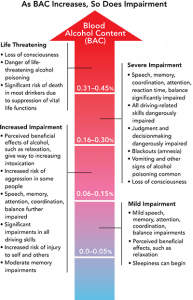
    Check out this NIAAA blood alcohol content chart for more.

    Basics for Alcohol Addiction Treatment

    If you think that you have a drinking problem, finding help can be a life changing experience. The goal of treating an alcohol addiction is to look at life through a new, clearer perspective. And to understand oneself without the use of drugs. Alcohol addiction treatment happens in two important stages; detox and continued treated.

    During detox, your body rids itself of alcohol’s chemicals and returns to its normal, organic functioning – a state known as homeostasis. If you’re a chronic drinker or have developed dependence on alcohol, you’re going to feel withdrawal symptoms. The severity of these symptoms and how long they last all depends on your level of addiction.

    A reputable treatment facility will give you a proper medical assessment which will determine your level of physical dependence. ALWAYS SEEK MEDICAL ATTENTION WHEN WITHDRAWING FROM ALCOHOL. Symptoms can become dangerous or life-threatening. Common withdrawal symptoms include:

    • Agitation
    • Anxiety
    • Depression
    • Difficulty concentrating
    • Disorientation
    • Fatigue
    • Headache
    • Heightened sensitivity to light and sound
    • Irritability
    • Jumpiness or shakiness
    • Mood swings
    • Nausea
    • Nightmares
    • Sweating
    • Transient hallucinations (in more serious cases)
    • Tremor
    • Vomiting

    After your body withdraws, you’re going to need to take the time address your thinking. Again, how long this will take and how difficult it will be all depends on your level of addiction. Generally speaking, most people go through intensive psychotherapy for an initial 3-6 month period. Ongoing weekly therapy then lasts upwards of a year or more.

    Where to Find Help

     If you’re unsure as to where to turn, there are a variety of options at your disposal. Here are some suggestions:

    If you’re looking to talk to someone immediately, check out the following helplines:

    • Drug Hotline 877-736-9802
    • National Council on Alcoholism and Drug Dependence HopeLine 1-800-475-HOPE (4673)
    • National Institute on Drug Abuse – Drug and Treatment Information 1-800-6224357
    • National Suicide Prevention Helpline 1-800-273-TALK (8255) or 800-SUICIDE (784-2433)
    • Substance Abuse Helpline (available 24/7) 1-800-923-4327

    Furthermore, you can always call us for more information on how to find the right treatment facility. The helpline number listed on this page will connect you to American Addiction Centers (AAC). The helpline is offered at no cost and with no obligation to enter treatment. Caring admissions consultants are standing by to discuss your treatment options. So, if you are ready to get help, reach out and pick up the phone.

    We’re happy to help!

    Your Questions

    If you have any further questions about the strongest alcohols or how to treat alcohol addiction, we invite you to ask them below. If you have any advice to give pertaining to these topics, we’d also love to hear from you. We try to reply to each question promptly and personally.

    View the original article at