Tag: alcohol statistics

  • Binge Drinking

    Binge Drinking

    ARTICLE SUMMARY: Drinking too much alcohol in one drinking session is known as “binge drinking”.  But bingeing is not same as alcoholism. How? We review here.

    ESTIMATED READING TIME: Under 10 minutes.

    TABLE OF CONTENTS:

    Binge Drinking Definition & Levels

    Binge drinking is known as drinking too much alcohol in a single setting. How much drinking qualifies for a “binge”?

    The amount of alcohol consumed at one drinking session that qualifies as a binge drinking is significantly more than a person would normally drink. More specifically, the National Institute on Alcohol Abuse and Alcoholism (NIAAA) defines binge drinking as a pattern of drinking that brings blood alcohol concentration (BAC) levels to 0.08 g/dl or above. This usually happens after:

    • 4 drinks for females
    • 5 drinks for males

    …in a timeframe of 2 hours.

    To give more context, the Substance Abuse and Mental Health Services Administration (SAMHSA) considers binge drinking as 4 or more alcoholic beverages for women on one occasion or 5 of more alcoholic beverages for men (at the same time or within few hours) on at least 1 day in a month.

    Finally, binge drinking is not yet classified as disorder by the American Psychiatric Association (APA). As of now, this type of drinking refers to a behavioral pattern that can be a risk factor for developing alcohol dependence.

    Is Binge Drinking the Same as Alcoholism?

    No. Binge drinking is not same as alcoholism. However, prolonged binge drinking may lead to alcoholism.

    In fact, most people who binge drink are not dependent on alcohol. Still, binge drinking is considered to be the most costly and deadly pattern of consuming alcohol. Excessive alcohol use such as binge drinking can put your health at serious risk. Binge drinking is connected with many health conditions including:

    • Becoming alcohol dependent.
    • Demonstrating violent/aggressive behavior.
    • Developing cancer of the mouth, throat, esophagus, liver, colon, or breast.
    • Developing chronic diseases like high blood pressure, heart disease, or liver disease.
    • Having memory or learning problems.
    • Risky sexual behavior.
    • Unintentional injuries like falls, burns, car crashes, or alcohol poisoning.

    Why People Binge Drink

    Reasons for drinking vary…and can be quite different. Some people start bingeing to as stress-relief. Some binge drink out of curiosity, while others drink excessively because they are already having alcohol problems. Moreover, reasons for binge drinking when you are in college are different than the reasons for drinking when you are older.

    Some of the more common reasons for drinking too much at once include:

    Boost in self-confidence. People who are shy or introverts may find it difficult to communicate with other. Alcohol has the ability to help you feel disinhibited, and thereby, can boost your self-confidence. So, when you are under the influence you might easily mix with others.

    Changing your image. Men might binge drink to display dominance, strength, or a macho image. Moreover, some people claim that they feel sexy when they drink. This goes for both genders.

    Curiosity. One of the common reason for binge drinking is wanting to know how and what it ‘feels’ like. This mostly happens after someone brags about his/her wild night out.

    Forgetting problems. Most studies and surveys that investigate the reasons for drinking list this reason as in the Top 10. Letting go of stress, and forgetting your problems through binge drinking, may be okay for one night. But, if you start using binge drinking as a coping mechanism, and not dealing with the underlying issues, you may become dependent on alcohol.

    Fun. Most people want to forget their problems, let go of their thoughts, and just enjoy. Binge drinking is a common event on parties. Also, drinking games such as Beer Pong, Pennies, and Never Have I Ever are based on binge drinking and having fun.

    Peer pressure. Acceptance issues are most common among students in high school and college. If binge drinking can help you ‘fit in’, then so be it… this is the thought that can go through our minds. Unfortunately, this thought pattern can result in health, school, and work problems.

    Rebellion. Rebellion is a psycho-social developmental phase that most teens and college students go through. They use binge drinking as a way to rebel against their parents in order to break the rules, and show independence.

    Socialize. Some friends bond with each other because of their drinking habits. Sometimes, if you want to become a part of a certain group of people, the ‘only’ way to get in is through drinking. No one wants to be the cast out, so many individuals have decided to raise their glass than to be left out.

    The list of reasons why people binge drink is not limited to this… but scientists and experts also add that the family history of alcoholism – and genetics – plays a huge part in why some choose this pattern of drinking.

    One in four Americans aged 12 or older are binge drinkers. And 4 out of 5 binge drinks are consumed by men.

    How Many People Binge Drink?

    About 25% of Americans binge drink.

    According to the 2016 National Survey on Drug Use and Health, a number of 65.3 million people aged 12 or older were binge drinkers in the past month. This number corresponds to about 1 in 4 people.

    Moreover,  the Annual Total Binge Drinks Consumed by U.S Adults of 2015 announced that 1 in 6 adult Americans binge drinks about 4 times in a months, consuming about 7 drinks per drinking session. This makes a grand total of of 17.5 billion total binge drinks in a year, or 467 drinks per binge consumer.
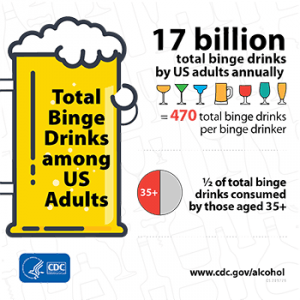
    Moreover, the same analysis reports that binge drinking is popular among younger adults aged 18 -34 years, but more than a half of the total binge drinks are consumed by people aged 35 or older. Additionally, the Centers for Disease Control and Prevention reports that about 4 in 5 binge drinks are consumed by men,. The U.S. states with the most binge users are Arkansas, Mississippi, Kentucky, and Hawaii.

    Furthermore, Alcohol and Public Health: Alcohol-Related Disease Impact (ARDI) stated that during 2006 to 2010, excessive alcohol use was responsible for about 88,000 deaths. More than half of these deaths happen due to binge drinking.

    Excessive alcohol use was responsible for around 88,000 deaths between 2006-2010.

    Binge Drinking Among College Students

    Drinking among college students has become a tradition that most of students see as a rite of passage into the higher education experience. However, most enter into college life with well-established drinking habits that started in their teen years, usually around the age of 13. Then, binge drinking peaks in young adolescents aged 18 to 22, and slowly decreases.

    So, how many college students are current binge drinkers?

    According to SAMHSA’s NSDUH survey of 2014 , about 60% of college students drank alcohol in the past month, while 2 of 3 students engage din binge drinking.

    But binge drinking may cause serious problems to the health of these young lives…

    A survey published in the Journal of Studies on Alcohol and Drugs reported that about 1,825 college students between the ages of 18 and 24 die from alcohol-related unintentional injuries, including motor-vehicle crashes. Moreover, National Institute on Alcohol Abuse and Alcoholism reported that about 696,000 college students are assaulted by another student who has been drinking, while about 97,000 students report experiencing alcohol-related sexual assault or date rape.

    Additionally, this study reports that 1 in 4 college students had academic problems (missing classes, poor exams and papers, low grades, and/or fall behind in class) due to alcohol use. Also, binge college drinkers who had at least 3 drinking sessions per week were 6 times more likely to perform poorly on a exam or a project, and 5 times more to miss a class than students who drank but never binged.

    Tragically, NIAAA  reported that 20% of college students meet the criteria for alcohol use disorder.­

    It’s better to drink in moderation,than to binge drink.

    Don’t start to binge drink just to fit on your college campus, choose what’s best for you!

    For more information, visit College Drinking Prevention.

    When Binge Drinking Is a Problem

    Binge drinking may become a problem when you start bingeing too often and/or drinking too much.

    But it can be hard to tell the difference or to spot a real drinking problem. For example, some people may drink a lot in one session, but don’t have a drinking problem. The main point is that you have a drinking problem when drinking affects your life and causes negative consequences.

    Some main signs of having a drinking problem include when you:

    • Black out or have trouble remembering what you did while drinking.
    • Cannot cut back on drinking.
    • Continue to drink despite negative effects on your health.
    • Drink more than you intend.
    • Engage in dangerous activities such as violence or driving drunk.
    • Experience a strong urge for drinking.
    • Experience withdrawal symptoms when you quit/cut down.
    • Have an increased tolerance for alcohol.
    • Have tried but cannot quit drinking on your own.
    • Have problems at work/home/school due to drinking.
    • Have problems with family and friends because of your drinking.
    • Lose interest in hobbies and activities because you want to drink.

    If you have some of these signs, you may need to reach out for help. DON’T WAIT!

    Drinking too often + Drinking too much = RISKY DRINKING!

    Get Help for a Drinking Problem

    Do you think that you may have a drinking problem? Get help as soon as possible!

    Don’t be afraid, just reach out…

    It can be hard to quit alcohol on your own, but don’t lose hope… today’s treatment programs customize the experience to match your needs.

    So, where should you look for help?

    1. Find a therapist.

    Talk therapy is one of the most efficient for treating alcohol problems. You can learn how to find a therapist to talk through the issue by seeing this Psychology Today article here.

    2. Find an addiction specialist.

    Doctors who have specialize in addiction medicine can provide addiction diagnosis, prevention, intervention, screening, and treatment. Find a specialist certified by the American Board of Addiction here.

    3. Find a psychotherapist.

    You can ask for help from a psychotherapist for your drinking problems. This includes one-on-one therapy, family therapy, or couples therapy.  You can find a therapist via the American Psychological Association’s online therapist finder here.

    4. Ask help from a psychiatrist. 

    Psychiatrist are proven doctors that can help you deal with alcohol dependence. Find a qualified psychiatrist on the American Psychiatric Association (APA) website.

     5. Call our helpline. 

    If you have a hard time dealing with excessive alcohol use, call the number you see on our website. Our addiction recovery specialists can talk to you about your drinking problems, and can help you find a way to deal with it.

    Reference Sources: SAMHSA: Alcohol
    NIH: What is a standard drink? 
    NCBI: Undergraduate drinking and academic performance: a prospective investigation with objective measures. 
    CDC: Binge Drinking 
    NCBI: Annual Total Binge Drinks Consumed by U.S. Adults, 2015 
    CDC: Alcohol and Public Health: Data and Maps 
    NCBI: Defining “Binge” Drinking as Five Drinks per Occasion or Drinking to a 0.08% BAC: Which is More Sensitive to Risk? 
    NCBI: Binge Drinking: A Confused Concept and its Contemporary History 

    View the original article at

  • Top 10 Strongest Alcohols

    Top 10 Strongest Alcohols


    ARTICLE OVERVIEW: Alcohol acts as a depressant on the central nervous system and slows down brain function. Though all alcohol is potentially dangerous, it’s important to that understand some alcohol is more deadly than others. In this article, we’ve compiled a list of the strongest alcohols currently on the market. At the end of the article, we invite you to ask further questions.

    ESTIMATED READING TIME: Less than 10 minutes.

    Table of Contents:

    The general amount of alcohol contained within liquor is 40%.

    How Do We Measure the Strength of Alcohol?

    We measure the strength of an alcoholic drink based on its percentage of alcohol content. The general amount of alcohol contained within hard liquor is 40%.

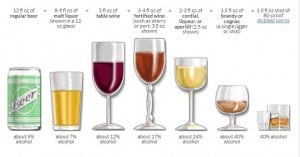
    Since much of the alcohol mentioned on this Top 10 list is much stronger than what we normally drink, it’s helpful to have something to compare it to. The following are your most typical alcoholic beverages and the percentage of alcohol each contains:

    • Beer, 4% to 5% alcohol content
    • Wine, 12% alcohol content
    • Fruit liquors, 28% to 32% alcohol content
    • Gin, 35% to 40% alcohol content
    • Vodka, 35% to 46% alcohol content
    • Rum, 40% to 46% alcohol content
    • Whiskey, 55% to 60% alcohol content

    The National Institutes on Alcoholism and Alcohol Abuse have created this graphic to help visualize the difference.

    However,, the alcohol percentages listed above are the average. What we’re about to list below are the ten strongest alcohols in the world. It’s vital to remember that drinking this amount of alcohol is very dangerous towards your health and well-being. Especially when getting behind the wheel.

    Every kind of alcohol sold on the market must be labeled under the Federal Alcohol Administration (FFA) Act. These labels will usually tell you the percentage of alcohol within each drink. Or, the label will give the “proof count”. For example, you purchase a whiskey which advertises itself as 100-proof. This is the doubled percentage of the alcohol content. Therefore, the whiskey you purchased has 50% alcohol within it.

    Alcohol addiction is a very serious disease and shouldn’t be left untreated. If you or anyone you love is struggling with alcohol addiction, you need to seek help as soon as possible. The longer you wait, the more time alcohol can ruin your life. Furthermore, if you happen to find any of the following alcohols within your liquor cabinet, it’s highly suggested you get rid of them. Again, these are the strongest alcohols the world has to offer and, likewise, the most dangerous.

    #10 – Absinthe (up to 72% Alcohol)

    Up until 2007, Absinthe was banned in the United States. This is primarily due to prior associations with the alcohol inflicting criminal-like behavior in those who drank it. Think mafia or just plain gangsters. Absinthe has psychoactive properties which caused seizures, thought to be caused by the grand wormwood plant – the source of Absinthe – and its production of thujone, a chemical which afflicts sleeplessness, convulsions, and hallucinations. It can be a serious danger and a lethal drug-of-choice.

    #9 – Bacardi 151 (75.5% Alcohol)

    Typically, people who drink Bacardi 151 do so through a variety of mixed drinks, such as combining it with fruit juice. . It is considerably one of the strongest rums ever created.

    However, this brand of Bacardi has been discontinued. The reason it’s no longer available for purchase is that people too often ignored the warnings of the drink being highly flammable. Due to this lack of inspection, many ended up exposing the bottle to open flames and experienced burns. If you still have a bottle of this lying around, it’s important to understand the fire safety risks involved with this alcohol.

    #8 – Devil Springs Vodka (80% Alcohol)

    Another highly flammable alcoholic beverage is Devil Springs Vodka. Coming in at 15 times stronger than your average beer, it comes to no surprise that this drink has found a market for abuse. It is especially popular with people and cultures who prefer vodka compared to other alcoholic beverages.

    As we climb the alcohol content ladder, it’s vital to remember that the stronger the alcohol is, the more dangerous it becomes to your health and the more susceptible the user ends up in terms of abusing it.

    #7 – Balkan 176 Vodka (88% Alcohol)

    An alcoholic drink so strong, it requires 13 health warnings on the bottle. The strongest drink made in Scandinavian, Balkan 176 is distilled three times over and is considered to be absolutely tasteless. This is dangerous, as without any pungent taste most associate with alcohol, this can leave the drinker consuming more and more, not realizing the potential harm he/she’s putting him/herself into.

    In fact, there are numerous reports of people experiencing alcohol poisoning and death due from drinking too much strong liquor in a short period of time.

    #6 – Pincer Vodka (88.8% Alcohol)

    Being the strongest alcohol Scotland produces, it comes to no surprise Pincer Vodka has similar qualities as Balkan 176. However, one major appeal of Pincer is the fact that it has such a low calorie count. So much so, there are people out there who claim they don’t get hangovers as bad as your average liquor.

    There is an obvious danger in this. One of the many qualities of alcohol that turns a social drinker off is the fact that they have to handle a hangover the next morning. Considering the calorie count of alcohol and what it can do to one’s health, it’s understandable that a responsible adult only drinks on occasions. However, since Pincer doesn’t offer these negative alternatives, there’s lies a stronger chance for abuse.

    #5 – River Antoine Royale Grenadian Rum (90% Alcohol)

    There’s a certain quality to River Antoine Royale Grenadian Rum. That is, the people who make it distill over a long period of time through an old, traditional pot stilling method. In turn, this gives it a very prominent flavor not usually found in alcohol with such a high percentage count.

    #4 – Bruichladdich X4+1 Quadrupled Whiskey (92% Alcohol)

    Balkan 176 Vodka is distilled three times over. But Bruichladdich X4 is distilled four times over, which is what gives it is name and appeal. Furthermore, it has a distinct taste which doesn’t match to most alcohols due to the fact that it’s aged in new oak casks.

    Due to the high level of alcohol content, we’re beginning to endeavor into very dangerous territory. This kind of alcohol can do serious harm to someone in a matter of minutes and it’s important to be aware of the fatal consequences alcohol can have if you’re not careful or properly prepared.

    #3 – Golden Grain (95% Alcohol)

    Golden Grain is made by the same people who make the next alcohol on this list and both drinks are actually very similar in appearance, taste, and effects they have on the user. It should be noted Golden Grain is illegal in certain parts of the United States.

    #2 – Everclear (95% Alcohol)

    Everclear was one of a kind when it came out, as no alcohol prior had could be labeled 190 proof. Furthermore, just like Pincer Vodka, it’s absolutely tasteless. As already mentioned, there are numerous dangers involved for those who decide to drink Everclear. Just as with all the alcohols on this list, addiction can happen much more quickly due to the fact that you need less of the drink to feel its effects.

    Furthermore, there are instances when an alcohol like Everclear is placed in someone’s drink without them realizing – a concept known as “drugging”. Inevitably, getting them much more inebriated than they intended to be or putting them in a dangerous position without their
    knowledge.

    #1 – Spirytus Rektyfikowany (96% Alcohol)

    Spirytus contains the most alcohol content by volume in the world. In fact, it’s not even legal in most states, due its potency. Though this alcohol is rare in the United States, it can be found in Poland or Eastern Europe, where it’s manufactured. Spirytus is without a doubt the most dangerous alcohol to intake and if you happen to run into it, or any of the other alcohols on our list, you should be aware of the risks this can have on your health.

    Alcohol’s Risk on Your Health

    Alcohol’s risk factors can be divided into two sections – the short term risks (those of which will appear either immediately or soon after drinking) and the long term risks (those of which will appear after drinking for months on end).

    The short term concerns primarily lie around over-drinking to the point of being incapable of inducing alcohol poisoning which can be fatal. Other health risks involved from short term use are:

    • Bluish tint to skin
    • Coma
    • Confusion
    • Loss of consciousness
    • Low body temperature
    • Seizures
    • Slow breathing
    • Vomiting

    Some people react to alcohol differently and even get sick from it, especially when they take too much of a beverage they can’t handle. If someone has a sensitivity to alcohol, they may feel the following:

    • Diarrhea
    • Facial flushing
    • Low blood pressure
    • Nausea
    • Worsening of asthma
    • Vomiting

    However, over time, people who drink alcohol frequently will develop a dependence. If this happens, they face the same health risks as the short term effects and more. These complications can include:

    • Brain and nerve damage
    • Cancer
    • Cardiomyopathy (damage to heart muscle)
    • Immune system dysfunction
    • Liver disease
    • Mental health issues (such as anxiety or depression)
    • Osteoporosis
    • Pancreatitis
    • Peripheral neuropathy
    • Stomach ulcers
    • Vitamin deficiency

    As you can see, an alcohol addiction is very serious and can have consequences on your health and well-being. If you or anyone you love is currently struggling with an alcohol addiction, it’s vital to seek out treatment as soon as possible.

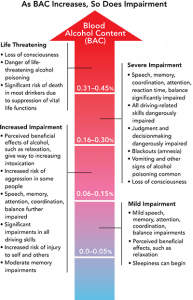
    Check out this NIAAA blood alcohol content chart for more.

    Basics for Alcohol Addiction Treatment

    If you think that you have a drinking problem, finding help can be a life changing experience. The goal of treating an alcohol addiction is to look at life through a new, clearer perspective. And to understand oneself without the use of drugs. Alcohol addiction treatment happens in two important stages; detox and continued treated.

    During detox, your body rids itself of alcohol’s chemicals and returns to its normal, organic functioning – a state known as homeostasis. If you’re a chronic drinker or have developed dependence on alcohol, you’re going to feel withdrawal symptoms. The severity of these symptoms and how long they last all depends on your level of addiction.

    A reputable treatment facility will give you a proper medical assessment which will determine your level of physical dependence. ALWAYS SEEK MEDICAL ATTENTION WHEN WITHDRAWING FROM ALCOHOL. Symptoms can become dangerous or life-threatening. Common withdrawal symptoms include:

    • Agitation
    • Anxiety
    • Depression
    • Difficulty concentrating
    • Disorientation
    • Fatigue
    • Headache
    • Heightened sensitivity to light and sound
    • Irritability
    • Jumpiness or shakiness
    • Mood swings
    • Nausea
    • Nightmares
    • Sweating
    • Transient hallucinations (in more serious cases)
    • Tremor
    • Vomiting

    After your body withdraws, you’re going to need to take the time address your thinking. Again, how long this will take and how difficult it will be all depends on your level of addiction. Generally speaking, most people go through intensive psychotherapy for an initial 3-6 month period. Ongoing weekly therapy then lasts upwards of a year or more.

    Where to Find Help

     If you’re unsure as to where to turn, there are a variety of options at your disposal. Here are some suggestions:

    If you’re looking to talk to someone immediately, check out the following helplines:

    • Drug Hotline 877-736-9802
    • National Council on Alcoholism and Drug Dependence HopeLine 1-800-475-HOPE (4673)
    • National Institute on Drug Abuse – Drug and Treatment Information 1-800-6224357
    • National Suicide Prevention Helpline 1-800-273-TALK (8255) or 800-SUICIDE (784-2433)
    • Substance Abuse Helpline (available 24/7) 1-800-923-4327

    Furthermore, you can always call us for more information on how to find the right treatment facility. The helpline number listed on this page will connect you to American Addiction Centers (AAC). The helpline is offered at no cost and with no obligation to enter treatment. Caring admissions consultants are standing by to discuss your treatment options. So, if you are ready to get help, reach out and pick up the phone.

    We’re happy to help!

    Your Questions

    If you have any further questions about the strongest alcohols or how to treat alcohol addiction, we invite you to ask them below. If you have any advice to give pertaining to these topics, we’d also love to hear from you. We try to reply to each question promptly and personally.

    View the original article at