Tag: awareness campaign

  • "Wear Your Meds" Buttons Help Fight Stigma Against Mental Health

    "Wear Your Meds" Buttons Help Fight Stigma Against Mental Health

    Creator Laura Weiss hopes her pinback buttons can spark conversations and break down the stigma surrounding mental illness.

    When Lauren Weiss took control of her mental health and began taking medication for bipolar disorder, she knew that she wanted to be an advocate for mental illness. Weiss studies advertising at Miami Ad School in New York City, so it was natural that she searched for a quick, engaging visual cue to open conversations about her condition. 

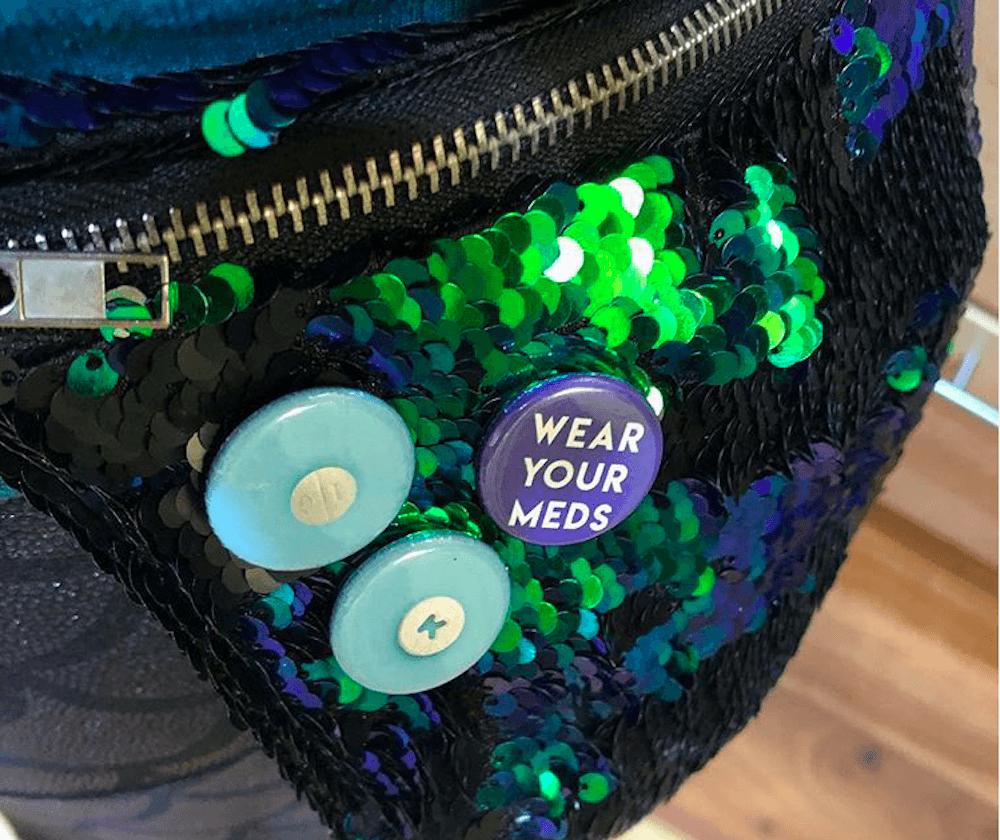
    Weiss designed pinback buttons depicting common psychiatric medications, like Xanax and lithium. Another button proclaims “Wear Your Meds,” summing up the mission of her project. Weiss told Fast Company that the buttons, which started as a class project, are a way to spark a conversation around mental health. 

    “[It’s a] symbol that represents the story you want to tell, and a gateway into your personal story,” she said. “I know that not everybody wants to be an activist about mental health. With something like the buttons, I think it’s a little more accessible for people who maybe are open to sharing their story, but don’t want to be shouting about it on the streets. They can have this button, and it’s an easy way for people to see it and maybe ask about it.”

    Weiss said that she doesn’t expect everyone to be comfortable broadcasting what medications they are on. Some people have said to her that they are afraid they would be fired or otherwise discriminated against if they were open about their mental health condition and the medications that they are taking. 

    However, she said the buttons allow people who are interested in sharing their story to help break down stigma. 

    “People like me who are talking about this from a position of privilege, in a community where we can feel safe talking about it, are the people who ultimately have to do the heavy lifting and have to do the work around this in order for that stigma to start to be lifted for people in communities that don’t feel comfortable talking about it right now,” she said. 

    Weiss is now selling the buttons online, with proceeds to benefit the National Alliance on Mental Illness. 

    “When you ‘wear your heart on your sleeve,’ it means you’re being honest, open, and vulnerable. When you wear your meds on your sleeve, you’re doing the same,” her website reads. 

    Weiss’ buttons depict 14 different pills commonly used for treating mental health conditions: Zoloft, Lithium, Adderall, Ativan, Klonopin, Desyrel, Lexapro, Lamictal, Effexor, Cymbalta, Celexa, Wellbutrin, Xanax, and Prozac.

    View the original article at thefix.com

  • After Losing 2 Sons To Overdose, Mom Shares Their Story To Help Others

    After Losing 2 Sons To Overdose, Mom Shares Their Story To Help Others

    Becky Savage is on a mission to help parents understand the dangers of prescription pills. 

    Losing a child is a parent’s worst nightmare. For Becky Savage, that nightmare became a reality twice within the same day, when her teenage sons Nick and Jack were both pronounced dead in her home after overdosing on prescription opioids. 

    On the evening of June 13, 2015, the boys attended a graduation party, and came home to check in with their mom just after midnight. On June 14, Savage noticed that Jack wasn’t breathing. She called 911 and frantically yelled for Nick, who was sleeping in the basement. 

    The paramedics arrived and tried to resuscitate Jack, before heading downstairs. 

    “I had no idea at that point what they were doing in our basement,” Savage said to CNN. “And then I remember one of them coming up and asking for a coroner. That’s the last thing that I remember that day.”

    The night before, Jack and Nick had combined hydrocodone and alcohol, “a bad choice that unfortunately cost them their lives,” Savage said. 

    At first, Savage, her husband and her two younger sons were just focused on surviving their grief. “Everything just kind of seemed like a blur that day,” Savage said. “Your mind is not really meant to process something that extreme.” 

    However, more than a year later Savage was asked to speak about underage drinking. She thought she would be talking to about 20 people, but 200 showed up. 

    “It was just overwhelming,” she said. That’s when Savage realized that sharing her story and speaking openly about Jack and Nick’s deaths could potentially save other families from tragedy.

    The Savage family started the 525 Foundation, named after the boys’ hockey numbers (Jack’s 5 and Nick’s 25). Now, Savage focuses on sharing her story with as many people as possible, and helping parents understand the dangers of prescription pills. 

    “We’ve talked to our kids about drinking, but we had never talked to them about prescription drugs, because it wasn’t even on our radar,” she said. “In different communities, there are still people who are unaware of the dangers. After I get done talking to them, the first thing they say is they’re going to go home and clean out their medicine cabinets.”

    Since 2016, Savage estimates that she has spoken to more than 23,000 students. She has also testified in front of a Congressional committee, and the 525 Foundation has started organizing events to collect unused prescription pills. At just three events they’ve collected 1,500 pounds of pills.

    “If you think about how much one pill weighs, that’s a lot of pills collected,” Savage said. “And when you think that one of those pills could take a life, that could potentially be a lot of lives saved.”

    For Savage, this is a small silver lining to the unimaginable heartbreak of losing her sons. 

    “By me telling their story, they’re still able to make a difference in the lives of others,” she said. “There can’t be a better goal than that.”

    View the original article at thefix.com