Tag: Big Pharma

  • Big Pharma Tries To Slip Benefit Into Senate Opioid Package

    Big Pharma Tries To Slip Benefit Into Senate Opioid Package

    “Big Pharma is trying to hijack the bill and turn it into a giant pharmaceutical company bailout,” said Senator Tina Smith (D-Minnesota).

    Pharmaceutical companies are attempting to inject $4 billion in savings for themselves into opioid legislation being considered in Congress. 

    A package of bills meant to address the opioid epidemic have passed both the House and Senate, and the two bodies are now working together to craft a version that both can agree on.

    The Pharmaceutical Research and Manufacturers of America, or PhRMA, has tried to get a clause added to the bill that would reduce the discount that pharmaceutical companies need to offer Medicare beneficiaries whose spending on drugs falls into the coverage gap, according to The New York Times.  

    “We have a good bipartisan opioids bill and we need to get it signed into law. But now Big Pharma is trying to hijack the bill and turn it into a giant pharmaceutical company bailout,” Senator Tina Smith (D-Minnesota) said in a Twitter post.

    Right now, pharmaceutical companies are required to discount brand-name drugs 50% for people in the coverage gap. Next year, the discount is set to increase to 70%. The increased discount was initially designed to reduce federal spending on Medicare’s drug benefit by $7.7 billion through 2027.

    However, after the law was passed increasing the discount, the Congressional Budget Office raised its estimate of the savings to $11.8 billion. Because of this, PhRMA would like the discount reduced to cover only the $7.7 billion savings, calling the updated level a “technical error.” 

    The AARP said that PhRMA’s proposal “will increase prescription drug costs for older Americans while providing a windfall of billions of dollars to the drug industry.”

    The prescription drug discount has nothing to do with the opioid crisis—but because there is broad bipartisan support for passing the opioid legislation quickly, PhRMA is trying to slip its desired changes into the bill while it has momentum, the Times noted. 

    “We are focused on ensuring Medicare Part D is secure for the future by correcting a technical error” by the Congressional Budget Office, said Stephen J. Ubl, the president and chief executive of PhRMA.

    However, most people outside PhRMA disagree. 

    “In the context of the current debate, I would not roll back the drug discounts,” said Mark E. Miller, the former executive director of a federal commission that advises Congress on Medicare. “We need broader changes in the structure of Medicare’s drug benefit. If the discounts are rolled back, patients and taxpayers should get something in return, to bring more competition to the market and drive down drug prices.”

    View the original article at thefix.com

  • Stephen Colbert Takes Aim At Big Pharma Over Opioid Crisis

    Stephen Colbert Takes Aim At Big Pharma Over Opioid Crisis

    “You know you’ve been bad when the government fines you one aircraft carrier.”

    Stephen Colbert publicly called out those responsible for the opioid crisis, as the Late Show host laid into Big Pharma during a segment last Friday (Sept. 14).

    “There are certain subjects that are genuinely hard to talk about like, the opioid crisis. It’s an epidemic that affects both political parties, Republican, Democrat, rich people, poor people, it does not discriminate,” Colbert said in the segment. “And a lot of people blame Big Pharma, but only because it’s their fault.”

    Colbert went on to single out Purdue Pharma, which manufactures OxyContin and is owned by members of the billionaire Sackler family. Colbert discussed the various lawsuits against the company accused of downplaying how addictive the medication could be “even as their sales reps used the words ‘street value,’ ‘crush’ and ‘snort’ in the late nineties.”

    “That’s what happens when the head of sales is El Chapo,” Colbert joked in the segment, referring to the former head of the Sinaloa drug cartel, who is now in U.S. custody.

    In 2007, Purdue was fined more than $600 million after pleading guilty to misrepresenting OxyContin’s potential for abuse.

    “You know you’ve been bad when the government fines you one aircraft carrier,” Colbert stated. “Of course, this same time they made $35 billion.”

    He went on to add that the Sackler family wants to expand globally and that they already own a lesser-known company called Rhodes Pharma.

    Colbert stated, “It was revealed just this week that they own a second, secret company, Rhodes Pharma, a little-known Rhode Island-based drug maker that is among the largest producers of off-patent generic opioids in the U.S.”

    Colbert went on to discuss the fact that Rhodes Pharma recently was granted a patent for a new medication—a “fast-acting form of buprenorphine”—that could potentially treat opioid use disorder. The new medication would be in wafer form rather than a tablet, meaning it would dissolve quickly and work faster. 

    “Another not-so-fun fact about Rhodes Pharmaceuticals is, in addition to selling all these off-brand opiates, they also just patented a new drug to help wean addicts off opioids,” Colbert said.

    “So, the Sacklers addicted the country to opioids, now they’re going to profit off the cure?” Colbert noted. “That takes a pair of swingin’ Sacklers.”

    View the original article at thefix.com

  • New Book "Dopesick" Explores The Opioid Crisis From All Angles

    New Book "Dopesick" Explores The Opioid Crisis From All Angles

    “My goal with this book was not to just show you how we got here and what it’s going to take to get out of it but also to inspire people to care,” says author Beth Macy.

    Journalist Beth Macy set out with a mission: to address the opioid epidemic from every possible angle. 

    In her new book, Dopesick: Dealers, Doctors and the Drug Company that Addicted America, she does that through examining the opioid epidemic from the very beginning to its current state. 

    According to NPR, Macy begins the book by detailing the story of Jesse, a 19-year-old whose struggles began with pills and ended with heroin. Jesse is one of the many lives taken at the hands of the opioid crisis.

    “He was one of these rambunctious kids who rarely napped,” Macy told NPR. “As a little boy, he would fall asleep with toys still in his hands. And early on, they put him on ADHD medication. He also had some football and snowboarding injuries when he was 15 and 16 and was prescribed opioid painkillers then.

    “His mother isn’t exactly sure at what point he became hooked, at what point he realized he was dope sick. But he knew he could trade his ADHD medicine for the opioid pills. And one thing led to another. When the pills got harder to get because of doctors cracking down on prescribing, that’s when the heroin started coming in.”

    Initially, Macy tells CBS, Jesse’s mother was unaware of the depths her son’s use had gone to.

    “She said something else that I heard a lot, which is ‘I thought it was just pills,’ and it had progressed to heroin unbeknownst to her, and he never missed a day at work,” Macy told CBS.

    As journalists do, Macy comes at the opioid epidemic from all angles. Her book also details her conversations with a drug dealer named Ronnie Jones, who “ran one of the largest heroin rings in the mid-Atlantic region,” according to NPR.

    Jones had tried a few times to recreate his life after spending time in jail, but with little luck.

    “Ronnie’s story illustrates how little we do for felons trying to re-enter our society. You know, we don’t make it easy for them to get jobs,” Macy told NPR. “They often come out, and they owe lots of fines. And he tries to go legit. And he ends up—you know, he starts out selling weed again, which he had been selling before. But meanwhile, since he’s been in prison, this opioid thing has exploded. And somebody tells him in the break room of George’s Chicken, hey, man, if you want to make the real money, you need to be bringing heroin in.”

    Also in her book, Macy examines the role that Purdue Pharma (the manufacturer of OxyContin) has played in the epidemic. She states that when Purdue introduced OxyContin, it was marketed as being more safe than other painkillers because of its 12-hour time release mechanism.

    For the past three years, Macy says, she has been following Google alerts for articles pertaining to the opioid crisis. However, she says, none of them addressed every angle of the crisis as she hoped to.

    “Each of them only deal with a little piece of something going on right now,” she tells NPR. “And my goal with this book was not to just show you how we got here and what it’s going to take to get out of it, but also to inspire people to care. And I really hope that that’s what I’ve done.”

    View the original article at thefix.com

  • Massachusetts Sues Purdue Pharma Over Opioid Crisis

    Massachusetts Sues Purdue Pharma Over Opioid Crisis

    Sixteen individuals are named in the lawsuit, including a few members of the Sackler family.

    The state of Massachusetts is suing 16 current and former Purdue Pharma board members and executives for their alleged role in the continuing opioid crisis.

    Massachusetts Attorney General Maura Healey says this is the first lawsuit brought on by a state that directly names executives and directors in connection with opioid-related deaths. 

    The BBC reports that Judy Lewent, a non-executive director of GlaxoSmithKline, is named in the charges for her involvement with the board of Purdue Pharma until 2014.

    Lewent currently serves as a director in GlaxoSmithKline (GSK), one of the six largest British pharmaceutical companies. In 2012, GSK pleaded guilty to promotion of drugs for unapproved uses, failure to report safety data, and kickbacks to physicians in the United States. The company was sentenced to pay a $3 billion settlement—the largest settlement for a drug company at that time.

    Sixteen individuals are named in the Massachusetts lawsuit, including a few members of the Sackler family.

    Purdue Pharma is owned by the descendants of Raymond and Mortimer Sackler who earned their fortune off of the drug OxyContin, which their company, Purdue Pharma, still produces.

    The Massachusetts lawsuit claims that Purdue Pharma “created the [opioid] epidemic and profited from it through a web of illegal deceit.”

    Judy Lewent was tagged as one “who oversaw and engaged in a deadly, deceptive scheme to sell opioids in Massachusetts.”

    AG Healey addressed the lawsuit in a press conference, “We found that Purdue misled doctors, patients, and the public about the real risks of their dangerous opioids, including OxyContin. Their strategy was simple: The more drugs they sold, the more money they made—and the more people died.” 

    Purdue Pharma “vigorously denies the allegations,” while GlaxoSmithKline declined to “comment on legal matters faced by another company,” according to the BBC.

    Purdue told the BBC, “The Attorney General claims Purdue acted improperly by communicating with prescribers about scientific and medical information that FDA (Food and Drug Administration) has expressly considered and continues to approve. We believe it is inappropriate for the Commonwealth [of Massachusetts] to substitute its judgment for the judgment of the regulatory, scientific and medical experts at FDA.”

    The company added that it shared “the Attorney General’s concern about the opioid crisis,” and that its “opioid medications account for less than 2% of total opioid prescriptions.”

    The state of Minnesota also recently filed a lawsuit against Purdue Pharma over the marketing of OxyContin.

    Purdue Pharma has recently stopped the marketing of opioid-based drugs in Canada, Westfair reported. Purdue already pulled marketing for these drugs in the U.S. back in February. Canada has asked drug companies to suspend marketing and advertising of opioid-based drugs.

    View the original article at thefix.com

  • Opioid Makers Cut Back On Marketing Payouts To Doctors

    Opioid Makers Cut Back On Marketing Payouts To Doctors

    In 2016, Big Pharma shelled out more than $15 million to doctors for opioid-related marketing—33% less than the year prior.

    Drugmakers are cutting back on opioid-related marketing payouts to doctors, according to a data analysis by ProPublica

    The newly released figures come as the latest update to the nonprofit news site’s Dollars for Docs online tool that tracks payments to physicians from drug companies and other medical companies. 

    In 2016, the latest numbers show, Big Pharma shelled out more than $15 million to doctors in exchange for opioid-related speaking and consulting work. That was 33% less than the 2015 figure and 21% less than the 2014 figure. Repeatedly, research has drawn a link between marketing and prescribing practices. 

    “Given the deluge of media attention with the opioid epidemic, I think we’ve seen the pendulum swing in the opposite direction,” Michael Barnett, an assistant professor of health policy and management at Harvard, told ProPublica. “If this is actually a result of manufacturers actually saying, ‘Holy crap, people actually care about opioids being used responsibly’ and they’re aware that their advocacy and payments to physicians could be seen as pushing these medications in a way that is ethically dubious, then that’s a beneficial development and something I’d like to see more of.”

    The shift comes amid a growing number of lawsuits against drug companies accused of downplaying the risks of painkillers in aggressive marketing campaigns over a yearslong uptick in opioid use. 

    It’s not clear exactly what’s driving the changing numbers, though, experts said. 

    “It’s possible that the pharmaceutical companies voluntarily reduced their marketing, realizing that they may have been contributing to overprescribing,” Dr. Scott Hadland of Boston University School of Medicine told ProPublica.

    At the same time the marketing dollars decreased, the number of opioid prescriptions started on the downswing as well. But, so far, the fall in marketing funds has outpaced the reduction in prescriptions.

    OxyContin maker Purdue Pharma cut off its speaker program for the drug in 2016, and this year the company halted all physician-targeted promotional efforts of its addictive painkillers and laid off sales reps. 

    “While the development of important new medicines will be the company’s priority going forward,” the company said last month, “we will continue to support our opioid analgesic product portfolio while continuing our commitment to take meaningful steps to reduce opioid abuse and addiction.”

    The FDA greenlit OxyContin in 1995 and since then it’s been Purdue’s biggest financial success, even amid the rise of generic alternatives and the growing popularity of other opioid painkillers. 

    View the original article at thefix.com

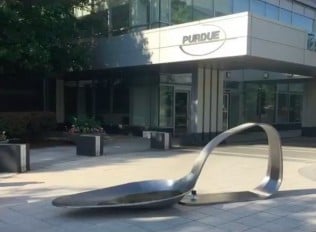
  • Massive Drug Spoon Sculpture Dropped At Purdue Pharma HQ

    Massive Drug Spoon Sculpture Dropped At Purdue Pharma HQ

    The message behind the guerrilla art exhibit is to call attention to the potential danger of prescription opioids.

    A gallery owner was arrested Friday morning (June 22) after placing a sculpture of a massive steel spoon at the headquarters of Purdue Pharma, the maker of OxyContin.

    Fernando Louis Alvarez was arrested and charged with obstruction of free passage, a criminal misdemeanor. The sculpture was displayed in front of the Stamford, Connecticut office for about two hours until it was hauled away by city workers.

    The 800-pound, 10.5-foot-long work of “guerrilla art” appears burnt and bent at the handle, a sight familiar to people who heat up and inject heroin. The artist, Domenic Esposito, of Westwood, Massachusetts, described how his family was affected by his brother Danny’s nearly 14-year addiction to heroin, which began with OxyContin and Percocet.

    “My mom would call me in a panic… screaming she found another burnt spoon. This is a story thousands of families go through. He’s lucky to be alive,” he said, according to the Hartford Courant.

    “The spoon has always been an albatross for my family. It’s kind of an emotional symbol, a dark symbol for me,” he added.

    The message behind the art exhibit is to call attention to the potential danger of prescription opioids, and to call on the federal government to “step in and do something,” Esposito said. Danny has been sober for the last four months.

    Purdue Pharma is among several pharmaceutical companies being targeted by lawsuits across cities, counties, and states that believe these entities had a hand in worsening the opioid crisis. Purdue, specifically, is accused of using deceptive marketing and downplaying the risk of addiction to promote OxyContin.

    The company has since announced that it will no longer market OxyContin to doctors, and just last week, laid off its entire sales team.

    Purdue released a statement on Friday regarding Esposito’s sculpture: “We share the protestors’ concern about the opioid crisis, and respect their right to peacefully express themselves. Purdue is committed to working collaboratively with those affected by this public health crisis on meaningful solutions to help stem the tide of opioid-related overdose deaths.”

    The night of the guerrilla art display, Alvarez hosted the opening of a full exhibit on the opioid crisis at his art gallery in Stamford.

    The spoon has reportedly been submitted as evidence.

    View the original article at thefix.com