A recent op-ed examined some of the reasons why women are drinking more alcohol than ever before.
Drinking used to be thought of as a boys’ club, and men have traditionally used alcohol had higher rates than women. However, in recent decades women’s drinking has expanded dramatically, and social factors may be to blame.
According to the CDC, the percentage of American women who drink more than once a week has increased dramatically, from 45% in 2002 to 67%.
Writing for The Bold Italic, Ginny Hogan examined the social pressures that may be affecting the rate in which women are drinking.
“The reality is that women often drink for different reasons than men do, and it’s not a stretch to think that those reasons often stem from social pressures that women face but men don’t,” Hogan writes.
Many women feel pressured to relax, even as they deal with higher levels of anxiety than men. Rather than showing that stress to people in their lives, many women opt to drink to mask it.
“When we put social pressure on women to not ever appear stressed or anxious, I worry that we instead make alcohol a more appealing option,” Hogan writes.
In addition, alcohol has become a marker of many female social groups, whether it is symbolizing high-powered career women or moms who gather together and bond over wine.
“Society tends to admire women who can play hard and work hard — to be cheerful and warm even in the face of negative surroundings or working conditions,” Hogan writes.
In popular culture, successful women are often shown sipping a drink.
“Tumblers of brandy, whiskey sours and fishbowls of merlot are synonymous with female glass-ceiling-smashing in TV shows like The Good Fight, The GoodWife, Scandal, Killing Eve, The Killing; I honestly can’t think of a successful female protagonist on TV who isn’t a hard drinker,” said Catherine Gray, author of The Unexpected Joy of Being Sober.
Finally, dating while sober can put even more pressure on women.
“I definitely feel like not drinking ups the stakes for going on a date with me — if getting a drink is the most casual meet-up, it’s like, ‘I’m sorry, you need to commit to coffee and a day date, and I’m now occupying your weekend,’” comedian Molly Brown told Hogan.
Ultimately, pushing back on some of these social pressures could be a way to help women reduce their drinking, if that’s something they desire, Hogan writes.
“I want women to feel OK being in bad moods, to speak up if someone is mistreating them, to be comfortable with boring their date and to turn down happy-hour invitations. If women are able to do this more often, I wonder if we could use alcohol as a way to enhance our lives instead of often suppressing them,” she wrote.
One such woman is Teena Richardson of Seattle, who nearly lost her husband and two adult children due to her drinking habits.
“I wasn’t drinking wine anymore,” she told Fox 17. “It had escalated to hard alcohol. I wanted to get the buzz as fast as I could get it, and I wanted to hide it so that nobody knew.”
Dr. Eric Shipley, medical director of Overlake Medical Center in Seattle, told Fox that despite these increasing numbers, people aren’t willing to cut out alcohol.
“If I went to somebody and said, ‘You could eliminate 15% of emergency room visits; would you do it?’ And they’d be, like, ‘Absolutely.’ Well, that means cutting out alcohol. ‘No, no, we’re not going there,” he said.
According to Fox 17, 88,000 people die each year of alcohol-related causes. This makes it the third leading preventable cause of death, with smoking and obesity coming in ahead.
“It’s one of the most dangerous drugs there is,” Dr. Harris Stratyner, a New York psychologist, told Fox 17. “It’s a little slower to kill you. It might take 10 years before it causes cirrhosis, but it’s gonna kill you.”
For those who choose to seek treatment, there are a number of options for help. For Richardson, it took a few tries to find what worked. She tried outpatient therapy and 12-step programs before going to a 10-day aversion therapy program at Schick Shadel Hospital in Seattle.
Erick Davis, the medical director at Schick Shadel, said the goal is to take away the craving for alcohol.
“What we do is we pair the experience of nausea with the thought, smell, taste and sight of alcohol,” he told Fox.
For Richardson, it worked, and she has been in recovery for seven years.
“Now I’m present, and I’m mindful of where I came from,” she told Fox. “And the test of alcoholism gave me a testimony. I’m on the other side of it.”
The board notes that 60 years ago, about 40% of American adults smoked cigarettes, whereas fewer than 20% do today. According to the board, this decrease has to do with the increase in cigarette taxes — and binge drinking should be treated in a similar manner.
The board cites a Johns Hopkins study from this year, which examined two tax increases in the state of Maryland. One was a 50% increase in alcohol sales tax in 2011 (bringing it to 9%), and the other was doubling the excise tax on a pack of cigarettes, bringing it to $2. In both cases, the board writes, consumption of the products went down quickly.
“Opponents of such increases are often quick to denounce nanny-state politics, but government has a responsibility to promote public health,” the Post board wrote. “Cigarette and alcohol consumption exact a terrible toll, and not just on users; witness the impact of binge drinking on families and children, not to mention the carnage on the nation’s highways attributable to drunken driving.”
More specifically, the study determined that in Maryland in 2015, retailers sold about 30% fewer packs of cigarettes than in 2007, which was the year before the excise tax was put into effect. Researchers determined that much of that decrease came quickly after the price increase. The change also affected minors, as researchers state teens who said they had smoked at least one time in the past 30 days decreased in that same span of eight years.
When it came to the increase in alcohol tax, the results were similar. According to the editorial board, researchers in another study examining police crash reports in Maryland found that the number of teenagers in alcohol-related crashes decreased by 12% annually in 11 years from the tax increase. Among drivers as a whole, the decrease was 6% annually.
The Johns Hopkins study also determined that alcohol intake decreased, as researchers said adult binge drinking in the state dropped by 17%, five years after the alcohol tax was enacted.
According to the board, those who oppose such increases may not be thinking about the whole picture.
“Among the arguments from opponents of such taxes is that they fall disproportionately on low- and middle-income people,” the board writes. “That’s true. It is also true that by reducing consumption (which weighs on wallets), they relieve the burden of long-term health care costs on those same people. That’s part of the compelling argument for public-health taxes, and why lawmakers are justified in imposing them.”
“America’s Health Rankings” report cited this state for its abnormally high percentage of adults who consume alcohol at a rate higher than the national average.
A new report released by the United Health Foundation, a non-profit group dedicated to improving American health care, claims that Wisconsin is the worst state in the US when it comes to excessive drinking.
In the foundation’s 29th annual “America’s Health Rankings” report, the Badger State was cited for its abnormally high percentage of adults who consume alcohol at a rate much higher than the national average. Factoring in community, environment, health outcomes and public policy (among other concerns), the report concluded that nearly a quarter of all adults in Wisconsin (24.2%) drank alcohol to excess.
The Foundation defines “excessive drinking” by using two separate categories: “binge drinking” and “chronic drinking.”
Binge drinkers include women who consumed four or more drinks on one occasion within the past 30 days (five drinks for men), while chronic drinkers are women who consumed eight or more alcoholic drinks per week (15 drinks for men).
By contrast, the best-ranked state was Utah, as only 12.2% of its adults reported excess drinking there. The study also found that men, young adults and adults in higher-income homes are far more likely to drink to excess than women, older adults or adults in comparatively lower socioeconomic brackets.
Overall, Wisconsin boasts roughly 3,800 law enforcement officers across those task forces—all of whom are trained with Advanced Roadside Impaired Driving Enforcement (ARIDE), a program developed by the National Highway Traffic Safety Administration to train police officers how to “observe, identify, and articulate the signs of impairment related to drugs, alcohol or a combination of both, in order to reduce the number of impaired drivers and impaired driving related traffic collisions.”
In terms of where Wisconsin falls in relation to the country’s overall health, it ranks 23rd out of the 50 states. (Last year, it ranked 21st.) The United Health Foundation also noticed a 16% increase in mortality and chronic disease in the state, including obesity. Premature death increased by 6% in Wisconsin, too.
“These rankings are indeed a wake-up call for all the people that are involved in such activities, and the state on the whole as well, and certain measures must be taken to address such situations which may not seem to have severe effects directly, but sure can be a cause for concern as they may affect many things indirectly, before it is too late for the same,” writer Jessica Pittard observed.
The Foundation’s annual report listed Alabama, Mississippi and Louisiana as the country’s most unhealthy states, while Hawaii, Massachusetts and Connecticut sat at the top as the healthiest.
A USA Today editorial explores how the US can save lives and money by reducing alcohol consumption.
Public health campaigns reduced cigarette smoking in the United States by more than half since 1964, according to the CDC. Can the same be done with alcohol?
A new report in USA Today reminds us that drinking alcohol—while it is socially acceptable and promoted widely—is no benign matter.
Alcohol is attributed to approximately 88,000 deaths every year in the U.S. About half of alcohol-related deaths involve binge drinking. According to a 2015 national survey, 15.1 million American adults were reported as having alcohol use disorder, with just about 6.7% of them receiving treatment for it.
“It’s just so socially acceptable, especially among the people who write the laws. It’s the drug of choice and incredibly normalized for upper income people in the USA,” says David Jernigan, a professor at Boston University School of Public Health.
In 2010, the public health cost of alcohol misuse in the U.S. was $249 billion—most of it involved binge drinking.
Alcohol-related deaths are reportedly on the rise. So what can be done about it?
“Alcohol taxes are a win, win, win. States get more money and people drink somewhat less,” says Jernigan. According to the CDC, a 10% increase in taxes leads to a 5-8% decline in drinking. But critics of this policy say that state coffers will suffer while drinking levels remain the same. They claim that instead of giving up booze, people will opt to travel to other states where taxes aren’t as high.
Restricting sales
Municipal governments have the option of limiting the number of liquor stores per region, and the days and hours of operation. With fewer liquor stores per capita, the idea is to reduce sales and thus drinking.
Expanding access to treatment
Psychologist Ben Miller says that integrating mental health care in the practice of primary care physicians can “begin to change the culture of care to be more comprehensive.” This may improve early detection of drinking problems.
Teaching coping skills
Teaching resilience, coping skills and mental health literacy at a young age are important and can be effective in preventing kids from seeking an unhealthy relationship with mind-altering substances.
“The most important substance we should be looking at is alcohol, because it leads to so many things, including physical abuse and rape, that shouldn’t happen,” says Jernigan. “We need to stop accepting that there isn’t anything we can do about it.”
A new study revealed that a lot of students are unaware of the consequences of risky drinking.
With some statistics showing that nearly half of all college students who drink alcohol regularly also experience a memory blackout, researchers have launched a series of studies to determine exactly what this demographic understands about alcohol and blackouts, as well as the toll that it takes on their health.
Their research underscored that while students are aware that hard drinking can lead to blackouts, they were unclear about how to avoid them. They were also unclear about the difference between a full blackout and a “brownout” (a shorter period of fuzzy memory).
The researchers hoped to use the information gleaned from their studies to provide more detailed information to students about the risks of high-volume drinking.
The research, published in the October 2018 edition of Psychology of Addictive Behaviors, was drawn from single-gender focus groups comprised of 50 students (28 women and 22 men) from four-year colleges and universities in the Providence, Rhode Island area.
The researchers analyzed the data and composed three reports, the first of which looked at students’ understanding of the cause of blackouts.
As Science Daily noted, the students were aware that drinking large quantities of liquor or drinking very quickly could produce a blackout; however, they were less aware of other factors—including mixing drugs with alcohol, gender and genetics—which could be contributing factors.
The second study looked at how students viewed the experience of blackouts. The results showed a mixed reaction, with many reporting them as “scary” or “embarrassing,” with others describing them as “exciting.”
External factors, such as friends’ perceptions of blackouts, who they were with at the time of the blackout, and what happened during the blackout, were also determining factors in how the experience was recalled.
The third report sought to determine if the students understood the exact nature of a blackout. Most respondents described a blackout experience as a period of heavy drinking, though a blackout is defined as a period of complete memory loss lasting one hour or more. Shorter periods of memory loss were described as “brownouts.”
Forty-nine percent of college students surveyed reported experiencing both blackouts and brownouts in the past month, while 32% only had brownouts and just 5% reported only blackouts.
Respondents also claimed that brownouts were less troubling than full blackouts, which study co-author Kate Carey from the Center for Alcohol and Addiction Studies at Brown’s School of Public Health noted as “discounting the earlier signs of memory loss, suggesting that they weren’t serving as red flags or even yellow flags.”
Carey and her fellow researchers hope to use the information culled from the study to create education modules for alcohol prevention programs that target high-volume, high-speed drinking or other behaviors that could lead to blackouts.
These behaviors include “pre-gaming”—in which alcohol is consumed prior to an event where more alcohol will be available—drinking games or “chugging” were all cited as behaviors that could lead to blackouts.
Reframing how students view these experiences as outside the norm could also serve as helpful prevention, Carey noted.
ARTICLE SUMMARY:Drinking too much alcohol in one drinking session is known as “binge drinking”. But bingeing is not same as alcoholism. How? We review here.
Binge drinking is known as drinking too much alcohol in a single setting. How much drinking qualifies for a “binge”?
The amount of alcohol consumed at one drinking session that qualifies as a binge drinking is significantly more than a person would normally drink. More specifically, the National Institute on Alcohol Abuse and Alcoholism (NIAAA) defines binge drinking as a pattern of drinking that brings blood alcohol concentration (BAC) levels to 0.08 g/dl or above. This usually happens after:
4 drinks for females
5 drinks for males
…in a timeframe of 2 hours.
To give more context, the Substance Abuse and Mental Health Services Administration (SAMHSA) considers binge drinking as 4 or more alcoholic beverages for women on one occasion or 5 of more alcoholic beverages for men (at the same time or within few hours) on at least 1 day in a month.
Finally, binge drinking is not yet classified as disorder by the American Psychiatric Association (APA). As of now, this type of drinking refers to a behavioral pattern that can be a risk factor for developing alcohol dependence.
Is Binge Drinking the Same as Alcoholism?
No. Binge drinking is not same as alcoholism. However, prolonged binge drinking may lead to alcoholism.
In fact, most people who binge drink are not dependent on alcohol. Still, binge drinking is considered to be the most costly and deadly pattern of consuming alcohol. Excessive alcohol use such as binge drinking can put your health at serious risk. Binge drinking is connected with many health conditions including:
Becoming alcohol dependent.
Demonstrating violent/aggressive behavior.
Developing cancer of the mouth, throat, esophagus, liver, colon, or breast.
Developing chronic diseases like high blood pressure, heart disease, or liver disease.
Having memory or learning problems.
Risky sexual behavior.
Unintentional injuries like falls, burns, car crashes, or alcohol poisoning.
Why People Binge Drink
Reasons for drinking vary…and can be quite different. Some people start bingeing to as stress-relief. Some binge drink out of curiosity, while others drink excessively because they are already having alcohol problems. Moreover, reasons for binge drinking when you are in college are different than the reasons for drinking when you are older.
Some of the more common reasons for drinking too much at once include:
Boost in self-confidence. People who are shy or introverts may find it difficult to communicate with other. Alcohol has the ability to help you feel disinhibited, and thereby, can boost your self-confidence. So, when you are under the influence you might easily mix with others.
Changing your image. Men might binge drink to display dominance, strength, or a macho image. Moreover, some people claim that they feel sexy when they drink. This goes for both genders.
Curiosity. One of the common reason for binge drinking is wanting to know how and what it ‘feels’ like. This mostly happens after someone brags about his/her wild night out.
Forgetting problems. Most studies and surveys that investigate the reasons for drinking list this reason as in the Top 10. Letting go of stress, and forgetting your problems through binge drinking, may be okay for one night. But, if you start using binge drinking as a coping mechanism, and not dealing with the underlying issues, you may become dependent on alcohol.
Fun. Most people want to forget their problems, let go of their thoughts, and just enjoy. Binge drinking is a common event on parties. Also, drinking games such as Beer Pong, Pennies, and Never Have I Ever are based on binge drinking and having fun.
Peer pressure. Acceptance issues are most common among students in high school and college. If binge drinking can help you ‘fit in’, then so be it… this is the thought that can go through our minds. Unfortunately, this thought pattern can result in health, school, and work problems.
Rebellion. Rebellion is a psycho-social developmental phase that most teens and college students go through. They use binge drinking as a way to rebel against their parents in order to break the rules, and show independence.
Socialize. Some friends bond with each other because of their drinking habits. Sometimes, if you want to become a part of a certain group of people, the ‘only’ way to get in is through drinking. No one wants to be the cast out, so many individuals have decided to raise their glass than to be left out.
The list of reasons why people binge drink is not limited to this… but scientists and experts also add that the family history of alcoholism – and genetics – plays a huge part in why some choose this pattern of drinking.
One in four Americans aged 12 or older are binge drinkers. And 4 out of 5 binge drinks are consumed by men.
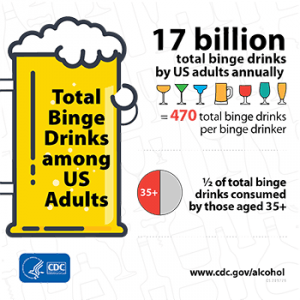
Moreover, the Annual Total Binge Drinks Consumed by U.S Adults of 2015 announced that 1 in 6 adult Americans binge drinks about 4 times in a months, consuming about 7 drinks per drinking session. This makes a grand total of of 17.5 billion total binge drinks in a year, or 467 drinks per binge consumer.
Moreover, the same analysis reports that binge drinking is popular among younger adults aged 18 -34 years, but more than a half of the total binge drinks are consumed by people aged 35 or older. Additionally, the Centers for Disease Control and Prevention reports that about 4 in 5 binge drinks are consumed by men,. The U.S. states with the most binge users are Arkansas, Mississippi, Kentucky, and Hawaii.
Excessive alcohol use was responsible for around 88,000 deaths between 2006-2010.
Binge Drinking Among College Students
Drinking among college students has become a tradition that most of students see as a rite of passage into the higher education experience. However, most enter into college life with well-established drinking habits that started in their teen years, usually around the age of 13. Then, binge drinking peaks in young adolescents aged 18 to 22, and slowly decreases.
So, how many college students are current binge drinkers?
According to SAMHSA’s NSDUH survey of 2014 , about 60% of college students drank alcohol in the past month, while 2 of 3 students engage din binge drinking.
But binge drinking may cause serious problems to the health of these young lives…
A survey published in the Journal of Studies on Alcohol and Drugs reported that about 1,825 college students between the ages of 18 and 24 die from alcohol-related unintentional injuries, including motor-vehicle crashes. Moreover, National Institute on Alcohol Abuse and Alcoholism reported that about 696,000 college students are assaulted by another student who has been drinking, while about 97,000 students report experiencing alcohol-related sexual assault or date rape.
Additionally, this study reports that 1 in 4 college students had academic problems (missing classes, poor exams and papers, low grades, and/or fall behind in class) due to alcohol use. Also, binge college drinkers who had at least 3 drinking sessions per week were 6 times more likely to perform poorly on a exam or a project, and 5 times more to miss a class than students who drank but never binged.
Tragically, NIAAA reported that 20% of college students meet the criteria for alcohol use disorder.
It’s better to drink in moderation,than to binge drink.
Don’t start to binge drink just to fit on your college campus, choose what’s best for you!
Binge drinking may become a problem when you start bingeing too often and/or drinking too much.
But it can be hard to tell the difference or to spot a real drinking problem. For example, some people may drink a lot in one session, but don’t have a drinking problem. The main point is that you have a drinking problem when drinking affects your life and causes negative consequences.
Some main signs of having a drinking problem include when you:
Black out or have trouble remembering what you did while drinking.
Cannot cut back on drinking.
Continue to drink despite negative effects on your health.
Drink more than you intend.
Engage in dangerous activities such as violence or driving drunk.
Experience a strong urge for drinking.
Experience withdrawal symptoms when you quit/cut down.
Have an increased tolerance for alcohol.
Have tried but cannot quit drinking on your own.
Have problems at work/home/school due to drinking.
Have problems with family and friends because of your drinking.
Lose interest in hobbies and activities because you want to drink.
If you have some of these signs, you may need to reach out for help. DON’T WAIT!
Drinking too often + Drinking too much = RISKY DRINKING!
Get Help for a Drinking Problem
Do you think that you may have a drinking problem? Get help as soon as possible!
Don’t be afraid, just reach out…
It can be hard to quit alcohol on your own, but don’t lose hope… today’s treatment programs customize the experience to match your needs.
So, where should you look for help?
1. Find a therapist.
Talk therapy is one of the most efficient for treating alcohol problems. You can learn how to find a therapist to talk through the issue by seeing this Psychology Today article here.
2. Find an addiction specialist.
Doctors who have specialize in addiction medicine can provide addiction diagnosis, prevention, intervention, screening, and treatment. Find a specialist certified by the American Board of Addiction here.
3. Find a psychotherapist.
You can ask for help from a psychotherapist for your drinking problems. This includes one-on-one therapy, family therapy, or couples therapy. You can find a therapist via the American Psychological Association’s online therapist finder here.
4.Ask help from a psychiatrist.
Psychiatrist are proven doctors that can help you deal with alcohol dependence. Find a qualified psychiatrist on the American Psychiatric Association (APA) website.
5. Call our helpline.
If you have a hard time dealing with excessive alcohol use, call the number you see on our website. Our addiction recovery specialists can talk to you about your drinking problems, and can help you find a way to deal with it.
Whether in the stands or the media, the consumption of alcohol is ever-present and widely celebrated in the world of sport. And with the 2018 World Cup providing the most recent example, it raises the question, does football promote binge drinking?
If this year’s World Cup has taught us anything, it’s that football and drinking still very much go hand-in-hand. Amid all the excitement and heartache throughout the tournament, alcohol maintained a very active presence in the media. Granted, much of it was due to the huge amounts of beer being thrown in the air to celebrate goals being
scored, but it’s clear that binge drinking was being given the green light for such a special occasion.
In this post, we’ll discuss the role of alcohol in football fandom and whether or not it encourages people to have “one too many”.
Alcohol Sponsorship in Football
For many years now, a wide range of beer and spirit brands have sponsored football teams and tournaments. Prime examples include Liverpool featuring the Carlsberg logo on their shirts, and the English League Cup spending several years under the mantle of “The Carling Cup”.
And while alcohol sponsorship on team shirts is substantially less common these days — with gambling and apps seemingly taking its place — there’s still a great deal of it being featured on pitch-side banners, as well as in pre and post-match television ads.
Although it would definitely be a reach to suggest that sponsorship in football alone is responsible for widespread binge-drinking, it’s safe to say that it’s established a link between the two. For many, this has been enough to promote the idea that:
Football is more enjoyable while under the influence.
Are We Ignoring the Obvious?
Considering that we live in an era where the awareness and treatment of alcohol addiction is held in such high regard, it’s surprising that the dangers of excessive drinking are somewhat ignored when it comes to football. And while it’s fair to say companies aren’t forcing their customers to drink in excess, the encouragement from advertising is a massive influence.
It’s especially worrying when you consider how many young fans associate football with alcohol consumption, and develop a binge drinking habit early on, due to the established routine of getting drunk.
The Impact of Binge Drinking
The definition of binge drinking is consuming a large amount of alcohol in a short period of time. Your body can only process one unit of alcohol per hour, which is worrying, because the average pint of lager contains 2-3 units.
A football match lasts for ninety minutes (plus 15 minutes for halftime), and, during this time, it’s safe to say the average fan will polish off several drinks.
Binge drinking can severely impact your mood and mental health, and it’s often the catalyst that fuels violent or hostile situations during football matches. When alcohol is flooded into your system over such a short period of time, it can also harm your liver and kidneys, especially if you binge drink on a regular basis.
Signs of a Problem
The definition of binge drinking is to consume lots of alcohol (6 units or more) in a short space of time, or drinking with the intention of getting drunk. For some, this will occur once or twice a month and have no long-lasting problems, but for others, binge drinking can become a regular or even daily habit. Here are some of the signs that your binge drinking is developing into a more serious problem:
1. You Can’t Consume Only a Small Amount of Drinks.
One of the most common signs of problem drinking is an inability just to have one or two drinks. Drinking a lot of alcohol because you are unable to stop once you’ve started is not only a sign of a binge drinking problem, but it’s also a red flag for alcohol dependence.
2. Drinking with the Intention of Getting Drunk.
There’s a big difference between having a few drinks and ending up drunk and going out with the sole intention of getting drunk. Regularly drinking to the point of intoxication can be harmful for several reasons, so it’s not something that you should aim to achieve and definitely shouldn’t be your reason for drinking alcohol.
3. Drinking Quick.
While many people like to sit down and enjoy a cold beer, a glass of wine with some food, or a tasty cocktail at a bar, there are others who finish or ‘down’ their drinks as quickly as possible. This is a common tactic of a binge drinker as it allows them to get drunk as quickly as possible and alcohol is simply treated as a means to an end, rather than an ingredient of an enjoyable beverage.
4. Drastic Personality Change.
The overindulgence of alcohol can often bring out a different side of people, causing them to act in ways that can potentially put themselves or others in danger. For example, when someone is sober, the concept of drinking and driving would seem ludicrous. However, they might be able to justify getting behind the wheel after a period of heavy drinking.
5. Aggression and Violence.
Several studies have revealed a link between binge drinking and aggressive or violent behaviour. Alcohol can massively influence how you respond to certain situations. So when you’re drinking, things can get out of control due to aggressive behavior. Combine that with other drunk people and there’s a recipe for aggravation and altercations.
What You Can Do About It
When it comes to excessive binge drinking the first and most important step is recognising that there’s a problem. Then, depending on the severity of the issue, a decision needs to be made about how you can go about reducing your intake and attitude towards alcohol. Everyone is different and will respond positively to different solutions. If you or someone you know is having problems with binge drinking then one of the following is advisable:
Remove Yourself from Toxic Environments.
Regular binge drinking isn’t necessarily a sign of alcoholism or alcohol dependency, in many cases, it’s simply down to the fact that you’re spending too much time in environments that promote the consumption of alcohol. The best way to remedy the situation could simply be a case of not going out for a while or avoiding hangouts such as bars and clubs, but it may require more drastic action such as not socialising with friends who insist on binge drinking regularly.
Try to Detox.
Binge drinking often occurs when you get into the routine of going out every weekend. Detoxing is not only a great way to give your body a much-needed rest from boozing, but it also allows you to break the habit and reduce the likelihood of you slipping back into a binge drinking routine.
Seek the Help of Professionals
Drinking alcohol to excess on a regular basis can have a severe impact on your physical and mental health, and if you’re struggling to reduce or give up drinking then you should seek professional help. Your doctor will be able to provide advice and guidance regarding any health issues you may be experiencing due to alcohol. However, if you’re looking for detox treatments and sobriety guidance then your best bet is a specialist rehab or addiction clinic.
In Conclusion
Whether or not football promotes binge drinking will always be a matter of opinion, but the environment and atmosphere it creates for fans is an undeniable influence. An influence, of any nature, can be enough to turn “a few drinks” into a bout of binge drinking. For the average fan, this may only be once every so often, but, for those who
watch every game at the pub, it could develop into a serious condition.
A new WHO report found that alcohol-related deaths continue to be a major issue, particularly among men.
More than 5% of worldwide deaths can be attributed to alcohol, according to a new report.
The data was part of a report from the World Health Organization (WHO) that is released every four years, according to the Guardian.
The report found that of the approximately 3 million alcohol-related deaths per year, about 2.3 million in 2016 were men. It also noted that nearly 29% of deaths caused by alcohol were the result of injuries, including driving incidents and suicides.
A standout finding of the report was the toll that alcohol takes on younger generations. For example, the report found that 13.5% of deaths in those in their 20s were linked to alcohol somehow, while alcohol was held responsible for 7.2% of premature deaths in all.
Despite the fact that worldwide alcohol-related deaths have decreased from 5.9% to 5.3% since 2012, Dr. Vladimir Poznyak, a WHO alcohol-control expert who was involved in the report, tells the Guardian that the results are not something to take lightly.
“Unfortunately, the implementation of the most effective policy options is lagging behind the magnitude of the problems,” he said. “Governments need to do more to meet the global targets and to reduce the burden of alcohol on societies; this is clear, and this action is either absent or not sufficient in most of the countries of the world.”
Additionally, Poznyak added that the numbers in the report were likely an underestimate.
“Alcohol use starts in many countries well before [age] 15, so that is why we can say that our estimates are quite conservative, because we don’t count at all the impact of alcohol consumption on kids below 15,” he told the Guardian.
On a more positive note, the report also detailed the fact that in some regions, such as Europe and the Americas, the number of drinkers is decreasing.
In Europe, consumption per person has decreased from 10.9 liters of pure alcohol in 2012 to 9.6 in 2016. Even so, Europe remains the region where the most alcohol is consumed overall.
Rajiv Jalan, professor of hepatology at University College London, tells the Guardian that one of the main concerns in the UK is the age of consumption. The report found that 44% of 15 to 19-year-olds in the region are considered “active drinkers.”
Jalan added that it is very concerning that alcohol accounts for 10% of deaths in Europe.
“The biggest problem that we have is that, certainly in Europe and if you focus more on the UK, there isn’t really a strategy which is all-encompassing in order to address this death rate. All the different elements that are known to work have not yet been implemented.”
A new study investigated how the main ingredient in energy drinks affected behavior.
Red Bull, according to the company itself, does not have any dangerous effects when mixed with alcohol. However, a new study indicates that this may not be the case—at least not with zebrafish.
According to Esquire, researchers from the University of Portsmouth and the Federal University of Santa Maria in Brazil took a common energy drink ingredient called taurine, mixed it with alcohol and tested it with zebrafish.
The zebrafish that were given the combination were then compared to zebrafish that had been exposed to water, taurine or alcohol separately. The fish, Esquire reports, were then observed to see how they interacted with one another and how they responded to potential threats.
Researchers found that the fish that had been exposed to alcohol and taurine combined were less likely to socialize with the other fish and were more likely to engage in risky behavior, like spending time in what researchers referred to as a “predator zone.”
“Taken together, these data appear to suggest that mixing alcohol and taurine might be a factor in increasing some of the negative effects of alcohol,” said Dr. Matt Parker, study co-author and senior lecturer at the University of Portsmouth, according to ScienceDaily. “People should be aware that drinking energy drinks in combination with alcohol may impair their judgement, and should do so with caution.”
Parker also stated that this particular study was the first of its kind to indicate that mixing alcohol and energy drinks can increase the risk of behaviors like fighting and violence.
“Binge drinking and general alcohol misuse is a key problem in the UK and across the world, with the numbers of hospital admissions resulting from illness or injury following intoxication costing the NHS millions per year,” Parker told Science Daily. “Alcohol reduces our inhibitions, and in low doses can cause relaxation and euphoria. However, in higher doses this low inhibition can cause problems with fighting or risky behavior. Zebrafish have similar biological and behavioural responses to alcohol, and are a highly social species, making them ideal for studying the effects of alcohol on behavior.”
While the results of this study seem to imply that the combination of alcohol and taurine can lead to risky behavior, it’s important to note that the study was done on fish, not humans.
Meanwhile, Red Bull maintains that there are no side effects of drinking the beverage with alcohol.
“There is no indication that Red Bull Energy Drink has any specific effect (negative or positive) related to alcohol consumption,” the company’s website reads. Red Bull also states that this claim is backed up by a 2012 decision from the UK Committee on Toxicity.