Tag: black market

  • Despite Legalization, Canada’s Pot Black Market Continues To Thrive

    Despite Legalization, Canada’s Pot Black Market Continues To Thrive

    Officials are hoping that dealers on the illegal market will be priced out.

    Last week Canada became only the second country in the world to legalize recreational marijuana, but the black market for pot is continuing to thrive as customers seek out products that they can’t buy legally, including edibles, and sellers push back on government intervention in their industry. 

    “We’ll keep selling what we are selling,” Don Briere, the owner of an illegal Vancouver pot shop, told The New York Times. Briere sells edibles and other products that are currently illegal under the national law, which only allows for the sale of fresh or dried cannabis, seeds, plants and oil. 

    Canada—especially Vancouver—has long had a thriving illicit marijuana industry, worth an estimated 5.3 billion Canadian dollars each year.

    One of the aims of legalization was to close the illegal shops that are common in cities like Vancouver. 

    However, Briere and other industry insiders object on principle. “The government taking over the cannabis trade is like asking a farmer to build airplanes,” he said. He’s not alone. In Vancouver, hundreds of illegal shops remain open.

    At a lower level, street dealers try to entice customers by offering services like delivery and selling joints at a two-for-one price. Some customers who were frustrated that legal stores ran out of product went back to their illicit contacts. 

    “Definitely going to use my dealer from now on his business is going way up because of your crappy service,” one frustrated customer wrote on Twitter.

    Despite the disregard for the law, Canadian law enforcement isn’t likely to step up consequences for people who are selling illegally. They have their hands full dealing with more pressing issues, including fentanyl overdoses, said Chief Constable Del Manak, police chief of Victoria and president of the British Columbia Association of Chiefs of Police.

    However, this doesn’t mean that authorities are oblivious to the fact that the illegal market still exists. “It is naïve to think that just because cannabis is legalized, the criminal will walk away from a highly lucrative industry,” said Del Manak. 

    Mike Farnworth, British Columbia’s minister of public safety, said that the government is hoping that over time the legal market will undermine the demand for illegal sales. “It’s a very Canadian way of doing things,” he said. “It won’t happen overnight.”

    Farnworth added that there won’t be any police raids with “guns and head-bashing.”

    However, in Toronto, police raided five illegal pot shops after the legalization law was passed. Others have voluntarily closed, showing that the government’s approach might be working. Even Briere has shuttered some of his stores across the country and is applying for licenses for the remaining stores. 

    Officials are also hoping that dealers on the illegal market will be priced out. Today, marijuana on the street costs about one-third of what it did five years ago, making it less lucrative for dealers.

    View the original article at thefix.com

  • Counterfeit Pill Ring Ran Out Of Vacant Apartment Busted By Police

    Counterfeit Pill Ring Ran Out Of Vacant Apartment Busted By Police

    The building’s super allegedly used a vacant apartment and boiler room to manufacture and package the illicit pills. 

    Three men were arrested and charged in the Bronx with alleged production and distribution of black market pills. Lab tests determined that pills said to be oxycodone were actually a dangerous mixture of heroin and fentanyl, while the 50 purported ecstasy pills contained pure methamphetamine.

    ABC 7 News reported that the men involved, Agustin Vasquez Chavez, Yefri Hernandez-Ozoria, and Roberto Castillo, are facing multiple drug charges after two separate arrests.

    The first arrest occurred in July when undercover cops on 201st Street and Grand Concourse purchased two bags of pills for $5,000. Chavez and Ozoria allegedly sold 860 pills as oxycodone and another bag of 50 pills as ecstasy (or MDMA).

    On September 11 police executed a second sting operation and arrested Chavez and Ozoria. Police confiscated approximately 3,000 purported oxycodone pills that looked to match the pills purchased on July 31.

    Law enforcement is awaiting the results of DEA laboratory analysis.

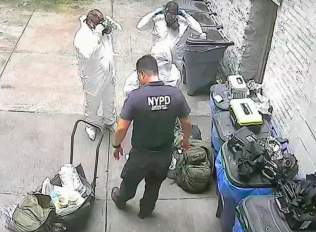
    Roberto Castillo is the superintendent of a five-story apartment building in the Bronx. Castillo allegedly used a vacant apartment and boiler room in this building to package and manufacture pills. Castillo worked with Chavez and Ozoria, who allegedly sold the manufactured and falsely labeled drugs in a large-scale black market pill distribution ring.

    All three men were arrested and charged on September 11 in connection with an alleged conspiracy to produce and distribute black market pills containing heroin, fentanyl, and meth, officials said. Chavez and Ozoria were arrested first, after which police were granted permission to search the boiler room and vacant apartment in Castillo’s building. There, in the boiler room, police found a pill press machine. 

    The boiler room and apartment were being used as a pill manufacturing operation, which included a pill press machine, pill press imprints designed to create oxycodone markings, multiple surgical masks and a vacuum sealer. The apartment contained a refrigerator filled with yet-unknown substances in assorted colors, as well as drug paraphernalia such as cutting agents, grinders and containers.

    According to an official, 420 grams of a heroin/fentanyl mixture were found in a suitcase, in addition to nearly 180 grams of methamphetamine and approximately 1,000 counterfeit oxycodone pills.

    “Narcotics traffickers have long exploited the nation’s high demand for pain pills, a powerful gateway to addiction, but this investigation reveals an even more deviant scheme—an organization creating and distributing counterfeit pills with highly potent and lethal compounds, manufactured in an apartment right next to the boiler room,” said Special Narcotics Prosecutor Bridget Brennan in a statement.

    View the original article at thefix.com

  • Lack Of Suboxone Access Leads Users In Need To The Black Market

    Lack Of Suboxone Access Leads Users In Need To The Black Market

    President Trump is expected to sign a bill to expand medication-assisted treatment but it remains unclear as to how soon that will take place.

    A new feature by NPR underscores a potentially dangerous conundrum for health care professionals and individuals seeking treatment for opioid use disorder: while buprenorphine (also known as Suboxone, Subutex and Zubsolv) has proven effective in blocking the effects of opioids, it’s also difficult to find and a challenge to obtain due to federal limits on prescribers.

    As a result, many prospective patients have turned to the illicit market, where Suboxone can be obtained via diversion, or from patients who sell or give away their own prescriptions.

    President Donald Trump is expected to sign a bill to expand medication-assisted treatment (MAT), but as NPR noted, it remains unclear as to how much access will be granted and how soon that will take place.

    Along with methadone and naltrexone (Vivitrol), buprenorphine is one of three federally-approved drugs to treat opioid dependency.

    As the NPR feature stated, while it is less potent than heroin or prescription opioids, including fentanyl, it is possible to overdose on buprenorphine if mixed with other substances.

    But such instances are rare, especially when the drug is formatted with the overdose reversal drug naloxone. As Dr. Zev Schuman-Olivier, an addiction specialist and instructor at Harvard Medical School, said, “The majority of people are using it in a way that reduces their risk of overdose.”

    Despite its effectiveness and relative lack of harmful side effects, obtaining buprenorphine is subject to federal regulations in regard to who can prescribe it—medical professionals need a special waiver to do so—and how much can be obtained. Currently, those doctors that meet the federal requirements to prescribe buprenorphine are limited to treating 275 patients.

    Nurse practitioners and physician assistants may apply for a waiver to administer the medication as well. Under the SUPPORT for Patients and Communities Act, the number of such health professionals and the length of prescription may be increased.

    Until that bill is signed, buprenorphine remains both difficult to obtain and expensive. According to 2016 estimates provided by the U.S. Department of Defense, medication and twice-weekly visits to a certified opioid treatment program are $115 per week or nearly $6,000 per year. That puts the medication out of range for many in need, forcing them to turn to diversion situations for assistance.

    But as NPR noted, that scenario can be dangerous: patients need assistance from a treatment professional for proper dosage and treatment for mental health issues that may come as a part of addiction.

    Diversion has become prevalent enough to warrant calls for more regulations regarding buprenorphine and stronger enforcement against those that break the law. But the NPR story quoted Basia Andraka-Christou, an assistant professor and addiction policy researcher at the University of Central Florida, who said that stricter rules are not what’s needed for patients.

    “I guarantee you, they’re either going to go and buy heroin and get high, which surely is not a great policy solution here,” she said. “Or they’re going to go buy Suboxone on the street.”

    View the original article at thefix.com