Tag: Brett Kavanaugh

  • The Unique Harm of Sexual Abuse in the Black Community

    What makes R. Kelly’s alleged sexual abuse of black girls different than that of other big-name alleged perpetrators, like Woody Allen?

    Originally published May 13, 2019.

    What makes R. Kelly’s alleged sexual abuse of black girls different than that of other big-name alleged perpetrators, like Woody Allen?

    What are the different pressures faced by Anita Hill and Christine Blasey Ford regarding their testimonies of alleged sexual and gender mistreatment by Supreme Court Justices Clarence Thomas and Brett Kavanaugh?

    As the founder of the #MeToo movement, why is Tarana Burke, a black woman, getting death threats from black men?

    The underlying core of these questions is: What really makes trauma traumatic?

    Decades of research on trauma, or physical, sexual or psychological violence, have shown the same thing: Victimization hurts people. Sexual assault in particular can be painful to all who experience it.

    However, as a trauma expert who has studied the effect of violence for over a decade, I have found that there is a unique harm for black people and other minorities whose perpetrators are of the same minority group.

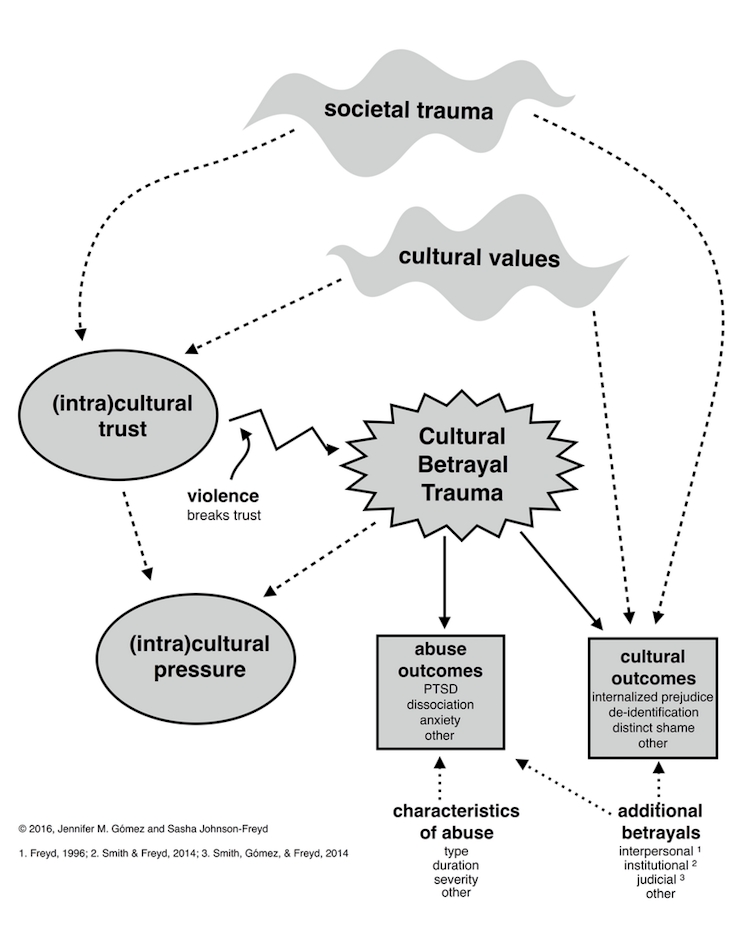
    To understand this harm, I created cultural betrayal trauma theory. The general idea of cultural betrayal trauma theory is that some minorities develop what I call “(intra)cultural trust” – love, loyalty, attachment, connection, responsibility and solidarity with each other to protect themselves from a hostile society. Within-group violence, such as a black perpetrator harming a black victim, is a violation of this (intra)cultural trust. This violation is called a cultural betrayal.

    The Harms of Cultural Betrayal

    Cultural betrayal leads to many different outcomes. CC BY-SA

    Cultural betrayal trauma, which is simply within-group violence in minority populations, is associated with many outcomes that go beyond things that are typically studied with trauma, such as post-traumatic stress disorder. It includes some things not often thought about with trauma, such as internalized prejudice – like a black person believing the stereotype that all black people are violent.

    (Intra)cultural pressure is another outcome of cultural betrayal trauma. With (intra)cultural pressure, people who experience cultural betrayal trauma are often demanded to protect the perpetrators and the minority group as a whole at all costs, even above their own well-being. With the mandate of “don’t betray your race,” (intra)cultural pressure punishes people who speak out about the cultural betrayal trauma they have endured.

    In a recent study, I tested cultural betrayal trauma theory in youth due to the increased risk for trauma and mental health problems in the transition into adulthood.

    I surveyed 179 college women online in 2015. Over 50% of these young women were victims of trauma. Just under half experienced psychological violence, 14% endured physical violence, and almost one in three women were victims of sexual violence.

    Of the young women who were victimized, over 80% reported at least one form of (intra)cultural pressure. This included their ethnic group suggesting that what happened to them may affect their minority group’s reputation. An example of this could be a black woman who has been raped by a black man being told that she should not go to the police because it will make all black people look bad.

    Additionally, I found that controlling for age, ethnicity and interracial trauma, cultural betrayal trauma and (intra)cultural pressure were associated with symptoms of PTSD. Meaning, cultural betrayal in trauma and (intra)cultural pressure were unique contributing factors of mental health problems in ethnic minority college women.

    What Does This All Mean?

    As I analyzed the findings, I was struck by several things:

    • The within-group nature of trauma includes a cultural betrayal in minorities that affects mental health.

    • Trauma gives us only part of the picture.

    • Group-level responses and cultural norms via intra-cultural pressure impact mental health.

    • Policy change that combats inequality, such as changes in education, health care, law enforcement and the judicial system, can benefit minorities who experience trauma.

    These findings have implications for interventions. Such therapy can address the very real threats of discrimination and the necessity for (intra)cultural pressure. At the same time, these interventions can use (intra)cultural trust to promote positive mental health. Additionally, evidence-informed feminist approaches, such as relational cultural therapy, may benefit people who are exposed to both trauma and societal inequality.

    The body of research to date suggests that cultural betrayal may be a unique harm within violence in minority populations, including the black community. As such, the alleged sexual traumas perpetrated by R. Kelly and Clarence Thomas have a cultural betrayal that isn’t found in Woody Allen’s alleged abuse. Moreover, black men’s death threats against Tarana Burke are (intra)cultural pressure that is laced with misogynoir, or sexism in the black community.

    Research that incorporates societal inequality can help us understand what makes trauma traumatic. In doing so, our social reactions and therapeutic interventions can ultimately be effective for blacks and other minorities who are exposed to trauma.

    Jennifer M. Gómez, Postdoctoral Fellow in Trauma Psychology, Wayne State University

    This article is republished from The Conversation under a Creative Commons license. Read the original article.

  • Blackouts and Memory Gaps: How Alcohol and Trauma Affect the Brain

    Blackouts and Memory Gaps: How Alcohol and Trauma Affect the Brain

    Dissociation is most common in trauma that involves a betrayal of trust. This is a survival mechanism that protects our need for social support.

    Sober October has ended and now (hopefully sober) November begins. Fall brings the annual three-fold challenge: Thanksgiving, Christmas and New Year’s. This year, the midterm elections have created a fourth stressor and some of us are barely muddling through. Recent events have been especially terrifying—mass shootings, pipe bombs, a new report of catastrophic climate change, and the ongoing nightmare that is the Justice Department’s current mandate.

    Recently, Senator Chuck Grassley (R-Iowa) called for an investigation into allegations made by Julie Swetnick—one of the brave women who accused Brett Kavanaugh of sexual misconduct. Unbelievably, Grassley ordered the FBI to open a criminal investigation—into Swetnick.

    Grassley said that Swetnick’s sworn affidavit was not true. Was this just his opinion? It wasn’t based on FBI reports because he and fellow Republicans would not allow the feds to thoroughly investigate her claims against Kavanaugh—nor anyone else’s.

    “During the years 1981–82,” Swetnick said in her sworn statement, “I became aware of efforts by Mark Judge, Brett Kavanaugh and others to spike the punch at house parties I attended.” She also stated, “In approximately 1982, I became the victim of one of these gang or train rapes where Mark Judge and Brett Kavanaugh were present.” Swetnick said she’d seen Kavanaugh drink excessively at these parties and described him as a mean drunk.

    CBS News video:

    The Brett Kavanaugh Hearing

    In late September, Kavanaugh accuser Dr. Christine Blasey Ford went before the U.S. Senate during Kavanaugh’s SCOTUS confirmation process. There were times during her testimony that I felt sick to my stomach. It was as if she were telling my story. Dr. Ford stated that some of her memories were seared into her mind. She also acknowledged that she wasn’t able to recall every detail from that day. But who remembers every detail of any event?

    It was reassuring when Senator Patrick Leahy (D-Vermont) acknowledged this:

    “Ford has at times been criticized for what she doesn’t remember from 36 years ago. But we have numerous experts, including a study by the U.S. Army Military Police School of Behavioral Sciences Education, that lapses of memory are wholly consistent with severe trauma and stressful assault.”

    But the Republicans were not interested in further investigation and, despite the #MeToo and #TimesUp movements and all of the highly publicized Harvey Weinstein and Bill Cosby survivors, much of the country remains obtuse when it comes to the shared traits of traumatized women: remembering some things but not others, and not telling anyone what happened to them for decades.

    Ford’s assault happened at a party when she was 15, in 1982. When I was 13 I was gang-raped by classmates at an outdoor gathering. Ford tried to forget what happened. So did I. She didn’t want to think about the worst night of her life. Neither did I. It took both of us decades to tell anyone. Ford said: “I convinced myself that because Brett did not rape me, I should just move on and just pretend that it didn’t happen.” Confused and freaked out, I, too, decided to pretend my rape didn’t happen and believed that would “erase” it.

    Ford told the committee: “I tried to yell for help. When I did, Brett [Kavanaugh] put his hand over my mouth to stop me from yelling. This is what terrified me the most, and has had the most lasting impact on my life. It was hard for me to breathe…. Both Brett and [his friend Mark Judge] were drunkenly laughing during the attack.”

    Through much of the hearing I was shaking and sobbing, wiping my eyes so I could see. The identification triggered the sensation that I was reliving my experiences. When she said her mouth was covered, it felt as if mine was, too. I felt like I couldn’t breathe. The laughter from the boys that hurt me is burned into my memory. When I went public with my story in January 2012, I wrote: “[My friend] grabbed me, clamped his hand over my mouth….I tried to scream but it came out muffled. They laughed. I gagged.”

    I became so upset watching the live video that I almost called a close friend. I stopped myself because I knew she’d say, “Stop watching it!” Inspired by Ford’s bravery, I felt a sisterhood during this historical moment. It felt like my duty to bear witness.

    During the hearing, Senator Feinstein addressed Ford: “You were very clear about the attack. Being pushed into the room, you say you don’t know quite by whom, but that it was Brett Kavanaugh that covered your mouth to prevent you from screaming, and then you escaped. How are you so sure that it was he?”

    Ford responded: “The same way that I’m sure that I’m talking to you right now. It’s just basic memory functions. And also just the level of norepinephrine and epinephrine in the brain that, sort of, as you know, encodes—that neurotransmitter encodes memories into the hippocampus. And so, the trauma-related experience, then, is kind of locked there, whereas other details kind of drift.”

    Alcohol Blackouts

    The second half of the Senate hearing was shocking. Who but an alcoholic would mention beer nearly 30 times in a job interview? This was to determine if Kavanaugh was right for a lifetime position on the highest court. He whimpered, cried and lashed out. Did baby need his bottle? When Sen. Klobuchar asked if Kav ever had a blackout, he responded, “Have you?” Twice.

    Video clip of that part of the Kavanaugh Hearing:

    A few days after the Kavanaugh hearing, still feeling wrecked, I reached out to neuroscientist Apryl Pooley, PhD, an expert on the brain and memory and the author of Fortitude: A PTSD Memoir, which documents her road to healing from rape, child abuse, PTSD, and addiction.

    Both Dr. Pooley and I were blackout drinkers. We discussed how unpredictable alcohol is. In my teen years, I blacked out if I drank too much too quickly or hadn’t eaten. But in the last few years of rum and cocaine, I could go into a blackout after one gulp, or I could guzzle 5-6 drinks and feel totally sober. Pooley said her experiences were similar.

    But both of us found it difficult to believe that Kavanaugh was telling the truth at the hearing. It’s possible he didn’t know that he blacked out, but that is highly unlikely. After many of my drunken binges, friends would refer to things I’d said or done that I had no memory of. When I asked them if everybody knew I was that drunk, they’d say no. “You seemed normal, maybe a little high.”

    Pooley said, “I’d be walking around and having conversations. People wouldn’t know if I was blacked out. When someone is blacked out, it means their blood alcohol level is so high that it’s impairing that part of their hippocampus, that part of your brain that encodes those memories.”

    She said that everything you’re doing and seeing may or may not be getting stored in your brain. I asked her about being in and out of consciousness. Sometimes I could remember a snippet of an evening. Chatting with a friend at a bar, but then I had no idea how I got home.

    “That’s called a fragmentary blackout,” she said, “or a brownout. That happens when you are blacked out for a while and then come out of it. That can mean that you’d metabolized some of the alcohol, enough of it to regain that function.”

    She also said that some people might think a blackout means passed out or unconscious, which can also look like you’d just fallen asleep.

    Blackouts from Trauma

    According to Pooley, Ford was correct when she spoke about how the brain and memories work. Ford stated that a “neurotransmitter encodes memories into the hippocampus” which explains that trauma-related experience can be “locked in” whereas other details can “drift.”

    Pooley expanded on that: “When recalling memories of trauma, they can pop into your head if you’re triggered, or when asked about a detail.”

    That reminded me of every episode of Law & Order: SVU. Olivia Benson always asks a traumatized victim specific questions: What did they look like? What were they wearing? Can you remember anything unusual? A logo on a hat, shirt or vehicle? The sound of their voice? What they said?

    “Right!” said Pooley. “Those questions can trigger a flashback. The survivor may remember details about the event but not be able to verbalize them. To an outsider, this may look like they don’t remember or are lying. If the survivor was dissociated at the time of the assault, when they remember it later they may seem surprised or confused at their own memory.

    “If survivors feel unsafe when questioned, they may not be able to use their pre-frontal cortex to understand the questions and retrieve certain memories. That’s because their brain was focused on survival. If triggered, they may experience emotional and sensory memories that are as intense as the trauma itself.”

    Aha! That’s why I was shaking and crying while watching the Kavanaugh hearing. And for days afterward. The PTSD had caused my body to react by reliving what happened to me.

    Research backs up Ford and Pooley’s explanations. Memories may be fragmented and certain details missing.

    “But,” Pooley said, “what the survivor does recall is incredibly accurate. Sometimes you hear the term ‘repressed memories,’ which is probably more accurately referring to memories that were stored during dissociation. Dissociation is a survival reflex that can occur when escape is—or seems to be— impossible. A threat may be perceived by the brain as inescapable because of a physical barrier.”

    Ford was afraid she was going to die when she described Kavanaugh’s hand over her mouth. In my case, dissociation happened when I was pinned by five guys. I’d tried to break free. I floated up to the trees and watched. I could see what the boys were doing to me but it took on a surreal quality. It served as a buffer. I was literally scared out of my mind and my body.

    “A threat can also be perceived by a psychological barrier,” said Pooley. “Dissociation is most common in trauma that involves a betrayal of trust. This is a survival mechanism that protects our need for social support. When the trusted individual betrays you, this is a social threat and social threats are real threats.”

    Ford and I both experienced that. She’d gone to what she expected to be a friendly party with people she knew. I thought the guy who tricked me was my friend. He said he wanted my advice about his girlfriend. Flattered, I practically skipped over. That’s when he clamped his hand over my mouth and threw me to the ground and the other boys surrounded me and held me down.

    Pooley explained: “Many people believe that life-threatening trauma only refers to threats to physical safety—like the presence of a weapon—but humans need social support for survival. So, social threats like bullying, ostracization, or anything that threatens social standing can be interpreted by the brain as life-threatening. If abuse or assault is perpetrated by a trusted individual, not only is the event traumatic, but the social threat of losing the sense of safety from that person [or people] is traumatic as well.”

    If trauma leads to dissociation, Pooley said, that can lead to amnesia. Traumatic amnesia is so common that it’s even included in the diagnostic criteria for PTSD.

    “When all or part of the traumatic experience cannot be remembered,” said Pooley, “the risk for developing PTSD greatly increases.

    Throughout the hearing, and frankly, throughout these past few years, I’ve often felt an overwhelming temptation to get high. My mind and body are so wound up that I crave some kind of relief. Rum and cocaine still hover in my mind, pretending to offer salvation. Thankfully my years in recovery have taught me not to listen to my head when it’s trying to get me high, not to keep secrets, and to make time to meditate, keep a journal, draw, hug my dog, and most importantly, remember to breathe.

    If you are shaken by the Kavanaugh Hearing, and especially if it has kicked up flashbacks, there is help. The same is true for anyone who is scared about the midterm election or having panic attacks and high anxiety.

    You can reach out to RAINN, the nation’s largest sexual violence organization. Their website is RAINN.org or you can call their hotline 24/7 at 800-656-HOPE. For any kind of mental health help including addiction, PTSD, or thoughts of harming yourself please visit the National Alliance on Mental Health’s list of hotline resources.

    View the original article at thefix.com
  • Post-Kavanaugh, Women’s Self-Care Needs to Lose the Alcohol

    Post-Kavanaugh, Women’s Self-Care Needs to Lose the Alcohol

    Alcohol, when construed as the first or best line of self-care, actually renders us less effective in resisting an exploitive system that makes legal space for our bodies to be legislated, controlled, and raped.

    “Should we get some wine?” I asked him, pushing a bit of sweet potato around on my plate. I felt my cheeks flush and a weird half smile launch across my lips, the way it always does when I feel embarrassed or awkward or sad or anything really. Whenever I’m feeling anything too much. My partner looked startled.

    “What? Why?” he set his own fork and knife down, leaned back in his chair. “I mean, an IPA sounds really good right now. But I guess, just, what’s the motivation behind it?”

    It had been 62 days since either of us had had anything to drink, thanks to a self-imposed sobriety challenge after I’d watched my already heavy alcohol consumption creep up and up and eventually become overwhelming in the years since Trump’s election, post-Access Hollywood tape, post-everything. Two months was a long time, I reasoned now. A quality effort. And in all likelihood, an accused sexual predator would sit on the Supreme Court when we woke up the next morning. If there was ever a good reason to nurse a nice bottle of beer to ease some of the anxiety, fear, anger and hopelessness I was feeling, both as a woman and a victim of past sexual abuse, now was it.

    Wasn’t it?

    “I mean, would this be about escaping things?” he continued, gently, pushing, asking the question I had begged him, at the start of our not-drinking, to raise when I inevitably said I wanted back off the wagon. Because the answer was, is, will always be: Of course.

    Of course. I have made a lifestyle out of escaping things, of turning away from what’s hard and ugly and painful. Either that or confronting darkness only when I was a couple of drinks in or after I’d settled beneath the protective blanket of Klonopin or during the rush of false energy following a purge, all the food I’d consumed vomited up and flushed quietly away. In a very real way, I can trace my life as a ping-pong game of silences and rages, each assisted along by some substance or behavior I’ve begun to describe as “not me,” in that they’ve all been designed to take me out myself and, as a result, out of proper caring—for this world, its injustices, its humanness, its pain.

    There’s a lot of rhetoric around the usefulness of women’s rage right now, but what keeps getting left out is how, so often, we (middle-class, white women) use anger to stand in for or erase action. How, so often, anger becomes the justification for harm. And for me—and the rising number of American women turning to alcohol to deal with stress, trauma, and its aftereffects—that often takes the shape of self-sabotage in a bottle to numb out, ease anxiety, filter boredom, help us slip into apathy dressed up as protection and self-care. Let me be clear, and I speak from experience: Drowning your sorrows is the opposite of self-care.

    Wine will not heal your wounds, will not even tend to them, no matter what the patriarchal messaging around alcohol promises you. And I say patriarchal because it’s true: Our American culture of binge-drinking and heavy alcohol consumption is directly and implicitly tied to the capitalist, racist, structural misogyny upon which our country is founded—and through which marginalized groups are subjugated, oppressed, and continually, insistently Othered. We only have to look to history to see the ways in which alcohol was used to keep said groups under the heel of white men in power: White Europeans, for example, notorious for their “extreme drinking” on the frontier, encouraged both alcohol trade and excessive consumption among Native populations, later weaponizing the stereotype of the “drunk Indian” against them. Years later, slave masters on Southern plantations developed strategies to carefully control slaves’ access to alcohol during the week, only to encourage them to drink heavily on Saturday evenings and special holidays. Frederick Douglass later castigated the so-called controlled promotion of drunkenness as a means of keeping black men and women in “a state of perpetual stupidity” that reduced the risks of rebellion. More recently, increased experiences of racism have been explicitly, causally linked to riskier drinking among black women on college campuses. Meanwhile, growing wealth, educational, employment, housing and health disparities between minorities and white Americans have led to a much greater increase in alcohol consumption among those communities between 2002 and 2013, a study published in JAMA Psychiatry suggests (although it’s not much of a stretch to say that increase is significantly greater in our Post-Trump world of racist nationalism, its cruel policies, and resulting demoralization among the people affected the most).

    Alcohol, too, has become the primary coping mechanism for women in America, regardless of race or ethnicity: Overall, female alcohol use disorder in the United States has increased by 83.7 percent, according to that same study. High risk drinking among women, defined as more than seven drinks in a week or three drinks in a day, has increased by 58 percent. We only have to look at mommy or work wine culture to see the ways in which alcohol is used to keep women quiet, dulled, apathetic and convinced they need booze to survive motherhood or employment or both. So perhaps it is no surprise the contemporary rhetoric of white feminism is rife with messages that draw a supposedly intuitive connection from anger to self-care, which is inevitably linked to drinking. We get tired? We pop open a bottle. We get scared? We fill a glass. We get angry? We rage over shots or cocktails or champagne. None of this helps us. In fact, all of this renders us less effective in resisting an exploitive system that makes legal space for our bodies to be legislated, controlled, and raped.

    “The master’s tools will never dismantle the master’s house,” Audre Lorde famously said in her 1984 call to and critique of the internalized patriarchy of white Western women. Alcohol, when construed as the first or best line of self-care, I’d argue, is one of the master’s tools. We indulge in the drinks that American culture (and American feminism) says we deserve, and we get raped while the men who were drinking alongside us get off and then get nominated to the Supreme Court. It’s a double bind—one that bears calling attention to, however hard it is to look at. We should be able to say that it’s absolutely, undeniably immoral for a man to abuse a woman’s body while she is drunk (or sober or somewhere in between). That rape or abuse is never a woman’s fault because of what she was drinking (or wearing or saying or where she walking or what time of night it was, etc., etc., forever, etc.). And we should also be able to challenge the messages that encourage a woman to relax or to rage or to start a revolution only after she has a glass of wine in her hand. 

    Alcohol is a depressant. It anesthetizes our pain and our power, our minds and our bodies, and we will need all of ourselves to fight what will come in the next weeks, months and years as those same bodies become the battleground upon which men’s petty force and overwhelming self-hatred wage war. Look, I’m barely nine weeks sober. I never hit the rock bottom people describe in AA or alcohol recovery programs. I don’t know if I plan on a lifetime of sobriety or if I’ll have a celebratory beer after I finish grading all of my students’ papers over fall break. What I do know? I spent years using alcohol to avoid the work I knew I should be doing. The healing I knew should be seeking. I know many women who don’t drink, who don’t turn to alcohol to deal with exhaustion and fear and heartbreak. I know many, many more who do. I’m not advocating for prohibition or teetotalism. But I am asking women—white women in particular—to take a hard look at what they mean when they say self-care, and what they’re hoping to accomplish by drinking their way through.

    We certainly don’t need #BeersforBrett, the hashtag that surfaced among white, wealthy men celebrating Kavanaugh’s confirmation Saturday. But we definitely don’t need feminist cocktails, either, as I saw recently championed on a Facebook group for women scholars and rhetoricians. Jessa Crispin has warned white women against misconstruing the philosophy of self-care that Audre Lorde conceived of as way for activist women of color to ease some of the burden of dismantling racism and misogyny while living at the very intersection of such oppression. “Now it’s applied to, I don’t know, getting a blowout,” Crispin writes. “And pedicures. Even if your pedicurist is basically a slave.” Especially if you’ve got a glass of champagne to assist you along in ignoring that reality. So, no. We don’t need rage if we’re going to use it as an excuse to drink, to sink into dispassion.

    We need real action. We need true healing. I didn’t need wine on Friday night, and the community of women I want to support through this troubling time didn’t need me buzzed or drunk or hollowly chill. We need the opposite of that. In our activism and in our downtime, we need a clear-eyed, hangover-free commitment to dismantling absolutely everything that violates us—whether through false comfort or force, apathy or abuse.

    View the original article at thefix.com

  • Trump Says Sobriety Is One Of His "Few Good Traits"

    Trump Says Sobriety Is One Of His "Few Good Traits"

    The president went on to say that he would “be the world’s worst” if he drank. 

    President Trump told reporters on Monday that his sobriety was one of his “few good traits.”

    “I’m not a drinker. I can honestly say I’ve not had a beer in my life. That’s one of my only good traits. I don’t drink,” Trump said, according to ABC News. “I’ve never had alcohol, you know, for whatever reason. Can you imagine if I had what a mess I’d be?”

    The president went on to say that he would “be the world’s worst” if he drank. 

    Alcohol came up during the press conference in relation to Supreme Court nominee Brett Kavanaugh who has been in the spotlight for an alleged sexual assault that reportedly took place when he was drunk. During a congressional hearing he was open about the fact that he enjoys alcohol. “Yes, we drank beer. My friends and I, the boys and girls. Yes, we drank beer. I liked beer. Still like beer. We drank beer,” Kavanaugh testified.

    “I was surprised at how vocal he was about the fact that he likes beer,” Trump said. “He’s had a little bit of difficulty. I mean, he talked about things that happened when he drank. This is not a man that said alcohol was absent.”

    On Monday night, Jimmy Kimmel picked up the comments on his late night talk show, saying it was alarming that anything about the potential Supreme Court Justice would surprise the president who is trying to appoint him. 

    “After the Kavanaugh hearing last week, it was really hard to enjoy a beer this weekend,” Kimmel said. “Imagine being so off the rails, you even surprised Donald Trump with something.”

    “By the way, I feel like it’s worth mentioning that this guy who has never had a drink in his life once had his own brand of vodka with his name on it,” Kimmel pointed out. “That’s kind of all you need to know about him.”

    Trump’s brother died from complications of alcoholism at the age of 42, which is part of the reason why Trump doesn’t imbibe, the president has said in the past. 

    “He was a great guy, a handsome person. He was the life of the party. He was a fantastic guy, but he got stuck on alcohol,” Trump told People in 2015. “And it had a profound impact and ultimately [he] became an alcoholic and died of alcoholism.”

    After seeing his brother’s struggle, Trump decided to stay away from booze. 

    “I’ve known so many people that were so strong and so powerful [yet] they were unable to stop drinking,” he said. 

    View the original article at thefix.com

  • Brett Kavanaugh’s Classmate Detailed Drunken Behavior In Memoirs

    Brett Kavanaugh’s Classmate Detailed Drunken Behavior In Memoirs

    Kavanaugh’s prep school classmate’s 1997 memoir features a drunken character named “Bart O’Kavanaugh.”

    Brett Kavanaugh’s nomination to the Supreme Court is still under review, as the court looks into accusations of sexual assault brought against Kavanaugh by a former classmate, Christine Blasey Ford.

    Details from the memoirs of Kavanaugh’s old high school friend, Mark Judge, may give important context.

    Ford has come forward to assert that in the early ’80s at a high school party, a drunken Kavanaugh allegedly pushed her down in a bedroom, covered her mouth and attempted to pull her clothing off. Another drunken young man, Judge, “piled on” the two and knocked them over, allowing Ford to run and hide in a bathroom.

    Ford’s accusation was backed by notes from her therapist in 2012 and 2013 when Ford discussed a sexual assault she endured in high school by an elitist prep, as well as a chilling detailed account recalled by a friend of Ford’s.

    Judge has denied that he saw a sexual assault take place and that in addition, aggressive sexual behavior—as Ford described—was out of character for the young men attending Georgetown Prep at the time.

    However, Judge’s own past writings illuminate a sex-driven, misogynistic and drunken culture at the school.

    Judge has written two memoirs, both of which depicted Georgetown Prep as a sexually aggressive environment where students abused alcohol regularly and attended “masturbation class,” according to the Independent.

    In his 2005 memoir, God and Man at Georgetown Prep, Judge wrote about his senior year, when he co-published the school’s underground student newspaper with a focus on the school’s intense party scene.

    One issue co-published by Judge pictured a Georgetown music teacher at a bachelor party “chugging a beer, surrounded by a group of us with raised mugs, sitting down while being entertained by the stripper.”

    Judge’s memoir Wasted even has a drunken, vomiting character named “Bart O’Kavanaugh.” Judge is now a self-claimed conservative moralist who has written that there is no excuse for rape.

    He has also written that “social justice warriors” confuse rape with innocent demonstrations of masculinity. He continued that there is “an ambiguous middle ground, where the woman seems interested and indicates, whether verbally or not, that the man needs to prove himself to her.”

    Judge concluded, “If that man is any kind of man, he’ll allow himself to feel the awesome power, the wonderful beauty, of uncontrollable male passion.”

    This thought was linked to a scene from the 1981 film Body Heat—the same time period that Ford alleges she was attacked by Kavanaugh—in which a man shatters a large glass window and then violently throws the woman on a table, where they have sex.

    View the original article at thefix.com