Entertainment during the pandemic doesn’t have to mean staring at a screen. Dip into our back catalogue of chats from our digital detox podcast to find out how people from all walks of life get a good screen:life balance;
Professor and author Cal Newport talks about his philosophy of ‘digital minimalism’ and why he has never had a social media account.
Founder of international lifestyle business kikki.k, Kristina Karlsson talks on the digital detox podcast about how to juggle life as an entrepreneur whilst still getting a good work:life and tech:life balance.
New York Times best-selling author and TED speaker Johann Hari talks about addiction, depression, anxiety and community and how we’re all looking for connection in the wrong places.
Award-winning explorer and UN Patron of the Wilderness Ben Fogle and his wife Marina talk about the challenges of parenting, and being a mindful partner, in the age of smartphones.
Journalist and TV presenter Tim Lovejoy chats about phone addiction and having a thin skin in a world of 24:7 celebrity culture, including what he said to Will.i.am when he started browsing his phone live on air.
Kelsea Weber from global repair community iFixit, talks about the environmental impact of our smartphone habits and what we can all do to counter the growing mountain of eWaste.
Celebrity photographer Dan Kennedy discusses maintaining focus in a permanently distracted world and how he has designed his working life to minimise distraction and maximise productivity.
Behavioural Change Specialist Shahroo Izardi talks on our digital detox podcast about the secret behind developing, and sustaining, healthy habits and how to apply that to our phone habits.
Social sex entrepreneur Cindy Gallop talks about why she believes online porn has become sex eduction by default, and why she’s pro-sex, pro-porn, pro-knowing the difference.
The former Deputy Leader of the UK Labour Party, Tom Watson, chats in a special lockdown episode about what this unprecedented period of intimate isolation may mean for our relationship with tech, and about the levels of abuse politicians routinely have to put up with online.
‘Craftivist’ and Founder of Badass CrossStitch Shannon Downey talks about using social media for good to connect communities across a physical divide and how keeping our hands busy stops them grabbing for our phones!
Activist and campaigner Seyi Akiwowo talks about what we can all do to stem the uncontrollable tide of online abuse and learn to be better digital citizens along the way.
Influencer power couple Vex King and Kaushal Beauty talk about they get screen:life balance with their huge online followings of over 3 million between them, and how they’re using their platforms to give back.
We’d love to get feedback from you on what sort of guests and topics you’d like to see on Season Four of the podcast. Drop us a line with any thoughts, or any feedback on the first three seasons. Let us know who was your favourite episode so far, and why! Stay safe everyone and keep using your screen time wisely.
Zoom seems to have taken over our lives. We’re all flocking to the video conferencing platform to keep in touch, both for work and play. But the huge increase of users has highlighted worrying safety issues on a platform that’s struggling to cope. These are particularly concerning for young users using the platform for distance learning. In a worrying trend, hackers are breaking in to join Zoom meetings uninvited and then broadcasting inappropriate content – dropping a so-called ‘Zoom Bomb’. Only last week in the UK, hackers broke into a Zoom virtual classroom in Scotland and broadcast child abuse to 200 children and parents during an online swimming ‘training session’. Here are six steps you can take to stop the same thing happening to you:
#1 Enable a Waiting Room
When you’re hosting a Zoom call ensure ‘enable waiting room’ is selected. This means that you will be able to check that everyone who joins the call is someone you know and not an unwelcome guest.
#2 Manage Participants
Once the meeting has started you can hit ‘manage participants’ to move people from the ‘waiting room’ into the call. You can also mute or remove participants at any time.
#3 Play Chime for Enter/Exit
Another way to manage this is to toggle on ‘play chime for enter/exit’. This might be an easier system if you are in the middle of the meeting already and do not want to be disturbed mid-flow as it will allow you to hear that people are joining without having to admit them yourself via the waiting room system.
#4 Default Screen Share
One of the most dangerous aspects of Zoom meetings is that people who join can share explicit imagery with all the attendees, so ensure that you have ‘default screen share’ assigned to you, as the meeting host, so that those who join will not be able to post publicly.
#5 Lock the Meeting
Once everyone has joined the meeting you can ‘lock’ it, meaning that anyone who may have found access to the URL or passcode after the meeting has started will now not be able to join. If you know exactly who should be in the meeting, and you can see they’re all there, this is a perfect way to block hackers.
#6 Never post the passcode or URL online
Many different meetings are being hosted on Zoom; public yoga classes, family group chats, business meetings, or online lessons and all of those will have different levels of security. We strongly advise you not to post the details of the meeting link on social media or on a website, but only to distribute it in private and direct messages. Obviously that’s easy if you know the people coming and can contact them directly, but even if you’re offering a public service online you can still ask that people contact you as the meeting/event host via a direct message to get the meeting link, and control the access to prevent it being hacked.
Follow these steps to stay free of the threat of Zoom Bombs in your future meetings. And stay alert, as all these services become more commonly used during the pandemic, there will inevitably be more security issues, and more counter-measures introduced – make sure you’re up to date.
One of the new challenges presented by lockdown measures is that of distance learning. With schools and universities generally closed, students are having to resort to attending class, watching lectures and turning in assignments all online.
Loss of routine, unfitting environments and just all-out strangeness of the present situation can make concentrating on education right now very difficult. However, with it uncertain how long the lockdown will continue for, we all need to be able to adapt and adjust so we can find how to stay engaged, keen and productive in these overwhelming times. Here are 6 tips to make distance learning just that little bit easier:
#1 Structure it
With nowhere we have to be, our days can have very little structure. This can result in long, drawn out and distraction-heavy study sessions. To keep your sessions brief but productive, create some sort of schedule. This can be a fully planned out timetable or even just a checklist. Note that this structure should include having a fixed bed time. Stop working a minimum of few hours before this to allow your brain to wind down; otherwise, you will be too alert to sleep. Sleep shouldn’t suffer just because we have nowhere to be early the next morning!
I personally prefer making a checklist at the beginning of the day of tasks that need to get done. Right now, a lot of us will be finding that our productivity can be hindered by outside events, and we may not be able to concentrate for as long as we timetabled. By focussing on tasks instead of time, we will be less harsh on ourselves if we do slip from schedule, rewarding and feeling good about ourselves when we can physically tick off things we’ve accomplished at the end of the day.
#2 Schedule breaks
Be kind to yourself. Trying to work for too long will just result in concentration lapses and therefore a decline in productivity. Limit the length of your study session so that you are never working for long enough that you get fed up. This will allow you to keep a healthier, happier attitude towards your work.
In addition to this, most of us will find that our distance learning is predominantly computer based. Looking at a computer for too long can cause headaches, eye strain and dry eyes. It is therefore incredibly important that we give ourselves time away from our screens.
On this note, maybe using tech to relax during your breaks isn’t the best idea. Take a look at our analogue activities suggestions for non-screen fun activities to take our minds off work!
I find that mealtimes are a great opportunity to take a longer break of an hour or so. Make the most of being in by taking the opportunity to prepare yourself something tasty and nutritious for lunch and dinner. It will be a welcome change from your usual packed lunch on the go!
This approach should extend to how you view your week. You’re working hard, even at home, and so you still deserve time off. Honour weekends; use them as a chance to relax. Whether this is by spending time together with family (only those you live with!), working on a hobby of yours, or even just using the time to read or watch TV, it’ll be a welcome and well-earned longer break.
#3 Eliminate tech distractions
First and foremost: put your phone away! Believe me, I know the temptation of the phone on the desk. It doesn’t even have to buzz. I find that the simple presence of the phone is a distraction itself, and, similarly, research shows that a phone’s presence alone is enough to impair learning. Therefore, I never even have my phone resting on my desk whilst I work. I put it out of sight, out of mind and waiting there for me after my work session.
Additionally, close any non-work related tabs and programs running on your computer. Having them in the background is another huge distraction, and can cause the mind to wander. Don’t even open up a tab to check the news midway through. With all that’s going on, scanning new pandemic stats and advice whilst trying to work is just going to cause unnecessary stress and loss of focus as you will struggle to go back to concentrating on your work. Get your task done, and then check the news when you are finished.
#4 Move around
Another great way to break up your study sessions, if you have the luxury, is to vary your study space. Attend a class from your bedroom; do your homework in the kitchen. You may then feel a bit less lethargic and cooped up than if you had been working from one space all day. However, as tempting as it may be, never work from bed. It’s not good for sleep or productivity.
#5 Exercise
If able to, do some exercise! Whatever the intensity, moving about and doing something completely different from your work will keep your brain fresh and help you focus better when you return to your work. This could even be a quick 10 minute yoga workout in your room. Studies show that exercise enhances learning and memory, and it will also add variety to your day.
#6 Ask for help
It’s so important for a multitude of reasons that we stay connected. Check in on your friends. How are they doing? How are they finding the lessons? Crucially, if you are struggling, don’t be afraid to tell someone this!
If the struggle is academic, there will always be a friend or a teacher willing to help. If you need extra help, don’t be afraid to contact them, just as you would in your normal learning environment. A video call study session with a friend could be fun!
There is no shame in finding the whole current situation and your new learning environment overwhelming and difficult to adjust to. Talk to friends, family, teachers – people will be there to listen. It’s only natural to feel a certain level of anxiety at present, but whether academically or mentally, it is important that you communicate any concerns to someone.
We’re providing updated resources specifically during the pandemic period so check back regularly for other ideas on how to use screens healthily at this tricky time.
“With emergency rooms and hospitals running at and even over capacity, and as the crisis expands, so does the risk to our healthcare workers. And with a shortage of PPE, that risk is even greater.”
Originally published 3/29/2020
Dr. Jessica Kiss’ twin girls cry most mornings when she goes to work. They’re 9, old enough to know she could catch the coronavirus from her patients and get so sick she could die.
Kiss shares that fear, and worries at least as much about bringing the virus home to her family — especially since she depends on a mask more than a week old to protect her.
“I have four small children. I’m always thinking of them,” said the 37-year-old California family physician, who has one daughter with asthma. “But there really is no choice. I took an oath as a doctor to do the right thing.”
Kiss’ concerns are mirrored by dozens of physician parents from around the nation in an impassioned letter to Congress begging that the remainder of the relevant personal protective equipment be released from the Strategic National Stockpile, a federal cache of medical supplies, for those on the front lines. They join a growing chorus of American health care workers who say they’re battling the virus with far too little armor as shortages force them to reuse personal protective equipment, known as PPE, or rely on homemade substitutes. Sometimes they must even go without protection altogether.
“We are physically bringing home bacteria and viruses,” said Dr. Hala Sabry, an emergency medicine physician outside Los Angeles who founded the Physician Moms Group on Facebook, which has more than 70,000 members. “We need PPE, and we need it now. We actually needed it yesterday.”
The danger is clear. A March 21 editorial in The Lancet said 3,300 health care workers were infected with the COVID-19 virus in China as of early March. At least 22 died by the end of February.
The virus has also stricken health care workers in the United States. On March 14, the American College of Emergency Physicians announced that two members — one in Washington state and another in New Jersey — were in critical condition with COVID-19.
At the private practice outside Los Angeles where Kiss works, three patients have had confirmed cases of COVID-19 since the pandemic began. Tests are pending on 10 others, she said, and they suspect at least 50 more potential cases based on symptoms.
Ideally, Kiss said, she’d use a fresh, tight-fitting N95 respirator mask each time she examined a patient. But she has had just one mask since March 16, when she got a box of five for her practice from a physician friend. Someone left a box of them on the friend’s porch, she said.
When she encounters a patient with symptoms resembling COVID-19, Kiss said, she wears a face shield over her mask, wiping it down with medical-grade wipes between treating patients.
As soon as she gets home from work, she said, she jumps straight into the shower and then launders her scrubs. She knows it could be devastating if she infects her family, even though children generally experience milder symptoms than adults. According to the Centers for Disease Control and Prevention, her daughter’s asthma may put the girl at greater risk of a severe form of the disease.
Dr. Niran Al-Agba of Bremerton, Washington, said she worries “every single day” about bringing the COVID-19 virus home to her family.
“I’ve been hugging them a lot,” the 45-year-old pediatrician said in a phone interview, as she cuddled one of her four children on her lap. “It’s the hardest part of what we’re doing. I could lose my husband. I could lose myself. I could lose my children.”
Al-Agba said she first realized she’d need N95 masks and gowns after hearing about a COVID-19 death about 30 miles away in Kirkland last month. She asked her distributor to order them, but they were sold out. In early March, she found one N95 mask among painting gear in a storage facility. She figured she could reuse the mask if she sprayed it down with a little isopropyl alcohol and also protected herself with gloves, goggles and a jacket instead of a gown. So that’s what she did, visiting symptomatic patients in their cars to reduce the risk of spreading the virus in her office and the need for more protective equipment for other staffers.
Recently, she began getting donations of such equipment. Someone left two boxes of N95s on her doorstep. Three retired dentists dropped off supplies. Patients brought her dozens of homemade masks. Al-Agba plans to make these supplies last, so she’s continuing to examine patients in cars.
In the March 19 letter to Congress, about 50 other physicians described similar experiences and fears for their families, with their names excluded to protect them from possible retaliation from employers. Several described having few or no masks or gowns. Two said their health centers stopped testing for COVID-19 because there is not enough protective gear to keep workers safe. One described buying N95 masks from the Home Depot to distribute to colleagues; another spoke of buying safety glasses from a local construction site.
“Healthcare workers around the country continue to risk exposure — some requiring quarantine and others falling ill,” said the letter. “With emergency rooms and hospitals running at and even over capacity, and as the crisis expands, so does the risk to our healthcare workers. And with a shortage of PPE, that risk is even greater.”
Besides asking the government to release the entire stockpile of masks and other protective equipment — some of which has already been sent to states — the doctors requested it be replenished with newly manufactured equipment that is steered to health care workers before retail stores.
They called on the U.S. Government Accountability Office to investigate the distribution of stockpile supplies and recommended ways to ensure they are distributed as efficiently as possible. They said the current system, which requires requests from local, state and territorial authorities, “may create delays that could cause significant harm to the health and welfare of the general public.”
At this point, Sabry said, the federal government should not be keeping any part of the stockpile for a rainy day.
“It’s pouring in the United States right now,” she said. “What are they waiting for? How bad does it have to get?”
We’re here for you during the pandemic and putting together resources on activities you can do that involve more than just staring at a screen (because there’s a lot of that right now). We’re making an effort to find groups that might be connecting online, but are then using that connection to engage in a real-world activity – together. The first round-up in the series was about making music, here’s some suggestions on how you can cook along with others;
Jason Atherton the ‘Chef’s Chef of the Year’ has been posting his cooking from his kitchen on his Instagram Live feed so you can watch the pro at work, while attempting to follow along too.
A post shared by The Doctor’s Kitchen (@doctors_kitchen) on Apr 1, 2020 at 4:01am PDT
Doctor’s Kitchen does live cook-a-longs most nights on Instagram and varies the recipes and skill level so you can all have a go. Get children and teenagers in your house cooking too!
Jack Monroe, aka the Bootstrap Cook famous for store-cupboard and budget recipes, has been answering vital cooking cooking questions on Twitter about how we all cope with reduced ingredients on offer in the shops, using the hashtag #JackMonroesLockdownLarder.
My Primrose Hill Kitchen beautifully displays ingredients and finished recipes side by side in the feed so you’re completely clear what you need and how the finished dish will look. Nearly all the recipes use basic store-cupboard ingredients, and offer suggestions for substitutions if you can’t get hold of exactly the right stuff.
A post shared by Antoni Porowski (@antoni) on Mar 30, 2020 at 5:54pm PDT
If you’re a fan of Queer Eye you’ll love Quar Eye: Cooking Lessons in Quarantine from Antoni Porowski who delivers daily cooking lessons with his usual pearls of wisdom “Chicken Soup For The Soul(cially distanced)” anyone?
Keep checking back as we’ll update this post with new cooking and food activities as we find them!
Social Distancing = Podcast Listening, It’s Complicated with Yes Theory
In the third episode of our podcast, It’s Complicated, Series Three, our founder Tanya Goodin chats to Thomas Brag about his role in the creation of Yes Theory, a Youtube channel which has gone on to create physical communities across the globe.
Yes Theory is a YouTube channel devoted to the idea that life’s most important and fulfilling moments happen beyond our comfort zone. Brag is one of three main founders who still work with the group to ‘seek discomfort’ by putting themselves out there. Yes Theory’s model places a premium on human connection, calling strangers ‘friends they have yet to get to know’ and forging true relationships through their work online.
In the podcast Brag talks with Tanya about his personal relationship with digital addiction specifically relating to social media. As a content creator, his work is largely online and its promotion takes place on social media, blurring the line between his work and social life in a way which has highlighted his dependence. As we wrote about before, Brag felt that this dependence was so greatly impacting his life that he took a 30-day sabbatical from social media influenced by Cal Newport who spoke to Tanya in Series One of the podcast. He says that he cannot recommend a digital detox highly enough, saying he found a ‘stillness and peace’ beyond that ‘initial discomfort’. He also describes the steps he, and another co-founder Matt, have put in place in order to find a balance between having to work in social media and using it for real connections.
The community which has been created by the group Yes Theory goes far beyond those who have been involved with their videos. They have a Facebook group and encourage everyone who watches their videos to connect with the people around them as well as online. This has sprouted groups around the world in many major cities who are able to take their connection offline and make meaningful statements, such as Indian and Pakistani groups who joined together in solidarity when their countries were experiencing tension. In the podcast, Brag talks about Yes Theory’s hopes for the future of their community, how he hopes to increase their offline presence and build relationships stronger than those of passive subscribers.
In this series of Its Complicated, we wanted to talk not just about the pitfalls, but also about the positives of the internet and social media. Despite their personal struggles, Yes Theory could not be a better example of this. In a recent video, they documented the last few months of the life of a stranger. The founders asked on the Facebook page if their subscribers knew anyone who needed help and, in response, Matt started visiting terminally ill Xavier Romero. Through their documentation of this relationship, the importance of human connection could not be made more clear; and yet this bond was forged intially through social media.
In this unprecedented time, as many of us we live unable to be with family and friends, it’s inspiring to see how online connection can be made into a real physical bonds that go beyond merely the online world.
“We consider addiction a disease of isolation…Now we’re isolating all these people and expecting them to pick up the phone, get online, that sort of thing — and it may not work out as well.”
Before the coronavirus became a pandemic, Emma went to an Alcoholics Anonymous meeting every week in the Boston area and to another support group at her methadone clinic. She said she felt safe, secure and never judged.
“No one is thinking, ‘Oh, my God. She did that?’” said Emma, “’cause they’ve been there.”
Now, with AA and other 12-step groups moving online, and the methadone clinic shifting to phone meetings and appointments, Emma said she is feeling more isolated. (KHN is not using her last name because she still uses illegal drugs sometimes.) Emma said the coronavirus may make it harder to stay in recovery.
“Maybe I’m old fashioned,” said Emma, “but the whole point of going to a meeting is to be around people and be social and feel connected, and I’d be totally missing that if I did it online.”
While it’s safer to stay home to avoid getting and spreading COVID-19, addiction specialists acknowledge Emma’s concern: Doing so may increase feelings of depression and anxiety among people in recovery — and those are underlying causes of drug and alcohol use and addiction.
“We consider addiction a disease of isolation,” said Dr. Marvin Seppala, chief medical officer at the Hazelden Betty Ford Foundation. “Now we’re isolating all these people and expecting them to pick up the phone, get online, that sort of thing — and it may not work out as well.”
Emma has another frustration: If the methadone clinic isn’t allowing gatherings, why is she still required to show up daily and wait in line for her dose of the pink liquid medication?
The answer is in tangled rules for methadone dispensing. The federal government has loosened them during the pandemic — so that patients don’t all have to make a daily trip to the methadone clinic, even if they are sick. But patients say clinics have been slow to adopt the new rules.
Mark Parrino, president of the American Association for the Treatment of Opioid Dependence, said he issued guidelines to members late last week about how to operate during pandemics. He recommended that clinics stop collecting urine samples to test for drug use. Many patients can now get a 14- to 28-day supply of their addiction treatment medication so they can make fewer trips to methadone or buprenorphine clinics.
“But there has to be caution about giving significant take-home medication to patients who are clinically unstable or actively still using other drugs,” Parrino said, “because that could lead to more problems.”
The new rules have a downside for clinics: Programs will lose money during the pandemic as fewer patients make daily visits, although Medicare and some other providers are adjusting reimbursements based on the new stay-at-home guidelines.
And for active drug users, being alone when taking high levels of opioids increases the risk of a fatal overdose.
These are just some of the challenges that emerge as the public health crisis of addiction collides with the global pandemic of COVID-19. Doctors worry deaths will escalate unless people struggling with excessive drug and alcohol use and those in recovery — as well as addiction treatment programs — quickly change the way they do business.
But treatment options are becoming even scarcer during the pandemic.
“It’s shutting down everything,” said John, a homeless man who’s wandering the streets of Boston while he waits for a detox bed. (KHN is not including his last name because he still buys illegal drugs.) “Detoxes are closing their doors and halfway houses,” he said. “It’s really affecting people getting help.”
Adding to the scarcity of treatment options: Some inpatient and outpatient programs are not accepting new patients because they aren’t yet prepared to operate under the physical distancing rules. In many residential treatment facilities, bedrooms and bathrooms for patients are shared, and most daily activities happen in groups — those are all settings that would increase the risk of transmitting the novel coronavirus.
“If somebody were to become symptomatic or were to spread within a unit, it would have a significant impact,” said Lisa Blanchard, vice president of clinical services at Spectrum Health Systems. Spectrum runs two detox and residential treatment programs in Massachusetts. Its facilities and programs are all still accepting patients.
Seppala said inpatient programs at Hazelden Betty Ford are open, but with new precautions. All patients, staff and visitors have their temperature checked daily and are monitored for other COVID-19 symptoms. Intensive outpatient programs will run on virtual platforms online for the immediate future. Some insurers cover online and telehealth addiction treatment, but not all do.
Seppala worried that all the disruptions — canceled meetings, the search for new support networks and fear of the coronavirus — will be dangerous for people in recovery.
“That can really drive people to an elevated level of anxiety,” he said, “and anxiety certainly can result in relapse.”
Doctors say some people with a history of drug and alcohol use may be more susceptible to COVID-19 because they are more likely to have weak immune systems and have existing infections such as hepatitis C or HIV.
“They also have very high rates of nicotine addiction and smoking, and high rates of chronic lung disease,” said Dr. Peter Friedmann, president of the Massachusetts Society of Addiction Medicine. “Those [are] things we’ve seen in the outbreak in China [that] put folks at higher risk for more severe respiratory complications of this virus.”
Counselors and street outreach workers are redoubling their efforts to explain the pandemic and all the related dangers to people living on the streets. Kristin Doneski, who runs One Stop, a needle exchange and outreach program in Gloucester, Massachusetts, worried it won’t be clear when some drug users have COVID-19.
“When folks are in withdrawal, a lot of those symptoms can kind of mask some of the COVID-19 stuff,” said Doneski. “So people might not be taking some of their [symptoms seriously], because they think it’s just withdrawal and they’ve experienced it before.”
Doneski is concerned that doctors and nurses evaluating drug users will also mistake a case of COVID-19 for withdrawal.
During the coronavirus pandemic, needle exchange programs are changing their procedures; some have stopped allowing people to gather inside for services, safety supplies, food and support.
There’s also a lot of fear about how quickly the coronavirus could spread through communities of drug users who’ve lost their homes.
“It’s scary to see how this will pan out,” said Meredith Cunniff, a nurse from Quincy, Massachusetts, who is in recovery for an opioid use disorder. “How do you wash your hands and practice social distancing if you’re living in a tent?”
This story is part of a partnership that includes WBUR, NPR and Kaiser Health News.
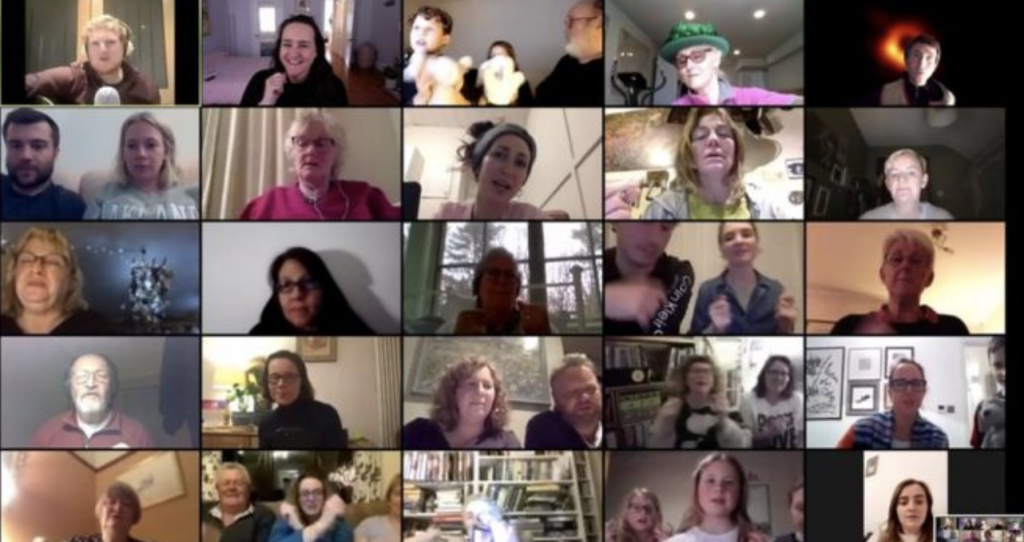
We’re here for you during the pandemic and putting together resources on activities you can do that involve more than just staring at a screen (because there’s a lot of that right now). We’re making an effort to find groups that might be connecting online, but are then using that connection to engage in a real-world activity – together. For the first round-up in the series here’s some suggestions on how you can make music:
The Sofa Singers is a free, weekly, online singing event from James Sills. His weekly online event sees 500 people come together for a 45-minute rehearsal where they learn a classic song and sing it together, apart. Their next event is 7th April at 7.30pm BST. Registration opens 6th April at 7.30pm BST.
Gareth Malone’s new initiative, ‘The Great British Home Chorus’, brings together both amateur and professional performers around the UK to sing with others online. Register here.
The Stay at Home Choir offers another opportunity to join a virtual choir. Vote for the next project and get involved here.
Operatic tenor Jeff Stewart is offering online singing lessons. Stewart teaches as the Royal College of Music and the Royal Welsh College of Music and Drama, also running amateur choirs. He has experience in giving lessons over the internet and is offering to work on repertoire and sing songs in a session with students.
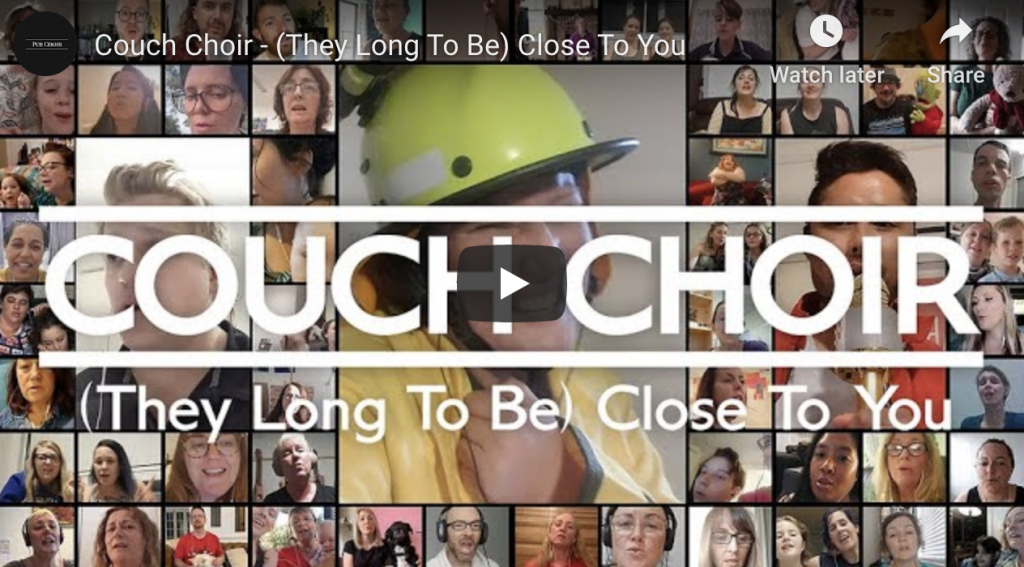
Couch Choir asked the internet to ‘stop misery scrolling’ for a minute and over 1,000 people from 18 countries submitted a video of their performance of “Close To You” (Burt Bacharach) in just TWO DAYS. Keep an eye out for future requests for submissions and songs.
Keep checking back as we’ll update this post with new singing opportunities – and other options to make music together – as we find them.
Our lives are getting ever smaller as social distancing and lockdowns spread throughout the world, making it harder than ever to separate our working and home lives. In a stressful time, the need to maintain structure is even more important for both our physical and mental wellbeing. Here are some tips to help, #wfh we have you sorted.
#1 Negotiate with housemates
If like most of us, you don’t usually work from home, you’re probably used to your workspace being designed so that you can get work done quickly and easily. As you get used to working from home it may become more annoying that your home is never quiet when you need to talk to a client or that someone is always sitting in that specific spot in the kitchen that has the best wifi signal. We’re are not suggesting you start ordering around your housemates, family or friends – especially while self-isolating. But, why not bring it up over breakfast and ask them if they could be especially quiet at 3pm because of your call; or request to bag the best WiFi spot for an hour before lunch for your critical project? And, be prepared to do the same for them, of course. Little negotiated adjustments like these mean you can all work smoothly from the same space.
#2 Set a routine
It could be all too easy, especially if you are a night owl, to use this time to have long lie-ins and work into the early hours, But living like this won’t benefit your mental health. Your sleep will be confused and you’ll end up spending far more time on your screens than is healthy. Though it may be frustrating at first, getting up on time and giving yourself time to get ready to ‘work’ as well as designating hours in which you ‘play’, will make your time at home a lot easier. As so many people are all working from home during the coronavirus pandemic there might also be an increase in employers expecting their employees to be available at all times, which could lead to an unhealthy working relationship. Nip that in the bud and set a routine!
#3 Create a physical workspace
Not everyone has the luxury of a home office or desk, especially if they are living with other working adults, or even children. So, in conjunction with setting a routine, we suggest you mark out a physical space which is only for work. This could be as simple as sitting at the other end of your bed facing the headboard if you have no other room. And as you will now be possibly working more on ‘home’ devices like your phone, separate your work apps from your home ones, Zoom from Skype etc, and put them all in different folders on your desktop and phone. Create little visual boundaries on your devices, to remind you what’s work and what’s play.
#4 Log off for leisure
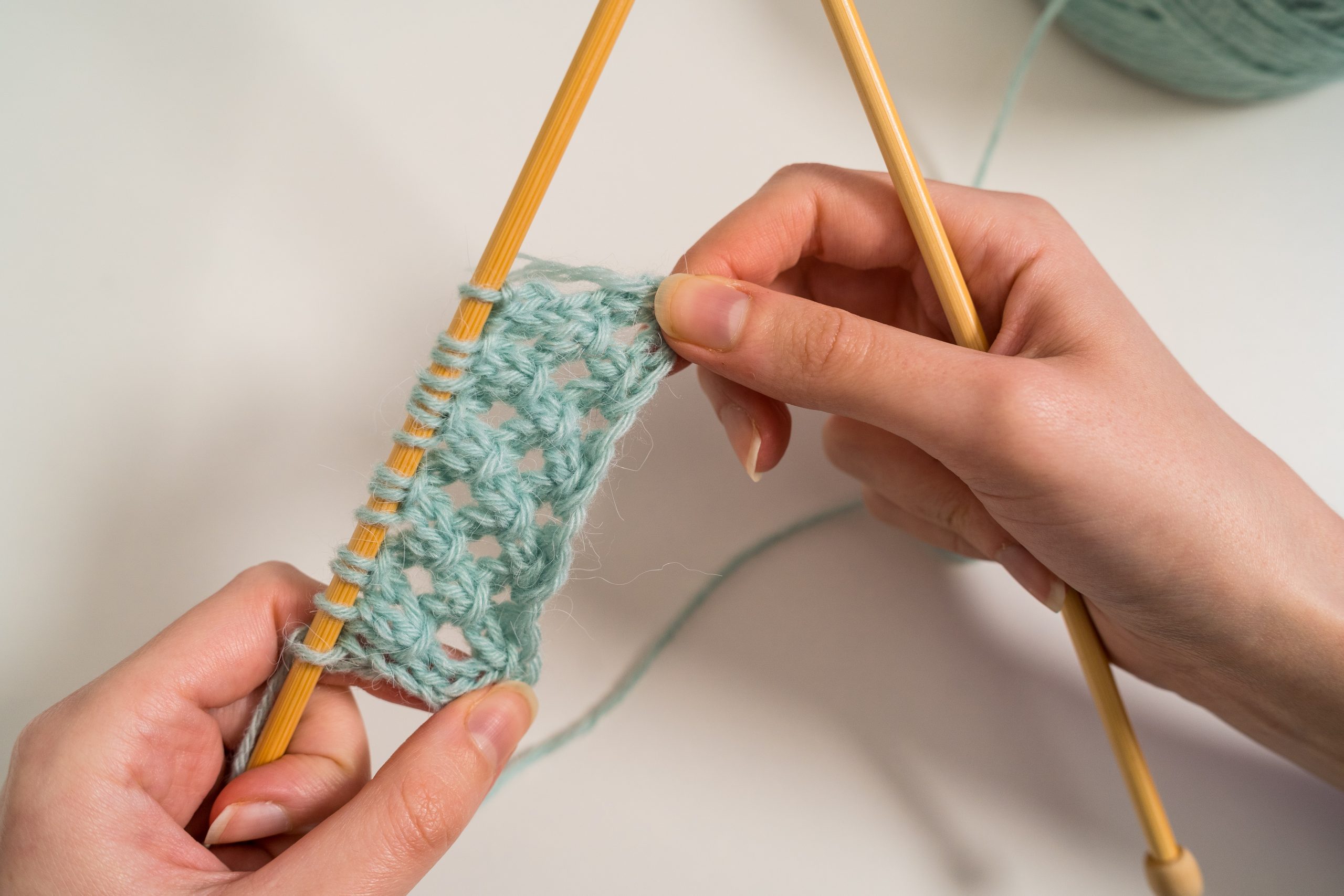
Even before Coronavirus many of us used our screens too much, both at work and at home. We’ve been trying to draw attention to that since the beginning of the Time to Log Off movement. Now, that these parts of our lives are getting even more intertwined, we’re going to be spending more and more time online – at home. So, find ways to relax which don’t involve staring at a screen. It could be cooking a proper meal, with all the hours saved from your daily commute, more reading, or getting back into knitting, drawing or crafts. Whatever it is, find something to occupy you and get you into a mindful state of flow after a day on screens for work – it will help you to maintain your sanity and balance during this time of chaos.
Handwashing and sanitizers may make people on the outside safer. But in prison it can be impossible to follow public health advice.
This article was originally published on March 6th by The Marshall Project, a nonprofit news organization covering the U.S. criminal justice system. Sign up for their newsletter, or follow The Marshall Project on Facebook or Twitter.
When Lauren Johnson reached for a squirt of hand sanitizer on her way out of the doctor’s office, she regretted it immediately.
In the Central Texas prison where she was housed, alcohol-based hand sanitizer was against the rules—and the on-duty officer was quick to let her know it.
“He screamed at me,” she said.
Then, she said, he wrote her up and she lost her recreation and phone privileges for 10 days.
The incident was a minor blip in Johnson’s last prison stay a decade ago, but the rules hold true today and underscore a potential problem for combating coronavirus: Behind bars, some of the most basic disease prevention measures are against the rules or simply impossible.
“Jails and prisons are often dirty and have really very little in the way of infection control,” said Homer Venters, former chief medical officer at New York City’s notorious Rikers Island jail complex. “There are lots of people using a small number of bathrooms. Many of the sinks are broken or not in use. You may have access to water, but nothing to wipe your hands off with, or no access to soap.”
So far, the respiratory virus has sickened more than 97,000 people worldwide and at least 200 in the U.S. More than 3,300 people have died. As of late Thursday there were no reported cases in American prisons, though experts say it’s just a matter of time. (Ed Note: These were the numbers as of March 6th, 2020. At time of this publication, they have increased. See current stats here.)
To minimize further spread, the Centers for Disease Control and Prevention suggests things like avoiding close contact with people who are sick, covering your mouth with a tissue when you cough or sneeze, disinfecting frequently-used surfaces and washing your hands or using alcohol-based hand sanitizer.
But these recommendations run up against the reality of life in jails and prisons. Behind bars, access to toilet paper or tissues is often limited and covering your mouth can be impossible if you’re handcuffed, either because of security status or during transport to another facility.
Typically, facilities provide some access to cleaning products for common areas and individual cells, but sometimes those products aren’t effective, and Johnson recalled women stealing bleach and supplies so they could clean adequately.
Hand sanitizer is often contraband because of the high alcohol content and the possibility for abuse (the alcohol can be separated out from the gel). A spokesman clarified Thursday that the Texas prison system now sells sanitizer on commissary, though it is a non-alcohol-based alternative, which is not what the CDC recommends.
Even something as basic as hand-washing can be difficult in facilities with spotty water access or ongoing concerns about contamination, such as in the recent Legionnaires’ outbreak at one federal prison complex in Florida. (Legionnaires is caused by contaminated water, though the source of that water is not clear in Florida).
Aside from all that, prisons and jails are large communities where a sicker-than-average population is crammed into close quarters where healthcare is oftenshoddy, and medical providers are oftenunderstaffed. In an infectious disease outbreak, health experts recommend separating sick people from well people to prevent the disease from spreading, but in prison that can be nearly impossible, since prisoners are already grouped according to security and other logistical considerations.
Given all that, correctional facilities often respond to outbreaks with the same set of tools: lockdowns, solitary confinement and visitation restrictions. That’s what some prisons and jails did during the 2009 swine flu pandemic, and it’s what happened more recently in the Florida federal prison complex struck by Legionnaires’. In Texas and other states, prison officials regularly shut down visitation or institute partial lockdowns during mumps and flu outbreaks.
“That’s a gauntlet for the U.S.,” said Jody Rich, a professor of Medicine and Epidemiology at Brown University. “ Really? Iran’s going to do it better than we are?”
Some in law enforcement immediately criticized the proposal.
“I don’t think a viable solution for the safety of our community is to have mass releases from jails,” said Joe Gamaldi, president of the Houston police union. “As much as we have to balance the dangers that coronavirus poses to the community, we also have to balance that against the danger of letting violent criminals back out on the streets.”
It’s not yet clear whether any prisons or jails are seriously considering widespread releases. A spokeswoman for the federal prison system did not respond to questions about the idea, instead saying that the isolating nature of prisons could be an asset in handling any potential outbreak.
“The controlled environment of a prison allows the Bureau of Prisons to isolate, contain and address any potential medical concern quickly and appropriately,” said Nancy Ayers, the spokeswoman. “Every facility has contingency plans in place to address a large range of concerns.”


 Jason Atherton
 My Primrose Hill Kitchen