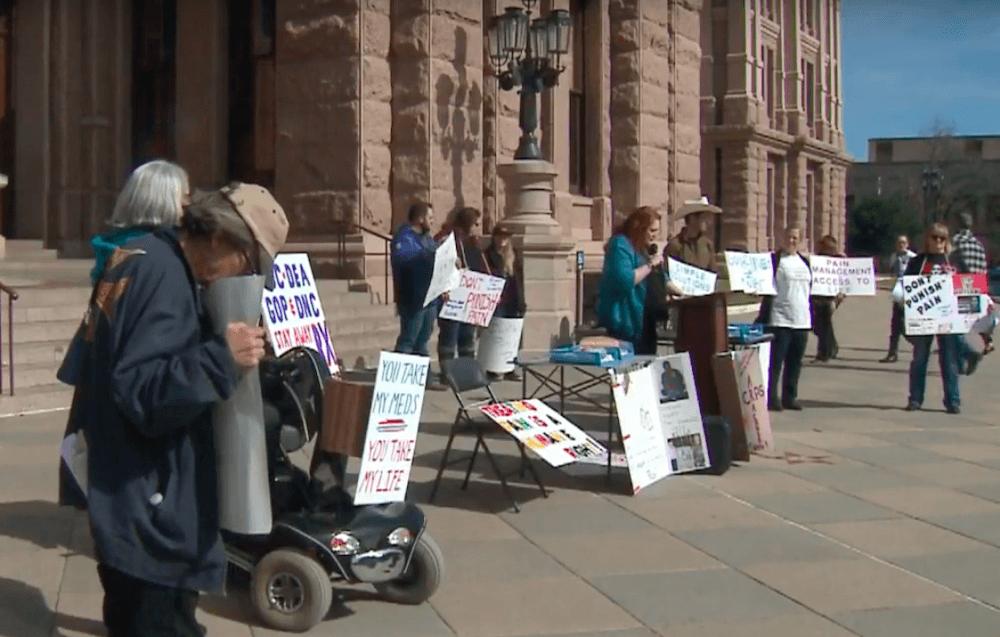
Tag: dont punish pain rally

  • "Don’t Punish Pain" Rallies Held Across The Nation

    "Don’t Punish Pain" Rallies Held Across The Nation

    Pain patients gathered around the US to bring attention to the damage caused by restrictive opioid prescribing guidelines.

    While the opioid epidemic has claimed thousands of lives, the regulations meant to stem the death toll are having unintended consequences for people who live with chronic pain, according to people who rallied across the country Tuesday Jan. 29 as part of the “Don’t Punish Pain” event. 

    In Concord, New Hampshire, Lauren Benson was one of the younger people at the rally. Nine years ago, when she was just 23, Benson injured her back working as an EMT, and has been disabled since.

    She told The Union Leader that she and many other people who need opioids to control their pain have a harder time accessing the drugs because of tightening prescription regulations. This is especially frustrating for pain patients who have used opioids responsibly for decades, she said. 

    “They’ve been on pain medication longer than I’ve been alive and all of a sudden it’s: ‘No, stop, no more for you.’ What are they supposed to do? They’ve been taking their meds properly.”

    Many pain patients are afraid that they won’t be able to access the pills that make their lives bearable. Many have already had doctors taper their dosage or have had to go through humiliating questioning and drug tests to get their opioids. 

    “For over 10 years, I took the same dose and because of the Oklahoma opioid task force, my doctor had to cut my prescription by 75%,” Patrick Burdette, who attended a rally in Oklahoma City, told Fox 25 News. “It caused me to sit at home in bed most days.”

    There’s a misconception that pain patients can choose alternatives to opioids, according to many patients, who say that this isn’t an option for everyone. 

    “My physical therapist would come to my house and I just basically sat there and cried because the pain was so bad,” said Patty Loveless, who was also at the Oklahoma rally. 

    In Tucson, Arizona, one patient carried a sign proclaiming that pain patients are “afflicted, not addicted,” according to The Tucson Sentinel

    “You know that horrific pain that takes about a minute or so to go away?” said Debra Hickey, whose doctor recently reduced her pain medications. “Can you imagine if you were in that kind of pain 24/7 with no opioids? That’s the pain I’m in.”

    In 2016, the Centers for Disease Control and Prevention issued guidelines about the amount of opioids that most patients should be on. This year, Medicare has plans to further restrict access to opioids. However, pain patients say that their lives are being negatively-affected by these well-intentioned measures. 

    “It is borderline genocide,” Lauren DeLuca, founder of the Chronic Illness Advocacy and Awareness Group, told The Fix last year. 

    View the original article at thefix.com

  • Pain Patients Rally To Have Voices Heard

    Pain Patients Rally To Have Voices Heard

    “The real message is that people in chronic pain are not drug abusers. Illicit drug use is the enemy,” said one rally participant. 

    People suffering from chronic pain gathered earlier this week in New Hampshire, hoping to share their frustrations about prescription opioid restrictions in one of the states hardest hit by the opioid epidemic. 

    “The pendulum has swung so far that now, people who have legitimate, documented, disease and illness and pain are now having their medications limited,” Bill Murphy, who helped organize the rally, told WMUR.

    Similar Don’t Punish Pain rallies were held in about 80 locations around the country. Participants say that they need pain medications—including opioids—to manage their chronic conditions. They say that long-term use of opioids can vastly improve the lives of people suffering from chronic pain, but that opioid painkillers have become misunderstood and stigmatized because of widespread misuse. 

    “Chronic pain patients are being denied their medications due to a false narrative that the drug epidemic is caused by prescription pain pills,” Kim Patty, who helped organize a rally in Springfield, Missouri, told the Springfield News-Leader. “The drug epidemic is being caused by heroin and synthetic fentanyl.”

    Participants in New Hampshire said this message gets lost. “It’s important for pain patients to have respect,” said Edie Allyn-Paige, who lives with chronic pain. “You know, every day, I have to choose whether or not to get out of bed.” 

    Bobbi Blades has had chronic pain for 30 years caused by a bone that presses on a nerve. She said that without opioids she wouldn’t have been able to complete rehabilitation, which helped her regain the ability to walk. “The real message is that people in chronic pain are not drug abusers,” she said. “Illicit drug use is the enemy.”

    Murphy said that unlike many people who abuse opioids, responsible users take low doses and are functional at home and at work. Despite that, many people have had their doctors cut back on their pain medications under pressure to reduce prescribing. “Because of that low-dose regimen, (people) are still working, raising families, and their doctors are feeling pressured to reduce that pain medication,” he said.

    Cheryl Ostrander, who rallied in Springfield, said she has used painkillers to help her cope with breast cancer, knee replacements, spinal fusions and fibromyalgia.

    “I am struggling really hard just to stay here,” Ostrander said. “I am in pain just like every day of my life. I’m a mess, but I don’t deserve to be treated like a criminal to get my pain medication.”

    View the original article at thefix.com