Tag: Driving Under the Influence

  • A Breathalyzer For Opioids Is In The Works

    A Breathalyzer For Opioids Is In The Works

    It’s being described as a “less invasive way to monitor a patient’s drug use by collecting their breath in a small specialized machine. “

    Researchers at UC Davis are working on a device that can detect the presence of opioids similar to the popular devices that detect alcohol on people’s breath. 

    “When we started this nobody knew you could measure drugs in breath,” Professor Cristina Davis, the chair of the Mechanical & Aerospace Engineering Department at UC Davis, told CBS Sacramento.

    She along with her team of researchers helped develop the device, which they believe has the potential to save lives.

    How It Works

    The device in question is described as a “less invasive way to monitor a patient’s drug use by collecting their breath in a small specialized machine. “

    Dr. Nicholas Kenyon, a member of the research team described the way the device works to CBS Sacramento. “We collect breath in a liquid format in this device and we chill it and then we collect it as a liquid and run it through a mass spectrometer to measure what’s in there.”

    The team believes that their device can help a multitude of professionals including doctors, firefighters, law enforcement and probation officers identify drug use. 

    For doctors, the device could help them ensure patients aren’t misusing their prescriptions. 

    “A device like this could help tell if they’re taking the drugs like they’re supposed to,” Davis said.

    For police officers, the device can help identify drivers under the influence, while for probation officers could use the device to make sure that parolees remain sober.

    Davis has high hopes for the future of breath testing. 

    “I would love to say in one to three years that we actually have people using this for one of the application areas and I think from there it will grow. I think over a five-to-10-year time frame, that breath testing won’t just be a story, it’ll actually be at your doctor’s office,” Davis said.

    Marijuana Breathalyzer

    Another type of breathalyzer is being rolled out to combat driving under the influence of cannabis. Star Labs have created a device that uses nanotechnology to detect THC levels in breath. While breathalzyers for alcohol use have been in use for decades, similar tests for marijuana have been slow to develop due to the way THC works in the body.

    Determining the ratio of THC in someone’s breath versus the amount of THC in their blood has left scientists scratching their heads. And federal prohibition makes researching the drug to come up with a proper way to measure it in the blood and breath particularly difficult. 

    According to NPR, Star Lab’s marijuana breathalyzer is “nearly ready for mass production” and could potentially be on the market soon. 

    View the original article at thefix.com

  • World's First Marijuana Breathalyzer To Hit Market In 2020

    World's First Marijuana Breathalyzer To Hit Market In 2020

    The device can distinguish between recent use of marijuana and residual THC, which lingers in the body for about 30 days after use.

    The world’s first marijuana breathalyzer—said to be able to detect recent use rather than the mere presence of residual THC in the system—will hit the market in 2020.

    Northern California-based Hound Labs, which received a funding boost to expedite the device’s release, says their device can distinguish between recent use of marijuana (which implies intoxication) and residual THC, which lingers in the body for about 30 days after use.

    A Very Important Distinction

    The Hound device’s ability to make this distinction is the key. The lack of a device able to weed out high motorists was a major issue for some law enforcement officials across the country and a key reason cited for opposing marijuana legalization.

    “DUI under marijuana is a huge, huge problem. It’s one of the reasons we’ve been against legalization,” said John Adams, district attorney of Berks County in Pennsylvania. “I’ve heard about the breathalyzers. If the technology is out there, it would be a great tool. It would alleviate some of our fears.”

    The Hound device is portable and can detect both alcohol and marijuana. The device is comprised of a base station and a hand-held device that, together, retails for about $5,000, according to the Providence Journal.

    Mike Lynn, a veteran emergency department physician and reserve deputy sheriff from Oakland, California, collaborated with scientists at the University of California at Berkeley and San Francisco to create the device.

    “We wanted to be able to detect THC in people who have recently used it—either eaten the stuff or smoked a joint,” said Lynn. “Those are the people we want to discourage before they go to the workplace or get behind the wheel.”

    Currently, medical marijuana is legal in 33 states and Washington, D.C. Recreational marijuana is legal in 11 states and D.C.

    “If Someone Is Not Stoned, They Shouldn’t Be Arrested.”

    Lynn emphasized the importance of distinguishing between people who are driving while high and people who are driving sober but may still use marijuana off the road.

    “It’s about creating a balance of public safety and fairness. I’ve seen the tragedies resulting from impaired driving up close,” said Lynn. “And I have a good idea how challenging it is at the roadside to know whether someone smoked pot recently. But I believe if someone is not stoned, they shouldn’t be arrested.”

    View the original article at thefix.com

  • Colorado Still Struggling With Marijuana Field Sobriety Tests

    Colorado Still Struggling With Marijuana Field Sobriety Tests

    Traffic fatalities involving drivers with marijuana in their system have risen as proper impairment testing continues to be an issue in the state.

    As Colorado marks the fifth anniversary of legalizing recreational marijuana, the problem of impaired driving—and how to properly test for impairment—remains as elusive as it was in 2014.

    As an article in the Routt County daily newspaper Steamboat Pilot & Today noted, according to state law an individual is under the influence if more than five nanograms of THC is present in their bloodstream. But how to properly and legally test drivers remains out of the reach of police in the Centennial State, and users have expressed concern that if a method is discovered, they could test over the limit even if they are not legally impaired.

    As a 2016-2017 report from the Substance Abuse and Mental Health Services Administration (SAMHSA) found, twice as many Coloradans smoke marijuana than residents of other states, and the number of adults in that demographic has risen since 2014.

    Traffic fatalities involving drivers with marijuana in their system have also risen from 75 in 2014 to 139 in 2017. Statistics like these fuel the call for impairment testing, but the facts behind the latter data also underscore the challenges inherent to such a test.

    The problem arises from the fact that the number of Colorado drivers involved in a traffic fatality who tested above the legal limit for THC has actually dropped, from 52 in 2016 to 35 the following year.

    As Reason noted, this may be due to the fact that THC remains detectable in a user’s system for up to 30 days, and drivers who test positive at the time of a crash may not, in fact, be legally impaired.

    THC Lingers

    As the Pilot & Today article stated, police are aware of this conflict. While field sobriety tests for alcohol impairment can be accurate at a rate between 91 and 94%, detecting marijuana impairment depends largely on blood tests.

    “There is no go-to tool that is considered reliable across the board to determine if someone is impaired by marijuana,” said former assistant district attorney of Routt County Matt Karzen in the article, who noted that most cases stem from a plea deal in which drivers plead guilty to driving while impaired, a traffic infraction which usually results in a fine and revoked driving privileges for 90 days—far less than a DUI conviction.

    Marijuana advocates and law enforcement alike see this information as proof positive for more accurate means of measuring marijuana impairment, but efforts by lawmakers in Colorado have come up short; a bill proposed in 2019 would have empowered officers with the full right to determine impairment through a combination of field sobriety tests—observation and coordination tests—and blood testing. The bill was met with opposition and currently remains postponed until a February 2020 review.

    5-Nanogram Limit

    Legal representatives like Karzen and police officers have been encouraged to pursue impairment cases in which the individual is both clearly impaired—as the Pilot & Today noted, those exhibiting memory loss, poor driving or if marijuana smoke is evident. These signs, along with a blood test above the legal limit, are the best possible indicators at the moment for driving impairment.

    “I’m very uncomfortable proceeding with a criminal prosecution on impaired driving based only on the five-nanogram limit,” said Karzen.

    View the original article at thefix.com

  • Chef Ludo Lefebvre’s Daughter Films Touching Drunk Driving PSA 

    Chef Ludo Lefebvre’s Daughter Films Touching Drunk Driving PSA 

    The eight-year-old made the PSA after losing her grandmother to a drunk-driving incident back in February.

    The daughter of Ludo Lefebvre, the French chef known for his innovative influence in the Los Angeles dining scene, shared a PSA about the dangers of drunk driving.

    Eight-year-old Rêve made the PSA after losing her grandmother, Peggy Stewart Braun, to a drunk-driving incident in February.

    “Over 29 people a day die from drunk driving,” said Rêve in the PSA. “You do the math, that’s too many. One of those persons was my grandmother and I miss her very much.”

    Powerful Moment

    Rêve  presented her PSA to the judge at the time of the sentencing of the driver who caused the fatal accident. There was not a “dry eye in the house” according to her mother Krissy.

    “The judge later stated that in her many years on the bench, she had never seen anything like Rêve’s message,” said Krissy. “Rêve hopes and we all hope that hearing what drinking and driving can do from the mouth of a child will really make people think before they drink.”

    In the video, Rêve also sings a song she wrote for her Nana. “The power of [Rêve’s] words was so strong. She was saying/singing exactly what the entire family was feeling,” said Krissy.

    The Accident

    Peggy Stewart Braun was in the car with her husband Bill and two other family members at the time of the accident in Golden, Colorado on February 22. Braun died at the scene, while the crash inflicted serious injuries including broken ribs and vertebrae on the other family members.

    William Randolph Lenox, the driver who caused the accident, registered a blood alcohol level of .136 at the time. 

    On July 2, Lenox was sentenced to 25 years in prison after pleading guilty to all charges related to the accident, including vehicular homicide and reckless driving.

    Drunk-driving crashes cause more than 10,000 deaths each year, according to the National Highway Traffic Safety Administration. Approximately one-third of all traffic accident deaths in the U.S. involve drunk drivers.

    View the original article at thefix.com

  • Vince Vaughn Convicted Of Reckless Driving In DUI Arrest

    Vince Vaughn Convicted Of Reckless Driving In DUI Arrest

    The “Wedding Crashers” actor was arrested at a sobriety checkpoint in June 2018.

    After being pulled over for driving under the influence last year, Vince Vaughn has been convicted of reckless driving and given probation time. 

    According to People, the 49-year-old actor recently pleaded no contest to the misdemeanor charge he received in Manhattan Beach, California in June 2018. The actor did not appear in court, but was represented by his attorney. 

    As a result, the Los Angeles County District Attorney’s office said in a statement, Vaughn was sentenced to three years of summary probation. 

    Additionally, the statement reads, Vaughn is required to participate in a three-month treatment program for alcohol and pay “an unspecified amount of fines.” 

    However, TMZ reported that he will pay “a $390 fine—plus various penalties which ups the payout to around $1,700.”

    People also reports that while on probation, Vaughn must agree to alcohol screening tests. He reportedly also was warned that if he were to be involved in a fatal crash while driving under the influence, the resulting charge could be murder. 

    “The defendant was ordered to complete a three-month alcohol program, pay fines, and cannot refuse a preliminary alcohol screening test while on probation if requested by law enforcement,” the official statement read. “A Watson advisement also was given that states if he drives under the influence and a person is killed, he could be charged with murder.”

    The June 2018 incident was Vaughn’s first DUI. People states that the actor was pulled over between Hermosa Beach and Manhattan Beach at 2:40 a.m. and apparently refused to exit his vehicle despite law enforcement officials’ requests to do so.

    Vaughn and his passenger were both taken to jail, but released after paying bail.

    At the time, Sgt. Tim Zins, a spokesman for the Manhattan Beach Police Department, told CNN that Vaughn was not “fighting with officers, but more of delaying the investigation.”

    “There was no officer use of force or anything like that,” Zins told CNN.

    According to People, Vaughn faced three misdemeanor charges at the time: driving under the influence, having a 0.08% or higher blood alcohol content and refusing to cooperate with law enforcement officials. If he had been convicted of all three, the District Attorney’s office stated, he could have had to serve up to 360 days in jail.

    View the original article at thefix.com

  • How Virginia's "Habitual Drunkard" Law Criminalizes Poverty

    How Virginia's "Habitual Drunkard" Law Criminalizes Poverty

    The Legal Aid Justice Center is taking the law to federal court, questioning its constitutionality.

    Virginia law allows the state to declare that a person is legally a “habitual drunkard,” and one infraction is all it takes to earn the title.

    While it’s unknown exactly how many Virginians carry the legal title of habitual drunkard—according to the Daily Press it could be in the thousands—it is used as a punishment for the vague crime of being someone who has “shown himself to be a habitual drunkard.”

    According to the statute, simply being in close proximity to alcohol or smelling like alcohol is grounds for arrest. A conviction under the statute can come with a year in jail and possible $2,500 fine.

    The label can also be applied to someone for their first DUI conviction, although in Virginia it is more likely to be used after a second offense. The statute arose from the 1800s and exists only in Virginia and Utah, according to the Legal Aid Justice Center in Virginia. The Justice Center is taking the law to federal court, questioning its constitutionality.

    The city of Roanoke has slapped 162 people with the label of “habitual drunkard.” This far exceeds other cities and counties in Virginia, many of which do not apply the statute at all.

    The Legal Aid Justice Center believes that the statute effectively criminalizes poverty. In 2016 it filed a class action lawsuit in Roanoke federal court. The lawsuit claimants are five homeless men who had been given the label of drunkard, who accuse the state of criminalizing addiction and homelessness. A decision is pending in the 4th U.S. Circuit Court of Appeals.

    Mary Frances Charlton, a former Legal Aid attorney, told the Daily Press, “It treats fundamentally what is a public health problem as a criminal justice problem. What these folks need is access to affordable housing and medical care—not incarceration.”

    Attorney Andy Rosenberg handles Virginia Beach’s prosecutions relating to the statute, and told the Daily Press that only 3% of the arrests relating to the law are of homeless people.

    Between 2007 and 2018, over 1,700 people were declared a habitual drunkard in Virginia. Two-thirds of those people were arrested in Virginia Beach. Enforcement of the law was originally ramped up in 2006 as the police sought a way to reduce DUIs. They began using the statute in cases of two or more DUIs.

    That year, 10% of Virginia’s DUI arrests were made in Virginia Beach, despite the fact that the city only accounted for 6% of the population at the time, according to a story published in The Virginian-Pilot.

    Regardless of the intentions, the law failed. In 2009, DUI arrests were at a record high of 2,733, compared to 1,959 in 2007.

    View the original article at thefix.com

  • Driving While On Prescription Opioids Can Be Deadly

    Driving While On Prescription Opioids Can Be Deadly

    Researchers have uncovered an alarming trend among drivers under the influence of prescription opioids.

    As the opioid epidemic continues to grow, the medications are being blamed for more fatalities on the road. 

    In the past 25 years, according to U.S. News & World Report, the number of fatal car crashes with drivers high on opioids has tripled. 

    These results come from a study which examined more than 18,000 fatal car crashes involving two vehicles in the U.S. from 1993 to 2016. Of those, more than half (55%) of driving errors made by drivers who later tested positive for prescription opioids had to do with the driver not staying in their own lane.  

    According to study co-author Dr. Guohua Li, who is also the director of the Center for Injury Epidemiology and Prevention at Columbia University Medical Center, the failure to stay in one’s lane was “a particularly dangerous driving error.” 

    In fact, researchers found that this error was a factor in more than 40% of fatal crashes involving two vehicles, “making it the most common cause of deadly auto accidents.”

    According to Li, the outcome of the study “adds important information for understanding the ripple effects of the opioid epidemic, particularly its adverse effect on driving safety.”

    Li adds that prescription opioids “are potent pain medications that can cause drowsiness, nausea, and impaired cognitive functions and psychomotor skills, including reduced reaction time, alertness, attention and concentration.”

    When it comes to how opioids impact drivers in comparison to alcohol, Li says that the effect of driving on opioids is about equal to having a blood alcohol concentration of 0.05%. This falls just under 0.08%, which is what most states consider driving under the influence, according to U.S. News and World Report

    According to Li, testing a driver for opioids is more expensive and more difficult than testing for alcohol. “It is also more difficult to detect drug-impaired driving than alcohol-impaired driving through field sobriety tests,” he said. 

    “But law enforcement is making effort to tackle the drugged driving problem,” he added. “For example, many states are expanding their drug recognition expert programs, which would train more police to become certified field evaluators of driving under the influence of drugs.”

    JT Griffin, chief government affairs officer for Mothers Against Drunk Driving, tells U.S. News that the results of the study are not surprising. “With the rising use of opioids, it is not surprising that there is an increase in the number of drivers with opioids in their systems,” he said.

    “Any drug that causes drowsiness, slows reaction times, or affects judgment and mobility in any way is a threat to public safety,” Griffin added. “It’s important that people do not drive anytime they are drinking or using any kind of impairing substance.”

    View the original article at thefix.com

  • States Struggle To Address Issue Of Driving While High On Cannabis

    States Struggle To Address Issue Of Driving While High On Cannabis

    Federal legalization could be on the horizon, yet so far no one has come up with a definitive method to determine if someone is too high to drive.

    As more states legalize both medical and recreational marijuana, authorities are struggling to determine the best way to address the issue of driving while high. Unlike alcohol, cannabis can stay in a person’s system for weeks after the last time they used – long after the high has subsided and they are no longer impaired. Blood and urine tests are therefore considered by many to be unreliable methods for determining if a driver is intoxicated. 

    Marijuana legalization will likely be a key issue in 2019 as Democrats line up to enter the 2020 presidential race. Ten states have now legalized recreational cannabis, and even conservative states like Utah and Oklahoma are starting to pass medical marijuana laws. Federal legalization could be on the horizon, yet so far no one has come up with a definitive method to determine if someone has taken too much of the drug to be able to drive safely.

    “You can’t legalize a substance and not have a coherent policy for controlling driving under the influence of that substance,” says Rand Corp. assistant policy researcher Steven Davenport. 

    Yet many states are relying on police officers to perform field sobriety tests as their only means of determining if someone is high on cannabis behind the wheel. According to Kaiser Health News, California police are given 16 hours of training on recognizing the influence of various drugs, including cannabis.

    The coordinator of this program, Glenn Glazer, claims that California officers are “very used” to recognizing marijuana intoxication, but as Davenport points out, field tests are subjective by nature.

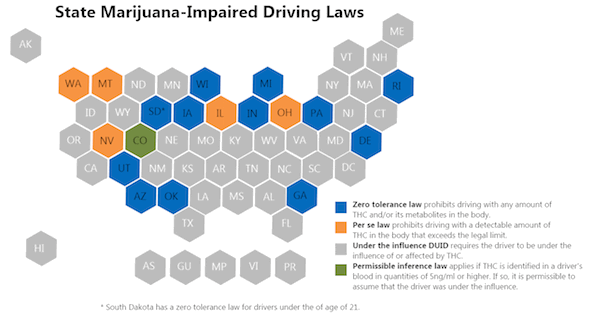
    According to the National Conference of State Legislators, the majority of states with some kind of legalized marijuana have “zero tolerance” laws on the books for driving while high, meaning that any amount of THC and/or its metabolites found in a driver’s system is grounds for legal action. This presents a serious problem when these chemicals can stay in a person’s system for a full month after they last used. 

    Source: NCSL

    Others have “per se” laws similar to the blood alcohol limit. However, cannabis researchers have repeatedly pointed out that finding a limit for cannabis-related compounds in the blood is much more complicated than with alcohol. There is no clear, linear relationship between THC levels in the blood and intoxication.

    Keith Humphreys, a psychiatry professor and drug policy expert at Stanford University in California, believes that the number these states have picked for their legal limit is arbitrary, saying they “made it up.” 

    “We don’t really have good evidence — even if we know someone has been using — [to gauge] what their level of impairment is,” says Humphreys.

    Coming up with a solution won’t be an easy task, but people are trying. In late 2017, an app was released that calculates the user’s reaction time. Cannabis often slows reaction time and impairs one’s ability to focus, making driving while high a dangerous endeavor. After Washington State and Colorado legalized recreational marijuana, highway collisions rose by 3%, according to the Highway Loss Data Institute

    The app, called DRUID, is far from a perfect system for detecting intoxication, but if a blood, urine or breathalyzer test can’t be developed soon, field tests and human judgment may be all police have to rely on.

    “The idea that you could come up with a completely objective test of performance … is ambitious,” says Carnegie Mellon University drug policy researcher Jonathan Caulkins.

    View the original article at thefix.com

  • "Glee" Star Jesse Luken Arrested For DUI

    "Glee" Star Jesse Luken Arrested For DUI

    The 35-year-old actor was released on $5,000 bail.

    Jesse Luken, who played Bobby “Boom Boom” Surette on the TV musical Glee, allegedly crashed his car after driving drunk last month. 

    Police in Glendale, California. responded to a call about a single-car crash and found Luken in the driver’s seat of his Toyota, which was driven up onto the curb. The front tire was damaged and the airbag was deployed, according to TMZ.

    Citing law enforcement sources, TMZ reported that Luken smelled strongly of alcohol, which prompted police to administer a field sobriety test. Luken failed that, and was arrested on suspicion of driving under the influence. 

    Fox News reported that the actor, 35, posted a $5,000 bail and was released from jail. 

    Glee, which aired on Fox, was a hit between 2009 and 2015. However, since the show ended the former cast has had a series of legal entanglements and tragedies. In 2013, the show’s star, Cory Monteith, died of an overdose of heroin and alcohol shortly after completing a 30-day stint in rehab.

    Prior to his death at age 31, Monteith had been open about his addiction, saying that he had been struggling with substance abuse since he was 13. 

    “I don’t want kids to think it’s OK to drop out of school and get high, and they’ll be famous actors, too,” he said. “But for those people who might give up: Get real about what you want and go after it. If I can, anyone can.”

    In 2016, Glee actress Naya Rivera wrote in her memoir about Monteith’s death, and how it affected the cast. 

    “I doubt I’m alone in feeling a lot of regret about his death,” she wrote, according to E! News. “Since he died, a lot of us have spent time wondering and talking about what would have happened if someone had stepped in or confronted him about what was going on. Or what if he’d been trying to talk to someone about what was going on and just thought no one cared?”

    Glee’s director, Adam Shankman, sought treatment for substance abuse disorder in 2013. 

    “His friends and family support him and wish him well on his journey to recovery,” a representative said at the time.  

    In January of 2018, another Glee actor, Mark Salling, was found dead by suicide. Salling pleaded guilty in October 2017 to possession of child pornography. He was facing four to seven years in prison, as well as fines and registration as a sex offender.  

    View the original article at thefix.com

  • Legal Marijuana Linked To Rise In Car Crashes

    Legal Marijuana Linked To Rise In Car Crashes

    Legalizing marijuana isn’t completely harmless, according to a pair of new studies.

    Car crashes went up by about 6% in states that have legalized recreational marijuana, a couple of new studies found. Colorado, Nevada, Oregon, and Washington have seen an increase in insurance claims for collisions, according to separate studies by the Insurance Institute for Highway Safety and the Highway Loss Data Institute.

    The institutes presented their research at the Combating Alcohol- and Drug-Impaired Driving Summit on Thursday.

    The Highway Loss Data Institute focused on claims between 2012 and October 2017, comparing the results to four illegal states, including Idaho, Montana, Utah, and Wyoming. The Insurance Institute for Highway Safety observed a 5.2% increase in police-reported crashes after legalization in Colorado, Oregon, and Washington.

    “States exploring legalizing marijuana should consider this effect on highway safety,” said David Harkey, president of the Insurance Institute for Highway Safety and Highway Loss Data Institute.

    The findings are important as the tide is increasingly turning to favor the legalization of marijuana. Nine states and the District of Columbia have legalized marijuana, and Michigan and North Dakota are holding a vote on the issue next month. Canada has legalized it as well.

    FIguring out who is or isn’t impaired by marijuana while driving is also a challenge, the institutes acknowledge. Marijuana’s active ingredient, THC, can remain detectable in a person for as long as 30 days—long after the high has worn off. Currently, there isn’t a reliable method to determine whether someone is currently high. But according to the studies, it’s clear that marijuana has some effect on driving ability.

    “Despite the difficulty of isolating the specific effects of marijuana impairment on crash risk, the evidence is growing that legalizing its use increases crashes,” Harkey said.

    The Center for Medical Cannabis Research at the University of California San Diego is undertaking studies to better understand the effects of marijuana on driving as well as methods to more reliably detect if a driver is currently under the influence.

    Methods now used by law enforcement are notoriously unreliable, and as a result field sobriety tests for marijuana cannot be used as evidence in some cases.

    View the original article at thefix.com