Tag: drug cartels

  • El Chapo Sentenced To Life Plus 30 Years, Ordered To Pay $12.6 Billion

    El Chapo Sentenced To Life Plus 30 Years, Ordered To Pay $12.6 Billion

    The infamous drug kingpin’s defense plans to appeal, claiming juror misconduct.

    The infamous drug kingpin known as El Chapo has been sentenced to life plus 30 years in prison and will have to hand over $12.6 billion after being found guilty of overseeing one of the biggest criminal drug operations in the world—the international Sinaloa Cartel.

    The drug lord, real name Joaquin Guzman Loera, was sentenced in U.S. District Court in Brooklyn by Judge Brian Cogan last Wednesday (July 17).

    Guzman’s Sinaloa Cartel has been blamed for fueling the opioid epidemic in the U.S. by funneling mass amounts of heroin into the country, as well as cocaine and methamphetamine. Much of his cartel operated in Mexico, where Guzman was twice incarcerated in maximum security prisons. He escaped each time, the second through a nearly mile-long tunnel under the prison.

    Guzman remained silent during his three-month trial, but made what CNBC called a “tear-choked statement” after his sentence was handed down, claiming that he was denied a fair trial and accusing the U.S. of corruption.

    “My case was stained and you denied me a fair trial when the world was watching,” he said as his words were translated from Spanish by his lawyer. “What happened here [in] the U.S. is not better than any other corrupt country.”

    Living Conditions

    He also claimed that he was being tortured in detainment.

    “I drink unsanitary water, no air or sunlight, and the air pumped in makes my ears and throat hurt. In order to sleep, I put toilet paper in my ears. My wife had not been allowed to visit, and I can’t hug my daughters. This has been psychological, emotional and mental torture 24 hours a day.”

    Guzman’s defense plans to appeal, claiming juror misconduct. One of the jurors for this case told Vice News in February that “at least five fellow jurors violated the judge’s orders by following the case in the media during the trial.”

    A Damning Statement

    One of his cartel’s victims made a statement about how Guzman has affected her life—and nearly ended it.

    “Today I come here a miracle of God,” said Andrea Velez Fernandez. “Mr. Guzman used me as bait to kidnap someone in Ecuador. He offered one million dollars to Hells Angels to end my life. Fortunately I found out and escaped with the help of the FBI.

    Guzman will likely serve out his sentence in the ADX Florence in Colorado, one of the country’s “supermax” security prisons, due to his history of escaping. The Sinaloa Cartel has continued to operate after the kingpin’s arrest.
    View the original article at thefix.com

  • "Tsunami" Of Meth Discovered In Record-Breaking Drug Bust

    "Tsunami" Of Meth Discovered In Record-Breaking Drug Bust

    The historic 1.9 ton meth haul was worth over a billion dollars.

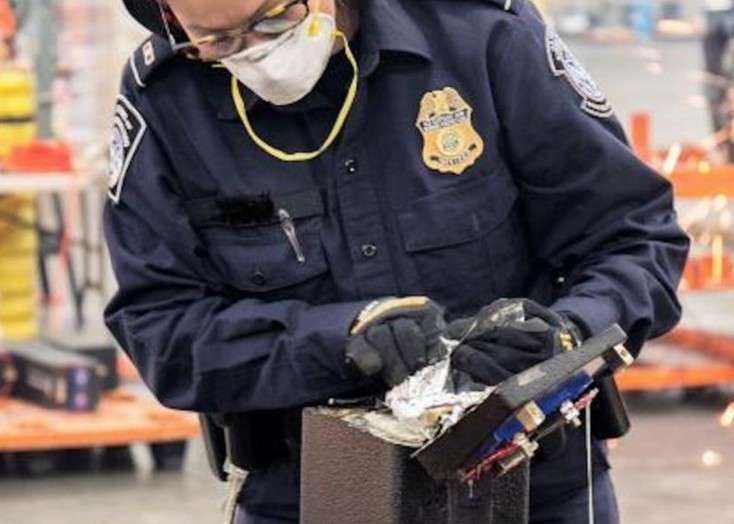
    US border officials in California seized a record-breaking shipment of meth, about 1.9 tons (3,800 pounds) worth around $1.3 billion, hidden in speakers and headed down under.

    Authorities say that the haul of meth broke two records, winning the dubious honor of being the largest amount of meth to be seized on US soil as well as the largest amount ever to be shipped to Australia. Some cocaine and heroin were also found hidden inside the speakers.

    The seizure was a joint effort between US Homeland Security, the DEA and the Australian Federal Police (AFP). On January 11, they managed to discover the drugs hidden inside the housing of a huge shipment of speakers which were packed away in dozens of metal boxes.

    Authorities have arrested two US citizens and four Australian citizens in connection with the shipment, believing them to be part of a larger US-based drug syndicate shipping drugs worldwide.

    The Australian authorities involved say that the bust prevented “a tsunami of ice” from reaching their country, which would have manifested as an estimated 17 million hits of meth. This would have been an especially large problem for the Australian state of Victoria, where the meth was headed, as sewage drug monitoring has found that the 6.3 million people living there use about 2 tons of meth a year.

    AFP Assistant Commissioner Bruce Hill claims that these drugs originate from Mexican cartels that have been pushing hard to get their products into Australia.

    “They have been sending smaller amounts over the years. This is now flagging intent Australia is now being targeted,” Hill told reporters. “The cartel is among one of the most powerful and violent drug trafficking syndicates in the world.”

    The previous largest seized meth shipment ever headed to Australia was a 1.3 ton shipment caught in December of 2017.

    View the original article at thefix.com

  • Top DEA Agent Accused Of Laundering Over $7 Million In Drug Money

    Top DEA Agent Accused Of Laundering Over $7 Million In Drug Money

    The former DEA agent allegedly kept $7 million of money laundered from drug sales in a business account.

    A former Drug Enforcement Administration (DEA) agent who oversaw a high-profile undercover operation has been linked to a $7 million money-laundering scheme involving Colombian drug cartels.

    Five current and former law enforcement officials told the AP that Jose Irizarry—who left the DEA in 2017—may be the co-conspirator in a recent federal case in which former DEA informant Gustavo Yabrudi pled guilty to laundering money for cartel members as part of an undercover contraband operation.

    Yabrudi claimed that he and the co-conspirator kept $7 million of money laundered from drug sales in a business account. Investigators are also investigating Irizarry’s second wife, who is related to a top money-laundering suspect in Colombia.

    The information about Irizarry came about as part of a plea agreement between the Venezuelan-born Yabrudi and federal prosecutors who were overseeing the case in Atlanta, Georgia.

    According to court records, Yabrudi—who worked as an informant for the DEA between 2010 and 2016—and Irizarry allegedly opened a bank account to direct deposits from a network of cartel contacts who sought to filter drug money through a contraband merchandise operation overseen by Irizarry for the DEA.

    Irizarry allegedly used a variety of means to launder the money, including shell companies and a variety of goods—including electronics and textiles—which were exported to Colombia for resale in pesos, which were then given to the cartel members. 

    According to Yabrudi’s plea agreement, the two men opened a secret account through which $7 million in drug cartel funds flowed over a period of six years. Yabrudi admitted that he withdrew money from the account to give to the co-conspirator, who according to the aforementioned officials, was Irizarry.

    “None of these deposits, nor the use of the funds that followed were officially sanctioned DEA operations,” wrote federal prosecutors in court filings.

    The AP noted that Irizarry, who was once a highly regarded agent, had come under scrutiny by DEA officials over a series of questionable decisions and connections. While conducting the undercover contraband operation, Irizarry reportedly bought an expensive home and vehicle, and hosted parties involving sex workers. 

    Irizarry’s marriage to his second wife, Nathalia Gomez, has also caught the attention of investigators due to her familial relationship with Diego Martin, whom the AP labeled as Colombia’s “contraband king.” Martin allegedly bought shipping containers filled with goods using drug money. Martin has remained out of the law’s grasp by serving as an informant for various U.S. law enforcement entities.

    The current whereabouts of Irizarry, who resigned from the DEA in 2017 after being recalled to Washington, D.C., are unknown. The AP noted that calls to a cell phone which officials said belonged to him went unreturned, as did calls to Gomez. It is also unknown if Irizarry has been charged in regard to the allegations.

    View the original article at thefix.com

  • Whistleblower Alleges Tesla Covered Up Employee's Drug Dealing Ties

    Whistleblower Alleges Tesla Covered Up Employee's Drug Dealing Ties

    Whistleblower Karl Hansen alleges that raising those concerns to Tesla management was what got him fired in mid-July.

    Last week, a former Tesla security employee filed an explosive tip with the Securities and Exchange Commission, claiming the company hacked employee cell phones and turned a blind eye to drug dealing and large-scale theft at the Nevada Gigafactory.

    Whistleblower Karl Hansen claimed that raising those concerns to Tesla management was what got him fired mid-July, according to The Mercury News. Hansen lodged his complaint with the feds on August 9, according to his attorney Stuart Meissner, of the New York-based firm Meissner Associates. 

    The sweeping complaint claims that Tesla spied on its own workers by wiretapping their phones and hacking their computers, including those of another recently axed whistleblower, Martin Tripp. 

    Hansen also accused the company of keeping secret the results of its internal probe into a cartel-connected coke- and meth-dealing ring that one employee operated out of the Nevada site, a claim to which the DEA supposedly alerted the company.

    On top of that, Hansen alleges that Tesla neglected to disclose information about $37 million worth of raw materials stolen this year, an incident that supposedly led to the firing of another worker who reported it all to police. 

    Tesla fired back against the allegations with its own statement, saying the claims were “taken very seriously” when Hansen came forward with them—but ultimately, the company claimed, they couldn’t be proven. 

    “Some of his claims are outright false,” the company said, according to a statement published by CNBC. “Others could not be corroborated, so we suggested additional investigative steps to try and validate the information he had received second-hand from a single anonymous source.”

    But, Tesla claimed, Hansen refused to keep speaking with the company. 

    “It seems strange that Mr. Hansen would claim that he is concerned about something happening within the company,” Tesla added, “but then refuse to engage with the company to discuss the information that he believes he has.”

    Elon Musk was more to-the-point in his appraisal of Hansen. 

    “This guy is super [nuts],” he wrote in a Twitter DM to a Gizmodo reporter, using the peanut emoji to drive home the point. 

    “He is simultaneously saying that our security sucks (it’s not great, but I’m pretty sure we aren’t a branch of the Sinaloa cartel like he claims) and that we have amazing spying ability,” Musk added. “Those can’t both be true.”

    View the original article at thefix.com

  • FBI Raid Nets 20 Suspected Cartel Traffickers, Nearly A Ton Of Cocaine

    FBI Raid Nets 20 Suspected Cartel Traffickers, Nearly A Ton Of Cocaine

    Three sprawling federal indictments unsealed last week named 57 defendants snared in the operation—and 35 of them are still on the run.

    Twenty alleged Sinaloa Cartel drug traffickers were arrested early Wednesday in a web of raids that netted 850 pounds of meth, nearly 1 ton of cocaine, 93 pounds of heroin and $1.42 million in cash. 

    Over the course of a three-year investigation involving a slew of government agencies from the Internal Revenue Service (IRS) to Los Angeles police, investigators uncovered a massive drug-trafficking ring regularly hauling in kilograms of narcotics from south of the border. Law enforcement also seized nearly 50 pounds of cannabis.

    Three sprawling federal indictments unsealed last week named 57 defendants snared in the operation—and 35 of them are still on the run. Most are believed to be in Mexico, according to the U.S. Department of Justice.

    “More than simply seizing large quantities of drugs and money, this investigation was able to identify the top-level, Mexican-based traffickers who directed the transactions, and who thought they were using secure communication devices to commit their crimes,” First Assistant United States Attorney Tracy L. Wilkison said in a statement. “Our ability to obtain those communications continues to be an important part of our ability to solve these crimes.” 

    The investigation—known as Operation Narconetas—zeroed in on three drug trafficking organizations accused of using vehicles with hidden compartments to smuggle large quantities of drugs from Mexico to the U.S., sometimes storing the substances in stash houses before distributing them throughout the country.

    The indictments outline allegations of vast drug trafficking conspiracies, and also include asset forfeiture requests as the government seeks to seize any property or resources used in the smuggling operation.

    “Today’s arrest of multiple defendants for their alleged role in smuggling funds from illegal drug transactions in and out of the United States is a victory for the American public and a defeat to drug traffickers everywhere,” said IRS Special Agent in Charge R. Damon Rowe of the Los Angeles Field Office. “The special agents of IRS Criminal Investigation continue in their mission to disrupt the flow of ill-gotten gains that is the life-blood for these criminals.”

    The multi-agency task force behind the arrests, known as the Los Angeles Strike Force, was formed in 2014 to target Mexican drug cartels in Los Angeles, which authorities identified as a major hub for drug trafficking and money laundering.

    The strike force, led by the Federal Bureau of Investigation (FBI) and the Drug Enforcement Administration (DEA), also included the Bureau of Alcohol, Tobacco, Firearms and Explosives; the California Highway Patrol; Torrance Police Department; U.S. Immigration and Customs Enforcement’s Homeland Security Investigations; Los Angeles Police Department and others.

    The arrests and indictments are just the latest federal offensive against the violent cartel. Earlier this year, prosecutors in San Diego indicted 75 people in a $6 million money laundering bust using WhatsApp, according to the Los Angeles Times

    View the original article at thefix.com