Tag: drug trafficking

  • Bananas Donated To Prison Contained $18M Worth of Cocaine

    Bananas Donated To Prison Contained $18M Worth of Cocaine

    The two unclaimed pallets of ripe bananas were filled with a lot more than potassium. 

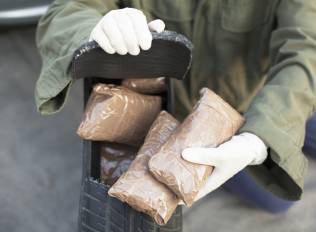
    A Texas prison got much more than it bargained for, when a shipment of donated bananas bound for the penitentiary was found to contain nearly $18 million worth of cocaine

    “Sometimes, life gives you lemons. Sometimes, it gives you bananas. And sometimes, it gives you something you’d never expect!” the Texas Department of Criminal Justice wrote in a Facebook post.

    According to NPR, representatives from the Ports of America in Freeport, Texas contacted the department when two pallets’ worth of ripe bananas were left unclaimed at the port. The port agreed to donate the fruit to the Wayne Scott Unit prison farm in Brazoria County so they could be consumed before they went bad. 

    “Two sergeants of the Scott Unit arrived to pick them up, and discovered something not quite right,” the department wrote. 

    When the correctional officers were loading the 45 boxes of bananas, one noticed that a particular box felt different.

    “They snipped the straps, pulled free the box, and opened it up. Inside, under a bundle of bananas, he found another bundle! Inside that? What appeared to be a white powdery substance,” the department wrote. 

    That led to the whole shipment being searched and authorities found 540 packages of cocaine with a street value of $17.8 million. 

    “U.S. Customs arrived on the scene, and the substance tested positive for cocaine,” the department wrote. “Customs agents then searched each box on the two pallets, and they were all ripe and loaded. Once all 45 boxes had been emptied, what was left was quite the cache.”

    The department praised the attentiveness of the corrections officers who followed his gut.

    “With an instinct that something just wasn’t quite right, our guys uncovered 540 packages of cocaine within the shipment, with an estimated street value of $17,820,000!” the department wrote. 

    The Drug Enforcement Administration and U.S. Customs and Border Protection are investigating the cocaine shipment. They have not released where the shipment came from or who the intended recipient was.

    Apparently, shipping cocaine in bananas is relatively common. In April, Spanish police seized nearly 9 tons of cocaine in a shipment of bananas from Colombia. Albanian, Romanian and German police have also uncovered cocaine in banana shipments shipped from Colombia, the largest producer of cocaine.

    View the original article at thefix.com

  • Pennsylvania Prisons Ban Books Due To "Drug Smuggling," Twitter Erupts

    Pennsylvania Prisons Ban Books Due To "Drug Smuggling," Twitter Erupts

    Pennsylvania Department of Corrections took to Twitter to defend the banning policy and were promptly ripped a new one by Twitter users.

    The Pennsylvania prison system got hilariously dragged on Twitter after officials claimed they’d intercepted a letter about drug-smuggling—when in fact the neatly-penned missive mentioned nothing of the sort. 

    The tweet and its aftermath are just the latest bizarre fallout from the alleged drug exposure incidents and subsequent book-banning policy that the Pennsylvania Department of Corrections defended in the first place. The letter, they said, was proof of the need for stricter book-sending policies to tamp down on drug trafficking into the facility.

    “Do you have any old books you read already? If so I want you to send them to me,” reads the inmate letter posted to Twitter on Sept. 14. Over the course of the next few lines, the missive-mailer explains how to game the system to send in used books as if they’re new, thus making it possible to get in a wider array of reading material for a lower cost.

    Nowhere in the 14 lines of writing does the letter mention drugs, or include instructions about how to conceal any type of material in the mailed-in books.

    “P.S. A dictionary would be lovely,” the prisoner scrawled in the margin with a smiley face.

    Nonetheless, prison officials spotted the literary subterfuge and saw something more sinister. In their tweet, the department described the note as “a letter from an inmate to family members describing how to smuggle drugs through a popular book donation program.”

    Twitter was not having it. 

    “That’s weird,” tweeted the Rhode Island chapter of the National Lawyers Guild. “Is ‘dictionary’ code for drugs? Many of my clients have asked for dictionaries over the years, and when I had actual dictionaries mailed to them, they did not ask me why I sent books instead of drugs. Please advise.”

    Another Twitter user wrote, “Ah yes, classic drug dealer lingo like ‘A dictionary would be lovely.’”

    Others joined in.

    “Do you know what a book is?” another user tweeted. More and more smart-alecky commenters piled on, ensuring the prison system’s tweet got soundly ratioed into Twitter infamy. 

    “Sir, I was promised a letter describing how to smuggle drugs & all I got was this lousy letter describing how to donate books,” tweeted another Twitter snarker. 

    The chain of unfortunate events that led to the Twitter dragging began a number of weeks ago after 57 prison staffers were sickened in a series of 28 alleged drug exposure incidents.

    In response, prison officials instituted a statewide lockdown in late August and shut down all mail. Afterward, prison brass linked it all to synthetic cannabinoid exposure—but experts told the Philadelphia Inquirer that it was more likely a “mass psychogenic illness.”

    “We see it all the time with law enforcement,” said Jeanmarie Perrone, director of medical toxicology at the University of Pennsylvania’s Perelman School of Medicine. “Police pull someone over and find an unknown substance. Suddenly their heart’s racing, they’re nauseated and sweaty. They say, ‘I’m sick. I’m gonna pass out.’ That is your normal physiological response to potential danger.”

    Another physician called the possibility of cannabinoid exposure through the skin “implausible.” But whatever caused the officers’ sickness, there’s been little doubt that the system—like prison systems in other states—has seen an uptick in K2 smuggling. 

    Accordingly, the Keystone State’s prisons announced plans to spend $15 million to up security with body scanners for visitation, digital mail delivery, drone-detecting equipment—and a shift to e-books.

    View the original article at thefix.com

  • Man Sentenced For Role In Amtrak Drug-Trafficking Ring

    Man Sentenced For Role In Amtrak Drug-Trafficking Ring

    The man helped direct the shipment of thousands of kilograms of heroin and cocaine from Los Angeles to Chicago. 

    A California man was hit with a 35-year prison sentence last week for his role in overseeing an international drug-running ring on Amtrak train lines, according to court records.

    Edgar Roque headed up the cocaine-dealing crew for at least six years, shipping thousands of kilograms of illicit drugs from Mexico across the United States.

    “This is criminal conduct of the worst kind,” federal prosecutor Paul H. Tzur wrote in a sentencing memorandum. “Edgar Roque’s leadership role directing the mass movement of heroin and cocaine into the Chicago area and elsewhere showed that he had absolutely no regard for the safety and well-being of addicts and the communities into which he delivered the drugs.”

    With at least 20 confederates—including men with names like “Lil Pimp” and “Traps”—Roque hauled in wholesale amounts of heroin and cocaine from cartel-level suppliers in Mexico, authorities said.

    After getting the drugs to California, Roque would have them shipped to Chicago where his accomplices would pick them up at Chicago’s Union Station and disperse them to stash houses across the Windy City. 

    After off-loading the goods, the lieutenants in Roque’s criminal circuit would hop on a commercial airline and fly the cash proceeds west, typically carrying $150,00 at a time.

    A multi-agency task force probed the underbelly of the organization for years, under the aegis of an investigation known as “Operation Derailed.”

    Months after the 32-year-old pleaded guilty to drug and money laundering charges, a federal judge on Tuesday sent him to prison. A number of Roque’s associates have either pleaded guilty or already been sentenced.

    Phillip Diaz netted more than 20 years in prison for helping ensure delivery of the drugs and maintaining bank accounts to launder the proceeds, prosecutors said.

    Anthony Koon of Colorado got nine years in prison for delivering almost 20 kilograms of heroin valued at around $1 million. Gerardo Sanchez of California helped launder the profits and accepted delivery of heroin to a Tinsley Park hotel room, which netted him a 17.5-year sentence. 

    Jorge Luis Ochoa-Canela was sentenced to five years behind bars for moving massive amounts of money back to suppliers. And Amtrak employee Roy Griffin netted an 18-month sentence for scheming to steal a package of cocaine arriving into Union Station. 

    Four other defendants have pleaded guilty and are scheduled for sentencing before the end of the year. 

    View the original article at thefix.com

  • Tunnel Beneath KFC Connects Drug Smugglers in Arizona, Mexico

    Tunnel Beneath KFC Connects Drug Smugglers in Arizona, Mexico

    The county sheriff’s department called the discovery a “heavy blow to that transnational criminal organization that built this tunnel.”

    A routine stop for an equipment violation led law enforcement in Arizona to an operation that numerous media outlets compared to the AMC series Breaking Bad, with a near-600-foot tunnel that connected a former fast food restaurant to a private home in Mexico for the purposes of trafficking narcotics.

    Police pulled over Jesus Ivan Lopez Garcia on August 13 after he was observed removing several containers from an abandoned Kentucky Fried Chicken (KFC) franchise located one mile from the U.S.-Mexico border; a search of the vehicle turned up more than 200 packages of various narcotics, including 6.8 pounds of fentanyl.

    This led to a search of the restaurant, where a tunnel traversed the border to a home in San Luis Rio Colorado, Mexico. The county sheriff’s department described the discovery as a “heavy blow to that transnational criminal organization that built this tunnel.”

    According to CNN, court documents showed that Lopez Garcia had purchased the former KFC location in San Luis, Arizona in April 2018. The structure was described as “vacant in recent years,” which raised the suspicion of police when Lopez Garcia was seen taking the containers, including a tool box from the former restaurant and loading them into a trailer attached to a pickup truck.

    Officers then pulled him over for what was described as an unspecified equipment violation, and during the traffic stop, a K-9 officer alerted authorities to suspected drugs in the two containers.

    A search of the containers yielded more than 261 pounds of methamphetamine, 14 pounds of cocaine, 30 pounds of white heroin, 13.7 pounds of brown heroin and 6.8 pounds of fentanyl.

    Homeland Security Investigations (HSI) Special Agent in Charge Scott Brown told a CNN affiliate station in Arizona that the fentanyl “translates to over three million dosage units.” Authorities gave the total price of the drugs at more than $1 million.

    After obtaining a warrant, HSI conducted a search of the KFC location on August 14 and found an eight-inch hole with a depth of 22 feet.

    This led to a walkway that was five feet tall and three feet wide that ran 590 feet across the border to San Luis Rio Colorado in Mexico. Mexican authorities reported that a search of a residential property on August 15 found an entrance to the tunnel under a bed. 

    “There was no mechanism to physically come up to the small opening” in the KFC location, said Brown in a press conference. “The narcotics we believe were raised up by a rope [and] then loaded into the tool box and taken out of the abandoned restaurant.”

    Yuma Sector Chief Patrol Agent Anthony Porvaznik said that the tunnel will be filled with cement to keep others from using it.

    View the original article at thefix.com

  • FBI Raid Nets 20 Suspected Cartel Traffickers, Nearly A Ton Of Cocaine

    FBI Raid Nets 20 Suspected Cartel Traffickers, Nearly A Ton Of Cocaine

    Three sprawling federal indictments unsealed last week named 57 defendants snared in the operation—and 35 of them are still on the run.

    Twenty alleged Sinaloa Cartel drug traffickers were arrested early Wednesday in a web of raids that netted 850 pounds of meth, nearly 1 ton of cocaine, 93 pounds of heroin and $1.42 million in cash. 

    Over the course of a three-year investigation involving a slew of government agencies from the Internal Revenue Service (IRS) to Los Angeles police, investigators uncovered a massive drug-trafficking ring regularly hauling in kilograms of narcotics from south of the border. Law enforcement also seized nearly 50 pounds of cannabis.

    Three sprawling federal indictments unsealed last week named 57 defendants snared in the operation—and 35 of them are still on the run. Most are believed to be in Mexico, according to the U.S. Department of Justice.

    “More than simply seizing large quantities of drugs and money, this investigation was able to identify the top-level, Mexican-based traffickers who directed the transactions, and who thought they were using secure communication devices to commit their crimes,” First Assistant United States Attorney Tracy L. Wilkison said in a statement. “Our ability to obtain those communications continues to be an important part of our ability to solve these crimes.” 

    The investigation—known as Operation Narconetas—zeroed in on three drug trafficking organizations accused of using vehicles with hidden compartments to smuggle large quantities of drugs from Mexico to the U.S., sometimes storing the substances in stash houses before distributing them throughout the country.

    The indictments outline allegations of vast drug trafficking conspiracies, and also include asset forfeiture requests as the government seeks to seize any property or resources used in the smuggling operation.

    “Today’s arrest of multiple defendants for their alleged role in smuggling funds from illegal drug transactions in and out of the United States is a victory for the American public and a defeat to drug traffickers everywhere,” said IRS Special Agent in Charge R. Damon Rowe of the Los Angeles Field Office. “The special agents of IRS Criminal Investigation continue in their mission to disrupt the flow of ill-gotten gains that is the life-blood for these criminals.”

    The multi-agency task force behind the arrests, known as the Los Angeles Strike Force, was formed in 2014 to target Mexican drug cartels in Los Angeles, which authorities identified as a major hub for drug trafficking and money laundering.

    The strike force, led by the Federal Bureau of Investigation (FBI) and the Drug Enforcement Administration (DEA), also included the Bureau of Alcohol, Tobacco, Firearms and Explosives; the California Highway Patrol; Torrance Police Department; U.S. Immigration and Customs Enforcement’s Homeland Security Investigations; Los Angeles Police Department and others.

    The arrests and indictments are just the latest federal offensive against the violent cartel. Earlier this year, prosecutors in San Diego indicted 75 people in a $6 million money laundering bust using WhatsApp, according to the Los Angeles Times

    View the original article at thefix.com

  • Chinese National Pleads Guilty To Importing Opioids

    Chinese National Pleads Guilty To Importing Opioids

    The businessman would receive large shipments of opioids from China and mail them out domestically.

    A Chinese businessman living in Massachusetts has pled guilty to charges of importing opioids. 

    Bin Wang, 42, was arrested in July and charged with importing shipments of carfentanil, fentanyl and other opioids. Wang would receive large shipments of opioids from China and mail them domestically, including to buyers in Ohio, according to a press release by the Ohio U.S. Attorney’s office.

    On Tuesday, Wang pleaded guilty in U.S. federal court to importing and distributing opioids. He will be sentenced on November 13.

    Opioids, particularly powerful synthetics, are reportedly made in China and shipped into the U.S. using couriers like FedEx and even the U.S. Postal Service.

    “Increasingly, the opioids that are killing our friends and neighbors are being sent here from China,” said Acting U.S. Attorney David Sierleja. “Shutting down this pipeline will help in our efforts to turn the tide on the opioid epidemic. We will focus on prevention, education, and aggressive law enforcement, both here and around the world.”

    This requires a new approach to intercepting drugs.

    “The importation of opioids and other synthetic drugs from China has played a significant role in America’s current drug use epidemic. Over 60,000 people a year die from drug overdoses in this country, and halting all methods of drug trafficking—including by way of the Internet—is a top priority of the DEA,” said DEA Special Agent in Charge Timothy J. Plancon. “This investigation makes clear that geographic and technological hurdles will not stop DEA and our partners from bringing to justice those responsible for the illegal distribution of drugs in the U.S.”

    Despite that tough stance, it is reportedly very difficult to catch opioids coming into the country from China. In part, that is because the shipments are small, and the volume of mail coming into the country makes it difficult to pinpoint suspicious packages. In addition, prosecuting Chinese manufacturers can be difficult.

    Officials first started investigating the drugs that led to Wang in 2016, after a series of fatal overdoses in Ohio. They determined that the drugs were bought online through a Chinese website, and that a Chinese man known as “Gordon Jin” was shipping the drugs to Wang in Massachusetts, who then distributed them domestically.

    Undercover agents purchase opioids from Jin, and were able to track the shipments to Wang, who was operating companies from a warehouse in Woburn, Massachusetts.

    “This investigation is a great example of a collaborative effort of federal agencies and a local drug task force working together to identify and track down people and organizations that are responsible for the ever-increasing shipments of very powerful synthetic opiates into Ohio,” said Don Hall, director of the MEDWAY Drug Enforcement Agency.

    View the original article at thefix.com

  • Celebrity Names Used By Ecstasy Ring To Order Drugs

    Celebrity Names Used By Ecstasy Ring To Order Drugs

    The use of the celebrity names drew the attention of customs agents and led to the eventual takedown of a drug ring.

    A Michigan father and son convicted for their alleged roles in a large-scale ecstasy distribution and manufacturing ring took what may have seemed—at least, to them—a unique approach to disguising their identities in order to reportedly purchase drugs and related paraphernalia for their alleged operation. Federal officials claim that they used the names of celebrities like Tim Allen and Tracy Morgan as aliases.

    Sylvester Boston Sr., and Sylvester Boston Jr., were sentenced to eight and nine years, respectively, in federal prison for their alleged participation in the drug ring, which they are accused of operating from a computer store on Detroit’s west side.

    The Bostons reportedly used the comedians’ names to order a pill press from China, but claimed that the aliases and burner phones used to place the orders were used for privacy reasons. Sylvester Boston, Jr., has denied the charges, claiming that he and his father sold energy-boosting pills, not illegal narcotics.

    The investigation, which was led by agents from U.S. Immigration and Customs Enforcement’s Homeland Security Investigations (HSI), began in 2013 when Customs and Border Protection officers seized an industrial pill press from China with fraudulent labels for shipment—specifically, Tracy Morgan’s name was written on the receipt.

    But the Bostons’ alleged use of celebrity names only drew the attention of customs agents, who opened a package addressed to Tim Allen and found BZP, a Schedule I drug and component in some ecstasy tablets which reportedly produces similar stimulation or hallucinogenic effects as MDMA.

    HSI agents, with the assistance of the Bureau of Alcohol, Tobacco, Firearms and Explosives (ATF), Michigan State Police and the Detroit Police Department began observing the Bostons’ business, S&B Computer Repairs, and used wiretaps to record the father and son reportedly placing orders for drugs and related paraphernalia on disposable cell phones.

    According to the investigation, the Bostons reportedly manufactured the pills using the press and hid them in potato chip bags, which were intercepted by federal agents.

    A raid was conducted on the Bostons’ store in 2014, and agents confiscated drugs, the pill press, multiple weapons and a bulletproof vest. In addition to the Bostons, seven other individuals were convicted for their role in the pill operation, and six received sentences ranging from two to seven-and-a-quarter years, with one individual sentenced as time served.

    In an interview with Detroit’s WDIV Local 4 station, Boston Jr., denied the charges levied against him, claiming that the pills he sold were legal, “caffeine-based” supplements, and blamed his conviction on several factors, including another individual whom he claimed was “part of the Iraq mafia,” an informant who confused his father whom Boston said suffered from schizophrenia; and his own attorney, whom he said forced him to agree to the plea deal that resulted in his nine-year sentence.

    “They pretty much ignore facts,” said Boston Jr.

    View the original article at thefix.com