Tag: family

  • Hard Conversations: Talking With a Loved One About Their Drinking

    Talking with a loved one about their drinking or drug use can seem impossible, but it can also help plant a seed of recovery.

    Watching a loved one struggle with drugs or alcohol can be incredibly painful. Oftentimes, as a family member, you will notice problematic behaviors before your loved one sees them or is willing to acknowledge them. That can put you in a powerful position to point out your concern and help your loved one get into substance abuse treatment before things reach a crisis point.

    In an ideal world, talking to a loved one about addiction can bring you closer and get them into treatment. But this can also be a fraught conversation ripe with pitfalls and opportunities for hurt feelings. To make the discussion go a bit more smoothly, it’s best to prepare ahead of time. Here’s how.

    1. Evaluate your own emotions and responses.

    Before you involve your loved one, start by taking an honest inventory of your own emotions and feelings. Oftentimes, we bring our own history into the current situation, which can cloud how we see things and confuse the conversation. Maybe you have your own personal experience with sobriety, or perhaps you grew up with a parent that was an alcoholic. Either of those scenarios can make you more sensitive to a loved one’s substance use and more likely to react, rather than have a thoughtful and logical discussion.

    Be sure that you’re expressing genuine concern for your loved one, and that you’re not merely being triggered by their behavior. If you have a trusted third-party — like a therapist or confidential friend — to talk through your concerns. Practice formatting your concerns in a way that centers your loved one, not yourself. Putting your own experiences aside might help your loved one take you more seriously.

    1. Organize your talking points.

    People in active addiction often don’t realize the ways that their behavior has escalated. Helping them see their actions can highlight that they really do need help. The key is doing this in an objective way. No one wants to feel scolded or judged; instead they want to feel seen.

    Think about what behaviors you are most concerned about. For example, you might say something like, “I noticed you’ve been drinking every day after work,” or “The kids mentioned that you slept through your alarm three times last week.” Show your loved one their behavior through your eyes, but don’t shove it in their face.

    1. Use “I” statements.

    It’s easy for difficult conversations to escalate, becoming more and more emotional. An emotional, reactive discussion rarely leads to a productive place. One way to deescalate the situation and remove some of the negative emotion is by using “I” statements.

    Here’s how it works: rather than coming at your loved one with everything they’ve done, you focus on the impact that has on you. For example, instead of saying “You’re drinking every night and ignoring your responsibilities,” say “I have to take care of the animals and dinner chores alone when you’re drinking after work.” I statements can incorporate emotions and feelings, too. You might say, “I get scared when you’re out late and I haven’t heard from you.”

    Using “I” statements removes some of the arguing and pushback. Your loved one might disagree about the details of their behavior, but they can’t argue with your experience.

    1. Keep expectations realistic.

    Everyone is familiar with the idea of a big, dramatic intervention that results in someone leaving immediately for treatment. In reality, your discussion is unlikely to look like that. Your loved one might not even agree that there is a problem. That’s ok — this can be the first step in an ongoing conversation. That’s why it’s important to have a positive conversation and leave the door open for your loved one to come back to you after they’ve thought about what you said.

    Of course, there are situations where waiting isn’t the right answer. If your loved one is endangering themselves or others, or having a negative impact on your emotional or mental wellbeing, it is entirely ok to set boundaries and stick with them. Only you can decide what boundaries are right for you at a given time.

    1. Be prepared to offer help.

    Even after a person realizes that they might need treatment, the logistics can be overwhelming. Be prepared before you even start the conversation by gathering some resources on recovery options, different programs, local meetings, and more. That way, you can capitalize on your loved one’s willingness to accept help as soon as they express it.

    Only the person who is struggling with drug or alcohol use can make the decision to get treatment. However, as a family member or close friend, you have an important role to play in encouraging them and planting the seed for recovery.

    Learn more about Oceanside Malibu at http://oceansidemalibu.com/. Reach Oceanside Malibu by phone at (866) 738-6550. Find Oceanside Malibu on Facebook.

    View the original article at thefix.com
  • 5 Ways to Support Your Loved One During Recovery

    Support from friends and family is crucial to the person’s success in recovery. It may be difficult to know exactly how to provide that support in a time of crisis.

    According to current statistics, an approximate 23 million people are in addiction recovery in the United States. Recovery, in any modality – inpatient, outpatient, 12-step, or otherwise – can be an emotionally, mentally, and physically challenging experience for the person seeking to break the grip of addiction, and for their friends and family. Recovery holds special challenges for the latter group, who have seen their loved ones struggle with addiction, and in some cases, may have endured negative experiences because of that addiction.

    However, support from those around the addicted individual is crucial to their success in recovery. It may be difficult to know exactly how to provide that support in a time of crisis. Following are 10 ways you can support a family member or friend as they take their first steps in recovery.

    1. Supporting isn’t enabling – know the difference.

    Cynical wisdom may suggest that any support for an addict is enabling their behavior. However, the two actions are not the same: support is offering help while maintaining healthy boundaries, while enabling is support at the expense of your own well-being. Support requires honesty, while enabling excuses and even participates in addictive behavior (“he/she can’t help it”). And support allows you to question addictive behavior while maintaining love and affection; enabling strangles healthy inquiry for fear of reprisal or recrimination.

    2. Educate yourself on recovery.

    Misinformation is a hot button topic of late, and the addiction and recovery worlds are no stranger to misguided, judgmental, and just plain wrong material in both print and online form as well. So it’s important that you know a few facts as your loved one undergoes recovery: addiction is not a sign of physical, mental, or moral weakness. It’s an imbalance in the chemical components of the brain which undoes impulse control and leaves the individual with a neural road map studded with triggers that, when tripped, set off addictive behavior, often without the individual’s conscious choice. It’s also important to understand that relapse is a common occurrence with individuals in recovery: there is no such thing as a “cure” for addiction. Understanding these core truths provides you with a foundation for a fuller and more accurate picture of the struggles your loved one is facing.

    3. Communicate clearly and without judgment.

    Remember that it’s okay to ask your loved one how they are feeling, and let them know that they can communicate with you as well. Assuring them that they can speak without fear of judgment allays a lot of concerns experienced by individuals in recovery. If they seem unsure of how to begin the conversation, give them a question that allows them to elaborate on their feelings, rather than a yes/no query (“Are you feeling all right?”). Though you may also experience anxiety about your loved one’s condition, try to avoid an interrogatory tone when asking about their well-being. Be honest: saying that you’re unsure or uncomfortable, but that you still want to ask about them, is the sort of honesty they crave. Choosing words that don’t carry a lot of negative freight helps, too: some people don’t mind the words “addict” or “rehab,” but your loved one may feel like those terms carry a stigma.

    4. Help them build good coping skills.

    External and internal stressors play havoc with everyone’s sense of well-being, but for individuals in the grip of addiction, or in the process of recovery, they can lead to a relapse. Your loved one will hopefully learn many ways to contend with stress while in recovery, but there’s simply no way to completely remove all stressors from life. Illness, personal loss, professional changes, and even differences in daily routines can all spark a stressful response. You can help by listening to your loved one when they feel stressed, and help them process and address their feelings. Discuss practical ways to solve those stressors, if possible, as well as coping mechanisms they’ve learned as part of their recovery.

    5. Know the signs of relapse.

    Relapse is a common occurrence during and after recovery. The National Institute for Drug Abuse notes that 40 to 60 percent of individuals with a substance addiction will relapse. To that end, it’s important for loved ones to first understand what a relapse is. From a clinical standpoint, relapse occurs when a clinical condition that had previously improved experiences a sudden decline. In terms of addiction, that typically means a return to substance use. Relapses are not only troubling in terms of the individual’s emotional and mental wellbeing, but they also pose physical danger: tolerance levels drop for many people who abstain from substance use over an extended period of time, and returning to drug use may lead to an overdose.

    Relapses don’t appear without provocation. The typical signs of relapse began with a change in the individual’s outlook: they may seem more negative about recovery, or downbeat about their existence. Old patterns of behavior may return: they may have mood swings, bursts of anger, or resistance to taking responsibility for their actions. From there, the individual withdraws from help, turning away from family, friends, and the support provided by recovery. Return to actual substance use is usually sparked by an emotional conflict of some kind; it could be a major issue, like family clashes or exposure to addictive substances, or it could be a less combustive concern, such as apathy, depression, or an encounter with a location where addictive behavior took place.

    If relapse occurs, it’s natural for both you and your loved one to feel a lot of emotions: anger, shame, grief, and even despondency. It’s important for you to follow some of the guidelines mentioned here: establish boundaries, listen to your loved one, offer support where you can without enabling, and most importantly, understand that relapse isn’t failure. Your loved one has experienced a setback, and needs to return to treating the disease.

    Tarzana Recovery Center is a luxury addiction treatment center in Tarzana, CA. For more info, visit their website or Facebook, or call 866-514-1748.

    View the original article at thefix.com

  • Gloria Harrison: True Recovery Is the Healing of the Human Spirit

    Although Gloria experienced trauma, violence, and institutionalized oppression, she never gave up hope. Now, in recovery, she is a counselor and staunch recovery advocate. 

    True recovery is the healing of the human spirit.
    It is a profound recognition that we not only have the right to live
    but the right to be happy, to experience the joy of life.
    Recovery is possible if only you believe in your own self-worth.

    -Gloria Harrison

    Although the dream of achieving recovery from substance use disorders is difficult today for people outside of the Caucasian, straight, male normative bubble, there is no question that progress has been made. If you want to know how difficult it was to get help and compassionate support in the past, you just have to ask Gloria Harrison. Her story is a stark reminder of how far we have come and how far we still must go.

    As a young gay African American girl growing up in a Queens household overrun with drug abuse and childhood trauma, it is not surprising that she ended up becoming an addict who spent years homeless on the streets of New York. However, when you hear Gloria’s story, what is shocking is the brutality of the reactions she received when she reached out for help. At every turn, as a girl and a young woman, she was knocked down, put behind bars in prisons, and sent to terribly oppressive institutions.

    Gloria’s story is heartbreaking while also being an inspiration. Although she spent so much time downtrodden and beaten, she never gave up hope; her dream of recovery allowed her to transcend the bars of historical oppression.

    Today, as an active member of Voices of Community Activists & Leaders (VOCAL-NY), she fights to help people who experience what she suffered in the past. She is also a Certified Recovery Specialist in New York, and despite four of her twenty clients dying from drug overdoses during the COVID-19 pandemic, she continues to show up and give back, working with the Harlem United Harm Reduction Coalition and, as a Hepatitis C survivor, with Frosted (the Foundation for Research on Sexually Transmitted Diseases).

    Before delving into Gloria’s powerful and heartbreaking story, I must admit that it was not easy for me to decide to write this article. As a white Jewish male in long-term recovery, I was not sure that I was the proper person to recount her story for The Fix. Gloria’s passion and driving desire to have her story told, however, shifted my perspective.

    From my years in recovery, where I have worked a spiritual program, I know that sometimes when doors open for you, it is your role to walk through them with courage and faith.

    A Cold Childhood of Rejection and Confusion

    Like any child, Gloria dreamed of being born into the loving arms of a healthy family. However, in the 1950s in Queens, when you were born into a broken family where heavy responsibilities and constant loss embittered her mother, the arms were more than a little overwhelmed. The landscape of Gloria’s birth was cold and bleak.

    She does not believe that her family was self-destructive by nature. As she tells me, “We didn’t come into this world with intentions of trying to kill ourselves.” However, addiction and alcoholism plagued so many people living in the projects. It was the dark secret of their lives that was kept hidden and never discussed. Over many decades, more family members succumbed to the disease than survived. Although some managed to struggle onward, addiction became the tenor of the shadows that were their lives.

    Gloria’s mother had a temper and a judgmental streak. However, she was not an alcoholic or an addict. Gloria does remember the stories her mother told her of a difficult childhood. Here was a woman who overcame a terrifying case of polio as a teenager to become a singer. Despite these victories, her life became shrouded in the darkness of disappointment and despair.

    Gloria Harrison: True Recovery Is the Healing of the Human Spirit

    In 1963, as a pre-teen, Gloria dreamed of going to the March on Washington with Martin Luther King, Jr., and the leaders of the Civil Rights Movement. Her mother even bought her a red beanie like the militant tam worn by the Black Panthers. Proudly wearing this sign of her awakening, Gloria went from house to house in Astoria, Queens, asking for donations to help her get to Washington, D.C. for the march. She raised $25 in change and proudly brought it home to show her mother.

    Excited, she did not realize it was the beginning of a long line of slaps in the face. Her mother refused to let her little girl go on her own to such an event. She was protective of her child. However, Gloria’s mom promised to open a bank account for her and deposit the money. Gloria could use it when she got older for the next march or a future demonstration. Gloria never got to turn this dream into a reality because her life quickly went from bad to worse.

    At thirteen, Gloria found herself in a mish-mash of confusing feelings and responsibilities. She knew she liked girls more than boys from a very early age, not just as friends. Awakening to her true self, Gloria felt worried and overwhelmed. If she was gay, how would anyone in her life ever love her or accept her?

    The pressure of this realization demanded an escape, mainly after her mother started to suspect that something was off with her daughter. At one point, she accused her daughter of being a “dirty lesbo” and threw a kitchen knife at her. Gloria didn’t know what to do. She tried to run away but realized she had nowhere to go. The only easy escape she could find was the common escape in her family: Drugs seemed the only option left on the table.

    The High Price of Addiction = The Shattering of Family Life

    In the mid-sixties, Gloria had nowhere to turn as a young gay African American teen. There were no counselors in her rundown public high school, and the usual suspects overwhelmed the teachers. Although the hippies were fighting the war in Vietnam on television, they did not reach out to troubled kids in the projects. Heck, most of them never left Manhattan, except for a day at the Brooklyn Zoo or Prospect Park. The Stonewall Riots of 1969 were far away, and Gay Rights was not part of almost anyone’s lexicon. Gloria had no options.

    What she did have was an aunt that shot heroin in her house with her drug-dealing boyfriend. She remembers when she first saw a bag of heroin, and she believed her cousin who told her the white powder was sugar. Sugar was expensive, and her mom seldom gave it to her brothers and sisters. Why was it in the living room in a little baggie?

    Later, she saw the white powder surrounded by used needles and cotton balls, and bloody rags. She quickly learned the truth, and she loved what the drug did to her aunt and the others. It was like it took all their cares away and made them super happy. Given such a recognition, Gloria’s initial interest sunk into a deeper fascination.

    At 14, she started shooting heroin with her aunt, and that first hit was like utter magic. It enveloped her in a warm bubble where nothing mattered, and everything was fine. Within weeks, Gloria was hanging out in shooting galleries with a devil may care attitude. As she told me, “I have always been a loner even when I was using drugs, and I always walked alone. I never associated with people who used drugs, except to get more for myself.”

    Consequences of the Escape = Institutions, Jails, and Homelessness

    Realizing that her daughter was doing drugs, Gloria’s mother decided to send her away. Gloria believes the drugs were a secondary cause. At her core, her mother could not understand Gloria’s sexuality. She hoped to find a program that would get her clean and turn her straight.

    It is essential to understand that nobody else in Gloria’s family was sent away to an institution for doing drugs. Nobody else’s addiction became a reason for institutionalization. Still, Gloria knows her mother loved her. After all, she has become her mother’s number one contact with life outside of her nursing home today.

    Also, Gloria sometimes wonders if the choice to send her away saved her life. Later, she still spent years homeless on the streets of Queens, Manhattan, the Bronx, and Brooklyn. Of the five boroughs of New York City, only Staten Island was spared her presence in the later depths of her addiction. However, being an addict as a teenager, the dangers are even more deadly.

    When her mother sent her away at fourteen, Gloria ended up in a string of the most hardcore institutions in the state of New York. She spent the first two years in the draconian cells of the Rockefeller Program. Referred to in a study in The Journal of Social History as “The Attila The Hun Law,” these ultra-punitive measures took freedom away from and punished even the youngest offenders. Gloria barely remembers the details of what happened.

    After two years in the Rockefeller Program, she was released and immediately relapsed. Quickly arrested, she was sent to Rikers Island long before her eighteenth birthday and put on Methadone. Although the year and a half at Rikers Island was bad, it was nothing compared to Albany, where they placed her in isolation for two months. The only time she saw another human face was when she was given her Methadone in the morning. During mealtimes, she was fed through a slot in her cell.

    Gloria says she went close to going insane. She cannot recall all the details of what happened next, but she does know that she spent an additional two in Raybrook. A state hospital built to house tuberculosis patients; it closed its doors in the early 1960s. In 1971, the state opened this dank facility as a “drug addiction treatment facility” for female inmates. Gloria does remember getting lots of Methadone, but she does not recall even a day of treatment.

    Losing Hope and Sinking into Homeless Drug Addiction in the Big Apple

    After Raybrook, she ended up in the Bedford Hills prison for a couple of years. By now, she was in her twenties, and her addiction kept her separate from her family. Gloria had lost hope of a reconciliation that would only came many years later.

    When she was released from Bedford Hills in 1982, nobody paid attention to her anymore. She became one more invisible homeless drug addict on the streets of the Big Apple. Being gay did not matter; being black did not matter, even being a woman did not matter; what mattered was that she was strung out with no money and no help and nothing to spare.

    Although she found a woman to love, and they protected each other when not scrambling to get high, she felt she had nothing. She bounced around from park bench to homeless shelter to street corners for ten years. There was trauma and violence, and extreme abuse. Although Gloria acknowledges that it happened, she will not talk about it.

    Later, after they found the path of recovery, her partner relapsed after being together for fifteen years. She went back to using, and Gloria stayed sober. It happens all the time. The question is, how did Gloria get sober in the first place?

    Embracing Education Led to Freedom from Addiction and Homelessness

    In the early 1990s, after a decade addicted on the streets, Gloria had had enough. Through the NEW (Non-traditional Employment for Women) Program in NYC, she discovered a way out. For the first time, it felt like people believed in her. Supported by the program, she took on a joint apprenticeship at the New York District College for Carpenters. Ever since she was a child, Gloria had been good with her hands.

    In the program, Gloria thrived, learning welding, sheet rocking, floor tiling, carpentry, and window installation. Later, she is proud to say that she helped repair some historical churches in Manhattan while also being part of a crew that built a skyscraper on Roosevelt Island and revamped La Guardia Airport. For a long time, work was the heart of this woman’s salvation.

    With a smile, Gloria says, “I loved that work. Those days were very exciting, and I realized that I could succeed in life at a higher level despite having a drug problem and once being a drug addict. Oh, how I wish I was out there now, working hard. There’s nothing better than tearing down old buildings and putting up something new.”

    Beyond dedicating herself to work, Gloria also focused on her recovery. She also managed to reconnect with her mother. Addiction was still commonplace in the projects, and too many family members had succumbed to the disease. She could not return to that world. Instead, Gloria chose to focus on her recovery, finding meaning in 12-Step meetings and a new family.

    Talking about her recovery without violating the traditions of the program, Gloria explains, “I didn’t want to take any chances, so I made sure I had two sponsors. Before making a choice, I studied each one. I saw how they carried themselves in the meetings and the people they chose to spend time with. I made sure they were walking the walk so that I could learn from them. Since I was very particular, I didn’t take chances. I knew the stakes were high. Thus, I often stayed to myself, keeping the focus on my recovery.”

    From Forging a Life to Embracing a Path of Recovery 24/7

    As she got older and the decades passed, Gloria embraced a 24/7 path of recovery. No longer able to do hard physical labor, she became a drug counselor. In that role, she advocates for harm reduction, needle exchange, prison reform, and decriminalization. Given her experience, she knew people would listen to her voice. Gloria did more than just get treatment after learning that she had caught Hepatitis C in the 1980s when she was sharing needles. She got certified in HCV and HIV counseling, helping others to learn how to help themselves.

    Today, Gloria Harrison is very active with VOCAL-NY. As highlighted on the organization’s website, “Since 1999, VOCAL-NY has been building power to end AIDS, the drug war, mass incarceration & homelessness.” Working hard for causes she believes in, Gloria constantly sends out petitions and pamphlets, educating people about how to vote against the stigma against addicts, injustices in the homeless population, and the horror of mass incarceration. One day at a time, she hopes to help change the country for the better.

    However, Gloria also knows that the path to recovery is easier today for facing all the “absurd barriers” that she faced as a young girl. Back in the day, being a woman and being gay, and being black were all barriers to recovery. Today, the tenor of the recovery industry has changed as the tenor of the country slowly changes as well. Every night, Gloria Harrison pictures young girls in trouble today like herself way back when. She prays for these troubled souls, hoping their path to recovery and healing will be easier than she experienced.

    A Final Word from Gloria

    (When Gloria communicates via text, she wants to make sure she is heard.)

    GOOD MORNING, FRIEND. I HOPE YOU ARE WELL-RESTED. I AM GRATEFUL. I LOVE THE STORY.

    I NEED TO MAKE SOMETHING CLEAR. MY MOTHER HAD A MENTAL AND PHYSICAL ILLNESS. SHE HAD POLIO AT THE AGE OF FOURTEEN BUT THAT DIDN’T STOP HER. SHE WENT THROUGH SO MUCH, AND I LOVE THE GROUND SHE WALKS ON. I BELIEVE THAT SHE WAS ASHAMED OF MY LIFESTYLE, BUT, AT THE SAME TIME, SHE LOVED ME. SHE GAVE ME HER STRENGTH & DETERMINATION. SHE GAVE ME HER NAME. SHE RAISED HER LIFE UP OVER HER DISABILITIES. SHE BECAME A STAR IN THE SKY FOR ALL AROUND HER.

    BEING THAT MY MOTHER WASN’T EDUCATED OR FINISHED SCHOOL, SHE DIDN’T KNOW ABOUT THE ROCKEFELLER PROGRAM. SHE ONLY WANTED TO SAVE HER TRUSTED SERVANT AND RESCUE HER BELOVED CHILD. SHE NEEDS ME NOW AND I AM ABLE TO HELP BECAUSE I WAS ABLE TO TURN MY LIFE AROUND COMPLETELY. SHE TRUSTS ME TODAY TO WATCH OVER HER WELLBEING, AND I FEEL BLESSED TO BE HER BELOVED CHILD AND TRUSTED SERVANT AGAIN. AS YOU HAVE MENTIONED TO ME, THE PATH OF RECOVERY IS THE PATH OF REDEMPTION.

    Postscript: A big thank from both Gloria and John to Ahbra Schiff for making this happen.

    View the original article at thefix.com

  • Chapter 6: The Thrush’s Song

    Shauna Shepard, who works as a receptionist in the local health clinic, visited with me on my back porch. She shared why she drifted into substance abuse, and how she struggled to get — and remain — sober.

    After a man in my small Vermont town who had a heroin addiction committed suicide, I began asking questions about addiction. Numerous people shared their experiences with me — from medical workers to the local police to people in recovery. Shauna Shepard, who works as a receptionist in the local health clinic, visited with me on my back porch. She shared why she drifted into substance abuse, and how she struggled to get — and remain — sober.

    “Drugs,” Shauna finally said after a long silence, tapping her cigarette on the ashtray. “Drugs are really good. That’s the problem. When you’re using, it’s hard to imagine a life without them. For a long time, I didn’t know how to deal with my feelings any other way. It’s still hard for me to understand that getting high isn’t an option anymore.”

    I nodded; I knew all too well how using could be a carapace, a place to tuck in and hide, where you could pretend your life wasn’t unraveling.

    “You can go weeks, months, even years without using, and then you smell something or hear a certain song on the radio, or you see somebody, and — bam! — the cravings come right back. If you don’t keep your eye on that shit, it’ll get you.”

    “It? You mean cravings for drugs? Or your past?”

    “Both,” she said emphatically. “I mean, fuck. Emotions don’t go away. If you bury them, everything comes crashing out when someone asks you for a fucking pen, and they get the last six months of shit because they walked in at the wrong time.”

    I laughed. “So much shit can happen in six months.”

    She nodded, but she wasn’t smiling.

    I rubbed a fingertip around the edge of the saucer, staring at the ashes sprinkled over its center. “What’s it like for you to be sober?”

    “It’s harder. But it’s better. My job is good, and I want to keep it. I have money the day after I get paid. I’ve got my therapist and my doctor on speed dial. I have Vivitrol. But I still crave drugs. I don’t talk to anyone who uses. It’s easy for that shit to happen. You gotta be on your game.”

    “At least to me, you seem impressively aware of your game.”

    With one hand, she waved away my words. “I have terrible days, too. Just awful days. But if my mom can bury two kids and not have a drug issue, I should be able to do it. When my brother shot himself, his girlfriend was right there. She’s now married and has two kids. That’s just freaking amazing. If she can stay clean, then I should be able to stay sober, too.”

    “Can I reiterate my admiration again? So many people are just talk.”

    Shauna laughed. “Sometimes I downplay my trauma, but it made me who I am. I change my own oil, take out the garbage. I run the Weedwacker and stack firewood. I’ve repaired both mufflers on my car, just because I could.” Her jaw tightened. “But I don’t want to be taken advantage of.” She told me how one night, she left her house key in the outside lock. “When I woke up next morning and realized what I had done, I was so relieved to have survived. I told myself, See, you’re not going to fucking die.”

    “You’re afraid here? In small town Vermont?”

    “I always lock up at night. Always have, always will.” Cupping her hands around the lighter to shield the flame from the wind, she bent her head sideways and lit another cigarette.

    “I lock up, too. I have a restraining order against my ex.”

    She tapped her lighter on the table. “So you know.”

    “I do. I get it.”

    *

    As the dusk drifted in and the warm afternoon gave way to a crisp fall evening, our conversation wound down.

    Shauna continued, “I still feel like I have a long way to go. But I feel lucky. I mean, in my addiction I never had sex for money or drugs. I never had to pick out of the dumpster. My rock bottom wasn’t as low as others. I’m thankful for that.”

    I thought of my own gratitude for how well things had worked out for me, despite my drinking problem; I had my daughters and house, my work and my health.

    Our tabby cat Acer pushed his small pink nose against the window screen and meowed for his dinner. My daughter Gabriela usually fed him and his brother around this time.

    “It’s getting cold,” Shauna said, zipping up her jacket.

    “Just one more question. What advice would you give someone struggling with addiction?”

    Shauna stared up at the porch ceiling painted the pale blue of forget-me-not blossoms, a New England tradition. She paused for so long that I was about to thank her and cut off our talk when she looked back at me.

    “Recovery,” she offered, “is possible. That’s all.”

    “Oh . . .” I shivered. “It’s warm in the house. Come in, please. I’ll make tea.”

    She shook her head. “Thanks, but I should go. I’ve got to feed the dogs.” She glanced at Acer sitting on the windowsill. “Looks like your cat is hungry, too.”

    “Thank you again.”

    We walked to the edge of the driveway. Then, after an awkward pause, we stepped forward and embraced. She was so much taller than me that I barely reached her shoulders.

    When Shauna left, I gathered my two balls of yarn and my half-knit sweater and went inside the kitchen. I fed the cats who rubbed against my ankles, mewling with hunger. From the refrigerator, I pulled out the red enamel pan of leftover lentil and carrot soup I’d made earlier that week and set it on the stove to warm.

    Then I stepped out on the front steps to watch for my daughters to return home. Last summer, I had painted these steps dandelion yellow, a hardware store deal for a can of paint mistakenly mixed. Standing there, my bare feet pressed together, I wrapped my cardigan around my torso. Shauna and I had much more in common than locking doors at night. Why had I revealed nothing about my own struggle with addiction?

    *

    I wandered into the garden and snapped a few cucumbers from the prickly vines. Finally, I saw my daughters running on the other side of the cemetery, racing each other home, ponytails bobbing. As they rushed up the path, I unlatched the garden gate and held up the cucumbers.

    “Cukes. Yum. Did you put the soup on?” Molly asked, panting.

    “Ten minutes ago.” Together we walked up the steps. The girls untied their shoes on the back porch.

    “We saw the bald eagles by the reservoir again,” Gabriela said.

    “What luck. I wonder if they’re nesting there.”

    Molly opened the kitchen door, and the girls walked into our house. Before I headed in, too, I lined up my family’s shoes beneath the overhang. Through the glass door, I saw Molly cradling Acer against her chest, his hind paws in Gabriela’s hands as the two of them cooed over their beloved cat.

    Hidden in the thicket behind our house, the hermit thrush — a plain brown bird, small enough to fit in the palm of my hand — trilled its rippling melody, those unseen pearls of sound.

    In the center of the table where Shauna and I had sat that afternoon, the saucer was empty, save for crumbles of common garden dirt and a scattering of ashes. When I wasn’t looking, Shauna must have gathered her crushed cigarette butts. I grasped the saucer to dump the ashes and dirt over the railing then abruptly paused, wondering: If I had lived Shauna’s life, would I have had the strength to get sober? And if I had, would I have risked that sobriety for a stranger?

    In the kitchen, my daughters joked with each other, setting the table, the bowls and spoons clattering. The refrigerator opened and closed; the faucet ran. I stood in the dusk, my breath stirring that dusty ash.

    Excerpted from Unstitched: My Journey to Understand Opioid Addiction and How People and Communities Can Heal, available at Amazon and elsewhere.

    View the original article at thefix.com
  • Dear William: A Father's Memoir of Addiction, Recovery, Love, and Loss

    The last time David Magee saw his son alive, William told him to write their family’s story in the hopes of helping others. Days later, David found William dead from an accidental drug overdose.

    The officer standing in the doorway raised his arm when I stepped forward, blocking my entrance to my son’s apartment. I tried to peer over his blue-uniformed shoulder to gaze around the corner to where the body of my son sat on the couch. My precious William—I saw him take his first breaths at birth, and I’d cried as I looked down at him and pledged to keep him safe forever. Now, within a day of his final breath, I wanted to see him again.

    “Please,” I said to the officer.

    “Listen,” he said, and I dragged my eyes from straining to see William to the officer’s face. His brown eyes were stern but not unkind. “You don’t want to see this.”

    “I do,” I said. “It’s my son.”

    He glanced over his shoulder, then back at me. “Death isn’t pretty,” he said. “He’s bloated. His bowels turned loose. That’s what happens when people die and are left alone for a day or more.”

    I didn’t say anything. I couldn’t.

    “And there’s something else,” he said.

    “What?”

    “He’s still got a $20 bill rolled up in his hand used for whatever he was snorting.”

    I felt the pavement beneath my feet seem to tilt. I reached to steady myself on the splintered doorjamb one of the officers had forced open with a crowbar just minutes before.

    At his hip, the officer’s radio squawked. I knew the ambulance would be here soon. “Your son—we found him with his iPad in his lap. It looks like he was checking his email to see what time he was due at work in the morning.”

    Yes, William was proud of holding down that job at the Apple Store. He was trying to turn things around.

    “It’s typical, really,” the officer continued. “That’s how addicts are. Snorting a fix while hoping to do right and get to work the next day. It’s always about the moment.”

    This past year, William had been the chief trainer at the Apple Store, and he’d been talking again about heading to law school, the old dream seeming possible once more now that he was sober. He seemed to have put the troubles of the previous year, with his fits and starts in treatment, behind him. They’d kicked William out of one center in Colorado because he drank a bottle of cough syrup. Another center tossed him out because he and a fellow rehabber successfully schemed over two weeks to purchase one fentanyl pill each from someone in the community with a dental appointment. They swallowed their pills in secret, but glassy eyes ratted them out to other patients, who alerted counselors. When asked, William confessed, hoping the admission might move the counselors to give him a second chance. But they sent him packing back to Nashville, where his rehab treatment had begun. One counselor advised us to let William go homeless. “We’ll drop him off at the Salvation Army with his clothing and $10,” he said. “Often, that’s what it takes.”

    We knew that kind of tough-love, hit-rock-bottom stance might be right, but our parental training couldn’t stomach abandoning our son to sleep at the Salvation Army. Instead, my wife and I drove five hours from our home in Mississippi to Nashville to pick him up. He was fidgety but he hugged us firmly, looking into our eyes. We took him to dinner at Ruth’s Chris Steak House, and, Lord, it felt good to see his broad smile, our twenty-two-year-old son adoring us with warm, brown eyes. We told stories and laughed and smiled and swore the bites of rib eye drenched in hot butter were the best we’d ever had.

    The next morning, after deep sleep at a Hampton Inn under a thick white comforter with the air conditioner turned down so low William chuckled that he could see his breath, we found a substance treatment program willing to give him another chance.

    “This dance from one treatment center to another isn’t unusual,” a counselor explained at intake. “Parents drop their child off for a thirty-day treatment and assume it’s going to be thirty days. But that’s just the tip of the iceberg.” My wife and I exchanged a look; that’s exactly what we’d thought the first time we got William treatment. Thirty days and we’d have our boy home, safe and healthy.

    The counselor continued, “If opiates and benzos are involved, it often takes eight or nine thirty-day stays before they find the rhythm of sobriety and self-assuredness. The hard part for them is staying alive that long.”

    When we left William in Nashville for that first thirty-day treatment, weeks before Thanksgiving, we imagined we’d have him home for Christmas. In early December, we bought presents that we expected to share, sitting around the tree with our family of five blissfully together. But William needed more treatment. Thanksgiving turned into Christmas, and Christmas turned into the new year, and the new year turned into spring. We missed William so much, but finally, the treatment was beginning to stick. We saw progress in William’s eyes during rare visits, the hollowness carved by substances slowly refilling with remnants of his soul.

    Now, when parents ask me how they can tell if their kid is on drugs, I say, “Look into their eyes.” Eyes reveal the truth, and eyes cannot hide lies and pain. In William’s eyes, we saw hopeful glimmers that matched improved posture and demeanor. Progress, however, can become the addict’s worst enemy since renewed strength signals opportunity. Addicts go to rehab because substances knocked them down, yet once they are out of treatment and are feeling more confident, they forget just how quickly they can be knocked down again.

    Yet we, too, were feeling confident about William’s prospects. He’d always been scrappy, a hard worker. In college, he ran the four-hundred-meter hurdles in the Southeastern Conference Outdoor Track and Field Championships, despite the fact that he had short legs for a college hurdler. He overcame that by being determined, confident, and quick. And all the time he was competing at the Division 1 level, he was an A student in the Honors College. He’d set his mind on law school and people had told us that with his resumé he could get into most any law school in America.

    During that year after his graduation, in 2012, when William was in and out of treatment, I decided to quit my job as a newspaper editor to spend more time with him. I wanted to keep an eye on his progress and be there if he started to slide, so I visited him in Nashville every other week. He worried I was throwing my career away, but I would throw away anything to help him. Also, I had a plan. Instead of the daily grind of editing a newspaper, I thought quitting might provide the opportunity to return to a book project I’d abandoned. The Greatest Fight Ever was my take on the John L. Sullivan versus Jake Kilrain bare-knuckle boxing match of the late 1800s. The Sullivan-Kilrain fight was an epic heavyweight championship held in South Mississippi, lasting seventy-five rounds in sultry July heat, part showmanship theater and part brute brawl. I had researched the story for years and was once excited about explaining its role in the playing—and hyping—of sports today. I enjoyed sharing anecdotes over the years, like how the mayor of New Orleans served as a referee. Or that the notorious Midwestern gunslinger Bat Masterson took bets ringside on the fight, which set the standard for sports’ bigger-than-life culture that continues today.

    I had written other books by then, including some that found commercial success, but looking back at them from a distance, I judged none to be as excellent and useful as they could have been. I wanted the Sullivan-Kilrain fight story to change that. But William noticed as we visited that my enthusiasm for the story had evaporated. I wasn’t spending time crafting the manuscript.

    “You need to finish your book,” William said that April when I visited him in Nashville. We were eating breakfast at a café known for pancakes, but I was devouring bacon and eggs as William wrestled with a waffle doused with jelly.

    “I’m trying,” I said between sips of coffee. “It’s easy to tell a story, but it’s more difficult to tell a good story. That’s what I’m working at.”

    “You are a good writer. You can do it if you get focused.”

    “It’s hard to immerse yourself in a championship boxing match from the 1800s when you and your family are in the fight of a lifetime,” I said.

    William looked at me over his jelly-slathered waffle. He knew I wasn’t just referring to his struggles. I was referring to my own as well. Two years earlier, I’d almost destroyed our family completely through a string of spectacularly bad decisions, and we, individually and collectively, were fragile.

    “William,” I said. “I’m worried about you. I’m worried about me. I’m worried about all of us.”

    We hadn’t talked so much about my own self-immolation. But now William turned to me. “I’m sorry if the mistakes I’ve made were what made it worse for you. I mean—” he looked off and took a breath. “For so long, I thought drugs were for fun, and I didn’t realize how deep I was in. And then it was too late. I needed them. I’m sorry for making it harder on you and Mom.”

    “No, William, don’t put that on yourself. I caused my own problems. And I want to apologize to you too. I’m sorry for when you struggled in college and I was so caught up in my own life or career that I wasn’t there when you needed me. I failed you.”

    We went on that way for a while, saying the things that had burdened us, the things we’d needed to say for a long time. That weekend was our best, most direct connection in years. I was glad to sit beside my son over coffee and a breakfast we could live without for conversation we’d been dying for, glad I’d quit a decent editing job, glad even to stop pretending I was writing a book that no longer held my interest.

    “Maybe there’s another book you should be writing, Dad,” he said.

    “About sports?”

    “About us.”

    I looked at his plate, the waffle barely eaten. I looked at his eyes, shining with encouragement.

    “Do you ever think maybe other people could learn something from hearing about our story? I mean, when we were growing up, no one would have looked at our family, this all-American family that pretty much lacked for nothing, and predict how bad we’d crash. But maybe hearing what happened to us could help people. Maybe that’s the story you should tell.”

    “Maybe we should tell it together,” I said after a bite.

    “I’m not ready yet,” he said. “But one day, we’ll do it.”

    “Yes,” I said, clutching his hand in mine. “One day, we’ll do it.”

    We said goodbye then and told each other we loved each other, and I walked to my car.

    “Dad,” William called out.

    “Yeah?” I turned over my shoulder.

    “Make sure you finish that book,” he said.

    I stopped. “What book? The Greatest Fight Ever?”

    He smiled and waved goodbye.

    I wiped tears away, then drove home.

    That was the last time I ever saw my firstborn child.

    Five sleeps later, William died. He didn’t plan on dying. But the early days of sobriety can be the loneliest days. And it’s never hard for an addict to find an excuse.
     

    Excerpted from Dear William: A Father’s Memoir of Addiction, Recovery, Love, and Loss by David Magee, available November 2, 2021 at Amazon and elsewhere.

    View the original article at thefix.com

  • Addiction and Estrangement

    Remarkably, a tense relationship with a sister or brother in adolescence may contribute to substance abuse.

    Addiction can roil relationships with abuse, betrayal, and domestic violence, placing great stress on a family. Typically, parents and siblings who try to help or manage a family member’s addiction find themselves sapped of emotional energy and drained of financial resources. My survey shows as many as 10 percent of respondents suspect that a sibling is hiding an addiction.

    I wonder: Does the addiction produce family problems, or do a dysfunctional family’s issues result in addiction? It sounds like a chicken‑and‑egg question. I suppose at this moment the sequence of events doesn’t really matter to me. What I need is guidance on helping my brother conquer his alcoholism.

    Typically, when it comes to addiction, many experts advise using “tough love” to change behavior—promoting someone’s welfare by enforcing certain constraints on them or requiring them to take responsibility for their actions. The family uses relationships as leverage, threatening to expel the member who is addicted. The message of this model is explicit: “If you don’t shape up, we will cut you off.”

    Tough love relies on solid, established relationships; otherwise, the family member at risk may feel he or she has nothing to lose. My relationship with Scott is tenuous, anything but solid. He has lived without me for decades, and if I try tough love, he could easily revert to our former state of estrangement.

    I wonder if there might be another way.

    Possible Causes of Addiction

    Addiction is a complex phenomenon involving physiological, sociological, and psychological variables, and each user reflects some combination of these factors. In Scott’s case, because alcoholism doesn’t run in our family, I don’t think he has a biological predisposition to drink. I suspect my brother’s drinking results from other origins.

    Current research identifies unexpected influences that also may be at the root of addictive behavior, including emotional trauma, a hostile environment, and a lack of sufficient emotional connections. Addictive behavior may be closely tied to isolation and estrangement. Human beings have a natural and innate need to bond with others and belong to a social circle. When trauma disturbs the ability to attach and connect, a victim often seeks relief from pain through drugs, gambling, pornography, or some other vice.

    Canadian psychologist Dr. Bruce Alexander conducted a controversial study in the 1970s and 1980s that challenged earlier conclusions on the fundamental nature of addiction. Users, his research suggests, may be trying to address the absence of connection in their lives by drinking and/or using drugs. Working with rats, he found that isolated animals had nothing better to do than use drugs; rats placed in a more engaging environment avoided drug use.

    Similar results emerged when veterans of the war in Vietnam returned home. Some 20 percent of American troops were using heroin while in Vietnam, and psychologists feared that hundreds of thousands of soldiers would resume their lives in the United States as junkies. However, a study in the Archives of General Psychiatry reported that 95 percent simply stopped using, without rehab or agonizing withdrawal, when they returned home.

    These studies indicate that addiction is not just about brain chemistry. The environment in which the user lives is a factor. Addiction may, in part, be an adaptation to a lonely, disconnected, or dangerous life. Re‑ markably, a tense relationship with a sister or brother in adolescence may contribute to substance abuse. A 2012 study reported in the Journal of Marriage and Family entitled “Sibling Relationships and Influences in Childhood and Adolescence” found that tense sibling relationships make people more likely to use substances and to be depressed and anxious as teenagers.

    Those who grow up in homes where loving care is inconsistent, unstable, or absent do not develop the crucial neural wiring for emotional resilience, according to Dr. Gabor Maté, author of In the Realm of Hungry Ghosts, who is an expert in childhood development and trauma and has conducted extensive research in a medical practice for the underserved in downtown Vancouver. Children who are not consistently loved in their young lives often develop a sense that the world is an unsafe place and that people cannot be trusted. Maté suggests that emotional trauma and loss may lie at the core of addiction. Addiction and Estrangement

    A loving family fosters resilience in children, immunizing them from whatever challenges the world may bring. Dr. Maté has found high rates of childhood trauma among the addicts with whom he works, leading him to conclude that emotional damage in childhood may drive some people to use drugs to correct their dysregulated brain waves. “When you don’t have love and connection in your life when you are very, very young,” he explains, “then those important brain circuits just don’t develop properly. And under conditions of abuse, things just don’t develop properly and their brains then are susceptible then when they do the drugs.” He explains that drugs make these people with dysregulated brain waves feel normal, and even loved. “As one patient said to me,” he says, “when she did heroin for the first time, ‘it felt like a warm soft hug, just like a mother hugging a baby.’”

    Dr. Maté defines addiction broadly, having seen a wide variety of addicted behaviors among his patients. Substance abuse and pornography, for example, are widely accepted as addictions. For people damaged in childhood, he suggests that shopping, chronic overeating or dieting, incessantly checking the cell phone, amassing wealth or power or ultramarathon medals are ways of coping with pain.

    In a TED Talk, Dr. Maté, who was born to Jewish parents in Budapest just before the Germans occupied Hungary, identifies his own childhood traumas as a source of his addiction: spending thousands of dollars on a collection of classical CDs. He admits to having ignored his family—even neglecting patients in labor—when preoccupied with buying music. His obsessions with work and music, which he characterizes as addictions, have affected his children. “My kids get the same message that they’re not wanted,” he explains. “We pass on the trauma and we pass on the suffering, unconsciously, from one generation to the next. There are many, many ways to fill this emptiness . . . but the emptiness always goes back to what we didn’t get when we were very small.”

    That statement hits home. Though my brother and I didn’t live as Jews in a Nazi‑occupied country, we derivatively experienced the pain our mother suffered after her expulsion from Germany and the murder of her parents. Our mother’s childhood traumas resulted in her depression and absorption in the past and inhibited her ability to nurture her children.

    Still, in the end, it’s impossible to determine precisely the source of an addiction problem. Maybe it doesn’t matter anyway. The real question is, What can I do about it?
     

    Excerpted from BROTHERS, SISTERS, STRANGERS: Sibling Estrangement and the Road to Reconciliation by Fern Schumer Chapman, published by Viking Books, an imprint of Penguin Publishing Group, a division of Penguin Random House, LLC. Copyright © 2021 by Fern Schumer Chapman. Available now.

    View the original article at thefix.com

  • The End

    The End

    With each sip I take, my brain and body scream “you freaking alcoholic,” and I know at that moment I can no longer do this.

    The last drink I have is a flute of champagne.

    It’s New Year’s Eve.

    My husband reserves a special room for us at a nearby hotel. He buys an imperial bottle of Moet, a misplaced purchase for this particular occasion. We’re making a last ditch effort at saving our marriage. A gala’s going on in the ballroom below, where we journey to join the revelers.

    Lights twinkle, streamers hang, and chandeliers glisten.

    I hardly notice.

    The band plays songs that were once my favorites.

    I hardly hear. 

    Hoards of gleeful couples celebrate around us.

    We dance with them, pretending to have a good time.

    But I know the end is creeping near.

    My husband’s been having an affair with a woman half his age. He hasn’t come clean yet, but my gut knows something’s going on. So I bleach my hair a sassier shade of blond, starve myself in hopes of losing the weight I know he hates, turn myself inside out to get him to notice me again.

    But mostly I drink.

    Because of my Catholic upbringing, I have a list of rules I follow.

    My commandments of drinking. I only have three. Ten is too many.

    1) No drinking before 5:00. I watch the clock tick away the minutes. It drives me crazy.

    2) No drinking on Tuesdays or Thursdays. I break this all the time. It’s impossible not to.

    3) No hard liquor. Only wine and beer. I feel safe drinking those.

    Anything else means, well, I’ve become my parents.

    Or even worse, his. I can’t bear to go there.

    One night, when he takes off for a weekend conference, or so he says, I get so stinking drunk after tucking my daughter in for the night, I puke all over our pinewood floor. All over those rich amber boards I spent hours resurfacing with him, splattering my guts out next to our once sexually active and gleaming brass bed.

    Tarnished now from months of disuse.

    The following morning, my five-year-old daughter, with sleep encircling her concerned eyes, stands there staring at me, her bare feet immersed in clumps of yellow. The scrambled eggs I managed to whip up the night before are scattered across our bedroom floor, reeking so bad, I’m certain I’ll start retching again. I look down at the mess I made with little recollection of how it got there, then peer at my daughter, her eyes oozing the compassion of an old soul as she says, “Oh Mommy. Are you sick?” Shame grips every part of my trembling body. Its menacing hands, a vice around my pounding head. I can’t bear to look in her eyes. The fear of not remembering how I’ve gotten here is palpable. Every morsel of its terror is strewn across my barf-laden tongue and I’m certain my daughter knows the secret I’ve kept from myself and others for years.

    You’re an alcoholic. You can’t hide it anymore.

    Every last thread of that warm cloak of denial gets ripped away, and here I am, gazing into the eyes of my five-year old daughter who’s come to yank me out of my misery.

    It takes me two more months to quit.

    Two months of dragging my body, heavy with remorse, out of that tarnished brass bed to send my daughter off to school. Then crawling back into it and staying there, succumbing to the disjointed sleep of depression. Until the bus drops her off hours later, as her little finger, filled with endless kindergarten stories, pokes me awake.

    Each poke like being smacked in the face with my failures as a mother.

    The EndAnd then New Year’s Eve shows up and I dress in a slinky black outfit, a color fitting my descending mood, a dress I buy to win him back. The husband who twelve years before drives hundreds of miles to pursue this wayward woman, wooing me over a dinner I painstakingly prepare, as I allow myself to wonder if he in fact, may be the one. We dine on the roof of the 3rd floor apartment I rent on 23rd and Walnut, in the heart of Philadelphia where I work as a chef, and where I tell him over a bottle of crisp chardonnay that I might be an alcoholic. He laughs, and convinces me I’m not. He knows what alcoholics look like. Growing up with two of them, he assures me I am nothing at all like his parents.

    His mother, a sensuous woman with flaming hair and lips to match, passes out in the car on late afternoons after spending hours carousing with her best friend, a woman he’s grown to despise. Coming home from school, day after day, he finds her slumped on the bench seat of their black Buick sedan, dragging her into the house to make dinner for him and his little brother and sister, watching as she staggers around their kitchen. His father, a noted attorney in his early years, drinks until he can’t see and rarely comes home for supper. He loses his prestigious position in the law firm he fought to get into, and gets half his jaw removed from the mouth cancer he contracts from his unrestrained drinking. He dies at 52, a lonely and miserable man.

    “I know what alcoholics look like,” he says. “You’re not one of them.”

    I grab onto his reassurance and hold it tight.

    And with that we polish off the second bottle of chardonnay, crawl back through the kitchen window and slither onto the black and white checkered tile floor, in a haze of lust and booze, before we creep our way into my tousled and beckoning bed. It takes me another twelve years to hit bottom, to peek into the eyes of the only child I bring into this world, reflecting the shame I’ve carted around most of my life.

    So on New Year’s Eve, we make our way up in the hotel elevator. After crooning Auld Lang Syne with the crowd of other booze-laden partiers still hanging on to the evening’s festivities, as the bitter taste of letting go of something so dear, so close to my heart, seeps into my psyche. A woman who totters next to me still sings the song, with red stilettos dangling from her fingers. Her drunken haze reflects in my eyes as she nearly slides down the elevator wall.

    At that moment, I see myself.

    The realization reluctantly stumbles down the hall with me, knowing that gleaming bottle of Moet waits with open arms in the silver bucket we crammed with ice before leaving the room. Ripping off the foil encasing the lip of the bottle, my husband quickly unfastens the wire cage and pops the cork that hits the ceiling of our fancy room. Surely an omen for what follows. He carefully pours the sparkling wine, usually a favorite of mine, into two leaded flutes huddling atop our nightstand, making sure to divide this liquid gold evenly into the tall, slim goblets that leave rings at night’s end. We lift our glasses and make a toast, to the New Year and to us, though our eyes quickly break the connection, telling a different story.

    As soon as the bubbles hit my lips, from the wine that always evokes such tangible joy and plasters my tongue with memories, I know the gig’s up. It tastes like poison. I force myself to drink more, a distinctly foreign concept, coercing a smile that squirms across my face. I nearly gag as I continue to shove the bubbly liquid down my throat, not wanting to hurt my husband’s feelings, who spent half a week’s pay on this desperate celebration. But with each sip I take, my brain and body scream you freaking alcoholic, and I know at that moment I can no longer do this. When I put down that glass, on this fateful New Year’s Eve, I know I’ll never bring another ounce of liquor to my lips.

    I’m done.

    There’s no turning back.

    And as we tuck ourselves into bed, I keep it to myself. 

    Each kiss that night is loaded with self-loathing and disgust. 

    Those twelve years of knowing squeezes tightly into a fist of shame.

    Little does my husband know, if he climbs on top of me,

    he’ll be making love to death itself. 

    Instead, I turn the other way and cry myself silently to sleep.

    Your days of drinking have finally come to an end.

    And you can’t help but wonder…

    will your marriage follow?


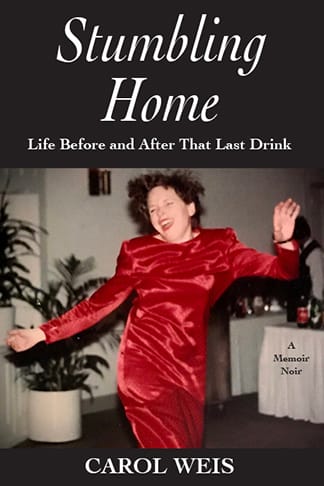
    Excerpted from STUMBLING HOME: Life Before and After That Last Drink by Carol Weis, now available on Amazon.

    View the original article at thefix.com

  • Helping Your Child Through Difficult Times

    All too often when we look beyond a child’s drinking or drug use we discover their struggle to manage intolerable thoughts, feelings or memories is a core issue that needs treatment.

    I have been a mental health and addictions counselor for over two decades. I’ve treated adults and adolescents diagnosed with serious psychiatric and substance abuse issues at one of the nation’s premier psychiatric hospitals. After informing parents of their child’s substance abuse history the most frequent response I heard from them was “I had no idea this was going on.” Or if they suspected their child was using a substance, they were shocked at how extensive it was.

    Adolescent substance abuse continues to invade too many of our families, leaving parents confused and without a roadmap to guide them in finding help for their child. Today, more than 40 percent of seniors and one-third of tenth graders are vaping a substance like marijuana. Twenty percent of teens report abusing prescription drugs like Xanax, Ritalin and Adderall.

    As the parent of an addicted child, feelings of helplessness, blame and fear can drown out any sense of hope. But in the pages of my book The Addicted Child: A Parent’s Guide to Adolescent Substance Abuse they receive the information and resources needed to help their child through assessment, treatment and recovery.

    Alcohol and drugs have the power to change a child’s brain and influence behaviors so I include a chapter on the neuroscience of substance abuse. In non-technical language parents learn how substances work in the adolescent brain.

    Because the best treatment starts with a comprehensive assessment there’s a chapter explaining which assessments are critical for a proper diagnosis. These assessments go beyond looking just at a child’s history of using substances. All too often when we look beyond a child’s drinking or drug use we discover their struggle to manage intolerable thoughts, feelings or memories is a core issue that needs treatment. While not every child using alcohol or drugs has an underlying psychological issue, for those that do, treating the alcohol or drug problem without treating the mental health issue can be a treatment plan doomed to fail.

    Other chapters in The Addicted Child address issues such as eating disorders, self-injury, gaming and cell phone use which often accompany a child’s use of substances. Parents learn the warning signs for these disorders and the warning signs that often accompany alcohol and drug use. Parents also learn which drugs are invading today’s adolescent population and how to recognize them.

    Parents often need guidance when looking for treatment options. There is no “one size fits all” treatment approach to addiction. For this reason, I have included chapters explaining the important principles of adolescent substance abuse treatment and various treatment options available for families. There is also a chapter listing helpful resources for parents.

    Very few things are more destructive to a family than having someone, especially a child, addicted to alcohol or drugs. While working on an adolescent treatment unit I met parents struggling to understand and accept their child’s psychiatric and substance use issues. For most of these families it was a heart-breaking experience. Sadly, many families do not have the financial resources to send their child to a nationally acclaimed hospital like the Menninger Clinic in Houston. Their desperate search for help often leaves them feeling alone and without a roadmap to guide them through the process of their child’s assessment and treatment. It’s for these families that I wrote my book, The Addicted Child: A Parent’s Guide to Adolescent Substance Abuse. You can find The Addicted Child on Amazon and at the following website: https://www.helptheaddictedchild.com

    View the original article at thefix.com

  • No Map or Compass

    The feeling of that first sip changed me into everything I was not: confident, brave, careless, fearless and most importantly, accepted by all the people I looked up to.

    There is nothing unique about my beginnings with alcoholism. The first time I got drunk it was exactly what every other alcoholic says, something inside of me changed. At the ripe age of 13 I took my first sip of alcohol outside the parameters of my own home.

    My parents always had empties lying around when I was a kid, mostly my dad in those years, and I found it to be both dangerous and exhilarating to take the few last bottom drips for myself. This started when I was four. Even then, the rush of being defiant felt warm and cozy — a feeling that later in life would fuel my every move.

    That same feeling hit me harder than ever before when I was sitting on a garage roof with an older boy from the neighborhood. He handed me a 26 of vodka and a one-liter carton of orange juice. Vodka, orange, vodka was how I was trained to drink. Made sense to me. The feeling of that first sip changed me into everything I was not: confident, brave, careless, fearless and most importantly, accepted by all the people I looked up to.

    Everyone drank where I came from and there were never really any parents around. Even if they were around, they didn’t seem to mind that we were stealing liquor and hiding in the basement to drink it or that they were the ones supplying it for us.

    My parents were not this way. My dad was an alcoholic drug addict and my mom was the same except she was a sober dry-drunk who eventually became an addiction counselor. So, I made sure to stay away from there as much as possible. This is how I ended up on that garage roof, eager to fit in and be like everyone else.

    I was not like everyone else. These nights became more frequent and the invites got more regular. The older boys loved getting me and my best friend as drunk as possible and seeing what they could make us do. There wasn’t much we wouldn’t do and there wasn’t much we wouldn’t drink. I had a knack for it. I could drink whatever was given to me and drink twice as much as I was expected to hold. The drunker I got, the better I felt — a dangerous cycle that my grandma, a recovered alcoholic, always warned me about. As a matter of fact, all my family warned me about the addiction gene we had but I always thought I was better than that. I would never end up a drunk.

    I kept this attitude for the next 13 years of my life. I had sobered up a few times, or tried to at least, but I always ended up coming back to the warm bath of alcohol and sinking right in.

    I started playing in bands in basements and garages when I was 16. We would play shows at community centers around Saskatoon and we would spend hours jamming, smoking weed and sipping Jägermeister. This is what all the greats did, so why would we do it any different? As I became bar age (or old enough to pass for bar age), I wanted to start playing shows to an older, more sophisticated crowd. The bar owners loved a guy that would play for free; as long as people were there drinking they didn’t mind.

    I remember the first time I got offered an “exposure” show to open for a touring band on a Thursday night on Broadway in Saskatoon. The offer was one set, 20 minutes, 50% off food and drink tickets. Drink Tickets! They were really going to pay me with booze! I had never heard of such an amazingly lavish thing. My band and I, 18 years old, playing on Broadway and being fed alcohol by the establishment. I truly felt like I was making it right then and there.

    But as all good things do, the band came to an end when my partner and I decided to pack up and move to my hometown of Calgary, Alberta. She got accepted to a school there and I could pursue my music dreams in a much bigger market.

    When I returned home all of my old drinking buddies were there right where I left them and our first night in Calgary was spent in a blackout at a karaoke bar in the same neighborhood I grew up in. It felt so good to be home. Things were not easy out in Calgary, though. I had more on my plate at 22 than anyone else I knew. I spent my days giving all of my time to others and by the time evening hit I just needed a beer. A beer would usually turn into a few more, followed by a few shots, some weed, more beers until the bar was closed and I ended up at someone’s house drinking until the booze ran out or I passed out, whichever came first.

    For a few years this was an everyday occurrence: a perpetual cycle of hangovers and morning bongs rips to get me through until it was time for a drink. The worst part is I was happy with this. Sure, I would get a little too rowdy sometimes and get into a fight with a stranger. And I mean, sure, on occasion I would end up needing to be removed by the police from the place I was at. And, okay, I once in a while got a little too drunk and liked to beat up my friends. Isn’t that what everyone did?

    2015 was the worst year of my life. My grandmother, after many years of battling heart and liver problems, passed away on April 30th. She was my rock, the only safe place I knew. Before she passed, she told me that I needed to stop drinking. She told me that the way I drank worried her and she wanted me to have a good life. She sobered up for me so I figured I could do the same for her.

    I could not. My drunks became sad, tear-filled nights that I barely remember. I don’t remember much from that year at all. November 14, 2015 is when my drinking took a hard turn for the worse. I was playing a show the night before at a bar in Calgary. Before I went on I called my dad which was a ritual we had established since I left the family acreage back in Saskatoon and he and mom split. He didn’t answer which I didn’t find to be that unusual and I figured he would call me back when he saw the missed call.

    My dad in a drunken state of desperation and sadness ended his life that night alone in our family home. I could not handle the pain of losing the two of them in the same year. It was like I was walking through the woods with no map or compass. I quit working to stay home and drink and my drunks were angry and violent. I would lash out one moment and the next be pouring shots for me and all my friends.

    The next few years are really all a big blur that I can’t seem to figure out. I was suppressing every emotion that would come up and hiding behind an image I had created with my music. No one knew what was going on inside of me unless I was in a manic, drunken state. I seemed to find a new rock bottom every few months but never seemed to hit my head hard enough.

    I am happy to say that as I write this down I have successfully stayed sober for two years’ worth of one day at a times, I have two beautiful daughters that I am actually able to be there for, and my partner and I have a stronger relationship than ever before. Life has not gotten easier since I put down the bottle, but it has gotten a whole lot better.


    Forrest Eaglespeaker’s band, The North Sound, has just released their second full-length roots-rock album, As The Stars Explode. The album is an autobiography written from places of pain, realization, and healing. It weaves together themes of addiction and sobriety, mental health, and intergenerational trauma. Some of the songs were written while Eaglespeaker was in the chaos of active alcohol addiction (such as “My Happiness”), some in the more grounded and “new” life of sobriety. “Better Days” was the first song Forrest wrote in sobriety and was released as a single during the beginning of the COVID-19 pandemic.

    Listen on Spotify. Watch the video for Heavy Heart.

    View the original article at thefix.com

  • Failing

    Would we be able to reach across the distance—and our failings—to touch each other, to smile?

    We’re together for the first time in five years, the three of us. Three sisters. Terry, the oldest, pastes us together with persistence and illusion. She believes we can be a family, that we are a family. Julie, the youngest, bites her lower lip and wears a worried brow, even while she drives her red Miata with the top down to her job as a South Carolina attorney. She left home for law school fifteen years ago and comes back only for weddings or other landmark celebrations like this, or for Christmas every two years. And me, in the middle. I moved to Connecticut almost twenty years ago to cut free from my tangled roots, I thought, and to be near the hospital where I learned to stop drinking and to want to live again.

    I suspect my newest illness—Chronic Fatigue Syndrome—structures my life in a way my family must find limiting. At least that’s what I think when I hear their voices in my head. You’re tired all the time? Go to bed earlier. You can’t think straight? You’re an Ivy League graduate, for heaven’s sake. Start jogging again. You’ll feel better.

    But when I’m tucked away, writing in the pretty place on Long Island Sound I call home, half an hour from Manhattan, surrounded by people who drive German and Italian cars and wear Prada and Polo, I pretend their success is mine and that my medical bills and dwindling bank accounts and lost jobs and derailed relationships don’t much.

    When I return Upstate to the tricky terrain on chilly Lake Ontario, though, my creative ambitions seem paltry and a little suspect. I feel I’ve failed. But, I remind myself, I’m thin. And I used to have enviable, respectable jobs. And I saw the Picasso exhibit at the Met. I hang onto those vanities like life preservers tossed to me in rough seas.

    We’re together to celebrate our mother’s birthday, her seventy-fifth. Each of us brings her gifts to the party. Collectively, we also bring 130 years of survival skills, learned, not on some Outward-Bound wilderness adventure with a trusted coach, but in this family, where I, at least, believed no one was to be trusted.

    *****

    For three weeks, we made plans. When I called to ask Terry what I could contribute to the buffet, she discouraged me from bringing anything other than Tom. “As for sleeping arrangements,” she mused. “I’ll put Julie and Ken in the guest room. You can sleep in Katie’s room, and Tom can take the den.” She paused. “But the pullout sleeps two if you want to stay with him.” 

    Terry and I have been sisters for forty-four years. We emerged, screaming, flailing, from the same womb, played hide and seek in the same neighborhood, suffered algebra in the same high school. But before that clause (“. . . if you want to stay with Tom.”), we never talked about touching men or sleeping with them. When I hung up and told Tom about this tender talk between my sister and me, I was baffled when he said, “I guess they think I’m okay.” How could he shape so private a moment between Terry and me into something about him? But I shook off his self-absorption. He’s not Catholic. He wasn’t raised in a home where no one touched without wriggling to get free. And he doesn’t know how important it is to try to get to know your sister when you’ve spent three decades shoring up the distance from her and you’re no longer sure why.

    When I called Julie, she railed because Terry decided the party date and time without asking her. “Why did I offer to help if she’s taking care of everything?”

    I’m the middle sister. I’m in the middle, again and always, but I welcomed Julie’s rant. Any connection would feel better than the unexplained plateau we tolerated between us since her marriage ten years earlier. “I don’t know what to wear,” she said, trying to regain her equilibrium.

    “Pants and a sweater maybe,” I posited gingerly, not wanting to sever the tentative thread between us. “April’s still winter upstate.”

    “I might need something new.” The thought of a shopping mission jumpstarted Julie’s party stride. “They’re all on special diets,” she said, “so we’ll need to make sure everyone has something to eat. Dad can’t have nuts, remember?”

    * * * * * *

    Tom and I set out late Friday morning, my mood dipping as we rode the thruway into Rockland County and beyond. The sky hung as heavy and gray as it did six months ago when we went home for Thanksgiving, me with the same faint hope. Maybe this time things will be different.

    When we pulled into Terry and Bill’s driveway five hours later, stiff from sitting, Dad rushed to the door, his hair whiter and thinner. For a moment I mistook him for his father. And before he hugged me, I remembered that one Father’s Day brunch, when my father raged at his father because Grandpa couldn’t hear the waitress when she rattled off the holiday specials. “Stop!” I yelled. Why did I need to tell him to stop hurting his father? All I wanted was to be his favorite girl.

    His favorite girl? A dicey proposition. “How’s my favorite girl?” he’d ask when he hustled in, late—again—for dinner.

    “We don’t have favorites,” Mom was quick to point out as she slid a reheated plate across the table to him.

    Stop. I pulled myself back to Terry’s foyer. We hadn’t yet said hello, and I had dredged the silt of the River Past. Say hello. My father hugged me tight—he at least was generous with his hugs, though from him they never stopped feeling dangerous. We don’t have favorites. Although I hugged back, I stiffened in his arms and drew away too quickly. “You remember Tom?” Then I kissed Mom who, smaller than she used to be, still held her affection in reserve. “Hi, hon.”

    “You made it.” Terry said, smiling as she came in from the kitchen, wearing a gingham apron over her Mom jeans. “How was the drive?”

    As soon as I answered— “An hour or two too long”—I wondered if she thought my words meant I didn’t want to be there. We attempted a hug, and I held on a little too long, searching for something bigger, warmer, because in her stiffness, I heard questions. Is she angry because I don’t do my share? (Who wouldn’t be?) That she’s the one who drives Dad to his cataract surgery and perms Mom’s hair? (Of course, she’s angry.)

    “Nice outfit,” she said, and I resisted suggesting a livelier hair color for her.

    When Terry offered her cheek for a quick kiss, I saw Julie at the edge of the foyer, half in, half out, arms crossed. “You look great,” I said, hoping to breathe a little fire into her. “Hi.” She stretched the one syllable to two, an octave higher than her normal speaking voice, trying to sound different than she looked, as if she were frozen, unable to come closer.

    Hungry?” Terry asked.

    “Starved,” I said, not letting on that, more than food, I wanted a belly full of comfort.

    Tom and I brought in the dinner fixings—ravioli and salad greens I bought at Stewart’s market, bread and cheesecake from Josephine’s bakery—and Terry, Julie and I set about making the meal. Before Terry lifted the lid from the cooking ravioli, I knew she would sample one before she pronounced, “They’re done.” Then she would wrap the dish towel around the pot so she wouldn’t burn herself when she lifted it from the stove and dumped the steaming pasta into her twenty-year-old stainless colander with the rickety feet in the sink.

    I knew, too, how Julie would stand at the counter, her shoulders sloping forward, while she diced tomatoes and chopped garlic.

    I knew their rhythms, their postures, but I wanted to reach to them, to ask them please, would they look at me, would they be my friends. Instead, I wondered why it seemed so hard to say something spontaneous, or to laugh from our bellies.

    “Stewart’s was so crowded when I shopped, I had to meditate to steady myself when I got home, even before I unloaded my bags.”

    They turned to me when I took a stab at something genuine, but their tilted heads, their uncomprehending eyes signaled they didn’t know know how post-shopping meditation worked or why it should be necessary.

    “How are the grocery prices in Connecticut?” Terry asked, and my hope for connection vaporized as rapidly as the steam rising off the ravioli.

    *****

    Party day. Relatives arrive from across the county. My cousin, Peter, the accountant, the one I was sure, when I was six, I would marry, with his wife, Marie, still perky, still chatty, still in love. My teacher cousin, Patricia, with her professor husband, Art, who sports a ponytail and more stomach than when I saw him last. Janice, married to Cousin Dave, squints as she walks in the door. “Madeleine?” She needs time to adjust to the light. “It’s been fifteen years!” She stretches out her arms and hugs me the way I want my sisters to hug me. “I’ve missed you.”

    One cousin, Karen, the one who took too many pills ten years ago, isn’t here. But her brothers are, and I feel like a part of them should be missing because their sister is dead. As if maybe each of them should be minus an ear or a hand, some physical part because Karen died. How is it you two are here when your sister isn’t?

    My uncles walk in, proud of their new plastic knees and hips. Here are my aunts, who shampooed my hair with castile soap, taught me to bake Teatime Tassies, and let me dress up in their yellowed wedding dresses in their dark attics. Each of them hobble-shuffles in, looking a little dazed by all the fuss.

    For almost twenty years, I kept my distance from these relatives, these potential friends, visiting every year or so for a day or two of polite, disingenuous conversation. I needed to banish myself, I suppose. After all, there was the drinking, and the fact that I hadn’t amounted to much, given all that potential they all told me I had. But at this party I look them in the eyes when I talk, trying to recover a little of what I lost by staying away. Uncle Frank tells me my maladies must emanate from some emotional twist, or from the fact that I’m alone, away from my family. Like a working man’s Gabriel Garcia Marquez, he confides magically real stories about men from the factory who went blind from jealousy or ended up in wheelchairs from unexpressed fears. “Why don’t you come home, honey?” Home? Is this still my home? Was it ever?

    There’s a lot of red in this house, I notice, when I scan the crowd. Except for Terry, whose hair still imitates the non-offensive light brown we were born with, each of us female cousins wear some shade or other of red hair: medium red beech; burgundy berry; Cinna berry; sunset blonde. And though my mother and her two sisters didn’t plan this, each of them is in red: tiny Aunt Emma in the knit dress she wore for last year’s Christmas portrait with her ten grandchildren; Aunt Anna in a red and black striped twinset with a black skirt; and Mom in a red blazer and skirt. They sit on the couch, one wearing a strand of pearls, another a locket, the other her “good” watch because this is a special occasion.

    All this red surprises me. We’re not what you’d call a red family. We may glower underneath; but as a rule, we don’t flare or flame. The Slavic temperament prefers to smolder chalky gray, while the red burns beneath the surface.

    They look too small, these women, sitting next to each other, after I ask to take their picture. And there’s too much distance between them. I want them to scrunch together—which they won’t—so they seem closer.

    No matter how far apart, though, it’s important that these three little women are together on this sofa, posing. Aunt Anna never used to let us take her picture. But maybe, like me, she knows there is something final about this portrait. Each of them is ill. Aunt Emma is diabetic; and, although we don’t yet know this, a cancer is growing in her left breast, just above her heart. Aunt Anna’s Parkinson’s disease is progressing, and Mom has a bad heart. I don’t know these specifics as I see these three women through my lens, but I know it’s inevitable. Something will happen to them soon.

    The flash goes off on my camera. Once. Twice. “That’s it.” Aunt Anna waves me away with her shaky arm. “Enough pictures.” She pushes herself off the couch and turns on the television to watch a golf tournament. The moment is over, but I have it on film, and in my heart.

    *****

    Mom is failing, Cousin Pat wrote in her holiday note about Aunt Emma. And when I called Aunt Anna on Christmas, she told me how she fell three times during the last month and Terry confirmed that, like Aunt Emma, Aunt Anna was failing.

    My father didn’t use the same word to describe my mother. Failing wasn’t a word that would come easily to him. But he apprised me in detail about Mom’s last neurologist appointment, when she would see him next, how he would adjust her medication schedule: eight in the morning, noon, four in the afternoon, and seven-thirty at night. I admired the way he structured her care. But when he barked at her to come to the phone, my stomach gripped. I worried he might be hurting her.

    After hanging up, I reached for the portrait of my mother and her sisters. I wondered. In twenty-five years, when my sisters and I are smaller, when we sit together for a picture on Terry’s seventy-fifth birthday, how much space would hang between us? Would we be able to reach across the distance—and our failings—to touch each other, to smile? I didn’t know. But I knew this: if I hoped to touch them in the future, I needed to reach to them now, as they are, not as I would have them be.

    Terry and Julie and I won’t sit for a portrait on Terry’s seventy-fifth birthday. She left us last year, victimized by a rare immune disorder, when she was sixty-two. So, there will be no photo. Only the memory of wanting one. And the hope, too long postponed, that the distance between us would narrow if we only reached to one another, even if just a little.

    View the original article at thefix.com