Tag: first responders

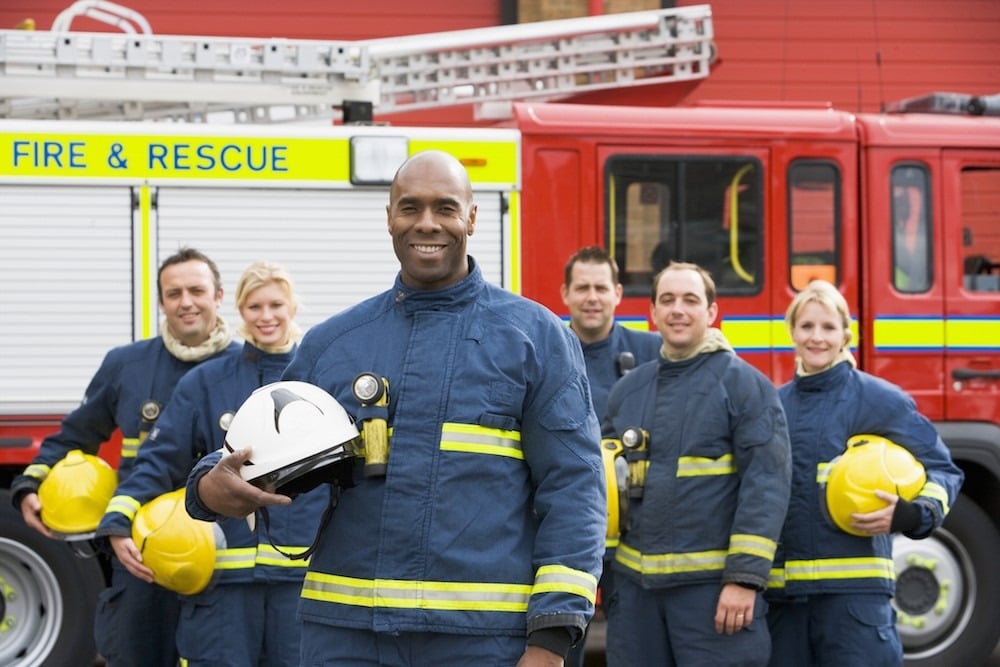
  • Firefighters Open Treatment Center For Their Own

    Firefighters Open Treatment Center For Their Own

    The center provides beds for 60 firefighters to get treatment for substance use disorder, mental illness or other behavioral health conditions.

    The opioid epidemic has touched people from all walks of life, including first responders, who often find it hard to reach out for help in a work culture that involves putting others first and brushing vulnerabilities aside. That’s why a new treatment center has opened, aimed specifically at helping firefighters who need support with addiction and mental health issues. 

    The International Association of Fire Fighters (IAFF) opened the Center of Excellence for Behavioral Health Treatment and Recovery last year just outside Washington, DC. It is set up similarly to a firehouse and provides beds for 60 firefighters to get treatment for substance use disorder, mental illness or other behavioral health conditions, whether they are associated with work or not. 

    “It’s really a state-of-the-art facility for our membership,” Ray Maione, a captain in the Phoenix Fire Department and vice president of member services for the United Phoenix Firefighters, Local 493, told Arizona Family. “To see it come to fruition is really pretty impressive; a lot of work went into this.”

    Maione said that the services are much needed for firefighters who are hesitant to seek help. 

    “We’re problem solvers, I mean we run into burning buildings when they’re on fire, so people think, and we think, we’re invincible,” he said. “And sometimes it just builds up. . . . When a firefighter reaches out I know they’ve already exhausted every option they have and they’re in crisis.”

    On-the-job injuries can expose firefighters to potent painkillers, and traumatic events can erode firefighters’ mental health, he said. 

    “We started to notice a big increase in suicides, a big increase in opioid addiction,” Maione said.

    Tyler Ramsey, a firefighter, first started using opioids for a back injury but noticed with time that he was becoming dependent on the pills. 

    “You get a prescription for an opiate or a pain medication, and at the start it’s need-based,” said Ramsey. “. . . Once it gets a hold of you, you use that as a crutch.”

    He told himself that because a doctor prescribed the pills they weren’t dangerous. 

    “I guess it gives you a false sense of security, almost, that it’s prescribed by a medical professional,” Ramsey said. “But being a fireman, I thought, ‘Oh I can control this. I don’t need to ask for help. I can manage this.’”

    However, when thoughts of opioids began taking over his day-to-day life, he realized he had a substance use problem. 

    “It’s the last thing you think about before you close your eyes at night and the first thing when you open your eyes in the morning, which is a pretty terrible place to be,” he said. When Ramsey reached out to colleagues, they got him into rehab that day, and they help him stay sober. 

    “I’m happy, upright, breathing and living a normal life again,” he said. “I feel like I’ve been afforded a second chance.”

    View the original article at thefix.com

  • Woman In Recovery Gives Anonymous Surprise To First Responders

    Woman In Recovery Gives Anonymous Surprise To First Responders

    “We were all a little fried after Thursday night, and so getting that thank you note, it was the nicest thing anyone could have ever done for us,” said one EMT.

    Sometimes giving back is the best way to thank those around you—and that’s the route a woman in New Jersey took when she saw a group of six EMTs out for breakfast.

    According to CNN, the EMTs wrapped up their meal only to find it had already been paid for. The person who paid had left a note reading, “Paid, thank you for all you do! Have a great day!” It was signed “Recovering Addict.”

    Alyssa Golembeski, the captain of the Toms River First Aid Squad, said the waitress came to the table to inform them of the woman’s deed. 

    “EMTs do not eat light,” Golembeski told CNN. “We racked up a $77 bill.”

    Golembeski then asked the waitress if the group could thank the woman, but the waitress said she wanted to keep her identity private.

    “We were all a little fried after Thursday night, and so Friday morning, getting that thank you note, it was the nicest thing anyone could have ever done for us,” Golembeski said.

    The group shared a photo of the receipt on Facebook, in hopes that the woman may come forward. However, that has not happened yet. 

    “To the woman who paid our tab today at IHOP, thank you so much for paying for our breakfast,” the EMTs wrote. “This gift was amazingly thoughtful, and brought our table of tired EMTs to tears. We are so blessed to be able to serve you and everyone else who lives and works in the greater Toms River area. Good luck on your journey of recovery!”

    The post garnered more than 1,000 likes, 700 shares and 70 comments. 

    “I still thank the police officer who found me behind a store leaning against a dumpster,” one Facebook user wrote. “This was in 2005, we weren’t far from a hospital so he put me in his car and rushed me there himself. Him and his wife reached out to me afterwards and we remain close to this day. I know some people think we should just be allowed to die, but y’all work on us no matter what. I’m sober over 11 years now, I’m alive because someone in a uniform thought I was worth it. Thank you for what y’all do… Sincerely, thank you.”

    Commenters also offered their support to the anonymous woman. 

    “To the woman who is remaining anonymous, I hope you find the strength to keep going forward on your journey,” another Facebook user  wrote. “I will keep you in my prayers and hope that if you are reading this, that you know there are people who support you and hope to see you continue on you journey to recovery.” 

    Golembeski tells CNN she and her coworkers have two messages they would like to pass on to the woman.

    “First of all, thank you for buying our breakfast and for literally making my whole week,” Golembeski said. “I couldn’t stop smiling that entire day. Second of all, I just want to commend you for getting into recovery and for beating the disease that is addiction.”

    View the original article at thefix.com

  • Narcan Administered At Record Pace In Boston

    Narcan Administered At Record Pace In Boston

    New city stats reveal that there were over 3,000 “narcotic-related illness” ambulance trips in 2017.

    In 2017, Boston’s first responders ran thousands of ambulance trips and administered Narcan for opioid overdoses in record numbers.

    New statistics revealed that Boston not only has a rising opioid epidemic in its own population, but that opioid use in the visiting population has risen alarmingly.

    According to the Boston Herald, Boston Emergency Medical Statistics revealed 3,557 “narcotic-related illness” ambulance trips to city hospitals in 2017—up from 2,848 in 2016.

    Twenty-nine percent of Boston’s narcotic-related ambulance trips were for patients who reported living outside Boston, EMS numbers show; this is a staggering 58% jump over 2016.

    Police and medical experts warn that 2018 could be just as bad with no signs that the drug epidemic is letting up. Boston police think it could be cheap heroin luring people with addiction to use in Boston.

    State police spokesman Dave Procopio told The Boston Herald that the drug fentanyl is increasingly laced into heroin to increase dealers’ profits.

    “Some users are actually seeking out fentanyl because it’s more potent,” said Procopio. He noted that the State Police Detective Unit for Suffolk County reported that a majority of current overdoses involved fentanyl.

    The Fix reported that some medical experts are seeking another avenue for reviving patients who have ingested fentanyl. The drug is so powerful that Narcan often does not work effectively.

    “Compounds like fentanyl, carfentanil, and other synthetic opioids act for longer periods of time,” said Dr. Roger Crystal, CEO of Opiant. “The concern is that naloxone’s half-life doesn’t provide sufficient cover to prevailing amounts of fentanyl in the blood.”

    Patients who overdosed with fentanyl in their system often have to receive multiple injections of Narcan over a period of time to be revived.

    Dr. Paul Biddinger, director of the Emergency Department at Massachusetts General Hospital in Boston, told The Boston Herald of the increasing number of Boston overdoses. “We don’t know what the cause is. The cost? Fentanyl? Unfortunately, it’s not going away for a while,” he said.

    The city of Boston reported that funds acquired to address the opioid epidemic are going to be put to use in the Boston Post-Overdose Response Team, or PORT. The program will be expanded and its hours increased.

    Paul Biddinger encourages “families, loved ones, even bystanders” to obtain and learn to use Narcan to save overdose victims.

    Of course treatment is necessary for recovery, but Narcan saves the person’s life so that they are here to participate in that recovery, he says.

    View the original article at thefix.com