
Officers Armond and Dodson, whose personal histories uniquely qualify them for this outreach effort, have personally gotten 49 people off the streets and into drug and alcohol treatment.
As someone with an extensive rap sheet, it was strange for me to be voluntarily climbing in the back seat of a police vehicle with two officers sitting up front. Twenty-five years sober, and I still don’t recognize my own life at times. For example, I work for my son’s non-profit, an organization that gives out quality tennis shoes to those in need. Who would have ever thought that this could be me? Certainly not me.
The seed for Hav A Sole was planted in the early nineties when I was getting sober. Rikki and I were living in a women and children’s shelter as I was on welfare and could barely make ends meet. Becky, a former shelter resident, offered to buy Rikki new shoes because his had huge holes in the soles. I was not someone who accepted handouts but, leveled by circumstances and my son’s needs, I relinquished my pride and said “Yes!” Becky bought Rikki two pairs of shoes that very same day. I never forgot her kindness, and neither would my son, though it would take another 30 years for that one act of kindness to inspire Hav A Sole, an organization that has given out more than 13,000 pairs of shoes to those in need.
On this particular day as I sit in the police car, Rikki and I have joined forces with the Quality of Life Division of Long Beach Police Department, and the officers are taking us to local homeless encampments. I was sitting in the back seat with two other volunteers while Rikki followed behind in his SUV filled with Nikes.
I leaned up to the diamond-shaped divider, watching Officer Dodson’s mustache in the rear-view mirror as he talked.
“Three years ago, a lot of complaints were coming in from residents who wanted the police to address the growing homeless situation,” he said. “When I saw the position for The Quality of Life posted I decided to apply for it. Up until then no one in the department knew I had once lived on the streets myself, but seeing how I had, it made me uniquely qualified for the job.” He shrugged. “But, it was a new concept and without a protocol in place, my commander told me to go out there and figure out what the police department could do to alleviate some of the challenges the homeless faced.”
“What did you do then?” I asked.
“At first, I would walk up and down the riverbed trying to engage people in conversations. But seeing how everyone is afraid of the police no one wanted to talk to me. So, I started bringing bottles of water and other items to pass out as a peace offering and it worked. Over time, people came out of the bushes and I got to know them on a first name basis and hear some of their stories.”
Officer Dodson made a hard right and pulled down a narrow asphalt road with the river on one side and a dirt embankment with bushes, tents, and piles of trash on the other. Suddenly, a long haired, bearded man appeared out of nowhere and waved. Officer Dodson stopped the car and we all got out. Within minutes, men and women were climbing up the embankment, greeting the officers like old friends. I watched as both officers caught up with everyone and passed out everything from water, socks, snacks, and even Zantac for indigestion.
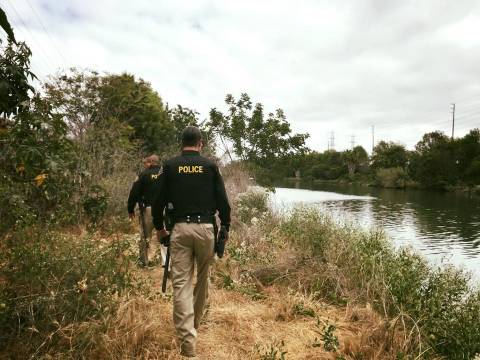
Officers on the riverbed (image via author)
At one point, I was introduced to Doug, a dark haired, good looking guy who told us his story: “I used to be a cop a long time ago,” he said, “but after a bout of depression and drugs, I lost everything and live on the streets now.” He stared into the distance as if he was recalling another time. “Someday I’m going to get out of here and get my life back on track.”
As Doug walked away with his water and new pair of black Nikes, I was struck, once again, with the realization that homelessness can happen to anyone.
After passing out several pairs of shoes, it was time to move on. I crawled in the back seat and started my own interrogation of sorts based on my own experience.
I leaned forward and asked, “So, Officer Armond, what makes you want to do this kind of job?”
“I suppose one of the reasons came from losing my teen age daughter, Ashlee, in an alcohol-involved car accident a few years ago. That changed my perception on a whole lot of things.”
“Oh. I’m so sorry…” I didn’t know what else to say.
Officer Armond talked about how Ashlee went missing and how he was waiting for her to get home while his colleagues were out there looking for her. Twenty-four hours later, and no sign of her, he went to search himself. As he retraced the way she might have driven home that night, he saw skid marks leading towards a downed chain link fence. Officer Armond crawled over the broken fence, and discovered his daughter’s car had plunged into the riverbed below.
With a somber tone, he said, “Part of me felt responsible as a police officer. I felt like I should have been able to help her. But I was drinking back then and felt incredible guilt. So, in many ways, helping the people out here who are struggling gives me a reason to go on.”
I found myself deeply moved by his tragic story, and it was becoming clear how these two officers’ life experiences made them uniquely qualified for a difficult job.

Officer Dodson hands out water (image via author)
As we drove towards the beach, Officer Dodson continued, “What we discovered is a lot of these people out here have substance abuse issues. Over time, as we started to build trust with them, many began asking us for help. That’s when I thought to myself, ‘Great, now we’ll actually be able to do some good out here.’ But when I started cold calling treatment centers, the people in charge were suspicious and couldn’t understand why a police officer was trying to help a homeless person. After explaining the Quality of Life’s mission, their next question was: did the person have insurance or money to pay for treatment? Honestly, I couldn’t believe it. We had someone who was desperate enough to ask the police for assistance and we were unable to provide it.”
I scooted closer, “So what did you do after that?”
“Persistence. In the last six months, the community has stepped up. We now have ten scholarship beds donated by Social Model Recovery. Redgate Hospital will detox people if needed and we have other treatment centers that help us out as well. But our work doesn’t just stop there. We also facilitate a meeting with a social worker to start the paperwork for housing so they have a place to live when they get out. If they complete their treatment and have any old warrants or cases pending, we’ll even go to court on their behalf.”
Officer Dodson went on to describe Ronnie, a man who had been in and out of prison for most of his life. When the officers first met him in the park, Ronnie told them that he had two boys and wanted to prove to them he could turn his life around. The officers immediately found a bed and got him into treatment. Six months later, Ronnie is still sober and working at the Salvation Army.
After the Hav A Sole team distributed shoes at the beach, we drove to a park. While we were there, a woman in her late twenties, with obvious mental health issues, told the officers she wanted to get help. Within five minutes, the health department arrived to take her to a local resource center where they would further assess her needs.
I later learned that Armond and Dodson have personally gotten 49 people off the streets and into drug and alcohol treatment. As a counselor myself for nearly two decades, it was clear that they were not only doing front line interventions, but had also created a multi-disciplinary approach in assisting individuals living on the streets.
At a time when so many of our homeless are suffering from addiction and mental health-related issues, we need to bring our compassion and our resources to the street. Rikki and I and the Hav A Sole team were honored to ride along with Officer Armond and Officer Dodson who go above and beyond the call of duty, protecting and serving the homeless who are part of our communities.

L-R: Elizabeth Kelley Erickson, Officer Dodson, Wendy Adamson, Officer Armond, Rikki Mendias and Dash Penland of Have A Sol, and Greg Moul (volunteer)
