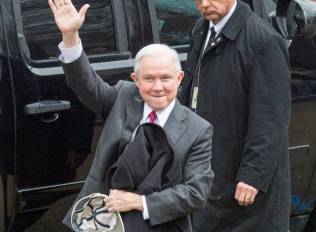
Tag: Jeff Sessions

  • Attorney General Nom William Barr Says He Won’t Go After Legal Pot

    Attorney General Nom William Barr Says He Won’t Go After Legal Pot

    Despite the fact that Barr would respect state laws in regards to marijuana, some drug policy advocates argued that he should not be made attorney general.

    As the Senate conducted confirmation hearings with President Trump’s nominee for attorney general, most questions were focused on how William Barr would steer investigations into possible collusion between the administration and Russia.

    However, during the confirmation hearings, Barr discussed the need for changing marijuana laws and said that he would not go after states that allow the legal sale of cannabis, a marked change in policy from that of previous Attorney General Jeff Sessions. 

    “I’m not going to go after companies that have relied on the Cole memoranda,” Barr said during the hearings, according to Rolling Stone. “My approach to this would be not to upset settled expectations.”

    The Cole Memorandum was signed in 2013 under President Obama. In it, United States Deputy Attorney General James M. Cole directed federal attorneys not to prosecute marijuana crimes in states that had legalized use. In essence, the memo meant that the federal ban on marijuana would not be enforced in states that had laws legalizing cannabis. However, the memo was rescinded last year by Sessions, who took a hardline stance on cannabis and wanted to stop recreational use in the states. 

    During his hearing, Barr said that it is time for the country to have a more consistent marijuana policy. 

    “I think the current situation is untenable,” he said. It’s almost like a “backdoor nullification of federal law. . . . We should either have a federal law that prohibits marijuana, everywhere, which I would support, myself. . . . If we want states to have their own laws, then let’s get there. And lets get there the right way.”

    Despite the fact that Barr would respect state laws in regards to marijuana, some drug policy advocates argued that he should not be made attorney general. Barr, in the past, has made statements against criminal justice reform and in favor of mandatory minimums that can hurt people with substance use disorder, the Drug Policy Alliance said in a press release

    “Trump is appointing someone who has long been a cheerleader for mass incarceration and the war on drugs. It shows the Administration’s true colors and undermines any recent criminal justice reforms,” Michael Collins, director of national affairs for the Drug Policy Alliance, said. “Senators from both parties should take Barr to task for his appalling views on drug policy and criminal justice, instead of giving him an easy ride like they did with Jeff Sessions.”  

    During the hearings, Barr did acknowledge that strict enforcement of policies, like those he previously supported, “harmed the black community,” according to USA Today

    No matter what the outcome of the confirmation hearings, it seems likely that Barr’s policy on drug enforcement and cannabis will be overshadowed by his perspectives on the Mueller investigation, however. 

    View the original article at thefix.com

  • What Jeff Sessions’ Departure Means For Marijuana

    What Jeff Sessions’ Departure Means For Marijuana

    Sessions’ departure has left some people wondering if President Trump may change his stance on marijuana legalization.

    When President Trump demanded the resignation of Attorney General Jeff Sessions last week many people were alarmed, but proponents for marijuana legalization saw Sessions’ departure as good news.

    “It’s a step in the right direction,” Andrew Jolley, president of the Nevada Dispensary Association, told the Las Vegas Sun

    Sessions was staunchly against cannabis, having famously said that “good people don’t smoke marijuana.” During his tenure as attorney general he repealed the Cole Memo, an Obama-era document that acknowledged the Justice Department’s limited resources and instructed US Attorneys avoid prosecution in areas where marijuana was legal in some form, according to Forbes.

    Despite his tough stance, Sessions was not able to do much to target the cannabis industry because of The Rohrabacher-Blumenauer Amendment, an amendment to the federal budget that specifically bars the Justice Department from spending money to enforce a ban on medical marijuana in states where it is legal.

    Following Sessions’ resignation on Wednesday morning, stocks in cannabis companies soared, with the marijuana index rising nearly 14% in two hours, according to Newsweek

    Sessions’ departure left some people wondering if President Trump would change his stance on marijuana, perhaps even removing the drug from the list of Schedule I substances with no medical benefit.

    “I think he’s waiting for after the midterms,” Anthony Scaramucci, former White House communications director, recently said.

    During the midterms, Michigan became the 10th state to fully legally recreational cannabis, and medical marijuana programs were established in Utah and Missouri. In addition, polling shows that two-thirds of Americans — including a majority of Republicans — support legalizing marijuana

    Sessions was replaced by his former chief of staff, Matthew Whitaker. Although it’s not clear what Whitaker’s stance on marijuana is, during his time as a U.S. attorney in Iowa, he worked to “reduce the availability of meth, cocaine, and marijuana in our communities,” according to his resignation letter from 2009.

    In 2014 when Whitaker was running to represent Iowa in the Senate, he said that he had sympathy for people who received relief from cannabidiol (CBD), and support the states CBD-only medical marijuana law. 

    “Families are going to be positively impacted by what happened in the state Senate,” he said. “And I applaud them for helping those families who need that help.”

    However, he added that the state should not establish a medical marijuana program while cannabis remained illegal under federal law. When he was asked whether Congress should legalize marijuana, Whitaker’s opinion wasn’t very clear.

    He said that the federal government “should regulate things that harm people,” like “hard drugs and the like,” but didn’t say whether he thought marijuana fit that description. However, he did talk about the dangers of a black market cannabis trade.

    “I saw the impact of marijuana on our border,” he said. “If you go to any of the counties in Texas where there’s an illegal importation of marijuana, there’s a tremendous amount of violence.”

    View the original article at thefix.com

  • Anti-Marijuana Attorney General Jeff Sessions Resigns

    Anti-Marijuana Attorney General Jeff Sessions Resigns

    “Our hope is the next attorney general will recognize that it is not politically popular to escalate the war on drugs,” said one drug reform advocate.

    Jeff Sessions is out as U.S. Attorney General.

    The former U.S. Senator from Alabama resigned on Wednesday (Nov. 7), a day after the midterm elections.

    “At your request I am submitting my resignation,” Sessions wrote in a letter to the White House. His chief of staff, Matthew Whitaker, will serve as acting attorney general until a permanent replacement is found.

    Sessions’ departure from the Department of Justice is cause for celebration for advocates of drug policy reform.

    “He’s been an absolute disgrace on drug policy. We would welcome any attorney general whose policy ideas would move beyond the 1980s,” said Michael Collins, interim director of national affairs at the Drug Policy Alliance.

    The 71-year-old former Alabama senator’s opinion of marijuana in particular is perhaps best illustrated by this statement he made during a 2016 Senate hearing: “Good people don’t smoke marijuana.”

    He also said in February 2017, “I don’t think America is going to be a better place when people of all ages, and particularly young people, are smoking pot. I believe it’s an unhealthy practice, and current levels of THC in marijuana are very high compared to what they were a few years ago, and we’re seeing real violence around that.”

    Last year, he took aim at sentencing reform, telling federal prosecutors to stop seeking leniency for low-level drug offenders and start seeking the toughest penalties possible, as NBC News reported at the time.

    And in January, Sessions reversed an Obama-era policy—the 2013 Cole memo—that prioritized marijuana cases that presented a safety threat (involving minors, organized crime, etc.) but otherwise left alone U.S. states that have approved marijuana in some capacity. In his own memo, the attorney general called it a “return to the rule of law.”

    But despite Sessions’ anti-marijuana stance, on Tuesday, Michigan became the 10th state to legalize cannabis for adult use, and two others—Utah and Missouri—approved medical marijuana.

    Marijuana policy reform has been winning with each election, and appears more popular than ever.

    “Our hope is the next attorney general will recognize that it is not politically popular to escalate the war on drugs,” said Collins of the Drug Policy Alliance.

    View the original article at thefix.com

  • Trump To Jeff Sessions: Sue Drug Companies For Opioid Crisis Role

    Trump To Jeff Sessions: Sue Drug Companies For Opioid Crisis Role

    The Attorney General said he would take action on Trump’s requests. 

    President Donald Trump has instructed Attorney General Jeff Sessions to file a federal lawsuit against pharmaceutical companies in Mexico and China, claiming that they have played a role in the US opioid epidemic.

    Last week, according to the New York Post, the president threw blame at China and Mexico for their roles in the opioid epidemic, claiming the countries had manufactured some of the illegal opioids coming into the United States.

    “In China, you have some pretty big companies sending that garbage and killing our people. It’s almost like a form of warfare. I’d like you to do what you can legally,” Trump said to Sessions.

    Fox News reports that Trump’s remarks came during a Cabinet meeting on Thursday, Aug. 16. Fox notes it was somewhat unusual that Trump asked for a new “major” lawsuit to be filed, rather than asking Sessions to join existing lawsuits filed by various US states. 

    “I’d also like to ask you to bring a major lawsuit against the drug companies on opioids,” Trump stated at the meeting, according to Fox. “Some states have done it, but I’d like a lawsuit to be brought against these companies that are really sending opioids at a level that — it really shouldn’t be happening. … People go into a hospital with a broken arm, they come out, they’re a drug addict.”

    Sessions said he would take action on Trump’s requests. 

    “We absolutely will,” Sessions said at the meeting. “We are returning indictments now against distributors from China; we’ve identified certain companies that are moving drugs from China, fentanyl in particular. We have confronted China about it … Most of it is going to Mexico and then crossing the border, unlawfully, from Mexico.”

    As of now, more than 25 US states have filed more than 1,000 lawsuits against opioid distributors and manufacturers.

    Last week, New York filed a lawsuit against Purdue Pharma, stating the manufacturer of the painkiller OxyContin has mislead medical professionals and patients about the dangers of the medication. Massachusetts also filed a lawsuit against the company in June, accusing the company of a “web of illegal deceit.” 

    According to recent estimates, overall overdose deaths in the US in 2017 were about 72,000 — an increase of 6,000 from 2016’s estimates.

    However, preliminary 2018 data implies that the “numbers may be trending downward in the wake of the Trump administration’s efforts to curb the epidemic.”

    View the original article at thefix.com

  • Jeff Sessions: DOJ Won't Back Down On Marijuana Laws

    Jeff Sessions: DOJ Won't Back Down On Marijuana Laws

    “States have a right to set their own laws and will do so, and we will follow the federal law,” Sessions said.

    At a Boston press conference about a federal sting operation that busted about two dozen people on immigration fraud, reporters went a bit off topic and asked U.S. Attorney General Jeff Sessions about individual states’ rights to create and enforce their own marijuana laws.

    Sessions was clear in his anti-marijuana stance, affirming that under his purview the Department of Justice will follow federal marijuana laws. “States have a right to set their own laws and will do so, and we will follow the federal law,” Sessions responded to the question.

    Earlier this year, Sessions wrote a memo that reversed a decision by the Obama-era Department of Justice to be more hands-off when it comes to states that have legalized marijuana. “The previous issuance of guidance undermines the rule of law and the ability of our local, state, tribal, and federal law enforcement partners to carry out this mission,” he wrote.

    The question at the Boston press conference was pertinent because two years ago, the state of Massachusetts legalized marijuana, but as of now still has not set up systems for its retail sale and purchase in the state. If Sessions goes after Massachusetts dispensaries, it would be disastrous for such a budding industry.

    “The American republic will not be better if there are marijuana sales on every street corner,” Sessions expanded on his answer.

    The sentiment was reflective of a statement the attorney general made during a 2016 Senate hearing: “Good people don’t smoke marijuana.”

    Despite the threats he’s made about marijuana, Massachusetts cannabis regulators are not worried. They’re confident even after they start retailing marijuana in their state, that the federal government will not intrude.

    Steve Hoffman, the chairperson of the Cannabis Control Commision, believes that a recent statement from one of Sessions’ federal attorneys, Andrew Lelling, seems to suggest that federal policy still resembles the previous hands-off policy.

    Federal focus around marijuana enforcement, according to Lelling, is focused on three things: making sure marijuana isn’t being passed to illegal markets, making sure it isn’t being distributed to minors, and cracking down on criminals seeking to transport marijuana across state lines.

    Hoffman is confident that the measures Massachusetts is putting in place will address these three priorities and thus the state will not draw Sessions’ ire.

    View the original article at thefix.com

  • Jeff Sessions Blocks MMJ Research, Despite Congress’ Approval

    Jeff Sessions Blocks MMJ Research, Despite Congress’ Approval

    The DEA has been accepting applications for new growers of research cannabis for two years, but the program has not moved forward at all thanks to Sessions.

    It’s been two years since the Drug Enforcement Administration (DEA) opened up applications for new growers of research cannabis, but two dozen applicants haven’t heard a peep from the federal government for one simple reason: Jeff Sessions doesn’t want it to happen.

    The DEA decided to end the federal monopoly on growing cannabis for research purposes in 2016, opening up the opportunity to applicants from all over the United States. However, the licensing process has come to a standstill because Sessions has taken the unprecedented step of intervening in the DEA’s decisions.

    Historically, the attorney general of the United States has not been involved in the regulation of scheduled drugs. Instead, the DEA has been in charge of such affairs, including “investigat[ing] the diversion of controlled pharmaceuticals and listed chemicals from legitimate sources while ensuring an adequate and uninterrupted supply for legitimate medical, commercial, and scientific needs.”

    Objections to Sessions’ actions have come from both sides of the aisle, with Senators Orrin Hatch (R-Utah) and Kamala Harris (D-California) sending a bipartisan complaint letter asking Sessions to provide a timeline for processing and potentially licensing these applicants.

    “Expanded research has been called for by President Trump’s Surgeon General, the Secretary of Veterans Affairs, the FDA, the CDC, the National Highway Safety Administration, the National Institute of Health, the National Cancer Institute, the National Academies of Sciences, and the National Institute on Drug Abuse,” wrote the senators in their letter. “In order to facilitate such research, scientists and lawmakers must have timely guidance on whether, when, and how these manufacturers’ applications will be resolved.”

    Sessions’ Department of Justice (DOJ) missed the March 15, 2018 deadline to provide this timeline and doesn’t seem to want to cooperate.

    Four applicants contacted by Reason say they haven’t heard back from the DOJ or the DEA for months. Responses included:

    “‘No formal communication,” “Hoping to hear more soon,” and “Just silence.”

    Sessions has suggested that the DEA isn’t prepared to supervise these proposed cannabis manufacturers despite the DEA regularly supervising dozens of new non-marijuana drug manufacturers this year.

    Senators Hatch and Harris have set a new deadline for Sessions to act on these applicants: August 11, 2018.

    View the original article at thefix.com

  • Bipartisan Bill To Protect States With Legalized Marijuana Gains Traction

    Bipartisan Bill To Protect States With Legalized Marijuana Gains Traction

    The bill would allow states to determine “the best approach to marijuana within [their own] borders.”

    Though Attorney General Jeff Sessions continues to wage war against marijuana, President Donald Trump has said that he is willing to support bipartisan legislation that would allow states to determine their own rules regarding the legalization and regulation of marijuana.

    The bill was introduced by Senators Elizabeth Warren (D-MA) and Cory Gardner (R-CO), who, as High Times noted, have taken distinctly opposite stances regarding marijuana in their respective states. But the pair has united over federal cannabis prohibition, which they view as impugning on not only states’ rights to determine their own laws, but also the legal cannabis industry’s ability to access safe banking and insurance.

    Their efforts appear to have earned a positive response from Trump, who told reporters that he would “probably” support the bill.

    The bill, called the Strengthening the Tenth Amendment Through Entrusting States, or STATES Act, would allow individual states, Washington, D.C., U.S. territories and federally recognized tribes to determine for themselves “the best approach to marijuana within [their own] borders.”

    This would be accomplished by amending the Controlled Substances Act (CSA) so that those states or tribes that comply with basic protection would be considered exempt from federal law regarding the “manufacture, production, possession, dispensation, administration, or delivery of marijuana.”

    The STATES Act would also remove industrial hemp from the CSA, and would implement several “common-sense guardrails” to ensure that states continue to regulate marijuana in a “safe and respectful manner” that is compliant with federal standards. These include prohibiting individuals under the age of 18 to work in marijuana operations and preventing sale or distribution of marijuana to individuals under the age of 21 for reasons other than medical purposes.

    Additionally, and most crucially for legal cannabis business, the bill would allow federally insured banks to do business with such entities.

    In a statement, Senator Warren wrote, “The federal government needs to get out of the business of outlawing marijuana.” She added that current federal laws have negatively impacted the criminal justice system, scientific research and economic development, while states like Massachusetts have implemented commonsense marijuana legislation that has supported these categories. “They have the right to enforce their own marijuana policies,” she wrote.

    Senator Gardner took similar aim at government policies in his statement while focusing his argument on states’ rights issues.

    “The federal government is closing its eyes and plugging its ears while 46 states have acted,” he wrote. “The bipartisan, commonsense bill ensures the federal government will respect the will of the voters—whether that is legalization or prohibition—and not interfere in an states’ legal marijuana industry.”

    At a press conference on June 6, President Trump said that he knew “exactly what [Senator Gardner’s] doing,” and “probably will end up supporting” the STATES Act.

    Given Trump’s penchant for spur-of-the-moment decisions that often take his cabinet and party by surprise, it remains unclear whether he will ultimately voice approval for the bill, but the statement flies in the face of Attorney General Sessions’ stance on marijuana, which was crystallized in a January 2018 memo granting federal prosecutors the “necessary tools” to crack down on cannabis.

    View the original article at thefix.com

  • President Trump Will "Probably" Support Ending Federal Marijuana Ban

    President Trump Will "Probably" Support Ending Federal Marijuana Ban

    Despite what he and Jeff Sessions have said in the past, President Trump has promised to support bipartisan legislation to legalize marijuana.

    On Friday, President Donald Trump publicly said that he would be willing to support a bipartisan bill by Congress to lift the federal ban on marijuana.

    Historically, marijuana has been subject to a federal ban alongside LSD and heroin. Recently, some states have moved to legalize marijuana, placing the drug in a strange middle ground where it is both legal and illegal depending on the tier of law considered.

    The bipartisan proposal would allow each state to decide on its own how to treat marijuana within its borders, while recommending a few federal restrictions such as an age limit set at 21.

    “I support Senator Gardner. I know exactly what he’s doing,” Trump told reporters, referring to Republican Senator Cory Gardner of Colorado. “We’re looking at it. But I probably will end up supporting that, yes.”

    President Trump’s remarks greatly deviate from his appointed U.S. Attorney General Jeff Sessions’ stance on pot. Sessions has previously reversed the Obama-era hands-off marijuana policy to start cracking down on cannabis again.

    “The previous issuance of guidance undermines the rule of law and the ability of our local, state, tribal, and federal law enforcement partners to carry out this mission,” Sessions wrote in a memo allowing federal prosecutors to return to “previously established prosecutorial principles that provide them all the necessary tools to disrupt criminal organizations, tackle the growing drug crisis, and thwart violent crime across our country.”

    The president himself has been wishy-washy about marijuana. During his campaign, he has at times said he would respect states’ decisions on marijuana, while he would also criticize legalization efforts.

    Senator Gardner wants to ensure that no matter what states decide, the federal government will keep its hands off.

    Democratic Senator Elizabeth Warren of Massachusetts is another one of the bipartisan supporters of the measure. She said that Washington “needs to get out of the business of outlawing marijuana.”

    With such a change, legal marijuana businesses in states like California would no longer have to worry about the looming threat of federal drug enforcement coming to sweep away their investments. This would also help with the fact that banks hesitate to do business with legal marijuana dispensaries because of fear of being prosecuted by the federal government.

    View the original article at thefix.com