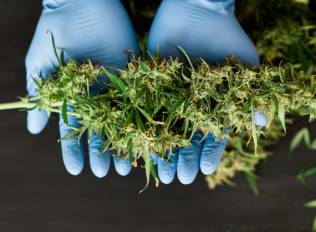
Tag: marijuana legalization

  • NYC Welcomes Public To Marijuana "Listening Sessions"

    NYC Welcomes Public To Marijuana "Listening Sessions"

    The public’s feedback will help state officials draft legislation to legalize marijuana in New York.

    New York is hosting “listening sessions” across the state to gather the public’s input on marijuana legalization.

    The Regulated Marijuana Listening Sessions will run from September to mid-October across New York state, as Governor Andrew Cuomo announced in August.

    “Community input is critical as we work to draft balanced and comprehensive legislation on a regulated marijuana program in New York,” Cuomo said at the time.

    A July report commissioned by Cuomo—the Assessment of the Potential Impact of Regulated Marijuana in New York State—concluded that the positive impacts of a regulated marijuana market outweigh the possible negative impacts, according to a press release issued in August by the governor’s office.

    The feedback from the public will inform the Regulated Marijuana Workgroup, which will draft legislation to legalize marijuana in New York, that will be considered by the state legislature in the upcoming session.

    “The multi-agency report identified the benefits of a regulated marijuana market, and with these listening sessions we are taking another important step to develop a model program for New York. We look forward to hearing what New Yorkers in every corner of the state have to say,” said Cuomo.

    New York currently has a medical marijuana program in place, albeit with several limitations. Home cultivation, smokable medical marijuana, and edible products are not allowed under the program.

    The report—which assessed the impact of a legal marijuana system in New York from a health, economic, public safety and criminal justice perspective—also stated that potential areas of concern can be mitigated through regulation and public education.

    “Input from communities in every region of the state is an essential part of our approach to a regulated marijuana program,” said Lieutenant Governor Kathy Hochul in August. “With a thoughtful process, New York is moving forward to craft a policy that will ensure continued progress across our state.”

    The remaining listening sessions are listed below:

    Sept. 26 – Staten Island

    Sept. 27 – Long Island

    Oct. 1 – Newburgh

    Oct. 2 – Binghamton

    Oct. 3 – Buffalo

    Oct. 4 – Rochester

    Oct. 9 – Syracuse

    Oct. 10 – Utica

    Oct. 11 – Watertown

    For more information on locations and pre-registration, visit the New York state website.

    View the original article at thefix.com

  • The Cannabis Industry Wants You To Ditch The Word "Stoner"

    The Cannabis Industry Wants You To Ditch The Word "Stoner"

    A new ad campaign is pushing to end marijuana-related stigma.

    The word “stoner” immediately brings to mind a specific stereotype: a low achiever clouded in smoke and looking for a snack. Now, a retail pot company in California has launched a $2 million advertising campaign trying to convince the public to let the world stoner go up in smoke.

    “That word can be used to negatively stereotype people,” Daniel Yi, senior vice president of communications at MedMen, which operates 14 retail pot stores, told The LA Times. “We want to take that stigma away. We want to make marijuana mainstream.”

    The ads feature actors dressed as police officers, nurses, teachers and other professionals. Next to the individual is the word “stoner” with a slash through it. Yi said the ads are meant to address the stigma that still exists around smoking pot, even in states like California where recreational use is legal. 

    Yi said that the recent controversy over Elon Musk smoking marijuana on a YouTube show shows that there is still a long way to go before cannabis is accepted as mainstream. 

    “The Stephen Colbert show (on CBS) does this thing where Colbert takes shots of tequila with some of his guests,” Yi said. “That doesn’t show up on the front page of the LA Times. But Musk smokes one blunt on “The Joe Rogan Experience” and it gets lots of press coverage. Alcohol is acceptable, marijuana isn’t.”

    MedMen’s ads are just one way that the marijuana industry is trying to rebrand smoking cannabis. Other retailers won’t use the term “pot.”

    “It’s legal now,” said Brooke Brun, cofounder of Kb Pure Essentials, a company that makes CBD products marketed for health and wellness. “People don’t feel so bad about asking for it, or being seen at a CBD booth.” 

    However, industry insiders said that stigma will be reduced the most as marijuana use becomes legalized with no social consequences. 

    “The negative prophecies didn’t come true,” said Dallin Young, executive director of the Assn. of Cannabis Professionals in San Diego. “California hasn’t turned into some Mad Max world.” 

    While some people took issue with the ads, other residents of San Diego — where some of the billboard are located — said the campaign is really nothing new. 

    “The alcohol industry has for eons shown advertisements of imbibers in all professions appearing to lead normal, healthy lives,” Don Paret of San Diego said. “Why (shouldn’t) the pot industry do the same? MedMen’s attempt to create a more legitimate image of pot users is no different than the alcohol industry portraying a similar image.” 

    Others weren’t sure that people would be able to stop using the word ‘stoner.’ 

    “While ‘stoner’ may conjure images of a permanently buzzed Jeff Spicoli-type [from Fast Times at Ridgemont High], I think trying to stop people from using it is a pointless and losing battle,” said California resident Gary Deacon. “Either embrace and reclaim the epithet by showing that ‘stoners’ can be productive contributors to society, or promote an alternate term for people to use.”

    View the original article at thefix.com

  • Harm Reduction Program Offers Cannabis As Alternative To Hard Drugs

    Harm Reduction Program Offers Cannabis As Alternative To Hard Drugs

    The Canadian program also offers free fentanyl testing strips and naloxone training.

    A Canadian harm reduction program is hitting the local opioid addiction crisis from a unique angle—by providing cannabis at little to no cost as an alternative to street drugs.

    The High Hopes Foundation, based in Vancouver, Canada—also home to North America’s first legal supervised injection site (SIF)—is the country’s first “full-time cannabis harm reduction program,” CTV News reports.

    While this isn’t the first recovery program to feature cannabis as a treatment, it’s still a rather novel idea that some consider controversial. But Sarah Blyth, president of High Hopes, says the program is a realistic approach to attacking the most potent addictions.

    “It’s not always possible for people to just completely come off all drugs, because they’ve got trauma. They have pain. They need something,” Blyth said last August, according to CBC. “Opiates may not be the best option for everyone so we’re trying to give them the options we have available.”

    High Hopes offers free or low-cost cannabis and CBD oils to people trying to wean off drugs like opioids, which have been a big problem in Canada as well.

    According to CTV News, nearly 4,000 Canadians died of opioid overdose in 2017; about 1,400 of them were in British Columbia, the province that Vancouver resides in.

    The foundation also offers free fentanyl testing strips and naloxone training. According to Blyth, the majority of illicit drug samples analyzed by the Vancouver Overdose Prevention Society tested positive for fentanyl, which raises the risk of overdose.

    The cannabis program, established last year, started out by collecting cannabis donations from registered patients or dispensaries. Once Canada’s marijuana legalization law goes into effect this October, perhaps High Hopes will have an easier time procuring legal cannabis.

    “What we are doing is not fully legal but we see it helps and we are desperate to help people. Watching people die isn’t okay,” said Blyth.

    The program’s goal is to give people with addictions an alternative to using potentially dangerous street drugs. Blyth noted that many are just seeking relief for pain, anxiety or inflammation. “It gives them a way to have an alternative to the drugs that they’re getting on the street,” said Blyth, who is also the founder of the Overdose Prevention Society. “It’s safe, it can reduce pain.”

    View the original article at thefix.com

  • Nearly 20% Of California Pot Products Fail Safety Testing

    Nearly 20% Of California Pot Products Fail Safety Testing

    Products like edibles and oils were much more likely to fail testing than marijuana buds.

    Nearly 20% of legal marijuana products in California are failing mandated safety testing, a figure that the industry says has more to do with an inefficient and inaccurate testing system than deficient products. 

    As of July 1, marijuana products sold on the legal market in California were subject to testing for pesticides and mold, and to ensure that the potency advertised matches the actual potency of the product.

    Since July, nearly 11,000 samples were inspected and nearly 2,000 rejected, according to a report by ABC News

    While some growers and distributors are unhappy with the state testing, the testing bureau says that the new screening process has been implemented successfully overall. 

    “Mandatory statewide testing is a new thing and it’s going to take some time for everything to run smoothly, but on the whole we’re pleased with how things are progressing,” said Bureau of Cannabis Control spokesman Alex Traverso.

    The California Growers Association, an industry group, disagrees. “Testing is currently costly, slow, and inconsistent,” the growers association said in a recent letter to the state. 

    Sixty-five percent of the samples that failed testing were rejected because of mislabeling, e.g. the potency advertised on the product label did not match the potency of the product. State law requires that the potency (which measures THC content), falls within a 10% margin of error. If a batch of product is even slightly outside that margin, it will be rejected and must be relabeled. 

    The California Cannabis Manufacturers Association, another industry group, says that this can happen when labs do not correctly test a sample, but right now there is no way for manufacturers to appeal a lab’s finding. The association is working to change that. 

    “Even if the lab admits it made an error, there is no way to change those results,” said Bryce Berryessa, an association board member who is CEO of TreeHouse dispensary in Santa Cruz County and president of La Vida Verde, which produces infused cookies. “Labs are not perfect. Mistakes get made.”

    About 90% of buds that were tested in California passed, while products like edibles and oils were much more likely to fail testing, suggesting that potency is more often inaccurate with those products. 

    The next most common reason for failed testing was pesticide levels that were too high (400 batches were flagged for this reason). And only about 100 samples failed testing because of contaminants or mold. However, this may be because state law only mentions a few specific types of mold in regards to cannabis.

    Because of this, Santa Ana-based testing company Cannalysis is urging the state to use a test that is already in place for food and pharmaceuticals, which could catch more potentially contaminated cannabis. 

    The regulators need to “create a bigger net to catch things,” said Swetha Kaul, the company’s chief scientific officer who sits on the board of the California Cannabis Industry Association. 

    View the original article at thefix.com

  • Los Angeles Cracks Down On Unlicensed Pot Shops

    Los Angeles Cracks Down On Unlicensed Pot Shops

    Authorities estimate that there may be more than 200 retailers operating in Los Angeles without proper licensing.

    Misdemeanor charges were filed against more than 500 individuals in Los Angeles as part of City Attorney Mike Feuer’s campaign against unlicensed marijuana-related businesses.

    At a press conference on September 7, Feuer said that the charges were part of 120 criminal cases, and carry a possible sentence of six months in jail and fines of up to $1,000.

    Los Angeles Police Department Chief Michael Moore, who was also in attendance at the press conference, added that city prosecutors may try to seize properties that are linked to illegal marijuana businesses by civil action.

    As both KTLA-TV and High Times noted, Feuer’s office began its crackdown on unlicensed marijuana businesses in June 2018 in an attempt to align the city’s cannabis industry with the regulations established by the 2016 passage of Proposition 64 by the state of California, which legalized recreational marijuana for individuals 21 years or older. 

    When the law was implemented in 2018, the state added a number ofnew and far stricter regulations in regard to packaging, contents and testing cannabis products, which took effect on July 1, 2018.

    Products that did not comply with the new regulations were required by law to be disposed of at the business’s expense, forcing many retailers to either sell their product at deep discounts or destroy it; by some estimates, the latter was estimated at $350 million in potential cannabis sales.

    According to Feuer, the new regulations—and making sure that businesses adhere to them—are in line with what Los Angeles-based voters sought from Proposition 64.

    “[They] wanted common-sense rules to regulate recreational marijuana so public safety is protected in our neighborhoods,” he said at the press conference. “Our message is clear: if you are operating an illegal cannabis business, you will be held accountable.”

    The city has so far charged 21 individuals who have pled guilty or no contest to misdemeanor charges or infractions related to marijuana regulations. One person was reportedly sent to a diversion program, and 11 cases appear to have been dismissed.

    Authorities estimate that there may be more than 200 retailers that are operating in Los Angeles without proper licensing. “The Los Angeles Police Department will continue to assign resources, dedicate personnel to take [enforcement] action—criminal action—against unlicensed retailers, manufacturers [and] cultivators who have not followed the rules,” said Police Chief Michael Moore.

    Some in the cannabis industry have supported Feuer’s efforts. Adam Spiker, executive director of the Southern California Coalition, said that cracking down on black market retailers is beneficial for the state’s industry as a whole. “I applaud the city for doing this,” he said. “You can’t have a regulated industry without strong enforcement.”

    View the original article at thefix.com

  • Canadians More Worried About Trump Than Legal Marijuana

    Canadians More Worried About Trump Than Legal Marijuana

    A new survey explored Canadians’ feelings on topics ranging from Trump and national health care to housing, climate change, and cannabis legalization.

    When it comes to the issues that worry Canadians, the impending legalization of marijuana is keeping fewer citizens awake at night than Donald Trump.

    That’s among the findings from a new poll from Abacus Data, which surveyed 1,500 Canadians about their political choices and concerns as they approach the 2019 federal election.

    Nearly half of participants said that they were “extremely concerned” about the U.S. president, while just 18% gave the same response about cannabis legalization. 

    Abacus Data conducted the survey online with 1,500 Canadians aged 18 and over from August 15 to 20, 2018. In regard to the federal election, respondents echoed statistics recorded earlier this year, with Justin Trudeau’s Liberal Party netting 37% of the potential vote and Conservatives earning 33% of the vote.

    Trudeau was viewed in a positive light by 43% of participants, and 41% believed that the country was moving in what they viewed as the right direction.

    In regard to political issues concerning Canadians, Abacus Data listed nine topics, ranging from Trump and national health care to housing, climate change, border crossings and cannabis legalization.

    Responses were somewhat varied according to demographic and political affiliation: voters under the age of 45 listed climate change and housing affordability among their top concerns, while those over 45 ranked health care and affordable housing as second and third of their most pressing issues.

    Climate change and health care also saw high numbers from liberal voters, while conservatives leaned towards border crossing and debt among their top three concerns.

    However, there were two factors which received a near-unanimous response across age and party lines: Donald Trump was listed as the top concern for voters both under and over 45, as well as with liberals and supporters of the New Democratic Party (NDP).

    Trump also topped lists for voters in major cities and smaller communities, and among respondents from specific territories like Ontario, British Columbia and Alberta. Only conservative voters listed Trump at a lower position on their lists, where he placed 5th, while border crossing was given as their most pressing concern.

    Demographics were also largely in agreement in regard to cannabis legalization, which was listed last among the nine issues for voters under and over 45 years of age, liberals and NDP voters, big city residents and those in smaller communities.

    Again, conservatives placed cannabis higher than other groups, but even in that demographic, it was ranked relatively low at 6th out of nine, below health care, housing and even Trump.

    As High Times noted, the response to cannabis legalization echoed similar results from polls in 2017 that found that 68% of adults favored legalization, and in 2018, where 42% of adults voted in the positive for legalization.

    View the original article at thefix.com

  • DEA Wants More Medical Marijuana, Fewer Opioids To Be Produced In 2019

    DEA Wants More Medical Marijuana, Fewer Opioids To Be Produced In 2019

    The new quotas are in line with the federal government’s goal of cutting opioid prescriptions by one-third in three years.

    When setting quotas for marijuana and opioid production for 2019, the Drug Enforcement Administration (DEA) did the unexpected.

    The DEA is raising the quota of cannabis that can be grown in the United States from 1,000 pounds (in 2018) to 5,400 pounds for 2019, Forbes reported.

    And in an attempt to push back on the opioid crisis, the agency lowered the production quota of opioids including oxycodone, hydrocodone, oxymorphone, hydromorphone, morphine and fentanyl.

    The quotas represent “the total amount of controlled substances necessary to meet the country’s medical, scientific, research, industrial, and export needs for the year and for the establishment and maintenance of reserve stocks,” the DEA said in a press release.

    The opioid quota reductions are in line with the federal government’s goal of cutting opioid prescriptions by one-third in three years.

    According to U.S. Attorney General Jeff Sessions, there’s already been “significant progress” in doing so in the last year.

    “Cutting opioid production quotas by an average of 10% next year will help us continue that progress and make it harder to divert these drugs for abuse,” said Sessions, according to High Times.

    The DEA’s decision to raise the quota for research cannabis grown in the U.S. is a welcome change for researchers and advocates alike.

    Strict regulations surrounding the cultivation and dispensation of research cannabis has made it difficult for the body of research to catch up to the increasing number of states that are “legalizing it” in some form.

    The current White House is blamed for stalling progress on this issue. As of July 2018, STAT News reported that the DEA still had not granted additional licenses to cannabis growers, despite a 2016 announcement by the agency that it would be open up the application process to new growers.

    It was reported that the directive to stop accepting and processing new applications came from the Department of Justice via Attorney General Sessions.

    Sessions had hinted in April that, “fairly soon I believe… we will add additional suppliers of marijuana under controlled circumstances.” But despite this cryptic promise, and calls for change from bipartisan lawmakers in Congress, there’s been little movement on the issue.

    Perhaps the updated quotas may fill in the demand for research cannabis, though pain patients will no doubt worry about how lower opioid production will affect them.

    View the original article at thefix.com

  • Wells Fargo Closes Political Candidate’s Bank Account Over Marijuana

    Wells Fargo Closes Political Candidate’s Bank Account Over Marijuana

    The bank reportedly decided to terminate the account after being told the candidate’s campaign would accept donations from MMJ-related entities.

    Florida political candidate Nikki Fried claims that Wells Fargo Bank recently terminated her bank account because of her stance on marijuana

    On Monday (August 20), Fried’s campaign shared the details of what transpired.

    According to the Washington Post, Wells Fargo asked if Fried, who is running for Florida agriculture commissioner, would accept donations from the medical marijuana industry.

    When the campaign replied that it would accept donations “from lobbyists for the medical marijuana industry, as well as from executives, employees and corporations in the medical marijuana industry,” the bank decided to terminate Fried’s account, citing its “responsibility to oversee and manage banking risks.”

    According to the campaign, the decision had to do with the candidate’s “relationship to the medical marijuana industry.”

    Wells Fargo’s decision once again sheds light on the complicated relationship between the legal marijuana industry and financial institutions.

    A rep for Wells Fargo stated that it is the bank’s policy “not to knowingly bank or provide services to marijuana businesses or for activities related to those businesses, based on federal laws under which the sale and use of marijuana is illegal even if state laws differ.”

    Businesses operating in states where marijuana is legal in some form must contend with the fact that marijuana remains illegal under federal law. In fact, by the federal government’s definition, cannabis is as dangerous as heroin—defined as “drugs with no currently accepted medical use and a high potential for abuse.”

    As Federal Reserve Chairman Jerome Powell stated, the disparity between state and federal marijuana laws “puts federally chartered banks in a very difficult situation.”

    As a result of many banks’ reluctance to deal with legal marijuana businesses, many must operate as cash-only, making them a target for robberies.

    However, new data shows that the tide might be turning. In June, Forbes reported that the number of banks and credit unions that are willing to work with marijuana businesses has been “steadily climbing.”

    The data came from a report from the U.S. Treasury Department’s Financial Crimes Enforcement Network (FinCEN).

    Fried criticized Wells Fargo’s decision to terminate her campaign’s account. “Wells Fargo’s actions against my campaign are emblematic of what is wrong with our government and politics today,” she said in a Monday press conference.

    View the original article at thefix.com

  • Does Medical Marijuana Make Workplaces Safer?

    Does Medical Marijuana Make Workplaces Safer?

    A new study examined workplace fatality statistics in states with medical marijuana programs.

    As legalized medical and/or recreational marijuana becomes a reality in the United States and abroad with each passing month, the question of safety in the workplace has become a topic of discussion among businesses and the legal community.

    A new study has directly addressed this issue by examining workplace fatality statistics in states with medical marijuana programs. What researchers found was that among certain demographic groups in states with such programs, there was a decline in the number of such incidents—a number that continued to decrease over a period of five years.

    The study, conducted by researchers from Montana State University, the University of Colorado Denver and American University, and published in the October 2018 edition of International Journal of Drug Policy culled workplace fatality data from all 50 states and the District of Columbia from the years 1992 to 2015.

    The data was obtained from the Bureau of Labor Statistics and adjusted for state demographics, unemployment rate and other factors. For the purposes of the study, the researchers looked at workers in two demographics—individuals between the ages of 16 and 24 and those between 25 and 44.

    As High Times noted, the study found evidence that in states with a legal medical marijuana program, incidents of workplace fatalities in the second age group (25-44) dropped by 19.5%.

    Workers between the ages of 16-24 in those states also saw a reduction, though as the researchers noted, this number was “not statistically significant at conventional levels.” 

    Additionally, the study authors found that states that had an active medical marijuana program for a period of five years saw a 33.7% reduction in the number of expected workplace fatalities.

    And those states that included pain as a qualifying condition to participate in their program were associated with a higher reduction in workplace fatalities among workers 25-44 than those states that did not have a program for a similar length of time.

    High Times pointed to two areas where further studies would benefit the argument for medical marijuana abetting workplace safety. The study does not mention any use of cannabidiol (CBD), which does not produce the euphoric, psychoactive effects of THC.

    Patients who use medical cannabis with cannabidiol have technically used a medical marijuana product but are not “high at work,” as the Times noted; as such, there is no means of measuring their impact on workplace fatalities.

    The study authors also cite the need for further research into studies which have suggested that states with medical marijuana programs have seen decreased use in alcohol, opioids and other substances that can cause physical or cognitive impairment which, in turn, can increase instances of workplace fatalities. But for advocates of legalized marijuana use, the study can be seen as adding to the argument for its safety in workplace scenarios.

    View the original article at thefix.com

  • Lyft Offers Incentives To Stop Drugged Driving In Massachusetts

    Lyft Offers Incentives To Stop Drugged Driving In Massachusetts

    Lyft has pledged $50,000 in fares to keep stoned drivers off the roads of Massachusetts.

    Popular ride-sharing service Lyft is encouraging people to drive cannabis-free with a special fare credit offer, according to High Times.

    Law enforcement in Massachusetts believe there could be a greater potential for drug-related accidents since cannabis has become legal in the state, so the state has teamed with Lyft to help educate the public on the dangers of driving high.

    Jennifer Queally, undersecretary of the Office of Public Safety and Security in Massachusetts, became concerned when she noticed an increase in people driving stoned in Colorado.

    “It’s not uncommon to hear people say, ‘I drive better when I’m high,’” Queally explains. “[But] if you are high or stoned, you are not a safe driver. And you are a danger to everyone on the road.”

    At the same time, ride-sharing companies like Lyft see a potential business boom. Just as Lyft and Uber are giving potential drunk drivers everywhere a safe ride home, the general manager of Lyft in New England told High Times, “We want to make sure residents can consume marijuana and not think twice about how they’re going to get home responsibly.”

    To help promote cannabis-free driving, Lyft has partnered with the Massachusetts Chief of Police Association, as well as the Cannabis Reform Coalition, to pledge $50,000 in Lyft fares to keep high drivers off the road. And if you make a pledge on social media not to drive high, you can get $4.20 in Lyft ride fare credit.

    As WBUR reports, there is also a new public service campaign that has been launched in Massachusetts called “Drive Sober or Get Pulled Over.”

    In the commercial, several actors tell the audience, “There are roads. Ones you take and one’s you don’t. There are laws. There are rules. And there’s you. You driving. You drunk driving. You driving high. You stoned and driving. You spinning. You crashing. You arrested. You killing… There are roads. And then there are just dead ends.”

    The commercial ends with a title card telling the audience, “Drunk? Stoned? Driving? Don’t.”

    According to a study released this year by the Governors Highway Safety Association, the rates of people driving high has increased 16% in the last 10 years. In 44% of fatal car crashes in 2016, 38% of the drivers tested positive for marijuana, with 16% of the drivers testing positive for opioids, and 4% testing positive for both.

    View the original article at thefix.com