Tag: marijuana legalization

  • Washington State To Pardon Thousands Of Pot Possession Charges

    Washington State To Pardon Thousands Of Pot Possession Charges

    The governor’s office says about 3,500 citizens qualify for the pardon according to the plan, called the Marijuana Justice Initiative.

    Governor Jay Inslee of the state of Washington announced he is offering to pardon thousands of people charged with only a misdemeanor marijuana charge, which will help citizens who would otherwise be dogged with these minor crimes as they seek employment or look for housing.

    The caveat is that the charge must be a state charge between January 1, 1998 and December 5, 2012, not a local ordinance. The December date marks the day marijuana possession was legalized in the state. The governor’s office says about 3,500 citizens qualify for the pardon according to the plan, called the Marijuana Justice Initiative.

    “We shouldn’t be punishing people for something that is no longer illegal behavior in the state of Washington,” said Inslee, believing that there is great support for the initiative.

    Inslee has always been enthusiastic about legal marijuana in his state. Last year on television, the governor bragged to host Bill Maher that “we’ve got the best weed in the United States of America.”

    Those who need the pardon can apply on the website of the governor’s office. Those who receive one will have the charge scrubbed from public criminal records; however, a copy will be retained for law enforcement knowledge only. To have the court records scrubbed as well, a petition can be made to the court that ruled over the charges.

    Some regard the moves to be good publicity for a possible presidential campaign.

    “While it’s a wonderful gesture, it won’t pardon everybody,” said Seattle Hempfest General Manager Sharon Whitson. “They really do need to look at it all the way up the scale.”

    Inslee agrees the initiative doesn’t do enough but claims it’s a good first step. He said citizens should urge other local authorities to follow his lead. His advisers claim that Inslee is looking into more comprehensive legislation for pardoning remaining marijuana offenders as well.

    A bill that was proposed in 2017 that would require all courts to hear any requests to clear these crimes did not pass. The city of Seattle, however, has begun to follow suit, vacating around 542 Seattle citizens of these charges.

    View the original article at thefix.com

  • States Struggle To Address Issue Of Driving While High On Cannabis

    States Struggle To Address Issue Of Driving While High On Cannabis

    Federal legalization could be on the horizon, yet so far no one has come up with a definitive method to determine if someone is too high to drive.

    As more states legalize both medical and recreational marijuana, authorities are struggling to determine the best way to address the issue of driving while high. Unlike alcohol, cannabis can stay in a person’s system for weeks after the last time they used – long after the high has subsided and they are no longer impaired. Blood and urine tests are therefore considered by many to be unreliable methods for determining if a driver is intoxicated. 

    Marijuana legalization will likely be a key issue in 2019 as Democrats line up to enter the 2020 presidential race. Ten states have now legalized recreational cannabis, and even conservative states like Utah and Oklahoma are starting to pass medical marijuana laws. Federal legalization could be on the horizon, yet so far no one has come up with a definitive method to determine if someone has taken too much of the drug to be able to drive safely.

    “You can’t legalize a substance and not have a coherent policy for controlling driving under the influence of that substance,” says Rand Corp. assistant policy researcher Steven Davenport. 

    Yet many states are relying on police officers to perform field sobriety tests as their only means of determining if someone is high on cannabis behind the wheel. According to Kaiser Health News, California police are given 16 hours of training on recognizing the influence of various drugs, including cannabis.

    The coordinator of this program, Glenn Glazer, claims that California officers are “very used” to recognizing marijuana intoxication, but as Davenport points out, field tests are subjective by nature.

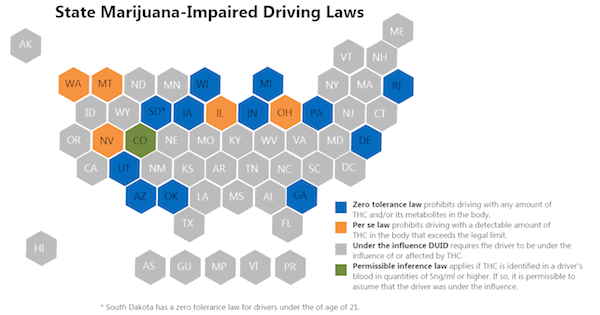
    According to the National Conference of State Legislators, the majority of states with some kind of legalized marijuana have “zero tolerance” laws on the books for driving while high, meaning that any amount of THC and/or its metabolites found in a driver’s system is grounds for legal action. This presents a serious problem when these chemicals can stay in a person’s system for a full month after they last used. 

    Source: NCSL

    Others have “per se” laws similar to the blood alcohol limit. However, cannabis researchers have repeatedly pointed out that finding a limit for cannabis-related compounds in the blood is much more complicated than with alcohol. There is no clear, linear relationship between THC levels in the blood and intoxication.

    Keith Humphreys, a psychiatry professor and drug policy expert at Stanford University in California, believes that the number these states have picked for their legal limit is arbitrary, saying they “made it up.” 

    “We don’t really have good evidence — even if we know someone has been using — [to gauge] what their level of impairment is,” says Humphreys.

    Coming up with a solution won’t be an easy task, but people are trying. In late 2017, an app was released that calculates the user’s reaction time. Cannabis often slows reaction time and impairs one’s ability to focus, making driving while high a dangerous endeavor. After Washington State and Colorado legalized recreational marijuana, highway collisions rose by 3%, according to the Highway Loss Data Institute

    The app, called DRUID, is far from a perfect system for detecting intoxication, but if a blood, urine or breathalyzer test can’t be developed soon, field tests and human judgment may be all police have to rely on.

    “The idea that you could come up with a completely objective test of performance … is ambitious,” says Carnegie Mellon University drug policy researcher Jonathan Caulkins.

    View the original article at thefix.com

  • Pot Legalization A Priority for 2019, Gov. Cuomo Says

    Pot Legalization A Priority for 2019, Gov. Cuomo Says

    Cuomo has positioned legalization as a key factor in “the most progressive agenda this state has ever seen, period.”

    The state of New York inched closer to major marijuana legalization and reform when Governor Andrew Cuomo announced that recreational marijuana should be legalized “once and for all” in early 2019.

    Speaking on December 17, 2018 and again in his inaugural address on January 1, 2019, Cuomo included legalization, as well as an end to “needless and unjust criminal convictions” for possession, as part of his administration’s agenda for the first 100 days of the new year. 

    Cuomo’s latest push for legalization comes at a time when support is reaching large and diverse numbers: Half of metro-area New York residents and the New York City mayor, Bill de Blasio, have expressed support for such a measure. The decision has far-ranging implications for the state – as WABC in New York noted, City Comptroller Scott Stringer estimated that the state stands to reap approximately $1.3 million in annual tax revenue from legalization.

    For his part, Cuomo has positioned legalization as a key factor in “the most progressive agenda this state has ever seen, period,” and one that includes justice reform, gun control, affordable health care and increased spending on the state’s infrastructure, and which can be viewed as rebuke of the Trump administration. 

    “When they write the history books and ask what did we do – in the face of anger and division, when people were disillusioned, let New York’s answer be that in this defining moment we brought healing and light and hope and progress and action,” said Cuomo in prepared remarks during his inaugural speech. “That New York led on legalizing recreational marijuana, bringing justice and new economic opportunity, not for rich corporations, but for the poor communities that paid too high a price for too long.”

    District Attorney Gonzalez’s actions in Brooklyn echoed Cuomo’s message of progressive reform by asking for the removal of 28 past convictions for misdemeanor possession charges. The court also vacated 1,400 open warrants for individuals who missed court appearances for marijuana possession charges. 

    “I do not believe these cases keep us safer,” Gonzalez said. “They cause a lot of distrust in our justice system. We all here know there is a tremendous racial disparity in respect to how these cases have been enforced in the past.”

    Gonzalez added that the decision to clear the convictions does not indicate a blanket response to all such past charges but instead reflects the growing legal attitude towards such cases. “It’s a little unfair to say we’re no longer prosecuting these cases, but to have these folks carry these convictions for the rest of their lives [would be unfair],” said Gonzalez

    View the original article at thefix.com

  • Illegal Marijuana Exporters Thrive In Colorado

    Illegal Marijuana Exporters Thrive In Colorado

    Authorities and regulators admit that this rise in black market activity is partly a growing pain, resulting from unforeseen consequences of legalization.

    The relaxed attitude about marijuana use has emboldened some growers and dealers who do business without a license.

    Legalization was supposed to kill the black market for marijuana, creating avenues for official businesses that would raise some tax income for the state of Colorado. However, some dealers have chosen to stay in the black market, taking advantage of the new, relaxed attitude towards the drug to expand their illegal grow and deal operations.

    “We thought that the black market would disappear,” said Gov. John Hickenlooper. “Evidently it contracted and then began to expand again, and that’s counter-intuitive, right? It is not what you would expect.”

    Colorado voted to legalize the drug in 2013, reasoning that jailing citizens over a relatively harmless drug was doing more harm than good. The state allows people 21 years of age or older to buy or grow reasonable amounts of marijuana. But despite these good intentions, some have taken advantage of the new, destigmatized political climate to upgrade their operations to the point where they are “just like a corporation,” according to Bob Troyer, Colorado’s former US attorney.

    These organizations also smuggle the goods outside to illegal states. Authorities have found contraband Coloradoan marijuana in more than 34 states. The pot can be traced back to huge illegal grow operations found in state parks, farmland or even inside neighborhood homes. A significant portion of the marijuana black marketeers hail from outside the United States, from places as far as Mexico, Cuba and even China.

    “The thing that nobody predicted (was that) normalization, commercialization, would be a magnet for international black market activity,” explained Troyer.

    Authorities and regulators admit that this rise in black market activity is partly a growing pain, resulting from unforeseen consequences of legalization.

    “I think one of the mistakes that was made in Colorado and some other states is allowing for home cultivation,” said Chris Woods, who founded a marijuana grow and retail business called Terrapin Care Station. “What we’re seeing right now is a lot of clean-up from the mistakes that have been made.”

    At least one regulation has been overturned and cleaned up since legalization: the 99 plant rule. Originally, the state allowed medical marijuana patients, and their caregivers, to store and grow up to 99 plants.

    “I think the 99 plant thing really opened the floodgates. No other states (allowed) any numbers like that,” said DEA agent Kevin Merrill. “Outside organizations took advantage of that … If you got 10 people signed up, you effectively could have 999 plants in a residence.”

    Authorities believe that as long as there is demand from illegal states, the black market will continue to grow.

    View the original article at thefix.com

  • New Zealand To Vote On Marijuana Legalization

    New Zealand To Vote On Marijuana Legalization

    New Zealand could become the third country to legalize marijuana in 2020.

    New Zealand will likely become the first country to hold a national referendum on legalizing recreational cannabis, after the government announced this week that a vote will take place during the 2020 general election. 

    New Zealand’s justice minister, Andrew Little, said a referendum question would be on the ballot during 2020, although he added that there is “a bit of detail still to work through,” according to The New York Times. That includes exactly what the referendum question will cover. 

    Marijuana proponents hope that the government will draft a law before the referendum that will lay out exactly how New Zealand would handle marijuana legalization. This would include details like whether sales would be legal or just personal use, and what age limits will be for cannabis use.  

    Chlöe Swarbrick, a member of Parliament from the Green Party who is also a spokesperson for Drug Law Reform told Newshub that by drafting the law ahead of time, “You can remove all the moral panic and what-ifs from the debate, and there would be clarity and hopefully maturity and respectability in the public debate.”

    In November, the country eased restrictions on growing medical marijuana, and polling shows that 46% of New Zealanders are in favor of legalizing recreational marijuana, while 41% are opposed

    Despite the relatively close margins, legalization gained a political foothold when the ruling Labour party was forced to join with the Green Party to form a government. As part of the negotiations, Labour leaders agreed to allow a vote on legalization. 

    Swarbrick said marijuana use is already widespread in New Zealand and that prohibition disproportionately affects minorities. Legalizing cannabis would allow policy to catch up with the current reality, she said. 

    “What we have to realise is that our legislative and regulatory response to problems can either exacerbate or minimise harm,” Swarbrick said. “We have to bring the problem out of the shadows and into the light.”

    She argued that by legalizing cannabis, the country will be able to control the drug better and keep profits out of the hands of criminal enterprises. 

    “There is no quality control of this stuff – people are not consuming with any guidelines or education. Drug dealers also aren’t checking IDs. If somebody in this country wants to get access to it there is literally no stopping them,” she said. “We also have the situation whereby because it is so accessible in this country, it’s helping to finance criminal underground activity and is held by the gangs.”

    View the original article at thefix.com

  • New York Should Use Marijuana Taxes to Repair Subways, Report Says

    New York Should Use Marijuana Taxes to Repair Subways, Report Says

    One NYU professor makes the case for why the state should use marijuana tax revenue to fund the MTA’s Fast Forward plan to fix the popular transportation system.

    For New York City residents, the simple act of taking the subway can come with a host of problems: long delays in crowded, poorly ventilated and aging cars, and stations without basic elements of accessibility, such as elevators.

    Delays can impact the schedules of the more than 1.7 billion individuals that use the subway each year, and late employees can cost businesses more than $380 million per year. The Metropolitan Transit Authority announced a “Fast Forward” plan to address these concerns, but the project is expected to take a decade and cost more than $40 billion.

    New York University (NYU) professor Mitchell L. Moss has a possible solution; use the tax revenue from legalized marijuana sales to fund the subway project.

    Moss’s plan, outlined in a report published by the NYU/Wagner Rudin Center for Transportation Policy and Management, suggests that legalizing marijuana could add between $110 and $428 million in annual tax revenue to Empire State coffers. That figure is lower than a projection by New York State’s health department, which suggested that taxes from legal marijuana could yield $670 million per year. 

    Figures like those – as well as growing dismay over the subway system’s woes by the public – have generated interest from city officials, including the Metropolitan Transportation Sustainability Advisory Workgroup, a panel assembled by New York Governor Andrew Cuomo and Mayor Bill de Blasio to conceptualize ways to pay for the subway project.

    Some members of the panel, including former City Council speaker Melissa Mark-Viverito, as well as current City Council speaker Corey Johnson, have voiced their support for the plan.

    With Democrats currently in control of the state Senate, Governor Cuomo suggesting that a legalization bill is in the draft stage, and subway riders voicing support for the plan in an informal New York Times poll, Moss’s proposal appears to be gaining traction.

    But as Vox pointed out, exactly how much marijuana tax revenue can be diverted to transportation remains unclear. 

    Colorado, which has earned $862 million in total revenue from legal marijuana since 2014, is one of the few states that use those funds for transportation issues. According to the Denver Office of Marijuana Policy, the city will put $9 million into “mobility projects,” like sidewalk repair and the creation of bike lines, in 2019. But the majority of tax funds will go towards regulation of the city’s marijuana sales, as well as education and safety.

    The $9 million is just part of the remaining funds left after those issues are paid.

    Eric Escudero, who serves as director of communication for the Office, said that the funds are welcome, but “it’s not going to solve every issue that needs financial or taxpayer support.”

    He noted that changes to the marijuana market – specifically, when new states initiate legalization – might impact how much tax revenue can be earned. As a result, Denver does not look at their marijuana tax as a silver bullet.

    “It’s important that you don’t promise the streets are going to be paved with gold because of marijuana, because that won’t happen,” he said.

    View the original article at thefix.com

  • Cannabis Industry Searches for Consistent High

    Cannabis Industry Searches for Consistent High

    “No one ever knows what they’re getting, and it’s a huge problem. It’s making it so the [cannabis] industry doesn’t work very well,” said one scientific expert about the lack of consistency.

    The cannabis industry is expanding rapidly, but scientists and investors are still chasing an elusive goal: a cannabis plant that can provide a predictable high when it is smoked. 

    Although tinctures, edibles and other products made with cannabis extracts can offer more exact amounts of cannabinoids that make the effects more consistent, industry leaders say that consumers want a bud that can offer the same type of reliable experience. Right now, that doesn’t exist. 

    “No one ever knows what they’re getting, and it’s a huge problem,” Mowgli Holmes, chief scientific officer of Phylos Bioscience in Portland, Oregon, told NBC News. “It’s making it so the industry doesn’t work very well. Often it’s way too strong. It’s Russian roulette. New customers get burned and don’t come back.”

    Jon Vaught, CEO of agricultural technology firm Front Range Biosciences, said that people who want to know what effects they’ll experience when using cannabis often opt for manufactured products because they better understand what they’re getting. Still, there is a demand for a marijuana flower that offers the same consistency. 

    “Folks are using it in new forms, low-dose, edibles, tinctures, capsules, and what they care about is the effect,” he said. “But there are consumers who want to consume cannabis the way they have for years. They like the things they know.”

    Growers have been chasing the goal for years but now there are more financial incentives than ever to get a product to market, with marijuana flower sales expected to reach $8.5 billion annually by 2022. 

    “That’s been the goal forever,” said Greg Zuckert, vice president of cultivation for cannabis producer Harvest Health & Recreation. 

    Some growers and researchers are analyzing the DNA of marijuana plants to better understand the effects they’ll have when smoked. 

    “I’m working on genetic markers and looking at taking DNA from different species, trying to create genetics to fit neurochemical profiles to treat different ailments,” Zukert said. “These are exciting things.”

    Growers who use specific genetic traits may be able to patent their plants, leading to an industry full of brand-name marijuana varieties that are much more tightly controlled than the strains pot aficionados are familiar with today. 

    “In the future, those strains will all be irrelevant,” said Marcus Walker, founder of Cult Classics Seeds in Colorado. 

    Attorney Gary Hiller of California’s Napro Research, a California seed-to-sale producer, said that various cannabis plants will likely become proprietary.

    “It doesn’t matter what it’s called once it’s correctly characterized and a good breeder can replicate it,” he said. 

    View the original article at thefix.com

  • How Cannabis Sales Are Affecting Canada’s Employment Rate

    How Cannabis Sales Are Affecting Canada’s Employment Rate

    A new report suggests that the recent legalization of cannabis in Canada has made a positive impact on unemployment rates. 

    Canada’s unemployment rate is the lowest since 1976 – and the country may have the legalization of cannabis to thank.

    According to new data from Statistics Canada, the legalization and growth of the cannabis industry have played a role in the drop in unemployment.

    High Times pointed out that the unemployment rate decreased by 0.2% in November, bringing the rate to 5.6%. In six different Canadian provinces, the rates increased, and the report stated that “private sector jobs” grew the most while public sector jobs and self-employment remained fairly unchanged. Cannabis was legalized in Canada in October. 

    Part of the report focused specifically on the cannabis industry and stated that in November, the month following legalization, there were 10,400 jobs related to the industry. In comparison, last November there were 7,500 fewer jobs in the industry, meaning that in one year, the jobs more than doubled. 

    More specifically, 58% of those jobs were in agriculture, while the other 42% ranged from educational services to health care to retail. Those working in the industry were also making more wage-wise than average, at about $29.58 per hour in comparison to the average of $27.03.

    The report also states that men were more likely to work in the industry than women, as men made up about 79% of jobs in the cannabis industry. 

    Alison McMahon, founder and CEO of Cannabis at Work, tells The Growth Op that the biggest demand for jobs is coming from licensed producers needing assistance with growing, cultivation, quality checks, post-production and order fulfillment. And the market will likely keep growing, as McMahon adds that “we expect to see a lot of jobs emerge around extraction, formulation and product R&D (research and development).” 

    In fact, there is even a new job engine dedicated solely to cannabis-related jobs. Brian Sekandi, the co-founder of Careers Cannabis, agrees that more and more research related jobs will be emerging over time. He also tells The Growth Op that he thinks jobs will be opening in the marketing of cannabis as more products hit the market.

    “With the massive restrictions on brand marketing and advertising the cannabis industry is faced with now, the big challenge is on how to educate consumers – particularly those who may be new cannabis users – about the different types of cannabis that are available to them and what the effects are of using cannabis,” Sekandi said. 

    Sekandi added that as of now, those working in the industry in Canada are ahead of much of the world.

    “Things are only going to go up from here for people gaining skills and experience in the Canadian cannabis industry,” he said. “The trend is definitely toward more liberalized cannabis laws being introduced around the world, so anybody who starts working in the industry in Canada today has a once-in-a-lifetime opportunity to be at the ground floor of a global industry and to help shape it for years to come.”

    View the original article at thefix.com

  • Joe Kennedy III Advocates For Federal Marijuana Legalization

    Joe Kennedy III Advocates For Federal Marijuana Legalization

    Representative Joe Kennedy III detailed his support for federal marijuana legalization in a recent op-ed.

    Representative Joe Kennedy III voiced his support for removing cannabis from the Controlled Substances Act and legalizing it at the national level.

    Kennedy, a Democrat and the US Representative for Massachusetts’ 4th congressional district, penned an op-ed for the health and life sciences magazine Stat in late November that outlined his advocacy for legalization, which he based on the growing number of states with legalization initiatives – including his own home state – and the health benefits attributed to marijuana.

    Due to the federal government’s apparent inability to reconcile these advancements with its stance on legality, Kennedy opined that it should “cede its responsibility – and authority – to thoughtfully regulate marijuana.”

    Kennedy’s position is an about-face from previous statements made on legalization, most notably on Jimmy Kimmel Live! where his support of cannabis prohibition put him at odds with the majority of his party.

    He addressed his reticence in the Stat piece, where he noted that his work with the mental health and addiction communities had made him “skeptical” of marijuana’s alleged benefits. “I’ve heard repeatedly from mental health advocates on the frontlines who have grave concerns about what access to marijuana might do for those prone to abuse,” he explained.

    But Kennedy said that he had also listened to those supporting cannabis legalization, primarily for health reasons, like “the parent whose epileptic child needs marijuana to calm her seizures, [or] the veteran whose trauma it eases [or] the black teen arrested for smoking a joint while his white friends did the same with impunity,” he wrote.

    Through research and conversations with individuals on both sides of the legalization argument, Kennedy said that he had reached the conclusion that “our federal policy on marijuana is badly broken, benefiting neither the elderly man suffering from cancer whom marijuana may help nor the young woman prone to substance abuse disorder whom it may harm.”

    He also noted the negative impact that prohibition has on the economy, citing marijuana businesses forced to implement cash-only transactions due to banks’ reluctance to work with them over federal regulation, and the loss of career and housing opportunities due to restrictions on jobs with and leasing to marijuana retailers.

    “Given the rapid pace of state-level legalization and liberation, I believe we must implement strong, clear and fair federal guidelines,” wrote Kennedy. “To do that requires us to remove marijuana from the Controlled Substances Act and legalize it at the federal level.”

    Though he has advocated for legalization, Kennedy also noted that his concerns about the public health issues associated with marijuana remain. But by making cannabis legal at the federal level, he said that health and addiction advocates will have their “best chance” to make sure that tax resources are directed towards consumer safety and treatment through federal regulation.

    “Legalization is not a cure-all,” he concluded. “But [it] would guide states choose to move forward with strong and cearly national standards meant to ensure that all Americans are protected fully and equally.”

    View the original article at thefix.com

  • Cannabis Lab Loses License After Falsifying Results

    Cannabis Lab Loses License After Falsifying Results

    The move has created something of a bottleneck as Sequoia Analytical Labs was one of only four cannabis testing labs in Sacramento.

    A Sacramento cannabis testing lab, Sequoia Analytical Labs, has lost its license after a surprise inspection by state regulators. The lab, it turns out, had been falsifying data, with 22 out of a required 66 pesticide tests having made-up data.

    According to Sequoia Analytical Labs’ general manager, Steven Dutra, state regulators came in on a surprise inspection of the facility and found that some of the lab equipment was faulty. The lab’s director, Marc Foster, knew that the equipment was faulty and said as much to the inspectors when asked where the data had come from.

    “When they asked the lab director where his data came from, he honestly told them, ‘I faked it,’” said Dutra.

    Foster was fired and the lab lost is license. The impact of the faulty equipment goes back about five months, with around 700 samples passing through without actually being tested. Despite this, Dutra says that the risks these 700 samples pose to consumers is slim, considering only 3% of the product ever fail the pesticide tests. And if anything has happened, it probably would have already happened by now.

    “Much of the product is just gone and probably already consumed,” Dutra concluded.

    As of now, no recalls have been put out by any regulatory body as a result of the incident.

    “Basically, everything is being taken care of by the state,” said Tommy Pawloski, dispensary manager at Sacramento’s All About Wellness. “If there is a problem, the state will let us know.”

    While the lab’s shutdown was necessary, the move has created something of a bottleneck as Sequoia Analytical Labs was one of only four testing labs in Sacramento. There are only 44 such labs serving the entire state of California. With one less lab in play, the industry could be looking at a shortage of products on the shelves.

    “The shortage of labs has really created a bottleneck in the supply chain across the state,” commented Joe Devlin, head of cannabis policy and enforcement in Sacramento.

    Sequoia Analytical Labs has since hired a replacement for Foster and hopes to get its license back by January 1st.

    View the original article at thefix.com