
Tag: mental health issues

  • Judge: Insurer Discriminated Against People With Mental Illness, Addiction

    Judge: Insurer Discriminated Against People With Mental Illness, Addiction

    People attempting to access mental health treatment are still being denied coverage at twice the rate of those seeking physical healthcare.

    A federal court has ruled that one of the largest health insurance companies in the U.S. has been discriminating against people with mental illness and addiction disorders by failing to apply coverage standards equally across physical and mental ailments. U.S. Chief Magistrate Judge Joseph C. Spero issued a “blistering” 106-page ruling stating that United Behavioral Health, a subsidiary of UnitedHealth Group, effectively discriminated against thousands of people seeking treatment for these issues from 2011 to 2017, according to The Los Angeles Times.

    The Mental Health Parity and Addiction Equity Act in 2008 made it illegal for insurers to apply different criteria to patients experiencing mental health issues than those experiencing physical health issues when determining what to cover. Unfortunately, people attempting to access mental health treatment are still being denied coverage at twice the rate of those seeking physical healthcare.

    According to the report by Anita Raghavan, the blame for this rests on a lack of enforcement of the 2008 law by the overstretched Employee Benefits Security Administration (EBSA).

    Labor Secretary R. Alexander Acosta wrote in a 2018 report that this small division of the Department of Labor has only 400 investigators and 100 benefit advisors working to keep track of about 5 million health benefit plans across the country.

    In the space of two years, the EBSA was only able to issue 136 citations to health insurance companies for violating the Mental Health Parity and Addiction Equity Act. To make matters worse, the agency can’t assess civil monetary penalties to deter future violators.

    The inability to get coverage for mental health issues have left many without desperately needed treatment. This is such a common problem that the National Alliance on Mental Illness (NAMI) has a guide for what individuals can do if they’ve been denied such coverage.

    This includes a list of “commonly denied types of care,” which appears to include all levels of care from diagnosis and common psychotherapy, “intermediate” care like outpatient or partial inpatient treatment, and full residential hospitalization.
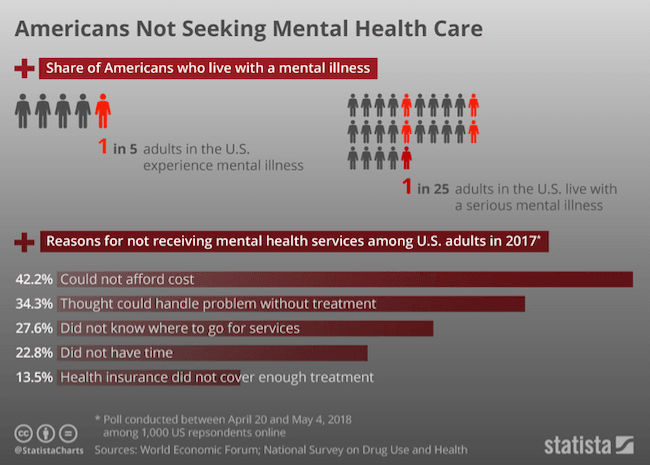
    Source: Statista/National Survey on Drug Use and Health

    Meanwhile, reports of families struggling to get the appropriate care for mentally ill family members proliferate. In September 2018, WFYI did a story on Matthew Timion and his fight to get coverage for treatment that his adopted son desperately needed.

    “He was cutting himself and he’s hearing voices and he is threatening to run away and kill me,” Timion said. “The insurance company says, ‘Well, he hasn’t done that in three or four days now, he’s good to go home.’ And the hospital said, ‘No, he has to stay.’”

    The problem has become so severe that parents are increasingly resorting to giving up custody of their children because once they do, the state will be forced to pay for the necessary mental health treatment. Adoptive parents call this decision “gut-wrenching,” but without health insurance coverage for expensive treatment plans, they often have little choice.


    View the original article at thefix.com

  • Deaths From Alcohol, Suicide & Overdose Reach Record High

    Deaths From Alcohol, Suicide & Overdose Reach Record High

    Suicide, drug overdose and alcohol now kill more than 150,000 Americans annually. 

    Deaths from suicide, drug overdose and alcohol have reached an all-time high in the United States. 

    Data from the Centers for Disease Control and Prevention (CDC) analyzed by two non-profit organizations revealed that deaths attributed to those causes rose 6% in 2017, USA Today reported.

    Those factors are now responsible for 46.6 deaths per 100,000—killing more than 150,000 people each year, according to U.S. News and World Report.

    In 2017, deaths from suicide rose 4%, double the pace of increase over the past decade. Deaths caused by synthetic opioids also skyrocketed, up 45%. However, five states saw decreases in deaths from suicide, overdose and alcohol. Those were Massachusetts, Oklahoma, Rhode Island, Utah and Wyoming.

    Loribeth Bowman Stein, of Milford, Connecticut, believes that social isolation is contributing to these co-called diseases of despair.

    She said, “We don’t really see each other anymore. We don’t share our hopes and joys in the same way, and we aren’t as available to one another, physically and emotionally, as we need to be. The world got smaller, but lonelier.”

    Kimberly McDonald, a licensed clinical social worker in Wisconsin lost her father to suicide, and says that she sees patients struggling with suicidal ideation and addiction every day. Often, they don’t get the support that they need to heal. 

    “We are a society that criticizes and lacks compassion, integrity, and empathy. I work daily with individuals who each have their own demons,” she said. 

    However, Benjamin Miller, a psychologist and chief strategy officer at the Well Being Trust, said that people need to avoid the temptation to explain away these alarming statistics. 

    He said, “It’s almost a joke how simple we’re trying to make these issues. We’re not changing direction, and it’s getting worse.”

    The Well Being Trust calls for policy changes, such as restricting access to firearms and medications that can be deadly for someone looking to end their life. In addition, the trust calls for more funding for programs that support resiliency in kids, address childhood trauma, and provide treatment for addiction.

    All of these efforts, Miller said, can help save lives. Progress has been made in these areas, but there is need for more work, Miller said. 

    “It is important to see hope in the slowing of rates—but it’s not nearly enough. We should not be satisfied at all. Too many of us are dying from preventable causes.”

    Overall, the suicide rate has increased 33% since 1999. Rural states including West Virginia, New Mexico, Ohio, Alaska and New Hampshire have the highest suicide rates. 

    View the original article at thefix.com

  • Wearable Sensor Could Point To Anxiety, Depression In Kids

    Wearable Sensor Could Point To Anxiety, Depression In Kids

    New tech may help children better identify their own feelings.

    Whether or not a child suffers from an internalizing disorder like depression or anxiety may soon be identifiable through a wearable sensor, new research indicates.  

    According to PsyPost, a recent study put the sensors to the test. The study involved 63 children ages 3 to 8, both with and without internalizing disorders. The children wore a motion sensor which tracked their movement, and a machine learning algorithm then analyzed those movements. 

    Study author Ellen W. McGinnis, a postdoctoral fellow at the University of Vermont Medical Center, says children struggle to identify their own feelings, so the sensor may help do so. 

    “Young children who suffer from anxiety and depression often have a lot of difficulty understanding and communicating their suffering—and for parents, it’s really difficult to read inner emotions of someone who doesn’t even understand themselves,” she said.  

    “This is also a large problem, with up to 1 in 5 children experiencing an internalizing disorder during childhood, that can lead to increased risk for serious health problems like chronic anxiety and depression, substance abuse, and suicide, later in life if left untreated,” added study co-author Ryan S. McGinnis, an assistant professor at the University of Vermont. 

    During the study, children were taken into a “dimly lit” room. A research assistant then made statements meant to increase the children’s anticipation. The statements included things like, “I have something to show you,” and, “Let’s be quiet so it doesn’t wake up.”

    The back of the room housed a covered terrarium. With the children in the room, the research assistant then pulled out a fake snake, assuring the children the assistant was allowed to play with the reptile. 

    This exercise and the sensors led researchers to determine that the children in the study with disorders like anxiety and depression were more apt to turn away before the snake was taken out. The algorithm from the machine did pick up on some variations between children with internalizing disorders versus those without—in fact, it was 81% accurate. 

    “Feasible objective screening of child anxiety and depression in young children is possible using wearable technology and is proving to be very sensitive—meaning we can find those previously overlooked kids and connect them to the services they need,” Ellen McGinnis told PsyPost.

    “Hopefully people will start to see technologies like these being deployed during their children’s pediatric well visits in the coming years,” Ryan McGinnis added.

    Though the results are promising, as with most small studies, researchers say a larger sample is needed to prove their results further.

    “A big caveat is that, although our results are intriguing and promising, we need to replicate them in a much larger, more diverse sample,” Ellen McGinnis told PsyPost. “In so doing, we’d like to partner with pediatricians to ensure that the resulting technology can easily fit within the workflow of a standard pediatric well visit.”

    View the original article at thefix.com

  • Can Fruits & Veggies Help Your Mental Health?

    Can Fruits & Veggies Help Your Mental Health?

    For a new study, researchers explored the potential link between intake of fruits and veggies and mental well-being.

    Eating your fruits and vegetables may be just as important for your mental health as it is for your body, according to CNN’s “The Conversation” column. 

    The column is written by the authors of a recent study done on the topic: Neel Ocean, research fellow in behavioral economics, and Peter Howley, associate professor of economics at the University of Leeds.

    For the recent study, the two drew from a 2016 study done in Australia which found that an increase in fruit and vegetables consumption led to improvements in a person’s psychological well-being. 

    Howley and Ocean wanted to determine whether the outcome was the same with a larger pool of participants. So, they studied more than 40,000 individuals from the UK Household Longitudinal Study.

    “Our analysis showed that increases in the consumption of fruit and vegetables are linked to increases in self-reported mental well-being and life satisfaction in data that spans a five-year period, even after accounting for other determinants of mental well-being such as physical health, income and consumption of other foods,” Ocean and Howley wrote. 

    According to the researchers, adding just one serving of fruits or vegetables daily may have as many benefits for mental well-being as adding seven to eight walks per month to your physical regimen.

    In this case, they define “one serving” as one cup of raw veggies, half a cup of cooked veggies, or one entire piece of fruit. 

    Howley and Ocean did point out that their research alone is not enough to establish a solid link between eating

    fruits and veggies and mental well-being. They also point out what they call the “substitution effect.”

    “People can only eat so much in a day, so someone who eats more fruits and vegetables might just have less room in their diet for unhealthy foods,” they wrote. “Although we accounted for bread and dairy in our study, ideally, future research should track all other foods consumed to rule out alternative explanations.”

    The two also a highlight a commentary on their findings by the researchers of the 2016 study in Australia. 

    “The authors show that the number of fruit and vegetable portions eaten in a day can predict whether someone is diagnosed with depression or anxiety two years later,” Howley and Ocean wrote. “But the reverse does not seem to be true. Being diagnosed with depression does not appear to be a strong predictor of fruit and vegetable consumption two years later. This suggests that it is perhaps more likely that eating fruits and vegetables is influencing mood and not the other way around.”

    In the end, the two say that while their findings are encouraging, more research on the topic is needed in order to draw definite conclusions. 

    “We are not suggesting eating fruits and vegetables is a substitute for medical treatment, but a simple way to improve your mental health could be to add a little more fruit and veg to your daily diet,” they wrote. 

    View the original article at thefix.com

  • Does Marijuana Use Put Teens At Risk For Depression?

    Does Marijuana Use Put Teens At Risk For Depression?

    A scientific review explored the potential link between depression and teen marijuana use.

    Smoking pot is often portrayed as a harmless rite of passage for teens, but according to a scientific review released this week, smoking cannabis can significantly increase a teenager’s risk of developing depression and suicidal thoughts as a young adult. 

    The review, published in JAMA Psychiatry, looked at data from 11 studies covering more than 23,000 individuals. Researchers concluded, “Adolescent cannabis consumption was associated with increased risk of developing depression and suicidal behavior later in life, even in the absence of a premorbid condition.”

    According to Science Daily, smoking pot increases the chances of developing depression by about 7%. That could lead to an additional 400,000 cases of depression in teens in the U.S.

    “Our findings about depression and suicidality are very relevant for clinical practice and public health. Although the size of the negative effects of cannabis can vary between individual adolescents and it is not possible to predict the exact risk for each teenager, the widespread use of cannabis among the young generations makes it an important public health issue,” said Professor Andrea Cipriani, who was involved in the study. 

    She pointed out that the data was carefully controlled and considered in order to really understand the connection between marijuana use, depression and suicidal thoughts. Interestingly, the researchers did not find any increased risk for anxiety in teens who smoked marijuana

    “We looked at the effects of cannabis because its use among young people is so common, but the long-term effects are still poorly understood. We carefully selected the best studies carried out since 1993 and included only the methodologically sound ones to rule out important confounding factors, such as premorbid depression,” Cipriani said. 

    Lead study author Dr. Gabriella Gobbi said that the review shows a new health concern stemming from marijuana use among teens. 

    “While the link between cannabis and mood regulation has been largely studied in preclinical studies, there was still a gap in clinical studies regarding the systematic evaluation of the link between adolescent cannabis consumption and the risk of depression and suicidal behavior in young adulthood. This study aimed to fill this gap, helping mental health professionals and parents to better address this problem,” she said. 

    The possible increased risk for depression is yet another health consequence of marijuana that policymakers need to consider, especially as the drug becomes more widely available on the recreational market, Cipriani said. 

    “Regular use during adolescence is associated with lower achievement at school, addiction, psychosis and neuropsychological decline, increased risk of motor vehicle crashes, as well as the respiratory problems that are associated with smoking.”

    View the original article at thefix.com

  • Disney Alum Alyson Stoner Opens Up About Anxiety, Anorexia

    Disney Alum Alyson Stoner Opens Up About Anxiety, Anorexia

    The “Step Up” star got candid about her battle with anorexia and the rehab stay that saved her life in a recent interview.

    Alyson Stoner first broke through as a child star when she was nine years old as a dancer in Missy Elliott’s “Work It” video. She then transitioned to starring in films like Cheaper By the Dozen, Step Up, and the Disney Channel movie Camp Rock.

    Yet as Stoner, now 25, revealed to People, she suffered from anxiety and anorexia as a result of the grueling pressures of stardom. As early as age six, Stoner had health issues from stress. Her anxiety gave her heart palpitations, and she also suffered from hair loss and seizures. Eventually, Stoner developed binge-eating disorder, anorexia and exercise bulimia.

    “Some people are complimentary of me when it comes to maybe not acting out in ways that they see other child stars behaving. I was acting out, but I chose vices that were societally acceptable and praiseworthy,” Stoner told People.

    Stoner’s weight loss left some casting directors concerned about her wellbeing.  

    “They would just tell me that I need help and [need] to go home and take care of my health because my eyes were sunken in and I was tired and lifeless,” Stoner told People. “The scary part is I wasn’t even the smallest person on set.”

    Stoner was hospitalized in 2011 then went to rehab to deal with her disordered eating when she was several months away from turning 18. “I had actually wanted to get help for some time, and my schedule didn’t allow for it. I had already needed hospitalization, but I had to complete projects.”

    Once her acting work was done, Stoner got help.

    “I still have my hospital gown, binder and letters from other patients tucked in a drawer as a reminder of one of the best choices I’ve made for my health,” Stoner revealed.

    “How much of my health am I willing to sacrifice for my job?” she wondered after her rehab stay.

    In the music video for her new song “Stripped Bare,” Stoner shaves her head. Stoner called the decision “an act of mental health and confidence, not self-destruction.” Symbolically, Stoner added that with every lock of hair that fell from her head, so did “many beliefs and opinions and insecurities… and I’m leaving them there. I’m shedding one era and rising as a new being in real time.”

    View the original article at thefix.com

  • Are "Night Owls" More Prone to Depression?

    Are "Night Owls" More Prone to Depression?

    Researchers examined if burning the midnight oil could put you at higher risk for mental health disorders.

    New research has found that a genetic link may exist between individuals who prefer sleeping later, or “night owls,” and mental disorders, including depression, anxiety and even schizophrenia.

    A study of genomic data—information culled from an organism’s genetic and DNA material—from thousands of participants in a UK health survey found that while differences in sleep timing did not impact sleep quality of “night owls” or “morning people,” it did reveal a causal link between night owls and the aforementioned conditions.

    While the reason for the connection remained unclear, researchers indicated that its presence underscored the need for greater research into genetics and mental health.

    The study, published in the journal Nature Communications, reviewed genomic data from nearly 700,000 participants culled from two sources: the private, U.S.-based genome analysis company 23andMe and the non-profit UK Biobank.

    Participants were given a health survey in which they would answer if they were “morning people” or “night owls” based on sleep timing and tendencies. The researchers compared information from the survey with data from wristband activity trackers worn by 85,000 participants in the UK Biobank.

    The data yielded two significant findings. First, the researchers determined a vastly larger number of regions in the human genome—351—associated with early rising than previously identified; prior to the study, only 24 of these regions were known to science. Study participants with more gene variants connected to early rising typically went to sleep up to a half hour earlier than individuals with fewer variants.

    These variants also appeared to be linked to both the retina and the body’s circadian clock, which is the body’s means of monitoring sleep, wakefulness, digestion and other bodily functions.

    As study lead author Samuel Jones noted, “Part of the reason why some people are up with the larks while others are night owls is because of differences in both the way our brains react to external light signals and the normal functioning of our internal clocks.”

    But what the scientists also found was that those individuals whose genomic data identified them as night owls also had a greater propensity for the risk of depression and schizophrenia, among other conditions.

    Sleep quality or lack of sleep did not appear to play a role in this causal link, and while the researchers were unable to determine a specific reason for the link, study co-author Jacqueline Lane suggested that a combination of physical stimuli, such as morning light, societal pressures—the need to feel awake in the morning and midday due to work schedules—and genetics may play a role.

    “Our current study really highlights the need for further study of how chronotype is causally linked to mental health and, until these studies are done, we can only speculate on the mechanism,” said Lane.

    View the original article at thefix.com

  • Depression Might Make You Angry

    Depression Might Make You Angry

    Some medical experts would like to see anger added to the list of symptoms for depression.

    Depression is associated with fatigue and melancholy, but there’s another often-overlooked symptom of depression, professionals say: anger. 

    Some medical providers, including psychiatrist Maurizio Fava, who practices at Massachusetts General Hospital and teaches at Harvard Medical School, would like to see anger included as a symptom of depression in the Diagnostic and Statistical Manual of Mental Disorders (DSM).

    “[Anger is] not included at all in the adult classification of depression,” Fava told NPR, despite the fact that it is a listed symptoms of depression for children and teens. “Why would someone who happens to be irritable and angry when depressed as an adolescent suddenly stop being angry at age 18?”

    Because anger isn’t listed as a symptom of depression, people present with anger as a primary symptom can be misdiagnosed. 

    “We see in our clinics patients who are labeled as having other diagnoses because people think, ‘Well, you shouldn’t be so angry if you are depressed,’” Fava said. 

    Still, he said about 1 in 3 patients have told him about angry outbursts associated with depression, something Fava calls “anger attacks.”

    “They would lose their temper, they would get angry, they would throw things or yell and scream or slam the door,” he said. 

    Fava would like the medical community to study anger more closely in order to fully understand depression. 

    “I don’t think that we have really examined all the variables and all the levels of anger dysregulation that people experience,” he said.

    Mark Zimmerman, who teaches psychiatry at Brown University, conducted a poll in which two-thirds of people seeking first-time psychiatric treatment reported feelings of anger. The fact that anger associated with mental illness, specifically depression, hasn’t been studied means that it is hard to know what treatment might work to alleviate this symptom. 

    “The most frequently used scales to evaluate whether or not medications work for treating depression don’t have any anger-specific items,” Zimmerman said.

    Kevin Einbinder, who handles communications for the Depression and Bipolar Support Alliance, said that looking back over his life he can see that anger played a big role in many of his relationships, although he didn’t realize it until a journalist posed the question. 

    “I thought of all the people in my life who have interacted with me — my family, the counselors, psychiatrists, even employers, significant others, and I realized that anger was an underlying factor in all those relationships,” Einbinder said. 

    If he had realized this at the time, or if his providers had known to ask about this symptom, he could have learned to cope with it earlier on, he said. 

    “I think that would have provided a tremendous amount of context for what’s adding to my depression and in helping me, early on in my life, with more effective coping mechanisms.”

    View the original article at thefix.com

  • Orchestra Aims To Help Musicians With Mental Health Struggles

    Orchestra Aims To Help Musicians With Mental Health Struggles

    “I cannot count the ways the orchestra helps me. It has allowed me to overcome the shame I felt about living with mental illness,” said one member.

    When he is conducting an orchestra, there’s nothing that alludes to Ronald Braunstein’s struggle with bipolar disorder.

    That’s because, according to The New York Times, Braunstein finds that music helps him cope with and manage his diagnosis. In fact, he believes this so much that he has founded the Me2/Orchestra for performers who are dealing with mental health struggles. 

    Braunstein graduated from the Juilliard School in his early 20s before traveling to Austria for a summer program at the Salzburg Mozarteum. In 1979, he won the Karajan International Conducting Competition and was the first American to do so. From there his career blossomed. 

    At the time, he did not know he had bipolar disorder. He was not diagnosed until age 35. But he says in looking back, he sees how it affected his career. 

    “The unbelievable mania I experienced helped me win the Karajan,” he told the Times. “I learned repertoire fast. I studied through the night and wouldn’t sleep. I didn’t eat because if I did, it would take away my edge.”

    “My bipolar disorder was just under the line of being under control,” he said. “It wasn’t easily detected. Most people thought I was weird.”

    In Vermont, after being dropped by his manager and terminated from a job, he met a woman named Caroline Whiddon, who he later married. Whiddon had been the chairwoman for the Youth Orchestra Division of the League of American Orchestras and had struggled with depression and anxiety.

    Braunstein contacted her in hopes of founding an orchestra for those who struggled with mental health issues. 

    In 2011, the Me2/Orchestra was born. Then in 2014, Me2/Boston was created. Both orchestras have about 50 members, ages 13 to 80, and perform six to eight times per year. 

    The orchestras are nonprofits and all musicians volunteer their times. Each year, Whiddon takes part in a letter-writing campaign to raise the money for expenses.

    “When we perform at a hospital, center for the homeless or correctional facility,” Whiddon said, “the cost of that performance is covered by corporate sponsorships, grants or donations from individuals, so the performance is free to those who attend.”

    Each time they perform, according to the Times, members of the orchestra discuss their mental health struggles and answer questions from the audience. 

    Jessica Stuart, 34, tells the Times that she had stopped playing violin in her 20s after her diagnosis of bipolar disorder. Now, as an orchestra member, she is back to playing.

    “Joining the Me2/Orchestra in Boston in 2014 was the first time I had played in years,” she told the Times. “I cannot count the ways the orchestra helps me. It has allowed me to overcome the shame I felt about living with mental illness. I no longer feel I have to hide an important part of my life from the rest of the world.”

    View the original article at thefix.com

  • Dads' Post-Natal Depression May Affect Their Teenage Daughters

    Dads' Post-Natal Depression May Affect Their Teenage Daughters

    A new study found a connection between paternal depression and the later depression of their female offspring. 

    There’s been much more attention given to maternal mental health in recent years, but a new study suggests that paternal mental health is also important to the long-term health of children, particularly daughters. 

    The study, published in the journal JAMA Psychiatry, examined more than 3,000 pairs of parents and children to try to understand how depression in a parent can increase depression risk in their offspring. The authors found that when dads are depressed during the postnatal period (8 weeks after a baby’s birth), their daughters are more likely to have symptoms of depression when they turn 18. 

    Interestingly, the study found that when dad is depressed, the mother may be more likely to have depression as well. In turn, this can affect the child, even in the long-term. 

    “Depression in fathers in the postnatal period has potential implications for family and child functioning into late childhood and adolescence; it should be addressed in perinatal services, and both parents should be considered when 1 presents with depression,” study authors wrote.

    The connection between paternal depression and the depression of offspring was seen in girls, but not in boys. 

    “The association between paternal depression in the postnatal period and depression in girls at age 18 years is partially explained by maternal depression,” study authors wrote. 

    More research has been delving into how fatherhood affect men’s mental health. Last year, research suggested that fathers can experience hormonal changes after the birth of a baby, which can lead to depression and affect the function of the whole family.

    Darby Saxbe, an assistant professor of psychology at USC Dornsife College of Letters, Arts and Sciences and lead author of that study told Science Daily that we are still learning how fatherhood affects men. 

    “We often think of motherhood as biologically driven because many mothers have biological connections to their babies through breastfeeding and pregnancy. We don’t usually think of fatherhood in the same biological terms. We are still figuring out the biology of what makes dads tick,” Saxbe said. 

    Having a healthy father in the home can help improve outcomes for children. 

    “We know that fathers contribute a lot to child-rearing and that on the whole, kids do better if they are raised in households with a father present,” Saxbe said. “So, it is important to figure out how to support fathers and what factors explain why some fathers are very involved in raising their children while some are absent.”

    View the original article at thefix.com