Tag: mental health

  • Are Young People Who Self-Harm More Likely To Commit Violent Crimes?

    Are Young People Who Self-Harm More Likely To Commit Violent Crimes?

    A new study examined whether adolescents who self-harm have a higher risk of hurting others. 

    New research has determined that a predilection for self-harm in adolescence and early adulthood may also foretell a risk for harming others. Data culled from a long-term study on twins from preschool age until their early 20s suggested that individuals who reported harming themselves were three times more likely to commit violent crimes than those that did not.

    Negative experiences during childhood, including mistreatment and low self-control, appeared to increase the odds of a self-harmer becoming a “dual harmer,” as the study labeled such individuals, as well as developing a dependency on alcohol and/or drugs.

    “We know that some individuals who self-harm also inflict harm on others,” said study author Leah Richmond-Rakerd of Duke University. “What has not been clear is whether there are early-life characteristics or experiences that increase the risk of violent offending among individuals who self-harm.” 

    The results of the study, published in the American Journal of Psychiatry, examined data compiled on more than 2,200 twins born in the United Kingdom between 1994 and 1995 who took part in the Environmental (E-Risk) Longitudinal Twin Study, which examined childhood behavior disorders in its subjects between the ages of five and 18.

    Beginning at age 18, the E-Risk study asked participants to report any experience with self-harm since the age of 12 as well as violent behaviors and any criminal records accrued between the ages of 10 and 22. Additional childhood experiences, including family psychiatry, maltreatment and low self-control, were also reviewed for the study.

    Of the 2,049 participants in the study, 13.4% met the criteria for self-harm, while 19.4% matched criteria for violent crime. Among the individuals who presented as dual harmers, there were higher incidents of low self-control and maltreatment; as US News and World Report noted, genetics and family history did not appear to impact the likelihood of self-harm or dual harm.

    “Our study suggests that dual-harming adolescents have experienced self-control difficulties and been victims of violence from a young age,” said Richmond-Rakerd. Other clinical characteristics exhibited by dual harmers included “higher lethality behaviors,” such as hanging or drowning, and acts of self-aggression, such as hitting themselves with objects or banging their heads against a wall and aggression towards others. Self-harmers, by comparison, appeared to engage in lower-lethality methods like cutting.

    Dual harmers also appeared to have a greater chance of exhibiting psychotic symptoms and meeting criteria for drug or alcohol dependency. As Richmond-Rakerd noted, early determination of the chance of dual harm behavior among self-harming young people through a “treatment-oriented, rather than punishment-oriented approach” could “guide interventions that prevent and reduce interpersonal violence.”

    View the original article at thefix.com

  • Parents Give Up Custody Of Adopted Kids To Get Them Mental Health Help

    Parents Give Up Custody Of Adopted Kids To Get Them Mental Health Help

    “To this day, it is the most gut-wrenching thing I’ve ever had to do in my life,” said one parent who gave up custody of his child.

    Every year, adoptive parents find themselves with no choice other than to give up custody of their mentally ill children to the state. This issue is outlined in a recent profile done by NPR about a family that was torn apart because the state of Illinois failed to provide the care they were supposed to give to an adopted child. 

    Daniel Hoy endured severe neglect as an infant before he was adopted by Toni and Jim Hoy when he was still a baby. In spite of a happy childhood, Daniel began to exhibit signs of severe mental illness after he entered the public school system at age 10. He began to experience bouts of violent behavior, attacking classmates and his siblings due to his severe anxiety and PTSD.

    When intensive inpatient care was recommended, the Hoys’ health insurance company denied coverage for the $100,000 per year treatment plan. Although states are supposed to cover mental health treatment for any children adopted through the government, Illinois also denied the family coverage for the desperately needed program.

    Eventually, after Daniel threw his brother down the stairs, state authorities gave Toni and Jim an ultimatum. They could either take Daniel home and be charged with child endangerment the next time he harmed one of his siblings or leave him in the hospital, lose custody and be charged with neglect.

    If Daniel was in the custody of the state of Illinois, the government would be forced to give him the recommended $100,000 treatment. Desperate and out of options, Toni and Jim abandoned their little boy. 

    “To this day, it is the most gut-wrenching thing I’ve ever had to do in my life,” Jim told NPR. “. . . I was crying terribly. . . . But it was the only way we figured we could keep the family safe.”

    The Hoys had to sue the state of Illinois in order to force them to cover the treatment, but by the time he was back in the family, he was 15 years old. 

    This has been a problem for thousands of other families across the US who find that the child they adopted has mental health issues. A study by the Government Accountability Office published in 2003 found that there are around 12,000 cases like this each year. More recent figures are not available as only one third of US states keep track of how many kids are given up in order to ensure they get proper mental health care.

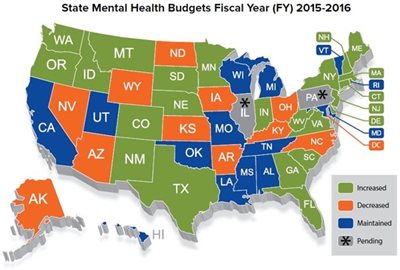
    According to mental health experts, the care these kids do get is often too little, too late. Unfortunately, state mental health services are often woefully underfunded by the federal government, and even less goes into preventative care and early intervention.

    Source: NAMI

    Early intervention is important. Children with severe mental illnesses who receive prompt intensive care tend to fare much better than those who have to wait due to money issues or a simple lack of programs in the area.

    “The research has shown that the earlier we can intervene, particularly with evidence-based interventions, the better outcomes we see later on,” said New York psychologist Danielle Rannazzisi, PhD. “The early years of childhood lay a foundation for future academic, social, emotional, and behavioral success.”

    Many states were forced to make severe cuts to mental health services during the recession of 2007 to 2009. That funding never recovered, and funding for mental health has been cut further under the Trump administration. Without that funding, states can’t afford to provide the care needed by kids like Daniel.

    View the original article at thefix.com

  • For Some Millennials, Access to Mental Health Care Can Be Problematic

    For Some Millennials, Access to Mental Health Care Can Be Problematic

    Millennials have been found to have the highest stress levels of any generation, but barriers like a lack of health insurance are preventing them from getting treatment.

    Aishia Correll, 27, grew up in a world where therapy was not an option. So, when the Philadelphia woman began struggling with her mental health, she turned to painting instead.

    But now, Correll tells the Bristol Herald Courier, she is a health care strategist and is working to increase access and affordability for mental health care, especially for millennials, women of color and the LGBTQ community.

    Correll’s areas of focus are in need. According to a 2018 survey by the American Psychological Association, millennials and Generation Z are at a higher likelihood of rating their mental health as fair or poor in comparison to other generations. In the same survey, millennials were found to have the highest stress levels of all generations.

    However, the survey also revealed that millennials and other young adults were more likely to seek out professional mental health care than older generations. In fact, over one-third of millennials and Generation Z said they were receiving treatment or therapy from a mental health professional.

    The Bristol Herald Courier also reports that since 2014, millennials have continually reported the highest stress levels. In Philadelphia specifically, one barrier to treatment is not having health insurance. According to a Pew report from 2014, 22% of those ages 18-34 in Philadelphia had no health insurance.

    Jennifer Schwartz, inaugural director of Drexel University’s Psychological Services Center and an associate professor in the department of psychology, tells the Bristol Herald Courier that without insurance, therapy can cost anywhere from $75 to $200 for one session.

    At Drexel, Schwartz states, patients are offered a sliding scale price that is based on income, and services are provided by doctoral students.

    “We have a large demand for our services, bigger than we could possibly provide,” Schwartz said. “We do get people who call us and are upset by the lack of services that they’ve been able to locate and access.”

    According to executive director of the Black Women’s Health Alliance, Brenda Shelton-Dunston, this issue is even bigger for millennial women of color.

    “There is a void in mental-health availability and access to mental-health prevention and support services for women of color in Philadelphia,” she told the Herald Courier.

    According to Correll, one solution could be services focused on millennials and located in the right areas.

    In the meantime, she is continuing to turn to art as a means of therapy and is hoping to provide a space for others to do the same through her creation of a “healing” art gallery in North Philadelphia.

    “I didn’t see that my family had a place like that,” she said. “I want to make sure I have a place like that.”

    View the original article at thefix.com

  • How Bullying Affects Mental Health

    How Bullying Affects Mental Health

    A new study examined the long-term health consequences of bullying.

    Bullying can lead to long-term brain changes in victims and leave them at increased risk of depression, anxiety and hyperactivity, according to a new study. 

    The study, published in the journal Molecular Psychiatry, examined the brain scans of 628 teens ages 14-19 who were also asked whether or not they were bullied.  About 30 reported that they had been victims of chronic bullying, according to Medical News Today

    The brain scans showed that the teens who had been chronically bullied had lower volume in two areas of their brains: the caudate and the putamen. The putamen regulates movements and can affect learning, while the caudate processes memories. The caudate is important for learning and helps individuals use past experiences to make decisions. These changes contributed to increased depression and anxiety in people who were bullied, according to Erin Burke Quinlan, a project coordinator for the study. 

    “Although not classically considered relevant to anxiety, the importance of structural changes in the putamen and caudate to the development of anxiety most likely lies in their contribution to related behaviors such as reward sensitivity, motivation, conditioning, attention, and emotional processing,” she said. 

    Study authors noted that while the changes occurred from bullying, earlier interventions could help prevent long-term health consequences from bullying. 

    “These data suggest that the experience of chronic peer victimization during adolescence might induce psychopathology-relevant deviations from normative brain development. Early peer victimization interventions could prevent such pathological changes,” they wrote

    Although previous studies have shown that bullying has long-term health implications, this is the first study to show how it affects the brain structure in victims. 

    “Chronic peer victimization has long-term impacts on mental health; however, the biological mediators of this adverse relationship are unknown,” the study authors wrote.

    A 2015 review published in the Archives of Disease in Childhood found that bullying can have an array of health and social consequences

    “This review considers the importance of bullying as a major risk factor for poor physical and mental health and reduced adaptation to adult roles including forming lasting relationships, integrating into work and being economically independent,” the authors wrote. 

    Health providers and others who work with kids should pay more attention to bullying and not accept it as normal childhood behavior, the authors wrote. 

    “Bullying by peers has been mostly ignored by health professionals but should be considered as a significant risk factor and safeguarding issue,” they said.

    View the original article at thefix.com

  • Depression Changes How We Use Language

    Depression Changes How We Use Language

    Researchers studied an online forum for mental health issues to examine how people with symptoms of depression used language.

    Depression can change both the content and style of the language that people use, according to a study published in the journal of Clinical Psychological Science

    The study compared the use of language in online forums dedicated to addressing depression, anxiety and suicidal ideation. It found that absolutist words — like never, always, completely and nothing — were 50% more frequent in forums dealing with depression than in control forums. In groups for people with suicidal ideation, absolutist language was 80% higher than in control groups, according to JSTOR Daily

    “Absolutist thinking is considered a cognitive distortion by most cognitive therapies for anxiety and depression,” study authors wrote. 

    However, the increased use of absolutist language wasn’t limited to people who are currently clinically depressed. 

    “We found elevated levels of absolutist words in depression recovery forums. This suggests that absolutist thinking may be a vulnerability factor,” study authors wrote

    The use of absolutist words was more closely connected to depression than the use of negative words like “sad,” “frustrated” or “upset.” However, people in the depression forums did use these negative words more frequently than people in the control forums, according to JSTOR

    Another interesting finding, which had been previously identified, is that people with depression were more likely to use first-person singular pronouns and less likely to use third-person pronouns. This could suggest that people with depression are isolated or focused on themselves. Which pronouns someone uses can predict the presence of depression more reliably than negative words, according to one study

    “We know that rumination (dwelling on personal problems) and social isolation are common features of depression,” Mohammed Al-Mosaiwi wrote for JSTOR. “However, we don’t know whether these findings reflect differences in attention or thinking style. Does depression cause people to focus on themselves, or do people who focus on themselves get symptoms of depression?”

    Last year, researchers developed an algorithm that could predict depression by evaluating a person’s speech or texts. 

    Tuka Alhanai, first author of the paper outlining the technology, told MIT News that in the future it could be an important diagnostic tool.

    “We call it ‘context-free’ because you’re not putting any constraints into the types of questions you’re looking for and the type of responses to those questions,” Alhanai said. “If you want to deploy [depression-detection] models in a scalable way … you want to minimize the amount of constraints you have on the data you’re using. You want to deploy it in any regular conversation and have the model pick up, from the natural interaction, the state of the individual.”

    View the original article at thefix.com

  • Idris Elba's Daughter Details Helping Mom With Mental Health

    Idris Elba's Daughter Details Helping Mom With Mental Health

    Isan Elba’s mother Hanne is living with bipolar disorder and depression. 

    British actor Idris Elba has had a remarkable acting career, from playing Heimdall in Thor and Roland in The Dark Tower, to being hailed People’s Sexiest Man Alive.

    Elba’s daughter, 17-year-old Isan, is also successful in her own right as an ambassador to the Golden Globes, and she’s using her position to raise awareness about mental health.

    As People explains, Isan’s ambassador role is a personal one because her mother, Hanne “Kim” Norgaard, suffers from mental illness, specifically bipolar disorder, depression and anxiety.

    At a luncheon in Beverly Hills, Isan explained, “It was only about two years ago that my mom opened up to me. I’m not going to lie, it’s a struggle every day. It’s a learning lesson for me, but it’s hard. Mental health is something that’s hard to deal with. We just sat down and talked about it, and I think that was better for her, talking about it and talking about it with someone who means the most in her life and just getting that out.”

    Once Isan learned what her mother was going through, “It was like, ‘Whoa.’ . . . It was definitely a learning curve. I’m so much closer to my mom now because I know what she’s going through.”

    At the luncheon, the Hollywood Foreign Press Association made the announcement that $50,000 would be donated to the Boris Lawrence Henson Foundation in Isan’s name. As the Henson Foundation website states, their goal “is to eradicate the stigma around mental health issues in the African-American community.”

    “Mental health, specifically among African Americans and my peers in particular, is something I really want to be more vocal about,” Isan said. “There’s this perceived stigma and I’ve seen friends struggle. We need to empower young people to not be afraid to ask for help.”

    Isan told Variety, “Being able to have this platform, and talk about something that I care about that hits home, was really like, ‘Yes, I have to do this.’ It’s something I care about and like I said, using your influence to talk about something you care about or an issue that needs to be fixed, I thought it was the perfect opportunity.”

    Isan also explained that after the luncheon, “[She] will still continue to advocate for mental health. And in the African-American community and among teenagers, because I’m both, and it’s such taboo in both communities.”

    View the original article at thefix.com

  • Can Tarot Cards Improve Mental Health?

    Can Tarot Cards Improve Mental Health?

    One expert says tarot card reading for mental health can be helpful in ways similar to meditation.

    Sometimes tools for managing mental health can be found in unlikely places — such as tarot cards.

    According to Teen Vogue, some individuals are finding comfort and meaning in the cards, which contain pictures, words and symbols. Psychotherapist Jessica Dore is one such person. Each morning, Dore shares a card on her Twitter feed and discusses the implications and interpretations it may have in regards to topics like relationships, boundaries and guilt.

    “The work that I do is really focused on trying to help people figure out what it is that they want, what is important to them, what are their values, and then also what is getting in the way of them moving in that direction,” Dore tells Teen Vogue. “There’s all these different ways of helping people see that for themselves through the tarot cards.”

    Over past centuries, Teen Vogue reports, the way people utilize and read tarot cards has evolved. Some think they are a tool for divination, while others feel they can be used for understanding one’s world and circumstances. 

    Dr. Rachel O’Neill, a therapist with online therapy website Talkspace, says tarot card reading for mental health can be helpful in ways similar to meditation, such as being mindful and taking in the present moment.

    “I think that there is so much space within tarot to find meaningful strategies that go beyond the card reading,” she says. “For example, looking at the card and just taking in what you are seeing, and even using it to practice acceptance without judgement. Be objective, instead of saying what does this mean, is this a bad card or a good card, just kind of accept the card and ask how is this personally meaningful to me?”

    For Lisa Nwankwo, working the cards into her morning routine has helped her learn to reshape her thinking.

    “To start the day I’ll pull a card to see how my day is going to go,” she tells Teen Vogue. “I use it for guidance. Based on the cards that come up, it might be something that is ‘negative’ like The Tower. Instead of thinking, OK, today is going to be a bad day, it just reframes how I am going to approach this day. It gives you a different perspective.”

    Nwankwo adds that interpreting tarot cards can aid in self-confidence and ownership over circumstances. 

    “My advice is to really use tarot as a way of inquiry and not confirmation,” she says. “Ask a question like, where should I focus my energy for the day? Honestly the best ways to make an internal change towards your health and wellness is to feel like it is coming from you, with tarot you can have ownership over that because you are guiding yourself.”

    View the original article at thefix.com

  • Experimental Addiction Treatment Program May Soon Lose Funding

    Experimental Addiction Treatment Program May Soon Lose Funding

    The medication-assisted mental health and addiction programs were showing promising results, but are running out of time.

    A federally funded experimental medication-assisted treatment program may be on its last legs, according to The Washington Post. The program, which has shown some promise in combating the opioid crisis in the year it’s been running, could dissolve as soon as March.

    If the program disappears, up to 9,000 patients would suddenly find themselves without a program and around 3,000 clinic personnel would be out of their jobs, according to an analysis by the National Council for Behavioral Health (NCBH). Because the clinics have to give their workers a 60-to-90 day advance notice for termination, the clinics could see staff leaving to seek other jobs as soon as January.

    Combating the opioid crisis has consistently been a bipartisan issue that both Democrats and Republicans have committed to working together on, but funding for the treatment programs was notably absent from Congress’ $8.4 billion budget that was passed in October. Speaking for the NCBH, Rebecca Farley David speculated that Congress got cold feet when they saw the projected cost of funding the treatment package: $520 million.

    “There was a lot of concern in Congress about the overall cost of the package,” she said.

    The program was conceptualized in 2014 through a set of standards, dubbed the Certified Community Behavioral Health Clinics, and was set to receive two years of flexible funding. In its first year of service in 2017, the program served around 381,000 patients according to the Substance Abuse and Mental Health Services Administration. Now, the program is due to expire in Oklahoma and Oregon in March and Minnesota, Missouri, Nevada, and New York in May.

    These states are trying to come up with alternate avenues for funding, including Medicaid waivers or applying for grants to keep paying staff after the federal funds dry up.

    It’s not just the patients and clinic workers that would suffer if these programs end. Law enforcement and the justice system also benefited from the program. If officers pick up intoxicated suspects, they cannot rely on these programs and instead have to take the time to drive the prisoner to an emergency room. Inmates being released from Niagara County jail relied on these programs to automatically continue treatment.

    “When people fail to make that first appointment upon release, we’ve lost them,” said Deputy Chief Daniel Engert. “Their condition deteriorates, they reoffend, and then they end up back in jail, or worse, they end up dead.”

    View the original article at thefix.com

  • Can Music Therapy Help Ease Anxiety For Pregnant Women?

    Can Music Therapy Help Ease Anxiety For Pregnant Women?

    Researchers examined whether music could work as a tool to help calm symptoms of anxiety in pregnant women.

    With four prior miscarriages, 42-year-old Elizabeth Larsen of Huntley, Ill., struggled with severe anxiety during her pregnancy. But Larsen says she found relief through music therapy, in which music is used to improve health.

    New research indicates that mothers with anxiety during pregnancy, like Larsen, can benefit from such therapy.

    “I wanted to find wellness tools to ensure that my baby and I would have a safe and wonderful birth,” Larsen told The Washington Post. “Music therapy opened up my bodily senses and helped me to relax.” Recently, researchers studied music and mental health during pregnancy. There were 409 participants, all in their third trimester of pregnancy.

    None had a history of anxiety. Of the group, half underwent music therapy where they listened to a relaxing CD three times per week. The other half of the group did not do so. Upon completion of the study, researchers found that those who had taken part in music therapy were overall less anxious than the other group.

    “During pregnancy, fears and anxieties about the health of the baby are very common. Many of the women in our study were anxious about the stress test, an ultrasound that examines the health of the baby,” lead researcher Jessica Garcia-Gonzalez told the Post.

    She added that the study indicates that “anxiety during pregnancy can increase a woman’s risk of postnatal anxiety and depression, but music therapy can help reduce stress.”

    According to Postpartum Support International, anxiety and depression before and after a child’s birth are not rare. The organization says about 6% of pregnant women and 10% of new mothers struggle with anxiety, and about 15% of women grapple with depression after a child is born.

    Karen Kleiman, a psychotherapist who specializes in maternal mental health, told the Post that it is vital for mothers and pregnant women to seek treatment for such issues. “Anxiety is associated with prenatal health concerns like preeclampsia, preterm delivery, and low-birth weight, which is why it’s important for women to learn coping strategies to minimize their worries during pregnancy,” she said.

    As a board-certified music therapist and birth doula, Kate Taylor told the Post she often provides music therapy for her clients. “I use music as a teaching tool,” she said. “We might analyze song lyrics or listen to instruments or music that can aid in relaxation. Songs can bring up intense emotions for women, which can help them connect with the baby, and openly share their worries and feelings about motherhood.”

    For Larsen, music therapy resulted in a more calming pregnancy overall. “During our sessions, we listened to the acoustic guitar,” she told the Post. “At home, I listened to relaxing music on my headphones. The music calmed my anxiety, which helped me stay positive.”

    View the original article at thefix.com

  • Stephen A. Smith Spouts Stigmatizing Rant About Josh Gordon's Addiction

    Stephen A. Smith Spouts Stigmatizing Rant About Josh Gordon's Addiction

    The controversial host ranted about the Patriots wide receiver battle with addiction and mental health issues on ESPN.

    Perennial hot-take artist and ESPN commentator Stephen A. Smith delivered a baffling on-air diatribe last week, drawing harsh criticism from the Twitterverse for his stigmatizing rant on addiction and mental health issues. 

    Describing drug addiction as “self-inflicted” and refusing to view it as a disease, Smith laid into Patriots Wide Receiver Josh Gordon on Thursday following the announcement that Gordon planned to step away from the game to take care of his mental health. 

    “I’m disgusted,” the First Take host said on the air afterward. “I’m sick and tired of this guy getting chances.” 

    Smith continued on and on, in a seemingly interminable stream of vitriol, calling out the 27-year-old for taking Xanax in middle school and offering baffling gems like: “I understand it’s sad that he’s an addict, but it appears he’s an addict. That’s what this comes down to.” 

    In a separate, shorter clip from Thursday’s ESPN, Smith said he didn’t want to seem “unsympathetic” before questioning whether addiction is a disease and seemingly blaming Gordon for becoming addicted. 

    “I don’t want to come across as harsh or unsympathetic to Josh Gordon,” Smith said. “But let’s be very, very clear here. You’ve got a whole bunch of people out there talking about ‘It’s a disease, it’s a disease’ because it’s an addiction.

    “Well, I’m not going to debunk or eliminate the notion that it’s a disease, but how did it become one? Because you can’t get addicted to something you never try. This isn’t cancer. This isn’t Alzheimer’s disease, dementia or something like that. This is self-inflicted.”

    The video clip circulated online, where it was not at all popular, as social media users and other sports analysts thoroughly dragged Smith for his hottest of takes.

    “This is a HORRIBLE take from Stephen A Smith on mental illness and addiction,” tweeted CBS Sports writer Will Brinson. “I’m absolutely appalled this aired on television.”

    Armen Keteyian concurred. “So now he’s a mental health expert,” tweeted the executive producer for The Athletic. “I happen to know something about this situation and this is Completely irresponsible.” 

    Following a series of suspensions, Gordon was indefinitely suspended from the NFL on Thursday for repeated drug violations. Announcement of the suspension came hours after he announced his departure on Twitter.

    “I take my mental health very seriously at this point to ensure I remain able to perform at the highest level,” he tweeted. “I have recently felt like I could have a better grasp on things mentally. With that said, I will be stepping away from the football field for a bit to focus on my mental health.”

    View the original article at thefix.com