Tag: opioid lawsuits

  • Sackler Family Wants To Settle Opioid Lawsuits

    Sackler Family Wants To Settle Opioid Lawsuits

    While the Sacklers are interested in settling, a rep for the family insists that they are not at fault for the opioid epidemic.

    Members of the Sackler family, owners of Purdue Pharma, want to settle the onslaught of opioid lawsuits against them, according to recent statements from a family lawyer. 

    Speaking with Reuters, Mary Jo White of Debevoise & Plimpton, who represents four members of the family, said their clients are interested in settling the lawsuits, but also insisted that the company and the family are not at fault for the opioid epidemic. 

    “The objective is and remains to try to achieve a global resolution,” White said. “Purdue and the Sackler family members, given this litigation landscape, would like to resolve with the plaintiffs in a constructive way to get the monies to the communities that need them, to the people that are addicted… rather than to pay attorneys’ fees for years and years and years to come. You’re talking 2,000 cases. How long will they take to go through the court system?”

    White said that given the scope of the lawsuits against the Sackler family and Purdue, settling is going to be a long and complex process. 

    She said, “You have municipalities and counties as well as state AGs involved in these matters, and getting all of those plaintiffs in a global resolution is very difficult.”

    Despite the family’s willingness to settle, White said that they are not interested in accepting fault. White said that the lawsuits twist and misconstrue normal business documents to shine a negative light on the company. She added that the lawsuits are politically motivated. 

    “Let’s be clear: There is a major public health crisis that we’re all dealing with. But in terms of litigation, what you always want are all of the motivators to be merits-based so that politics are not playing a role, incentives are not playing a role that alters the outcome,” she said. “Let’s see what the real problem is and what the real solutions are rather than playing a litigation blame game with the fingers pointed in the wrong direction.”

    However, Paul Hanly, who is representing municipalities suing Purdue, said that the cases against the company are solid. 

    “Our cases assert strong legal, not political, claims against the Sacklers and all of the other defendants,” he told Reuters. “Ms. White’s comments are belied by the facts that Judge Polster [overseeing the federal cases in Ohio courts] has denied motions to dismiss brought by any number of defendants also claiming that the allegations are without a proper legal basis… and such motions have met the same fate in the New York state coordinated cases.” 

    Massachusetts Attorney General Maura Healey, who is leading a lawsuit against the company, was not impressed with White’s statements. 

    “For years, members of the Sackler family tried to shift the blame and hide their role in creating and profiting off the opioid epidemic,” she said. “Our lawsuit exposed their illegal deception, and we will aggressively pursue our case against them.”

    View the original article at thefix.com

  • Sackler Family Says Opioid Lawsuit Is "Misleading"

    Sackler Family Says Opioid Lawsuit Is "Misleading"

    The family’s lawyers have filed motions to dismiss the complaint filed against them by the Massachusetts Attorney General.

    Members of the billionaire Sackler family say that public outrage over their alleged role in the opioid epidemic—as the owners of OxyContin maker Purdue Pharma—is all a big misunderstanding. 

    According to lawsuits filed across the country, including one in Massachusetts, members of the Sackler family played an active role in pushing opioid painkillers marketed by Purdue Pharma, despite knowing about the addiction risks.

    As the national opioid crisis worsened, the company even considered selling addiction medication to further profit off of opioid addiction, the lawsuits allege. 

    However, a statement made by the family’s attorneys this week said that prosecutors and the press are cherry-picking information to make the family look bad, according to WGBH Boston

    “We are confident the court will look past the inflammatory media coverage generated by the misleading complaint and apply the law fairly by dismissing all of these claims,” the statement read. 

    The Sacklers are one of the richest families in the U.S. and are major donors to museums, colleges and other institutions. However, the family has been subject to more scrutiny as the lawsuits against them pile up.

    In February, activists staged a “die-in” at the Guggenheim Museum in New York City to highlight the role of the Sacklers in promoting addictive opioids. The family had donated extensively to the museum. More recently, a donation to the UK’s National Portrait Gallery was mutually cancelled because of public outcry. 

    “It has become evident that recent reporting of allegations made against Sackler family members may cause this new donation to deflect the National Portrait Gallery from its important work,” a spokesperson for the Sackler Trust told NPR. “The allegations against family members are vigorously denied.”

    Those allegations include that family members, particularly former Purdue Pharma President and Chairman Richard Sackler, were actively involved with marketing OxyContin in misleading ways even when they knew the risk of addiction to the pills was high. The Massachusetts lawsuit alleges that Sackler even visited doctors to help push OxyContin, something that the family denies. 

    Richard Sackler also reportedly made a comment in 1996 about OxyContin’s launch being “followed by a blizzard of prescriptions that will bury the competition.”

    This week, attorneys for the family said that the statement was taken out of context, and that Sackler was actually referring to a snow blizzard that had made him late for the event. 

    The statement goes on to say that the lawsuit “mischaracterizes and selectively quotes from the hundreds of documents it cites to create the false impression” that the family “micromanaged every aspect of Purdue’s marketing strategy.” Rather, the family was not that closely involved with the operations of Purdue, the statement said. 

    However, the Sackler family (not just Purdue) was ordered to pay $75 million over five years as part of a settlement with the state of Oklahoma last week. After that, New York added the family to its ongoing lawsuit against Purdue. 

    View the original article at thefix.com

  • Opioid Lawsuits Pile Up Against Family Behind Purdue Pharma

    Opioid Lawsuits Pile Up Against Family Behind Purdue Pharma

    A string of lawsuits seeks to hold the Sackler family, who own Purdue Pharma, responsible for the opioid crisis.

    The Sackler family is withdrawing from the public sphere, including ending their philanthropic initiatives, as legal pressure rises to hold them responsible for the opioid crisis.

    Their charity arm, the Sackler Trust, has historically donated millions but announced it was ceasing all such activity now that they’re receiving bad press and alleging that “false allegations” are being made against them.

    “The current press attention that these legal cases in the United States is generating has created immense pressure on the scientific, medical, educational and arts institutions here in the U.K., large and small, that I am so proud to support. This attention is distracting them from the important work that they do,” said Sackler Trust chairwoman Theresa Sackler. “The Trustees of the Sackler Trust have taken the difficult decision to temporarily pause all new philanthropic giving, while still honoring existing commitments. I remain fully committed to all the causes the Sackler Trust supports, but at this moment it is the better course for the Trust to halt all new giving until we can be confident that it will not be a distraction for institutions that are applying for grants.”

    Purdue Pharma is the manufacturer of the opioid painkiller OxyContin, a drug for which they stand accused of downplaying the negative effects of while encouraging doctors to prescribe as much as possible in the name of profit.

    According to the Centers for Disease Control, opioids caused about 218,000 American deaths between 1999 and 2017. A recent study found that people are now more likely die from an opioid overdose than in a car accident. The Sacklers say they recognize that action needs to be taken.

    “We recognize that more needs to be done and that’s why we launched a long-term initiative that continues to build as we pursue a range of solutions that we believe will have a meaningful impact,” wrote Theresa Sackler.

    The Sacklers have suspended a $1.3 million grant to the United Kingdom’ National Portrait Gallery as to “avoid being a distraction.” Some other organizations, like the art gallery Tate, the Guggenheim, and the hedge fund Hildene Capital Management, have cut ties to the Sacklers preemptively.

    “The weight on my conscience led me to terminate the relationship,” said hedge fund manager Brett Jefferson.

    Some have called for removing the Sacklers’ name from buildings they funded, including Harvard University’s Arthur M. Sackler Museum and the Smithsonian’s Arthur M. Sackler Gallery, which were funded by the Sacklers long before the invention of OxyContin. Spokespeople for both museums have said they are not going to remove the Sackler name from their buildings.

    “Museums (are) white washing the reputation of a family that is directly responsible for the deaths of hundreds of thousands of people … But the tide is turning against them,” said L.A. Kauffman of accountability group Sackler PAIN.

    View the original article at thefix.com

  • Oklahoma Lawsuit Against Purdue Pharma Settles For $270 Million

    Oklahoma Lawsuit Against Purdue Pharma Settles For $270 Million

    The bulk of the settlement will go to Oklahoma State University to fund an addiction treatment center and addiction treatment medicine.

    The first lawsuit of around 2,000 filed against Purdue Pharma and other drug manufacturers/distributors has settled for $270 million, Reuters reports. The money which will go toward mitigating the opioid crisis.

    The lawsuit was filed by Oklahoma Attorney General Mike Hunter and would have gone to court in May.

    It accused pharmaceutical companies Purdue Pharma (the maker of OxyContin), Johnson & Johnson, and Teva Pharmaceutical Industries of deceptive marketing that fueled the national opioid epidemic.

    The $270 million settlement is with Purdue Pharma only, so Johnson & Johnson and Teva are still expected in court on May 28 of this year.

    According to Reuters, the state of Oklahoma was seeking a total of $20 billion in damages caused by opioid addiction and overdose. The bulk of the $270 million from the settlement will be granted to Oklahoma State University to fund an addiction treatment center and addiction-fighting medications.

    $12.5 million will be given to local governments to help them recover from the opioid epidemic, and $60 million will be paid in legal fees. Members of the Sackler family who own Purdue Pharma will pay an additional $75 million to the university.

    This settlement has been encouraging news for critics of drug companies who believe this is a sign of more settlements to come. Purdue Pharma had been considering bankruptcy as a way to halt the roughly 2,000 lawsuits against it.

    However, it appears that Purdue may instead be opting for a far-reaching settlement across the many similar lawsuits. This is how the legal battles against the tobacco industry ended in 1998—with a $246 billion settlement, Reuters noted.

    University of Connecticut School of Law Professor Alexandra Lahav believes that the Purdue settlement “may be the start of the dominoes falling” for the company.

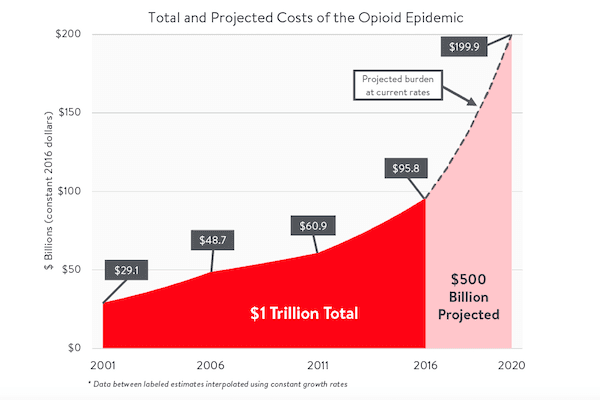
    According to the White House Council of Economic Advisers, the opioid epidemic has caused over $500 billion in economic damages across the U.S. in the year 2015 alone.

    That number likely rose in 2016, when the total number of deaths from opioid-related overdoses jumped from 33,091 to over 42,000.

    Between deaths, the costs of treating overdose cases and addiction, missed work by those affected, and crime related to illicit opioids, the crisis has been economically devastating to communities across the nation.

    Purdue Pharma and members of the Sackler family have continued to deny its alleged role in fueling the opioid epidemic, stressing that prescription opioids come with FDA warnings about addiction and overdose. This argument, however, has proved to be an ineffective deterrent. 

    View the original article at thefix.com

  • Johnson & Johnson Called Opioid "Kingpin" In Oklahoma Lawsuit

    Johnson & Johnson Called Opioid "Kingpin" In Oklahoma Lawsuit

    The lawsuit names the multinational company as a “top supplier, seller and lobbyist” for prescription opioids.

    Johnson & Johnson is being named as a “kingpin” of the opioid epidemic in the first big trial targeting opioid manufacturers, which is set to take place in May 2019.

    The lawsuit, brought by the state of Oklahoma, is naming the multinational company as a “top supplier, seller and lobbyist” for prescription opioids, according to a report by Axios.

    Although Purdue Pharma is the most commonly cited company associated with the opioid crisis, there are several other pharmaceutical companies being targeted by the many hundreds of lawsuits being brought to court by local governments as well as individuals.

    Johnson & Johnson, most often associated with baby powder and lotion products, is classified as a pharmaceutical company. 

    Prior to the Axios report, Johnson & Johnson came under fire when it was discovered that the brand’s baby powder contained asbestos. The company was ordered by a California judge on Wednesday to pay $29 million to a woman who sued based on the claim that the powder was a “substantial contributing factor” in the development of her terminal cancer.

    In addition to everyday home products, Johnson & Johnson “produced raw narcotics in Tasmanian poppy fields, created other active opioid ingredients, and then supplied the products to other opioid makers—including Purdue Pharma,” according to the report.

    The company also allegedly boasted about the high morphine content of its poppies, targeted children and the elderly in its marketing, and funded multiple “pro-opioid groups.” A brochure made by one of the company’s subsidiaries even claimed that “opioids are rarely addictive.”

    The lawyers representing Oklahoma in the upcoming case have asked a court to release millions of pages of Johnson & Johnson’s confidential documents to the public, based on the fact that the company has divested from the opioid business and therefore shouldn’t have to worry about losing trade secrets.

    “The public interest in this information is urgent, enduring and overwhelming,” wrote Oklahoma Attorney General Mike Hunter.

    Johnson & Johnson provided Axios with a statement in the company’s defense, claiming that it “appropriately and responsibly met all laws and regulations on the manufacturing, sale and distribution of APIs (active pharmaceutical ingredients) and the raw materials that go into them” and that its “actions in the marketing and promotion of these important prescription pain medications were appropriate and responsible.”

    The company claims that it accounted for “less than one percent” of the total market share for opioid medications.

    However, the Axios report points out that Johnson & Johnson made $1 billion in 2015 by selling the opioid Nucynta and $2 billion from the fentanyl patch Duragesic, which it still sells to this day.

    View the original article at thefix.com

  • Connecticut Judge Dismisses Opioid Lawsuits Against Purdue Pharma, Others

    Connecticut Judge Dismisses Opioid Lawsuits Against Purdue Pharma, Others

    The Connecticut lawsuits are part of a nationwide effort to make pharmaceutical companies pay for a portion of the damage caused by this crisis.

    Judge Thomas Moukawsher in Connecticut ruled against 37 cities and towns within the state that brought lawsuits against pharmaceutical companies accused of fueling the opioid crisis in the U.S.

    According to the Associated Press, the judge ruled that the lawsuits were “not allowed because they were not filed as government enforcement actions authorized by state public interest laws.”

    “Their lawsuits can’t survive without proof that the people they are suing directly caused them the financial losses they seek to recoup,” Moukawsher wrote. “This puts the cities in the same position in claiming money as the brothers, sisters, friends, neighbors, and co-workers of addicts who say they have also indirectly suffered losses by the opioid crisis. That is to say—under long-established law—they have no claims at all.”

    Though this is a setback in the efforts of the plaintiffs to recoup the many billions of dollars spent to mitigate and combat the opioid crisis, appeals are already being considered.


    Source: ALTARUM

    The lawsuits in Connecticut are only a part of a nationwide effort to make pharmaceutical companies pay for a portion of the damage caused by this crisis. States, cities, counties and Native American tribal councils across the country are filing civil suits against some of the biggest drug manufacturers, claiming that misleading advertising and the alleged encouragement of physicians to over-prescribe opioids have fueled the epidemic of addiction and overdoses.

    According to Forbes, the collective action could become “the largest civil litigation settlement agreement in U.S. history.”

    The record is currently held by the settlement between 46 states and the tobacco industry—a case that some are pointing to as a precedent for the present-day opioid lawsuits. However, experts have pointed out that there are marked differences between these two cases.

    Addiction to prescription opioids is often caused by misuse, whereas there is a clear link between using tobacco products as directed and illness. This makes it easier to blame addiction, overdose and other health concerns on the opioid users themselves.

    “Individual plaintiffs who have sued pharmaceutical companies over how opioids have been marketed have rarely been successful, according to Richard Ausness, a professor at the University of Kentucky College of Law,” wrote Alana Semuels for The Atlantic in 2017. “Courts have made clear that they believe that individual victims are largely responsible for their addiction.”

    However, drug makers have been successfully sued in the past, though many of the lawsuits were settled out of court for a small portion of company profits. Purdue and others have continued to deny any allegations of deceptive marketing or other roles in the opioid crisis.

    Purdue Pharma released a statement about Judge Moukawsher’s ruling, praising him for “applying the law” and vowing to “help address this public health challenge.”

    View the original article at thefix.com

  • What Does 2019 Hold For Opioid Lawsuits?

    What Does 2019 Hold For Opioid Lawsuits?

    Many are looking at the settlements with Big Tobacco to see how the opioid settlements—if there are any—might take shape.

    During 2018, as opioid overdose rates continued to soar, municipalities from around the country vowed to hold drug manufacturers and distributors accountable. This year, 2019, will show how many of the lawsuits around the opioid epidemic will pan out. 

    The plaintiffs — mostly local and county governments from around the country — hope that settlements from the lawsuits will help them recoup some of the costs of treating people addicted to opioids and maybe even help finance better treatment options going forward.

    “We are still in the throes of a public health crisis in Summit County,” Greta Johnson, a county official in Akron, Ohio, told NPR. In order to respond to that crisis, she said, the county needs funds from the major companies that caused or contributed to the epidemic. “We’re confident the court will see it that way as well.”

    Johnson’s argument, echoed in dozens of lawsuits, may sit well with Federal Judge Dan Polster, who is presiding over the largest group of lawsuits out of his Cleveland courtroom. Polster has called the opioid epidemic a “man-made plague,” and called for comprehensive solutions to the issues of addiction and recovery

    While defendants will likely try to have certain allegations dismissed on legal technicalities — like the statutes of limitations being up — Richard Ausness, a law professor at the University of Kentucky, told NPR that effort is unlikely to succeed entirely.

    “The judge has made it clear that he wants a settlement ultimately from this, along the lines of the tobacco settlement,” Ausness said. “If that is indeed the way that he feels, he is probably not going to let the defendants off the hook.”

    As the court cases proceed, the public could learn even more about practices that led to millions of Americans becoming hooked on opioids. Attorney Joe Rice, who represents some governments suing Big Pharma, said that he would like to see the information about misleading advertising and other unscrupulous practices become common knowledge. 

    “Our next battle is to get the documents that are being produced made available to the public instead of everything being filed under confidentiality agreements so we can get the facts out,” he said. 

    Many people are looking at the settlements with big tobacco to see how the opioid settlements — if there are any — might take shape. Tobacco companies have paid more than $100 billion in damages to Americans, some of which have been used to fund anti-smoking public health campaigns. A similar settlement with manufacturers and distributors could impact how future generations are educated about drug use.  

    View the original article at thefix.com

  • Lawsuits Aim To Benefit Kids Born Dependent On Opioids

    Lawsuits Aim To Benefit Kids Born Dependent On Opioids

    One West Virginia law firm is reviewing up to 200 cases of children born with neonatal abstinence syndrome (NAS). 

    Last year, dozens of lawsuits were filed against pharmaceutical manufacturers and distributors for the role they play in the opioid crisis.

    Many were filed by states and cities in an attempt to recoup the costs they’ve shouldered as the result of what they say were irresponsible prescribing and misleading marketing of opioid pain pills. 

    Now, a movement is at hand to try to recoup damages for the hundreds of infants born dependent on opioids, many of whom will have life-long health affects. 

    “I really think that we lose the real human toll that the opioid crisis has taken if we’re not bringing cases on behalf of actual human beings who were victimized by the flood of pills that were pumped in here,” Booth Goodwin, an attorney in Charleston, West Virginia, told The Charleston Gazette-Mail.

    Goodwin’s firm, Goodwin & Goodwin LLP, is reviewing up to 200 cases of children born with neonatal abstinence syndrome (NAS). 

    Goodwin has already lodged a lawsuit on behalf of Andriana Riling, an 11-year-old from West Virginia who has NAS and is being raised by her grandparents.

    “Her case is just kind of typical for what you hear from throughout Southern West Virginia,” Goodwin said. “She lost her father even before she was born in a drug-related car accident. Her birth mother is hopelessly addicted to pills and opioids in general.”

    The lawsuit alleges that Purdue Pharma, Endo Health Solutions and Pharmaceuticals, McKesson Corp., Cardinal Health, AmerisourceBergen and Mallinckrodt all bear responsibility for Riling’s condition for their role in making and distributing the opioids that Riling’s mother took during her pregnancy. 

    Although most of the lawsuits against the opioid manufacturers and distributors have been lumped together under the jurisdiction of a federal judge in Cleveland, Ohio, Goodwin argues that cases involving children with NAS should remain separate so that the unique details of each case can be shown, rather than lumping them together in a class action suit. 

    “Each one of them is affected a little bit different,” he said. “And we want to make sure that we focus on each one of these individual children.”

    He said that the individual cases will focus more on the specific ways these children have been affected by the practices of the companies that are named as defendants. The federal case in Ohio will focus more on the overarching — and perhaps illegal — practices that companies had in place. Because of that, Goodwin’s firm filed a motion to keep Riling’s case from being combined with the Cleveland cases. 

    “The complaint contains very specific allegations, unique to this case, with respect to prescribing doctors and pharmacies,” attorneys wrote when they requested that the case be heard separately. “Although there are generalized facts at issue in both [the Cleveland cases] and the Rilings’ case regarding the reprehensible conduct of the defendants, this overlap is minor.”

    They continued, “[The Cleveland cases] potentially involve comparative fault on the part of the plaintiffs, while Riling, a child born opioid dependent, is an innocent victim who is inherently and completely blameless.”

    While Goodwin waits to hear whether the case will be heard on its own, his law firm is continuing to look for children with NAS, which affected up to 5% of births in West Virginia during the peak years of the opioid epidemic. 

    View the original article at thefix.com

  • Trump To Jeff Sessions: Sue Drug Companies For Opioid Crisis Role

    Trump To Jeff Sessions: Sue Drug Companies For Opioid Crisis Role

    The Attorney General said he would take action on Trump’s requests. 

    President Donald Trump has instructed Attorney General Jeff Sessions to file a federal lawsuit against pharmaceutical companies in Mexico and China, claiming that they have played a role in the US opioid epidemic.

    Last week, according to the New York Post, the president threw blame at China and Mexico for their roles in the opioid epidemic, claiming the countries had manufactured some of the illegal opioids coming into the United States.

    “In China, you have some pretty big companies sending that garbage and killing our people. It’s almost like a form of warfare. I’d like you to do what you can legally,” Trump said to Sessions.

    Fox News reports that Trump’s remarks came during a Cabinet meeting on Thursday, Aug. 16. Fox notes it was somewhat unusual that Trump asked for a new “major” lawsuit to be filed, rather than asking Sessions to join existing lawsuits filed by various US states. 

    “I’d also like to ask you to bring a major lawsuit against the drug companies on opioids,” Trump stated at the meeting, according to Fox. “Some states have done it, but I’d like a lawsuit to be brought against these companies that are really sending opioids at a level that — it really shouldn’t be happening. … People go into a hospital with a broken arm, they come out, they’re a drug addict.”

    Sessions said he would take action on Trump’s requests. 

    “We absolutely will,” Sessions said at the meeting. “We are returning indictments now against distributors from China; we’ve identified certain companies that are moving drugs from China, fentanyl in particular. We have confronted China about it … Most of it is going to Mexico and then crossing the border, unlawfully, from Mexico.”

    As of now, more than 25 US states have filed more than 1,000 lawsuits against opioid distributors and manufacturers.

    Last week, New York filed a lawsuit against Purdue Pharma, stating the manufacturer of the painkiller OxyContin has mislead medical professionals and patients about the dangers of the medication. Massachusetts also filed a lawsuit against the company in June, accusing the company of a “web of illegal deceit.” 

    According to recent estimates, overall overdose deaths in the US in 2017 were about 72,000 — an increase of 6,000 from 2016’s estimates.

    However, preliminary 2018 data implies that the “numbers may be trending downward in the wake of the Trump administration’s efforts to curb the epidemic.”

    View the original article at thefix.com

  • Man Sets Out On Legal Mission After Seeing Opioids Destroy His Hometown

    Man Sets Out On Legal Mission After Seeing Opioids Destroy His Hometown

    A West Virginia lawyer is working to hold major opioid manufacturers legally responsible for their role in the epidemic that has ravaged his home state.

    With record-high rates of overdose deaths and babies born with opioid dependence, Huntington, West Virginia is at the heart of the nation’s overdose crisis.

    It’s also home to Paul Farrell, a lawyer working to sue major opioid manufacturers, who doesn’t want his town to be grouped into the usual picture of downtrodden rural America. 

    “People have been underestimating me for a very long time,” Farrell told MSN. “I’m accustomed to being stereotyped as the Appalachia, redneck hillbilly.”  

    Farrell is leading the lawsuits for many West Virginia towns, who are suing big names like Purdue Pharma, Johnson & Johnson, Endo Pharmaceuticals, Teva, and drug distributors.

    He says that he has personally seen the toll that opioids have taken on the region. “I have people my age that I know that are addicted to opioids,” Farrell said. “I know people that have children in their early 20s that they have lost.”

    And yet Farrell isn’t overly sentimental about the crisis—he’s out for revenge. “We eat what we kill,” Farrell said. “I’m stalking. I’m stalking the herd.”

    Many of Farrell’s lawsuits hang on public nuisance laws, with his argument essentially being that drug manufacturers and distributors created a massive and costly public nuisance throughout the state. 

    “If you drop a nuclear bomb right there—boom!—this is the fallout,” Farrell said of the region. 

    Paul Hanly, a lawyer who has sued Big Tobacco and is working with Farrell on his suits, said that Farrell is tenacious in defending his region. 

    “He’s a gladiator,” Hanly said. “He feels he’s on a mission to correct some wrongs that have adversely affected his state worse than any other state in the nation.”

    Farrell is also unapologetic about the potential money that he could make from the lawsuits. The firms filing the suits stand to make up to 25% of their client’s portions of any settlement. With settlements that could reach $50 billion, the payout for lawyers could be significant. 

    “Sometimes it’s a feast. Sometimes it’s a famine,” Farrell said.

    Farrell started his career in family law, before moving on to the more lucrative role of a plaintiff’s attorney, representing people who had been harmed. “I was writing very large checks to dumbass lawyers, and I thought to myself, ‘I’d like to be one of those dumbasses that gets one of these checks,’” Farrell said.

    This time, he’s aiming for a significant payout for the communities that have been impacted. Farrell believes that past settlements between West Virginia and opioid manufacturers have been too small.

    “It pissed me off that we got handled like that,” he said.

    View the original article at thefix.com