Tag: prescription drugs

  • Benzodiazepines: Another Prescription Drug Problem

    Benzodiazepines: Another Prescription Drug Problem

    Even taking benzodiazepines in adherence to a prescribing physician’s instructions can lead to dependence.

    May 30, 2019
    This tip sheet, originally published in 2018, has been updated to include more recent statistics and additional information.

    Benzodiazepines, a class of anti-anxiety drugs, are commonly-prescribed medications with the potential for abuse, addiction and overdose. Sound familiar? The parallels to the opioid epidemic are apparent; some physicians have taken to calling it “our other prescription drug problem” as they warn of potential dangers.

    “People don’t appreciate that benzodiazepines are addictive and that people abuse them,” said Dr. Anna Lembke, a psychiatry professor at Stanford Medical School. In a phone call with Journalist’s Resource, she said that, just as with alcohol, benzodiazepines can be taken to achieve a state of intoxication.

    Lembke is the program director for the Stanford University Addiction Medicine Fellowship and chief of the Stanford Addiction Medicine Dual Diagnosis Clinic. She has published research in JAMA Psychiatry, Molecular Psychiatry, the Journal of Substance Abuse Treatment, Addiction and other journals. In 2016 she published Drug Dealer, MD: How Doctors Were Duped, Patients Got Hooked, and Why It’s So Hard to Stop, a book on the prescription drug epidemic. Journalist’s Resource spoke with Lembke to learn more about the drugs and factors that have spurred current prescribing trends.

    For context, a few recent studies put numbers to these trends: A new study that focuses on Sweden finds that benzodiazepines and benzodiazepine-related drug prescriptions increased 22 percent from 2006 to 2013 among individuals aged 24 and younger.

    A study published in 2016 in the American Journal of Public Health finds that from 1996 to 2013, the number of adults in the United States filling a prescription for benzodiazepines increased 67 percent, from 8.1 million to 13.5 million. The death rate for overdoses involving benzodiazepines also increased in this time period, from 0.58 per 100,000 adults to 3.07.

    What Are Benzodiazepines?

    Benzodiazepines are a class of drugs with sedative and anti-anxiety effects. A few of the most commonly prescribed benzodiazepines include diazepam (brand name: Valium), alprazolam (brand name: Xanax; street names: bars, xannies), clonazepam (brand name: Klonopin) and lorazepam (brand name: Ativan). These drugs differ with respect to how long they take to start working and how long they last, but all have similar effects, since they work by the same mechanism.

    How Do They Work?

    Benzodiazepines bind to gamma-aminobutyric acid (GABA) receptors in the brain. GABA is an inhibitory neurotransmitter; in other words, it inhibits brain activity. Turning the power down in the brain feels like sleepiness and calm.

    What Are They Prescribed For?

    They can be prescribed for a number of concerns, including anxiety, insomnia and seizures.

    How Can They Be Dangerous?

    Benzodiazepines are accompanied by a number of side effects, including tolerance (reduced sensitivity) for the drug, cognitive impairment, anterograde amnesia (the inability to remember events that occurred after taking the drug), increased risk of Alzheimer’s disease, increased risk of falls (particularly among the elderly, who, according to a study in JAMA Psychiatry, comprise the age group in the U.S. most likely to use the drugs, and use them over the long term), and, most notably, dependence, abuse and overdose. Benzodiazepines are similar to opioids, cannabinoids, and the club drug gamma-hydroxybutyrate (GHB) insofar as the same neural mechanism underlies their addictiveness, according to research published in Nature.

    Even taking benzodiazepines in adherence to a prescribing physician’s instructions can lead to dependence. Withdrawal symptoms are likely among patients who have taken benzodiazepines continuously for longer than a few weeks, according to a study published in Australian Prescriber.

    For people who are looking to discontinue their use of benzodiazepines, Lembke noted that withdrawal could be potentially life threatening. “You can have full-blown seizures and die just from the withdrawal,” she said.

    “The way that they’re prescribed and continued is contrary to the evidence in the medical literature,” Lembke said. She noted that the evidence indicates benzodiazepines are effective and useful only in the short term, and typically at low doses. “There’s no evidence that benzodiazepines taken long term work for anxiety,” she said. “Nonetheless, it is common practice to prescribe and continue those prescriptions for months to years to decades. Somehow there’s a disconnect between the evidence and what the practice is.”

    Given These Risks, Why Are Prescriptions on the Rise?

    “No one knows for sure,” Lembke said. She did, however, offer a few possible explanations.

    She mentioned changes over the past three decades in the way healthcare is delivered.

    As more physicians have shifted from private practice into integrated health care centers, they might feel pressure to adhere to standard protocols or perform procedures and prescribe pills like benzodiazepines, because “that’s what pays.”

    She added that the way medicine is currently practiced separates patients into parts: “Patients have a different doctor for every body part … The right hand doesn’t know what the left hand is prescribing.”

    Frequent changes in insurance coverage, or churn, means that individuals bounce from one coverage source (and care provider) to another. This eliminates the possibility of a sustained, caring and trusting relationship that might allow for more efficacious, long-term health interventions, Lembke added.

    Other changes to the health care system have also occurred: “In many ways, doctors are like waiters and patients are customers,” Lembke explained, adding that some doctors feel the need to respond to patients’ requests and provide short-term relief or “customer satisfaction.”

    A cultural shift might be at work here, too, “Patients expect it,” Lembke said. “We now think pain in any form is dangerous … We’ve also got a whole generation of individuals raised on Prozac, Adderall, Xanax thinking there isn’t anything wrong with using chemicals to change the way you feel.”

    Benzodiazepines and Opioids

    As Lembke pointed out, rising pharmaceutical use isn’t limited to benzodiazepines. And as the United States grapples with widespread opioid use, research points to a dangerous link between these drugs and benzodiazepines.

    A study of over 300,000 patients receiving opioid prescriptions between 2001 and 2013 finds that by 2013, 17 percent also received benzodiazepine prescriptions — up from 9 percent in 2001.

    Moreover, a study that looked at U.S. veterans who received opioid prescriptions finds that those who received benzodiazepines as well experienced increased risk of drug overdose death; the risk increased along with the dose. Another study finds that the overdose death rate among patients receiving opioids and benzodiazepines was 10 times higher than among those receiving opioids alone.

    According to statistics from the National Institute of Drug Abuse (NIDA), from 1999 to 2017, there was a 10-fold increase in the number of overdose deaths involving benzodiazepines in the United States — a rise from 1,135 in 1999 to 11,537 in 2017. Most of the increase has been driven by the use of benzodiazepines in combination with opioids (since 2014, the number of overdose deaths involving benzodiazepines but not any opioids has held steady). As opioids contribute increasingly to benzodiazepine overdose deaths, benzodiazepines too are increasingly present in opioid overdose deaths — the powerful combination of drugs is present in over 30 percent of opioid overdoses, NIDA reports.
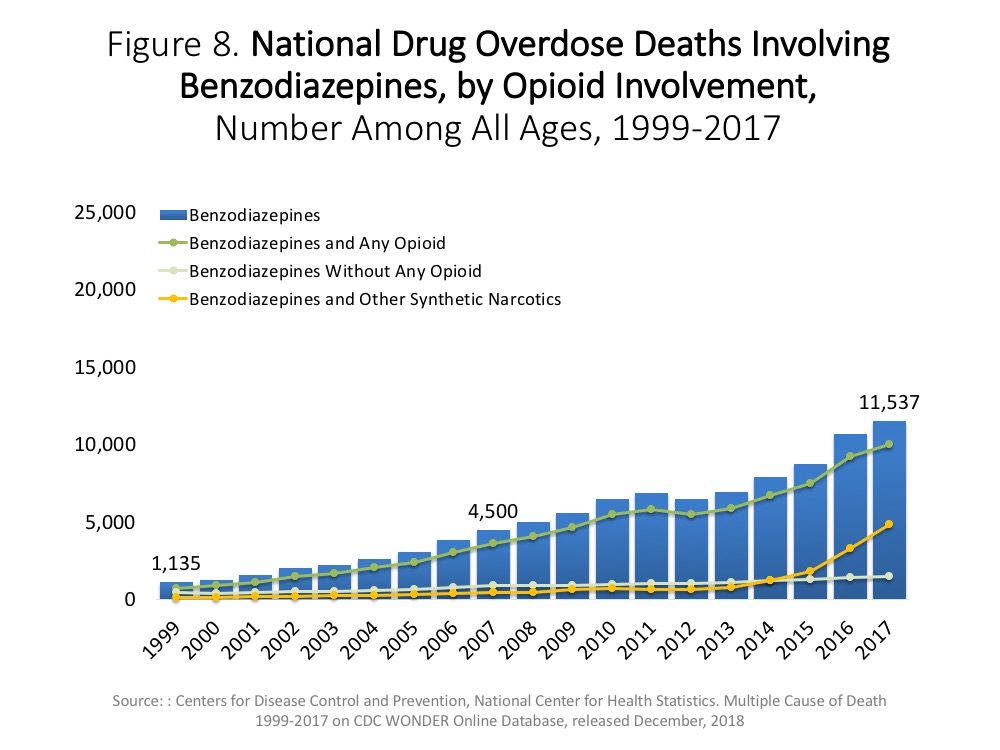
    cdc benzodiazepine overdose stats

    Benzodiazepine abuse on its own can lead to overdose and death, but overdose deaths typically occur in combination with other substances — generally other central nervous system depressants, which, like benzodiazepines, can lead to the life-threatening effect of slowed or stopped breathing.

    In August 2016, the Food and Drug Administration issued a requirement that opioids and benzodiazepines carry a black-box warning about the risks associated with using these substances together.

    Now that you have the background, here are some story ideas, courtesy of Lembke:

    Look into the latest wave of benzodiazepines: super-potent, designer, synthetic varieties made in illicit labs.

    Investigate the growth of benzodiazepine-related patient advocacy organizations as a phenomenon.

    Probe Big Pharma’s role in prescription trends and look at socioeconomic variations in benzodiazepine prescriptions (e.g., Medicaid prescribing rates).

    Journalist’s Resource also has explainers on other drugs, including fentanyl and meth.

    This photo, property of the United States Department of Justice, was obtained from Wikimedia Commons and used under a Creative Commons license.

    This article first appeared on Journalist’s Resource and is republished here under a Creative Commons license.

  • In UK, Opioids Will Carry Addiction Warning

    In UK, Opioids Will Carry Addiction Warning

    “Things are not as bad here as in America, but we must act now to protect people from the darker side of painkillers.”

    Prescription opioids in the United Kingdom will carry a prominent warning about the risk of addiction following new recommendations from an opioid policy group.

    “I have been incredibly concerned by the recent increase in people addicted to opioid drugs,” health secretary Matt Hancock said in announcing the change, according to The Guardian.

    He continued, “Painkillers were a major breakthrough in modern medicine and are hugely important to help people manage pain alongside their busy lives – but they must be treated with caution. We know that too much of any painkiller can damage your health, and some opioids are highly addictive and can ruin lives like an illegal drug.”

    The policy decision is based on a recommendation from the United Kingdom’s Commission on Human Medicines, a group that makes recommendations in regards to opioids. The group recommended that the Medicines and Healthcare Products Regulatory Agency require manufacturers to label opioids with the warning. 

    “This is an important first step to help minimize the risks of addiction associated with opioid medicines, while supporting patients to get the right information at the right time to support their care,” said Dr. June Rain, director of the agency.

    In the UK, the prescription rates for opioids have risen 60 percent in ten years. The labeling effort is a way to get ahead of opioid abuse, Hancock said.

    “Things are not as bad here as in America, but we must act now to protect people from the darker side of painkillers,” he said. “We need to place a greater focus on making sure that these medicines are used appropriately and for pain management alone, and make sure people are fully aware of the risks.”

    England’s chief medical officer, Dame Sally Davies, said the warnings are an important way for patients to learn about the dangers of opioid pills.

    “We know that long-term use of painkillers can lead to life-altering and sometimes fatal addictions – so I am delighted to see measures put in place to raise awareness of the risks of codeine and prescribed drugs,” she said. “It is vital that anyone who is prescribed strong painkillers takes them only as long as they are suffering from serious pain. As soon as the pain starts to alleviate, the drugs have done their job, and it is important to switch to over-the-counter medications which do not carry the same risk of addiction.”

    In the United States, U.S. senators introduced legislation last fall that would require opioids to be labelled with a warning about their addictive nature. 

    “The path from one bottle of pills for patients who have had their wisdom teeth removed or experienced lower back pain to addiction needs as many roadblocks as possible, and a warning label could help save lives,” said Senator Ed Markey of Massachusetts, who sponsored the bill. “In the same way we put warning labels on cigarettes for being addictive and causing death, we need labels to caution patients about the dangers of prescription opioids. It is important that everyone who receives an opioid prescription understand the potential risks, and a sticker on an opioid pill bottle is a consistent reminder.”

    View the original article at thefix.com

  • Google Maps Now Points Users To Drug Disposal Sites

    Google Maps Now Points Users To Drug Disposal Sites

    The tech giant aims to help people with opioid prescriptions get rid of excess pills in the hopes of preventing them from being abused.

    Tech giant Google wants to do its part to combat the opioid epidemic by making it easy for users to find places where the can drop off unneeded medications.

    If people search for “drug drop off near me” or “medication disposal near me,” Google Maps will find nearby pharmacies, hospitals, or government buildings where they can dispose of pills that could otherwise be abused.

    The project was part of a cooperative effort between Google, the Drug Enforcement Administration, the Department of Health and Human Services, and state governments as well as private pharmacy companies like Walgreens and CVS.

    “Addiction to opioids can start after just five days of use, and the majority of prescription drug abuse (53%) starts with drugs obtained from family and friends,” wrote Dane Glasglow, Google Maps’ vice president of product, in a blog post. “That’s why Google wants to help people get rid of leftover pills that are sitting in people’s medicine cabinets, and to make drug disposal locations easier for people to find with a simple search.”

    Such medications are usually prescribed for good reason, especially in cases of recovery after surgeries for ailments like broken bones, burns, or serious illness.

    “Treating pain adequately helps recovery, reduces the downstream psychiatric and psychological effects,” said Dr. Elliot J. Krane. “In the absence of risk factors or concerns about the child’s home environment, I am more concerned about deleterious effects of untreated pain than I am about creating somebody with substance abuse disorder.”

    Some families might think it’s clever to keep these powerful painkillers for future use, but health experts warn that just having the medications in the house can boost the potential for abuse.

    “You should not keep them for use for a future time,” Dr. Linda J. Mason said. “These are for a specific surgery.”

    Google’s ease in involving itself in such an intervention should come as no surprise to those who are aware of the massive amounts of data the tech giant has kept on its users. A study has found that Google can predict the onset of overdoses in a given area by tracking certain search terms.

    “For a number of fiscal and practical reasons, data on heroin use have been of poor quality, which has hampered the ability to halt the growing epidemic,” the researchers wrote. “Internet search data, such as those made available by Google Trends, have been used as a low-cost, real-time data source for monitoring and predicting a variety of public health outcomes.”

    View the original article at thefix.com

  • Top 10 Largest Pharmaceutical Companies

    Top 10 Largest Pharmaceutical Companies

    ____________________________________________________________________

    ARTICLE OVERVIEW: We’ve listed the top ten largest pharmaceutical companies in the world and listed their annual growth. Your questions or comments are welcomed at the end.
    ____________________________________________________________________

    ESTIMATED READING TIME: Less than 10 minutes.
    ____________________________________________________________________

    Table of Contents:

    How Do We Measure the Largest Pharmaceutical Companies?

    In our modern age, we’re extremely lucky that we’ve developed cures for diseases that were previously untreated. But we’re also in an age of Big Business…and pharmaceuticals called “Big Pharma” tend to operate not from altruism, but are motivated by the bottom line.

    In 2017, the pharmaceutical industry hit its most profitable mark in history at $1.11 trillion. These profits are estimated to rise further in the coming years. This is partly due to the fact that medicines are continuously evolving.  Yet, another reason for this large profit has to do with the ever-growing problem with addiction.

    It’s no coincidence that the Opioid Crisis hit its peak in 2017. Further, the CDC reported that more than 191 million opioid prescriptions were dispensed to American patients in 2017. With around 25% of people prescribed Rx pain killer misusing their opioid prescriptions, there’s a rising demand for these drugs. Not only within pharmaceutical companies but also on the illicit market.

    The CDC WONDER Report estimates that, on average, 115 Americans die every day from an opioid overdose.

    With this in mind, you may be wondering, “What role does Big Pharma play in trends like the Opioid Epidemic?” and “How can we identify the ‘largest’ pharmaceutical companies?”

    The easy answer is that we can look first to profit. Those who make more money must experience a measure of business success. Yet, there are certain cases related to sales growth and offshore competition that broaden the net. A large reason for this is the demand for medications isn’t solely in the U.S. We’re noticing countries within Eastern Asia, Eastern Europe, and South America developing an increasing demand for pharmaceuticals. It’s possible that ROI is higher offshore. It’s also possible that costs are lower.

    It should be noted that not every company on this list solely manufactures prescriptions which have fueled drug addiction. There are plenty of companies whose sole aim is to find cures for specific diseases and their medications don’t always cause a “high”.

    As of October 2018, here are the top ten largest pharmaceutical companies in the world.

    #10 – Amgen

    Unlike most of the companies on this list, Amgen only recently became one of the largest pharmaceutical companies. The reason for this has to do with its recent innovations in developing medications which are primarily focused on cardiovascular diseases such as:

    • Bone health
    • Inflammation
    • Nephrology
    • Neurosciences

    Within recent years, Amgen has found much success in their products and is considered one of the most admired companies in the pharmaceutical industry. Last year, the company profited with $22.85 billion.

    #9 – GlaxoSmithKline (GSK)

    Located in the United Kingdom, GlaxoSmithKline has been one of the leading pharmaceutical companies for years now. Particularly, due to how it consistently comes up with advanced and original medications.

    Though the company offers a variety of different medicinal therapies for various diseases, its primary focus is within:

    • HIV/AIDS
    • Respiratory
    • Vaccines

    Their rise in the economy has much to do with the rise in asthma and their sales with inhalers. With that, GSK has also put much focus towards research in three specific areas of medication which have been approved:

    • A daily HIV pill.
    • Shingrix – medication to treat the shingles virus.
    • Trelegy Ellipta inhaler – to treat COPD and Juluca

    With these approvals, GlaxoSmithKline’s profit is expected to rise from the $24 billion it made in 2017.

    #8 – Gilead Sciences

    The range of medications Gilead Sciences has been able to develop the proper treatment for is astounding:

    • Hepatitis infections
    • HIV/Aids
    • Inflammation
    • Oncology
    • Respiratory
    • Virology

    Though it holds similarity to what it treats in comparison to GlaxoSmithKline, the notable difference is its location in California and, therefore, offering easier access to the American public. In 2017, the companies best-selling drug was Harvonis which is used to treat Hepatitis C. They also found success in their medications Truvada to treat and avert HIV and Epclusa, another drug to treat Hepatitis C.

    Through gaining approval of further medications being researched, it’s expected their 2017’s $25.65 billion will increase.

    #7 – AbbVie

    With a recent spike in revenue, the American company, AbbVie, has made this top ten list only in the last two years. The reason for their success has to do with their high research-driven work ethic. Test after test, AbbVie has produced a drug expected to treat atopic dermatitis through their product upadacitinib.

    However, their research goes even further with other medications they hope to impact the following fields with:

    • Dermatology
    • Gastroenterology
    • Neurology
    • Oncology

    Currently, AbbVie’s most popular medications are Humira and Imbruvica, both of which are top picks for doctors trying to treat cancer. With that in mind, it comes to no surprise AbbVie made $28.22 billion back in 2017.

    #6 – Novartis

    Novartis has made much recent headway but has a strong hold on Switzerland’s pharmaceutical history. It’s one of the top companies which focuses on the following fields:

    • Dermatology
    • Neuroscience
    • Oncology
    • Respiratory

    The main reason they’ve reached this high on the list is due to their pharmaceutical sales staying strong. Medications such as Gleevec have been used for numerous oncology diseases whereas the drug Gilenya has helped with a variety of sclerosis complications.

    The most notable medication is Cosenty x, a top pick amongst dermatologists, which had an 82% increase in sales according to Novartis’s website. They totaled $33 billion in 2017.

    #5 – Merck & Co. (MSD)

    Merck can be compared to Novartis in the sense that it has a place in history when it comes to pharmaceuticals. Though the company didn’t boost profits to a great extent these past years, it’s their already developed drugs which keep them in the top 5. These include treatments for the following areas:

    • Cardiovascular
    • Endocrinology
    • Infectious diseases
    • Oncology

    The medications of which they’ve had the most success are Keytruda – a cancer immunotherapy – the HPV vaccine Gardasil, and Januvia – a pill for diabetes. Overall, the company earned $35.4 billion in 2017. For a time, Merck’s was the largest pharmaceutical company in the world.

    #4 – Johnson & Johnson

    Johnson & Johnson may just be the most recognizable company name on this list and it’s due to their 130-year history in American households. Their most popular products are:

    • Aveeno
    • Listerine
    • Neutrogena

    Due to their history of success, Johnson & Johnson will be on this list for years to come. However, they may even climb higher considering their sales increased this past year by 8.3%. Leaving them a $36.3 billion company.

    #3 – Sanofi

    There are three reasons Sanofi is the third top pharmaceutical company:

    1. Aubagio – a pill which treats multiple sclerosis.
    2. Lantus – a diabetes insulin injection.
    3. Lovenox – an anticoagulant to avert blood clots.

    These three medications were not only their best-selling drugs but also gives the company a quarter of its total profit at $36.66 billion.

    #2 – Roche

    The innovation at Roche is just what puts it near the top of this list. Thanks to Roche, there’s been great progress in the following areas:

    • Immunology
    • Infectious disease
    • Neuroscience
    • Oncology

    Even more so, the company is looking to submit further researched drugs to help with a variety of diseases such as rheumatoid arthritis and various cancers. Roche totaled in at $44.36 billion in 2017.

    #1 – Pfizer

    Just as with Johnson & Johnson, Pfizer has a strong place in pharmaceutical history. Though their revenue growth from 2017 wasn’t huge, it’s thanks to their research towards a wide span of therapies that makes them the largest pharmaceutical company in the world. These therapies include:

    • Immunology
    • Neurosciences
    • Oncology

    In 2017, Pfizer had great success in their FDA approval of a variety of products. Likewise, there were certain products which grew heavily in revenue including:

    • Eliquis
    • Ibrance
    • Xelanz

    Overall, Pfizer earned a total of $52.54 billion in 2017.

    What Pharmaceutical Medications Should You Be Aware Of?

    Pharmaceuticals are vital for us to understand and treat both physical and mental health. Thanks to the companies above, modern medicine has progressed in a way which seemed unfathomable years ago. Yet, where there’s an upside, there’s also a bad.

    Not all pharmaceutical medication is safe. In fact, there are many out there was hold high probability for causing a drug addiction. This is when an individual retracts a chronic diseased in which they seek out drugs compulsively and find it difficult to control themselves despite negative consequences. Though not everyone is prone to addiction, it’s important to be aware of the pharmaceutical medications which can cause one.

    These include, but aren’t limited to:

    Central nervous system (CNS) depressants such as:

    Opioids used for pain treatment such as:

    Stimulants (amphetamines) such as:

    • Adderall
    • Concerta
    • Daytrana
    • Methylin
    • Ritalin

    If you or someone you love is prescribed these drugs, it’s vital you only take the dosage the doctor recommends. People who misuse prescriptions often take more than this dosage at more frequent intervals.

    Your Questions

    If you have any further questions pertaining to pharmaceutical companies, we invite you to ask them in the comments section below. If you have any further knowledge on this topic, we’d also love to hear from you. We try to reply to each comment in a prompt and personal manner.

    View the original article at addictionblog.org

  • Artificial Intelligence System Aims To Identify Drug Thefts In Hospitals

    Artificial Intelligence System Aims To Identify Drug Thefts In Hospitals

    The technology is meant to be used as a tool to help administrators monitor employees and alert them to anything unusual. 

    A new artificial intelligence system will monitor hospital workers and assign them a score that indicates how likely they are to steal prescription drugs from their workplace. The technology will address the growing issue of healthcare workers diverting drugs from their place of employment. 

    “The technology calculates how unusual one’s behavior is versus peers in their department, as well as peers across other hospitals, and analyzes a number of underlying metrics and patterns to create an overall risk score,” said Kevin MacDonald, CEO of Kit Check, which developed the system. 

    Kit Check develops software for prescription drug management, and works with about 400 hospitals and other healthcare clients throughout the U.S. and Canada. The new system will assign employees an Individual Risk Identification Score (IRIS). This is calculated by looking at data from drug dispensing cabinets, electronic medical records and drug disposal records.

    “The IRIS dashboard then shows who has the most risk in ranked order so hospital personnel can focus on people who are showing risky patterns,” MacDonald said. “The technology allows an administrator to look at why a person is scored as unusually risky and shows the specific transactions that contributed to the risk score.”

    The technology is meant to be used as a tool to help administrators monitor employees and alert them to anything unusual. 

    “A person’s score can change over time, and it’s not a 100% certainty that a high score means a staff member is diverting medications,” MacDonald said. “There will be situations where a person’s patterns shifted in an unusual—but explainable—way, for example, temporarily getting assigned to a different department/pattern. IRIS allows hospital personnel to have that conversation, evaluate the available data, and move on to other staff members that represent high risk.”

    A Utah hospital reported that up to 4,800 patients may have been exposed to hepatitis C in 2015 through a nurse who diverted medications by swapping needles with narcotics for needles containing saline. Healthcare workers who steal medications is a growing problem, according to some healthcare professionals. 

    “I think we’re all trying to figure this out,” said Angela Dunn, a medical epidemiologist with the U.S. Centers for Disease Control and Prevention (CDC).

    Scott Byington, president of the Utah chapter of the National Association of Drug Diversion Investigators, said that diversions from hospitals are likely to go unreported. 

    “A lot of the clinics or hospitals, when they catch employees doing theft, I would say more go unreported than reported,” he said. “All of a sudden somebody doesn’t show up for work and the rumor mill starts going. They’ll report it to us anonymously, usually, and when we go to investigate, (Human Resources employees) sometimes will just say, ‘We’re not going to release any information from that.’”

    Christine Nefcy, chief medical officer at McKay-Dee Hospital in Utah where the hep-C exposures occurred, said drug abuse is “rampant in communities across our country. Hospital personnel, hospital employees aren’t any different.”

    View the original article at thefix.com