Tag: psychiatric medication

  • Kirstie Alley Shares Hot Take On Psychiatric Meds

    Kirstie Alley Shares Hot Take On Psychiatric Meds

    The “Cheers” actress had a lively discussion about psychiatric medication on Twitter over the weekend. 

    Actress Kirstie Alley’s Twitter feed has been the topic of debate over her controversial tweets on psychiatric drugs.

    Before her Sunday hot take on psychiatry, Alley shared a heartfelt revelation on the popular app. The Cheers actress opened up about what she does with the money she used to spend on cocaine back when she was battling an addiction to the drug. 

    “For u who don’t know much about me, I used to be a coke head,” Alley who is now 40 years drug-free tweeted on Thursday. “I quit drugs in 1979 & vowed to spend the same $ weekly on flowers that I’d spent on drugs.”

    The 66-year-old added, “I buy & arrange my own flowers as a gift to MYSELF. I buy them in the grocery store.”

    Alley’s fans congratulated the actress for her four decades of being drug-free and shared their own sober tales. A couple days later, Alley upset some Twitter users when she called into question the prevalence of psychiatric drugs. 

    Hot Takes

    “Does anyone else worry about how unconscious we are being rendered by pharmaceutical drugs? Is anyone else concerned that we are the most psych drugged country on the planet? I tell you what, if I was an evil dictator & wanted to control a society, I would drug them into apathy,” Alley tweeted on Sunday. 

    Her tweet received mixed reviews from her followers, with some lauding Alley, a long-time Scientologist, for speaking out against what she perceives as an overall overprescription of psychiatric drugs. Alley’s views echo those of Tom Cruise, inarguably the world’s most famous living Scientologist.

    Cruise caught a wave of backlash from mental health experts and patients after proclaiming his disdain for psych meds in a now-infamous 2005 interview with Matt Lauer.

    “I’ve never agreed with psychiatry, ever,” Cruise said. “Before I was a Scientologist I never agreed with psychiatry, and when I started studying the history of psychiatry, I understood more and more why I didn’t believe in psychology.”

    Prior to the Lauer interview, Cruise had taken Brooke Shields to task with accusations that she was “promoting” antidepressants by saying that the medication Paxil helped her deal with postpartum depression.

    “As far as the Brooke Shields thing, look, you have to understand, I really care about Brooke Shields – she’s a wonderful and talented woman, and I want her to do well, and I know psychiatry is a pseudoscience,” Cruise stated. “The thing that I’m saying about Brooke is that there’s misinformation, okay. And she doesn’t understand the history of psychiatry. She doesn’t understand in the same way that you don’t understand it, Matt.”

    “There’s No Such Thing As A Chemical Balance”

    Cruise went on to denounce the prescription of Ritalin to children and suggested that “vitamins and exercise” could resolve personal issues. 

     “Drugs are not the answer,” said Cruise. “I think there’s a better quality of life.”

    Shields responded to Cruise’s comments in an interview with People

    “I agree with him about his feeling on prescribing drugs to kids. We are in accord,” she said. “I don’t think Ritalin should be prescribed to kids. Postpartum depression is a different matter. I think I’m more qualified to talk about that (than he is).”

    According to Shields, Cruise offered her a “heartfelt apology” in 2006 for bringing her into his psychiatric debate.

    View the original article at thefix.com

  • The Million Dollar Smile: My Life with Bipolar Disorder

    The Million Dollar Smile: My Life with Bipolar Disorder

    As many as 60 million people worldwide have bipolar disorder. Many of those people, like me, lead productive, happy lives.

    He said my smile was worth a million bucks, or was it that I had a million-dollar smile? 

    I remember when smiling was foreign to me. I’d wake in the morning feeling great for a few minutes, and then the dark clouds came, weighing in on my body, pressing down on me. Depression overwhelmed me, so much so that my entire body ached. I felt empty, hopeless, sad beyond belief, and exhausted.

    An Emotional Black Hole

    It was another day filled with mental and physical pain…another day spent looking for ways to make the pain stop. I sought help from the big one – God. I was in the early stages of finding Him. I also saw a psychologist for therapy, joined a support group, and listened to Melanie Beattie healing tapes. I read books like Happiness Is a Choice and joined a running club. Nothing worked. I sank deeper and deeper into an emotional black hole.

    I wondered how I could enjoy my new relationship with God, love Him, and still feel this intense pain. It was like nothing I ever experienced. I began to understand why people kill themselves, they want to stop the pain. So did I, and I entertained thoughts of committing suicide. Once when running, I visualized doing the deed. It felt real. I sobbed and limped home.

    Even in my desperate search for help, my suicidal thoughts were a closely-kept secret. I was afraid that if I revealed them to anyone I would be admitted to a hospital – maybe locked up forever.

    My life was spiraling down fast. Scared, I called my therapist. He referred me to a psychiatrist who focuses on chemical imbalances.

    The psychiatrist listened to me and asked me a series of questions. He seemed to know the symptoms I experienced without me telling him. Our session ended when he diagnosed me as bipolar 2. He said after six weeks of taking the medication he prescribed, a lot of those symptoms would disappear. I left his office feeling optimistic. Maybe this was the help I needed.

    A Real Smile

    Six weeks later, something wonderful happened. I was in my car and heard something funny on the radio. I smiled – something I hadn’t done in a long time. It felt so good that I pulled the car over and looked at my smile in the mirror.

    It was as if the sun burst out from behind the dark clouds, gobbling each one up. The cobwebs in my brain cleared, and I was smiling – even laughing. The medication wasn’t a miracle worker, but it squelched my black depression and left me with the ability to deal with my problems. 

    That was nearly 20 years ago. I don’t remember what it felt like to live with intense mental and physical pain for no apparent reason, and I don’t want to go there again. So, I take my medication and see my psychiatrist regularly. The dark clouds came back to haunt me once in the last 20 years, and I immediately saw my psychiatrist for help and got back on track.

    The Big Secret

    For the most part, I prefer to keep my bipolar status under wraps. I guess it’s out of the bag now with this story. There’s stigma and prejudice against people who are bipolar. Most people don’t know much about people with mental illness and expect us behave in negative, sometimes scary ways. Some of the most common beliefs are that we have wide mood swings, engage in manic behavior, and that we’re promiscuous, wild spenders, and we can’t sustain relationships or jobs. Even worse, some people, including the media, promote characteristics that bipolar people have tendencies to be violent.

    Sometimes the media reports a story about a criminal or murderer, adding that the person is bipolar. This makes me cringe. They don’t comment if a person has asthma, hypertension, allergies, or was overlooked for a promotion. Labeling these people as bipolar compounds the negative stereotype of violence. People with bipolar disorders don’t come in one category, and most of us, like the general population, do not have violent tendencies. 

    Should I Tell Him?

    Because of the negative stigma and prejudice, I’m careful about who I share my diagnosis with and when. I decided 10 months into a relationship would be a good time for this revelation. By that time, the person I’m in a relationship with would know what I’m typically like. I’m an okay, normal person who gets sad when the situation merits it – like when my boyfriend died from cancer or my job was eliminated. 

    Things moved fast when I met my husband. We started falling in love on our first date, so I felt he should know that I’m bipolar 2 sooner rather than 10 months later. Three months into the relationship, I told Larry about my diagnosis. I remember that nerve-wracking evening. When I tried to speak, the words stuck in my throat. It seemed to take hours before I had the courage to tell him. During this time, Larry grew nervous and wondered if I was going to break up with him. After I told him about my diagnosis, Larry acted like I told him about the weather – not anything serious like being bipolar 2.

    At my suggestion, Larry came with me to the psychiatrist so that my doctor could tell him about my case and answer his questions. Again, I was nervous. I believe I’m okay, but what will my psychiatrist say? What if I’m a nutcase in denial? My psychiatrist of 17 years told Larry that I have a mild case and will be okay as long as I continue taking my meds regularly and get enough sleep.

    Larry and I have been married for three years. As I expected, there haven’t been any crazy episodes or depressions.

    I feel very lucky that I’m getting the treatment I need. I started seeing my psychiatrist four times a year; now I see him twice a year. When I asked him if I could get off the meds, he said it’s not a good idea. I’m fine because I take the medicine.

    There Are a Lot of Us

    As many as 60 million people worldwide have bipolar disorder. Many of those people, like me, lead productive, happy lives. Some articles state that our 16th U.S. President, Abraham Lincoln, had bipolar disorder. Other people with this diagnosis include Catherine Zeta-Jones, Oscar-winning actress; Mariah Carey, singer; Jean-Claude Van Damme, an actor; Ted Turner, media businessman and founder of CNN; Patricia Cornwell, crime writer; Patrick J. Kennedy, Jesse Jackson, Jr., and Lynn Rivers, former members of the U.S. House of Representatives; Jane Pauley, a television journalist; maybe your colleague, sibling or neighbor…and me, a corporate communications and freelance writer.

    Bipolar disorder is a chronic illness with no cure, but it can be managed with psychiatric medication and psychotherapy. I’ve been doing it for nearly 20 years and plan to do that for the rest of my life. Being free of bipolar symptoms enables me to smile…and mean it. 

    View the original article at thefix.com

  • Lake Bell Details Traumatic Home Birth To Destigmatize Psychiatric Meds

    Lake Bell Details Traumatic Home Birth To Destigmatize Psychiatric Meds

    “I barely take Advil but I was like, this is absolutely imperative in order for me to function.”

    Actress Lake Bell was a believer in the “organic f—ing kumbaya way of living,” but that did not stop her from seeking medication after a traumatic home birth in which she nearly lost her son.

    “It was like I need something, I can’t be a person. I don’t know how to be… I had never felt that before,” the Bless This Mess star said on a recent episode of The Conversation with Amanda De Cadenet. “My heart aches for those who feel that through the hardship of their life every day, like, I have felt it. I know what it is and it’s a monster. It’s a demon.”

    Bell is hoping to lessen the stigma around psychiatric medication by sharing her story. She said that turning to Zoloft after her son Ozzy’s birth in 2017 allowed her to function and feel like herself again.

    Taking Antidepressants To Feel Normal

    “I took a medication called Zoloft, a very low dose and this was again, a person who was afraid of Advil, and I begged for it for my own well-being and for my family’s well-being… and it took me to a place where I could be. I could just be,” she said. “It was rational. I needed to just be Lake and I felt finally like I could breathe the air that Lake breathes, not like some other person that I don’t recognize.”

    She was on the medication for about a year before she tapered off.

    Bell said she was overcome by guilt after insisting that she have a home birth for Ozzy. The birth of her first child in 2014 to daughter Nova was “empowering,” she told Bless This Mess co-star Dax Shepard on his podcast Armchair Expert in July, and inspired her to have a second home birth.

    Nova was born with the umbilical cord around her neck, but Bell and her husband watched as “she came to life” with the help of the midwife.

    The Trauma Of Almost Losing Her Son 

    Ozzy was also born with the cord around his neck, but did not recover as well as Nova did. The newborn was rushed to the hospital and spent 11 days in the NICU. Having been deprived of oxygen for “longer than the four minutes that is associated with being okay,” the parents were informed that “he could [have] cerebral palsy or never walk or talk. That was our reality,” Bell said.

    She struggled to cope with the guilt and trauma of almost losing her son.

    “I’ve dealt with that since,” she told Shepard. “You could blame the midwife, you could blame yourself, but ultimately the result is the only thing that matters. I’ve gone through therapy and was medicated for a year and a half. I did wean myself off but I was on antidepressants to help kind of regulate. I barely take Advil but I was like, this is absolutely imperative in order for me to function.”

    View the original article at thefix.com

  • Patients, Psychiatrists Share Their Experience With Treating Depression

    Patients, Psychiatrists Share Their Experience With Treating Depression

    From medication to exercise, patients and psychiatrists get candid about their methods of treating depression. 

    Kelli María Korducki wanted options. While she appreciated the arsenal of medications being offered to treat her depression, she also wanted to explore the emotional, personal side of the disease, not just the chemical imbalance. 

    “A more realistic, nuanced approach to the way we conceive of mental illness would go a long way toward validating the myriad potential causes for human suffering and clearing paths for many more in need,” Korducki wrote in a July 27 editorial for The New York Times

    Medication Management

    Korducki argued that psychiatry has become “medication management.” 

    “To be sure, many people need medication, and greatly benefit from it,” she wrote. “The right drugs have made my life better too. But I fantasize about a future in which mental illness is understood less in terms of static diagnoses and psychopharmaceutical stopgaps than each individual’s symptoms and the circumstances that might inform them.”

    In response to Korducki’s editorial, many people—doctors and patients—shared their experience with treating depression. 

    Insurance Changes the Game

    John M. Oldham, chief of staff at the Menninger Clinic and former president of the American Psychiatric Association, said that insurance requirements have transformed psychiatry into short, 20-minute med-check visits that do not have the length or intimacy to address a patient’s underlying concerns. 

    “Don’t get me wrong,” Oldham writes. “Psychiatric medications are valuable components of treatment. But mental illnesses are complicated. Medications can do part of the job, but the rest must be done by a careful partnership between psychiatrist and patient, a thoughtfully crafted treatment plan that includes psychotherapy and/or high-quality psychosocial interventions.” 

    Christopher Lukas, author of Shrink Rap: A Guide to Psychotherapy From a Frequent Flier, shared that his doctor told him that antidepressants weren’t serving him—instead, talk therapy was what really made a difference for Lukas. 

    “My psychotherapist believes in listening,” Lukas writes. 

    Jenny Orme, who has struggled with major depression, said that she refused to believe she was a “victim of her genes” even though her mother died from complications of depression at 45. Orme took her health into her own hands, with what she describes as a “rigorous program of yoga, tai chi, swimming and meditation.” That, combined with Eastern medicine and the support of friends and family, help Orme stay stable. 

    “The epidemic of mental illness and suicide calls for a multifaceted, enlightened approach to the treatment of this serious personal and public health problem,” Orme writes. 

    Like Orme, Kordicki says she now views her depression as more than a biological process, and now treats it as so. 

    “Rather than view my psychological experience as a biologically fated roller coaster, I’ve come to think of my mental health as a reflection of the complex ebbs and flows of life; accordingly, I’ve developed tools to better mitigate that which I can’t control, an agency I once wouldn’t have imagined possible,” she wrote. “I feel, for the first time, like a person who belongs to the world.”

    View the original article at thefix.com

  • I Tried “Medical” Marijuana in Sobriety, Here's What Happened

    I Tried “Medical” Marijuana in Sobriety, Here's What Happened

    I was a destructive, chronic blackout drinker for years; marijuana, on the other hand, always seemed like a potential safe zone.

    Three years ago, at six years sober, I decided to try medical marijuana. “Try” is a cuter word than “relapse,” and “medical” made it seem like it was under the care of a doctor. But there were no doctors involved. And I should’ve known that for the kind of addict I am, when it comes to drugs, there is no try. There is only do, and do, and do more until one day you are on your floor sobbing because all the doing is making your life a living hell but you don’t know how to stop.

    I Know I’m an Alcoholic, but Pot Is Not Alcohol

    I was a destructive, chronic blackout drinker for years (not to brag). This is a gift only in that I have the clarity to know that “casual” drinking is not an option for me. Even the idea of a glass or two of wine with dinner makes me shudder because I want the whole bottle for dinner, followed by a dessert course of hard liquor and total chaos. I could one day forget this and convince myself that things might be different, but luckily it hasn’t happened yet. I’ve made too many amends and recounted too many drunk horror stories at dinner parties to ever go back.

    Marijuana, on the other hand, always seemed like a potential safe zone—a gray area in between complete sobriety and destructive annihilation. Before getting sober in 2010, I was too busy getting wasted on booze to give weed much attention. Unlike with alcohol, I don’t have a back pocket full of marijuana horror stories to put things in perspective. 

    It doesn’t help that the drug has a reputation for being extremely cool and relatively harmless. In TV and movies, heavy weed use gets to be the punchline while heavy alcohol use is the point of tension or tragedy. Alcoholics on screen always seem to crash their cars and destroy their families, while the potheads make dumb jokes and go on snack-related adventures. Sign me up please!

    Plus, medical marijuana really does help a lot of people—it’s been reported to work wonders for people with PTSD, cancer, epilepsy, and other problems I don’t have. It also seems to help people with problems I do have: anxiety, depression, insomnia, ADHD, feeling bored, feeling restless, feeling feelings, the pain of being alive. Based on what I’d read and heard, weed was the potential antidote to about 95% of my problems. 

    Weed’s public image has gotten even better as it becomes legal in more U.S. states, which I fully support even if it does me no favors. The days of reefer madness have been replaced by a culture of vape pens, gummy bears, bud-tenders, and medical marijuana. I live in LA, where you can’t go a block without a billboard or a storefront touting the drug as a solution to all your problems. Fun, glamorous, and soothing, it’s both therapy and leisure! For someone who loves therapy and medication as much as candy, an anti-anxiety medication in gummy bear form is almost irresistible.

    At six years sober from alcohol and drugs, I knew intellectually that smoking, vaping, or eating weed was probably a bad idea. But my imaginative addict brain convinced me I could be a “functional pothead” like I’d seen on TV and movies. I told myself I could smoke up like Frankie from Grace and Frankie or Ilana from Broad City. I didn’t take into account that I’m neither a divorced aging hippie with a bottomless bank account nor the most confident 20-something in the world. Or that neither of these characters are real people.

    Functional potheads exist in the real world, too. I know because I’m friends with them. Many are super-successful and seem happy with their lives. 

    So, with no doctor in sight, I made the decision to join the usually-high club.

    I Was a Dysfunctional Pothead from the Start

    Moments after getting high at a friend’s apartment, I realized my sobriety, which I’d worked so hard to attain, was gone. I also realized the universe was a simulation and everyone I’d ever met was mad at me. I had a debilitating panic attack and woke up the next day on my friend’s couch covered in Dorito crumbs. So, I did it again. And again. And again. For years.

    Weed didn’t torpedo my life the way drinking had. It worked slowly, gradually eroding my mental health and the life I’d built for myself. Like a frog in water slowly heated to boiling, I didn’t realize what was happening until the damage was done. Even then, I didn’t realize, because any time I had a bad feeling, I got high. If I felt shame, sadness, dissatisfaction, worry, pain, or longing, I got high. But emotional pain, like physical pain, exists for a reason. It’s your brain’s way of saying “SOS! We have a problem! Fix it!” Instead of listening and resolving the problem, I just shut the voice up with a weed pen.

    In some ways, weed did improve my life, especially at first. It made parties, which I had avoided since getting sober, more fun and easier to navigate. There’s a reason people numb their brains to ease the discomfort of interacting with groups of other humans all crammed into one place. One of my biggest struggles at parties is how to escape a conversation without the excuse of “grabbing another drink.” You can only go to the bathroom so many times before people get suspicious or try to do coke with you. Weed helped me detach from my anxious, people-pleasing brain and just enjoy hovering right outside the moment, looking in. 

    Sometimes I miss being high at parties. But since most of my life does not take place at parties, it’s not worth it.

    Must All Addicts Be Completely Sober?

    I want to make this clear: I’m pro-weed, just not for me. Like most rational people, I believe that it should be legal. It’s not marijuana’s fault I can’t use it wisely. And it’s certainly not the people wasting their lives away in prison for possessing or distributing it, most of them men of color. Draconian and racist U.S. drug laws have been shamelessly exploited by the police and the prison industrial complex for way too long. So I support the legalization of weed for medical and recreational use. Even if that means I have to smell weed smoke on every street corner and see it passed around at parties like pigs-in-a-blanket. 

    I also disagree with the idea that all addicts must be completely sober. Addiction is a complex problem that manifests differently for everyone and we don’t all benefit from the same treatment. Total abstinence works for some people (i.e. me), but I know recovering addicts who benefit from weed, sometimes as a form of harm reduction. I have lost friends to overdoses because they couldn’t stay sober. So if one kind of high prevents you from a much more lethal one, I’m all for choosing the lesser of two evils. Especially in a society where most people can’t afford therapy or prescription medication. Maybe some people need weed to just make it through the day, and that’s okay.

    For me, it didn’t work. I wanted weed to provide a temporary escape from this reality to a wackier one where food somehow tastes even better, like it does in every Seth Rogen movie. But the “temporary” part didn’t work out for me. I’ve never been good at dipping in and out of reality. If I find an escape, I’m buying a one-way ticket, learning the language, and putting down roots. Bye, reality! I’m an ex-pat now.

    The good news is: I finally got my high horror story. The bad news is it’s not exciting enough to tell at a dinner party. It involves long stretches of panic and paranoia, paralyzing depression, compromising my creative dreams, and isolating myself from people. Shortly before getting sober, I had a panic attack from taking too many edibles while hiking and two very kind strangers had to help me down a mountain. I’ll revisit that one next time I try to tell myself it’s a good idea to “treat my anxiety” with weed.

    Since quitting, my anxiety and depression have improved, in part because the doctor-prescribed medications I take are no longer cancelled out by weed use. I’m more productive, which makes me happier. And food, it turns out, tastes just as good sober. My life isn’t perfect, but it’s a lot better than it was. A big part of me wishes I’d never taken that 2.5-year vacation from reality. But at least next time I pass a billboard advertising weed as “therapy,” which happens at least once every time I leave my apartment, I know to smile and just keep walking.

    View the original article at thefix.com

  • Stopping Psych Meds as a Form of Self-Sabotage

    Stopping Psych Meds as a Form of Self-Sabotage

    It’s impossible to explain to someone who’s never had suicidal thoughts what it feels like to be in a space where the only option you think you have to end your suffering is death.

    “See…it’s not that bad.” My friend was responding to a text with an image of the Alamo in San Antonio, Texas. It was the first road trip my husband and I took after moving to Houston. My friend was right, the Alamo wasn’t bad; but having to move back to the States after living in the UK for three years sucked. In all fairness, we were given a choice, and I was the one who pushed for Houston over New York. I wasn’t ready to return to the crowds and chaos of Manhattan, and due to the nature of my husband’s work, Houston made logistical sense.

    “We’ll only be there for a year,” my husband assured me on our last night in London. “It’ll go by so fast.” I wanted to believe him, but I wasn’t ready to.

    Taking a “Break” from Psychiatric Medication

    There’s much planning and reflecting involved in making a big move and my biggest concern was managing my anxiety and depression medication. Not only did I need to make sure I had enough to last me a few months once I got back to the States, but I also needed to sort out insurance and find a new doctor.

    But I kept avoiding these tasks.

    Once we were settled in Houston, every time I thought about the process of meeting a new doctor and running down the lengthy list of addicts and alcoholics in my family, describing my abusive childhood and my almost successful suicide attempt while remembering all of the medications I’d tried in vain, my brain flatlined. What I needed to do to ensure my mental health suddenly felt impossible. Instead of asking for help, which felt like a herculean task, I assuaged my anxiety by deciding to let my prescriptions run out. Besides, after five years on medication, my body could use a break, and despite clear evidence to the contrary, I felt stable enough to handle any anxiety or depression that could pop up in the future. However, at the time I neglected to give any credit to the role my medication played in supporting my relative calm and stability.

    As the months passed in Houston, I started to notice subtle dips in my mood, but each time I’d dismiss it as being part of my monthly PMS package or something that could easily be fixed with a long walk or a quick afternoon nap. But about six months in, I found it exhausting to even think about putting on my sneakers. My occasional mood swings turned into full on sobbing sessions and instead of experiencing PMS one or two weeks every month, it slowly became four and then five until I lost track of when my last cycle ended and the new one began.

    Depression, Anxiety, and Suicidal Ideation

    My deepening depression wasn’t the only issue. One sunny Saturday afternoon, my husband and I took a road trip to Austin. As I was driving us home, I became increasingly anxious. The roads were dark, I couldn’t see beyond the headlights, and my mind began to spin. Mid-panic attack, my husband convinced me to pull over so he could take the wheel. I was so angry at myself for not being able to handle something as simple and routine as driving.

    The more I struggled, the more I believed there was just something wrong with me and as a result, my medication or lack thereof never came to mind. I’d spiraled so quickly down a black hole that it didn’t even occur to me to ask for help, although it was becoming undeniably clear that I desperately needed it.

    It’s impossible to explain to someone who’s never had suicidal thoughts what it feels like to be in a space where the only option you think you have to end your suffering is death. There’s no way to put into words the void that enters your mind when you no longer feel the pain, but it continues to seep into every second of your life. And there’s no making sense of the relief you quietly experience when death, something you may have once feared, suddenly becomes your very own golden ticket. Sadly, during the year I lived in Houston, off medication, I reached this low.

    Finally, my husband sat me down and gently asked if I’d stopped taking my meds. At that moment I surrendered. In a freak moment of clarity, I knew what I had to do – I needed to find a doctor. We were getting ready to move back to New York in a few weeks, but before I left Houston, I got on the phone and scheduled an appointment.

    Why Did I Stop Taking My Meds?

    At our first meeting, I jumped through all of the usual hoops, getting my new doctor up to speed on my background and mental health history. I dove into the details about my alcoholic mother and father, the physical, sexual, and emotional abuse I sustained as a kid and was completely honest about the suicidal thoughts that had been roaring inside my head. And of course, I told her I’d stopped taking my medication.

    “When did you decide to stop taking your meds?” the doctor asked.

    I answered hesitantly, “um…about a year ago.” I was embarrassed by the choice I’d made, and I kept my fingers crossed that she wouldn’t ask me why.

    “Why?” she asked.

    “Honestly I don’t really know,” I told her. “I had insurance…I had everything I needed to find a doctor here in the States. I just didn’t do it.”

    “So, when you needed your medication the most, you stopped taking it?” she gently asked.

    “I don’t understand.”

    “You sabotaged yourself, Dawn,” she explained, leaning back in her chair. “As I understand it, living in Houston was rough for you, and you stopped using the one tool you had to help yourself get through it,” she said. “It’s self-sabotage.”

    Self-Care

    I’ve been back on my meds for two years now, and while I still occasionally get snagged with depression or get overly anxious about a work deadline, for the most part my life has become manageable again. I added therapy back into my mental health regimen about a year ago, and that too has helped tremendously.

    Now, without hesitation, I give my meds the credit they deserve. As it turns out, they’ve done more than balance out the chemicals swirling around in my head; in their absence I eventually discovered one of the many tricks I use to get in my own way, especially when I appear to be making progress. Today, taking medication isn’t something I have to do, it’s something I choose to do because I know it’s right for me. Instead of self-sabotage, I choose self-care, health, and stability.

    View the original article at thefix.com

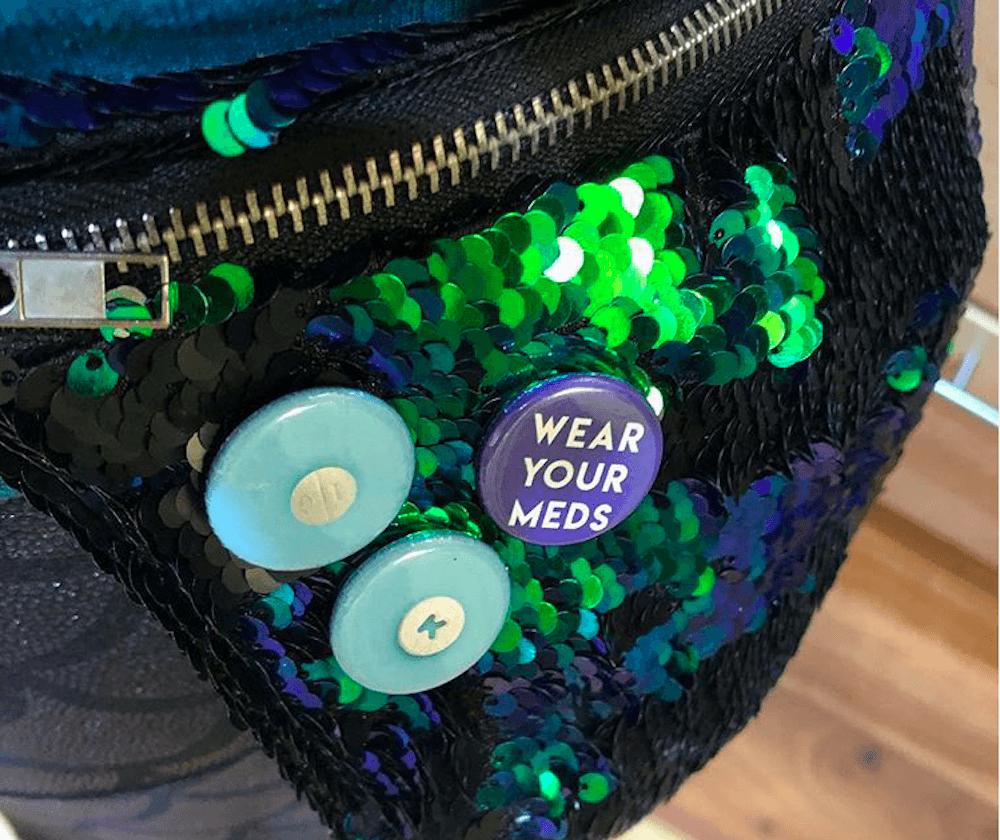
  • "Wear Your Meds" Buttons Help Fight Stigma Against Mental Health

    "Wear Your Meds" Buttons Help Fight Stigma Against Mental Health

    Creator Laura Weiss hopes her pinback buttons can spark conversations and break down the stigma surrounding mental illness.

    When Lauren Weiss took control of her mental health and began taking medication for bipolar disorder, she knew that she wanted to be an advocate for mental illness. Weiss studies advertising at Miami Ad School in New York City, so it was natural that she searched for a quick, engaging visual cue to open conversations about her condition. 

    Weiss designed pinback buttons depicting common psychiatric medications, like Xanax and lithium. Another button proclaims “Wear Your Meds,” summing up the mission of her project. Weiss told Fast Company that the buttons, which started as a class project, are a way to spark a conversation around mental health. 

    “[It’s a] symbol that represents the story you want to tell, and a gateway into your personal story,” she said. “I know that not everybody wants to be an activist about mental health. With something like the buttons, I think it’s a little more accessible for people who maybe are open to sharing their story, but don’t want to be shouting about it on the streets. They can have this button, and it’s an easy way for people to see it and maybe ask about it.”

    Weiss said that she doesn’t expect everyone to be comfortable broadcasting what medications they are on. Some people have said to her that they are afraid they would be fired or otherwise discriminated against if they were open about their mental health condition and the medications that they are taking. 

    However, she said the buttons allow people who are interested in sharing their story to help break down stigma. 

    “People like me who are talking about this from a position of privilege, in a community where we can feel safe talking about it, are the people who ultimately have to do the heavy lifting and have to do the work around this in order for that stigma to start to be lifted for people in communities that don’t feel comfortable talking about it right now,” she said. 

    Weiss is now selling the buttons online, with proceeds to benefit the National Alliance on Mental Illness. 

    “When you ‘wear your heart on your sleeve,’ it means you’re being honest, open, and vulnerable. When you wear your meds on your sleeve, you’re doing the same,” her website reads. 

    Weiss’ buttons depict 14 different pills commonly used for treating mental health conditions: Zoloft, Lithium, Adderall, Ativan, Klonopin, Desyrel, Lexapro, Lamictal, Effexor, Cymbalta, Celexa, Wellbutrin, Xanax, and Prozac.

    View the original article at thefix.com

  • Can SSRIs Interfere With Opioid Pain Relief?

    Can SSRIs Interfere With Opioid Pain Relief?

    A new study examined whether patients who were on SSRIs received less pain relief from certain opioids.

    SSRIs—the most common type of antidepressant—can make some opioid pain relievers less effective, exposing patients to higher levels of pain, according to a new study. 

    For the study, published in the journal PLOS ONE, researchers examined medical records of 4,300 patients who underwent a major operating room procedure at a medical center between 2009 and 2016. They found that patients who were on SSRIs and who received a certain type of opioid had less pain relief following their operations. 

    To understand the study, it’s important to note that opioids come in two varieties, according to NPR. Direct opioids, including morphine and OxyContin, begin working as soon as they are administered. Prodrugs, which include Vicodin and hydrocodone, have to be broken down in the liver before they can begin relieving pain. 

    SSRIs interrupt this process. This is because they affect a liver enzyme that is needed to break down prodrugs. With less of the enzyme breaking down drugs, the pain relief is less effective. 

    “There was theoretical evidence that suggested SSRIs might block prodrug opioids, but we didn’t know if it actually affected patient outcomes,” said Tina Hernandez-Boussard, who authored the study. 

    People on SSRIs who were prescribed prodrug opioids were in more pain up to two months after their procedure. 

    Because SSRIs and opioids are some of the most common prescriptions in the country, the study could have widespread implications for how pain is handled, said Jenny Wilkerson, a professor who teaches pharmacodynamics at the University of Florida.

    “This is an important study,” she said, before calling for additional research. 

    People who get less effective pain relief from opioids are likely to take more pills, which “could lead to misuse or abuse down the road,” Hernandez-Boussard said. 

    “If the opioids aren’t being activated and you’re not getting appropriate pain management, you’re going to take more opioids and you’re going to take them for a longer period of time,” she said. 

    One way around this would be to prescribe direct-acting opioids to patients on SSRIs. 

    “Every opioid has a side effect, not one opioid that is better than another. Possibly for patients taking SSRI, morphine or oxycodone, direct-acting drugs which don’t need to be broken down by the liver might be a better choice,” Hernandez-Boussard said. 

    Wilkerson said that patients should be confident in advocating for themselves when it comes to effective pain relief. 

    “Patients shouldn’t feel stigmatized for being depressed or in pain. Patients have to advocate for their best personal care.”

    However, Hernandez-Boussard acknowledged that this can be difficult for people who are depressed. Instead, she believes the medical community should work to better understand the interaction of SSRIs and opioids. 

    She said, “We need to think about how we can tailor treatment towards more vulnerable groups. More work needs to be done, but this is a good first step.”

    View the original article at thefix.com

  • Not Crazy: How I Overcame My Double Standard About Taking Psychiatric Medication

    Not Crazy: How I Overcame My Double Standard About Taking Psychiatric Medication

    Women hold themselves to this standard where we’re supposed to be perfect. We all have our own image of what that should be, and it doesn’t involve taking psychiatric medication.

    I’m walking up Lexington Avenue towards the subway on a cold Manhattan winter day from my psychiatrist’s office. It’s a route I’ve walked for five years, at varying frequencies, depending on the intensity of my mental health issues.

    My doctor is warm and nurturing with a great sense of humor, and I always walk out her door with a smile on my face. But once I hit the street, my mood can quickly shift: frustrated that I need yet another medicine to achieve some semblance of normalcy or disappointed in myself that I can’t cope. I scan the faces of the crowds in busy Midtown. Can they tell I’m crazy? Do they see some vacant look in my eyes I can’t see? Or, conversely, I wonder about them: is she, that pulled-together woman over there, also buoyed by a bevy of psychiatric meds?

    When I started an anti-depressant four years ago, I immediately started calling it my “crazy pill.” I want to say that’s just because I have a self-deprecating sense of humor, but that’s not the whole truth. Deep down, I thought it was because I was crazy.

    But this time leaving her office was different. My doctor used the words “in recovery,” (probably not the first time she used the phrase) and something inside me shifted. Of course I’m in recovery. I suffered myriad traumas last year: losing my mom, my job, needing to give up my dog, and, hey, let’s throw a summer fling breakup in there for fun. Needing to take medicine to recover from emotional trauma should be the same as if I had been in a car accident and needed painkillers…right?

    The word recovery resonated with me, and I finally internalized this: depression is a very real condition, and my doctor is treating me for it. I’ve written that depression can be like an emotional cancer—entirely pervasive and something that may go away. Or it may worsen.

    On the outside, I pen essays, like this one, where I tell others that they should treat depression and other mental illness just as if it were any other disease. That it shouldn’t hold stigma. And I meant it…for them.

    But why the double standard? Why would I be proud, even, to hear a friend was taking care of her health and taking antidepressants—but think that it made me crazy?

    “Women hold themselves to this standard where we’re supposed to be ‘perfect,’” says Dr. Carly Snyder, a Manhattan-based psychiatrist. “We all have our own image of what that should be, and it doesn’t involve taking an antidepressant.”

    In our culture, memes abound about wine being “mommy juice,” yet “there’s still stigma in trying to feel better in an appropriate way,” Snyder says. “’I’m seeking treatment for an anxiety disorder or depression’ becomes seen as ‘I couldn’t hack it on my own.’”

    For me, I see others dealing with grief or job loss “better” than me, and I wonder what’s wrong with me. I’m doing all the “right” things: I ran the NYC Marathon (my seventh marathon) last year, I picked up personal training and yoga teaching certifications this year, and I have tried every last wellness trend known to woman in hopes that crystals, or maybe hypnosis, will be my magic bullet.

    “We are in a really positive wellness kick right now [societally], and there’s a sense of ‘I didn’t do enough to help my mental health issues,’” says Snyder. Yet, “if someone were struggling with another disorder, a physical disorder, people wouldn’t say not to take care of it. Running is not going to get you out of a major depressive episode.” I constantly joke that if running a marathon isn’t enough to cure a depressive episode, maybe I just need to run an ultramarathon, but I know that’s not actually the answer.

    But while a 50K isn’t the answer, it is important to care for our bodies to care for our brains, says Snyder. (In case you forgot—your brain is a part of your body!) “It’s important to give one’s self the leeway to not feel OK and realize it’s a process to feel better.” People with depression tend to see the world in black and white, and if you wake up every day and say: “I’ll feel better today,” then as soon as you don’t, it becomes a bad day, according to both Snyder and my own experience. “There has to be room for disappointment and some gray area—and allowance for time of healing. It’s not going to happen overnight in the presence of significant illness and trauma.” She likens it to a bad bruise: it can come on quickly but take a long time to go away.

    If you’re already depressed though, that still sounds bleak. You want immediate gratification, right? Of course you do. Here’s the thing: we have control, and we’re not failures for having depression and anxiety. (Take a minute and write that down or say it out loud. Let it really sink in.)

    You don’t have to let your mood disorder dictate your self-worth or how you see the world—things I was guilty of. I identified myself as a depressed person, I threw my hands up in the air and blamed depression for my behavior. Snyder says that “when we are depressed, we deprive ourselves: I don’t deserve to feel better, I don’t need to feel better. There’s this bleakness that comes in. You know in your heart that this is not what it feels like to live in your day-to-day life, but it becomes harder to see a way out.”

    But you win, she says, by taking control—by going to therapy, by going to a psychiatrist, by not listening to that voice in your head that says you don’t deserve it.

    And although I’ve been treated for years—through therapy, medication, hospitalization and myriad holistic approaches, some legit, some snake oil—it was only on that cold day that I finally internalized it, that I really believed I deserved to feel better, and that depression was an actual diagnosis I had that needed to be treated. I saw my psychiatrist as a partner in my recovery, rather than someone who held all the power to cure me via her prescription pad.

    This realization took some of the power from the disease and allowed me to (eventually) reframe subsequent flares as just that, something that might happen to anyone with a chronic illness.

    View the original article at thefix.com

  • New Type of Antidepressant Could Be Game Changer

    New Type of Antidepressant Could Be Game Changer

    The new medication will reportedly deliver fast-acting relief for patients, who often need to wait four to six weeks to feel the effects of current anti-depressants. 

    A fast-acting and innovative depression medication that works differently from drugs currently on the market received a positive result in clinical trials this week, clearing the way for the drug to be approved by the Food and Drug Administration as soon as March. 

    Sage Therapeutics announced in a news release that its drug, SAGE-217, led to statistically-significant improvements for women with postpartum depression in just two weeks, while being well tolerated by the women overall. 

    “These are strong and consistent data demonstrating a rapid, stable, and clinically meaningful improvement in PPD depressive symptoms in the SAGE-217 treatment group compared to placebo,” Dr. Jeff Jonas, M.D., CEO of Sage, said in the release.

    Despite the fact that depression is one of the most common health conditions in the world, there are currently limited means for treating the condition. Current medications that act on the brain’s serotonin system don’t work for as many as a third of patients. SAGE-217 offers an entirely different model for treatment, acting on the brain’s GABA receptors in order to alleviate depression symptoms. 

    Jonas said last year that the new approach will deliver fast-acting relief for patients, who often need to wait four to six weeks to feel the effects of current anti-depressants. 

    “In this development program, we are exploring the potential for patients with [major depression] to feel well within days, with just a 2-week course of treatment – similar to how antibiotics are used today – instead of enduring long-term chronic treatment,” Jonas wrote in a news release. “We believe a medicine with rapid onset and robust response could be truly paradigm shifting. SAGE-217, if successfully developed and approved, may rewrite the textbook on how the tens of millions of people suffering from [major depression] are treated, ultimately turning depression into a disorder, not an identity.”

    In June, the FDA announced that it would allow an accelerated approval plan for Sage, allowing the drug to come to market faster by using shorter clinical trials to prove its effectiveness.

    In addition to providing fast-acting relief, Jonas has said that SAGE-217 could be taken intermittently so that patients don’t need to take a monthly pill. 

    Despite the lofty promises, many medical professionals are cautiously optimistic about the new drug and how life-changing it may be for patients.

    Psychiatrist Cristina Cusin, who specializes in depression at Massachusetts General Hospital and Harvard University told Business Insider that the company’s predictions might be a little rosy, saying it seems “a little excessive to say a chronic disease would disappear after two weeks, that’s something you can’t say about diabetes or any other chronic disease.”

    View the original article at thefix.com