Tag: PTSD

  • The ‘Grief Pandemic’ Will Torment Americans for Years

    The optimism generated by vaccines and falling infection rates has blinded many Americans to the deep sorrow and depression of those around them.

    Cassandra Rollins’ daughter was still conscious when the ambulance took her away.

    Shalondra Rollins, 38, was struggling to breathe as covid overwhelmed her lungs. But before the doors closed, she asked for her cellphone, so she could call her family from the hospital.

    It was April 7, 2020 — the last time Rollins would see her daughter or hear her voice.

    The hospital rang an hour later to say she was gone. A chaplain later told Rollins that Shalondra had died on a gurney in the hallway. Rollins was left to break the news to Shalondra’s children, ages 13 and 15.

    More than a year later, Rollins said, the grief is unrelenting.

    Rollins has suffered panic attacks and depression that make it hard to get out of bed. She often startles when the phone rings, fearing that someone else is hurt or dead. If her other daughters don’t pick up when she calls, Rollins phones their neighbors to check on them.

    “You would think that as time passes it would get better,” said Rollins, 57, of Jackson, Mississippi. “Sometimes, it is even harder. … This wound right here, time don’t heal it.”

    With nearly 600,000 in the U.S. lost to covid-19 — now a leading cause of death — researchers estimate that more than 5 million Americans are in mourning, including more than 43,000 children who have lost a parent.

    The pandemic — and the political battles and economic devastation that have accompanied it — have inflicted unique forms of torment on mourners, making it harder to move ahead with their lives than with a typical loss, said sociologist Holly Prigerson, co-director of the Cornell Center for Research on End-of-Life Care.

    The scale and complexity of pandemic-related grief have created a public health burden that could deplete Americans’ physical and mental health for years, leading to more depression, substance misuse, suicidal thinking, sleep disturbances, heart disease, cancer, high blood pressure and impaired immune function.

    “Unequivocally, grief is a public health issue,” said Prigerson, who lost her mother to covid in January. “You could call it the grief pandemic.”

    Like many other mourners, Rollins has struggled with feelings of guilt, regret and helplessness — for the loss of her daughter as well as Rollins’ only son, Tyler, who died by suicide seven months earlier.

    “I was there to see my mom close her eyes and leave this world,” said Rollins, who was first interviewed by KHN a year ago in a story about covid’s disproportionate effects on communities of color. “The hardest part is that my kids died alone. If it weren’t for this covid, I could have been right there with her” in the ambulance and emergency room. “I could have held her hand.”

    The pandemic has prevented many families from gathering and holding funerals, even after deaths caused by conditions other than covid. Prigerson’s research shows that families of patients who die in hospital intensive care units are seven times more likely to develop post-traumatic stress disorder than loved ones of people who die in home hospice.

    The polarized political climate has even pitted some family members against one another, with some insisting that the pandemic is a hoax and that loved ones must have died from influenza, rather than covid. People in grief say they’re angry at relatives, neighbors and fellow Americans who failed to take the coronavirus seriously, or who still don’t appreciate how many people have suffered.

    “People holler about not being able to have a birthday party,” Rollins said. “We couldn’t even have a funeral.”

    Indeed, the optimism generated by vaccines and falling infection rates has blinded many Americans to the deep sorrow and depression of those around them. Some mourners say they will continue wearing their face masks — even in places where mandates have been removed — as a memorial to those lost.

    “People say, ‘I can’t wait until life gets back to normal,’” said Heidi Diaz Goff, 30, of the Los Angeles area, who lost her 72-year-old father to covid. “My life will never be normal again.”

    Many of those grieving say celebrating the end of the pandemic feels not just premature, but insulting to their loved ones’ memories.

    “Grief is invisible in many ways,” said Tashel Bordere, a University of Missouri assistant professor of human development and family science who studies bereavement, particularly in the Black community. “When a loss is invisible and people can’t see it, they may not say ‘I’m sorry for your loss,’ because they don’t know it’s occurred.”

    Communities of color, which have experienced disproportionately higher rates of death and job loss from covid, are now carrying a heavier burden.

    Black children are more likely than white children to lose a parent to covid. Even before the pandemic, the combination of higher infant and maternal mortality rates, a greater incidence of chronic disease and shorter life expectancies made Black people more likely than others to be grieving a close family member at any point in their lives.

    Rollins said everyone she knows has lost someone to covid.

    “You wake up every morning, and it’s another day they’re not here,” Rollins said. “You go to bed at night, and it’s the same thing.”

    A Lifetime of Loss

    Rollins has been battered by hardships and loss since childhood.

    She was the youngest of 11 children raised in the segregated South. Rollins was 5 years old when her older sister Cora, whom she called “Coral,” was stabbed to death at a nightclub, according to news reports. Although Cora’s husband was charged with murder, he was set free after a mistrial.

    Rollins gave birth to Shalondra at age 17, and the two were especially close. “We grew up together,” Rollins said.

    Just a few months after Shalondra was born, Rollins’ older sister Christine was fatally shot during an argument with another woman. Rollins and her mother helped raise two of the children Christine left behind.

    Heartbreak is all too common in the Black community, Bordere said. The accumulated trauma — from violence to chronic illness and racial discrimination — can have a weathering effect, making it harder for people to recover.

    “It’s hard to recover from any one experience, because every day there is another loss,” Bordere said. “Grief impacts our ability to think. It impacts our energy levels. Grief doesn’t just show up in tears. It shows up in fatigue, in working less.”

    Rollins hoped her children would overcome the obstacles of growing up Black in Mississippi. Shalondra earned an associate’s degree in early childhood education and loved her job as an assistant teacher to kids with special needs. Shalondra, who had been a second mother to her younger siblings, also adopted a cousin’s stepdaughter after the child’s mother died, raising the girl alongside her two children.

    Rollins’ son, Tyler, enlisted in the Army after high school, hoping to follow in the footsteps of other men in the family who had military careers.

    Yet the hardest losses of Rollins’ life were still to come. In 2019, Tyler killed himself at age 20, leaving behind a wife and unborn child.

    “When you see two Army men walking up to your door,” Rollins said, “that’s unexplainable.”

    Tyler’s daughter was born the day Shalondra died.

    “They called to tell me the baby was born, and I had to tell them about Shalondra,” Rollins said. “I don’t know how to celebrate.”

    Shalondra’s death from covid changed her daughters’ lives in multiple ways.

    The girls lost their mother, but also the routines that might help mourners adjust to a catastrophic loss. The girls moved in with their grandmother, who lives in their school district. But they have not set foot in a classroom for more than a year, spending their days in virtual school, rather than with friends.

    Shalondra’s death eroded their financial security as well, by taking away her income. Rollins, who worked as a substitute teacher before the pandemic, hasn’t had a job since local schools shut down. She owns her own home and receives unemployment insurance, she said, but money is tight.

    Makalin Odie, 14, said her mother, as a teacher, would have made online learning easier. “It would be very different with my mom here.”

    The girls especially miss their mom on holidays.

    “My mom always loved birthdays,” said Alana Odie, 16. “I know that if my mom were here my 16th birthday would have been really special.”

    Asked what she loved most about her mother, Alana replied, “I miss everything about her.”

    Grief Complicated by Illness

    The trauma also has taken a toll on Alana and Makalin’s health. Both teens have begun taking medications for high blood pressure. Alana has been on diabetes medication since before her mom died.

    Mental and physical health problems are common after a major loss. “The mental health consequences of the pandemic are real,” Prigerson said. “There are going to be all sorts of ripple effects.”

    The stress of losing a loved one to covid increases the risk for prolonged grief disorder, also known as complicated grief, which can lead to serious illness, increase the risk of domestic violence and steer marriages and relationships to fall apart, said Ashton Verdery, an associate professor of sociology and demography at Penn State.

    People who lose a spouse have a roughly 30% higher risk of death over the following year, a phenomenon known as the “the widowhood effect.” Similar risks are seen in people who lose a child or sibling, Verdery said.

    Grief can lead to “broken-heart syndrome,” a temporary condition in which the heart’s main pumping chamber changes shape, affecting its ability to pump blood effectively, Verdery said.

    From final farewells to funerals, the pandemic has robbed mourners of nearly everything that helps people cope with catastrophic loss, while piling on additional insults, said the Rev. Alicia Parker, minister of comfort at New Covenant Church of Philadelphia.

    “It may be harder for them for many years to come,” Parker said. “We don’t know the fallout yet, because we are still in the middle of it.”

    Rollins said she would have liked to arrange a big funeral for Shalondra. Because of restrictions on social gatherings, the family held a small graveside service instead.

    Funerals are important cultural traditions, allowing loved ones to give and receive support for a shared loss, Parker said.

    “When someone dies, people bring food for you, they talk about your loved one, the pastor may come to the house,” Parker said. “People come from out of town. What happens when people can’t come to your home and people can’t support you? Calling on the phone is not the same.”

    While many people are afraid to acknowledge depression, because of the stigma of mental illness, mourners know they can cry and wail at a funeral without being judged, Parker said.

    “What happens in the African American house stays in the house,” Parker said. “There’s a lot of things we don’t talk about or share about.”

    Funerals play an important psychological role in helping mourners process their loss, Bordere said. The ritual helps mourners move from denying that a loved one is gone to accepting “a new normal in which they will continue their life in the physical absence of the cared-about person.” In many cases, death from covid comes suddenly, depriving people of a chance to mentally prepare for loss. While some families were able to talk to loved ones through FaceTime or similar technologies, many others were unable to say goodbye.

    Funerals and burial rites are especially important in the Black community and others that have been marginalized, Bordere said.

    “You spare no expense at a Black funeral,” Bordere said. “The broader culture may have devalued this person, but the funeral validates this person’s worth in a society that constantly tries to dehumanize them.”

    In the early days of the pandemic, funeral directors afraid of spreading the coronavirus did not allow families to provide clothing for their loved ones’ burials, Parker said. So beloved parents and grandparents were buried in whatever they died in, such as undershirts or hospital gowns.

    “They bag them and double-bag them and put them in the ground,” Parker said. “It is an indignity.”

    Coping With Loss

    Every day, something reminds Rollins of her losses.

    April brought the first anniversary of Shalondra’s death. May brought Teacher Appreciation Week.

    Yet Rollins said the memory of her children keeps her going.

    When she begins to cry and thinks she will never stop, one thought pulls her from the darkness: “I know they would want me to be happy. I try to live on that.”

    Subscribe to KHN’s free Morning Briefing.

    View the original article at thefix.com

  • New Intergenerational Trauma Workbook Offers Process Strategies for Healing

    New Intergenerational Trauma Workbook Offers Process Strategies for Healing

    By following the clearly outlined steps to healing in the workbook, one can start healing the emotional wounds brought on by unaddressed intergenerational trauma.

    In the Intergenerational Trauma Workbook, Dr. Lynne Friedman-Gell, PhD, and Dr. Joanne Barron, PsyD, apply years of practical clinical experience to foster a healing journey. Available on Amazon, this valuable addition to both the self-help and mental health categories is perfect for a post-pandemic world. With so many people uncovering intergenerational trauma while isolated during the extended quarantines, the co-authors offer a direct approach. The book shows how to confront and ultimately integrate past demons from within the shadowy depths of the human psyche.

    Addressing such a difficult challenge, the Intergenerational Trauma Workbook: Strategies to Support Your Journey of Discovery, Growth, and Healing provides a straightforward and empathetic roadmap that leads to actual healing. Dr. Gell and Dr. Barron explain how unintegrated memories affect a person negatively without the individual being aware of what is happening. Rather than being remembered or recollected, the unintegrated memories become painful symptomology.

    By following the clearly outlined steps to healing in the workbook, finding freedom from what feels like chronic pain of the mind and the body is possible. Yes, the emotional wounds of childhood often fail to integrate into the adult psyche. Never processed or even addressed, they morph into demons. In response, the workbook is all about processing.

    Clearly-Defined Chapters about Processing Intergenerational Trauma

    The workbook is divided into clearly defined chapters that provide a roadmap to recovery from trauma. In the first chapter, the authors focus on “Understanding Intergenerational Trauma,” providing the reader with an orientation to the subject matter while defining key terminology for future lessons. From a multitude of perspectives, they mine the depths of intergenerational trauma. Expressing with a clarity of voice balanced with compassion, they write, “Intergenerational trauma enables a traumatic event to affect not only the person who experiences it but also others to whom the impact is passed down through generations.”

    New Intergenerational Trauma Workbook Offers Process Strategies for HealingThe chapters carefully outline how the workbook is to be used and the psychological underpinnings behind the exercises. Moreover, they use individual stories to demonstrate the ideas being expressed. Thus, moments of identification are fostered where someone using the workbook can see themselves in the examples being presented. Overall, the organization of the workbook is well-designed to help someone face the difficult challenge of dealing with their legacy of intergenerational trauma

    In terms of the chapter organization, the authors make the smart choice to start with the microcosm of the individual and their personal challenges. By beginning with the person’s beliefs and emotions using the workbook, these chapters keep the beginning stages of healing contained. Afterward, a chapter on healing the body leads to expanding the process to others and the healing of external relationships. As a tool to promote actual recovery, the Intergenerational Trauma Workbook is successful because it does not rush the process. It allows for a natural flow of healing at whatever pace fits the needs and personal experiences of the person using the workbook.

    A Strong Addition to Self-Help Shelves in a Time of Trauma Awareness

    In a 2017 interview that I did for The Fix with Dr. Gabor Maté, one of the preeminent addictionologists of our time, he spoke about how the United States suffered from traumaphobia. The rise of the 21st-century divide in our country came about because our social institutions and popular culture avoid discussing trauma. Beyond avoiding, they do everything they can to distract us from the reality of trauma. However, after the pandemic, I don’t believe that these old mechanisms will work anymore.

    Losing their functionality, people will need tools to deal with the intergenerational trauma that has been repressed on both microcosmic and macrocosmic levels for such a long time. The pain from below is rising, and it can no longer be ignored. In need of practical and accessible tools, many people will be relieved first to discover and then use the Intergenerational Trauma Workbook by Dr. Lynne Friedman-Gell and Dr. Joanne Barron. In this resonant work, they will be able to find a way to begin the healing process.

    View the original article at thefix.com

  • Avoiding Family Drama During the Covid-19 Pandemic

    When the pandemic broke out, for the first time since I left home, I felt conflicted between the need to learn my brothers are safe and my need to maintain a drama-free life.

    Several times since the Covid-19 pandemic broke out, I have wondered whether my brothers were safe. Knowing whether John*, my middle brother, was okay was easy. Although we’ve not talked to each other in 12 years, I found out through two of our mutual childhood friends that he was not one of the more than 350,000 people in his state who have contracted the virus.

    Finding out whether Marco* was okay took several weeks. Nobody in our family and none of my childhood friends can deal with him. He has bipolar disorder, and since his diagnosis 39 years ago, he has consistently refused meds. He’s verbally and physically abusive to most people he comes in contact with, especially women, which he came by honestly as the saying goes.

    I never needed a diagnosis to know something was seriously off with Marco. Looking back, he exhibited all the signs: stretches of mania followed by equally long bouts of depression, calculated and well-thought-out verbal and physical assaults, and rage that seemed to come from nowhere.

    When I was 10 (Marco is four years older than I) he planned out his first of two attempts to kill one of the neighbors in our Manhattan apartment building. He tied a thin wire across the top of the staircase. He then rang the doorbell and tried to lure this woman out of her apartment and down those marble stairs, where she would surely have fallen to her death. She saw the wire just in the nick of time and held onto the banister. Marco was hiding out of sight, snickering.

    He told our parents he did it because the neighbor wouldn’t let him play with her daughter. Laughing as he retold the story was creepy as hell.

    A few days later while staring out the window, Marco noticed the same neighbor climbing out of a cab. He had a 10-gallon garbage bag already filled with water, waiting beside the window. As she closed the car door, Marco dropped that 85-pound “water balloon” down 10 flights. It missed our neighbor by a hair and she did as anyone would do: she looked up and saw Marco looking out the window. He not only didn’t duck inside (as most people would have done), he yelled out to her, “Better luck next time!” Although none of us saw this happen, his version of events was identical to hers.

    With me Marco had a trigger hand, like our father. If our father didn’t like something I said or did, I would get knocked across the room. Our father beat all three of us whenever he felt like it, which was probably three to four times a week, as did his father to him growing up. When I was 14, I paid $25.00 from my babysitting money to a neighborhood kid to install a lock on my bedroom door. I couldn’t control the world outside my bedroom, but I could protect myself in my own room.

    And what was John doing as Marco was abusing his sister and trying to kill the neighbor? John has always been good at taking care of John and ignoring everyone else. Give him a substance and the world ceases to exist.

    Forgive and Forget Because Nothing is More Important Than Family

    Those who don’t know my family or think I’m exaggerating when I describe what it was like growing up usually say things to me like, “Nothing is more important than family,” “Whatever happened, just forgive him and move on” or “You’ll regret it when you get older.”

    The last comment has some merit. We are all in our 50s, and I’m acutely aware there are fewer years in front of us than behind. Our parents are now deceased, so they’re non-issues in the forgive and forget department. But for the living, reconciliation isn’t always so easy.

    It involves real work my brothers are too stuck to do. The apple rarely falls far from the tree, although the real mystery isn’t how one brother has bipolar and the other is an alcoholic. The question I’ve had my whole life is, why didn’t I become an alcoholic, have bipolar or both?

    Depression, bipolar disorder and alcoholism run on both sides of my family. My mother struggled with depression and used alcohol to self-medicate. She was a functional alcoholic—so functional that she was the editor for The New Yorker Magazine for years. While she rarely hit me, my mother was the queen of belittling. To give you an idea how biting her tongue could be, when I hit adolescence and my body started changing, she told me, “I don’t know what I did in life to deserve a mother, a best friend, a husband and a daughter who are all fat.”

    My father was a different variety of excrement. He just shit on everyone he knew and claimed to love. When he wasn’t confessing his mortal marital sins to my mother on a near-weekly basis, he was beating the crap out of us. He used whatever was handy: a book, a shoe, a belt, his fist, his legs to kick us, and when he was really frustrated, he’d throw things at us.

    My mother used to say, “Parents give their children unspoken commands their children learn to implicitly obey.” Marco and John learned at a young age to throw weapons instead of using their words. Their weapons of choice included a skateboard, a frying pan, scissors, lamps, glass bottles and a hammer. It amazes me they’re both still alive.

    Shorter and less muscular than Marco, John took up martial arts when he was 11. By the time he was 15, John was a black belt in three styles of Kung Fu. He was still shorter than Marco, but now his weapons became sharper, his hands and arms stronger, and he could inflict serious, life-altering damage. I lost count of how often I had to call the police because I wasn’t about to get in the middle of a fight between two rabid dogs.

    I used to pray for my parents and brothers to get arrested, so I could raise myself.

    Aleutian Islands: Same Name, Not Connected

    After I graduated from high school at 16, I rented a furnished room in the apartment of a different neighbor. By 17, I was in therapy, where I was diagnosed with PTSD and a panic disorder. I would end up spending seven years with Barbara, working through the damage of my childhood. Together, we dismantled me so we could put me back together. I was 24 when Barbara and I decided I was ready to go out into the world without an attendant.

    The first few years after I left home—especially while I was still in therapy—I hardly spoke with my parents or my brothers. I honestly didn’t know what Marco was doing, but I knew from various people he was fine and living with a woman in another state. Periodically, I’d run into John on the street. On those occasions we were cordial, but there was nothing to talk about. It was like seeing someone from my childhood I had nothing in common with now. We’d promise to catch up, knowing full well neither of us would make that call.

    Weeks turned into months and eventually years between check-ins with my brothers. I spoke with my parents every so often because, no matter how much work I’d done on myself, I was also raised with a sense of obligation, and daughters aren’t supposed to just cut off their parents. While they were still alive, I controlled the direction of the conversations to keep them from touching on areas that could trigger me.

    I once told Barbara in therapy that I felt like we were the Aleutian Islands. They were people I knew but had no connection to. I didn’t hate them; I felt nothing for them. My mother used to say, “The opposite of love isn’t hate. It’s indifference.” She was right.

    I met my husband in 1996 and we were married in 2001 while living in Southern California. Although all of my girlfriends who had previously gotten married and who were getting married opted to keep their maiden names, I couldn’t wait to change mine. Despite being every bit as feminist as my friends, for them the decision to keep their maiden name was about maintaining their identity. For me, the act of changing my last name meant adopting a new one.

    As important as leaving my home the first chance I got and staying in therapy for seven years (no matter how uncomfortable things got sometimes), changing my name allowed me to reinvent myself.

    The beauty of having a different last name is that, unless I tell people my maiden name, nobody knows I have any association with those people. It helps that I have an amazing relationship with my husband’s family, who have been my tribe for 23 years.

    Today, my husband and I live in Puerto Rico on an organic farm. We have rich relationships with people both in Puerto Rico and the States. When I think about the stark contrast between my life then and now, I’m reminded of a quote by Maya Angelou: “Family isn’t always blood, it’s the people in your life who want you in theirs: the ones who accept you for who you are, the ones who would do anything to see you smile and who love you no matter what.”

    Separate Lives in the Time of Covid-19

    My husband and I have talked with my brothers a handful of times over the last 24 years we’ve been together. My mother died in 1994 and, after my father’s death in 2002, I was named executor of my parents’ estate. I had to periodically be in touch with both brothers for signatures on this or that document required to sell our parents’ home, which we did in 2008. Between then and now, I had no desire to contact them.

    When the pandemic broke out, for the first time since I left home, I felt conflicted between the need to learn they’re safe and my need to maintain a drama-free life. Once I found John was alive, I felt I was halfway to feeling I wouldn’t need to expose myself.

    It took several weeks, but I was finally able to confirm Marco is also safe from Covid-19. I remembered a nickname he used to refer to himself when we were younger and during times he was manic. I started googling versions of the nickname and eventually came across his Twitter profile.

    He’s on his fourth wife, living somewhere in the Midwest. What I read were 75 tweets in rapid fire succession about everything that angers him that nobody reacted to or commented on. Based on my accelerated heart rate while reading them, I deduced he still isn’t treating his bipolar disorder. I got what I came for: I know he’s alive. Now that I know both my brothers are safe from Covid-19, and that I can continue to confirm it without reaching out to them, I no longer have to wonder and I can continue living my life.

    View the original article at thefix.com

  • The Unique Harm of Sexual Abuse in the Black Community

    What makes R. Kelly’s alleged sexual abuse of black girls different than that of other big-name alleged perpetrators, like Woody Allen?

    Originally published May 13, 2019.

    What makes R. Kelly’s alleged sexual abuse of black girls different than that of other big-name alleged perpetrators, like Woody Allen?

    What are the different pressures faced by Anita Hill and Christine Blasey Ford regarding their testimonies of alleged sexual and gender mistreatment by Supreme Court Justices Clarence Thomas and Brett Kavanaugh?

    As the founder of the #MeToo movement, why is Tarana Burke, a black woman, getting death threats from black men?

    The underlying core of these questions is: What really makes trauma traumatic?

    Decades of research on trauma, or physical, sexual or psychological violence, have shown the same thing: Victimization hurts people. Sexual assault in particular can be painful to all who experience it.

    However, as a trauma expert who has studied the effect of violence for over a decade, I have found that there is a unique harm for black people and other minorities whose perpetrators are of the same minority group.

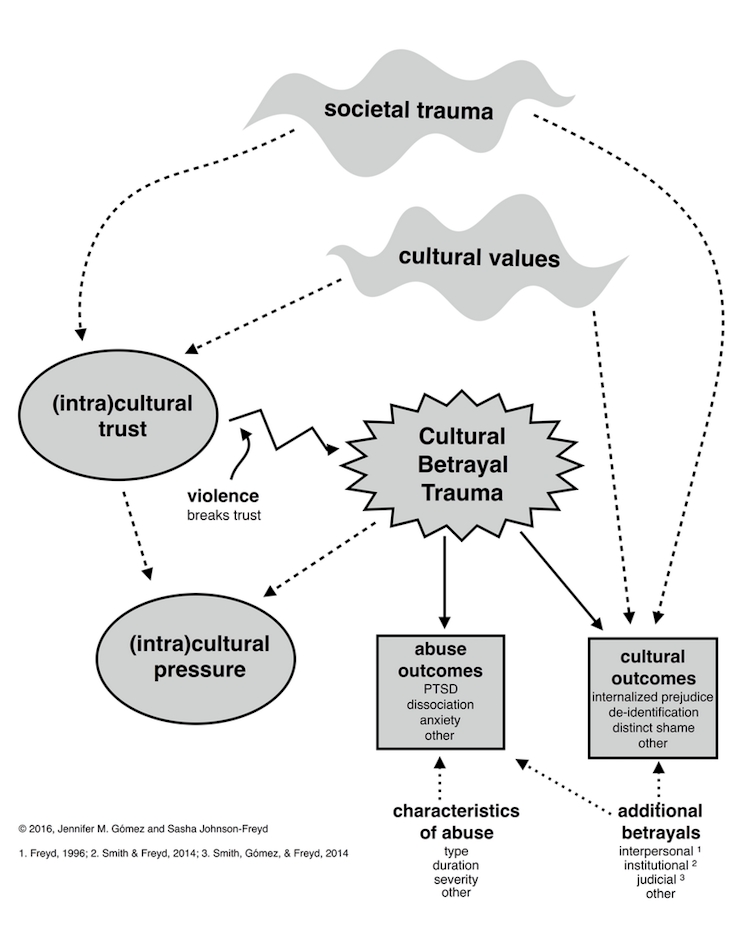
    To understand this harm, I created cultural betrayal trauma theory. The general idea of cultural betrayal trauma theory is that some minorities develop what I call “(intra)cultural trust” – love, loyalty, attachment, connection, responsibility and solidarity with each other to protect themselves from a hostile society. Within-group violence, such as a black perpetrator harming a black victim, is a violation of this (intra)cultural trust. This violation is called a cultural betrayal.

    The Harms of Cultural Betrayal

    Cultural betrayal leads to many different outcomes. CC BY-SA

    Cultural betrayal trauma, which is simply within-group violence in minority populations, is associated with many outcomes that go beyond things that are typically studied with trauma, such as post-traumatic stress disorder. It includes some things not often thought about with trauma, such as internalized prejudice – like a black person believing the stereotype that all black people are violent.

    (Intra)cultural pressure is another outcome of cultural betrayal trauma. With (intra)cultural pressure, people who experience cultural betrayal trauma are often demanded to protect the perpetrators and the minority group as a whole at all costs, even above their own well-being. With the mandate of “don’t betray your race,” (intra)cultural pressure punishes people who speak out about the cultural betrayal trauma they have endured.

    In a recent study, I tested cultural betrayal trauma theory in youth due to the increased risk for trauma and mental health problems in the transition into adulthood.

    I surveyed 179 college women online in 2015. Over 50% of these young women were victims of trauma. Just under half experienced psychological violence, 14% endured physical violence, and almost one in three women were victims of sexual violence.

    Of the young women who were victimized, over 80% reported at least one form of (intra)cultural pressure. This included their ethnic group suggesting that what happened to them may affect their minority group’s reputation. An example of this could be a black woman who has been raped by a black man being told that she should not go to the police because it will make all black people look bad.

    Additionally, I found that controlling for age, ethnicity and interracial trauma, cultural betrayal trauma and (intra)cultural pressure were associated with symptoms of PTSD. Meaning, cultural betrayal in trauma and (intra)cultural pressure were unique contributing factors of mental health problems in ethnic minority college women.

    What Does This All Mean?

    As I analyzed the findings, I was struck by several things:

    • The within-group nature of trauma includes a cultural betrayal in minorities that affects mental health.

    • Trauma gives us only part of the picture.

    • Group-level responses and cultural norms via intra-cultural pressure impact mental health.

    • Policy change that combats inequality, such as changes in education, health care, law enforcement and the judicial system, can benefit minorities who experience trauma.

    These findings have implications for interventions. Such therapy can address the very real threats of discrimination and the necessity for (intra)cultural pressure. At the same time, these interventions can use (intra)cultural trust to promote positive mental health. Additionally, evidence-informed feminist approaches, such as relational cultural therapy, may benefit people who are exposed to both trauma and societal inequality.

    The body of research to date suggests that cultural betrayal may be a unique harm within violence in minority populations, including the black community. As such, the alleged sexual traumas perpetrated by R. Kelly and Clarence Thomas have a cultural betrayal that isn’t found in Woody Allen’s alleged abuse. Moreover, black men’s death threats against Tarana Burke are (intra)cultural pressure that is laced with misogynoir, or sexism in the black community.

    Research that incorporates societal inequality can help us understand what makes trauma traumatic. In doing so, our social reactions and therapeutic interventions can ultimately be effective for blacks and other minorities who are exposed to trauma.

    Jennifer M. Gómez, Postdoctoral Fellow in Trauma Psychology, Wayne State University

    This article is republished from The Conversation under a Creative Commons license. Read the original article.

  • From War Correspondent to Workplace Mental Health Advocate: An Interview with Dean Yates

    From War Correspondent to Workplace Mental Health Advocate: An Interview with Dean Yates

    People often think of PTSD as being something that affects the nervous system, the brain, the body. I think it also affects the soul.

    After years of covering war, terrorist attacks, and natural disasters in the Middle East and Southeast Asia for Reuters, journalist Dean Yates was diagnosed with PTSD and “Moral Injury.” He sought healing not only with professionals and clergy, but by writing and sharing his story with the world. What happened next created a new role for him at Reuters and an opportunity to turn something tragic into something inspiring. 

    After meeting at a conference in London, Dean Yates spoke with me from his home in Australia. 

    What did it mean to be a bureau chief for Reuters in Bagdad at the time you were there? 

    Yates: I was the bureau chief in Bagdad at the height of the Iraq war just before the surge of US troops into Iraq. This was George W. Bush’s last roll of the dice. It had plunged basically into civil war. That first six months of 2007 were the most violent period during the Iraq war. There were car bombs going off every day. That job entailed being responsible for coverage of that story but also being responsible for close to 100 men and women in the world’s most dangerous reporting zone. That made it an extremely stressful job. If I had half an idea of what it was going to be like, I’m not sure I would’ve gone there in retrospect because what ended up happening was way beyond anything I was prepared for. 


    On the roof of the Reuters office in Baghdad

    Over the years you reported on many tragic events including a nightclub massacre that killed 202 people in Bali in 2002 and a tsunami that killed 165,000 in Indonesias Aceh province in 2004 before you arrived in Bagdad. You’ve written in your stories about losing several colleagues in Iraq. Can you talk about what that was like? 

    What it comes down to really is, you know, I felt morally responsible for the safety of my staff. I think that’s something a lot of people experience. Even though people say you did everything you could, you shouldn’t blame yourself, that wasn’t how I felt. It surfaced later into this moral injury. I just couldn’t live with myself because of what I saw as my own culpability and my failure. It was a spiritual care worker at the psych ward who helped guide me through a healing ceremony where I was able to pay my respects to Namir (22) and Saeed (40), the two men who were killed in an attack by a U.S. Apache helicopter on July 12, 2007 in Baghdad. This spiritual care worker was able to be at my side. No clinician could have done that. I really found I was able to make peace with myself after that ceremony.

    What is Moral Injury? 

    Actually, you can trace it back to the writings of Homer, the ancient Greek poet, and his epic poems “The Iliad” and “The Odyssey.” What it really means is if someone feels there is something that they did or didn’t do or that they witnessed that so deeply contravenes their moral compass or ethical values, they end up with a moral injury. People often think of PTSD as being something that affects the nervous system, the brain, the body. I think it also affects the soul. Think of a soldier who believed he was doing something good for the community but the Taliban, it turned out, didn’t like what he was doing and so the end result is that children die. You can’t give someone medication for that or give them a bit of evidence-based therapy.

    That makes sense. I’ve heard a lot of people in recovery talk about how when they were using and drinking, they did things in service of their disease which were not in alignment with their own moral compass. 

    You talk in one of your stories about taking paracetamol and codeine tablets to get to sleep and about drinking heavily as well as staying in bed, do you feel you were self-medicating your undiagnosed condition at that time? 

    Oh yeah, totally. I honestly don’t think I’ve ever suffered from addiction. I went through bouts where I’d rely on alcohol or prescription medication but I was never in that years long cycle that some of my colleagues have been in. I had a little bit of an experience with it, but I got off the booze quite easily on my first psych ward admission.

    Journalists have been known as boozers for as long as the profession has existed. I remember one weekend I was on duty and I was in the office asleep on the couch so hungover and the boss walked into the office with his wife and I remember him saying to his wife “let’s be quiet, I think Dean’s had a big night, we don’t want to wake him.” If that happened now, I’d be fired. But back then it was all part of the journalist culture. We went out and got roaring drunk. It was how we dealt with a lot of the traumatic stories. When we were in Baghdad we used to spend huge amounts of money on alcohol. Because we had to. Otherwise we would have gone crazy.

    You’re lucky you were brave enough to seek out help and you did find the help you needed so you no longer had to self-medicate. We talk now in the addiction field about trauma being one of the main causes of addiction.

    Who can be affected by PTSD

    Oh anyone. All it takes is a severe enough traumatic event for someone to be at risk of developing PTSD. But the problem is that people associate PTSD with soldiers and increasingly with first responders. I’ve seen it across so many different sectors of the work force: nurses, doctors, and then in the civilian sphere—domestic violence, road accident victims. In Australia 70% of people will experience a traumatic event, according to Phoenix Australia (a center for post-traumatic mental health in Australia). In the U.S. the biggest group of people with PTSD are actually victims of rape. It doesn’t matter what brought you to the diagnosis. It doesn’t matter what your profession was. You all have flashbacks, nightmares, anxiety, depression. We have these things in common that I thought wouldn’t have been possible and it makes me angry that so many of these people suffering with PTSD are silenced. It’s the same with addiction. 

    Addiction is very much a disease of isolation. The whole idea of stigma contributes to the avoidance. It looks to me like avoidance has a role in the development of mental illness and PTSD in the first place. 

    Yes, I had isolated myself incredibly. The only people who knew I had PTSD were my family and a few close friends. It was the same when I was in the psych ward. When I walked in that door it was terrifying. You know once you go through that door you can’t take that back. How’s that going to look on your resume? Because people think you’re crazy.

    What do you think happened for you in the process of writing your story “The Road to Ward 17” even before you published it? 

    The writing process is cathartic, it’s therapeutic, you learn a lot about yourself; it’s part of the recovery process. There’s so much research out there about the power of writing and sharing your story with others. 

    When you wrote your story, how were your expectations different from what happened when you actually published it? 

    I had initially thought that this could maybe be used as a blog for other colleagues, but then I thought this should actually be published. One of the things I thought about in the psych ward was that these folks who were in there, they were going through really rough times, and no one could tell their story. But I thought if I tell my story it’s a little like telling their story. 

    The story ended up in the hands of our investigations editor in New York who is responsible for what’s called our special reports. We rarely publish first person account stories. But he really liked it. And when the story came out I wasn’t prepared for the response. I was more prepared to get negative responses. For people to be angry about me talking about the Apache attacks and Wikileaks. But I got messages from people all over the world and all walks of life who had experienced trauma just saying thanks for writing your story, thanks for putting this out there, thanks for telling it like it is. I’d only come out of the psych ward a couple months earlier. 

    The video of the attack that killed your two colleagues, and the way only parts of it were released, created a certain perspective that skewed much of the response to it, even your own if I read you right. What have you learned about perspective in all this? 

    Two weeks after Namir and Saeed had been killed, I was sitting in this office with these two generals and they started playing the tape and we had no idea that was coming. I saw the first— not even three minutes— of the tape and the tape was stopped at the moment the Apache fired on the men which included my staff. I walked out of that briefing with this one image in my head of our photographer peering around that corner. That image actually was burned into my brain for years and I just could not get that image out of my head to the point where I actually started seeing him as being responsible for what happened, whereas the order to fire had already been given before he even peered around the corner. And then when the (full) tape was released in 2010 I could not actually physically watch it. I knew what happened. I had read the transcripts by then but I hadn’t actually watched it. It was only when I wrote that story that I was able to watch that tape for the first time because I knew I had to get the timing of the events correct. So it did give me a different perspective. That tape to me shows the world what the Iraq war was really like.


    Tributes to Namir and Saeed

    Changing the Face of Mental Health at Work

    How are you transforming what was a tragic event into something inspiring in your new role at Reuters? 

    I wanted to try to create an environment where our staff felt comfortable putting their hands up and saying I’ve got mental illness or whatever and have management respond with compassion so that they could access the resources we have available. Because when you have an environment where people don’t feel comfortable talking about it, there’s not much you can do. 

    We’ve been doing a series of internal blogs at Reuters. I wrote about my PTSD issues, and what it did is it kicked off other journalists writing about their own issues. The next person was a journalist in the Middle East who wrote about his struggle with bi-polar, another woman wrote about her depression, another guy wrote about his burnout. Some of these journalists have been overwhelmed with responses which also makes them feel like they’ve got meaning out of what they’ve done. They’ve got purpose out of what they’ve done. 

    We’ve had about 30 now but not a single blog about addiction. So this colleague of mine in London is going to write about her addiction but she wants to remain anonymous. I think that just shows how much stigma there still is.

    Those blogs were very powerful in normalizing that conversation to the point where I think they’ve been as effective as anything we’ve done in getting that message out there that it’s okay to come forward, and that you’ll get the support you need. And it’s helpful for managers because if they’re reading about colleagues getting help, they’re thinking I want to be a good manager and make sure my people get the help they need,too. One of my areas of focus this year has been in training managers on how to look after the mental health of their team.

    This is an important endeavor considering that, according to the Mental Health at Work 2019 Report BiTC, 62% of managers faced situations where they put the interests of their organizations above the interest of their colleagues. 

    You’re not a psychologist or a psychiatrist but what you’re offering is peer support; you can explain to a manager how to talk to their staff who are struggling because you’ve been there. 

    Right, I know the profession and I’ve got the lived experience of mental illness. I try to operate in the early intervention space. I am not an expert but I can be an advocate. I’ve got the street cred. No one can look at me and say you don’t know what you’re talking about. Because I do.

    If the 12-step movement has taught us nothing else it’s taught us that peer support works. 

    It crosses my mind that there’s something in this for the corporate world. How does mental health and addiction effect a company’s level of productivity?

    I was able to function very highly for a long time but one of the symptoms of PTSD is avoidance. And so one of the great ways of avoiding your issues is through work and that was how I did it and I know a lot of people who have done the same thing. People want to contribute and they want to be part of something bigger than themselves. All the research shows that work is good for people’s mental health in general. But the point is: Don’t look after people’s mental health because it’s good for the business, look after people’s mental health because it’s the right thing to do. People with a mental health issue just want to be acknowledged. They want to be treated as if they had come into the office with their leg in a plaster (cast). You come into the office with your leg in plaster–it’s okay, we’ll sort this out; you’re supposed to be at that conference next week, we’ll send someone else; and okay, you’ve got to go to that doctor appointment, no problem. If you treat people like that, the numbers take care of themselves. 

    Fair enough, though it is interesting to note that at the Mad World Summit in London, where we met, Sir Vince Cable was quoted as saying, “Mental illness costs the UK economy more than Brexit.” Which is a lot of money. And, according to the CDC, by combining medical and behavioral health care services, the United States could save $37.6 billion to $67.8 billion a year.

    One last question. What would you say to someone out there who’s suffering in silence from depression or PTSD or trauma or substance use disorder or any kind of mental illness? 

    You are not alone.


    Dean Yates in Times Square, October 2019 (Helen Barrow/Evershine Productions)

    The Road to Ward 17: My Battle with PTSD
    Return to Ward 17: Making Peace with Lost Comrades

    View the original article at thefix.com

  • Upon Release from Prison, a New Kind of Nightmare

    Upon Release from Prison, a New Kind of Nightmare

    After staring at a wall for almost half of my life, being able to look out the windows of the halfway house at the world but not being able to go out and experience it was maddening.

    When you’re being escorted out of a federal court room in shackles and handcuffs, after being sentenced to almost two decades behind bars, you can almost feel the life ooze out of your pores. The pronounced slam of a gavel drives home the fact you’re not in Kansas anymore, while one hope creeps its way into your brain: the day those cuffs come off and you’re free. This image is your savior, your best and only friend to keep you company throughout the brutally unforgiving years of violence, isolation, and solitude. Visions of beautifully simple things like going to the park or eating strawberry pancakes shoot through your psyche in bright shining lights onto the faded white graffiti laced brick walls of your 9-by-6-foot cell of despair. 

    All this promise makes it all the more devastating when that magical day arrives for the nightmare to end, and you realize just how far you are from getting out of the rabbit hole.

    “Have you ever played a PlayStation? Hell, have you even used a cell phone?” These are the words the middle-aged Latino case manager told me through the battered food slot inside the cell door of the Special Housing Unit. 

    “Someone like you, I wouldn’t give more than 4 months. The world has passed you by…but good luck.”

    These words of encouragement came from someone who spent almost as much time in the Bureau of Prisons as I have. A man who has witnessed firsthand how hard it is to adjust to a world that will chew you up and spit you right back. He wasn’t talking about my transition back into the free world. He was talking about the federally funded center that was in charge of restoring my sanity. 

    Institutionalization, PTSD, and Post Incarceration Syndrome

    PTSD and its sister syndrome, PICS (Post Incarceration Syndrome), are disorders in which a person has difficulty recovering after experiencing or witnessing a terrifying event. The condition may last months or years, with triggers that can bring back memories of the trauma accompanied by intense emotional and physical reactions.

    During my 15 years of incarceration, I experienced and witnessed atrocities that would make most war veterans cringe. Divided racial lines and the total disregard for human life were the first things that greeted me behind the grimy walls down in the swamps of Louisiana, USP Pollock. The “slaughterhouse of the south” averaged 40 stabbings a month, while incurring 16 murders in an 18-month span. Desensitization set in rapidly when watching a stabbing was as common as watching a baseball game. This was just the first of four penitentiaries in which I was beaten, stabbed, isolated, and herded throughout half of my life.

    While President Bush was fighting his wars overseas, and smartphones, text messaging, and iPods were shaping humanity, I was envisioning a breathtakingly beautiful sun setting over the ocean. The sound of waves crashing danced through my ears, as I felt the cool wet sand beneath my feet. When President Obama was still fighting the war, and Google, Facebook, and YouTube took over society, I was sitting in solitary confinement, my stomach touching my ankles, as I dreamed of the family dinners at my parents’ house. The four cheeses of mom’s famous lasagna made my mouth water, as I imagined the smiling faces of better years sitting around the table listening to Dad’s old war stories. As President Trump was halfway through his reign of terror, the cuffs finally came off and I was released. But little did I know, the nightmare was far from being over.

    Institutionalization is a gradual normal reaction to the unnatural and abnormal conditions of prisoner life. The more extreme, harsh, dangerous, or otherwise psychologically taxing the nature of the confinement, the deeper the damage that will be done. During this process, a prisoner incorporates the norms of prison into their habits of thinking, feeling, and acting. It renders some people so dependent on external constraints that they gradually lose the capacity to rely on internal organization and self-imposed personal limits to guide their actions and restrain their conduct.

    When I was released from the SHU in Big Sandy Kentucky on July 29, 2017, the world seemed to be in hyperdrive. My parents and sister, along with the girlfriend I’ve never held, laughed as I bounced around the car like a dog in heat. The speed of everything left me spinning as I tried to comprehend the tiny screen in my hands that was speaking directions towards the home I’ve never seen. Inside that car I felt alive for the first time in over a decade and a half. Then we stopped a block short from my residence, and all the rules that I’d just broken by being with my family drove away with five minutes to spare, as a whole new nightmare began.

    Bait and Switch

    According to the Federal Bureau of Prisons: “Residential reentry centers provide a safe, structured, supervised environment, as well as employment counseling, job placement, financial management assistance and other programs and services. RRC’s help inmates gradually rebuild their ties to the community and facilitate supervising ex-offenders activities during this readjustment phase.” 

    When I walked into the reentry center in downtown Pittsburgh, I wasn’t greeted with a homecoming of old friends and relatives like in the movies. Instead, I sat in a drearily filthy break room as paramedics wheeled off a semi-conscious reentrant to a waiting ambulance. These overdoses, ranging from heroin to K-2, would become a normal part of my daily routine. Once I made my way to the seventh of eight floors, each floor packed to capacity with clueless ex-cons all trying to breathe free fresh air, the prison mentality quickly set back in.

    My case manager greeted me in her tiny cluttered office and gave me a list of all the rules and regulations that make readjustment damn near impossible. No smartphones, riding in cars, or being ANYWHERE without approval a week ahead of time. If I wanted to stop at 7-Eleven for a cup of coffee in the morning on my way to work, I would be in violation of my release. I also received the bonus of not being allowed to publish any of my writing or leave the city limits. She concluded her orientation with the added kick to the nuts of twenty five percent of my pay getting kicked back to the house for the opportunity to feel the sunshine on my face for the first time in a decade and a half.

    I also was given the one-time warning about being late. If I was more than 5 minutes late back from a pass, whether it be a late bus or a broken leg, it was back to the box to finish out the remainder of my sentence. Just riding on public transportation is enough to give me a panic attack after years of isolation. The need to sit with my back against the wall is uncontrollable while my hypervigilance runs wild surveying everyone and everything. When you add a traffic jam to that equation, it’s almost debilitating. Going from a world with nothing but time, to one that will literally put you in a cage if it’s mismanaged, was and still is one of the hardest things to deal with after my release.

    During the 15 years of my incarceration, I lived with a lot of different people. A redneck from Wyoming to a skinhead from Seattle, I’ve been forced to share a bathroom with the best of them. No matter where they were from, there was one thing in common: I didn’t like any of them. Even Mother Teresa is going to get on your nerves if you’re stuck in a broom closest with her 24 hours a day for months on end. 

    Standing on the Edge of Freedom

    In the late 70’s, psychologist Bruce K. Alexander conducted his Rat Park study. In this study he took lab rats and housed them in two different environments. In the first, “skinner boxes” (solitary confinement), they were completely deprived of everything, even movement was difficult. The second environment housed the rats in a space 200 times bigger, with wheels, and boxes and other rats to interact with. Inside both settings were two different water bottles. One filled with narcotics to numb the pain that will run through any being under such harsh conditions, and the other without. Each time when the rats are housed in skinner boxes, they go right for the drugs. But, when they’re in rat park with all their friends, free to make decisions and live a good life, they always chose the clean water.

    After staring at a wall for almost half of my life, being able to look out the windows of the halfway house at the world below but not being able to go out and experience what I’ve been dreaming about for so long was maddening. Having that freedom dangling in my face, after coming so far, was heartbreaking. After years of dreaming about what you want to do, where you want to go, who you want to see, and then discovering you won’t be doing any of those things for a long time, it absolutely puts you right back into that ‘I don’t give a fuck’ mentality.

    Institutionalization can be taken to extreme lengths or become chronic and deeply internalized so that even though the conditions of one’s life have changed, many of the once functional but now counterproductive patterns remain.

    I spent 14 months inside the halfway house after my release. It almost seemed to last as long as the 15 years that I did behind the walls of our fine penal system. During that time, I wasn’t allowed to go to the park, or take my girlfriend out on a date. I couldn’t sit down for those family meals or see that sunset on the beach, but I made it through it. 

    I absolutely know that I suffer from PTSD and PICS as a result of my incarceration, and I’m far from the only one who suffers from these syndromes. Anyone would feel the same way as I do if they grew up deep inside the belly of the beast. Who knows if the hypervigilance, paranoia, and anxiety will ever allow me to be at ease when I’m out in society. It took me getting out of the system completely before I could even begin to heal.

    View the original article at thefix.com

  • Finding Meaning in Tragedy: Addiction, Trauma, and Activism

    Finding Meaning in Tragedy: Addiction, Trauma, and Activism

    Turning grief into activism is a powerful way to process and give meaning to the pain of traumas like the death of a loved one who struggled with addiction. It is on the heels of tragedy that we can make voices of change be heard.

    Grief is complicated, individually experienced, and universal. And humans are not the only creatures on this planet who mourn their dead. Scientists continue to debate how complex the grief of non-human animals is, but the evidence points to many species grieving the loss of their kin and mates.

    For millennia, scholars have been searching for a way to explain the depths of human grief. Plato and Socrates mused on what death and dying meant and philosophized about the grieving man. Sigmund Freud, often considered the father of modern psychology, began psychological research into mourning in his 1917 essay “Mourning and Melancholia.” In 1969, Elisabeth Kübler-Ross published her influential book, On Death and Dying. The popular five stages of grief were born from her work.

    Social Media Affects How We Grieve

    Loss can be traumatic. Whether expected or sudden, close or removed but symbolic, grief can take hold when we lose someone or something significant. We mourn and ritualize loss as a means to process it. There are culturally distinct rituals for mourning families; processing the emotions that come with grief can be guided by these rituals. These customs help us find meaning in our grief, even when we don’t consciously recognize it.

    As social media continues to become a more ingrained aspect of modern life, people are developing new rituals to mark tragic loss. The social norms of these rituals (such as posting photos, posting on the wall of the recently deceased, or sharing a status that talks about special memories) is always in flux. But one norm that is constant in the age of social media is our immediate collective knowledge of loss. There is an urgency to information and the negotiation of emotions in a shared space. This immediacy is changing the old social norms of letting some time pass before talking about causes of death.

    There is another related but distinct way people sometimes process grief, and that’s by turning tragedy into a call for activism. Smithsonian Magazine published a powerful piece titled “The March for Our Lives Activists Showed Us How to Find Meaning in Tragedy.” The author, Maggie Jones, describes the instant response students had because they knew “time was not on their side.” With on-demand information, the collective conscience quickly moves from one tragedy to the next as new headlines take over. These Parkland students were not being inconsiderate in their quick call to activism, they were creating meaning from tragedy and were bolstered by the collective grief that took shape immediately, in large part because of social media.

    The Trauma of Drug-Related Deaths

    Across the United States, drug overdose deaths have been on the rise, particularly those involving synthetic narcotics (primarily fentanyl). Overdoses caused by the most commonly used drugs are tracked by the Centers for Disease Control and Prevention (CDC). And deaths due to overdose are underreported and misclassified. The stigma that surrounds addiction and the prejudice against people with Substance Use Disorder (SUD) relegates many overdose deaths to the world of whispers and rumors.

    My life has been marked by traumatic losses due to the effects of SUD. People close to me have overdosed, some survived and some died. I’ve also lost people to complications due to a lifetime struggle with Alcohol Use Disorder. Only recently have I seen these losses become conversation starters, where people will openly talk about the battles once fought by the brave folks who lost their lives to disease. Maybe that means we’re turning a corner in addiction stigma. Maybe we’re opening the door for people to feel less shame in talking about their struggles while they still have a chance to change the course of their lives. We can pay homage to our lost loved ones by sharing their stories and removing the stigma that may have kept them from receiving the help they needed.

    Recently a person in recovery told me that their co-workers do not know about their history and they will never tell them because multiple times they have made comments like “drug addicts are scum and should be shot” and “addicts are worse than rabid dogs.” The negative perceptions of people with SUD grated on this person and fed their alcoholism in a detrimental way. They believe they are simply a bad person who does not deserve help because addiction cannot be cured. This is a falsehood perpetuated by ignorant and fearful people.

    When we lose people and we share the entirety of our memories about them, from childhood to work life, and we share the truth of their battles with addiction, we are combating these dangerous preconceptions and prejudice.

    Overdoses aren’t the only way addiction kills. According to drugabuse.gov, “drug-related deaths have more than doubled since 2000 [and] there are more deaths, illness, and disabilities from substance use than from any other preventable health condition.” SUD is a diagnosable and treatable condition that deserves as much recognition as any other health issue for which there are awareness campaigns and funds devoted to find treatments to save and improve lives. Substance use disorders have the highest mortality rate of any mental and behavioral disorder.

    Tragedy as a Call for Activism

    In a world where so many people process aspects of their grief online and where tragic events unfold live for millions of people around the world at the same time, finding meaning in tragedy is necessary for our mental health. When we experience trauma, we are at risk of developing post-traumatic stress. Trauma can manifest as a strong psychological or emotional response to a distressing or disturbing event or experience. We can be traumatized when we lose someone; we can even be traumatized when we hear that someone we care for went through a terrifying ordeal. If our ability to cope is overwhelmed, that is trauma. When someone develops post-traumatic stress disorder (PTSD), their sense of self in relation to the world around them has become damaged. Trauma has the potential to shatter our beliefs about our place in the world and our sense of safety.

    Finding meaning in tragedy can go a long way in preventing the development of post-traumatic stress and can be a marker in recovery from PTSD.

    In our changing experience of bereavement, tragedy is a call for activism. It is on the heels of tragedy that we can make voices of change be heard. Tragedy creates space in which people listen. Frequently, we want to connect with others when we experience loss; sharing grief reduces its intensity. Turning grief into activism is a powerful way to process and give meaning to the pain of traumas like the death of someone who struggled with addiction.

    View the original article at thefix.com

  • Can 12-Step Programs Treat Dual Diagnoses?

    Can 12-Step Programs Treat Dual Diagnoses?

    Effective treatment needs to include both the substance use disorder and the co-occurring disorder in an integrated approach because the two conditions build on each other.

    Thirty-three percent of people with mental illness also have a substance use disorder (SUD); that number rises to 50 percent for severe mental illness. Fifty-one percent of people with SUD have a co-occurring mental health disorder. Effective treatment needs to include both the SUD and the co-occurring disorder in an integrated approach because the two conditions build on each other. People with mental illness may turn to substances to alleviate symptoms and severe substance misuse can cause lasting psychological and physiological damage.

    12-step programs are free, prolific, and available throughout the world. These mutual-help organizations are designed to facilitate recovery from addiction, but are they suitable for treating the large segment of people with addiction who also have other mental health conditions or psychiatric diagnoses?

    A 2018 meta-analysis  undertook a literature review on 14 years of studies related to dual diagnosis and Alcoholics Anonymous (AA). This extensive quantitative look into the effiicacy of AA for people with dual diagnosis found that participation in AA and abstinence “were associated significantly and positively.” The research supports the clinically-backed notion that an integrated mental health approach that encourages participation in mutual help programs is the best approach for treating patients with comorbid SUD and mental illness.

    Does it Depend on the Dual Diagnosis?

    There is enormous variation in mental illnesses, so does the potential effectiveness of 12-step programs change based on the type of disorder or diagnosis? The co-founder of AA, William Wilson (known as Bill W.), was afflicted with a co-occurring disorder. Wilson struggled with “very severe depression symptoms” and today his mental health issue may have been diagnosed as major depressive disorder.

    A study published in the Journal of Substance Abuse Treatment followed 300 alcohol-dependent people with and without social anxiety disorder who went through hospital-assisted detox followed by participation in AA. Social anxiety disorder is characterized by an intense fear of being rejected or disliked by other people. This study found that there was no significant difference in relapse or abstinence rates between the two groups and concluded that social anxiety disorder was “not a significant risk factor for alcohol use relapse or for nonadherence to AA or psychotherapy.”

    Do Sponsors Matter?

    People with dual diagnoses tend to participate in 12-step programs like AA as much as people with just SUD and receive the same benefits in recovery. Those people with co-occurring conditions may actually benefit more from “high levels of active involvement, particularly having a 12-step sponsor.”

    In many 12-step mutual help organizations, people enter into an informal agreement with another recovering person who will support their recovery efforts and hold them accountable for continued sobriety. This one-on-one relationship of sponsor and sponsee has been compared to the “therapeutic alliance” that is formed between patients and their clinicians. The therapeutic alliance is positively correlated with treatment outcomes and abstinence.

    The therapeutic alliance is one of the most important aspects of effective psychotherapy, as it helps the therapist and the patient to work together. The relationship is based on a strong level of trust. Patients need to feel fully supported, and know that that their therapist is always working towards the best possible outcome for the patient. In the sponsor-sponsee relationship, a similar level of trust and belief is essential if sponsorship is going to be beneficial. 

    As with therapy, it may take many tries with many different people to find the right fit. Not all people are suitable to be sponsors and not all sponsorships go well. A sponsor is generally expected to be very accessible to their sponsee, and available at any time, day or night. They are supposed to help with completing the 12-steps, and they often provide advice and suggestions from their own experiences. It’s a lot of responsibility.

    A strong therapeutic alliance has been found to be an excellent predictor for treatment outcomes. Does that mean a failed therapeutic alliance could derail treatment? In short, the answer is yes. Trust is critical to healing from any mental illness.

    Trauma and the Therapeutic Alliance

    Traumatic events have a serious impact on mental health. People with mental illness are at a higher risk of being further traumatized and people who are traumatized are at a higher risk of developing mental illness than the general population. Childhood trauma “doubles risk of mental health conditions.”

    Recovery from trauma is based on empowering the survivor and developing new connections to life, including re-establishing trust. Judith Herman, a leading psychiatrist specializing in trauma is adamant that recovery is not a solitary process. This may be why 12-step programs have been successful in helping some people recovery from trauma. 

    Being a sponsor to someone who has been traumatized requires a fine balance between listening and giving space. Herman explains that survivors need to know they’re being heard when telling their story. At the same time, “trauma impels people both to withdraw from close relationships and to seek them desperately.” Meaning that when the sponsor does not go away, their motives may seem suspect in the eyes of the survivor. Yet, if the sponsor doesn’t stay, it can reinforce negative self-appraisal and stoke a fear of abandonment.

    Individuals with psychological trauma can struggle to modulate intense emotions, such as anger. A sponsor or therapist has to have healthy boundaries with a sponsee/patient if the relationship is going to work. Providing good sponsorship is a huge undertaking that requires a firm commitment.

    The good thing about the 12 steps is that they are considered a long-term program which encourages revisiting the steps many times to sustain successful recovery. This is useful in terms of trauma recovery because most trauma is never fully resolved. A traumatized person will likely experience reappearance of symptoms; traumatic memories can surface in different stages of life. Stress is a major cause of these recurrences and having a place to process these events as they come up is important.

    Do 12-Step Programs Have a Role in Treating Dual Diagnoses?

    Integrated holistic treatment that addresses how the two conditions interact and affect each other will provide the best outcomes. Ultimately, what we want is to improve quality of life and to return to ordinary life with an open door to future support when necessary. The research shows that when the principles of 12-step programs are integrated with other treatments, we see improvements in self-esteem, positive affect, reduced anxiety, and improved health.

    Further research is necessary to compare 12-step programs with other emerging mutual and self-help organizations, as they have been around for less time and there are fewer published studies on their efficacy. 

    View the original article at thefix.com

  • Post-Incarceration Syndrome: Adjusting to Reality After Spending 15 Years in Prison

    Post-Incarceration Syndrome: Adjusting to Reality After Spending 15 Years in Prison

    Life inside the penitentiary is extremely hard. The violence and deprivation warp your whole view; you see a total disregard for basic human life firsthand. But the after-effects can be even worse.

    The day you get out of prison, especially after serving almost two decades behind the walls of the most dangerous penitentiaries in the United States, you honestly believe that you’re free; the healing road from all the horrors endured throughout your stay in the belly of the beast is about to begin. But, as you step foot back into society — especially your government reintegration center — you quickly realize that a whole new level of institutional hell awaits.

    I was released July 31st, 2017 after serving 15 years behind the walls of four extremely violent federal penitentiaries. This sentence was incurred for a bank robbery I committed at a young age to feed my addiction to heroin

    Assaults, Riots, and “The Hole”

    The atrocities experienced and observed while inside are enough to break any man. My body is healed from the eight stab wounds I survived during a riot, and from the multiple assaults received not only from other inmates, but from the officers who were hired to oversee my “rehabilitation.” Physically my legs still work after “laying it down” for three years in administrative segregation (“the hole”). 

    But I’m still in pain as my brain tries to process the trauma of it all. 

    “You come to prison by yourself, and you leave prison by yourself,” says Ryan, a convict who just completed almost a decade of his life behind bars. These words of wisdom have been passed down for years from the old heads who have lived it to the young bucks who are just coming into an unforgiving system. But the fact that 95 percent of prisoners with multiple years in segregation come out suffering from some type of psychological disorder undermines the saying. PTSD, severe anxiety, and paranoia of law enforcement are just a few of the friends riding shotgun with you back into society.

    There isn’t really a class to prepare you for your release from incarceration. The Bureau of Prisons technically has “pre-release” programs, but these programs mostly consist of returning your linen, giving your DNA, and getting a physical to prove you’re healthy enough to walk out from under the gun towers that have been your babysitters for most of your life. Until the day you walk out of prison, psychologically and physically, it doesn’t seem like it’s really going to happen.

    When you walk out those gates, there’s so many things you want to do, places you’ve been dreaming about over the years of isolation; seeing your old house (or new house, for that matter, because you’re unlikely to return to the only place you knew before prison). You want to see your family, finally free after the years of phone calls and visits behind glass. You dream of walking through a park with your shoes off and getting to just…breathe. 

    Disbelief at Being Out of Prison

    After my release from Big Sandy Kentucky, I wanted to eat breakfast with my family. I wanted to see the fountain that welcomes you to downtown Pittsburgh, and I wanted to see my girlfriend for the first time in years, actually hold her in my arms and kiss her (something that will immediately send you to segregation while incarcerated).

    “My mother and cousin showed up at the prison when I was released. Luckily, the CO’s that released me let me ride with [my family] to the bus stop an hour away,” says Tim Tyler. Tim was granted clemency from president Obama after 26 years of incarceration.

    The bus ride from his prison in Jessup, Georgia to Las Vegas took over three days with multiple stops across the country. “When I got off at my first stop in Savannah, Georgia, Wes Bruer of CNN and NBC took me to the beach. I sat there and stared at the curve of the earth with the sand on my feet. I went swimming, and cried my eyes out. I was just in disbelief I made it out.”

    Tim was able to start healing in those few hours at the bus stop in Savannah. He got a chance to see there’s still beauty in this world. When you’re used to nothing but walls, gun towers, and extreme violence, something as simple as this is life changing. 

    The only problem was that Tim technically had broken the law as soon as he was released. The law states that an assigned inmate must drive you to the bus station. No one else is allowed to ride with you or take you anywhere once you’ve arrived.

    “The inmate was fighting with the COs that let me ride with my mother to the bus stop. He didn’t want to let them do it. I didn’t know what to do, I was just lucky I was well known in the prison and they all knew what was happening with me.” Most of us aren’t that lucky.

    Finally Free…Sort of

    The name of the halfway house that you’re heading to has been decided long before you leave prison. You’re aware of its location, the things you can and can’t have, and the amount of actual time that you’ll be spending in what is still considered Federal Bureau of Prisons (BOP) custody. Everything else is left for you to discover on your own. 

    A packet is issued the day you leave, or sometimes a few days ahead of your release. This file contains all the information about the life you’re about to embark upon in your new world.

    You receive a bus ticket, along with an itinerary which states the amount of stops and what time you’re expected to report to the halfway house that’s been assigned. If you’re lucky enough to have clothes sent and actually given to you, the unforgettable prison stench almost separates from your body. If you’re like me, released from administrative segregation, a fresh pair of state-issue skinny jeans, white t-shirt, and pair of leftover shoes are provided, and 50 dollars. This is the cash payment for the debt paid with your entire youth, and this will be the very first trip taken without the luxury of shackles and handcuffs for the better part of your life.

    Soul Murder

    Soul murder is a term that Dr. James Gilligan, professor of psychology and law at NYU, uses to describe long-term incarceration. This “destroying of someone’s personality, the sense of their own aliveness,” is a condition most of the 2.3 million people in prison will bring with them after their release as they attempt to reintegrate back into some semblance of a normal life. 

    But what all the previously incarcerated will find out is exactly how hard it will be to get those few hours towards your healing journey.

    “The day I got out of the penitentiary was like a dream,” Ryan said. “My family picked me up outside the prison in Virginia and I had three days to get back to Chicago for my probation. That was the best three days of my life after ten years in that hell hole.” Ryan had fulfilled his entire sentence and wasn’t going to a halfway house. He was no longer in the custody of the BOP.

    Unlike Ryan, the day I was released was more like a nightmare. The moment I was dropped off at the bus station in the middle of nowhere, I was greeted with the best and worst sight I could possibly see: my family.

    I was in sheer horror as they introduced themselves to the inmate driver who is 100 percent going to tell as soon as he gets back that your family was there at the station to meet you. Whether you get on the bus or not, you’re guilty. Just ask the formerly incarcerated rapper T.I. who was sent back to his prison after getting his own bus to meet him. 

    I gave my family hugs and bummed a cigarette from my father. Leaning back against the hood of my mother’s car, I lit up the most bittersweet cigarette of my life. I’d quit smoking for years on the inside but I needed something to simmer down the level of stress I felt at that exact moment. It was the first time I realized the obstacles that came with readjusting to civilization. 

    We went to the local IHOP where I sat down at a table for the first time in 15 years. Just looking at the menu and knowing I could order anything was completely mind bending. The feeling of having a real plate, real cup, real silverware after 15 years of sporks and plastic trays was insane. All the people around me, the fast movements — it became overwhelming. I kept scanning the room for trouble, all the while processing the fact that I was not going back to segregation after this, I wasn’t even going back to the penitentiary. This was my first “normal” life experience.

    While absorbing the whole life change around me, I’m also seeing a smartphone for the first time. I saw Facebook, YouTube, and texting for the first time, and truly saw how far life had gone ahead while I was buried deep inside the prison system.

    Instead of waiting for the bus in banjo country, which would then whisk me away to the ghetto of every major city between podunk Kentucky and the city that held so many beautifully heartbreaking memories, Pittsburgh PA, I rode with my family. Luckily, the inmate who drove me didn’t end up telling on me.

    Post-Incarcaration Syndrome

    Life inside the penitentiary is extremely hard. The violence and deprivation warp your whole view about having any hope in humanity. You see the total disregard for basic human life firsthand. The years spent literally staring at walls teach you to detach yourself from all the horrors, and you shut out “life on the street” as a survival mechanism. You dream of walking with your shoes off on the beach and listening to the ocean. You envision a meal that doesn’t include someone getting beaten to a pulp while shoveling down whatever garbage given that day. But no matter how difficult and degrading the 15 years was that I spent just trying to survive multiple warzones, the after-effects are the most lasting.

    Post-Incarceration Syndrome (PICS) is a mental condition that affects people who have recently been released from prison, and the longer someone is incarcerated, the worse it becomes. Institutionalized personality traits, social sensory deprivation syndrome, and reactive substance use disorders are just a few of the main symptoms of what a returning convict will suffer. Just riding a bus or subway can cause panic. Flashbacks of being herded across the country in chains then released into a new warzone with absolutely nothing race through your mind. The simple act of walking into a grocery store or shopping mall can be so overwhelming you immediately need to leave.

    I struggle greatly with the demons and horrors I experienced while incarcerated. I drink before going out in public to numb the hypervigilance that never leaves me. The fear of going back is crippling. Simple things like having a smart phone, contact with a convicted felon (which is basically everyone you know at this point in your life) on Facebook, or not making it on time for work can end your healing journey before it even begins.

    About 650,000 men and woman are released from incarceration each year with some form of PTSD. The U.S. represents 4.4 percent of the world’s population yet houses around 22 percent of the world’s prisoners, according to U.S. Bureau of Justice statistics. Nationwide, 45 percent of admissions to state prisons are the result of probation or parole violations at a cost of $9.3 billion each year. Close to a third of that, $2.8 billion, is spent reincarcerating people for technical violations.

    Those technical violations include offenses like going to the ocean for the first time in 26 years, or enjoying a family breakfast after almost two decades behind bars.

    View the original article at thefix.com

  • I Don’t Always Feel Better After a 12-Step Meeting

    I Don’t Always Feel Better After a 12-Step Meeting

    Why would someone continue to go to something that they don’t always like and don’t feel immediate relief from? I’m playing the long game.

    I can’t seem to figure it out, the sinking feeling in my gut, the feeling that I am too visible, too likely to be ogled and leered at by some man old enough to be my father. What the actual hell is this feeling in my gut? I call it a homesick feeling. Maybe it is something else entirely, but it makes me want to cloak myself in a protective layer, strip myself of sexuality and erase the sexualized parts of myself. I feel a deep shame and am overcome with a sorrowful lonesomeness as if a hole has cracked into existence and swallowed me whole. I feel stripped naked: Too visible. Too human. Too vulnerable.

    It happens almost every time, at almost every 12-step meeting. I want to disappear. There is a black hole in my gut, a homesick longing that begs me to give in, and I would, if I knew what it wanted. I fear it wants to swallow me whole.

    An Emptiness Inside Me

    I don’t always feel better after attending a recovery group meeting; sometimes at the end I feel worse than I did before I got there. I don’t share the experience of always feeling supported and comfortable that seems to echo through the rooms. At nearly every 12-step meeting, someone invariably says, “When I walk into the rooms, I feel immediately at ease and at home.” 

    Well, I don’t.

    There are times when the entire affair goes swimmingly. I’ll laugh and relate and feel at ease. I will connect to other people’s shares and fully articulate my own. It will all be very nice and fun. It will feel really good, on all fronts. Then, as soon as I leave, a pit in my stomach opens and I can feel myself falling in. Other times the aching lonesomeness begins as soon as I step inside the room.

    Dangerous Adaptability

    I survived my life because I could change according to outside circumstances. It has always felt dangerous to do anything other than adapt. For much of my life, it was dangerous.

    From my adaptations have sprung multiple versions of me. Other people are privy to the Light-Hearted Jokester and the Loud and In Charge Diplomat. Being honest when sharing about my experience with addiction and recovery means another part of myself might become visible. I have spent a lot of time with Depressed Me and revealing her is scary. The Quiet One fears she makes people uncomfortable with her silence. She’s acutely aware that she is not the Jokester and doesn’t want to be noticed and doesn’t want to slip into Depression in public.

    My defenses are up in spaces where I’m allowing unvetted people to know something real about my life. I begin to feel unworthy and not good enough: proof that my worst enemy is my own mind. My instinct tells me: Don’t reach out for a while. Don’t be early for the meeting tonight, go late to avoid chitchat and leave early. My brain fills with excuses to avoid discussions and socializing.

    Getting to know me means you may grow to understand who I am in all my contradictions, which will make it harder for me to adapt. I know that facilitating communication between all of myself is necessary for healing. But the truth is, sometimes it’s really difficult. It’s difficult to be seen, to be open. Yet each time I attend a meeting, that is exactly what I’m doing. I’m expressing myself with complete honesty. I am trusting the process, despite my fear and discomfort.

    I can no longer neglect the parts I’ve long tried to keep hidden. Together we must heal. Together is the only way we can heal.

    Playing the Long Game in Recovery

    Why would someone continue to go to something that they don’t always like and don’t feel immediate relief from? I’m playing the long game. Seeking immediate relief is what I did in active alcoholism. In recovery, I’m learning to resist that behavior. 

    Over time I have seen the subtle and dramatic improvements in my mental wellbeing and quality of life. I can see the changes in my life outside of those meetings. The people around me notice my rediscovered joy, my grounded perspective, my newly formed boundaries. I go to the meetings because it’s part of a treatment plan that works for me. It’s a commitment I made to myself. A commitment to heal from trauma, because I deserve to experience a better life than I once lived. 

    I feel inspired by the possibility that if I keep trying, the healing work will be able to fill the hole that is always there; the emptiness which has eternally been ebbing and flowing in strength, making me happy and fearful in turn. I’m aiming for a stable emotional baseline. 

    It’s not going to happen overnight, but it is happening over time. The inspiration itself comforts the sorrow.

    Progress Not Perfection

    When I first got sober, I was in a very dark place. I was trapped in my own head and despite having survived everything, I couldn’t feel safe. I could only feel the pain from the past. I thought I was alone. I believed I was too broken, too sick, too lost. Finding anyone else who could truly understand what I was going through seemed out of the question. I didn’t think I was unique or special in my pain, I just believed I was hopeless. 

    Then I found a therapist, a psychiatrist, and 12-step meetings. All of which worked in tandem to lead me from the darkness.

    Today I’m not feeling that despair or sorrow. I feel content more often than I feel abject depression. I used to cry every single day and now I laugh every day. I used to swing from one overwhelming emotion to another, with no control over where my mind was taking me.

    Climbing out is an ongoing effort, but what kept me down—one of many things—was that I expected myself to be just be “better.” I thought I had to be different than I was. I now accept that this is hard work, but the results keep me doing it. It isn’t supposed to always be easy. I have to continually work on dismantling the defensive walls that have become maladaptive in their formations. 

    So, I let myself be, I take breaks to enjoy the view that is coming into perspective as the stones of my fortifications are disassembled. Sometimes I get scared, and put back a stone that was particularly heavy, afraid to lose such a significant tool of protection. That’s okay, too. I try not to judge myself. It’s a journey of progress, not perfection.

    View the original article at thefix.com