Tag: racism

  • New Data Show Disturbing Racial Disparities in Combined Opioid-Cocaine Overdose Rates

    The problem is not just increased use of stimulants and opioids, it is also a lack of recovery resources, substance use disorder treatment, and a historical mistrust of healthcare providers.

    An exclusive interview with researcher Tarlise Townsend, Ph.D., reveals a definitive need for harm reduction policies plus investment in treatment in marginalized communities. In these communities, particularly lower-income African American and Latino neighborhoods, the opioid epidemic has combined with stimulant abuse to create a sharp spike in overdoses. These findings, from a study funded by the National Institutes of Health that examined death certificate data in the dozen years before the start of the COVID-19 pandemic, were published last month in the American Journal of Epidemiology.

    Driven by the three-headed dragon of fentanyl, prescription painkillers, and heroin, drug overdoses kill over a hundred thousand people every year in the United States. However, from 2007 to 2019, drug overdose deaths involving more than one substance increased dramatically across the board nationwide. Additionally, these multi-drug overdoses had a more noticeable spike in traditionally marginalized communities that lack substance disorder education, prevention efforts, and treatment opportunities.

    The Fix is honored to interview Dr. Tarlise Townsend about the implications of her study.

    The Fix: Why is the combination of stimulant abuse like cocaine or methamphetamines and opioid use disorder like heroin or prescription painkiller misuse hitting marginalized racial and ethnic communities so hard? As opposed to one or the other, what do you think is the reason for the two-headed dragon?

    Dr. Tarlise Townsend: The overarching response to that question, unfortunately, is that we don’t have an answer. Although we have diagnosed and identified the problem, we still desperately need to understand what’s driving it: Why are marginalized communities, particularly Black Americans, being hit proportionately hard by these combined overdose deaths? At the same time, the reality is that structural racism shapes everything, including access to resources. There is a lack of harm reduction options in this community, a historical lack of trust in healthcare providers, and a profound lack of access to treatment for substance use disorder.

    Also, criminalization is a really big factor when it comes to the increased risk of overdose. It is so much less likely that authorities will be contacted in time to administer overdose antagonists like Naloxone. After all, Black Americans, particularly men, are so much more likely to be criminalized for just being in possession of these drugs.

    As a result, there are many factors contributing to these racial disparities. Also, these disparities may not be specific to just these two types of drugs; stimulants and opioids. It may be a more systemic problem that right now is just manifesting as increased overdose due to the combination of stimulants and opioids. When you put this issue into the context of fundamental cause theory, you realize that the fundamental causes of health issues like socioeconomic status or racism affect health outcomes in almost every context in these communities. These overarching causes fundamentally affect people in so many ways because they basically bleed into everything.

    Even if you try to address other causes of these health disparities, socioeconomic status and racism will find another way to generate other challenges. Indeed, socioeconomic status and racism have been and continue to be fundamental causes of adverse health outcomes in these marginalized communities. The problem is not just the increased use of stimulants and opioids leading to more overdoses. It also is a lack of recovery resources, educational opportunities, and substance use disorder treatment in these communities.

    What drug is playing the driving role in this overdose crisis? Is heroin or cocaine proving to be more destructive in these communities?

    Our study did not look specifically at the type of opioids contributing to these overdose deaths. However, other recent research looking at the problem of opioid-stimulant deaths has found that fentanyl is playing the driving role. The story of this rise in overdoses is due primarily to a surge in fentanyl exposure. There is a contamination of these street drugs that the person who is using does not realize. Despite the increase in combined opioid-stimulant use, the inclusion of fentanyl in that picture is the driving force. 

    In developing countries, particularly in Southeast Asia, methamphetamine use has been connected with working long hours. Is that happening in the U.S. as well?

    I don’t feel like I can answer that question with any expertise or confidence, but it does bring up another perspective. There is evidence of people who use opioids in homeless populations on the street intentionally using stimulants to stay alert. First, these people are more readily targeted and criminalized for using. Second, they cannot afford to be oblivious when living in such extreme conditions. It could be that the stimulants counteract the opioids, allowing these people to avoid what we would describe as loitering and remain aware of external threats.

    Thus, the co-use of these two drugs by homeless populations could be described as an effort to cope with really trying conditions. However, despite such hypotheses about what is going on, there is not a lot of proven research. Thus, we know very little about those specific dynamics. Still, the idea of homeless people addicted to opioids using stimulants as a survival mechanism is a notion that deserves greater investigation.

    Specifically, what kind of harm reduction and evidence-based SUD treatment services are needed in Black and Latino neighborhoods? For example, if you had a billion dollars in funding to fight this crisis, how would you spend it?

    We need to look at both the money is no object question, and money is an object, so what do we do question. For the first, we need all the things. There is no specific policy solution or harm reduction solution that is going to address everything. There is no quick and easy fix to eliminate rising disparities in opioid and stimulant overdose deaths. We would think that when we implement a societal health intervention, the population in our society that needs the most help will receive the most benefit from such an intervention. However, this is not the case because health disparities will often widen unless you specifically target the communities with the greatest needs. If you want to help those communities, you have to target the barriers preventing them from accessing the help they need, like resource barriers, stigma issues, socioeconomic gaps, and racial and ethnic challenges. Often, the people who benefit the most from societal health interventions are the people with the most resources. The lack of resources in marginalized communities results in such health interventions often proving ineffective.

    In general, when we are thinking about policies and programs designed to target disparities in substance use and overdose, we need to be intentional about tailoring those interventions to the communities that need them most. We need culturally informed and competent efforts tailored to address the needs of these specific communities that are being hit the hardest by opioid and stimulant overdose deaths. Highlighting such tailoring, we need education and outreach materials translated into the languages primarily spoken in these communities. Awareness of substance use disorder treatment and harm reduction programs need to be raised in contexts that people in these communities trust. A great example is the role that Black churches are playing in Black communities. Since that setting implies a greater trust, it leads to a greater uptake of these recovery options. There is a lot of distrust in these communities when it comes to traditional healthcare settings.

    Beyond these efforts, I also think we need to be thinking bigger. For example, the safe consumption sites that just opened in New York are encouraging, and initial evaluations are already underway. Researchers are looking at how effectively they reduce opioid mortality and increase the uptake of treatment for substance use disorder and other health intervention efforts. I’m also eager to see what effects decriminalization like we are seeing now in Oregon will have on overdose mortality trends. When it comes to spending money to combat these problems, whether it is the limited funds that are now accessible or an imaginary unlimited amount, researchers need in-depth cost-effectiveness analyses. No matter how much money is being spent, many health interventions that people thought would lead to major results did not give us the greatest bang for our buck. In reality, resources are limited and scarce. Thus, the money spent needs to be used in the best way possible. We need to study which of these programs and policies will prove cost-effective. 

    An example of such a cost-effective study is seen today in the use of Naloxone, the opioid antagonist that can reverse an overdose in an emergency. Distributing Naloxone to people who most likely will experience overdose is highly cost-effective and saves lives. It has proven to be one of the most cost-effective medications on the market. Our experience with Naloxone so far is a good model for figuring out how we can best use limited resources to address this crisis and reduce the health disparities in these marginalized communities.

    View the original article at thefix.com

  • The ‘Grief Pandemic’ Will Torment Americans for Years

    The optimism generated by vaccines and falling infection rates has blinded many Americans to the deep sorrow and depression of those around them.

    Cassandra Rollins’ daughter was still conscious when the ambulance took her away.

    Shalondra Rollins, 38, was struggling to breathe as covid overwhelmed her lungs. But before the doors closed, she asked for her cellphone, so she could call her family from the hospital.

    It was April 7, 2020 — the last time Rollins would see her daughter or hear her voice.

    The hospital rang an hour later to say she was gone. A chaplain later told Rollins that Shalondra had died on a gurney in the hallway. Rollins was left to break the news to Shalondra’s children, ages 13 and 15.

    More than a year later, Rollins said, the grief is unrelenting.

    Rollins has suffered panic attacks and depression that make it hard to get out of bed. She often startles when the phone rings, fearing that someone else is hurt or dead. If her other daughters don’t pick up when she calls, Rollins phones their neighbors to check on them.

    “You would think that as time passes it would get better,” said Rollins, 57, of Jackson, Mississippi. “Sometimes, it is even harder. … This wound right here, time don’t heal it.”

    With nearly 600,000 in the U.S. lost to covid-19 — now a leading cause of death — researchers estimate that more than 5 million Americans are in mourning, including more than 43,000 children who have lost a parent.

    The pandemic — and the political battles and economic devastation that have accompanied it — have inflicted unique forms of torment on mourners, making it harder to move ahead with their lives than with a typical loss, said sociologist Holly Prigerson, co-director of the Cornell Center for Research on End-of-Life Care.

    The scale and complexity of pandemic-related grief have created a public health burden that could deplete Americans’ physical and mental health for years, leading to more depression, substance misuse, suicidal thinking, sleep disturbances, heart disease, cancer, high blood pressure and impaired immune function.

    “Unequivocally, grief is a public health issue,” said Prigerson, who lost her mother to covid in January. “You could call it the grief pandemic.”

    Like many other mourners, Rollins has struggled with feelings of guilt, regret and helplessness — for the loss of her daughter as well as Rollins’ only son, Tyler, who died by suicide seven months earlier.

    “I was there to see my mom close her eyes and leave this world,” said Rollins, who was first interviewed by KHN a year ago in a story about covid’s disproportionate effects on communities of color. “The hardest part is that my kids died alone. If it weren’t for this covid, I could have been right there with her” in the ambulance and emergency room. “I could have held her hand.”

    The pandemic has prevented many families from gathering and holding funerals, even after deaths caused by conditions other than covid. Prigerson’s research shows that families of patients who die in hospital intensive care units are seven times more likely to develop post-traumatic stress disorder than loved ones of people who die in home hospice.

    The polarized political climate has even pitted some family members against one another, with some insisting that the pandemic is a hoax and that loved ones must have died from influenza, rather than covid. People in grief say they’re angry at relatives, neighbors and fellow Americans who failed to take the coronavirus seriously, or who still don’t appreciate how many people have suffered.

    “People holler about not being able to have a birthday party,” Rollins said. “We couldn’t even have a funeral.”

    Indeed, the optimism generated by vaccines and falling infection rates has blinded many Americans to the deep sorrow and depression of those around them. Some mourners say they will continue wearing their face masks — even in places where mandates have been removed — as a memorial to those lost.

    “People say, ‘I can’t wait until life gets back to normal,’” said Heidi Diaz Goff, 30, of the Los Angeles area, who lost her 72-year-old father to covid. “My life will never be normal again.”

    Many of those grieving say celebrating the end of the pandemic feels not just premature, but insulting to their loved ones’ memories.

    “Grief is invisible in many ways,” said Tashel Bordere, a University of Missouri assistant professor of human development and family science who studies bereavement, particularly in the Black community. “When a loss is invisible and people can’t see it, they may not say ‘I’m sorry for your loss,’ because they don’t know it’s occurred.”

    Communities of color, which have experienced disproportionately higher rates of death and job loss from covid, are now carrying a heavier burden.

    Black children are more likely than white children to lose a parent to covid. Even before the pandemic, the combination of higher infant and maternal mortality rates, a greater incidence of chronic disease and shorter life expectancies made Black people more likely than others to be grieving a close family member at any point in their lives.

    Rollins said everyone she knows has lost someone to covid.

    “You wake up every morning, and it’s another day they’re not here,” Rollins said. “You go to bed at night, and it’s the same thing.”

    A Lifetime of Loss

    Rollins has been battered by hardships and loss since childhood.

    She was the youngest of 11 children raised in the segregated South. Rollins was 5 years old when her older sister Cora, whom she called “Coral,” was stabbed to death at a nightclub, according to news reports. Although Cora’s husband was charged with murder, he was set free after a mistrial.

    Rollins gave birth to Shalondra at age 17, and the two were especially close. “We grew up together,” Rollins said.

    Just a few months after Shalondra was born, Rollins’ older sister Christine was fatally shot during an argument with another woman. Rollins and her mother helped raise two of the children Christine left behind.

    Heartbreak is all too common in the Black community, Bordere said. The accumulated trauma — from violence to chronic illness and racial discrimination — can have a weathering effect, making it harder for people to recover.

    “It’s hard to recover from any one experience, because every day there is another loss,” Bordere said. “Grief impacts our ability to think. It impacts our energy levels. Grief doesn’t just show up in tears. It shows up in fatigue, in working less.”

    Rollins hoped her children would overcome the obstacles of growing up Black in Mississippi. Shalondra earned an associate’s degree in early childhood education and loved her job as an assistant teacher to kids with special needs. Shalondra, who had been a second mother to her younger siblings, also adopted a cousin’s stepdaughter after the child’s mother died, raising the girl alongside her two children.

    Rollins’ son, Tyler, enlisted in the Army after high school, hoping to follow in the footsteps of other men in the family who had military careers.

    Yet the hardest losses of Rollins’ life were still to come. In 2019, Tyler killed himself at age 20, leaving behind a wife and unborn child.

    “When you see two Army men walking up to your door,” Rollins said, “that’s unexplainable.”

    Tyler’s daughter was born the day Shalondra died.

    “They called to tell me the baby was born, and I had to tell them about Shalondra,” Rollins said. “I don’t know how to celebrate.”

    Shalondra’s death from covid changed her daughters’ lives in multiple ways.

    The girls lost their mother, but also the routines that might help mourners adjust to a catastrophic loss. The girls moved in with their grandmother, who lives in their school district. But they have not set foot in a classroom for more than a year, spending their days in virtual school, rather than with friends.

    Shalondra’s death eroded their financial security as well, by taking away her income. Rollins, who worked as a substitute teacher before the pandemic, hasn’t had a job since local schools shut down. She owns her own home and receives unemployment insurance, she said, but money is tight.

    Makalin Odie, 14, said her mother, as a teacher, would have made online learning easier. “It would be very different with my mom here.”

    The girls especially miss their mom on holidays.

    “My mom always loved birthdays,” said Alana Odie, 16. “I know that if my mom were here my 16th birthday would have been really special.”

    Asked what she loved most about her mother, Alana replied, “I miss everything about her.”

    Grief Complicated by Illness

    The trauma also has taken a toll on Alana and Makalin’s health. Both teens have begun taking medications for high blood pressure. Alana has been on diabetes medication since before her mom died.

    Mental and physical health problems are common after a major loss. “The mental health consequences of the pandemic are real,” Prigerson said. “There are going to be all sorts of ripple effects.”

    The stress of losing a loved one to covid increases the risk for prolonged grief disorder, also known as complicated grief, which can lead to serious illness, increase the risk of domestic violence and steer marriages and relationships to fall apart, said Ashton Verdery, an associate professor of sociology and demography at Penn State.

    People who lose a spouse have a roughly 30% higher risk of death over the following year, a phenomenon known as the “the widowhood effect.” Similar risks are seen in people who lose a child or sibling, Verdery said.

    Grief can lead to “broken-heart syndrome,” a temporary condition in which the heart’s main pumping chamber changes shape, affecting its ability to pump blood effectively, Verdery said.

    From final farewells to funerals, the pandemic has robbed mourners of nearly everything that helps people cope with catastrophic loss, while piling on additional insults, said the Rev. Alicia Parker, minister of comfort at New Covenant Church of Philadelphia.

    “It may be harder for them for many years to come,” Parker said. “We don’t know the fallout yet, because we are still in the middle of it.”

    Rollins said she would have liked to arrange a big funeral for Shalondra. Because of restrictions on social gatherings, the family held a small graveside service instead.

    Funerals are important cultural traditions, allowing loved ones to give and receive support for a shared loss, Parker said.

    “When someone dies, people bring food for you, they talk about your loved one, the pastor may come to the house,” Parker said. “People come from out of town. What happens when people can’t come to your home and people can’t support you? Calling on the phone is not the same.”

    While many people are afraid to acknowledge depression, because of the stigma of mental illness, mourners know they can cry and wail at a funeral without being judged, Parker said.

    “What happens in the African American house stays in the house,” Parker said. “There’s a lot of things we don’t talk about or share about.”

    Funerals play an important psychological role in helping mourners process their loss, Bordere said. The ritual helps mourners move from denying that a loved one is gone to accepting “a new normal in which they will continue their life in the physical absence of the cared-about person.” In many cases, death from covid comes suddenly, depriving people of a chance to mentally prepare for loss. While some families were able to talk to loved ones through FaceTime or similar technologies, many others were unable to say goodbye.

    Funerals and burial rites are especially important in the Black community and others that have been marginalized, Bordere said.

    “You spare no expense at a Black funeral,” Bordere said. “The broader culture may have devalued this person, but the funeral validates this person’s worth in a society that constantly tries to dehumanize them.”

    In the early days of the pandemic, funeral directors afraid of spreading the coronavirus did not allow families to provide clothing for their loved ones’ burials, Parker said. So beloved parents and grandparents were buried in whatever they died in, such as undershirts or hospital gowns.

    “They bag them and double-bag them and put them in the ground,” Parker said. “It is an indignity.”

    Coping With Loss

    Every day, something reminds Rollins of her losses.

    April brought the first anniversary of Shalondra’s death. May brought Teacher Appreciation Week.

    Yet Rollins said the memory of her children keeps her going.

    When she begins to cry and thinks she will never stop, one thought pulls her from the darkness: “I know they would want me to be happy. I try to live on that.”

    Subscribe to KHN’s free Morning Briefing.

    View the original article at thefix.com

  • Why cellphone videos of black people’s deaths should be considered sacred, like lynching photographs

    Likening the fatal footage of Ahmaud Arbery and George Floyd to lynching photographs invites us to treat them more thoughtfully. 

    As Ahmaud Arbery fell to the ground, the sound of the gunshot that took his life echoed loudly throughout his Georgia neighborhood.

    I rewound the video of his killing. Each time I viewed it, I was drawn first to the young black jogger’s seemingly carefree stride, which was halted by two white men in a white pickup truck.

    Then I peered at Gregory McMichael, 64, and his son Travis, 34, who confronted Arbery in their suburban community.

    I knew that the McMichaels told authorities that they suspected Arbery of robbing a nearby home in the neighborhood. They were performing a citizen’s arrest, they said.

    The video shows Arbery jogging down the street and the McMichaels blocking his path with their vehicle. First, a scuffle. Then, gunshots at point-blank range from Travis McMichael’s weapon.

    My eyes traveled to the towering trees onscreen, which might have been the last things that Arbery saw. How many of those same trees, I wondered, had witnessed similar lynchings? And how many of those lynchings had been photographed, to offer a final blow of humiliation to the dying?

    A series of modern lynchings

    It may be jarring to see that word – lynching – used to describe Arbery’s Feb. 23, 2020, killing. But many black people have shared with me that his death – followed in rapid succession by Breonna Taylor’s and now George Floyd’s officer-involved murders – hearkens back to a long tradition of killing black people without repercussion.

    Perhaps even more traumatizing is the ease with which some of these deaths can be viewed online. In my new book, “Bearing Witness While Black: African Americans, Smartphones and the New Protest #Journalism,” I call for Americans to stop viewing footage of black people dying so casually.

    Instead, cellphone videos of vigilante violence and fatal police encounters should be viewed like lynching photographs – with solemn reserve and careful circulation. To understand this shift in viewing context, I believe it is useful to explore how people became so comfortable viewing black people’s dying moments in the first place.

    Images of black people’s deaths pervasive

    Every major era of domestic terror against African Americans – slavery, lynching and police brutality – has an accompanying iconic photograph.

    The most familiar image of slavery is the 1863 picture of “Whipped Peter,” whose back bears an intricate cross-section of scars.

    Famous images of lynchings include the 1930 photograph of the mob who murdered Thomas Shipp and Abram Smith in Marion, Indiana. A wild-eyed white man appears at the bottom of the frame, pointing upward to the black men’s hanged bodies. The image inspired Abel Meeropol to write the poem “Strange Fruit,” which was later turned into a song that blues singer Billie Holiday sang around the world.

    Twenty-five years later, the 1955 photos of Emmett Till’s maimed body became a new generation’s cultural touchstone. The 14-year-old black boy was beaten, shot and thrown into a local river by white men after a white woman accused him of whistling at her. She later admitted that she lied.

    Throughout the 1900s, and until today, police brutality against black people has been immortalized by the media too. Americans have watched government officials open firehoses on young civil rights protesters, unleash German shepherds and wield billy clubs against peaceful marchers, and shoot and tase today’s black men, women and children – first on the televised evening news, and, eventually, on cellphones that could distribute the footage online.

    When I conducted the interviews for my book, many black people told me that they carry this historical reel of violence against their ancestors in their heads. That’s why, for them, watching modern versions of these hate crimes is too painful to bear.

    Still, there are other groups of black people who believe that the videos do serve a purpose, to educate the masses about race relations in the U.S. I believe these tragic videos can serve both purposes, but it will take effort.

    Why cellphone videos of black people’s deaths should be considered sacred, like lynching photographs
    In 1922 the NAACP ran a series of full-page ads in The New York Times calling attention to lynchings. New York Times, Nov. 23, 1922/American Social History Project

    Reviving the ‘shadow archive’

    In the early 1900s, when the news of a lynching was fresh, some of the nation’s first civil rights organizations circulated any available images of the lynching widely, to raise awareness of the atrocity. They did this by publishing the images in black magazines and newspapers.

    After that image reached peak circulation, it was typically removed from public view and placed into a “shadow archive,” within a newsroom, library or museum. Reducing the circulation of the image was intended to make the public’s gaze more somber and respectful.

    The National Association for the Advancement of Colored People, known popularly as the NAACP, often used this technique. In 1916, for example, the group published a horrific photograph of Jesse Washington, a 17-year-old boy who was hanged and burned in Waco, Texas, in its flagship magazine, “The Crisis.”

    Memberships in the civil rights organization skyrocketed as a result. Blacks and whites wanted to know how to help. The NAACP used the money to push for anti-lynching legislation. It purchased a series of costly full-page ads in The New York Times to lobby leading politicians.

    Though the NAACP endures today, neither its website nor its Instagram page bears casual images of lynching victims. Even when the organization issued a statement about the Arbery killing, it refrained from reposting the chilling video within its missive. That restraint shows a degree of respect that not all news outlets and social media users have used.

    A curious double standard

    Critics of the shadow archive may argue that once a photograph reaches the internet, it is very difficult to pull back from future news reports.

    This is, however, simply not true.

    Images of white people’s deaths are removed from news coverage all the time.

    It is difficult to find online, for example, imagery from any of the numerous mass shootings that have affected scores of white victims. Those murdered in the Sandy Hook Elementary School shooting of 2012, or at the Las Vegas music festival of 2017, are most often remembered in endearing portraits instead.

    In my view, cellphone videos of black people being killed should be given this same consideration. Just as past generations of activists used these images briefly – and only in the context of social justice efforts – so, too, should today’s imagery retreat from view quickly.

    The suspects in Arbery’s killing have been arrested. The Minneapolis police officers involved in Floyd’s death have been fired and placed under investigation. The videos of their deaths have served the purpose of attracting public outrage.

    To me, airing the tragic footage on TV, in auto-play videos on websites and social media is no longer serving its social justice purpose, and is now simply exploitative.

    Likening the fatal footage of Ahmaud Arbery and George Floyd to lynching photographs invites us to treat them more thoughtfully. We can respect these images. We can handle them with care. In the quiet, final frames, we can share their last moments with them, if we choose to. We do not let them die alone. We do not let them disappear into the hush of knowing trees.

    [Insight, in your inbox each day.You can get it with The Conversation’s email newsletter.]

    Allissa V. Richardson, Assistant Professor of Journalism, University of Southern California, Annenberg School for Communication and Journalism

    This article is republished from The Conversation under a Creative Commons license. Read the original article.

  • The Unique Harm of Sexual Abuse in the Black Community

    What makes R. Kelly’s alleged sexual abuse of black girls different than that of other big-name alleged perpetrators, like Woody Allen?

    Originally published May 13, 2019.

    What makes R. Kelly’s alleged sexual abuse of black girls different than that of other big-name alleged perpetrators, like Woody Allen?

    What are the different pressures faced by Anita Hill and Christine Blasey Ford regarding their testimonies of alleged sexual and gender mistreatment by Supreme Court Justices Clarence Thomas and Brett Kavanaugh?

    As the founder of the #MeToo movement, why is Tarana Burke, a black woman, getting death threats from black men?

    The underlying core of these questions is: What really makes trauma traumatic?

    Decades of research on trauma, or physical, sexual or psychological violence, have shown the same thing: Victimization hurts people. Sexual assault in particular can be painful to all who experience it.

    However, as a trauma expert who has studied the effect of violence for over a decade, I have found that there is a unique harm for black people and other minorities whose perpetrators are of the same minority group.

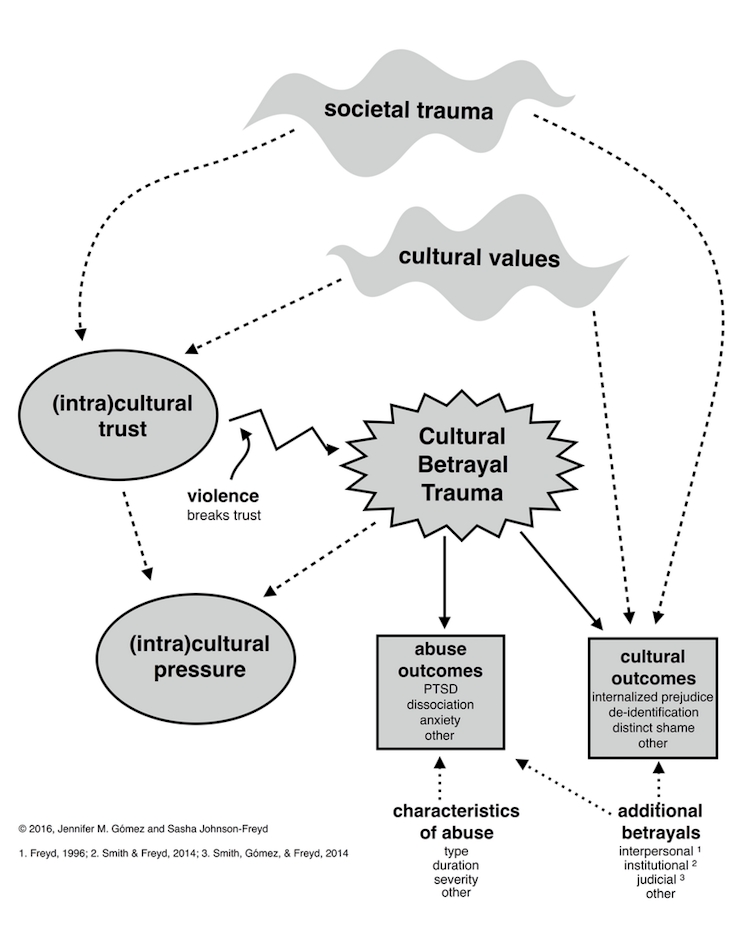
    To understand this harm, I created cultural betrayal trauma theory. The general idea of cultural betrayal trauma theory is that some minorities develop what I call “(intra)cultural trust” – love, loyalty, attachment, connection, responsibility and solidarity with each other to protect themselves from a hostile society. Within-group violence, such as a black perpetrator harming a black victim, is a violation of this (intra)cultural trust. This violation is called a cultural betrayal.

    The Harms of Cultural Betrayal

    Cultural betrayal leads to many different outcomes. CC BY-SA

    Cultural betrayal trauma, which is simply within-group violence in minority populations, is associated with many outcomes that go beyond things that are typically studied with trauma, such as post-traumatic stress disorder. It includes some things not often thought about with trauma, such as internalized prejudice – like a black person believing the stereotype that all black people are violent.

    (Intra)cultural pressure is another outcome of cultural betrayal trauma. With (intra)cultural pressure, people who experience cultural betrayal trauma are often demanded to protect the perpetrators and the minority group as a whole at all costs, even above their own well-being. With the mandate of “don’t betray your race,” (intra)cultural pressure punishes people who speak out about the cultural betrayal trauma they have endured.

    In a recent study, I tested cultural betrayal trauma theory in youth due to the increased risk for trauma and mental health problems in the transition into adulthood.

    I surveyed 179 college women online in 2015. Over 50% of these young women were victims of trauma. Just under half experienced psychological violence, 14% endured physical violence, and almost one in three women were victims of sexual violence.

    Of the young women who were victimized, over 80% reported at least one form of (intra)cultural pressure. This included their ethnic group suggesting that what happened to them may affect their minority group’s reputation. An example of this could be a black woman who has been raped by a black man being told that she should not go to the police because it will make all black people look bad.

    Additionally, I found that controlling for age, ethnicity and interracial trauma, cultural betrayal trauma and (intra)cultural pressure were associated with symptoms of PTSD. Meaning, cultural betrayal in trauma and (intra)cultural pressure were unique contributing factors of mental health problems in ethnic minority college women.

    What Does This All Mean?

    As I analyzed the findings, I was struck by several things:

    • The within-group nature of trauma includes a cultural betrayal in minorities that affects mental health.

    • Trauma gives us only part of the picture.

    • Group-level responses and cultural norms via intra-cultural pressure impact mental health.

    • Policy change that combats inequality, such as changes in education, health care, law enforcement and the judicial system, can benefit minorities who experience trauma.

    These findings have implications for interventions. Such therapy can address the very real threats of discrimination and the necessity for (intra)cultural pressure. At the same time, these interventions can use (intra)cultural trust to promote positive mental health. Additionally, evidence-informed feminist approaches, such as relational cultural therapy, may benefit people who are exposed to both trauma and societal inequality.

    The body of research to date suggests that cultural betrayal may be a unique harm within violence in minority populations, including the black community. As such, the alleged sexual traumas perpetrated by R. Kelly and Clarence Thomas have a cultural betrayal that isn’t found in Woody Allen’s alleged abuse. Moreover, black men’s death threats against Tarana Burke are (intra)cultural pressure that is laced with misogynoir, or sexism in the black community.

    Research that incorporates societal inequality can help us understand what makes trauma traumatic. In doing so, our social reactions and therapeutic interventions can ultimately be effective for blacks and other minorities who are exposed to trauma.

    Jennifer M. Gómez, Postdoctoral Fellow in Trauma Psychology, Wayne State University

    This article is republished from The Conversation under a Creative Commons license. Read the original article.

  • Privilege Lurks at the Heart of Recovery Movements

    Privilege Lurks at the Heart of Recovery Movements

    Making blanket statements that “anyone can recover” whitewashes and overlooks the gross inequities that people of color and marginalized communities face.

    Recovery is possible for anyone, but it isn’t the reality for everyone. We may see an increasing number of people on social media proudly displaying their recovery as badges of honor — which in turn reduces stigma about addiction and a life in recovery — but it doesn’t accurately depict the true picture that recovery isn’t accessible to everyone, it heavily depends on your privilege.

    Recovering “out loud” has gained so much momentum that it’s now a social justice movement: we are now questioning advertisers who normalize the excessive use of alcohol, challenging the use of biased language, highlighting the inequity in authorities tackling opioids but overlooking alcohol as the leading cause of drug-related deaths, and advocating for policy changes that affect people with substance use disorders.

    While this recovery activism should be celebrated, we are still overlooking the inconvenient truth lurking beneath the surface: recovery is, unfortunately, still a privilege. Can we really be part of a social justice movement if we overlook the role privilege plays in the accessibility of recovery? 

    The Role of Privilege in Substance Use Disorders and Recovery

    Many people within the recovery movement believe that recovery is possible in spite of race, ethnicity, economic circumstances, nationality, sex, gender, access to health insurance, and a strong support system — in other words, privilege. This simply isn’t the reality. There are great disparities both in how addiction affects people and how much recovery capital is available to us based on privilege.

    Rates of addiction are higher in oppressed populations, especially among LGBTQ people and people of color. Black women over 45 are the fastest growing population with alcohol use disorder, and the risk of developing a substance use disorders is 20-30 percent higher for individuals who identify as LGBTQ+.

    We don’t hear about those statistics, though; we see an opioid epidemic that is largely affecting white people. When drugs have a detrimental impact on communities of color, the media is less interested in covering it. Advocate Shari Hampton explains “Nobody gave a damn when black lives were being ravaged by crack cocaine in the 80’s. Families were ripped apart; communities were literally destroyed. People were thrown in jail and some of them are still there.”

    She continues, “I’ve witnessed grandparents raise grandchildren right up to their grave while their grown children suffered from a crack addiction or a jail sentence that is so ridiculously long, it might as well be life. But now we have an opioid epidemic. It’s affecting a different demographic. And now, now it’s a treatment issue. This is disparaging and discouraging, especially to the black and brown folks that have never been treated with even a remote sense of compassion compared to what we see today.”

    This disparity continues in access to recovery. Recovery is vastly different for those who lack recovery capital — the resources that can be used to sustain recovery: financial security, education, health insurance, and a support system — which is heavily linked, again, to our privilege.

    Not all people who speak openly about their addiction and recovery are blind to the reality of the effects of privilege. In her recent book Strung Out, author Erin Khar unpacks the role of privilege in her own recovery: “Escaping addiction, and it truly does feel like an escape, requires protective layers of aftercare. I have been incredibly fortunate to have access to the support I’ve needed.”

    She continues, “We don’t have a system in place that makes it simple or easy for people to get help or support. There are financial, social, and racial barriers to getting help. If we are going to see a real downshift in the opiate crisis, support is what is needed — not just from peers and family members, but also the medical community and government.”

    Studies show that African American and Latinx individuals are far less likely than white people to complete outpatient and residential substance use disorder treatment.

    The inequity is also in access to medication. NPR highlighted a recent study by Dr. Pooja Lagisetty, an assistant professor of medicine at the University of Michigan, who stated that “this epidemic over the last few years has been framed by many as a largely white epidemic, but we know now that’s not true.”

    Lagisetty found that as overdose deaths rose between 2012 and 2015, so did though the number of medical visits where buprenorphine was prescribed. However, researchers found no increase in prescriptions for African Americans and other minorities. In fact, the study found that white populations are almost 35 times more likely to have a buprenorphine visit than African Americans even though death rates among people of color were rising faster than white people. Researchers also observed that these visits were paid for by cash (40 percent), or private insurance (35 percent) rather than with Medicaid (25 percent), suggesting inequalities in healthcare. 

    “We shouldn’t see differences this large, given that people of color have similar rates of opioid use disorder,” says Lagisetty. “As the number of Americans with opioid use disorder grows, we need to increase access to treatment for black and low-income populations, and be thoughtful about how we reach all those who could benefit from this treatment.” 

    People of color have less access to treatment not only due to socio-economic circumstances. There is also a disparity in how drug use is viewed in communities of color. Despite similar rates of drug use and sales, people of color are more likely than white people to be arrested and receive harsher punishments for drug-related offenses. 

    Khar reflects on the criminalization based on race: “Some might say it’s a miracle that I never got pulled over, never got caught with that briefcase of drugs. But I see it less as a miracle and more because I was a young woman with passing-white privilege in a Jetta.”

    She continues, “I’ve thought about this often, that had my skin been darker, had I come from less privilege, I have no doubt that I would have been arrested early on. I’ve thought about how that would have changed the trajectory of my life, how early arrests may have kept me forever trapped in a cycle of incarceration. Our drug laws are undeniably skewed to keep people of color and people of less privilege imprisoned and enslaved. And I’ve always been aware of that.”

    The true picture of addiction and recovery inequity are often ignored on social media because our privilege blinds us to these realities. But if we really want to create a social justice movement, we have to change how we relay what substance use disorders and recovery looks like for all.

    Creating a More Impactful Social Justice Movement

    Let me be clear: this article is not intended to shame anyone for their privilege; instead, I’m suggesting that we can’t ignore the true picture in favor of a prettier, more palatable version. Making blanket statements that “anyone can recover” whitewashes and overlooks the gross inequities that people of color and marginalized communities face. 

    Advocate Shari Hampton explains this discomfort that underlies many recovery advocacy conferences. “I went to a conference earlier in the year and the white fragility in the room was nauseating. I literally didn’t understand why even talking about inequality caused so much discomfort. Simply discussing the topic had white folk with pursed lips and clenched fists. White folks can’t bear to examine a system that has entitled them to more, as being broken. It’s like admitting that Jesus was black. It’s not going to happen. To do so would disrupt all things.”

    When asked how we can make a difference, Hampton responds: “America’s history teaches that black people are inferior to white people — that we don’t deserve the same treatment or opportunities. The mindset must shift. Because until we are seen, truly seen as magnificent beings, equal and worthy of the same quality of life and opportunities afforded to whites, very little will change.”

    If we really want to create a more impactful social justice movement, we need to get uncomfortable. We need to be more mindful in our social media posts and consider if what we are portraying is an accurate representation of recovery, and question if our privilege played a role in our access to resources. We need to consider if we are amplifying the voices of those marginalized and oppressed. If not, why not? And in creating events to address addiction, or in going to Washington, DC seeking policy changes, we need to stop and ask ourselves if we have invited the people who are most affected by these policies. If not, we need to ask ourselves why we aren’t amplifying the voices of the people who most need to be heard?

    We cannot divorce recovery from true social justice. Writer and sobriety coach Holly Whitaker says: “For those people who don’t want to ‘dirty up’ or confuse recovery spaces with talk of racism, classism, transphobia, homophobia, ableism, classism, etc. — remember that recovery is about awareness, and that this path is about inclusion, love, and acknowledging wrongs and injustices. If we aren’t talking about the way the system works, and who gets crushed by the system, we aren’t actually talking about recovery. We’re still just talking about our comfort zones, and using our privilege to deny other experiences.”

    View the original article at thefix.com

  • Overdose Deaths: Not an Epidemic or a Crisis, and Not by Accident

    Overdose Deaths: Not an Epidemic or a Crisis, and Not by Accident

    Overdoses are not mysterious, they result from predictable causes like criminalizing drug use, ineffective policies, poverty, lack of stable housing, and persistent racism.

    Opioid-related overdoses are not a crisis or an epidemic, and should not be described as either. Both words stigmatize the victims of a phenomenon that is not happening by accident. Such overdoses have been steadily increasing throughout the United States and are especially high in Appalachia (where we both work). Yet overdoses are not a natural or mysterious phenomenon. They result primarily not from individual, but from larger structural factors — criminalization of drug use, ineffective social policies, poverty, lack of stable housing, historical and persistent racism, and other forms of systemic oppression — which are all the result of deliberate policy decisions.

    We are told by the media, CDC, and state governments that the region where we live and work is ground zero for a drug “crisis.” Yet those same entities contribute to the problem through policies, funding allocations, and covering-up of underlying systemic causes. We must shift our language to reflect this. Substance use and overdose happen in predictable contexts and disproportionately affect marginalized communities.

    Terms Like “Epidemic” and “Crisis” Cause Alarm and Hysteria, Stigmatizing People Who Deserve Compassion

    More than 67,000 people in the United States died from opioid-related overdose in 2018. Alarmist headlines, even well-intended reports, do not justify an inaccurate framing. We advocate instead for the use of the term impact, or other language that indicates the underlying roots of suffering, instead of epidemic or crisis.

    Epidemic is most accurately used to describe infectious or viral spread of a disease within a population over a short period of time. Substance use, even for the relatively low 18% of people who use “chaotically,” does not meet this criteria. People who overdose or suffer negative consequences of substance use may be more socially or genetically vulnerable to a substance use disorder but in basic epidemiological principles, that does not an epidemic make. Calling structural violence that leads to specific overdose patterns an epidemic or a crisis feeds into a hysteria that marginalizes drug users and their loved ones. Both words take the focus away from the underlying causes of suffering; naturalizing it and leaving the conversation at a surface level without motivating real change. 

    We both work in and study harm reduction and overdose prevention in North Carolina: a microcosm of opioid-related deaths and specific patterns of suffering repeated elsewhere in Appalachia and throughout the country. Daily, we observe the dynamics of economic policies, limited healthcare access, and stigmatization that impact people already at greater risk for substance use and overdose. Later in this essay we discuss how it plays out in North Carolinians’ overdose risks — making it more likely they and their loved ones will be blamed if they do.

    How Misguided Drug Policies Blame the Victims While Ignoring the Causes

    Like the thousands of lives lost to fentanyl poisoning in the context of increased drug use criminalization today, there was nothing natural about the thousands of lives lost to alcohol poisoning during prohibition a century ago; or the increase in deaths and drug-related arrests that ravaged inner-cities during the government-manufactured “crack era” of the 80s and 90s. Consequences of drug use, like mass incarceration, have never been a natural disaster. Instead, policy responses to drug use tend to create systemic storms that rage in vulnerable communities. This is a classic example of blaming the victims of problems while ignoring the causes.

    If a “crisis” is happening to those around you, you may feel bad for them, you may vote for a politician who promises to address it — but you probably won’t ask how the same politicians or political system contributed to creating it, or how arresting and jailing poor and Black and Brown people will fail to fix it. Overdose deaths in the U.S. have always been both a symptom and outcome of discriminatory policies

    Suffering is further exacerbated by punitive policies such as drug-induced homicide laws that increase overdose deaths, weaken Good Samaritan legislation intended to reduce overdose, and criminalize drug users and their loved ones. For example, opioid de-prescribing mandates in 19 states appear to result in an increase in heroin overdose deaths. And, healthcare policy is an oft-overlooked aspect of overdose prevention — states that did not expand Medicaid (which increases coverage of treatment) are disproportionately states with higher overdose and substance use.

    Mainstream media portrays sympathetic stories of the middle-class sons and daughters of urban politicians dying of overdose, while the stigmatized partners and friends of poor Appalachians who disproportionately die of overdose from drugs often laced with fentanyl fear being arrested under ‘drug-induced homicide’ and ‘death by distribution’ laws if they call 911. The ways that drug users are talked about serve political agendas that further contribute to patterns of suffering.*

    We must acknowledge and address what is missing, obscured, and ignored when we promote an inaccurate framing of drug use as a “crisis” or “epidemic,” rather than something caused by policy decisions. Who is disproportionately blamed? Who is left out of the conversation? 

    When we fail to address how a combination of economic, political, biological, behavioral, genetic, and social factors intersect within the lives of drug users and their wider communities, we legitimize the use of simplistic and punitive approaches to complex issues. Where we live and work, North Carolina policy makers used the 2016-2017 increase in drug overdose deaths to justify an argument for harsher punishments despite a wealth of research that shows that such approaches increase the very health consequences they claim to reduce. Further, these approaches do nothing to address economic disparities in North Carolina where 13 of 100 counties have experienced rates of poverty at 20% or higher for the last three decades. They do nothing to address the lack of Medicaid expansion or limited employment and economic growth — all upstream drivers of overdose and suffering.

    Simply put, an increase in overdose deaths is not the result of society’s inability to get tough on crime, or even the need for more biomedical treatment. Rather, overdose deaths persist due to an unwillingness to acknowledge that treatment expansion and more or harsher punishment fail to address gaping social wounds

    Communication: Start Using Language That Reveals the Roots of Unequal Suffering

    As long as policymakers, politicians, and journalists continue to use inaccurate terms like “opioid crisis/epidemic,” opportunities are missed to discuss and address the causes and effects of substance use and overdose. We advocate for talking instead about “opioid impact” or “overdose impact.” A more neutral term like impact is less stigmatizing and hyperbolic, and thus less marginalizing for those directly affected. Impact is also more flexible — not all drug use is harmful, nor leads to substance use disorder, illness, or overdose. Impact is a more accurate and flexible term to allow for discussion of people’s lived experiences with substances.

    Even so, it may not go far enough. As a parallel example, public pressure and justice-oriented advocacy shifted public conversation and journalistic style from talking about human beings as “illegal” to “undocumented.” But referring to these same folks as “economic refugees” would be even more accurate and less stigmatizing. Similarly, impact is a more useful term than “crisis” or “epidemic” when referring to patterns of opioid-related overdose and substance use-related illness. And, terminology that clearly unmasks the deeper roots of unequal suffering would be even better.

    A person using drugs is not a disease vector nor the precipitator of a crisis. What we witness in communities like Philadelphia, Austin, and Asheville are not drug-related epidemics or naturally occurring crises. The harms impacting these communities are symptoms of destructive social policies that ensure the most vulnerable populations remain vulnerable, shamed, and disproportionately suffering from the very problems for which they are blamed. 

    So where do we go from here? We can start by answering this with another question: How might our conversations, and thus policy and response efforts change, if we use language that reveals the structural roots of suffering instead of further contributing to stigma and hysteria that shames the people who are most directly affected?

    View the original article at thefix.com

  • Drug Deaths in Black Communities and Our Collective Denial

    Drug Deaths in Black Communities and Our Collective Denial

    “While white addicts receive treatment, drug counseling, and a lenient criminal justice system, there are Black people still behind bars because of mandatory minimums, three-strikes laws, and disparate drug sentencing.”

    “Google ‘Children of the Opioid Epidemic,’” said professor Ekow N. Yankah. The search sent me to a year-old New York Times feature about children born to mothers struggling with opioid use disorder.

    “How tender a picture is that?” he asked.

    The image, a white infant coddled by her mother, was hard to ignore. They stood crouched down on the floor of what could be my childhood home. Mom’s dirty-blonde hair was strewn about, covering her face as she embraced her child. She was asking for forgiveness or redemption or both. I’ve been there.

    “That is a picture of a young woman who, whatever her drug addiction is, is fighting to be a decent mother,” Yankah continued. 

    Yankah, who teaches criminal law at Cardozo Law School and is a board member of the Innocence Project, made his point. “Compare that with what you know of welfare queens and crack mothers,” he said. “Was there any image like this in the collective mind of our society when we talked about crack mothers?”

    It’s a rhetorical question. Images and headlines from the crack-cocaine era remain burned into our psyche. But awareness is not acceptance. So, let’s be honest. It’s no accident that America’s newfound compassion comes during the opioid crisis. Eighty percent of overdose victims are white. 

    “We don’t get to move on by pretending that this is a coincidence,” Yankah said. 

    “People are saying: look, it’s not racism. It’s that we tried the other model and it just didn’t work,” he continued. “As if for 25 years, we tried to lock up a whole community, and when the color of the community switched, we suddenly grew enlightened.”

    There’s Always Been a Cocaine Epidemic

    According to the Centers for Disease Control and Prevention, cocaine-related overdose deaths rose about 216 percent between 2012 and 2017. That’s double the growth rate of opioid deaths for the same period.

    Most of those deaths happened in black communities. Black adults were twice as likely as whites to die from cocaine-related causes. In 2017 the numbers were 8.3 per 100,000 compared to 4.6. And even though overall deaths rose recently, the data shows that black people have always had double the rate of cocaine overdose as their white counterparts. 

    Further data shows that black folks are more likely to develop cocaine dependence or a past-year use disorder. For almost two decades now, we’ve had data that shows cocaine use disproportionately affects black communities.

    But today’s headlines make it appear as if it’s a recent phenomenon. “The Opioid Crisis Is Becoming A Meth And Cocaine Crisis,” wrote Buzzfeed last January. “As the Opioid Crisis Peaks, Meth and Cocaine Deaths Explode,” the Pew Trusts noted in May. The list goes on ad infinitum

    The cocaine epidemic in black communities is not new. 

    Around three-fourths of these fatalities involved fentanyl or other opioids, but we don’t know if the presence of the opioid was disclosed to the user. Officials speculate it could be a contaminated drug supply. More people could also be doing speedballs (a combination of cocaine and opioids).

    Whatever is behind the disproportionate rate of overdose, experts remain stumped — and until recently, no one really cared.

    Because despite the data, and the appreciation for treatment-based solutions, research remains lacking. A PubMed search shows little to no relevant information. Most news outlets have ignored the issue. 

    It’s Just a Cruel Delusion

    “Americans really have the sense that history starts anew with every generation,” Yankah said. 

    “I schematically undermined your family, and then my children look up and say to your children, ‘look, I don’t know why I’m so much better off. I must have worked harder,’” he continued. 

    “It’s just a cruel delusion.”

    At first, systemic racism spared black people from the opioid crisis. Doctors are more likely to label black patients as either addicts or drug dealers, so they are less likely to prescribe opioid painkillers. 

    But opioid use is rising in black communities. Minority-majority cities like Baltimore, Chicago, and Washington D.C. know this better than most. The opioid crisis isn’t white. Over 47,000 people died of an opioid overdose last year. More than 5,000 of those deaths, or 12 percent, occurred in black communities. 

    Black people have less access to life-saving medications like buprenorphine than white people. And due to limited resources, they’re less likely to complete addiction treatment. Even if they do find treatment, almost 90 percent of psychologists are white. As one Philadelphia reporter wrote, it’s difficult to connect in a clinical setting.

    Outside Philadelphia’s federal courthouse this summer, activists gathered in support of SafeHouse. It’s the city’s — and the nation’s — possible first planned safe injection site. Family members lined the building with photos of overdose victims. 

    Every single photo was white.

    “Doing the right thing for the wrong reasons is yet polarizing, divisive, and racist,” Bishop Talbert W. Swan, II told me. Swan, the pastor of Spring of Hope Church of God in Christ, is a civil rights activist and president of the Greater Springfield NAACP

    “The wrong reason, of course, is because the addicts are now considered ‘victims’ because they’re predominantly white,” he continued. “The softer, gentler approach is not because lessons were learned by how America dealt with the crack epidemic, but because of white supremacy and the consistent dehumanization of Black and brown people.”

    Just Say No

    During the crack-cocaine era, murder rates doubled for young black males of all ages. Fetal death rates increased, fathers went to prison, and children, to foster care. Many black urban neighborhoods, which have the highest concentrations of poverty in the country, still bear the scars of those years.

    “America needs to remember that the U.S. government allowed the influx of drugs into inner-city Black America and profited from the death, addiction, incarceration, and destruction of Black families and communities,” said Bishop Swan.

    He continued: “While Nancy Reagan went around the country telling Black people to ‘just say no,’ her husband Ronald Reagan and Oliver North were funneling proceeds from the sale of crack to the Contras in Nicaragua and funding terrorism.” 

    We held black people to a higher standard. Americans preached personal responsibility. But the opioid crisis created victims. We blame Johnson & Johnson, Purdue, Richard Sackler, and our doctors.

    “The government will now ensure that pharmaceutical companies pay [restitution] for the addiction of whites to opioids, but will never pay for being complicit in the devastation to Black families and communities,” said Swan.

    “While white addicts receive treatment on demand, drug counseling, and a lenient criminal justice system, there are Black people still behind bars because of mandatory minimums, three-strikes laws, and disparate drug sentencing,” said Swan.

    We have “collective self-denial” about this disparity, Professor Yankah once wrote. It’s left black people world-weary and bitter. Yankah and Swan agree that contemporary models of addiction treatment are the way forward. Each expressed the need to reflect on our past — not to be cliché — for fear of repeating it.

    “One of the things I got a chance to do once was have a thoughtful conversation with one of the first minority judges who is on the federal bench in Miami,” said Yankah. “He spoke about when heroin was ravaging Miami in the 70s.”

    “People wanted to wrestle with this problem that was hurting their communities until a bunch of politicians started making hay that the heroin problem was a problem with Hispanics,” he continued. “Suddenly all this money for rehabilitation disappeared.”

    Meanwhile, cocaine continues to ravage black communities. Since 2012, cocaine has killed as many, if not more, black Americans as opioids. They die unseen as politicians and policymakers do nothing. There is no New York Times spread, no pharmaceutical company settlement. No one asks about the black children of the cocaine epidemic.

    View the original article at thefix.com

  • Harpies, Bitches, Witches and Whores: Women Write About Anger in New Anthology

    Harpies, Bitches, Witches and Whores: Women Write About Anger in New Anthology

    “People can see an angry man [who is] fighting for a cause and see him as strong. It’s not the same for women—especially not for women of color and trans women.”

    Burn It Down: Women Writing About Anger is a fiery collection of 22 essays. Editor Lilly Dancyger (Catapult, Narratively, Barrel House Books), an accomplished essayist (Longreads, The Rumpus) and journalist (Rolling Stone, Washington Post), brought together a diverse group of writers. Currently Dancyger is working on a memoir about her artist father and his heroin addiction.

    With empathy in short supply these days, Burn It Down is an invigorating read. The collection is filled with compelling creative nonfiction in the form of first-person narratives from women of different races, ethnic groups, and religions. No matter how you identify—cis female, cis male, trans, or nonbinary—there is a lot to learn here. Dark humor and gorgeous prose take you through the lessons learned in other people’s lives.

    The first sentence in Dancyger’s introduction demanded my attention: “Throughout history, angry women have been called harpies, bitches, witches and whores.” With a shorter-than-ever attention span, I was surprised to devour this book in one sitting. Dancyger guided the writers to go deep and spill raw feelings. 

    Dancyger told The Fix about her troubled teen years. She said, “I had good reason to be angry.” Not only was she raised by two people with drug addictions, but her father died at age 43 when she was a preteen. Her beloved cousin Sabina was only 20 when she was randomly murdered.

    “Anger overwhelmed me,” Dancyger said. “It came out in excessive drinking and doing a lot of drugs.” Her life was thrown out of whack, which sent her on a rocky journey where she learned that you need to “make space for anger in your life or it pushes you into self-destruction.”

    “Those were wild, reckless years. Then I dropped out of ninth grade,” she said. She made it to college, still drinking heavily. “There’s a big difference between drinking with your friends and being determined to get drunk every day. Finally, I ran out of steam and decided I was just done.”

    Writing has been healing, Dancyger told me.

    Burn It Down is meant for readers to give themselves permission to access their own anger. “To feel it, recognize it and accept it. There are so many things to be angry about,” Dancyger said. “It can be fortifying to enforce boundaries, pursue passions, and let anger out.” The book acknowledges that men are angry too, but this is a book about women. “People can see an angry man [who is] fighting for a cause and see him as strong. It’s not the same for women—especially not for women of color and trans women.”

    The first piece, “Lungs Full of Burning,” is by Leslie Jamison, who never thought of herself as ill-tempered. She spent years telling people, “I don’t get angry. I get sad.” Jamison writes about her long-held belief that sadness was more refined than rage. Out of a fear of burdening others, she squelched her feelings in order to spare people the “blunt force trauma” of her wrath. She writes, “I started to suspect I was a lot angrier than I thought.” Her essay talks about women in literature and film, pointing to the Jean Rhys novel, Good Morning, Midnight, in which the heroine resolves to drink herself to death, and describing Miss Havisham as “Dickens’s ranting spinster—spurned and embittered in her crumbling wedding dress.”

    I Started to Suspect I Was Angrier Than I Thought

    Jamison writes, “I’d missed the rage that fueled Plath’s poetry like a ferocious gasoline.” She talks about I, Tonya and how it handled what became known as the “whack heard around the world,” where one woman’s anger leaves another woman traumatized. Harding was portrayed as a “raging bitch,” said Jamison. Kerrigan was a pitiable victim. Yet, things are usually not as black and white in real life. Jamison points out how little coverage there was of Harding’s abusive mother and husband.

    “Women’s anger is a necessary conversation to be having,” said Dancyger. On Hillary Clinton, she explained, “Here was a woman who bent over backwards to avoid coming off as shrill. Look at the words used to describe angry women—hysterical, crazy, hormonal, irrational. And women of color experience an extra dimension of misogyny.”

    Alexandria Ocasio-Cortez is “under tremendous pressure. We hear the racism in words like ‘fiery Latina.’ Kamala Harris is an ‘angry black woman.’”

    Erin Khar, editor-essayist-columnist and author of the much-anticipated memoir, Strung Out: One Last Hit and Other Lies That Nearly Killed Me (Park Row Books, Feb. 25, 2020) writes in her essay “Guilty” about panic attacks and anxiety she felt as a child, who then began keeping secrets. She grew into a troubled 13-year-old who turned to heroin. Later she was a chronic relapser: “As a junkie I was a walking apology.” Finally, thanks to a wise therapist, she learned that it wasn’t the guilt that was killing her; it was unexpressed anger. It’s a powerful story that illustrates the madness of addiction.

    There are tough scenes of self-loathing in Khar’s piece: digging fingernails into her arms till she bled, using a box cutter to carve into her leg. Recovering memories of being raped at age four. But the ending is satisfying, with a description of what her life is like today and the steps she took and tools she used to get there.

    Khar was generous with her time and very open in our interview. We covered a wide range of topics and segued into how many women experienced PTSD from watching the Brett Kavanaugh hearings. 

    “Lilly [Dancyger] was editing the essays during the Kavanaugh hearings and I was writing my essay for the book at that same time,” Khar said. We talked about Kavanaugh’s weeping, and blubbering about beer during his job interview for SCOTUS. We teared up as we shared our similar experience of shaking while listening to Christine Blasey Ford. 

    An Angry Black Woman, No Matter the Reason, Is Thought to Have an Attitude

    Burn It Down isn’t about what makes you angry, it’s about anger itself. In the essay, “The One Emotion Black Women Are Free to Explore,” Monet Patrice Thomas writes, “[A]nger spread through me like red wine across a marble floor, but I did not show it.” She describes her conditioning: “An angry Black woman, no matter the reason, is thought to have an attitude.” Her rage was inside her “like a shaken can of soda.”

    In “Rebel Girl,” Melissa Febos writes, “I knew that I was queer and that it wasn’t safe to admit that at school.” She burned with self-hatred that was “slowly blackening my insides.” Then she met Nadia, who was “six feet tall in combat boots … with a shaved head and arms emblazoned with tattoos. She stomped rather than walked.” 

    Lisa Marie Basile describes living with chronic pain and all of the stupid, condescending advice that dismissed her very real symptoms in “My Body Is a Sickness Called Anger.” One doc tells her she probably stuck her finger in her eye too hard. She writes, “I gently remind the doctor…that feeling like absolute shit with two enlarged assholes for eyes just cannot be normal.” Friends say she looks fine, then offer useless unsolicited advice like yoga, green juices, and giving up gluten. Basile’s snarky inner dialogue is hilarious. 

    There is an energizing quality to women’s rage and it builds a united front. Dancyger has succeeded with her goal to “create a place where anger could live” and her vision to display rage on pages that “sizzle and smoke.” As the last sentence of her intro reads, “Our collective silence-breaking will make us larger, expansive, like fire, ready to burn it all down.” 

    Burn It Down is now available on Amazon and elsewhere.

    View the original article at thefix.com

  • "Miles Davis: Birth of the Cool" Connects Jim Crow Oppression to Davis' Heroin Addiction

    "Miles Davis: Birth of the Cool" Connects Jim Crow Oppression to Davis' Heroin Addiction

    Miles Davis’ heroin addiction and alcoholism are all well known and well documented. However, Nelson frames this period as resulting from Davis’ return to a reality in which he was not wanted but his music was.

    The documentary Miles Davis: Birth of the Cool opened up the world of one of the most innovative musicians in American history. In the film, Director Stanley Nelson laid bare all the details of the music man’s life, including the darkness and despair of Davis’s struggle with alcoholism and heroin addiction. It is during this piece of the film, which should have been the low and slow point, that the pieces Nelson offered began to connect. Davis’s heroin addiction was a direct result of the treatment he received as a black man living under Jim Crow laws in 1949.

    In the documentary, Nelson offers audiences the French tour where Miles Davis discovered love and existence without the restriction and oppression of Jim Crow America post-WWII. Davis went to France in 1949, touring with the Tadd Dameron group for quite some time. By all accounts—even those outside of Nelson’s documentary—the man became enamored with the country that embraced him for his talent without placing restrictions on him due to his skin color. Here he experienced life without the heavy hand of racism weighing him down.

    The freedom of living abroad was buoyed by a romance with a French singer named Juliette Gréco. The couple, despite their racial differences, was able to maintain a public relationship just like other couples in France and much of Europe. The oppressive, dangerously restrictive Jim Crow laws in the U.S. would have made their relationship illegal. American laws and policies in 1949 were enacted to maintain the belief that black people were inferior to their white countrymen.

    In Birth of the Cool, the narrator discusses how Davis became “disillusioned” by American racism after spending quite some time away in France. The weight of Jim Crow was enough to send the musician into a depression that he could not recover from. This was compounded by the lull in his musical career because of the waning popularity of bebop and the lack of a fresh new sound from Davis. He was also mulling the loss of the relationship that he would remember well into his later years. Davis told an interviewer that he never married Gréco because he loved her and wanted her to be happy. Their marriage could not exist in the U.S.

    The next part of the documentary was a slow plunge into the darkest parts of the musician’s life. Davis’s heroin addiction and alcohol abuse are all well known and well documented. However, Nelson frames this period as resulting from Davis’s return to a reality in which he was not wanted but his music was. Although Nelson never explicitly says so, the racism Davis experienced led to his depression, which sent him into the heroin addiction and alcoholism rabbit hole. Even in the documentary, Davis describes his depression as something that sprouted the moment he returned to the racist United States and followed him through the period of his life where he struggled with addiction.

    Studies like “Exploring the Link between Racial Discrimination and Substance Use: What Mediates? What Buffers?” from the Journal of Personality and Social Psychology show that not only is there a relationship between racism and mental health issues as a whole, but the link also exists specifically between racism and addiction. The authors write, “Psychologists have known for some time about the pernicious effects that perceived racial discrimination can have on mental health.” The study goes on to dig into the research gathered from this link. They found that “[n]umerous correlational studies have documented relations between self-reports of discriminatory experiences and reports of distress, including anxiety and depression, as well as anger.” All of these elements were likely in place as Davis returned to the U.S. The weight of segregation, sundown laws, lynchings, and other trappings of Jim Crow laws was more than enough to anger and depress any black person at the time.

    Substance use promises an escape from pain and Davis needed a way to cope with all these feelings. According to the aforementioned study, “[T]he increased substance use we found was evidence of a coping style that includes use as a means of handling the stress of discrimination.” Davis probably became more angered and frustrated with the racist behavior (especially after returning home to the predominantly white St. Louis suburb his parents lived in). The documentary also described how his musical popularity waned and his personal life was disrupted from the breakup with Gréco. At the time, the musician’s life had all the elements in place to breed the raging heroin addiction that followed.

    Fortunately, Davis recovered from his addiction to opioids and alcohol, but it was a lifelong struggle. Nelson depicts as much in the documentary. In fact, racism and substance abuse become a very strong subplot to the documentary that works to educate viewers as much as entertain them. Between the scenes depicting the origins of the famous everchanging Miles Davis sound, Nelson buried important nuggets that should force us to redefine how we view and treat racism and addiction.

    Birth of the Cool essentially describes the environment from which Miles Davis’s addiction was created. There are other factors that also affected his addiction, but racism and depression were the primary and most powerful drivers that pushed him toward problematic substance use. Nelson thus lends one more voice to the chorus of stories that illustrate how racism and the oppression of white supremacy is an impetus to substance misuse and addiction. Acknowledging this can help with not only treating addiction in the black community, but also with understanding why racism should be considered a public health concern worthy of more serious attention.

    More info on Miles Davis: Birth of the Cool here.

    View the original article at thefix.com

  • Support for President Trump is Not Sober

    Support for President Trump is Not Sober

    We would not accept from our sponsees things that President Trump does, without remorse, on a daily basis.

    If you go to 12-step meetings and you’re a MAGA person, here’s something fun to try. Pick a public statement of President Trump’s — one that isn’t explicitly political, as we wouldn’t want politics to sully the rooms — and share it with the group. Don’t cheat by picking something bland, choose a real Trumpian one. Call a woman “horseface,” maybe, or say of Mexicans, “They’re rapists.” Or if you want to bring up rape, raise your hand and tell your fellow addicts that women who don’t report rapes to the police are lying.

    Yes, yes, Alcoholics Anonymous is a non-partisan, non-political organization that, to quote the famous preamble, “does not wish to engage in any controversy, [and] neither endorses nor opposes any causes.” That’s great, for what it is — AA as an organization isn’t about to make grand proclamations about the issues. But nothing you shared with the group, hopefully not your home group, was really “political.” You just put forth your point of view, like the President does on Twitter every day. How do you feel? How is the room looking at you? Are you ashamed?

    it’s a cop-out to believe that the AA program has nothing to say about anything deemed “political.” Whatever your feelings on taxes or immigration, there’s no question that Trump doesn’t represent sober (in the 12-step sense) values. And it’s actually far worse: Trump, in his embrace and encouragement of resentment and ego, has made himself into a symbol of self-centeredness, a totem of negativity. His morals are about as far removed from sobriety as morals get, and he’s actively bringing down his followers with him. You cannot support this man and call yourself sober. Dry, maybe. Not sober.

    Calm down. This is not as limiting as it first sounds. Because Trump is unique, and support for his presidency is also a unique kind of support, there’s not much overlap with pure partisan issues when it comes to what is and isn’t “sober” as we 12-step adherents understand the word. I’m not here to tell people how to advocate for low taxes, reduce regulations, build a wall on the southern border, or that they need to repent and get right with the spirit of Bill W. I’m of the libertarian/anarchist bent, so if AA is a program for leftists, I better go check out LifeRing. I’m talking about Donald Trump as a man, what he stands for, and what emotional reactions he encourages (and in turn benefits from) in those who support him.

    If you get past the simplistic idea that AA is “non-partisan,” none of this should be too surprising. Trump’s whole life has been about his own gratification at the expense of the world, like mine was when I would guzzle vodka for days on end. In his 2005 book How to Get Rich, he explained: “Show me someone with no ego and I’ll show you a big loser.” (I can’t imagine he would think too highly of the idea that “Twelve Steps deflate ego.”) His supporters like this about Trump — that he is unabashedly self-seeking, proudly vain, constantly boastful, and in a way, I get that. It’s fun, and forbidden, but it certainly isn’t how we hope to model ourselves, or for that matter guide our sponsees; but as entertainment? There’s a certain magnetism.

    The bigger problem with President (no longer entertainer) Trump, for those of us who wish to live sober lives, is that he has embraced the role of playing on and promoting resentment, the thing the Big Book says “destroys more alcoholics than anything else.” His public persona, tweets, and political strategy have all become inseparable from his desire to inflame the ugliest sides of human emotion, the sides that we recovering alcoholics try to manage with grace and magnanimity. He tells his followers, both implicitly and outright: allow yourselves to be bitter; indulge your righteous anger; lash out and never apologize. If anything can conclusively be called “un-sober,” it is the celebration of resentment, and that is what the #MAGA movement stands for.

    Trump’s infamous and above-quoted take on Mexicans — “They’re rapists” — is nothing more or less than a naked appeal to the very sort of shit we sober folks try to avoid rolling around in — and this was in his campaign announcement speech! Since then, Trump has expanded this resentment narrative, directing the bitterness of his followers laser-like toward Muslims, immigrants, and women. He dubbed the midterms the “caravan election,” explicitly and unapologetically stoking fear and hate for a group of impoverished people who may or may not arrive at our border in 6 to 8 weeks.

    Look, you can feel any way you want about the legalistic issue of who should and shouldn’t be allowed in America. But sober people who give in to the caravan fear-mongering, or who play into the resentment culture Trump fosters, are trashing whatever spiritual development the 12 steps have helped them achieve. Is one president worth that?

    Maybe Trump does things like this for political expediency more than a desire to single out groups of people — I’m not the therapist he clearly needs — but the effect is to inflame and encourage resentment. This was certainly the result of his declaration that “very fine people” were part of the Charlottesville white supremacist march, and his prolonged foray into claiming that Barack Obama wasn’t born in America. Racism is resentment purified and focused. If we can’t call racist dog-whistling contrary to AA thinking, I’m not sure AA thinking is good for much of anything.

    We would not accept from our sponsees things that President Trump does, without remorse, on a daily basis. “Progress, not perfection,” goes the sobriety cliché. Trump luxuriates in his lack of progress. He infamously refuses to apologize — or even express some contrition — for his worst comments. With two years of the presidency under his belt, he took great joy in mocking (in public, at a massive rally) a woman who at the very least sincerely believed herself to be a sexual assault survivor. The day after an election he claimed to be happy about, he mocked members of his own party who lost — it’s hard to think of a less gracious way of behaving. As addicts we make mistakes, but we recognize that to live an honest life we need to evaluate those mistakes and learn from them. Trump just doesn’t give a shit about this, and in his role as the most powerful person in the world, he’s uniquely able to beam this way of thinking directly into the psyches of his followers. He is kryptonite to sobriety.

    There is a difference between making mistakes and acting selfishly and egotistically — something we all do, and something that George W. Bush and Barack Obama did often — and basing your entire public life around encouraging others to indulge in what Step Six calls “self-righteous anger,” of the sort that “brings a comfortable feeling of superiority.” The 12 steps take as a given that we have a higher nature that our addiction obscures. How can we then express admiration or support for someone who proudly parades his lack of that higher nature, and asks others to follow his lead?

    Some readers might be puzzled as to how Trump’s rhetoric could appeal to allegedly spiritually aware people, and while it seems odd, but it isn’t. All things considered, if Trump’s public persona is attractive to these AAs — or even if they fail to see the damage his verbal assaults inflict on the psyches of individuals and the nation as a whole — they are simply not sober. They have egocentrically taken back their will at a massive cost to those around them. They are dry, maybe, but they are not sober. And as we all know, the rooms of Alcoholics Anonymous are filled with people of various levels of spiritual sobriety.

    I don’t think so-called “normies” like Trump (and yes, it is weird to think of him as normal) should be held to the standards we hold ourselves to as recovering addicts. But at the same time, we recovering addicts are supposed to recognize the problems with a celebration of ego, selfishness, and most importantly, proud and unapologetic resentment. We wallowed in that for years, and it landed us in the rooms of Alcoholics Anonymous where we ostensibly hoped to redirect our energies to our better natures. Let’s practice what we preach in sobriety. Let’s earn the respect of our sober peers, our sponsors and sponsees, and the people who around us who remember us at our worst.

    There are members of the groups Trump singles out in AA rooms across the country. There are transgender people — the administration’s recent target — in the LGBT meetings I attend here in New York. There are Mexicans recovering from alcohol addiction, including undocumented ones. They don’t have the option of leaving their “politics” at the church basement door. Under this administration, neither do we.

    Trump himself has infamously never had a drink. Maybe that’s the biggest lesson here — we don’t need to be actively drunk to be spiritually wasted.

    View the original article at thefix.com