Tag: relapse

  • Get Rid of Drug Cravings Once and for All

    Get Rid of Drug Cravings Once and for All

    ARTICLE SUMMARY: There is no way to completely eliminate drug cravings. However, you can learn to live with them…and get through them. This article reviews why cravings occur and offers three practical ideas on how to cope.

    ESTIMATED READING TIME: 5-10 minutes.

    TABLE OF CONTENTS:

    Drugs and Pleasure

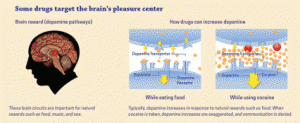
    To start to understand a craving, we need to look first at how drugs work in the brain. According to the National Institute on Drug Abuse (NIDA), experts used to think that a specific chemical neurotransmitter (dopamine) produced by drugs creates an extreme feeling of well-being. However, the reality is that the way drugs work in the brain is a little more complicated than that.

    Today, scientists now think dopamine has more to do with getting us to repeat pleasurable activities (reinforcement) than with producing pleasure directly. Large surges of dopamine “teach” the brain to seek drugs … while other, healthier activities such as exercise, creative pursuits, relationships, or even sex, get sidelined.
    The Definition of  a Craving

    So, what is a craving, exactly?

    Well, take away the drug-of-choice…and the need to feel pleasure still exists.  Our natural ability to feel pleasure can take some time to return as the brain returns to normal function. This is why people often feel the following in the first few months of addiction recovery:

    • depressed
    • flat
    • lacking motivation
    • lifeless

    The technical term for this is “anhedonia”. For some drugs – like meth, cocaine, heroin, or painkillers – it can take months or years for the brain’s chemistry to return to normal. And the amount of time it takes for the brain to return to homeostasis after a period of addiction will vary by individual.

    What’s important to know is that most of us are physically unable to enjoy things that were previously pleasurable. And naturally, we consciously and subconsciously seek out pleasure…to make life fun! This is why drug craving is natural outcome of drug use: it is a physical or psychological urge for your drug-of-choice.

    A craving is a deep yearning for the effect of your drug-of-choice.

    Triggers

    A craving can come out of the blue. It can also be”triggered”. Indeed, most cravings are usually prompted by a trigger. Triggers include external stimuli such as:

    • Certain people
    • Places
    • Situations
    • Smells
    • Other external stimuli

    Triggering situations affect the area of the brain called “amygdala”. When a triggering situation occurs, the amygdala sends signals to the other parts of the brain reminding you of your drug-of-choice. The amygdala regulates functions such as memory and learning, so you are in the company of a person, or in a certain situation that somehow reminds you of your previous addictive behavior… reaching for drugs again is a program running in your brain. The trigger sets of a pattern of decision making that can spiral you into an unconscious decision to use.

    During this process, you may even experience sensations such as shaking, cramps, anxiety attacks, nervousness… etc. A craving sensation can literally nearly take control over a person. However, you can stay in control by knowing the brain science behind them.

    Cravings occur as the result of powerful memories linked to substance abuse. When a trigger occurs, the amygdala lights up and in a moment, you can nearly feel the pleasure of your drug-of-choice. But cravings come and go. They do not last.

    They key to coping with cravings is to anticipate triggers and learn to avoid them. A craving may never go away compltely…the learned “reflex” can last a long time, even in people who haven’t used drugs in many years. Like riding a bike, the brain remembers. Cues that are linked with drug use can trigger uncontrollable cravings whenever you experience the cue, even if the drug itself is not available. However, you can stay in control of a craving and learn to ride it like a wave.

    Are Cravings Normal in Recovery?

    Yes.

    Almost every addict in recovery experiences craving. In fact, cravings are a very common and normal part of addiction recovery. The urge to take your drug-of-choice is rooted in brain chemistry.

    Again, they key is to be aware that they happen. When cravings appear out of nowhere they tend to take us by suprise. And if they come out of the blue, a craving can be sudden and very unpleasant. Indeed, the sudden and impulsive nature of cravings are one of the key factors for relapse.

    Therefore, it’s highly recommended that you ask for help when they strike. This because you’re working with long term memory association in the brain. A trigger can not be “deleted” as easily as people think. So, because cravings act as “automatic” and unconcious desire,s it’s best that you seek help from mental health professionals in order to manage them.

    A counselor, psychotherapist, social worker, or addiction doctor can help you to plan for cravings and teach you tools and strategies for managing them.

    Experiencing cravings and looking for ways to get rid of them? The next section offers you ideas aabout how to manage a craving and what to do when they appear.

    • Are your thoughts preoccupied with your drug-of-choice?
    • Can you literally taste your drug-of-choice on your tongue?
    • Do you experience a strong desire to see old friends?

    Do not worry, these are all normal.

    What you do next is key!

    What Do The Experts Say?

    Ph.D. Adi Jaffe defines cravings as programmed responses to environmental signals that have been connected to drug use through experience. His advice is that when you have a craving, recognize it for what it is. If the experience is overwhelming, make sure there’s someone you can talk to about it (a therapist, partner, parent, or 12 step sponsor). As time passes your cravings will become less and less frequent, though without specific treatment, their intensity will likely not go away. Like he says, cravings are a part of the reality of addiction – knowing what to do with them is a key to success.

    Randy Lindel, Facilitator at SMART Recovery says:

    “Everyone who’s engaged in addictive behavior will experience uncomfortable cravings (“I want it badly”) and urges (“I have to do it now”).”

    Again, this experts notes tha they are normal. And fortunately, h reminds us, they always pass with time. At the outset of recovery, they can be pretty intense, but each one will subside if you can wait it out and have a plan for relapse prevention. Cravings and urges will decrease in strength and frequency over time. You can make this happen by adopting some coping strategies that work best for you.

    3 Ways to Cope: How To Work with Cravings

    1. Learn your personal triggers.

    Being aware about the things that are associated with your addiction past is the first step towards learning how to take control of them. Most people are not aware about which things signal a craving. This is one of the main tricks of cravings. If they are not consciously recognized and registered they tend to act as automatic occurrences forcing your attention on using.

    Cravings may present themselves in any form, but the key thing is learning to recognize your personal triggers. When you are able to detect your personal triggers, you can avoid them. In fact, many professional recommend that you list alternatives to avoid certain people, places, smells or situations which can bring up old, unhealthy habits.

    2. Find a new brain circuit to reinforce pleasure. Or, occupy your mind.

    It’s vital as you identify triggers, you also look for other activities to replace drug use. The brain is re-programmable. So, here are some ideas for what you can do when cravings strike:

    • Ask for guidance and help from a trained treatment professional.
    • Change your routine.
    • Distract yourself: Read a book, see a movie, or talk to a friend.
    • Do something spontaneously from your bucket list.
    • Go out for a walk or exercise for 20 minutes.
    • Practice mindfulness meditation.

    3. Actively create a safe, healthy and drug-free environment.

    We are creatures that hunt for reward. The need to satisfy your cravings and/or desires is based on availability. When a drug-of-choice is completely unavailable, we are forced to shift our attention elsewhere. Know this about your own human nature and bring health into your environment.

    In sum, eliminate all the possible triggers from the place you live and the places you go and the people you hang out will at least make you feel safe. Take responsibility for what you surround yourself in. Then, adjust your lifestyle accordingly.

    Professional Help

    There are many professionals and treatment methods developed to help people deal with cravings and prevent relapse . You can seek professional help from the following:

    • Addiction counselors or psychotherapists (APA find a counselor)
    • Addiction specialist doctors, or MD (ABAM find a doctor)
    • Licensed clinical social workers
    • Hotlines such as SAMHSA’s National Helpline – 1-800-662-HELP.

    Mental health providers can engage you in the following treatment modalities:

    • 12-Step meeting facilitation
    • Cognitive Behavioral Therapy (CBT)
    • Individual Therapy or Group Counseling
    • Mindfulness techniques

    Your Questions

    We hope this article offers practical guidance and some useful ideas about how to get through cravings in addiction recovery. In case you still have a question or want to share a personal experience… please feel free to use the comments section below. We try to answer all real-life comments personally and promptly, or refer you to an expert in case we do not know the answer.

    Reference Sources: Alternatives In Treatment: What Are Drug Cravings and How Do They Impact an Addict’s Life?
    Psychology Today: Craving: When the brain remembers drug use
    Addiction Blog: How does a heroin craving feel?
    Recovery: Cravings Symptoms, Treatments and Relapse Prevention
    A Road To Recovery Rehab: Understanding Cravings and How it Helps Recovery
    Addiction Blog: Coping with urges and cravings
    Addiction Blog: Coping with drug and alcohol cravings: A skills list

    View the original article at

  • The Most Important Person in the Room

    The Most Important Person in the Room

    There’s no need to worry about my career, or lack of intimate relationships, or future, or even quitting nicotine. I’m taking it easy, I’m in my first year of sobriety.

    Every time I relapse I forget I am not God.

    I am no longer able to allow the darkness to bloom into the grand external circumstances I once did; when it does, while the bigger picture slowly darkens, there’s a life constantly poised to begin.

    I think that continuous sobriety is boring; I must, based on the evidence of my own life, of my own lies.

    Imagine this: You are playing soccer. You’re on defense, almost as far away from the goal as you can get but you take the ball from the other team, all the way through their offensive and then defensive line with intense speed. You’re in front of the goal now, with a wide open shot. You flub the kick. The ball rolls just a foot. The goalie grabs it. It was all for nothing. This is how I played soccer. 

    Imagine the beginning of the semester: You love beginnings and showing what you are capable of, so you get A’s and read everything for the first month or two. Then you lose interest, get bored maybe, stop paying attention. You let your grades dip until it gets scary, until a note gets sent home. And then you have to work your ass off to get back to maybe a B+ final grade. If you really pull it off you might get an A-. That is what kind of student I was. 

    It seems like I need others and myself to know that I am capable, but also that I can’t be counted on. I want you to know that I can win, but I won’t. I don’t want to be expected to. It’s been almost ten years since my first attempt at recovery. I’ve never been sober long enough to date, to move, to make any major life changes within the constraints of the program’s suggestions.

    I’m addicted to each part of the cycle – the descent into not giving a fuck, the bloody climb from the pyre of my own making. As I get too close or move too fast towards what I want, the part of me that knows I am not worthy of it, the part that’s sure I don’t want the responsibility of a better life screws me. There’s a lot of fragmentation.

    When we—and by “we” I mean my perception of you and the culture-at-large—when we look at a chronic relapser, our tendency is to look at the drug as the thing they can’t let go of – and it is, mostly. For those of us who know what the other side can hold and yet continue to throw the ships of ourselves against the rocks, chasing siren songs, the guilt and shame only add fuel to the orgiastic pull of destruction. 

    Shame is our primary emotion and perhaps our greatest addiction.

    I recall every slide toward rock bottom I created, every flail out, the night spent hurling my body into the door of the drunk tank with piss-soaked pants, finally settling down to bite off each fingernail and howl. And I remember what comes after; being so broken I would allow help, would allow others to love me; how my father would prove he cared by letting me use a lawyer from his firm for my DUI case, how a nice lady from a meeting paid my October rent, how friends brought me to look for a job. 

    I get a new boyfriend, a new job, everything working out until I find myself moving down the mountain too fast, and, turning the tips of my skis inward to slow down, I fall.

    And when I come back to recovery, it’s the same. Just a few people to believe that this time’s different. The climb feels like springtime, that’s why I make sure to do one at least every spring. In fact, looking back over the data, a bottom out in winter followed by a good 4-6 month sober stretch is my usual.

    I won’t take AA seriously until I have nothing else left and nobody left to talk to. Or at least, that’s how it used to be. Now it’s more of an internal emptiness, as the fear mounts that I may not get another shot to take the ball all the way up the field. Until I start to feel better, until my life starts to get bigger, until I’m in front of the goal again. I choke, over and over and over, and I climb back out, over and over and over. I raise my hand: “I have two days back,” and I get the applause, again and again. I’m the most important person in the room.

    There’s a sense that I will always be on the verge, never quite crossing the line into success. I want more, or do I? The cycle is a familiar distraction.

    There’s no need to worry about my career, or lack of intimate relationships, or future, or even quitting nicotine. I’m taking it easy, I’m in my first year of sobriety. And there’s always new people.

    I almost believe it. 

    This is the place where I used to blame my abusive mother, and believe me, I would really like to. She loved nothing more than to break me so that she could comfort my brokenness. But I’m an adult now. Once I was a victim, now I am a volunteer; now I have internalized my abuser. I have some of her weapons, and some I have added. I do it when I talk to myself, when I won’t get out of bed, when I couldn’t finish this article for a month.

    And at the same time I have a picture of three-year-old me, my inner child, and ten-year-old me, my outer child, on my refrigerator. I talk to them, too. I tell them they are good enough, worthy of love and happiness and all the things the rest of the world seems able to allow themselves to have. I hope that one day we’ll all believe it. 

    What if life on the other side of a year of continuous sobriety isn’t beyond my wildest dreams? No need to worry about that, I’ll probably never get there. My promise is an unopened present, though I have shaken the box more than a few times. Now, it’s possibly rotting.

    How do I change? When does my sobriety and not my ego, not my love of a pattern repeating, become the most important person in the room? Will this time be different? Every time is. Will it be different in the way that I need it to be? I don’t know. 

    If the first step is honesty, these words are my only hope. These are the thoughts I keep in the shadows, the patterns with which I choose to keep myself trapped, the self-victimization through which I am still waiting to awaken, still waiting to let down my golden hair for some knucklehead prince to save me.

    What if I could climb past the first plateau of growth in recovery and keep climbing? What if I could continue to work on sobriety on the days I don’t feel like I need it? What if I could stop wanting to be something and start working on becoming it? 

    Every time I come back, I remember that I am not God. That I don’t have to do it on my own, that nobody really cares if I’m happy besides me.

    I would say wish me luck, but I’ve had so much of that. Wish me consistency over time. Wish me willingness. I am tossed by the waves yet I do not sink; I have proven that. Wish me, to stay.

    View the original article at thefix.com

  • Anatomy of a Relapse

    Anatomy of a Relapse

    When my father died, I hadn’t been to a meeting in over a year. I had no active knowledge of how to apply healthy coping mechanisms to a devastating situation so I just went back to what I knew: opioids and numbness.

    Two years ago I wrote a controversial feature for The Fix, “I Take Psychedelic Drugs and I’m in Recovery.” It was controversial in the sense that the response from the publication’s readers — many of whom have an obviously vested interest in topics related to addiction recovery — ranged from sarcastic, hyperbolic criticism to open-minded consideration, with some even condoning the perspective I was sharing.

    The reason I chose to write this honest, albeit uncomfortable “Part 2” of sorts, is to do what folks in certain recovery circles do best (when at their best): share experience, strength, and hope, so that whoever may be listening, reading, or watching may, at the very least, relate and ideally, be helped by it.

    Full disclosure: My name is not James Renato. It’s a pseudonym, adopted out of respect for the principle of anonymity in a 12-step offshoot group I am a member of. It’s also, of course, meant to protect myself from facing unnecessary personal backlash merely for engaging in public discourse.

    Now that I’ve successfully buried the lede, in the spirit of qualifying in the style of an Alcoholics Anonymous meeting: “here’s what it was like, what happened, and what it’s like now.”

    Last April, I ended a full-blown relapse of what previously was an opioid use disorder in remission. In other words, I’d started injecting heroin again eight months earlier, for the first time in over six years.

    It was the culmination of a tripartite experiment involving: firstly, a noble attempt to actively practice a program I helped form (namely, Psychedelics in Recovery [PIR]). Secondly, a misguided lack of acknowledgement that I was inviting a serious risk to my life by no longer practicing abstinence (not just from psychedelics). And lastly, a gradual ceasing of the daily commitment to personal growth in the form of meeting attendance, regular contact with a sponsor, associating with peers in recovery, and just continuing to work on improving the overall quality of my life and relationships with others.

    People in recovery continue to regularly engage in their program of choice because life is unpredictable, and the myriad tools we learn are not always the same ones we rely on for every situation. One day a simple phone call can be all that’s necessary to get ourselves out of “a funk.” Another day it’s hitting four meetings, extensively praying and meditating, and taking a newcomer out for coffee because we were just laid off from a full-time job and needed to avoid the danger that can come from “feeding the poor me’s.”

    In my case, when I stopped participating in my ongoing recovery process, I made an inexplicably impulsive decision to reintroduce opioids to my system. When the DEA announced that they were planning to classify kratom as Schedule 1, I purchased a kilogram from an online vendor for literally no good reason. Several weeks after I received the package of high potency kratom leaf powder (of the “super green vein” variety), I conducted a dose-response self-experiment. I have a history of progressing down the road of “continued use [of opioids] despite negative consequences” (the current best definition of addiction), and within a few months I developed a dependency and went through the entire kilo, despite attempts to reassure my partner that the amount I purchased was intended to last for years, and would only be used when absolutely necessary.

    Right around the time my supply ran out, a friend who had no idea of the habitual relationship I had with kratom use told me about another mild opioid sold on the supplement market called tianeptine sulfate. Tianeptine had undergone clinical trials as an opioid-based antidepressant in the 1990s but did not progress past the second of three phases required by the Food and Drug Administration (for unknown reasons). With the drug’s unscheduled status, enterprising entrepreneurs in the unregulated supplement industry capitalized on tianeptine’s acute, short-acting antidepressive effects at low doses, but savvy opioid connoisseurs discovered the euphoric high it brought on (also short-acting) at much larger doses.

    My kratom habit switched to tianeptine, in large part because of how disgusting I found the taste of the tea I made from brewing the leaf powder, and the hassle of masking the taste by encapsulating the amount I needed to take to reach the effects I preferred. In addition to the perfect storm of things perpetuating my now very active addiction, I’d even stopped attending PIR meetings, was becoming increasingly disillusioned with my graduate studies, and was now too ashamed to admit to anyone that I was seriously struggling.

    Then, tragedy struck. My father, a seemingly healthy 64-year-old on the verge of retirement, suffered a sudden, fatal heart attack on a scuba diving trip in the Caribbean. I was already treading on thin ice, and this kind of event is something I’d long heard people in 12-step meetings share reservations over in their commitment to recovery. But I hadn’t been to a meeting in over a year at this point, so I had no active knowledge of how to apply healthy coping mechanisms to a devastating situation. It was a situation that countless people have gone through, relying on their recovery program to help them navigate as safely as possible, but I’d learned from the opioids I’d been relying on that if I could just figure out how to stay numb 24/7, that’s all I needed to do.

    After the standard bereavement rituals of a wake, funeral, and burial at the family cemetery plot, which was actually a very supportive and comforting assemblage of close friends, loved ones, and long-lost acquaintances paying their respects, I ended up alone in a dangerous situation. I called my old dealer, whose number I still had memorized after over six years of no contact, and one night drove out to meet him just like old times. No need to bother snorting or smoking whatever powder he claimed to be heroin; I had already been well reacquainted with the too-mild results of those routes of administration, so I went right back to the needle.

    I’ll spare you all the details of the familiar downward spiral and just hit on the highlights: I depleted all of my savings, misappropriated funds from an award I’d received, stole thousands of dollars from my father’s still active bank account, then my mother’s shared account, totaled my partner’s car from multiple accidents, couldn’t maintain my job, took a leave of absence from school, and wreaked a devastating emotional toll by shattering the trust of my friends and family.

    Miraculously, I was not arrested, did not overdose (though I came close), and was not robbed (although certainly ripped off repeatedly). About six weeks before I was confronted about the missing money, I obtained a 15-day supply of Suboxone from a chemical dependency clinic, but I shelved it, having no intention of taking it. Towards the end of the first week of April, my partner was preparing to go out of town for the weekend, and I had just been asked by my mom if I knew anything about the empty bank accounts.

    I woke up alone on April 5th, a Thursday, and began my morning ritual of taking stock of the heroin I had left, trying to negotiate with myself on how to titrate the remaining amount throughout the day. I always lost these negotiations and usually just did all of it, or the rest soon thereafter. But after I injected the last of it, I didn’t feel the slightest bit high. Instead, I wept. With only the company of my two cats (who avoided me as much as possible), I realized that I could no longer hide. I faced a crossroads: I could escalate my lies and attempt to find another hustle — knowing full well how inept I am when it comes to actual criminal behavior — or, surrender.

    I remembered the Suboxone sublingual film, and without really taking any time to talk myself out of it, I tore open the package and put the film under my tongue — realizing that if I kept it in long enough to absorb the full dose, I’d be inducing opioid withdrawal. I felt incredibly lonely and remorseful, so I begged my partner to come home from work, admitting to her what she had long known but felt powerless to help me with. Then I texted my mom, hinting to her that I was in a desperate state, and needed to spend the weekend at her home or I wouldn’t be able to “see things through.”

    Tears were pouring down my face in these moments, and I was wailing — one of the deepest emotional pits of despair I’ve ever found myself in. I’ve never found the concept of rock bottom useful. Instead of labeling that moment or attempting to explain it, I attribute my actions to grace.

    A New Perspective on an Old Idea

    I’m a wholehearted believer in the potential of psychedelics or plant medicines in recovery. I have heard first-hand tremendously powerful stories from people who have overcome their reluctance and the doubt instilled upon them by their peers, and are actively integrating the spiritual insights from their psychedelic journeys into their lives. PIR continues to meet regularly via an online meeting, twice a month, and our members gather from across whatever time zones they’re in to come together and share experience, strength, and hope with each other. We’ve formulated a list of guiding principles, meant to clarify the scope of our suggested program. I had strayed from those principles and met the predictable outcome we’re hoping to help others avoid.

    There are ongoing FDA-approved clinical trials for the use of psilocybin (the active pro-drug of psilocin, a psychedelic found in several species of mushrooms) for nicotine, cocaine, and alcohol use disorder, as well as a recently approved study in Europe looking at MDMA-assisted psychotherapy for treatment of alcohol use disorder. While these trials are aimed at treatment of an acutely manifesting substance use disorder, one of the primary guidelines for PIR is that our members should have a firmly established foundation of recovery in a primary qualifying recovery fellowship, and are actively working that program as it’s suggested.

    Recently, now just five months out from ending my relapse, I considered having a ceremony with iboga (the alkaloid-containing root bark of a shrub indigenous to western equatorial Africa), as I wanted to commemorate the one-year anniversary of my father’s death. After soliciting the feedback of my support network, none of whom gave me any advice, but instead offered honest and open perspective to help guide me in making a decision, I decided against it. Ultimately, the decision to commemorate the anniversary unaided came during several of my morning sitting meditations, a practice that has become vital to my ongoing recovery.

    Instead, friends, family, and loved ones gathered at our house on the anniversary day, and shared memories, pictures, and videos of my father.

    View the original article at thefix.com

  • Let’s Get Real: How To Handle the Tough Stuff in Recovery Without Using

    Let’s Get Real: How To Handle the Tough Stuff in Recovery Without Using

    Of course, people had good reason to think that I couldn’t handle upsetting news. Every time a hardship, breakup, or something unsettling happened, I wound up in the psych ward, detox, ER, or a bloody, tear-filled mess.

    When I was drinking, I was the girl who took pulls of rail vodka right from the bottle. I took it straight, no chaser. Others looked at me with a mixture of surprise and disgust. Girls were supposed to mix their vodka with fruit juice or soda. Girls weren’t supposed to out-drink the men or keep straight razors in their wallet for chopping up fat lines. Fellow drunks patted me on the back. I was one of them. I embraced my heavy drinking as a point of pride, wore it like a badge of honor.

    But the point of this isn’t to share my war stories or act like I was the most bad ass alcoholic or junkie to ever haunt the planet. Rather, I want to share how I still prefer to apply the “straight, no chaser” motto to other areas of my life. I prefer when loved ones are straightforward, blunt, and honest with me about tough stuff and hardship rather than trying to gloss over the truth or protect me from pain. Even though I have been in recovery for years, some of my loved ones have continued to worry that I will relapse upon hearing bad or heartbreaking news, as though I was some sort of wounded dove with the word “fragile” stamped on my forehead.

    Of course, they had good reason to think that I couldn’t handle upsetting news. Every time a hardship, breakup, or something unsettling in my life happened, I wound up in the psych ward, detox, ER, or a bloody, tear-filled mess. I categorized people as either “normies” or “addicts and crazies” because it was easier than embracing the messy complexity of human beings. In my mind I was broken. Normal people went to the gym, spa, or the mall when they were troubled. But those options didn’t work quickly enough to soothe my mercurial temperament and smooth my edges. I labeled myself as a crazy addict, so I went straight to the liquor store or to the organic grocery store (ironically this was where my dealers were, standing outside with signs reading: “needs money, anything helps”).

    If you’re someone who struggles with addiction, you understand this self-destructive pattern. It’s hard to deal with “life on life’s terms,” as they say in the program. When stressful life events happen, we often turn to our familiar coping mechanisms. In fact, the National Institute of Drug Abuse found that up to 60 percent of people relapse within their first year of recovery. 

    There is a constellation of reasons that people relapse. Studies have found that being exposed to stresses that originally caused someone to excessively drink or use drugs is a major trigger for relapse. Another study found that patients with alcohol and opioid dependence were most likely to relapse when they had a family history of substance use and high number of relapses, used maladaptive coping strategies, and also had “undesirable life events.”

    I can relate as I had my share of undesirable life events this past year. Even though I’ve been clean for a few years, I still felt a massive urge to use after hearing about the death of my god-daughter and, on a less serious note, a heartbreaking romantic let-down.

    These events were handled very differently. The morning after my god-daughter died, my mom called and told me the tragic news. She wanted to make sure I heard it from her directly rather than passively finding out about the death on social media. Although this was devastating news, I appreciated that she was direct and real with me.

    What really triggered my cravings was ambiguity and a romantic disappointment. Although we broke up a few years ago after I relapsed, I still consider my ex one of my best friends. We text every single day and I even stayed with him for five days when I was visiting Portland in December. He let me sleep in his bed while he slept on the couch. Wrapping myself in his blankets, I was comforted by his familiar smell of Camel cigarettes and Old Spice. Although the visit was platonic, there were moments when I felt a possible rekindling of our romantic relationship.

    He paid for all my meals, opened doors to restaurants, and even took me to the Oregon Museum of Mental Health in Salem where I researched an essay. Okay, maybe going to a museum of mental health isn’t exactly a hot date, but the fact that he was willing to take me felt positive. He also talked about taking a road trip together in his new BMW coupe, laughing at how when we had been together he drove a Buick and we barely made ends meet. I reminded myself that my intention for this visit was to make amends in person for spinning him in my addictive chaotic orbit and leaving him in the wreckage of our relationship. Yet I still got my hopes up that we would get back together and I wrote him a long letter proclaiming my feelings for him.

    He never responded. He faded away from me, and his texts became infrequent and vague. He said that he was busy and stressed with work. Finally, he admitted to our mutual friend that he had a girlfriend but was afraid to tell me because I was “constantly on the verge of suicide” and he was worried about relapse.

    I was crushed, but at the same time I sort of understood his perspective. He knew the story of my old self. I had shown him in the past that I couldn’t handle such rejection or disappointment.

    So how do we deal with the tough stuff in recovery? Amanda Decker, a Licensed Addiction Counselor (LAC) and Licensed Professional Counselor (LPC) in Fargo, North Dakota, explained: “There will be growing pains throughout the ebb and flow of recovery. It’s hard knowing how to deal with life without drugs or alcohol but it’s helpful to remember that perspective shifts over time. It also helps to develop hobbies and interests. When people in recovery can embrace these things, drugs and alcohol become white noise in the background.”

    Decker suggested developing a “pre-emptive” relapse prevention plan by thinking about how to handle life stressors without alcohol or drugs. If we are in the position of telling difficult or uncomfortable news to a family member or friend who is in recovery, Decker advises: “As an addiction counselor, I’ve had to tell my group about a fellow group member who has overdosed. The first thing I did was to be direct and be present with my group members who were struggling in that moment. There will be a lot of grief and sadness that we have to learn to cope with.”

    The truth is that hardship, tragedy, and disappointment are parts of life that we have to learn how to come to terms with in recovery. We have to start embracing and seeing the shades of wellness and addiction rather than labeling things “normal” or “crazy.” It’s hard to tell a different story about ourselves, it’s even harder to break the story that others have about us. But I have faith in myself and I have faith in you, my fellow humans in recovery. For we are resilient, brave survivors, not fragile wounded doves.

    View the original article at thefix.com

  • Steve-O Discusses Bam Margera's Recent Relapse

    Steve-O Discusses Bam Margera's Recent Relapse

    Margera was allegedly seven months sober prior to cracking open a beer following a traumatizing mugging, but Steve-O doesn’t buy it.

    Jackass alum, Steve-O, sat down for an interview with TooFab where he weighed in on a recent Instagram post by former Jackass co-star, Bam Margera.

    In a recent post, Margera shared that he had been robbed of $500 during a taxi ride from the airport to Cartagena, Colombia. He then cracks open a bottle of Club Colombia beer with one hand, though the latter part seems to have been removed.

    Bam’s act was significant as it marked the end of seven months of sobriety, which came hard won after being charged with a DUI in January and being sent to rehab by the courts.

    However, Steve-O seems to believe that Margera had already broken his sobriety prior to the robbery. “I guess. I don’t know that that’s the case, but perhaps,” Steve-O said in regards to the alleged seven-month timeframe.

    Steve-O was at first hesitant to expand on what he meant by the statement, but ended up explaining himself.

    “I mean, I don’t know. And I don’t want him to [feel like] I’m attacking him or calling him out, I just think that there were signs that, if he hadn’t already drank, it was evident that he was going to,” Steve-O explained. “The signs were there. I think if you’re a sober alcoholic that you kind of can tell.”

    Steve-O seemed to believe Margera wasn’t ready for sobriety.

    “When people are on the path, sort of doing the things that sober people do, it’s evident,” he exanded. “It’s evident that he’s not been ready or willing to do the simple things that sober people do that make our lives really great. It’s sad, and I wish that I could somehow force him to want to do these things and get healthy and have a great life, but it doesn’t work that way. You can’t push people into it.”

    Speaking with 10 years of sobriety, Steve-O said that even if Margera resorted to drinking because of the robbery, it’s still a poor decision.

    “Let’s say he did get drunk because of being robbed—we call that the philosophy of a man who having a headache hits himself in the head with a hammer so that he cannot feel the ache,” Steve-O explained. “Way to go. Now you got two problems.”

    Margera has long struggled with alcoholism. He recently tried to get healthy by taking a long trip and isolating himself, but ended up falling off the wagon.

    “I think the catalyst was when I stepped on a scale after a fucking drinking bender and I was 230 pounds. So I flew myself to Estonia, to the middle of the fucking woods in a log cabin for six months. I was on a full-blown Rocky Balboa mission to hike and bike and get myself in shape just to be able to skate,” Margera said.

    However, in January Margera got the DUI that landed him in rehab.

    View the original article at thefix.com

  • Can Exercise Prevent Cocaine Relapse?

    Can Exercise Prevent Cocaine Relapse?

    Researchers used animals to model the effects of exercise on addictive behaviors for a new study.

    According to researchers, the possibility of a cocaine relapse can be reduced with exercise.

    The discovery comes thanks to research at the University of Buffalo led by Panyotis Thanos.

    “Cocaine addiction is often characterized by cycles of recovery and relapse, with stress and negative emotions, often caused by withdrawal itself, among the major causes of relapse,” said senior scientist Thanos.

    In the study, Thanos and his team used animals to model the effects of exercise on addictive behaviors.

    To this end, he and his team observed that test subjects who did regular aerobic exercise (one hour on a treadmill five times a week) were less likely to exhibit “stress-induced cocaine-seeking behaviors.” Not only were they more likely to be drug-free, they also changed the way they responded to stress, both behaviorally and physiologically.

    Cocaine addiction causes these behavioral and physiological shifts in response to stress. Thanos’ research found that physical exercise can change the mesolimbic dopamine pathways in the brain. These pathways are the same ones that cocaine acts on, creating the rewarding feeling that makes cocaine so addictive.

    Exercise can also help boost mood and cut down on the hormones responsible for stress, which could keep those mental formations that tempt relapse at bay.

    There are also the other known benefits to aerobic exercise, including the prevention of heart disease, diabetes, and arthritis, that make regular aerobic exercise worthwhile.

    “Our results suggest that regular aerobic exercise could be a useful strategy for relapse prevention, as part of a comprehensive treatment program for recovering cocaine abusers,” explained Thanos. “Further research is necessary to see if these results also hold true for other addictive drugs.”

    The use of exercise has helped at least one person: country superstar Tim McGraw. He previously used alcohol to help with pre-show jitters, but in his recovery, replaced that with a long run instead.

    “The ritual now is to run,” McGraw explained. “Me and a few of the guys in the band—I do my meet and greet and right after the meet and greet, we take off and run for 4 or 5 miles. It is literally timed so I run straight into the dressing room, get ready and hit the stage.”

    View the original article at thefix.com

  • "Breaking Amish" Star Almost Died of Heroin Overdose

    "Breaking Amish" Star Almost Died of Heroin Overdose

    Reality star Sabrina Burkholder opened up about the overdose on Facebook.

    Sabrina Burkholder, a star of TLC’s reality television series Breaking Amish, revealed to her fans on Facebook that she recently suffered from an overdose that nearly took her life. She wrote that the incident happened while she and her boyfriend Jethro were out and about in June.

    “A few days before my 32nd birthday, almost 2 months ago, Jethro and I were with our friend Sean in York County, PA,” she wrote on the Facebook post. “I was almost a year clean from heroin. For whatever reason that day, I was in a mood. We all were.”

    Her friend Sean then produced drugs for the trio to take.

    “We did the molly and then Sean did some heroin and handed me a capful of it. I asked him if it was all for me because it looked like a lot. He was like ‘Yeah happy birthday.’ So I mixed it up and shot it,” she recalled on the post.

    The next thing she knew, she woke up to paramedics and her distressed boyfriend around her.

    “I remember feeling very weird and that was my last conscious thought. Half an hour later I woke up surrounded by paramedics,” she continued the post. “I remember seeing Jethro staring at me with tears running down his face. And I was suddenly hit with memories of what happened when I was dead. Yes, dead.”

    It turns out that while she was unconscious, both Sean and Jethro were fighting for her life.

    “Sean did CPR on me and kept on going even after my heart had stopped beating. Jethro was kneeling on the ground crying out to God to save me,” she wrote in the post. “Sean and Jethro both told me later that Sean tried to stop after he realized I was gone, but Jethro kept screaming at him to keep on going and wouldn’t let him stop giving me CPR.”

    Fortunately, paramedics were able to revive her with Narcan, which reversed the effects of the overdose to keep her alive.

    “They had to narcan me twice to bring me back. They only had 2 narcans on them; had I needed another, I wouldn’t be here,” she recalled. “That experience shook me to my core and forced me to look at the shitty person I’ve allowed myself to become.”

    Burkholder is now focused on recovery, according to a more recent post.

    “Trying not to lose my mind on this road trip… I am so excited to get to rehab,” she wrote on August 4. “3 more hours of this bs and then I’m off the map. Adios.”

    The incident represents only the latest of her struggles. On the show Breaking Amish, Burkholder was one of a handful of Amish or Mennonite people who traveled to New York to experience the outside world. Fans of the show have been following her struggle with sobriety since season one in 2012.

    In 2017, Burkholder was charged with manufacture of a controlled substance, possession of a controlled substance and criminal conspiracy.

    View the original article at thefix.com

  • Kelly Osbourne Discusses Relapse, Celebrating One Year Sober

    Kelly Osbourne Discusses Relapse, Celebrating One Year Sober

    “To cut a long story short things got really dark. I gave up on everything in my life but most of all I gave up on myself.”

    When Demi Lovato ended up hospitalized last month for an apparent overdose, one celebrity to speak out and support her was Kelly Osbourne. 

    Osbourne has been public in the past about her own battles with substance use, but she only recently spoke out about her own relapse and celebrating one year of sobriety in a post on Instagram.

    “To cut a long story short things got really dark,” she wrote. “I gave up on everything in my life but most of all I gave up on myself. Life on life’s terms became too much for me to handle. The only way I knew how to function was to self-medicate and go from project to project so I never had to focus on what was really going on with me.”

    Osbourne thanked her family for the role they have played in the past year of her sobriety. 

    “I want to take this time to thank my brother @jackosbourne who answered the phone to me one year ago today and picked me up from where I had fallen yet again without judgment,” she wrote. “He has held my hand throughout this whole process. Thank you to my Mum and Dad for never giving up on me.” 

    In 2009, Osbourne spoke to People about her battles, beginning at the age of 13. 

    “I had my tonsils taken out, and they gave me liquid Vicodin,” she told People. “I found, when I take this, people like me. I’m having fun, I’m not getting picked on. It became a confidence thing.” 

    In the next few years, Osbourne says she started seeking out pills from friends and doctors. In 2002, during filming of The Osbournes, she says she was self-medicating every day to manage her anxiety and “not be me.”

    In 2004, People reports, Osbourne’s parents sent her to Promises Treatment Center in Malibu. Then, in 2005, she went to treatment again. For the following three years she lived in London, with what she tells People were high and low points. 

    When she returned to Los Angeles in 2008, Osbourne says she hit an ultimate low and an intense relapse. When her friends and family stepped in and demanded she get help, she says she was relieved. 

    “I knew if I didn’t go, I would die,” she told People. “I thought, ‘Thank God someone’s going to make this pain go away.’”

    While it isn’t clear how long of a stretch of sobriety Osbourne had previous to this relapse, she says she is now content with where she is and where her sobriety stands.

    “I still don’t know who the fuck I am or what the fuck I want but I can wholeheartedly confess that I’m finally at peace with myself and truly starting to understand what true happiness is,” she concluded in her Instagram post. 

    View the original article at thefix.com

  • Dr. Drew and Dave Discuss Overdose Death of "Dopey Podcast" Host

    Dr. Drew and Dave Discuss Overdose Death of "Dopey Podcast" Host

    Chris from Dopey Podcast had been clean for almost five years before his fatal relapse.

    Dopey Podcast co-host, Chris, 33, passed away from an overdose on July 24. 

    The Fix spoke with Dave, his friend and Dopey co-host, about the sudden loss. The two met eight years ago at Chris’s 14th rehab. They stayed in touch and became close friends.

    Chris had a year and a half sober and Dave was three months sober when they started the Dopey Podcast.

    “I loved Chris and I will always miss him,” Dave told The Fix, his voice cracking with emotion. Dave is unsure of the exact date that Chris’s relapse began. 

    Board-certified internist and addiction specialist “Dr. Drew” Pinsky is a big fan of Dopey. Back in March, he sat down with the guys to discuss addiction, rehab and romance for their 124th episode.

    The Fix spoke with Dr. Drew about Dopey after his appearance on the show. “If you’re an addict,” he said, “and you listen to Dopey, you will find your people, and your story here. Listen to it and you’ll see what I mean.”

    During the episode, it was revealed that Pinsky had treated Chris years ago after one of his relapses. Dr. Drew joked with Chris about what a difficult case he’d been.

    After finding out about Chris’s death, Pinsky offered his condolences to Dave, “Chris’s death is such a huge loss. His was a great success story—especially after so many years of chronic relapses. This is a real tragedy.”

    “Chris loved being sober and he loved Dopey,” Dave said. “He drove to New York every week—10 to 12 hours roundtrip—just to record each episode of Dopey with me. But the last month he became really unreliable.”

    Annie Giron, Chris’s girlfriend, told The Fix that she was the one who found his body in the bedroom of their Boston apartment. Giron has extensive training in the medical field of addiction.

    “Chris had just finished his MA and was working towards a PhD in Clinical Psychology,” said Giron, fighting back tears. “I’m studying to be a psychiatrist. I know his death was not intentional. He was not suicidal at all. We were very much in love and excited about the future.”

    “I’ve never been an addict and there are no addicts in my family but I have always been passionate about the field of addiction,” she said. “Over the years, I have administered Narcan to so many patients in the ER. I treated one patient 17 times and Narcan saved his life. That’s why the minute I saw Chris, I knew that he was dead. I tried to revive him with Narcan anyway even though I knew it was too late.”

    Dave said, “Over the past month Chris had started acting really weird. I asked him what was going on. He blamed it on exhaustion. I believed him. He was really busy as a manager in a sober living facility and always studying.

    Chris had a long history of drug abuse but had been clean for almost five years before his final relapse. Dave, Annie and friends were concerned that Chris was close to relapsing. Annie said he wasn’t depressed but had been anxious and agitated. He’d spent a week helping a patient and he may have confiscated medication.

    “Chris tore a ligament in his leg that was extremely painful. He couldn’t sleep and I’d hear him moaning in agony. A doctor said it would take 4-6 months before Chris would feel any better. He needed to do physical therapy which the doctor warned would be painful. He hadn’t wanted to take painkillers but the injury was excruciating.”

    Dave said he’d talked with Dr. Drew and Annie about how far Chris had come in his life and how shocked and heartbroken they are at this unexpected loss.

    Dr. Drew’s next Dopey episode will go live on Saturday, August 11. He and Dave will discuss addiction, recovery, and the frightening reality of America’s spike in fatal relapses.

    View the original article at thefix.com

  • Relapsing While Famous: Demi Lovato, Stigma, and Compassion

    Relapsing While Famous: Demi Lovato, Stigma, and Compassion

    “We would typically not blame a patient with a chronic medical condition for their problem; nor imbue the patient with shame over their offending organ—why do we seem to do this with addiction?”

    The news that Demi Lovato was hospitalized of a suspected drug overdose has sent her celebrity friends and fans into overdrive; they are full of praise and well wishes for the singer.

    The support offered has been a beautiful response to witness, and this outpouring of encouragement is the exact caring that Lovato needs right now.

    This overwhelmingly positive response is a very different reaction than we normally associate with people falling off the wagon. Our society has painted the ordinary (non-celebrity) person with an addiction—whether it be to drugs, alcohol, sex or some other negatively perceived behavior—who loses their sobriety as a monster, as someone who cannot fix themselves, as a loser, as an undisciplined and unhealable soul.

    How many Internet memes have been generated that show the unforgiving and unflattering face of addiction? How many ill-conceived jokes about addicts relapsing have you heard? How often do you see mockery of those who have lost their fight? Or a sense of them being not strong enough to withstand the urges we all face?

    But the reality is that relapses are oftentimes part of the process, even for those who have spoken about their recovery. Just because someone has stood up and celebrated their recovery does not mean they will never possibly have a setback.

    Demi Lovato has been open about sharing her struggles through addiction, eating disorders and bipolar disorder. In her music (her song “Sober” details her ongoing struggle with sobriety), her interviews and social media accounts, Lovato has never shied away from speaking her truth. She is proud to be a mental health advocate and has spoken about how she knows her music has helped other young women struggling with some of the same issues that she has.

    Lovato’s openness in sharing her fight and the help her art has provided for others is all the more remarkable considering she was on the Disney Channel when she first entered rehab. There were many pressures and expectations upon her young shoulders and no one would have blamed her for wanting to keep that part of her life private.

    But admitting that the struggle continues after a setback can be the hardest part. Often, as a culture, we are not gung ho on offering people second chances, and especially not third or fourth chances.

    What’s that famous saying? Hurt me once, shame on you. Hurt me twice, shame on me.

    As a society, we can be unforgiving when it comes to people relapsing, but we seem to be much more sympathetic and forgiving with celebrities who struggle with addiction than we are with our ordinary peers.

    There is an unwritten social contract that we follow with celebrities that allows them to loom larger in our minds than normal, everyday people. We see them as larger than life while at the same time feeling intimately connected to them, as though they are family. We feel we know them.

    And we do know them when they share their personal demons with us. We recognize our own struggles and feel buoyed up by their example of openness and honesty.

    Could Lovato’s suspected relapse be an opening for a new understanding of the addiction cycle and conversation about the role of relapse in recovery? Perhaps her experience can shine a light on why no one deserves to be stigmatized for their illness.

    Of course, this goes for all mental health conditions, whether the diagnosis is addiction, bipolar disorder, depression, schizophrenia or others. Historically, our culture has stigmatized people with mental illness so that they feel embarrassed or that they need to hide their condition. It is only in recent decades that more individuals have been brave enough to come forward and speak about their struggles.

    Lovato’s overdose can serve as an example and a beacon to help people understand that addiction and other mental health issues are illnesses which aren’t always cured on the first, second or even third try.

    The fact that wealthy celebrities, who often have the best treatments and practitioners at their fingertips, still suffer relapses shows us how devastating mental health conditions can be. How can we expect our neighbors—who have those same diagnoses but may be struggling to make ends meet—to fare any better than our most celebrated and privileged?

    Many individuals prefer to suffer in silence rather than seek help because of this prejudice. They would rather live with often debilitating diseases rather than expose themselves to the potential stigma that comes with admitting they need help.

    What can we do to help alleviate the suffering of those around us?

    We can read and learn more about addiction and how difficult the road is to recovery and we can work to understand that the road is not always without bends and turns and sometimes brief exits.

    “Research has consistently shown addiction to be a chronic/relapsing disease, where multiple treatment episodes are often necessary, and that recovery may be a cumulative and progressive (non-linear) process,” says Dr. David Greenfield, Assistant Clinical Professor of Psychiatry at University of Connecticut Medical School and a specialist in addiction medicine. “We would typically not blame a patient with a chronic medical condition for their problem; nor imbue the patient with shame over their offending organ—why do we seem to do this with addiction?”

    We can have compassion for those who struggle and sometimes fall in their recovery, which will help alleviate their feelings of shame. For those closest to us, we can be supportive without enabling them or being codependent. The celebrity outpouring of love and caring through social media is an example of how compassion can be expressed through this modern tool.

    But Lovato’s friends are not the only ones sharing the love; her fans are sending messages of support, too.

    How Demi Lovato speaks to the public about her reported relapse can have real consequences for the greater conversation society needs to have. Hopefully, she will use her celebrity status to continue the dialogue with her fans about addiction; at the same time, she may express a need for privacy and time for reflection.

    The real opportunity for change will occur around the water coolers at work or on our social media feeds. When we can openly discuss mental health conditions—not as signs of weak moral character or evidence of being less than or incapable—but as true illnesses which require assistance from all corners—financial, family and friends, and sociocultural—we will then be truly supporting not only the celebrities amongst us, but our neighbors and ourselves as well.

    View the original article at thefix.com