Tag: Sinaloa cartel

  • Illicit Mexican Fentanyl Taking Its Toll on Arizonans

    Illicit Mexican Fentanyl Taking Its Toll on Arizonans

    The number of fentanyl deaths in Arizona tripled between 2015 and 2017.

    At a party in Arizona, a small group of people took a few blue pills together, unaware of what was in them. Police were able to save three of them by applying naloxone, but it was too late for a fourth, 19-year-old Aaron Francisco Chavez.

    Investigators discovered that the group believed they had gotten their hands on oxycodone, a relatively less powerful opioid. The deaths, authorities say, are part of a massive fentanyl epidemic sweeping the state.

    “It’s the worst I’ve seen in 30 years, this toll that it’s taken on families,” said Arizona-based DEA agent Doug Coleman. “The crack (cocaine) crisis was not as bad.”

    The pills are reportedly gaining steam among partygoers in the state, which some experts believe is due to the delivery system.

    “There’s less stigma to taking a pill than putting a needle in your arm, but one of these pills can have enough fentanyl for three people,” said Lt. Nate Auvenshine of the Yavapai County Sheriff’s office.

    The blue pills that are taking over Arizona have an “M” on one side and a “30” on the other side, done to intentionally fool users into thinking that the meds are legitimate. These pills are the newest product from the notorious Mexican Sinaloa drug cartel, claims Tucson Police Lt. Christian Wildblood. The reason they are particularly deadly is simple—they adhere to no standards, made with pill presses bought online, so the amount of fentanyl in each pill isn’t very exact.

    “There is no quality control,” said Lt. Wildblood.

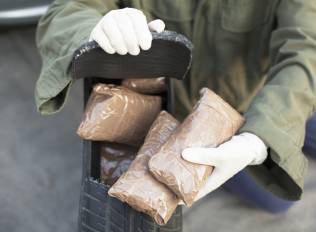
    The main way Mexican fentanyl enters the United States is in hidden compartments inside vehicles crossing through official border crossings, according to Customs and Border Protection (CBP). About 85% of the stuff comes in through the San Diego crossing, but the Drug Enforcement Administration notes that Arizona’s crossings are seeing a sharp rise in fentanyl seizures.

    Between 2017 and 2018, the DEA saw seizures rise from 172 pounds, or 54,984 pills, to a whopping 445 pounds, or 379,557 pills.

    The Sinaloa cartel continues to smuggle drugs despite the extradition of its leader, El Chapo, who recently received a life sentence in the U.S. This is a testament to their ability, says Coleman. 

    View the original article at thefix.com

  • El Chapo Trial Ends, Leaving Drug Lord Facing Life In Prison

    El Chapo Trial Ends, Leaving Drug Lord Facing Life In Prison

    El Chapo’s sentencing hearing is set for June 25.

    The three-month long trial of El Chapo, whose real name is Joaquín Guzmán Loera, came to an end on Tuesday (Feb. 12), the New York Times reports. Guzmán was found guilty of leading a Mexican drug cartel, the Sinaloa cartel, and aiding in smuggling tons of drugs into the United States. He was found convicted on all 10 charges he faced. 

    The determination from the jury was given more than a week after the deliberations started in Federal District Court in Brooklyn, New York. During the trial, 56 witnesses spokes against Guzmán, 14 of whom had worked with him at one point. 

    “Confronting this onslaught, Mr. Guzmán’s lawyers offered little in the way of an affirmative defense, opting instead to use cross-examination to attack the credibility of the witnesses, most of whom were seasoned criminals with their own long histories of lying, cheating, drug dealing and killing,” the Times reports. 

    Guzmán’s sentencing hearing is set for June 25. He faces life in prison, though it is not yet determined where he will serve his time.

    U.S. attorney for the Eastern District of New York, Richard P. Donoghue, spoke outside the courthouse. He stated that the verdict was a victory. “There are those who say the war on drugs is not worth fighting,” Mr. Donoghue added. “Those people are wrong.”

    Guzmán’s lawyers say they plan to file an appeal. 

    “When he came here he was already presumed guilty by everyone, unfortunately. We weren’t just fighting evidence, we were fighting perception,” said A. Eduardo Balarezo, one of his lawyers. 

    Despite the fact that aspects of the cartel were uncovered and Guzmán was convicted, the Times reports that the Sinaloa cartel is still in operation. In fact, the Drug Enforcement Administration states that in 2016 and 2017, when Guzmán was taken into custody for the final time, heroin production in Mexico still grew by 37% and border seizures of fentanyl “more than doubled.”

    Ángel Meléndez, the special agent in charge for Homeland Security Investigations, tells the Times that the outcome of this case drives home an important message to others involved in trafficking.

    “One of the important things about this conviction is that it sends a resounding message,” he said. “You’re not unreachable, you’re not untouchable and your day will come.”

    View the original article at thefix.com

  • Whistleblower Alleges Tesla Covered Up Employee's Drug Dealing Ties

    Whistleblower Alleges Tesla Covered Up Employee's Drug Dealing Ties

    Whistleblower Karl Hansen alleges that raising those concerns to Tesla management was what got him fired in mid-July.

    Last week, a former Tesla security employee filed an explosive tip with the Securities and Exchange Commission, claiming the company hacked employee cell phones and turned a blind eye to drug dealing and large-scale theft at the Nevada Gigafactory.

    Whistleblower Karl Hansen claimed that raising those concerns to Tesla management was what got him fired mid-July, according to The Mercury News. Hansen lodged his complaint with the feds on August 9, according to his attorney Stuart Meissner, of the New York-based firm Meissner Associates. 

    The sweeping complaint claims that Tesla spied on its own workers by wiretapping their phones and hacking their computers, including those of another recently axed whistleblower, Martin Tripp. 

    Hansen also accused the company of keeping secret the results of its internal probe into a cartel-connected coke- and meth-dealing ring that one employee operated out of the Nevada site, a claim to which the DEA supposedly alerted the company.

    On top of that, Hansen alleges that Tesla neglected to disclose information about $37 million worth of raw materials stolen this year, an incident that supposedly led to the firing of another worker who reported it all to police. 

    Tesla fired back against the allegations with its own statement, saying the claims were “taken very seriously” when Hansen came forward with them—but ultimately, the company claimed, they couldn’t be proven. 

    “Some of his claims are outright false,” the company said, according to a statement published by CNBC. “Others could not be corroborated, so we suggested additional investigative steps to try and validate the information he had received second-hand from a single anonymous source.”

    But, Tesla claimed, Hansen refused to keep speaking with the company. 

    “It seems strange that Mr. Hansen would claim that he is concerned about something happening within the company,” Tesla added, “but then refuse to engage with the company to discuss the information that he believes he has.”

    Elon Musk was more to-the-point in his appraisal of Hansen. 

    “This guy is super [nuts],” he wrote in a Twitter DM to a Gizmodo reporter, using the peanut emoji to drive home the point. 

    “He is simultaneously saying that our security sucks (it’s not great, but I’m pretty sure we aren’t a branch of the Sinaloa cartel like he claims) and that we have amazing spying ability,” Musk added. “Those can’t both be true.”

    View the original article at thefix.com

  • FBI Raid Nets 20 Suspected Cartel Traffickers, Nearly A Ton Of Cocaine

    FBI Raid Nets 20 Suspected Cartel Traffickers, Nearly A Ton Of Cocaine

    Three sprawling federal indictments unsealed last week named 57 defendants snared in the operation—and 35 of them are still on the run.

    Twenty alleged Sinaloa Cartel drug traffickers were arrested early Wednesday in a web of raids that netted 850 pounds of meth, nearly 1 ton of cocaine, 93 pounds of heroin and $1.42 million in cash. 

    Over the course of a three-year investigation involving a slew of government agencies from the Internal Revenue Service (IRS) to Los Angeles police, investigators uncovered a massive drug-trafficking ring regularly hauling in kilograms of narcotics from south of the border. Law enforcement also seized nearly 50 pounds of cannabis.

    Three sprawling federal indictments unsealed last week named 57 defendants snared in the operation—and 35 of them are still on the run. Most are believed to be in Mexico, according to the U.S. Department of Justice.

    “More than simply seizing large quantities of drugs and money, this investigation was able to identify the top-level, Mexican-based traffickers who directed the transactions, and who thought they were using secure communication devices to commit their crimes,” First Assistant United States Attorney Tracy L. Wilkison said in a statement. “Our ability to obtain those communications continues to be an important part of our ability to solve these crimes.” 

    The investigation—known as Operation Narconetas—zeroed in on three drug trafficking organizations accused of using vehicles with hidden compartments to smuggle large quantities of drugs from Mexico to the U.S., sometimes storing the substances in stash houses before distributing them throughout the country.

    The indictments outline allegations of vast drug trafficking conspiracies, and also include asset forfeiture requests as the government seeks to seize any property or resources used in the smuggling operation.

    “Today’s arrest of multiple defendants for their alleged role in smuggling funds from illegal drug transactions in and out of the United States is a victory for the American public and a defeat to drug traffickers everywhere,” said IRS Special Agent in Charge R. Damon Rowe of the Los Angeles Field Office. “The special agents of IRS Criminal Investigation continue in their mission to disrupt the flow of ill-gotten gains that is the life-blood for these criminals.”

    The multi-agency task force behind the arrests, known as the Los Angeles Strike Force, was formed in 2014 to target Mexican drug cartels in Los Angeles, which authorities identified as a major hub for drug trafficking and money laundering.

    The strike force, led by the Federal Bureau of Investigation (FBI) and the Drug Enforcement Administration (DEA), also included the Bureau of Alcohol, Tobacco, Firearms and Explosives; the California Highway Patrol; Torrance Police Department; U.S. Immigration and Customs Enforcement’s Homeland Security Investigations; Los Angeles Police Department and others.

    The arrests and indictments are just the latest federal offensive against the violent cartel. Earlier this year, prosecutors in San Diego indicted 75 people in a $6 million money laundering bust using WhatsApp, according to the Los Angeles Times

    View the original article at thefix.com