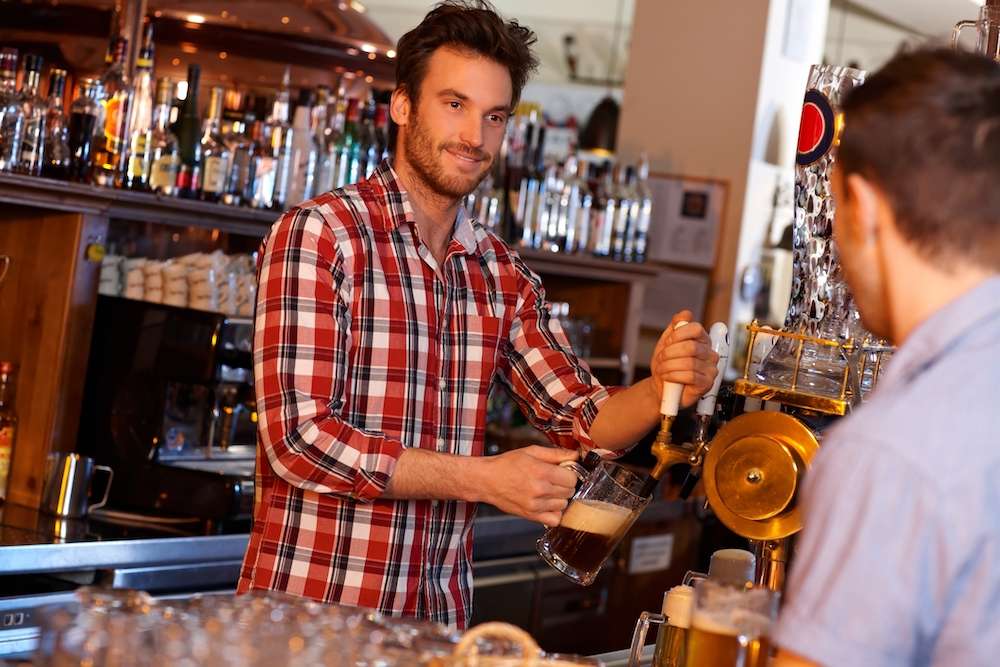
Tag: sober bartenders

  • Pin Project Helps Servers Tell People They’re Abstaining From Alcohol

    Pin Project Helps Servers Tell People They’re Abstaining From Alcohol

    The pin initiative allows servers to nonverbally communicate to coworkers and patrons that they won’t be drinking during a shift.

    For people working behind a bar, drinking during a shift can be a way to socialize with colleagues, keep patrons happy and keep work fun. However, one sober bartender wants to make it easier for servers to let people know that they’re not drinking that shift, with no messy explanations. 

    Mark Goodwin, who has been sober for 10 months, founded The Pin Project as a way for servers to send a signal to their communities. The small pins that he will soon be selling for $15 tell coworkers and patrons that a server won’t be drinking during that shift.

    “Bartenders are surrounded by alcohol, but we rarely talk about that as putting ourselves in a risky situation,” Goodwin told Vinepair. “For some of us, it really is.”

    However, the pin isn’t just for people in recovery—it’s for anyone who wants to pass up drinking for their shift for any reason. This aspect is very important, Goodwin said. 

    “It’s not a sobriety token,” he said. Rather, the pins “let the people around you know that you’re making a choice not to imbibe that shift… You could be on antibiotics, or you might have to pick someone up from the airport, or maybe you have a substance problem.”

    Everyone can use the pin to steer their own relationship with alcohol at work, without intrusive questions. “You could put the pin on and wear it forever,” Goodwin said. “But what’s really important is that it’s now.”

    The Pin Project received a grant in 2018 from Tales of the Cocktail Foundation, which supports service industry workers. 

    “Whether it’s just a night off, or many nights off, we hope The Pin Project helps bartenders (and patrons alike) remove the stigmas around not drinking,” said the organization’s Executive Director Caroline Rosen. 

    The Bay Area is the first region where Goodwin will promote the pins, but he hopes to have the initiative take off in other major cities as well. Half of the proceeds will go toward funding the Pin Foundation, which will support counseling and mental health services for hospitality workers. 

    Goodwin knows that making the pins mainstream will take a lot of effort. “There’s a lot of work left to do,” he said. 

    However, he is hopeful that the Pin Project will make it easier to talk about not drinking in the heart of the nightlife scene, and he is happy to see the positive response that the initiative has received thus far. 

    “I’m really honored and humbled to see people taking interest in this little idea that started over a couple of hungover breakfasts,” he said.

    View the original article at thefix.com

  • Bartenders Talk Being Sober In The Alcohol Industry

    Bartenders Talk Being Sober In The Alcohol Industry

    Fine cocktail places are getting into the sober spirit, supporting a health-conscious clientele with non-alcoholic drinks.

    The concept may at first seem like an oxymoron, but sober bartenders are becoming more common as the industry transforms.

    Bar professionals like Jack McGarry of New York’s famous Dead Rabbit and Nectaly Mendoza of Las Vegas’ Herbs & Rye don’t drink anymore, breaking the industry stigma of sober servers and, eventually, sober bar patrons.

    “It sort of ties back into the maturity and the further professionalization of our industry,” said McGarry, explaining that the bar industry was traditionally synonymous with a party atmosphere that invited health problems and alcoholism.

    As bartending has evolved, it has increasingly entered into a professional space—some places elevating themselves to something comparable to a fine-dining restaurant. Moderation and sobriety have come hand-in-hand with this professionalism, and they’re welcoming to any customers who are also seeking the same.

    “The reality is, anyone who drinks regularly knows there are periods where people might not want to drink,” said Jim Kearns of The Happiest Hour and Slowly Shirley in New York.

    To accommodate this, it’s increasingly common for bars to have alcohol-free cocktails on the menu. Not only do some establishments take pride in their non-alcoholic concoctions, any restaurant seeking the coveted Michelin stars is required to offer a non-alcoholic cocktail menu to even be considered.

    Mendoza also has some wisdom to dispense regarding cutting down alcohol in your life: don’t try too hard.

    “If you’re trying to lose weight, and you only eat a can of tuna and water, you’re setting yourself up for failure,” said Mendoza.

    Another key factor is dealing with friends or family who might be put off by you not joining in on the liquid revelry. On this, the pros agree: just be honest.

    “Tell your people you’re doing it for a month so you have their support, and they can also hold you accountable for it,” McGarry advised. “You’re just making it more difficult [by lying]. It’s already difficult enough without making it harder.”

    Kearns’ advice is more blunt.

    “If anybody is mad about a choice that’s made in someone’s best interest, maybe they’re not a very good friend,” he said.

    In the end, it’s your choice, they stress. And it’s not as hard as you might think.

    View the original article at thefix.com

  • Sober Bartenders Share Their Experiences At Work

    Sober Bartenders Share Their Experiences At Work

    “People can see sobriety as a referendum on their own drinking. I’ll tell someone that I’m sober, and their response will be, ‘Well, I don’t have a drinking problem.’”

    When you get sober, it’s highly recommended you stay away from old environments and friends that could trigger a relapse.

    So while it may seem intuitive to stay away from bartending if you’re in recovery, Mic spoke to a number of bartenders who are doing the opposite.

    One bartender in Los Angeles, Billy Ray, said, “I couldn’t imagine a life without alcohol, yet I wanted to stop. I tried everything from Sober January to limiting myself to just beer and wine.”

    Ray’s identity was so wrapped up in his work “that I had the thought run through my head I should kill myself. I thought it was the only way out.”

    After Ray got sober, he explains, “Now and then I get called boring or a guest is offended that I will not take a shot with them.”

    At the same time, he can talk with customers about what they’re going through with their own drinking. “I am able to share with them what I have walked through and help in any way I can.”

    Joanna Carpenter, a bartender who works in New York says, “Bartending sober is, in a word, hard.”

    A lot of customers find it odd that Carpenter stays away from drinking. “I can never tell if they’re expecting me to crumble out of desperation for a drink or if they’re waiting for me to wax poetic as to the reasons I don’t imbibe,” she says. “The people pleaser in me always feels like I have to walk around with a stash of explanations.”

    Bartending can also be a challenge when you’re trying to emphasize self-care in sobriety. Carpenter adds, “Believe it or not, self-care is one of the last things that is prioritized in hospitality, so to actively make the choice to cut out the lubricant that gets us all going feels like a scary upstream swim.”

    A lot of sober bartenders also don’t speak openly about their recovery in an industry that needs a steady stream of drinkers to make money.

    As another explained, “I don’t tend to tell guests about it unless I’m backed into a corner… People can see sobriety as a referendum on their own drinking. I’ll tell someone that I’m sober, and their response will be, ‘Well, I don’t have a drinking problem.’”

    The bartender explains, “Hospitality is about making people comfortable, and because of that, I’m not inclined to do things that run counter to that.”

    Yet contrary to how many would think, one bartender explains, “There’s a misconception that bartenders somehow need to drink in order to enjoy their job, which is so wrong!”

    While it can definitely be challenging to work in an environment where you’re surrounded by temptation, this bartender has a good team of co-workers “that are completely respectful of my sobriety. That makes it easy to come to work and be my sober self.”

    View the original article at thefix.com