Category: Take Control

  • Persuasive Technology 101

    Persuasive Technology 101

    The digital environment isn’t all bad, but our time spent in it is dominated by a small number of large platforms that use sophisticated manipulation techniques to keep us on screens. Amazon, Instagram, Snapchat, Facebook, Twitter and TikTok are all built around these techniques. It’s called persuasive technology.

    All these companies are part of what’s been called the attention economy, an online environment that treats our human focus and attention as a commodity and where each company or platform is vying to keep more and more of it focused on their products, apps and platforms.

    But what exactly is persuasive tech? And, more importantly, what do we need to do if we don’t want to be manipulated by it? Here’s our starter guide on how persuasive technology works.

    #1 What is persuasive technology and where did it come from?

    Persuasive technology was pioneered largely by one man, Professor BJ Fogg, at Stanford University in the late 1990s. He began formulating the principles of persuasion in technology while studying for his doctorate in psychology. In 1998 he founded the Stanford Persuasive Tech Lab, subsequently re-renamed the ‘Behavior Design Lab‘, for the study and promotion of technologies which can change and/or modify human behaviour.

    “​In written form, my model looks like this:

    ​B=MAP

     Here’s the simplest way to explain it: “Behavior (B) happens when Motivation (M), Ability (A), and a Prompt (P) come together at the same moment.”

    BJ Fogg ‘Fogg Behavior Model’

    All the features of persuasive tech use the three factors of Fogg’s ‘Behavior Model’ to manipulate their users – motivation, ability, and prompts – and get them behaving in the way they want. 

    • Motivation  – a desire to connect with other people (social media) or a desire for a product (online shopping) for example.
    • Ability – the ability to actually do what the technology or app wants us to do (click on a button, input a credit card, share a post). 
    • Prompts – features like banners, app badges, sounds and notifications, ‘prompting’ us what to do.

    Good examples are those red numbers on our app icons ( ‘badges’) or the banners that pop up on our phone lock and home screens. They all get us going back and reconnecting with an app, even when we had no desire to use that app right now – or were happily doing something else.

    Fogg’s influence can be seen everywhere in Big Tech. The co-founder of Instagram was a student of his and there are now numerous former students of his lab working in tech. His 2007 ‘Facebook class’, which encouraged students to design and launch Facebook apps at rapid speed, made many of his students millionaires before they’d even finished the course at Stanford.

    #2 What makes persuasive technology work so well?

    Persuasive tech works so brilliantly because it manipulates human psychology and exploits our weaknesses (and sometimes also our strengths) to make us do its bidding.

    We tend respond to urgent alerts, for example, because as humans we are primed to recognise danger and warnings (all app badge notifications tend to be red, the classic warning colour). This tendency to be hyper-alert to dangers and threats in our environment is what kept us alive in our hunter-gatherer days and our brains haven’t changed much since then, though the world around us has.

    Persuasive technology manipulates our hunter-gatherer brain today

    We’re also primed as humans to seek out human connection and to look for signs of approval from those around us (another tendency that kept us safe – keeping us within a larger group). Signs of approval from those around us ‘reward’ our primitive brains with bursts of dopamine – the feel good brain hormone.

    Persuasive technology is now mostly built using artificial intelligence (AI) which can work at break-neck speed to track how each of us is responding in real-time to different prompts and techniques and then refine and hone the tricks that work best on our unique psychology. You might be immune to red badge icons on apps for example, but particularly susceptible to app banners on your home screen. Or, you might respond very speedily to the type of messages telling you what you’ve missed on an app while you’ve been away from it.

    Of course, people trying to ‘sell’ a product or service have always used human psychology to manipulate their customers into buying. But what is happening now is on a huge scale with billions of dollars invested in it and with computing power more powerful than anything seen before in our history.

    #3 What harm is persuasive tech doing to all of us?

    Persuasive technology is manipulating human behaviour on a global scale and with that has come many unintended consequences. At its most basic level it’s causing us to waste hours of time on social media. At its most concerning it’s changing society by manipulating our opinions, our world views, our view of ourselves and our bodies and facilitating the spread of damaging misinformation online.

    Wasting our time

    Scrolling through social media may seem benign and spending just a little bit more time than we really intended to may not seem much of a problem. But evidence is building that these apps are wasting hours and hours of our days and causing us to scroll aimlessly for those tiny brain rewards, neglecting important areas of our lives. We now spend an average of nearly two and a half hours a day on social media – up from an hour and a half in 2012 just ten years ago.

    Changing society

    The unintended consequences and societal changes are the most concerning aspect of persuasive technology. Some scientists believe that the increasing time on social media is causing widespread mental health damage for example. And disinformation spread by anti-vaxxers or climate-change deniers has done real damage to society and to the planet. YouTube’s recommendation engine, built around persuasive technology, has been found to amplify outrage, conspiracy theories, and extremism to keep us watching.

    BJ Fogg actually warned about the damage persuasive technology could potentially do at some point in the future. This video was put together by him and his students as far back as 2006.

    The inventor of persuasive technology warns about its use.

    #4 What can we do about it?

    If we don’t want to be manipulated by Big Tech and persuasive technology we need to take back control. We need to put our scrolling and viewing habits firmly back under the charge our own conscious decision-making abilities, rather than blindly allow ourselves to go down internet rabbit holes designed to ensnare us. Here are some suggestions;

    • Turn off notifications – persuasive tech isn’t magic. The prompts only work if you can see or hear them (or feel them if you have vibration mode on). Turn off as many as possible on your devices so you choose when to engage with your apps – not Big Tech.
    • Cull social media apps – be ruthless and eliminate as many as possible. We have very little good news, and lots of bad, on what these apps are doing to us. Use them sparingly.
    • Be wise to emotional triggers – sharing of disinformation and propaganda largely relies on stirring up strong emotions. Be very careful if a post or video makes you feel very angry or indignant. Resist the temptation to share outrage.
    • Use anti-distraction tools – digital wellbeing tools and apps have developed a lot in the past few years as persuasive tech has been more widely discussed. Apps like Forest and Freedom will help you stay focused.

    digital detox bookdigital detox book

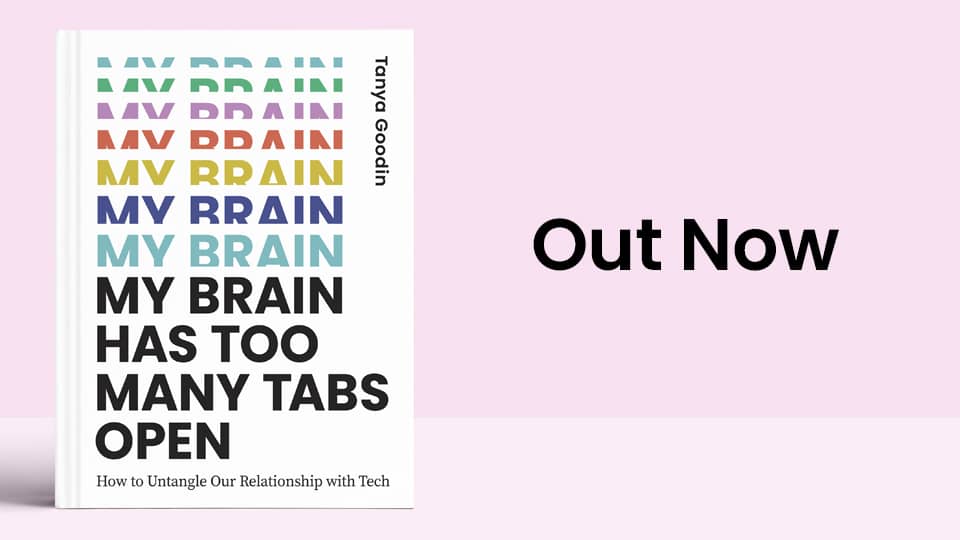
    For more about how persuasive tech and the attention economy and how to resist it, without switching off completely – pick up a copy of our new book: My Brain Has Too Many Tabs Open. Available to order here.
    View the original article at itstimetologoff.com

  • Is ‘Slowcial Media’ The Answer?

    Is ‘Slowcial Media’ The Answer?

    Social media addiction is on the rise with more and more people struggling to stop endlessly scrolling through their feeds. Could ‘slowcial media’ be the answer to using social media intentionally and avoiding some of the harmful side-effects?

    What is slowcial media?

    Slowcial media is all about slowing down the rush to connect with tech and making it intentional, meaningful and mindful. It can be applied to the ways in which we use social media – or it can be applied to a whole new type of tech which focuses on mindfulness and meaningful connection.

    Slowcial Media: Platforms that foster unhurried and meaningful connection between humans”.

    Urban Dictionary

    In that sense, slowcial media can be compared to other ‘slow’ cultural movements to slow down life’s pace, such as the slow food movement or slow fashion, both of which ask for considered consumption, thinking about the sources of products, and emphasising sustainability.

    The slow movement is thought to have begun in 1986 when Carlo Petrini protested against the opening of a McDonald’s restaurant near the world-famous Spanish Steps in Rome. His protest sparked the creation of the slow food movement which over time developed into the full-blown slow subculture.

    “It is a cultural revolution against the notion that faster is always better. The Slow philosophy is not about doing everything at a snail’s pace. It’s about seeking to do everything at the right speed. Savouring the hours and minutes rather than just counting them. Doing everything as well as possible, instead of as fast as possible. It’s about quality over quantity in everything from work to food to parenting.”

     Carl Honoré  In Praise of Slow

    Can using social media itself ever be ‘slow’?

    The attention economy and persuasive tech encourages us to use social media at break-neck speed, scrolling from one feed and account to another, FOMO making us worry that we might be missing out. But, we can learn to use social media intentionally and mindfully if we follow a few simple rules:

    • Set limits for time spent online.
    • Set an intention before you connect with social media – what’s your purpose in using it?
    • Keep checking in with how social media makes you feel.
    • Use social media to be inspired and informed – follow accounts that celebrate achievement, not appearance.
    • Reply thoughtfully to online interactions, pause before responding.
    • Put hurdles and obstacles in place to make you slow down before you use apps.

    Your hurdles and obstacles can be very personal and specific to you. Some ideas; putting your phone in another room, uninstalling social media apps at certain times, leaving messages for yourself on the home screen of your phone. Think creatively about how you can design behavioural nudges like these to ensure you’re being mindful about your use.

    Other uses which help you to go slow

    Of course, it’s not just about using social media apps in a way that’s more intentional. There are a range of other apps which exist purely for the purpose of developing mindfulness and meaningful connection. Some ideas might be;

    • Headspace – an app for everyday mindfulness and meditation.
    • Freedom – an app and website blocker, to enable you to focus and be productive.
    • Reflection – a journalling-focused app that guides a meaningful reflection practice.
    • Forest – another app to help focus, but this one plants a tree in the real-world if you meet your goals.

    The slowcial media action plan

    Here’s our simple plan to help you reap the benefits of a more slowcial approach

    1. Use existing social media and other apps mindfully.
    2. Prune notifications and alerts that distract you.
    3. Set an intention every time you use an app that might be encouraging you to be mindless.
    4. Look for alternatives that encourage meaningful connection.

    If you want to try out a full disconnection from tech to slow down, check out all the resources on our website for how to do a digital detox.

    View the original article at itstimetologoff.com

  • It’s OK to Ignore a Text (Sometimes)

    It’s OK to Ignore a Text (Sometimes)

    Human communication never used to be immediate, unless we were standing face-to-face. Letters could take days to arrive, and even more time to be answered. Phone calls could be left ringing, or answered by an answerphone message. No-one got irate if their attempts to contact us took a little bit of time. Now, if we ignore a text for longer than a few minutes it feels like a deadly social crime.

    Text response times, ghosting, and being ‘left on read’ spawn memes all over the internet. We’re all agonising about why our messages aren’t being replied to immediately, while acknowledging we’re all overwhelmed with the volume of messages we receive every day.

    So, is it really ever OK just to ignore a text?

    Messaging is overwhelming us

    Before we answer that question, take a look at just how big the problem of messaging overwhelm is. In 2016 Mark Zuckerberg revealed that the daily message volume from Facebook Messenger and WhatsApp combined stood at three times the global volume of daily SMS messages, at 60 billion messages a day compared to 20 billion SMSs. And in 2012 we knew that adults 18-44 were individually sending and receiving between 50 and 120 texts a day.

    • Adults 18-24 sent and received over 128 texts every day.
    • Adults 25-34 sent and received over 75 texts a day.
    • Adults 35-44 sent and received about 52 texts a day.

    A decade later we have a glimpse into how those messages have proliferated. In the third quarter of 2021 in the UK alone the volume of SMS and MMS messages sent and received was around 10.6 billion messages.

    Take a look at your own phone for a minute and count up how many messages you sent and received across all messaging platforms yesterday. Had you any idea just how many it was?

    Do response times really = importance?

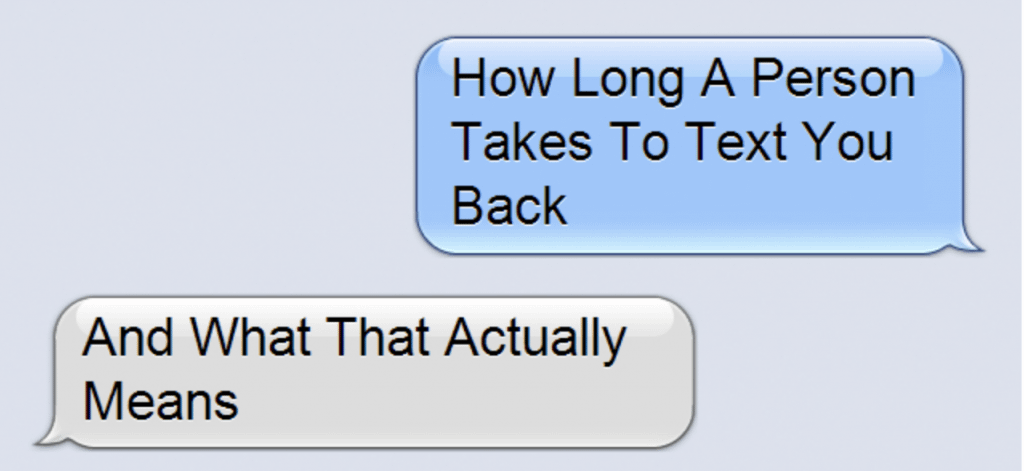
    A whole heap of (only partially) tongue-in-cheek analysis has been devoted online to what it really means when someone takes a takes a certain amount of time to text you back. 12+ hours apparently means “you’re definitely on the cusp of insignificance” whereas 5-60 seconds means “You are Christmas morning to this person!”.

    It’s OK to Ignore a Text (Sometimes)

    It’s worth noting though that even in the good news that you are “Christmas morning” to the speedy responder is buried the warning “Or they have no life at all”…

    So, does the length of response time really equate to where you are in the life importance hierarchy of the person receiving it? What if they’re in a meeting, on a call, in the gym? What if they’re having a really, really bad day (or equally a really, really good one, and are off out celebrating somewhere)? What if they’re sitting across a table from a friend who, maybe one day like you, needs their full attention right now?

    The agony of being ‘left on read’

    Of course, it’s not as simple as just agonising over the gap between sending a message and receiving the response. ‘Read’ receipts, introduced by Apple in 2011, signalling when a message is ‘read’, rather than just ‘delivered’ (along with the timestamp) introduced a whole new realm of messaging-related anxiety. (Along with those evil blue ticks on WhatsApp).  Both the Apple and WhatsApp read receipts can now be switched off (whew) but Facebook and Snapchat, don’t allow that. Snapchat even cruelly lets us know whether a screenshot of a snap or message has been taken.

    It’s OK to Ignore a Text (Sometimes)
    How does this make you feel? Would it be better if you couldn’t see that ‘read’ timestamp?

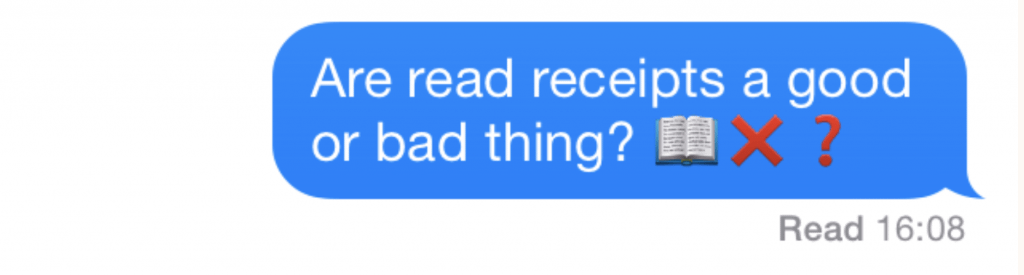
    Knowing when something we’ve sent has been received isn’t new of course. Postal organisations have let us use ‘signed for’ services for decades, so we could find out when a parcel or package was received. Courier and delivery companies now even record and send a photo of a parcel actually being handed over on the doorstep. But the ‘read’ receipts of the online world seem to induce a particular type of agony. We are unequivocal in our advice on this for your mental health – turn read receipts off.

    It’s OK to Ignore a Text (Sometimes)
    We’re going to say ‘bad’.

    Digital triage

    One of our favourite digital gurus Cal Newport, whom we interviewed on our ‘It’s Complicated’ podcast, describes what we all need to do with digital and messaging overwhelm as ‘digital triage’. And digital triage inevitably means that yes, sometimes we are just going to have to ignore a text message for a while, if something much more urgent is in our in-box.

    triage (noun)

    (in medical use) the assignment of degrees of urgency to wounds or illnesses to decide the order of treatment of a large number of patients or casualties.

    Most of us have absolutely no choice but to get much better at digital triage and to make it a central part of our day, when we’re flooded with requests for Zoom calls, Slack messages, emails, texts and DMs. Instead of attempting the impossible task of replying to everything immediately, we need to stop and think before answering and work out which ones are urgent and which merely important, while not worrying about offending those who we place further down the triage list.

    Balancing good manners and self care

    Maybe our worries about how our response (or delayed response) will be perceived are actually more about us than the sender?  A November 2021 study found receivers tend to overestimate how quickly senders expect responses to non-urgent work emails, for example. Perhaps the same is true for messaging, and we can let ourselves off the hook a little more than we think?

    “You have to be a civil and decent person, but you don’t have to give your time and attention to everyone who asks for it.”

    Daniel Post senning, the emily post institute

    It’s all about how we ignore a text of course. No-one wants to be rude. So, set clear expectations for response times, use automated tools to let people know you won’t be responding for a while and remind yourself that, if you’re doing digital triage properly, not every message needs or deserves a response.

    The sanity checklist

    So, yes, we really do think there are times when it’s absolutely OK to ignore a text. But, unless you want to find yourself without any friends and with a very annoyed family, design your environment and communicate your new habits clearly so you can do this with the minimum of offence given. Here’s our checklist;

    • Tell everyone your ‘no go’ texting times ( ie “never after midnight”)
    • Disable all ‘read’ receipts
    • Make use of ‘do not disturb’ mode
    • Enable ‘auto reply’ features
    • Give others permission to ignore a text from you

    That last one is the most important of all. You can’t expect to be able ignore a text from a friend because it doesn’t come at a good time for you, then get upset when they do the same. Explain that this is about taking stress off everyone and that you’re completely OK with longer response times (just make sure you mean it, when you say it).

    It’s OK to Ignore a Text (Sometimes)It’s OK to Ignore a Text (Sometimes)

    For more about texting, messaging and the impacts of being over-connected to the digital world – pick up a copy of our new book: My Brain Has Too Many Tabs Open. Available to order here.
    View the original article at itstimetologoff.com

  • Spending money late at night on things you don’t really need? Beware ‘vampire shopping’.

    Spending money late at night on things you don’t really need? Beware ‘vampire shopping’.

    This is post 4 of 4 in the series “My Brain Has Too Many Tabs Open”

    1. Are You Guilty of Sharenting? How to Stop
    2. Have you been ‘phubbing’ your loved ones? We can help.
    3. Technoference: What it is and How to Stop Doing it.
    4. Spending money late at night on things you don’t really need? Beware ‘vampire shopping’.

    As we come out of the Christmas season, and on through the January sales, many of us will be seeing an increase in the number of packages delivered to our door on a weekly (sometimes daily..) basis. This phenomenon of excessive spending is not a seasonal issue. If we’re honest, we all know that come February and March we will all still be scrolling through clothes, home improvement and pet care sites, buying things we don’t really need. Compared to just 10 years ago we are buying exponentially more, and now those purchases have been moved online, removing the friction of in-person shopping trips of yore. It’s not simply a lack of willpower either, we are being manipulated into late night sprees we can’t afford with the same techniques used to hook us into social media: we are vampire shopping.

    What is Vampire Shopping?

    Vampire shopping is the act of online shopping late at night, usually between 1 and 4am. It is characterised by shopping largely from your bed, making more purchases than you would at any other time. Often buying things you may realise the next day were not entirely essential. If that sounds familiar, you are not alone. Over 1/3 of shoppers now spend more money at night than during the day. Perhaps not surprisingly the over-represented groups in the vampire shopping category are gamers and sleep deprived parents. It has become more and more prevalent because of the ease of spending money online: just one click away if you use ApplePay, “It doesn’t feel like real money” as one self-confessed vampire shopper exclaimed.

    Why is it a problem?

    Vampire shopping is a problem because it is characterised by buying things we don’t actually need, and haven’t thought enough about, because we make the decision in the stupor of late night scrolling. Not only that, but we are much more likely to make bad financial decisions later in the evening. If you scroll at night instead of during the day research shows you’re likely to spend 20% more. In a country like the UK, where our hours of night are greatly increased in the winter months this can mean that shoppers spend nearly 2.5 hours shopping at night in winter compared to 1.5 hours in the summer.

    How to stop

    If, like thousands of shoppers around the world, this is no longer sustainable for you – have no fear. We have some advice which should stop your late night sprees in their steps:

    1. Remove all your card details from auto-fill online and from any eWallet you may have. This reintroduces the friction which would exist in real life and gives you a second to evaluate your purchase.
    2. Leave the items in your basket overnight: if you are shopping late at night it is highly unlikely that what you want will have sold out tomorrow so give yourself a night’s sleep before you make the purchase: you will be surprised how frequently you decide you really don’t need it come sun up.
    3. Check in with yourself: if you are feeling Hungry, Angry, Lonely or Tired it’s time to HALT your late-night scrolling, and try and get some sleep.

    If you want to learn more about ‘vampire shopping’ and the many other ways in which our digital habits are changing our lives, pick up Tanya Goodin’s new book: ‘My Brain Has Too Many Tabs Open’.

    View the original article at itstimetologoff.com

  • Spending money late at night on things you don’t really need? Beware ‘vampire shopping’.

    This is post 4 of 4 in the series “My Brain Has Too Many Tabs Open”

    1. Are You Guilty of Sharenting? How to Stop
    2. Have you been ‘phubbing’ your loved ones? We can help.
    3. Technoference: What it is and How to Stop Doing it.
    4. Spending money late at night on things you don’t really need? Beware ‘vampire shopping’.

    As we come out of the Christmas season, and on through the January sales, many of us will be seeing an increase in the number of packages delivered to our door on a weekly (sometimes daily..) basis. This phenomenon of excessive spending is not a seasonal issue. If we’re honest, we all know that come February and March we will all still be scrolling through clothes, home improvement and pet care sites, buying things we don’t really need. Compared to just 10 years ago we are buying exponentially more, and now those purchases have been moved online, removing the friction of in-person shopping trips of yore. It’s not simply a lack of willpower either, we are being manipulated into late night sprees we can’t afford with the same techniques used to hook us into social media: we are vampire shopping.

    What is Vampire Shopping?

    Vampire shopping is the act of online shopping late at night, usually between 1 and 4am. It is characterised by shopping largely from your bed, making more purchases than you would at any other time. Often buying things you may realise the next day were not entirely essential. If that sounds familiar, you are not alone. Over 1/3 of shoppers now spend more money at night than during the day. Perhaps not surprisingly the over-represented groups in the vampire shopping category are gamers and sleep deprived parents. It has become more and more prevalent because of the ease of spending money online: just one click away if you use ApplePay, “It doesn’t feel like real money” as one self-confessed vampire shopper exclaimed.

    Why is it a problem?

    Vampire shopping is a problem because it is characterised by buying things we don’t actually need, and haven’t thought enough about, because we make the decision in the stupor of late night scrolling. Not only that, but we are much more likely to make bad financial decisions later in the evening. If you scroll at night instead of during the day research shows you’re likely to spend 20% more. In a country like the UK, where our hours of night are greatly increased in the winter months this can mean that shoppers spend nearly 2.5 hours shopping at night in winter compared to 1.5 hours in the summer.

    How to stop

    If, like thousands of shoppers around the world, this is no longer sustainable for you – have no fear. We have some advice which should stop your late night sprees in their steps:

    1. Remove all your card details from auto-fill online and from any eWallet you may have. This reintroduces the friction which would exist in real life and gives you a second to evaluate your purchase.
    2. Leave the items in your basket overnight: if you are shopping late at night it is highly unlikely that what you want will have sold out tomorrow so give yourself a night’s sleep before you make the purchase: you will be surprised how frequently you decide you really don’t need it come sun up.
    3. Check in with yourself: if you are feeling Hungry, Angry, Lonely or Tired it’s time to HALT your late-night scrolling, and try and get some sleep.

    If you want to learn more about ‘vampire shopping’ and the many other ways in which our digital habits are changing our lives, pick up Tanya Goodin’s new book: ‘My Brain Has Too Many Tabs Open’.

    The post Spending money late at night on things you don’t really need? Beware ‘vampire shopping’. appeared first on Time to Log Off.

    Source: itstimetologoff