Author: It’s Time to Log Off

  • Digital Detox for Teens: BBC Mimi on a Mission [review]

    Digital Detox for Teens: BBC Mimi on a Mission [review]

    We were intrigued to find out about social media content creator Mimi Missfit’s new BBC iPlayer series, which investigates the need for a teen digital detox. In the series she takes seven teens from varied backgrounds (although mostly city kids) and together they camp for a week in the Cairngorms with celebrity guests joining them each day. Though the focus is placed more on nature and connection than the tech they are giving up, this show is a great first step to examine the relationships that iGen have with technology and how a digital detox for teens could potentially help them.

    Are they all addicted?

    We, think don’t we, that teenagers are the age group most incapable of switching off from devices? We believe that they are always distracted by likes and comments and that they can’t stop comparing themselves to those around them. This is certainly the case for some of the members of the group. Elise admits to only getting 2-3 hours of sleep a night and struggles to stay awake in school, due to her love of gaming (she has an all-time high record of 18.5 hrs on a game). She is not alone. 22% of 12-15 year olds say that watching too much TV has caused them to fall behind in their school work; another study showed that teenagers who spent more than 4 hours online per day were 3.5x more likely to get poor sleep – which is defined as less than 5 hours a night.

    Digital Detox for Teens: BBC Mimi on a Mission [review]

    Yet in this group of seven are two teenagers who would seem to buck the ‘addicted teens’ trend – Shanzeh and Maddie. Shanzeh doesn’t even own a phone believing that she has enough to occupy her time without getting distracted by a phone. Maddie, on the other hand, does have a phone but doesn’t have social media believing that she doesn’t have strong enough self-confidence to manage the onslaught of negative comments.

    Amy Hart

    One of the celeb guests to the digital detox for teens is Amy Hart, best known for appearing on Love Island 2019. She and Mimi Missfit have both spoken out about the impact of social media on their mental health. At the opening of the show she read one message from her Instagram DMs as an example of her daily trolling: “F*** you, I hate you and every other girl like you. F*** you and your annoying voice, fix that you sl*t.” Though she says she tries not to let it get to her, the impact that continued attacks can have on an adult, let alone teens, must surely be huge.

    What about their mental health?

    Throughout the week, the teen group discuss the impact of social media on their lives with many describing a mental health impact. The show even brings along a therapist, Kemi, to help them with this. From eating disorders and bad poor image amongst a few of the boys, to a fear of Islamaphobia from Shanzeh there were many reasons given for needing to switch off (or in the latter case for never logging on). However, all admit to never previously logging off and when handing in their phones were anxious to be without them, one saying: “I love it and I hate it, I want to get away but I just can’t”. We know from research studies that early half of those aged 18-34 have said that their social media feeds made them feel unattractive, so the mental health impacts for this generation are well documented.

    Digital Detox for Teens: BBC Mimi on a Mission [review]

    Connection

    Our favourite part about this digital detox for teens is the focus on in-person connection. The survival guide Andy says “Friends that you make outdoors are friends for life… you can’t help but make REAL relationships”. Though we would not mandate a weeks camping in order to foster true connections we cannot support this sentiment of the importance of human connection more. On this teen digital detox, the kids are able to move away from the constant need to compare and have nuanced in-depth conversations that they say are rare in the outside world. We think this show is definitely worth a watch by you or the teen in your life.

    All five episodes of Mimi on a Mission: Digital Detox land on BBC iPlayer on Saturday 26 September

    Digital Detox for Teens: BBC Mimi on a Mission [review]

    If you want to embark on a similar journey but don’t have time to travel to Scotland for a week, why not try our new Digital Detox Online Course? You even get 50% off until October 7th!

     

    JOIN US!
    Claim your FREE Digital Detox Cheat Sheet
    And build a happier, healthier, relationship with screens!

    View the original article at itstimetologoff.com

  • Digital Wellbeing In The Age Of Social Distancing

    Digital Wellbeing In The Age Of Social Distancing

    How To Connect With Friends Whilst Avoiding Digital Burnout

    One more Zoom ‘pub’ quiz and I might scream.

    In Spring I enjoyed the novelty of group calls with my friends, and in Summer I had a healthy mix of spending long hours outside and socialising with friends via screens for a few hours in the evening.

    However,  with many of us returning remotely to work and university, socialising via screens is no longer feasible if we don’t want to spend upwards of 10 hours daily on a screen. So how do we maintain and enjoy our relationships without compromising our digital wellbeing and running the risk of getting digital burnout?

    With many of us still shielding, and local lockdowns being threatened (if not imposed, even), seeing friends in real life is not always possible or responsible.

    Yet it is indisputable that connecting with friends is crucial. The past six months have been challenging for all of us, and these challenges continue. Especially as the days get shorter and the dark and depressing weather rolls in, along with higher infection rates and risk, we need to find sustainable ways of keeping ourselves healthy and happy whilst preserving some kind of digital wellbeing.

    Write a letter to a friend

    Whilst instant messaging is an okay way to have a real time conversation with a friend, it has nothing on sending a letter. Writing a letter allows you to organise your thoughts, and really think about what you want to say. So rarely nowadays do we get to take our time in our correspondence  – we are all used to typing hastily to get your words out before you receive the next message. With a letter, you can pause and breathe. 

    Furthermore, not only is letter-writing a fun and therapeutic activity, it makes the recipient feel good. I’m sure I’m not the only one whose face and whole attitude lights up whenever I receive post from a friend.

    Phone call a friend

    Nothing beats hearing the familiar voice of friends and family. Whilst seeing them via webcam every so often is nice, it is not necessary for every conversation, and you may find that your conversation is better when you don’t have a screen to focus on.

    I like to combine the phone call with a walk. That way, I’m not distracted by anything other than where my feet take me. I have found that the sensation of wondering aimlessly whilst chatting with a friend has instilled a bit of carefree normality back into my routine, as well as providing a welcome break from a screen, a good breath of fresh air and a healthy amount of exercise.

    Alternatively, you and your friend could pick a hobby to take up whilst talking. Choose something tactile, like arts and crafts, and chat to each other over the phone whilst you hone your skills and create your masterpieces. Then, at the end you can swap photos. It’s a nice way to engage in normal activities with friends without relying on a screen.

    Opt for non-screen-based activities

    If we are lucky enough to be able to spend time together with family friends, whether with our household or socially distanced with other friends, look for activities where you can get away from the screen. For example, instead of playing video games together, do some arts and crafts, or get outside. Why not swap movie night for an evening where you all cook and eat together? Board games and playing cards are underrated and underused forms of entertainment and really help maintain digital wellbeing.

    Share skills and hobbies with each-other

    Whilst we may still be keen to sign up to Zoom classes and pick up new hobbies, this only adds to our screen-time and increases the likelihood of digital burnout.

    So instead of turning to virtual classes, turn to friends instead. Whether over phone call or in person, take it in turns to teach each other a new skill: whether it’s how to cook a certain dish, how to draw in a certain style or how to play clock patience. We have so much to learn and to share from each other, after all.

    Embark on a digital detox together to maintain digital wellbeing

    After months of relying on our tech so heavily, a digital detox is very much needed. This can seem daunting, however, so find a friend with whom you can take on the challenge together.

    Call each other to discuss how it is going, and what you find difficult. Going through it together will motivate you and reduce FOMO, a common excuse for not partaking in a digital detox. On the other side, you will have accomplished something together and worked out the best way to connect without relying on screens.

    JOIN US!
    Claim your FREE Digital Detox Cheat Sheet
    And build a happier, healthier, relationship with screens!

    View the original article at itstimetologoff.com

  • 5 scary symptoms of phone addiction

    5 scary symptoms of phone addiction

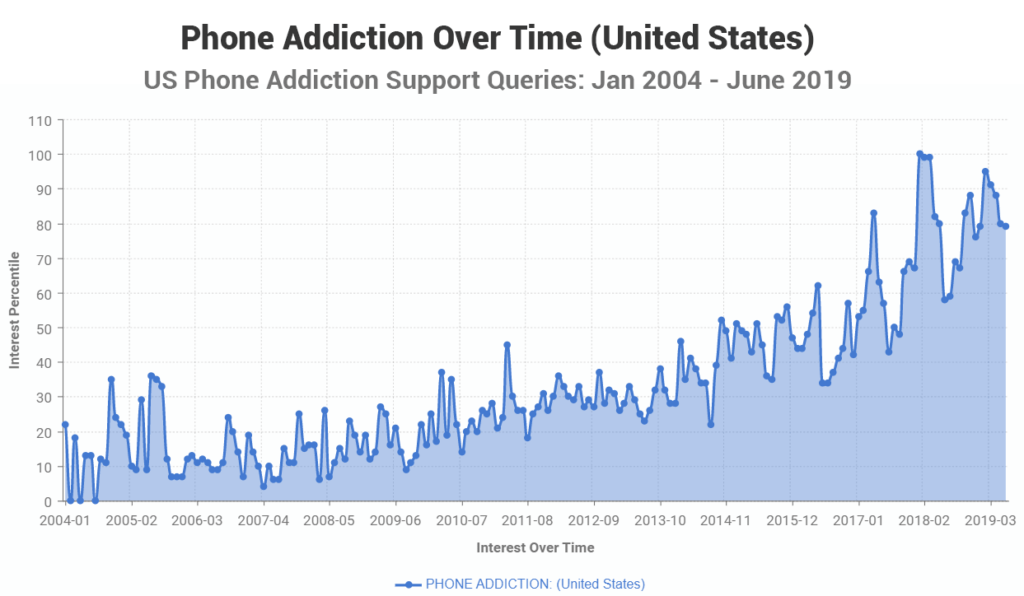
    Our phones are our constant companions. We use them for work, to keep in touch with loved ones and to entertain ourselves on long commutes. A 2016 study found that on average, we touch tap or click on our phone screens 2617 times per day, a figure that can only have increased by 2020. So it is no wonder then that so many people admit to being addicted to their phones. Below you can see the increase in interest in searching on phone addiction in the last 15 years: increasing exponentially.

    5 scary symptoms of phone addiction

    If so many people worldwide are searching for the topic it must mean they are experiencing negative side effects of this addiction in their daily life. However, in a world designed around phones, it can be difficult to gauge what’s ‘normal’ and what’s problematic. So we have put together 5 symptoms of phone addiction to help you decipher when you need to take steps to better your tech-life balance.

    #1 Poor sleep

    40% of adults look at their phone within 5 minutes of waking up- 65% of adults under 35. We know that longer time spent on technology each day has been definitively linked to shorter sleep and that 47% of adults miss out on sleep due to their phone usage. So, why are we still sleeping with our phone in our rooms- let alone our beds?! We have often talked about the benefits of sleeping without your phone- but it is not just us. 93.6% of study participants said that they would consider not sleeping with their phone again because of the positives they experienced.

    #2 Eye strain

    Symptoms of phone addiction are both physical and mental. Eye strain is one of the most common results of digital dependence with 73% of young adults feelings its effects. A 2018 study found that those who were shortsighted tended to use double the amount of phone data compared to those who didn’t need glasses- suggesting that phone addiction is correlated to excess phone usage. Once you begin to log off more often and look at the world around you instead of the small screen you will notice the difference!

    5 scary symptoms of phone addiction

    #3 Nomophobia

    Nomophobia (the fear of being without your phone) is one of the most common symptoms. Do you feel anxious if your phone is dead or if you leave it at home? If so you are suffering from this symptom. Start to combat it by deliberately leaving your phone at home and experiencing the world without it. Go to the shops, the park or to a friends house without it and see how you feel. Take back your independence step by step.

    #4 Subconcious scrolling

    In awkward situations, the modern go-to is to take out your phone and get lost down a scroll-hole. Even without consciously deciding to, we open our phones and instinctively click- often on social media. This passive consumption is bad for us, without engagement we are simply viewing others’ lives and losing the positives of connection. Delete apps you find yourself wasting time on, or regularly move them around your phone screen, so that there is one small layer of friction between you and the mindless activity. Introduce hurdles to stop it merely being instinctive.

    5 scary symptoms of phone addiction

    #5 Phubbing

    Perhaps the worst symptom of phone addiction, phubbing, is the action of snubbing someone by your phone activity. We all know how it feels to be on the receiving end of less than half of someone’s attention but we all do it. If you’re regularly ignoring your loved ones in favour of your phone you may need to reconsider your actions. Make a resolution not to phub in future. If the phone activity is so vital, excuse yourself and return to the conversation with your full attention. One way to ensure this is to leave your phone in a box or pocket for mealtimes, and whenever you are spending time with loved ones.

    Keep reviewing these 5 symptoms to help you to work out the level of your potential phone addiction – and use our tips to help you log-off more.

    5 scary symptoms of phone addiction

    If you’re struggling with phone addiction check out our new 6 week Digital Detox Online Course for more detailed information, curated content and direct support. Use the code NOW-50 for 50% off until October 7th 2020.

    View the original article at itstimetologoff.com

  • Why we’re launching a digital detox online course

    Why we’re launching a digital detox online course

    This September we are launching one of our most exciting new projects: a digital detox course. For years we’ve been debating whether we should run a course on screens – after all the course is teaching you to log off the screens you’re taking the course on! But Covid-19 decided us.

    Screen time has simply rocketed in the pandemic. OfCom has found that we are now spending 4 hours online a day in the UK. The National Australian Broadband Association found that screen time increased by 70-80% in Australia 2020 and in the US, three-quarters of American families felt that there was an increased need for them to do a digital detox this year.

    There has never been a greater need for, and simultaneously more restrictions on, providing our services. It has been quite a dilemma.

    We realised, like many organisations, that the pandemic meant we couldn’t take people on retreats around the world, and our founder couldn’t give talks in schools and at corporate events. We came to the realisation that creating an online course would allow us to overcome this, and mean we could reach a much wider audience at a more affordable price. And we’ve always been advocates of tech where it helps, rather than harms. So, during the lockdown, we worked away and now it’s ready!

    Why we’re launching a digital detox online course

    Who is the course for?

    This course is designed for anyone who struggles in their relationship with technology. Over the years we have taken hundreds on retreats and spoken to thousands from schools to corporate talk to festivals and big public events such as StylistLive in London. We know the need is there. Everyone we speak to from young teenagers to CEOs, feels they have a problem with their screen habits and wants to change them for the better. This course is designed for all of them. Our advice can be tailored to fit any lifestyle and is universal in its application. This course is for you if you:

    • Are desperate for a proper break but can never seem to log off from work
    • Waste too much time in your day endlessly scrolling
    • Are struggling with sleep/ concentration or creativity, related to screen use
    • Simply want to learn simple techniques to help you switch off more

    No matter your occupation, age, or geographic location you will get something out of this course. You can start it whenever you like and complete it at your own pace. All you need is an internet connection, a device and an eagerness to learn.

    Why we’re launching a digital detox online course

    What do you get?

    The course is designed to be six weeks long (but you can take it at your own pace), and over that time we will guide you through four weeks of learning about technology addiction and methods to help you log off, followed by a two week digital detox which we support you through. That means that you get:

    • 13x videos from our founder, Tanya Goodin, explaining the content and motivating you along the journey
    • 2x quizzes unique to the course to help you quantify your tech addiction and the beginning of the course and the change by the end
    • Curated weekly reading lists chock-full of information
    • Weekly quizzes to ascertain your understanding
    • 3x downloadable resources unique to the course, full of tips and which you can use beyond the course to keep you on track
    • And access to support from both the team at Time To Log Off and your fellow pupils
    Why we’re launching a digital detox online course
    60% Early Bird Discount until 14th September 2020

    For the first week we have a HUGE discount of 60% off (until the 14th of September) so sign-up whilst the discount lasts!

    We are so excited for you to join us on the journey to digital wellbeing and a more balanced tech-life routine!

    View the original article at itstimetologoff.com

  • Highlights from S4 of our digital detox podcast

    Highlights from S4 of our digital detox podcast

    During lockdown we’ve carried on producing episodes of our digital detox podcast. One of the most addictive features of our smartphones are their blue-light producing screens, so as part of your focus on digital wellbeing we’ve always suggested you rest your eyes by listening to podcasts. Your brain is absorbed, but you’re not looking at a screen – leaving your hands and eyes free to get a lot more done. So far in Season Four we’d like to suggest checking out the following episodes:

    #1 Olympian Pete Reed OBE on Resilience {Listen here}

    Pete Reed kicked the season off with a bang discussing disability, ableism, activism and more. Olympic rower Reed had a spinal stroke late last year and is still in rehab, recovering from a life-altering injury. One that, especially for an Olympic gold medalist, has changed his day-to-day and outlook. Yet he continues to be relentlessly positive and to use technology, Instagram in particular, to raise awareness of disability. Reed has always been an advocate of logging off, recommending it in his ‘AthleteAdvice’ on Instagram but also knows how useful it is as a tool. Like all of us, he’s always trying to maintain a healthy balance.

    https://www.instagram.com/p/CDy5v5Tg8_Q/

    #2 Grace Beverly on Inclusivity {Listen here}

    Next on the podcast was entrepreneur Grace Beverley. Founder and CEO of three multi-million pound fitness businesses at the age of 23 (B_ND, Tala and Shreddy), in Forbes 30 Under 30 and Young Entrepreneur of the year. Beverly joined us to talk about inclusivity and diversity in the fitness industry, and how she’s carving out her own path of what business success looks like. Especially as a young woman who sometimes struggles to be taken seriously by other business leaders.

    #3 Memes and Mental Health {Listen here}

    The creator of @NickCaveAndTheBadMemes, Dave Tarnowski sat down with our founder, Tanya to talk about his use of social media. His memes are hilarious, but they have a deeper meaning behind them. Tarnowski uses them to create relatable content about mental health which he continues on his Insta stories where he offers relatable advice Agony-Aunt-style. He has created a community of those who offer each other support through their mental health issues, and though he never seems to log off (!) he’s making social media work for him in wholly positive way.

    View this post on Instagram

    Go fuck yourself, me!

    A post shared by Dave Tarnowski (@nickcaveandthebadmemes) on Jul 25, 2020 at 3:04pm PDT

    #4 Fake News with Prof Emily Bell {Listen here}

    Emily Bell is Professor of Professional Practice at the Columbia School of Journalism and Director of the Tow Center for Digital Journalism. She joined us on the digital detox podcast to talk about the impact that technology is having on our ability to find out what’s really going on in the world. Algorithms are increasingly rewarding worse and more extreme behaviour, both in politics and in other parts of our world. This encourages the spread of misinformation (and disinformation) which has been particularly rife during the pandemic. Bell addresses how we can possibly get a grip on the truth and get the accurate and unbiased news we need.

    #5 Jack Edwards and Vee Kativhu on The StudyTube Project {Listen here}

    In the final episode of the first half of Season 4, Jack Edwards and Vee Kativhu sat down with us to talk about their ‘StudyTube Project’. This project is a channel supported by ‘StudyTubers’ who post educational videos on it daily in an attempt to fill the vacuum left when schools went online during lockdown earlier this year, leaving many children without teaching. They both also discuss their experience as influencers and their responsibility in being a role model for black and state-educated young people especially.

    We’ve got a few more episodes to go before we finish this season and then we’re starting planning for Season Five in the autumn. if there’s any person or subject you’d like us to cover please do get in touch at podcast {at} itstimetologoff.com. We’d love to hear from you.

    View the original article at itstimetologoff.com

  • 5 accessible analogue activities for summer

    5 accessible analogue activities for summer

    After five months of screen-based lockdown, many of us are looking for things to do to keep us offline. 3/4 of American families say that they intend to take a digital detox post-lockdown, but it can be hard to find analogue activities that appeal to all ages. And this summer we’re also faced with added challenges; we can’t leave our house as often, places we would usually visit are closed or restricted, and foreign holidays are not advised. So, we’ve come up with five analogue activities that you can do this summer offline, cheaply, easily, and from the comfort of your own home. You could even post about what you’re doing (after the event of course!) using our #SummerUnplugged hashtag to join in the challenge.

    #1 Cooking

    As lockdown continued many of us were experimenting in the kitchen from sourdough bread to making our own pesto, That doesn’t have to stop now that restrictions are lifting! The most authentic way to log off would be to cook without a recipe and fully immerse yourself in the experience, but we don’t know about you but we’re certainly not at that level yet. So, to begin your culinary journey we suggest you follow the easy steps of BBC Good Food or a food blogger such as ‘My Primrose Hill Kitchen‘ perfect for lazy chefs and avid foodies! There are hundreds of recipes across both platforms which cater to different dietary requirements, budgets and time scales so everyone should be able to find something.

    5 accessible analogue activities for summer
    Caramelised pumpkin salad with beetroot and goats cheese from My Primrose Hill Kitchen

    #2 Juggling

    Juggling is one of those activities that always looks impressive, is relatively simple (in terms of steps to take, not ease of practice) to learn, and yet evades so many of us. So, why not take up juggling as your summer goal? There are loads of videos showing how-to online, with new and exciting methods to add extra balls to the rotation or to do tricks. Essentially to juggle you just need three balls, a lot of concentration and time to practice. Get on it now and you will be a master-juggler come September!

    #3 Needlecraft

    We’ve been shouting the benefits of needlecraft as a way to keep both hands and mind busy (and crucially away from screens) for a long time so we won’t try to convince you yet again – just trust us, it works. Instead here are two ideas for how to craft this summer. First is the RSN postcard from home challenge which encourages us to create a beautiful representation of our surroundings in stitches, as we can’t go away. Second is the weekly ‘stitch-up’ hosted by Badass Cross Stitch in which people from all across the world can come together to create and share about their creations!

    5 accessible analogue activities for summer

    #4 Pen and paper games

    One of the most accessible analogue activities has have to be pen and paper games. These are the kinds of games we often play at holidays and family gatherings but you don’t need 15 people to play! One of our particular favourites at Time To Log Off is the ‘hat game’. This involves all players putting 10 (or as many as you like) names into a ‘hat’. Those names can be of celebrities, fictional characters, family or friends as long as all players could reasonably recognise them. The players are split into two teams and under time pressure (usually 1 min per round) one player from each team will pick names out of the ‘hat’ and describe them to their teammates without using any of the words on the paper. Each name correctly guessed is a point and this continues alternating between the teams and players until no names are left. After that you can continue to rounds in which you use the same names and players can only use one word or even mime the name – endless fun!

    #5 Puzzling

    Another analogue activity we have praised many times is completing a puzzle. Over lockdown, we admit we have become slightly obsessed. In particular with the unique whimsy pieces which characterise Wentworth Puzzles. They make doing a jigsaw even more enjoyable and introduce a level of challenge even the most experienced puzzler may not have faced. If funds won’t stretch to a wooden puzzle though, there are plenty of pre-loved options which can be found online. Puzzling has become incredibly popular over these past few months. It’s an absorbing way for you to keep both your hands and mind busy. We highly recommend.

    5 accessible analogue activities for summer

    Whatever analogue activity you choose to keep yourself offline and busy this summer, keep us in the loop through our #SummerUnplugged challenge – we look forward to seeing what you get up to!

    View the original article at itstimetologoff.com

  • How to Spot Internet Addiction

    How to Spot Internet Addiction

    We all laugh and tease others about being ‘addicted to the internet’, and to social media and messaging in particular. But in lockdown we know that all our time online has absolutely soared. In a world when we need the internet more than ever for education, work and social connection, how can we see through our own excuses and recognise when we might have a real case of internet addiction?

    Here are some red flags to watch out for in monitoring yourself, or others, for signs of addiction to the internet:

    You’re neglecting the rest of your life

    One of the hallmarks of addiction to any substance or process is the way in which it creeps slowly to take over the whole of your life. Time spent in your addiction causes you to neglect areas that are important. Sleep, food, exercise, time with friends and family – these are all areas to take a look at. Are you spending the time you need to, in each area to live a healthy, happy and well-rounded life? Or is your internet addiction eating up hours of your day, leaving you no time to focus on one, or all, of those things?

    You’re scrolling mindlessly

    Think about how mindful, or how unconscious your internet use is. Do you have a plan for your time online? Does time on the internet help you to achieve your goals in your professional or personal life? Do you know exactly what you’re getting out of your time on various apps and websites, and how much time you plan each day to spend there?

    Or is your internet use more on automatic pilot? Do you pick up your device without thinking and scroll mindlessly and compulsively, without a plan for what you’re trying to achieve? Do you go online for one distinct purpose, then 30 minutes latter find yourself fallen down an internet rabbit hole, doing something completely different?

    You get anxious at the thought of not being connected

    How to Spot Internet Addiction

    You might be familiar with the phenomenon of Nomophobia; where someone is so worried about being without their phone they keep anxiously patting their pockets for it. But what about wifi anxiety? if you can’t leave the house, go into a restaurant or book a trip away until you’ve checked the wifi facilities, you might want to rethink whether you have internet addiction. It’s healthy to take a break sometimes from the digital world. Planning your life completely around internet, not so much.

    You wake in the night to go online

    internet addiction: nighttime checking

    We’ve mentioned sleep, but don’t just check if your sleep is impacted by the hours you spend online. Are you actively breaking your own sleep to check the internet? Is your FOMO so bad that you find yourself regularly waking up to check for email or message replies, or for the performance of your social media posts? This is a big red flag for internet addiction. Sleep is important, so many mental and physical health processes rely on it.

    What can you do?

    If you’ve felt a flash of recognition at any of the above, we recommend trying the first steps of weaning yourself away from your unhealthy internet use with a digital detox.

    #1 Be mindful with your use of the internet. Don’t use it as the default to fill in every gap in your day. Make a conscious effort to connect with others and to rediscover analogue activities and real-world pleasures.

    #2 Make a deliberate plan for your internet use. Ask yourself how logging-on is helping your achieve your life goals.

    #3 Check-in with yourself to make sure you’re not using mindless scrolling to numb-out uncomfortable feelings.

    The internet is an important tool for connection, especially now, but don’t let it become a substitute for the rest of your life. No-one is going to say on their death-bed “I wish I had spent more time online”. Step away from your devices from time to time.

    How to Spot Internet Addiction

    For more about internet addiction and living healthily and happily with tech, check out our podcast ‘It’s Complicated‘ on Apple podcasts and Spotify.

    View the original article at itstimetologoff.com

  • 5 tips for digital wellbeing this summer

    5 tips for digital wellbeing this summer

    With 75% of American families and nearly half of British families planning to take a digital detox this summer, digital wellbeing is an issue spanning the Atlantic. From a full digital detox to instituting simple rules, there are plenty of ways to go about revamping your digital wellbeing for the summer. We’ve spent too long glued to our screens inside. During a pandemic we should excuse ourselves for letting unhealthy behaviour slide. But now we at Time To Log Off say it’s time to overhaul our bad habits and re-boot our screen habits for a healthier way of living.

    #1 Set boundaries

    Our first, and most oft-repeated, piece of advice is to set boundaries around your tech use. The boundaries that are easiest to put in place are those around space or time. So maybe you can leave your phone outside the bedroom this summer, or institute a bed-time for your phone, ideally a mix of both! Maybe, as you head back to work, you could choose to not use your phone on your commute? Instead how about you read a book or just look out the window? As you spend less and less time mindlessly doomscrolling you’ll find yourself better able to appreciate the world around you and have some time with your thoughts. You won’t just gain back time, you will gain back peace of mind – we guarantee it.

    5 tips for digital wellbeing this summer

    #2 Adopt analogue activities

    As you continue your journey towards digital wellbeing you may struggle with what to do with all your newfound free time. The average adult (in 2017) spent 8 hours consuming media everyday. So, even if you only cut 1/8 of your time on devices, you’ll have a whole free hour daily! We suggest that you fill this hour with a productive analogue activity that you look forward to and which will keep those idle hands busy. Perhaps you could get into cooking? Or sewing? Or even puzzling? These kinds of activities will keep not only your hands, but also your mind busy – and away from tech. Choosing analogue activities from time to time will improve your digital wellbeing.

    #3 Put friends before phones

    Connection is a vital part of the human condition. We need support from our family, friends and colleagues to get through the day. So why is it that when we are meeting our loved ones or spending time with them, we’re often distracted by our screens? 47% of families admit to using phones at the dinner table and 36% of children say that their parents are often too distracted by scrolling to pay attention to them. Don’t phub (phone-snub) your loved ones. Choose to turn your phone off, or at least put it away, when you are with those who matter.

    5 tips for digital wellbeing this summer

    #4 Go green

    A great way to stay offline is to spend time outside. Most devices don’t work quite as well in the fresh air, due to poor wifi and hard-to-read screens. It should help if you’re encouraging other family members to join you on the path to digital wellbeing. Being outside for just 2 hours a week can give a huge boost to your physical and mental health. Why not replace your unhealthy time online in the evening with a quick 15 min walk, or a quick stretch in the garden (if you have one)? It will do you the world of good.

    #5 Stop counting

    Finally, we really want to encourage you this summer to stop counting everything. Stop tracking your sleep, stop counting your steps, stop monitoring your heartbeat. Just be. Go with your circadian rhythms. Technology has taken over every part of our life from food to sleep to each and every kind of movement. Instead of tracking everything in an app; listen to your body. If you feel lethargic, eat differently, or move more. The unhealthy obsession with quantifying every part of our lives is keeping us from the mindful and intuitive lifestyles that will make us happy. Stop counting!

    5 tips for digital wellbeing this summer

    Focus on improving your digital wellbeing moving forward but remember there are no hard or fast rules. Pick whichever tip suits you best and have a go at incorporating it into your life. We wish you the best of success in your summer liberated from screens.

    5 tips for digital wellbeing this summer

    For more strategies on how to deal with phone addiction, and interviews with people from all walks of life talking about their relationship with tech, check out our podcast “It’s Complicated”

    View the original article at itstimetologoff.com

  • Digital detox with embroidery on National Embroidery Day

    Digital detox with embroidery on National Embroidery Day

    Post-lockdown we at Time To Log Off are encouraging you to put your screens down and engage in some real-world activities. Through our #SummerUnplugged challenge we want to get you out of your doom-scroll-hole and back in the physical world via some digital detox. One of the best ways to stick to your new lifestyle is through finding analogue alternatives to screentime such as – embroidery! So, on National Embroidery Day, 30th July, we’re celebrating all the ways that needlework can help you on the journey to digital wellbeing.

    The Royal School of Needlework

    We’ve been big fans of the home of beautiful embroidery, The Royal School of Needlework, at Time To Log off since we first recommended one of their courses in a Christmas gift list. The RSN has been promoting the unique benefits of embroidery since 1872 – well before digital devices created a need for embroidery to help a digital detox! They are based at the historic Hampton Court Palace in the UK, and host a myriad of different courses and programmes to teach everyone from beginners through to advanced embroiderers new skills. They even have a degree programme: a BA (Hons) Hand Embroidery Degree validated by the University for the Creative Arts (UCA) which enables many keen needleworkers to stretch their wings and work for big names such as Alexander McQueen. They famously worked on the Duchess of Cambridge’s wedding dress! 30th July is not only National Embroidery Day but also World Friendship Day, very fitting considering the many friendships made through the RSN embroidery studio this year as courses were taken online in the pandemic, and made available to people all across the globe.

    Digital detox with embroidery on National Embroidery Day
    A degree student embroidering under the watchful eye of a tutor

    Idle hands?

    The average adult spends 8 hours online every day. We pick up and touch our phone around 2,617 times a day. Since lockdown, we’re spending 70-80% more time on our phones according to Australia’s National Broadband Network. If we want to improve our digital wellbeing, we all need to set aside time for some digital detox. For many of us, the habit of reaching for our phone has become so instinctive we don’t even realise we’re doing it. One of the best ways to fight against this habit is to keep our hands busy. We’re fans of embroidery as a fantastic analogue activity for this. It’s not repetitive and, no matter how good at it you are, you always need to be using both hands – leaving no room for a quick Twitter scroll!

    Digital detox with embroidery on National Embroidery Day
    The work of a day class student

    Busy brain?

    Our brain processes are suffering with all the time we’re spending on screens. Our concentration is deteriorating, our creativity waning and our mental health declining. Embroidery is a perfect anecdote for all of this. After WW1, the Royal School of Needlework women actually visited soldiers in hospital and taught them needlepoint. It gave disabled vets a way to earn a living, and also helped relieve their post traumatic stress. Some of those soldiers went on to create an altarpiece for St Paul’s Cathedral in London, under the instruction of the RSN. If embroidery was powerful enough for WW1 vets to recuperate with, we’re thinking there must be a lot it can do for us today.

    Digital detox with embroidery on National Embroidery Day
    Day class students enjoying the community embroidery can create

    Make something lasting

    One aspect of embroidery we particularly like, is that in doing it you create something tangible. So often today our daily life is full of nebulous ideas and activities, that can’t be touched or displayed. But, with embroidery each stitch you make is visible, beautiful and physical. Your work can’t be lost or taken away from you, you must stay in the moment with it. On National Embroidery Day, why not investigate embroidery as an analogue activity to give you a break from your phone this summer? You may just find a new hobby you love.

    Digital detox with embroidery on National Embroidery Day

    For more discussion of the intersection between needlework and digital detox listen to our ‘It’s Complicated‘ podcast episode with Badass Cross Stitch.

    View the original article at itstimetologoff.com

  • ナショナル刺繍デーの刺繍付きデジタルデトックス

    ナショナル刺繍デーの刺繍付きデジタルデトックス

    ポストロックダウン私たちはログオフする時間で画面を下に置き、いくつかの現実世界の活動に従事することをお勧めしています。 私たちの #SummerUnplugged 挑戦を通して、私たちはあなたの 運命のスクロールホール からあなたを取り除き、いくつかのデジタルデトックスを介して物理的な世界に戻りたいと思っています。 あなたの新しいライフスタイルに固執するための最良の方法の一つは、このようなスクリーンタイムに アナログの代替を 見つけることです – 刺繍! だから、ナショナル刺繍の日、7月30日に、私たちは針仕事が デジタルウェルビーブへの旅にあなたを助けることができるすべての方法を祝っています.

    ロイヤル・スクール・オブ・ニードルワーク

    私たちは、最初にクリスマスギフトリストに彼らのコースの1つを推薦して以来、私たちは最初にログオフする時間で美しい刺繍の家、針仕事の王立学校の大ファンでした。 RSNは、デジタルデトックスを助けるために、デジタルデバイスが刺繍の必要性を作成する前に、1872年以来、刺繍のユニークな利点を促進してきました! 彼らは英国の歴史的なハンプトンコート宮殿に拠点を置き、初心者から高度な刺繍に至る新しいスキルまで、すべての人に教える無数の 異なるコース やプログラムを開催しています。 彼らは学位プログラムを持っています:多くの熱心な針労働者が翼を伸ばし、アレクサンダー・マックイーンのようなビッグネームのために働くことを可能にするクリエイティブアーツ大学(UCA)によって検証された BA(Hons)ハンド刺繍学位 。 彼らは有名なケンブリッジ公爵夫人のウェディングドレスに取り組みました! 7月30日はナショナル刺繍デーだけでなく、世界友好デーでもあり、今年のRSN刺繍スタジオを通じて行われた多くの友情を考えると、パンデミックでオンラインでコースが取られ、世界中の人々が利用できるようにしました。

    ナショナル刺繍デーの刺繍付きデジタルデトックス
    家庭教師の注意深い目の下で刺繍する学位の学生

    怠惰な手?

    平均的な大人は毎日 オンラインで8時間 を過ごします。 私たちは1 日に2,617回前後で携帯電話を拾って触れます。 ロックダウン以来、オーストラリアのナショナルブロードバンドネットワークによると、 私たちは携帯電話に70〜80%多くの時間 を費やしています。 デジタルの幸福を向上させたい場合は、デジタルデトックスの時間を確保する必要があります。 私たちの多くにとって、私たちの携帯電話に手を伸ばす習慣は非常に本能的になったので、私たちはそれをやっていることに気付いていません。 この習慣と戦う最善の方法の一つは、私たちの手を忙しくすることです。 私たちは、このための素晴らしいアナログ活動として刺繍のファンです。 それは繰り返しではなく、どんなに優れているとしても、常に両手を使う必要があります – 迅速なTwitterスクロールのための余地を残さない!

    ナショナル刺繍デーの刺繍付きデジタルデトックス
    日課の生徒の仕事

    忙しい脳?

    私たちの脳のプロセスは、私たちが画面に費やしているすべての時間に苦しんでいます。 私たちの集中力が悪化し、創造性が衰え、メンタルヘルスが低下しています。 刺繍は、このすべてのための完璧な逸話です。 第一次世界大戦後、ロイヤル・スクール・オブ・ニードルワークの女性たちは実際に入院中の兵士を訪ね、針先を教えました。 それは障害のある獣医に生計を立てる方法を与え、また彼らの心的外傷後ストレスを和らげるのに役立ちました。 これらの兵士の中には、RSNの指示の下、ロンドンのセントポール大聖堂の祭壇画を作り続けた人もいました。 第一次世界大戦の獣医が回復するのに十分な刺繍が強力だった場合、私たちは今日私たちのためにできることがたくさんあると考えています。

    ナショナル刺繍デーの刺繍付きデジタルデトックス
    コミュニティの刺繍を楽しむ日のクラスの学生が作成することができます

    何かを持続させる

    私たちが特に好きな刺繍の一つの側面は、それを行う際に有形のものを作成することです。 多くの場合、今日、私たちの日常生活は、触れたり表示したりすることはできませんネビュラスなアイデアや活動でいっぱいです。 しかし、刺繍で、各ステッチは、目に見える、美しく、物理的です。 あなたの仕事はあなたから失われたり奪われたりすることはできません、あなたはそれで瞬間にとどまらなければなりません。 ナショナル刺繍の日に、この夏あなたの携帯電話から休憩を与えるためにアナログ活動として刺繍を調査してみませんか? あなたが愛する新しい趣味を見つけるかもしれません。

    ナショナル刺繍デーの刺繍付きデジタルデトックス

    針仕事とデジタルデトックスの交差点の詳細については、バダスクロスステッチで私たちの「それは複雑です」ポッドキャストエピソードを聞いてください。

    元の記事を表示する itstimetologoff.com