Author: It’s Time to Log Off

  • Is Your Phone Habit Wrecking Your Memory?

    Is Your Phone Habit Wrecking Your Memory?

    How many phone numbers can you recall? If you’re anything like the Time to Log Off team, you’ll find its very few. And yet, a few years ago we could all recall the phone numbers of our friends and family with ease, couldn’t we? And what about navigating ourselves from one place to another, didn’t that used to be something we could mange without heavy reliance on our smartphone and GPS?

    Memory researcher Catherine Loveday found in 2021 that 80% of the adults she surveyed felt that their memories were worse than before the pandemic. But prolonged periods of stress, isolation and exhaustion – common experiences for all of us since March 2020 – are known for their impact on memory. Is something else going on?

    Are we outsourcing too much to our phones?

    The term ‘digital amnesia’ has been defined as “a phenomenon where our brains are fast losing their ability to remember as we become increasingly reliant on technology to retain data”.

    digital amnesiadigital amnesia

    Scientists and psychologists are divided on whether it’s actually a true phenomenon or whether other factors (like the pandemic, ageing etc) are impacting our ability to recall information.

    The argument against digital amnesia

    Some neuroscientists believe we have always ‘outsourced’ some of our brain processes to other methods and that this isn’t necessarily worrying of itself.

    “We have always offloaded things into external devices, like writing down notes, and that’s enabled us to have more complex lives, processes. We’re doing it more, but that frees up time to concentrate, focus on and remember other things.”

    Chris Bird professor of cognitive neuroscience, University of Sussex

    These experts think that some of things our smartphones help us with are actually quite challenging as our brains aren’t evolved to remember highly specific, one-off things. Before we had devices, for example, it was challenging to remember all the things we needed to do at specific times of the day as our lives became more complex and now reminders, alarms and online calendars help with all of that.

    The argument for digital amnesia

    Other experts are more cautious about dismissing the potential long-term impact of outsourcing so much of our brain function.

    “Once you stop using your memory it will get worse, which makes you use your devices even more. We use them for everything. If you go to a website for a recipe, you press a button and it sends the ingredient list to your smartphone. It’s very convenient, but convenience has a price. It’s good for you to do certain things in your head.”

    Professor Oliver Hardt, McGill University

    Professor Hardt cites research that shows that people who have relied long-term on GPS have reduced grey matter density in the hippocampus (the part of the brain that has a major role in learning and memory). This is because GPS doesn’t encourage us to build up large spatial maps in the brian (which navigating without it does), rather it gives us simple, one-step instructions ‘turn left’ ‘go straight on’ which don’t engage the hippocampus and challenge it.

    Countering digital amnesia

    If you think your own brain power and memory might be being affected by over-reliance on your devices try these tips:

    • Try memorising five phone numbers of those you call the most frequently.
    • Go out on a day trip and ban the use of smartphone GPS, use a physical map instead.
    • Play old-fashioned memory games as a family (recalling random objects on a tray is a good one).

    Actively look for opportunities to memorise and recall information in your daily life, instead of using digital reminders and shortcuts. Your hippocampus needs to be challenged and exercised like any other part of your body and brain – don’t let it get rusty!

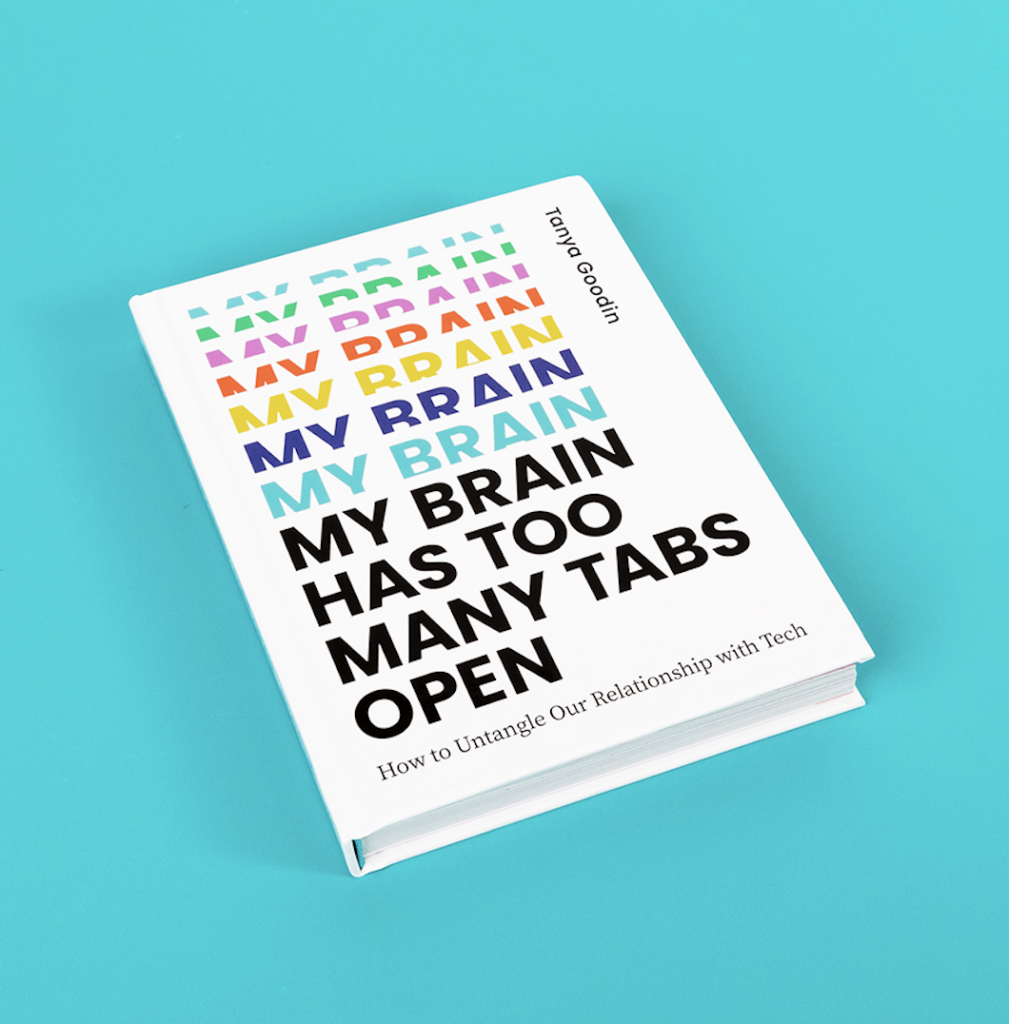
    For more about how to get a healthy balance with tech: My Brain Has Too Many Tabs Open is out now
    View the original article at itstimetologoff.com

  • Six Signs of a Compulsive Phone Checking Habit

    Six Signs of a Compulsive Phone Checking Habit

    Has your phone checking habit got out of hand? Recent research suggest we check our phones on average 58 times a day and while some of that might be with a specific purpose (work or connecting with friends), most of us recognise that a lot of those pickups are for no good reason at all. So, how does compulsive phone checking start?

    How a compulsive phone checking habit starts

    Right before you check your phone the dopamine levels in your brain start to rise. Dopamine is the ‘feel good’ or ‘pleasure’ brain hormone but it’s also released in anticipation of something that will make you feel good. Dopamine rising in your brain feels great. When you post on social media your dopamine starts to rise thinking about all the likes, comments and new followers you might get.

    When you don’t get the likes or engagement you were hoping for, your dopamine levels drop. This feels bad, so you’re compelled to keep checking or refreshing to see if there’s been a mistake.

    But if you do get the reaction you were hoping for your dopamine levels rise – which feels good.

    You keep repeating the behaviour (wanting even more dopamine if it’s rising, frantically trying to build it up if it drops) and it becomes a pattern – your brain gets trained into a cycle of wanting more and more dopamine. Dopamine is associated with all addictive processes and substances, so your phone checking starts to feel compulsive and addictive.

    Here are the six signs of compulsive phone checking you should keep an eye on;

    #1 Getting up in the night to check your phone

    You might convince yourself that your compulsive phone checking is nothing of the sort during the day, but if you’re getting up at night just to check your phone your habit has got way out of hand.

    six signs of a compulsive phone checkingsix signs of a compulsive phone checking

    Make it harder for you to check your phone in the night by plugging it in the furthest power socket from your bed – don’t sleep with it right by your fingertips.

    #2 Checking your device again when so little time has passed nothing can have realistically changed

    It’s not compulsive behaviour to go back to a post to see if anyone new has engaged it. But when you’re checking every two or three seconds or so, that’s definitely a worrying sign. Try and lengthen out the time between checks – and keep an eye on time gaps that are shortening.

    #3 Refreshing more than once in the hope something new will appear

    We all know apps can go down, there are glitches in wifi and mobile data connections, so refreshing a post while you’re looking at it is fine. But refreshing over and over again looking for something new isn’t healthy. Limit yourself to one refresh for each check and be strict with yourself.

    #4 Spending a significant time after posting merely refreshing

    After you post something there are lots of other things you can do on each app – check for friends’ updates, like their content, write comments. But if all you’re doing every time you check your phone is refreshing the app – beware.

    #5 Setting limits on checking which you break immediately

    You might have been aware that your habit was getting out of control, so you might have decided to set some limits on the amount of time you pick up and check your phone. If you find that any limit you set is completely impossible to stick to you’re going to need to involve other people to take your phone off you for a while, or to make you accountable.

    #6 Feeling out of control and angry and frustrated with yourself

    If you hate your habit but you can’t seem to change it and feel out of control with escalating behaviour that’s impacting the rest of your life, get help. Talk to a professional, check out the rest of the resources on this site or just let a loved-one know you need some support and help. Don’t trivialise it, or suffer in silence.

    For more about how to deal with compulsive and addictive behaviour around your smartphone, and how get a healthy balance with tech: My Brain Has Too Many Tabs Open is out now

    View the original article at itstimetologoff.com

  • Social Media Harms Boys and Girls at Different Ages

    Social Media Harms Boys and Girls at Different Ages

    Social media may affect the wellbeing of boys and girls at different ages, according to research from Oxford University that describes what the researchers have dubbed ‘windows of vulnerability’ to social media harms.

    Girls may experience harms younger than boys

    The research team found that girls who increased their time on social media between the ages of 11 and 13 were less satisfied with their lives one year later. The same effect was found in boys but at the slightly later age of 14 to 15 years old.

    There was no other link between social media and wellbeing at other ages for both sexes, except at 19 years, when higher usage was again followed by a drop in life satisfaction.

    “We find there are certain ages, which differ between the sexes, when social media more substantially predicts life satisfaction.”

    Dr Amy Orben, University of Cambridge.

    Teen mental health and social media

    Increasingly levels of teen mental health problems have prompted researchers all over the world to investigate whether there is a link with social media usage. In the UK, the number of children aged five to 16 with a suspected mental health problem rose by 50% between 2017 and 2021, suggesting about five children in every classroom are now affected, a substantial increase from one in nine affected in 2017.

    ‘Two way’ effect shown in research

    Frequently discussions about social media harms and young people centre around which comes first – deteriorating mental health or social media use. The Oxford University research showed that the impact is in fact two way;

    At 11-13 years old for girls and 14-15 for boys, social media use was linked to a drop in life satisfaction a year on, while low life satisfaction was also linked to greater social media use the year after.

    Tips for parents

    • Hold off giving a social media-enabled smartphone to young teens for as long as you can.
    • Discuss social media harms, comparison culture and how social media might make them feel.
    • Keep and eye on escalating use and keep the lines of communication open.
    • Check in frequently with how they are feeling, especially during the vulnerable age windows highlighted in the research.

    For more about how to deal with social media harms, and how get a healthy balance with the digital world: My Brain Has Too Many Tabs Open is out now
    View the original article at itstimetologoff.com

  • Is ‘Slowcial Media’ The Answer?

    Is ‘Slowcial Media’ The Answer?

    Is ‘Slowcial Media’ The Answer?

    Social media addiction is on the rise with more and more people struggling to stop endlessly scrolling through their feeds. Could ‘slowcial media’ be the answer to using social media intentionally and avoiding some of the harmful side-effects?

    What is slowcial media?

    Slowcial media is all about slowing down the rush to connect with tech and making it intentional, meaningful and mindful. It can be applied to the ways in which we use social media – or it can be applied to a whole new type of tech which focuses on mindfulness and meaningful connection.

    Slowcial Media: Platforms that foster unhurried and meaningful connection between humans”.

    Urban Dictionary

    In that sense, slowcial media can be compared to other ‘slow’ cultural movements to slow down life’s pace, such as the slow food movement or slow fashion, both of which ask for considered consumption, thinking about the sources of products, and emphasising sustainability.

    The slow movement is thought to have begun in 1986 when Carlo Petrini protested against the opening of a McDonald’s restaurant near the world-famous Spanish Steps in Rome. His protest sparked the creation of the slow food movement which over time developed into the full-blown slow subculture.

    “It is a cultural revolution against the notion that faster is always better. The Slow philosophy is not about doing everything at a snail’s pace. It’s about seeking to do everything at the right speed. Savouring the hours and minutes rather than just counting them. Doing everything as well as possible, instead of as fast as possible. It’s about quality over quantity in everything from work to food to parenting.”

     Carl Honoré  In Praise of Slow

    Can using social media itself ever be ‘slow’?

    The attention economy and persuasive tech encourages us to use social media at break-neck speed, scrolling from one feed and account to another, FOMO making us worry that we might be missing out. But, we can learn to use social media intentionally and mindfully if we follow a few simple rules:

    • Set limits for time spent online.
    • Set an intention before you connect with social media – what’s your purpose in using it?
    • Keep checking in with how social media makes you feel.
    • Use social media to be inspired and informed – follow accounts that celebrate achievement, not appearance.
    • Reply thoughtfully to online interactions, pause before responding.
    • Put hurdles and obstacles in place to make you slow down before you use apps.

    Your hurdles and obstacles can be very personal and specific to you. Some ideas; putting your phone in another room, uninstalling social media apps at certain times, leaving messages for yourself on the home screen of your phone. Think creatively about how you can design behavioural nudges like these to ensure you’re being mindful about your use.

    "Am I addicted to social media?" QUIZ

    Are you addicted to social media? Try our social media addiction quiz.

    Other uses which help you to go slow

    Of course, it’s not just about using social media apps in a way that’s more intentional. There are a range of other apps which exist purely for the purpose of developing mindfulness and meaningful connection. Some ideas might be;

    • Headspace – an app for everyday mindfulness and meditation.
    • Freedom – an app and website blocker, to enable you to focus and be productive.
    • Reflection – a journalling-focused app that guides a meaningful reflection practice.
    • Forest – another app to help focus, but this one plants a tree in the real-world if you meet your goals.

    The slowcial media action plan

    Here’s our simple plan to help you reap the benefits of a more slowcial approach

    1. Use existing social media and other apps mindfully.
    2. Prune notifications and alerts that distract you.
    3. Set an intention every time you use an app that might be encouraging you to be mindless.
    4. Look for alternatives that encourage meaningful connection.

    If you want to try out a full disconnection from tech to slow down, check out all the resources on our website for how to do a digital detox.

    digital detox bookdigital detox book

    For more about using tech intentionally pick up our new book: My Brain Has Too Many Tabs Open. Available to order here.

    View the original article at itstimetologoff.com

  • A Week off Social Media Reduces Depression and Anxiety

    A Week off Social Media Reduces Depression and Anxiety

    A new study has revealed that taking just a week off social media can reduce depression and anxiety and increase a sense of wellbeing. 

    The University of Bath study found that people who took a break from apps such as TikTok, InstagramTwitter and Facebook for just seven days reported an increased sense of wellbeing.

    How did the study work?

    Researchers split their sample of 154 people aged 18 to 72 into two groups. One group was banned from social media while the other was not. On average, participants used social media for eight hours a week.

    Participants were quizzed before the study on their baseline levels of anxiety and depression, and their sense of wellbeing, using three widely-used tests;

    • To measure their wellbeing they were asked to rate their agreement with statements like “I’ve been feeling optimistic about the future” and “I’ve been thinking clearly”.
    • To measure depression they were asked questions such as “how often during the past two weeks were you bothered by little interest or pleasure in doing things?”
    • Their anxiety was monitored using the General Anxiety Disorder Scale, which asks how often a person is bothered by feeling nervous or on edge, or an inability to stop worrying.

    What did the results show?

    Those who took a one-week break from social media saw their wellbeing climb from an average of 46 to 55.93 on The Warwick-Edinburgh Mental Well-being Scale.

    Levels of depression in this group dropped from 7.46 to 4.84 on the Patient Health Questionnaire-8 while anxiety fell from 6.92 to 5.94 on the scale.

    Lead author Dr Jeff Lambert, of the University of Bath’s Department for Health, said the changes represented a moderate improvement in depression and wellbeing, and a small improvement in anxiety.

    “Many of our participants reported positive effects from being off social media with improved mood and less anxiety overall. This suggests that even just a small break can have an impact.”

    Dr Jeff Lambert, Department for Health, University of Bath

    Have other studies shown the same results?

    The research findings support previous research around the globe linking regular social media use with higher rates of depression and anxiety.

    The ‘chicken and egg’ relationship between social media and mental health has still not been established however. ie whether social media use leads to mental health problems, or whether pre-existing feelings of low self-worth drives people to social media as a means of validation.

    In the UK the number of adults using social media increased from 45% in 2011 to 71% in 2021. Among 16 to 44-year-olds, as many as 97% use social media and scrolling is the most frequent online activity performed.

    The researchers say that in future they hope to study the impact of stopping social media use on specific parts of the population, such as younger people and those with physical and mental health conditions. They also hope to follow up with people beyond one week to see if the benefits of the social media break have a lasting effect.

    What steps can we take to improve our own wellbeing?

    #1 Log off

    Logging off for either a small or longer period of time would seem to be a good idea, as suggested by this study and many others.

    #2 Cut down

    If logging-off completely isn’t feasible, then cutting down on the amount of time spent on social media (particularly the time spent passively scrolling) is also linked to improvements in mental health.

    #3 Be more mindful

    A mindful approach, which takes a note of how we are feeling before and after episodes on apps, is also recommended to monitor the unique impact it may be having on our own wellbeing. Checking in with ourselves from time to time and asking the question “how does this make me feel?” is top on our list of strategies to build a healthier relationship.

    My Brain Has Too Many Tabs Open by Tanya GoodinMy Brain Has Too Many Tabs Open by Tanya Goodin

    My Brain Has Too Many Tabs Open

    For more about how the digital world is impacting our wellbeing. Out now on Amazon and in all good bookshops.


    View the original article at itstimetologoff.com

  • Here’s the Proof Zoom is Killing Our Creativity

    Here’s the Proof Zoom is Killing Our Creativity

    In-person meetings generate more ideas, and more creative ones, than video meetings which produce fewer ideas overall. Those are the findings from a new study of more than 600 people highlighting the challenges and downsides of using tech to work remotely, as opposed to collaborating face-to-face.

    Videoconferencing inhibits creative ideas

    In the study, carried out by researchers at Columbia and Stanford, more than 600 people worked in pairs for five minutes – either in person or virtually – to try and come up with ideas for how to creatively use bubble wrap or a Frisbee. Then they had a minute to pick their best idea to put forward. Judges scored the creativity of their ideas — based on novelty and value.

    • They found pairs working on Zoom came up with fewer ideas.
    • The Zoom pairs also came up with ideas scored as ‘less creative’ by the judges.
    • Exactly the same effect was seen in studies of 1,490 engineers who paired up to brainstorm during workshops at a multinational telecommunications company.

    The researchers had a few ideas about what might happening when Zoom is killing creativity in scenarios like this.

    Why? The ‘shared space’

    In an in-person collaboration one thing that’s often overlooked is that team members are in the same shared physical space and share the same visual cues from their environment – and each other – that can generate ideas. In a virtual meeting, their eyes tend to focus on their screens and they ignore their own environment, which “constrains the associative process underlying idea generation,” say the researchers.

    In the study, the pairs on Zoom calls spent more time looking at their partner and less time looking at the room they were in, and remembered fewer unexpected props (a large house plant or a bowl of lemons) in the room compared to in-person pairs.

    Why? Moving less

    zoom is killing creativity - try walking to more generate ideaszoom is killing creativity - try walking to more generate ideas
    Move more if you want to be more creative – go for a walk.

    One thing we all know is that people move less when they meet virtually staring at a screen, and movement has specifically been shown to enhance creativity. One 2014 Stanford study found for example that a person’s creative output increased by an average of 60 percent when walking (as opposed to sitting).

    “Staying still hinders creativity”

    PROFESSOR Jeremy Bailenson, Stanford UNIVERSITY

    During in-person meetings or even phone calls, we can look around, walk around, multitask and use our hands – all of that movement isn’t just more relaxing than staring fixedly at a screen, it also stimulates creativity.

    If you find Zoom is killing your creativity, take these steps

    #1 Match the medium to the task

    Video calls are useful for large teams working remotely to check in and share information and they’re used more and more because of the cost savings in getting people working in different locations together. But this research shows they’re not suited for creativity and ideas generation. For effective brainstorming – meet in person.

    #2 Move more

    Movement of all types has been shown to help with idea generating and problem solving. If Zoom is killing creativity in your team, why not all go for a walking meeting in the park? Adding in contact with a green space will also give your ideas a boost.

    #3 Step away from screens more

    It’s not just the time on screens during brainstorming that might be impacting our creativity. Filling our heads with a non-stop stream of news, communication and entertainment doesn’t give us our brains any time to wander and get into the state of flow that’s conducive to problem solving. Spend less time looking at a screen and you may find that your ideas flow too.

    My Brain Has Too Many Tabs Open by Tanya GoodinMy Brain Has Too Many Tabs Open by Tanya Goodin

    My Brain Has Too Many Tabs Open

    For more about how the digital world is impacting our work and productivity (and our home, and love lives). Out now on Amazon and in all good bookshops.


    View the original article at itstimetologoff.com

  • 5 Reasons to do a Digital Detox

    5 Reasons to do a Digital Detox

    If you’re pondering whether time away from your phone is worth it, here are five good reasons to do a digital detox;

    #1 Your Sleep Will Improve

    Experts disagree on exactly what it is about sleep and screens that causes a problem. Some say it’s the blue-light producing screens that interferes with our body clock and keeps our brain and body alert. Others say it’s the activities we’re carrying out on screens that are stimulating – like gaming or watching videos which can increase bursts of adrenalin and dopamine. But most experts agree on one thing – sleep and screens are not good bedfellows. So taking part in a digital detox is almost certainly going to lead to deeper and more restful sleep.

    #2 Anxiety and Depression Will Lessen

    Some quite recent research found that just a week off all forms of social media reduced depression and anxiety. And a study from as far back as 2015 found the same effect with those taking a complete break from Facebook for a week feeling 55% less stressed. Frankly, we’re yet to come across a study that finds that people who take a break from social media feel worse. That’s one of the most compelling reasons to do a digital detox we can think of.

    #3 Your Relationships Will Deepen

    In new book My Brain Has Too Many Tabs Open author Tanya Goodin writes about the ways in which our digital habits are impacting our relationships. From phubbing to sharenting, from technoference to trolling. The many ways in which the digital world is negatively affecting how we relate to each other are multiplying. And yet, the number and quality of our closest relationships is the best predictor of our health and longevity. Taking part in a digital detox, and using that time to focus on those you care about will reap rewards in every area of your life.

    5 reasons to do a digital detox5 reasons to do a digital detox
    One of the best reasons to do a digital detox – to spend time with friends.

    #4 You Will Escape the 24:7 Bad News Cycle

    A relentless non-stop stream of all the bad news in the world is wearing on all our mental health. And the digital world is designed to emphasise the negative, so it’s specifically hard to escape bad news online. Putting down your screens to take a break from bad news – and maybe seek out some good news instead – will make you feel a lot better.

    #5 You Can Get Outside More

    The time we’re all spending in green spaces has been sadly reducing over the past few decades. But nature is a great healer and time outside helps with both our mental and physical health; reducing blood pressure, alleviating stress and improving sleep. Use your time off your smartphone to get outside and get strolling instead of scrolling – your body and mind will thank you.

    My Brain Has Too Many Tabs Open by Tanya GoodinMy Brain Has Too Many Tabs Open by Tanya Goodin

    My Brain Has Too Many Tabs Open

    For more about how the digital world is impacting our lives, and how and why to take a break. Out now on Amazon and in all good bookshops.


    View the original article at itstimetologoff.com

  • Digital Wellbeing: What is it?

    Digital Wellbeing: What is it?

    The concept of ‘digital wellbeing’ has popped up all over the digital world in the past few years – as a Google program, an Android app, a TikTok feature, even an UNESCO Council.

    But what does digital wellbeing actually mean? And is it something that’s possible to achieve in an attention-based digital economy?

    The UNESCO Council sets as its definition of digital wellbeing;

    “The enhancement and improvement of human well-being, in the intermediate and long term, through the use of digital media,” 

    UNESCO, Forum for Well-being in Digital Media

    Here are Our 7 Principles of Digital Wellbeing

    #1 Keeping Safe and Being Well

    You should be able to use and explore the digital world and keep safe. More than that, your experiences should positively enhance your mental health rather than detract from it.

    #2 Achieving Your Goals

    Using the digital world should help you to achieve your personal goals; whether that’s in education, in being informed about the world about you, to be entertained or to connect.

    #3 Self-expression

    Self-expression through creativity is crucial for the development of our identity, confidence and belonging. Self-expression helps us communicate our feelings in a positive way and the digital environment should enable us to do that.

    #4 Connecting With Others

    One of the most important benefits of digital spaces is the way in which they allow us to connect with others. The desire for connection is a fundamental human need and we should be able to connect in a way that enhances our lives.

    digital wellbeingdigital wellbeing
    Digital wellbeing should help us build good mental health and resilience

    #5 Being Inspired

    Seeing how others are expressing themselves and impacting the world can inspire and motivate us – digital wellbeing means finding sources of inspiration online.

    #6 Growing Your Skills

    Learning new skills and accessing education online enhances our sense of digital wellbeing.

    #7 Having Impact

    A feeling that we are making a difference, impacting others and effecting positive change, should form part of digital wellbeing.

    Try Our Ultimate Guide to Digital Wellbeing

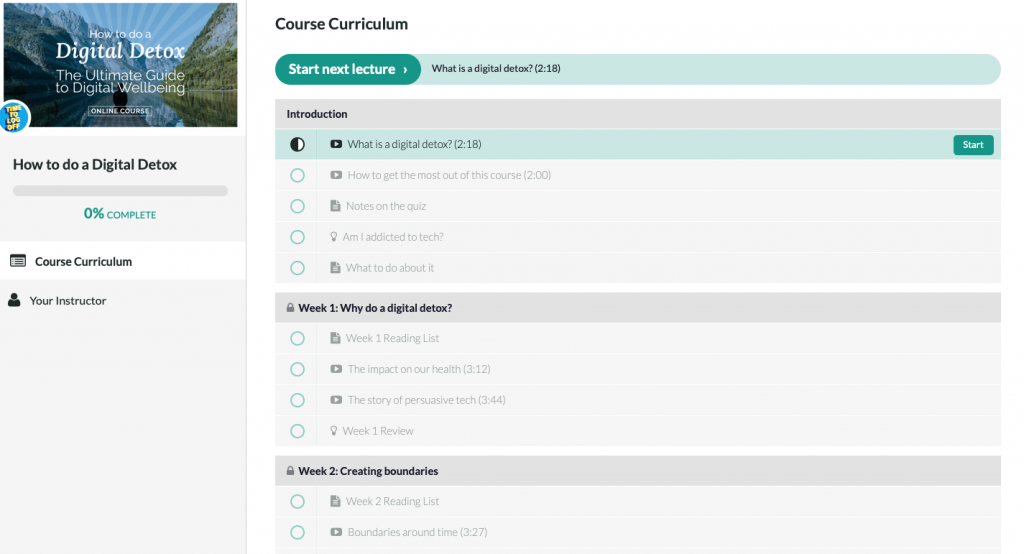
    If you want to explore digital wellbeing more, the ultimate guide to digital wellbeing is in our online course.

    Who is the digital wellbeing course for?

    This course is designed for anyone who struggles in their relationship with technology. It’s for you if you:

    • Are desperate for a break from working but can never seem to log off
    • Waste too much time endlessly scrolling
    • Struggle with sleep/ concentration or creativity
    • Want to learn easy techniques to help you switch off from tech

    You can start it whenever you like and work through it at your own pace.

    What’s included?

    The course is designed to be six weeks long (but you can take it at your own speed), and in that time we guide you through four weeks of learning about technology addiction and methods to help you log off, followed by a two week digital detox, which we support you through. You get:

    digital wellbeing coursedigital wellbeing course
    • 13x videos from founder, Tanya Goodin, explaining the content and motivating you along the journey
    • 2x quizzes to help you quantify the extent of any tech addiction at the beginning of the course and to assess your change at the end
    • Curated weekly reading lists
    • Weekly quizzes to ascertain your understanding
    • 3x downloadable resources unique to the course, which you can use beyond the course to help keep you on track

    There’s a discount of 25% off for readers of this article.

    In the meantime, use these seven principles as a reference to ensure the digital world is enhancing, not detracting from your life, and your health and wellbeing.

    View the original article at itstimetologoff.com

  • Ditch Your Device for a day on UK Unplugging Day 26th June 2022

    Ditch Your Device for a day on UK Unplugging Day 26th June 2022

    UK Unplugging Day will take place on Sunday 26th of June this year and we are challenging you to join in! The day encourages everyone to ditch their devices for a day to take part in a universal 24-hour digital detox.

    The last couple of years have seen a massive change in our relationships with digital devices: from students at university taking their entire degrees through screens, to parents working from home whilst home-schooling and global interconnection increasing even more. These changes have allowed us to continue participating in social, educational, and political spaces more accessibly, whilst maintaining our safety. However, it has also had the effect of reducing our in-person interaction with 30+% of adults voluntarily reducing their interaction with others throughout the pandemic. This has had a negative impact on the collective mental health of the world. So, however, difficult we may find it, taking a step back from tech this UK Unplugging Day will provide a much needed break.

    Time to Log Off regularly emphasises the importance of maintaining our off-screen relationships. Despite tech providing us with the opportunity to build quantitively greater connections, these do not translate qualitatively in the real world. It is in-person that we have our most valuable interactions.

    At Time to Log Off we are advocates of regular digital detox in order to achieve a healthy tech-life balance. But we know how daunting the than be, especially in the world we live in: for some it may even seem impossible to put our phones down for an hour, let alone one day a week.

    Therefore, UK Unplugging Day can be a great place to start: to let people know that you are going to be off-grid and committing only one day, a Sunday, to finally taking that break. UK Unplugging Day is always the 4th Sunday of June for that reason: to those working and studying to participate as much as possible.

    Whilst we would always encourage you to log off for the whole day, anything is better than nothing so if you have to allot yourself times throughout the day to checkin and give yourself the rest of the day off that could work too- it is the first step which makes the most difference!

    With all of these accommodations therefore there is very little excuse for anyone to not get involved. You could even get friends and family involved to help you pass the time and give them the gift of logging off too. One day without these will help you rediscover off-screen activities that you used to love, and perhaps some new ones. Don’t underestimate the rejuvenating power of being away from your tech for a while. We will be spending the day out in nature, getting back into colouring and maybe some puzzles too!

    By joining in on Sunday 26th, you’ll be joining a community of people who realise the value of maintaining and growing their off-line interests, relationships and communities. Enjoy it!

    View the original article at itstimetologoff.com

  • Cutting smartphone use by just one hour a day could leave you more satisfied with life

    Cutting smartphone use by just one hour a day could leave you more satisfied with life

    Several studies have shown that smartphone overuse is linked to obesity, neck pain, impaired sleep and poor mental health outcomes. So a team of researchers set out to monitor cutting smartphone use out completely, versus reducing it, to establish just how much smartphone too much smartphone.

    Is there an ideal amount of time to use your smartphone?

    The researchers recruited 619 people for their study and divided them into three groups. One group of 200 people put their smartphone away for the week, 226 reduced the amount of time they used the device by one hour a day, and 193 didn’t change anything at all in their smartphone use.  All groups filled out questionnaires before the experiment and then were followed up both one month and four months afterward it had ended – when they had all gone back to their normal smartphone use.

    The researchers discovered that in both the ‘intervention’ groups the following were reduced

    • Smartphone use intensity.
    • Problematic use tendencies.
    • Depressive, and anxiety symptoms.

    In both groups, overall life satisfaction and physical activity also increased.

    Life satisfaction improved when cutting smartphone use down

    A reduction in use was found to be better than giving up completely

    Most effects were stronger and remained more steady over four months in the group that reduced their usage rather than in the group that gave up their smartphone completely. Interestingly, in the reduction group only the number of daily smoked cigarettes also decreased. 

    “It’s not necessary to completely give up the smartphone to feel better, there may be an optimal daily usage time.”

    Dr Brailovskaia, Ruhr-Universität Bochum

    How can you find your own ‘sweet spot’?

    The research seems to suggest that there is a ‘sweet spot’ of smartphone use. Something that backs up a previous study from Oxford University which had similar findings and described it as the ‘Goldilocks point‘ (ie, not too much, not too little, just right).

    Finding your own sweet spot is something we suggest to people who take our online course as well as those who attend talks our founder delivers. We suggest the following steps;

    #1 Check-in with how you feel

    Sit and monitor how you feel, both physically and mentally, before you pick up your smartphone. Do an all-over body check and get it touch with and name your emotional state.

    #2 Pick up and start using your smartphone

    Start using your smartphone as normal, carrying out the actions you intended to do.

    #3 Check-in after a few minutes, again at the end of your use

    After a few minutes of use, check-in with yourself again and then as many times as you want to throughout your usage. Do a final check-in at the end of the sessions. Make a note of what you were doing, the time you spent on your phone, and whether you noticed any change in your state.

    Use this simple 3-step process over a couple of weeks to build up self-awareness of how your smartphone use is affecting you, and see if you can work out what your own sweet spot might be.

    My Brain Has Too Many Tabs Open by Tanya GoodinMy Brain Has Too Many Tabs Open by Tanya Goodin

    My Brain Has Too Many Tabs Open

    For more about how the digital world is impacting our wellbeing. Out now on Amazon and in all good bookshops.


    View the original article at itstimetologoff.com