Category: Addiction News

  • States Struggle To Address Issue Of Driving While High On Cannabis

    States Struggle To Address Issue Of Driving While High On Cannabis

    Federal legalization could be on the horizon, yet so far no one has come up with a definitive method to determine if someone is too high to drive.

    As more states legalize both medical and recreational marijuana, authorities are struggling to determine the best way to address the issue of driving while high. Unlike alcohol, cannabis can stay in a person’s system for weeks after the last time they used – long after the high has subsided and they are no longer impaired. Blood and urine tests are therefore considered by many to be unreliable methods for determining if a driver is intoxicated. 

    Marijuana legalization will likely be a key issue in 2019 as Democrats line up to enter the 2020 presidential race. Ten states have now legalized recreational cannabis, and even conservative states like Utah and Oklahoma are starting to pass medical marijuana laws. Federal legalization could be on the horizon, yet so far no one has come up with a definitive method to determine if someone has taken too much of the drug to be able to drive safely.

    “You can’t legalize a substance and not have a coherent policy for controlling driving under the influence of that substance,” says Rand Corp. assistant policy researcher Steven Davenport. 

    Yet many states are relying on police officers to perform field sobriety tests as their only means of determining if someone is high on cannabis behind the wheel. According to Kaiser Health News, California police are given 16 hours of training on recognizing the influence of various drugs, including cannabis.

    The coordinator of this program, Glenn Glazer, claims that California officers are “very used” to recognizing marijuana intoxication, but as Davenport points out, field tests are subjective by nature.

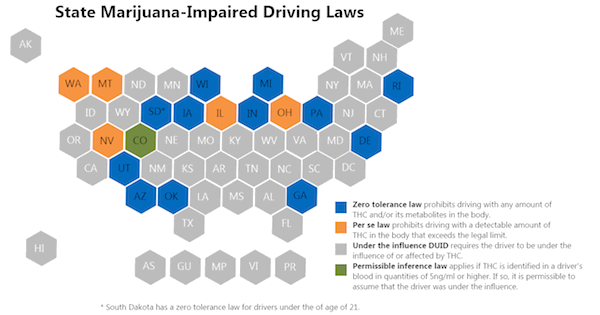
    According to the National Conference of State Legislators, the majority of states with some kind of legalized marijuana have “zero tolerance” laws on the books for driving while high, meaning that any amount of THC and/or its metabolites found in a driver’s system is grounds for legal action. This presents a serious problem when these chemicals can stay in a person’s system for a full month after they last used. 

    Source: NCSL

    Others have “per se” laws similar to the blood alcohol limit. However, cannabis researchers have repeatedly pointed out that finding a limit for cannabis-related compounds in the blood is much more complicated than with alcohol. There is no clear, linear relationship between THC levels in the blood and intoxication.

    Keith Humphreys, a psychiatry professor and drug policy expert at Stanford University in California, believes that the number these states have picked for their legal limit is arbitrary, saying they “made it up.” 

    “We don’t really have good evidence — even if we know someone has been using — [to gauge] what their level of impairment is,” says Humphreys.

    Coming up with a solution won’t be an easy task, but people are trying. In late 2017, an app was released that calculates the user’s reaction time. Cannabis often slows reaction time and impairs one’s ability to focus, making driving while high a dangerous endeavor. After Washington State and Colorado legalized recreational marijuana, highway collisions rose by 3%, according to the Highway Loss Data Institute

    The app, called DRUID, is far from a perfect system for detecting intoxication, but if a blood, urine or breathalyzer test can’t be developed soon, field tests and human judgment may be all police have to rely on.

    “The idea that you could come up with a completely objective test of performance … is ambitious,” says Carnegie Mellon University drug policy researcher Jonathan Caulkins.

    View the original article at thefix.com

  • Depression Changes How We Use Language

    Depression Changes How We Use Language

    Researchers studied an online forum for mental health issues to examine how people with symptoms of depression used language.

    Depression can change both the content and style of the language that people use, according to a study published in the journal of Clinical Psychological Science

    The study compared the use of language in online forums dedicated to addressing depression, anxiety and suicidal ideation. It found that absolutist words — like never, always, completely and nothing — were 50% more frequent in forums dealing with depression than in control forums. In groups for people with suicidal ideation, absolutist language was 80% higher than in control groups, according to JSTOR Daily

    “Absolutist thinking is considered a cognitive distortion by most cognitive therapies for anxiety and depression,” study authors wrote. 

    However, the increased use of absolutist language wasn’t limited to people who are currently clinically depressed. 

    “We found elevated levels of absolutist words in depression recovery forums. This suggests that absolutist thinking may be a vulnerability factor,” study authors wrote

    The use of absolutist words was more closely connected to depression than the use of negative words like “sad,” “frustrated” or “upset.” However, people in the depression forums did use these negative words more frequently than people in the control forums, according to JSTOR

    Another interesting finding, which had been previously identified, is that people with depression were more likely to use first-person singular pronouns and less likely to use third-person pronouns. This could suggest that people with depression are isolated or focused on themselves. Which pronouns someone uses can predict the presence of depression more reliably than negative words, according to one study

    “We know that rumination (dwelling on personal problems) and social isolation are common features of depression,” Mohammed Al-Mosaiwi wrote for JSTOR. “However, we don’t know whether these findings reflect differences in attention or thinking style. Does depression cause people to focus on themselves, or do people who focus on themselves get symptoms of depression?”

    Last year, researchers developed an algorithm that could predict depression by evaluating a person’s speech or texts. 

    Tuka Alhanai, first author of the paper outlining the technology, told MIT News that in the future it could be an important diagnostic tool.

    “We call it ‘context-free’ because you’re not putting any constraints into the types of questions you’re looking for and the type of responses to those questions,” Alhanai said. “If you want to deploy [depression-detection] models in a scalable way … you want to minimize the amount of constraints you have on the data you’re using. You want to deploy it in any regular conversation and have the model pick up, from the natural interaction, the state of the individual.”

    View the original article at thefix.com

  • Idris Elba's Daughter Details Helping Mom With Mental Health

    Idris Elba's Daughter Details Helping Mom With Mental Health

    Isan Elba’s mother Hanne is living with bipolar disorder and depression. 

    British actor Idris Elba has had a remarkable acting career, from playing Heimdall in Thor and Roland in The Dark Tower, to being hailed People’s Sexiest Man Alive.

    Elba’s daughter, 17-year-old Isan, is also successful in her own right as an ambassador to the Golden Globes, and she’s using her position to raise awareness about mental health.

    As People explains, Isan’s ambassador role is a personal one because her mother, Hanne “Kim” Norgaard, suffers from mental illness, specifically bipolar disorder, depression and anxiety.

    At a luncheon in Beverly Hills, Isan explained, “It was only about two years ago that my mom opened up to me. I’m not going to lie, it’s a struggle every day. It’s a learning lesson for me, but it’s hard. Mental health is something that’s hard to deal with. We just sat down and talked about it, and I think that was better for her, talking about it and talking about it with someone who means the most in her life and just getting that out.”

    Once Isan learned what her mother was going through, “It was like, ‘Whoa.’ . . . It was definitely a learning curve. I’m so much closer to my mom now because I know what she’s going through.”

    At the luncheon, the Hollywood Foreign Press Association made the announcement that $50,000 would be donated to the Boris Lawrence Henson Foundation in Isan’s name. As the Henson Foundation website states, their goal “is to eradicate the stigma around mental health issues in the African-American community.”

    “Mental health, specifically among African Americans and my peers in particular, is something I really want to be more vocal about,” Isan said. “There’s this perceived stigma and I’ve seen friends struggle. We need to empower young people to not be afraid to ask for help.”

    Isan told Variety, “Being able to have this platform, and talk about something that I care about that hits home, was really like, ‘Yes, I have to do this.’ It’s something I care about and like I said, using your influence to talk about something you care about or an issue that needs to be fixed, I thought it was the perfect opportunity.”

    Isan also explained that after the luncheon, “[She] will still continue to advocate for mental health. And in the African-American community and among teenagers, because I’m both, and it’s such taboo in both communities.”

    View the original article at thefix.com

  • Heroin-Related "Wound Botulism" Found in San Diego

    Heroin-Related "Wound Botulism" Found in San Diego

    Nine people have been hospitalized with the heroin-related illness in California.

    An outbreak of a rare and life-threatening illness linked to black tar heroin use was discovered in San Diego, prompting health officials in the Southern California city to launch an investigation while warning doctors and IV users alike to be aware of the condition.

    The Centers for Disease Control (CDC) reported that nine cases of wound botulism, which is caused by a toxic bacterium entering the body through a wound, were discovered between 2017 and 2018, which resulted in one fatality and intensive care treatment for all nine individuals.

    Though the number of cases may seem relatively small, only 20 cases of wound botulism are reported per year for the whole of the United States, so the situation was cause for alarm for both state and national health care officials.

    According to the CDC report, two patients with a history of using black tar heroin — so called because of its dark, sticky appearance, caused by crude and often contaminated processing — were believed to have contracted wound botulism though IV drug use.

    The County of San Diego Public Health Services (COSD) issued an alert through the California Health Alert Network to notify Southern California doctors of the situation. A subsequent investigation by the COSD and the California Department of Health eventually found nine patients – eight confirmed and one probable – by April of 2018.

    All nine were IV drug users, and seven reported using black tar heroin. Of the latter number, six reportedly injected the drug through “skin popping,” or injecting the drug under the skin.

    Symptoms of wound botulism typically manifest several days after injecting the contaminated drugs and may include double or blurred vision, slurred speech, dry mouth and muscle weakness.

    If left unchecked, it can result in labored breathing and even paralysis. However, many of these symptoms coincide with signs of opioid use or overdose, and in four of the cases, the individuals were initially diagnosed with drug intoxication, and two were treated with the overdose reversal drug naloxone. 

    Eventually, all of the patients were diagnosed with wound botulism and treated with heptavalent botulism antitoxin (BAT), and eight were transferred to long-term care facilities; the ninth patient declined further treatment. One of the eight died after nine days in long-term care.

    The COSD issued health alerts in 2017 and 2018 notifying health care providers to inform IV drug users about the risks of contracting wound botulism and asking them to carefully observe patients reporting IV drug use history for symptoms. One day after the 2018 alert, clinicians reported additional cases of suspected wound botulism for two hospitalized patients.

    The CDC’s report concluded with a request for heightened awareness of the condition for both doctors and IV drug users, in light of the national opioid crisis.

    Dr. Sayone Thihalolipavan, the deputy public health officer for San Diego County, reiterated the need for careful observation of IV drug patients.

    “Even if they’re seeking treatment, providers might not be recognizing it for what it is,” he said. “Patients can think they’re feeling out of whack due to the drug itself and not realize that the drug is actually contaminated.”

    View the original article at thefix.com

  • How to Keep Your New Year's Resolutions, Ten Minutes at a Time

    How to Keep Your New Year's Resolutions, Ten Minutes at a Time

    You can keep your New Year’s resolutions just by devoting ten minutes to certain simple daily tasks. I’ve seen people build websites in 10-minute increments, write screenplays, do taxes, and even date!

    I want to work out more. I want to lose five pounds. I want to drink less. Have better relationships. I used to love making New Year’s resolutions. I would write my list, check it twice, and write another one, and another, and another. I loved writing lists. It made me feel productive, organized, on top of things; in control. I can’t tell you how many lists I wrote that had “drink less” on it. Or “save money.” “Get in better shape.” I wanted to be perfect because I thought that would get rid of the anxiety and the feeling that something was very, very wrong.

    The only thing that worked for me was recovery. AA, DA, SLAA, and Alanon have become my cocktail of choice. But as they say, “program” is not self-improvement, it’s self-acceptance and, of course, surrender.

    I was talking to a friend yesterday who was chowing down the candy at a SLAA holiday potluck. She laughingly said she was out of control. She’s in a few programs and goes to OA occasionally; she’s not sure she really identifies.

    “I really want to lose some weight this year,” she said. I asked if she tried Weight Watchers because it seemed to work for some people.

    “I’ve tried everything. The only thing that works for me is self-will. It may not sound program to say that, but it’s true. I just set my mind to it and I can control my food and lose weight. All on the strength of will.” She helps herself to another cookie.

    “Is it sustainable?” I ask.

    She looks at me then sighs. “No. It works for a time – even a long time, but then eventually I give up.”

    I understood. I tried to quit drinking or “drink responsibly” so many times and then, like my friend, eventually gave up and went back. I could not do it on my own will. Some people can. And based on un-scientific observation, a few of them are sorta happy and not complete assholes. I have a friend who quit drinking without any program in his 20’s and never looked back. He may be a little workaholic-y (not like I’m taking his inventory or anything) but he seems pretty happy, and not, as they say, “dry.”

    I can’t speak for other people’s process, but I can say that now that I’ve found recovery, I don’t drink (aka I’m sober), I have an IRA, and I don’t use unsecured debt. In terms of SLAA, I don’t have sex outside of a committed relationship. I also meditate regularly and exercise maybe three times a week, sometimes more, sometimes less.

    I still do love the illusion of being “perfect” but I have to admit that as I get older, or perhaps accumulate more time in recovery, it compels me less. When I first got sober, I would think of myself conceptually, like I was a conceptual art piece. It wasn’t conscious and it was only in retrospect that I noticed it. It was like I was outside my body and I looked at myself like a piece of clay that I wanted to mold. It was an idea of me. Just like I had an idea of who my boyfriend was, or what our relationship was going to be or “should” be. Or just like I had an idea of who my dad was supposed to be. Or what life should be like. They were all concepts. Ideas. Fantasies. And they all were outside of me. From me, but looking in from the outside.

    I am learning to trust myself more. I think that’s hard for an addict. That still small voice – is it safe to trust her? But as I get to know the lay of the land of my dis-ease and recovery, and I do it within a community, I find that, yeah, I can trust her and wow, I can maybe even trust life. And if I want to make sure that life doesn’t get dry and brittle, I’d better start listening to that inner voice because that voice is deeply connected to my higher power. And that higher power is intrinsically linked to the life around me.

    And to that end (here come the lists!):

    I want to be more present
    Find work that is more rewarding
    Reconnect to my creativity
    Date in a fun and juicy way
    Furnish my new apartment
    Continue to expand my community
    Volunteer

    So how do I do it?

    In my local Debtors Anonymous, a guy named Chris created the DA Tools Game. It is brilliant. Everyone gets into teams of about four and you play for four weeks against the other teams. The team with the most points wins. You gain points by taking four daily actions. And each action you do for exactly ten minutes, not more, not less.

    The first action is making an outreach call to one of your team members to check in. The second action is spiritual/financial (which is usually recording what you spent your money on or opening your bills, etc.) The third action is self-care (stretching, taking a walk, listening to music). The fourth action is income expansion so that can be sending out a résumé, following up on a lead, or updating your website. Once you choose what your action is going to be, you have to commit to it for the whole month otherwise you lose points. This is to avoid the monkey mind that wants to switch things up all the time – especially when things feel uncomfortable. So if you choose taking a short walk as your self-care action, you can’t, after week one, switch it to yoga – unless you check in with your team first. And the consequence is losing 100 points (ouch!).

    The brilliance of this game is that you get to see how much can be accomplished in ten-minute segments each day. Some people will have decluttering as their self-care action and will spend the ten minutes every day that month decluttering their home office and then, lo and behold, they find themselves in a new relationship, or career path, or, at the very least, a clean office! The phone calls keep us accountable and provide support. I’ve seen people build a website in ten-minute increments, write a screenplay, do their taxes, and even date!

    Every action gets 25 points so if you do all your actions in a day, you get 100 points and the team with the most points at the end of the month wins. It’s a great way to accelerate one’s recovery: “Just for today, I will do my numbers for ten minutes. Just for today, I will work on my résumé…for ten minutes. Just for today, I will listen to music. Just for today, I will make a phone call to a fellow.” It cuts right through the obsession of perfection, the obsession of self-will, procrastination, and isolation.

    Granted, there are those who are able, through the sheer force of their own will, to change their lives. There are a ton of YouTubers talking all about that. I think that’s awesome. But that has never worked for me. And when it did (for a time), I was not a very fun person to be around. There wasn’t much room for intimacy when I was like that.

    But just for today… I will not drink. I will not debt. I will not act out. I will call a fellow. I will meditate. I will take actions to increase my earnings. And other “top line” behaviors (as they say in SLAA) would be: having fun, dancing, singing, going to yoga, cooking, sponsoring, being sponsored, doing the steps, reading literature, and practicing gratitude. A lot of those actions were on previous New Year’s resolution lists but, prior to recovery, the chance that they would become a part of my life was close to zero. 

    Let me know your thoughts on how your life has changed and what resolutions you’ve made in the past or want to make today. I would love to hear your experiences with this stuff because there are as many approaches as there are people. Let me know in the comments.

    And Happy New Year! Happy New Day.

    View the original article at thefix.com

  • Lawsuits Aim To Benefit Kids Born Dependent On Opioids

    Lawsuits Aim To Benefit Kids Born Dependent On Opioids

    One West Virginia law firm is reviewing up to 200 cases of children born with neonatal abstinence syndrome (NAS). 

    Last year, dozens of lawsuits were filed against pharmaceutical manufacturers and distributors for the role they play in the opioid crisis.

    Many were filed by states and cities in an attempt to recoup the costs they’ve shouldered as the result of what they say were irresponsible prescribing and misleading marketing of opioid pain pills. 

    Now, a movement is at hand to try to recoup damages for the hundreds of infants born dependent on opioids, many of whom will have life-long health affects. 

    “I really think that we lose the real human toll that the opioid crisis has taken if we’re not bringing cases on behalf of actual human beings who were victimized by the flood of pills that were pumped in here,” Booth Goodwin, an attorney in Charleston, West Virginia, told The Charleston Gazette-Mail.

    Goodwin’s firm, Goodwin & Goodwin LLP, is reviewing up to 200 cases of children born with neonatal abstinence syndrome (NAS). 

    Goodwin has already lodged a lawsuit on behalf of Andriana Riling, an 11-year-old from West Virginia who has NAS and is being raised by her grandparents.

    “Her case is just kind of typical for what you hear from throughout Southern West Virginia,” Goodwin said. “She lost her father even before she was born in a drug-related car accident. Her birth mother is hopelessly addicted to pills and opioids in general.”

    The lawsuit alleges that Purdue Pharma, Endo Health Solutions and Pharmaceuticals, McKesson Corp., Cardinal Health, AmerisourceBergen and Mallinckrodt all bear responsibility for Riling’s condition for their role in making and distributing the opioids that Riling’s mother took during her pregnancy. 

    Although most of the lawsuits against the opioid manufacturers and distributors have been lumped together under the jurisdiction of a federal judge in Cleveland, Ohio, Goodwin argues that cases involving children with NAS should remain separate so that the unique details of each case can be shown, rather than lumping them together in a class action suit. 

    “Each one of them is affected a little bit different,” he said. “And we want to make sure that we focus on each one of these individual children.”

    He said that the individual cases will focus more on the specific ways these children have been affected by the practices of the companies that are named as defendants. The federal case in Ohio will focus more on the overarching — and perhaps illegal — practices that companies had in place. Because of that, Goodwin’s firm filed a motion to keep Riling’s case from being combined with the Cleveland cases. 

    “The complaint contains very specific allegations, unique to this case, with respect to prescribing doctors and pharmacies,” attorneys wrote when they requested that the case be heard separately. “Although there are generalized facts at issue in both [the Cleveland cases] and the Rilings’ case regarding the reprehensible conduct of the defendants, this overlap is minor.”

    They continued, “[The Cleveland cases] potentially involve comparative fault on the part of the plaintiffs, while Riling, a child born opioid dependent, is an innocent victim who is inherently and completely blameless.”

    While Goodwin waits to hear whether the case will be heard on its own, his law firm is continuing to look for children with NAS, which affected up to 5% of births in West Virginia during the peak years of the opioid epidemic. 

    View the original article at thefix.com
  • Pot Legalization A Priority for 2019, Gov. Cuomo Says

    Pot Legalization A Priority for 2019, Gov. Cuomo Says

    Cuomo has positioned legalization as a key factor in “the most progressive agenda this state has ever seen, period.”

    The state of New York inched closer to major marijuana legalization and reform when Governor Andrew Cuomo announced that recreational marijuana should be legalized “once and for all” in early 2019.

    Speaking on December 17, 2018 and again in his inaugural address on January 1, 2019, Cuomo included legalization, as well as an end to “needless and unjust criminal convictions” for possession, as part of his administration’s agenda for the first 100 days of the new year. 

    Cuomo’s latest push for legalization comes at a time when support is reaching large and diverse numbers: Half of metro-area New York residents and the New York City mayor, Bill de Blasio, have expressed support for such a measure. The decision has far-ranging implications for the state – as WABC in New York noted, City Comptroller Scott Stringer estimated that the state stands to reap approximately $1.3 million in annual tax revenue from legalization.

    For his part, Cuomo has positioned legalization as a key factor in “the most progressive agenda this state has ever seen, period,” and one that includes justice reform, gun control, affordable health care and increased spending on the state’s infrastructure, and which can be viewed as rebuke of the Trump administration. 

    “When they write the history books and ask what did we do – in the face of anger and division, when people were disillusioned, let New York’s answer be that in this defining moment we brought healing and light and hope and progress and action,” said Cuomo in prepared remarks during his inaugural speech. “That New York led on legalizing recreational marijuana, bringing justice and new economic opportunity, not for rich corporations, but for the poor communities that paid too high a price for too long.”

    District Attorney Gonzalez’s actions in Brooklyn echoed Cuomo’s message of progressive reform by asking for the removal of 28 past convictions for misdemeanor possession charges. The court also vacated 1,400 open warrants for individuals who missed court appearances for marijuana possession charges. 

    “I do not believe these cases keep us safer,” Gonzalez said. “They cause a lot of distrust in our justice system. We all here know there is a tremendous racial disparity in respect to how these cases have been enforced in the past.”

    Gonzalez added that the decision to clear the convictions does not indicate a blanket response to all such past charges but instead reflects the growing legal attitude towards such cases. “It’s a little unfair to say we’re no longer prosecuting these cases, but to have these folks carry these convictions for the rest of their lives [would be unfair],” said Gonzalez

    View the original article at thefix.com

  • Firefighters Open Treatment Center For Their Own

    Firefighters Open Treatment Center For Their Own

    The center provides beds for 60 firefighters to get treatment for substance use disorder, mental illness or other behavioral health conditions.

    The opioid epidemic has touched people from all walks of life, including first responders, who often find it hard to reach out for help in a work culture that involves putting others first and brushing vulnerabilities aside. That’s why a new treatment center has opened, aimed specifically at helping firefighters who need support with addiction and mental health issues. 

    The International Association of Fire Fighters (IAFF) opened the Center of Excellence for Behavioral Health Treatment and Recovery last year just outside Washington, DC. It is set up similarly to a firehouse and provides beds for 60 firefighters to get treatment for substance use disorder, mental illness or other behavioral health conditions, whether they are associated with work or not. 

    “It’s really a state-of-the-art facility for our membership,” Ray Maione, a captain in the Phoenix Fire Department and vice president of member services for the United Phoenix Firefighters, Local 493, told Arizona Family. “To see it come to fruition is really pretty impressive; a lot of work went into this.”

    Maione said that the services are much needed for firefighters who are hesitant to seek help. 

    “We’re problem solvers, I mean we run into burning buildings when they’re on fire, so people think, and we think, we’re invincible,” he said. “And sometimes it just builds up. . . . When a firefighter reaches out I know they’ve already exhausted every option they have and they’re in crisis.”

    On-the-job injuries can expose firefighters to potent painkillers, and traumatic events can erode firefighters’ mental health, he said. 

    “We started to notice a big increase in suicides, a big increase in opioid addiction,” Maione said.

    Tyler Ramsey, a firefighter, first started using opioids for a back injury but noticed with time that he was becoming dependent on the pills. 

    “You get a prescription for an opiate or a pain medication, and at the start it’s need-based,” said Ramsey. “. . . Once it gets a hold of you, you use that as a crutch.”

    He told himself that because a doctor prescribed the pills they weren’t dangerous. 

    “I guess it gives you a false sense of security, almost, that it’s prescribed by a medical professional,” Ramsey said. “But being a fireman, I thought, ‘Oh I can control this. I don’t need to ask for help. I can manage this.’”

    However, when thoughts of opioids began taking over his day-to-day life, he realized he had a substance use problem. 

    “It’s the last thing you think about before you close your eyes at night and the first thing when you open your eyes in the morning, which is a pretty terrible place to be,” he said. When Ramsey reached out to colleagues, they got him into rehab that day, and they help him stay sober. 

    “I’m happy, upright, breathing and living a normal life again,” he said. “I feel like I’ve been afforded a second chance.”

    View the original article at thefix.com

  • The High Financial Cost Of Addiction & Recovery

    The High Financial Cost Of Addiction & Recovery

    A new survey highlights the financial hardships that people with addiction face.

    Addiction and recovery come with huge emotional costs, for the person with substance use disorder and for their family members. Yet, there is also a very real financial cost to both active addiction and recovery — one that can affect family members and people with substance use disorder in the short and long term.

    According to a recent survey by True Link Financial, 82% of family members said their loved one’s finances have been affected by their addiction. People who are addicted need a constant stream of cash to fund their drug purchases.

    Survey respondents also said their loved ones had made irresponsible financial decisions to fund their addiction: 48% said their family member had used savings or retirement money to purchase drugs; 42% had family members who sold assets to fund their addiction; and 11% had family members who had declared bankruptcy in part because of their addiction.

    However, the challenge doesn’t stop when people get sober.

    “Treatment is extraordinarily expensive, and it often takes a couple of tries,” Kai Stinchcombe, True Link’s co-founder and CEO, told Forbes.

    Eighty percent of respondents said that getting on track financially is one of the biggest challenges of recovery for their family members.

    “Being able to make typical day-to-day purchases, like putting gas in your car to get to work, or taking a new friend out for coffee, is critical,” Stinchcombe said. “Having no safe, dignified way to pay for basic items makes it harder to build yourself a new life. Recovery is not just tough physically, mentally, and spiritually. There are financial barriers in place that make it harder to build yourself a new life.”

    True Link is known for making debit cards that have limitations, like only working at certain locations, helping family members guide purchases for adults. Although it’s usually used for adults with disabilities, Stinchcombe said that the cards can be a tool for people in recovery.

    Eric Dresdale, who is in recovery, said he was used to borrowing money when he was addicted, but when he got sober and had access to more money, he began spending recklessly.

    “I realized I could take out money and in about a week I spent $500 on silly things to fill an emotional void,” he said, adding that he was about $7,000 in debt by the time he left a half-way house program. After regaining control of his own finances, Dresdale went on to help develop a prepaid debit card for people with substance use disorder and mental illnesses. He says that cards like this can help family members provide support, without enabling.

    “I’ve worked with families and there’s a fine line between helping and hurting,” he said. “You might think you are saving or protecting someone by giving financial support, but you could be making the problem worse. I believe in providing financial help with boundaries.”

    View the original article at thefix.com

  • Parents Of Opioid Epidemic Named Citizens Of The Year

    Parents Of Opioid Epidemic Named Citizens Of The Year

    A New Hampshire paper has named the “parents of the addiction crisis” as the citizens of the year for 2018.

    In New Hampshire last year, 437 people died of drug overdoses, a significant number in the small state. Many of them were young adults who left behind parents who were unable to save them, despite their best intentions.

    Now, a New Hampshire paper has named the “parents of the addiction crisis” as the citizens of the year for 2018.

    “The selection honors parents who have lost children to overdoses — and others whose loved ones have found recovery — but who are striving to help other families find hope and healing,” Shawne K. Wickham wrote in a piece for The New Hampshire Union Leader explaining the selection. “Most do that work quietly, out of public view. They run support groups and volunteer at recovery centers. They raise their grandchildren, postponing retirement in favor of parenting a second time around. Others have shared their stories publicly, reaching out in hopes of sparing other families their grief.”

    After Susan Messinger’s son died of a fentanyl overdose in 2014, Messinger and her husband John (who passed away suddenly last fall) threw themselves into advocacy and awareness in hopes that other parents would never need to experience a loss like theirs.

    “It may look like we’re OK; you see us in the grocery store, Walmart, wherever. We’re there, we’re putting one foot in front of the other; we may have a smile on our face that day or we may look sad,” Messinger said. “But our heart is broken inside and it’s never, ever, ever going to be together again.”

    Jim and Anne Marie Zanfagna lost their daughter to an opioid overdose in the fall. Anne Marie has since painted 180 pictures of people who have died from drug overdoses.

    She calls the series “Angels of Addictions.” It has now been displayed around the state and led the Zanfagnas to found a nonprofit by the same name to raise awareness and cut stigma. They want to encourage other people to be open about addiction. 

    “Speak about this,” said Jim Zanfagna. “Let people know what’s going on. Maybe we can save some lives.”

    Charles “Chucky” Rosa has been speaking out since his two sons died of drug overdoses more than 10 years ago. Recently he has seen more and more parents doing the same. 

    “I used to be the only member of the club that nobody wants to be part of,” he said. “Now there’s so many people that have lost children.”

    Senator Jeanne Shaheen (D-NH) said that New Hampshire parents have shown resiliency in the face of crisis.

    “So many families have courageously shared their experience of losing a loved one, which has been instrumental in destigmatizing substance use disorders and raising awareness of the magnitude of this crisis,” she said. “I deeply appreciate their advocacy and will continue to work with them to end this scourge on our state and our country.”

    View the original article at thefix.com