Category: Addiction News

  • Sober and Still Addicted: Compulsive Behavior in Recovery

    Sober and Still Addicted: Compulsive Behavior in Recovery

    There are plenty of us who discovered that even though the dope was laid to rest, that fiendish mentality kept on kicking, making us slaves to compulsive behaviors like overeating, gambling, sex, or shopping.

    Seems I need to make amends.

    You’re supposed to be reading right now about how after we put the dope down, that destructive behavior that went along with it often continues, our addiction manifesting itself in cunning and baffling new ways.

    But I just can’t seem to start writing.

    There’s always one more cigarette to smoke, cup of coffee to drink. One more level to get past on this new game on my phone. My side business is pet care and there’s always one more dog I can add to the walk, my mild hernia screaming as I mush my way towards a serious medical condition. My fingers are wrecked, too, from gnawing on the cuticles. Maybe after one more Band-Aid I’ll be able to sit down and type. I really do want to share all the information I’ve gathered about how most people in recovery find themselves still struggling with these sorts of “replacement” addictions.

    But as a hobby I make models and I just scored this kickass new car online, so I’d better try to finish at least one from the perpetual batch before the new one gets delivered.

    And even if I do get around to writing this article, what the hell sort of message would I be conveying anyway? Here I am two years sober (November was my sobriety birthday), and still feel practically paralyzed by addiction. Cigarette, coffee, dog walk, repeat. Once again I have found my life bordering on unmanageability, my health suffering in the grips of these persistent new vices.

    Yes, as I’ve said, there have been health complications and they are directly related to some of these addictive tendencies which I simply refuse to give up.

    At least not any time soon.

    And certainly not today.

    After all, I’ve got this…thing to write, for God’s sake. How can I expect to work, or get anything done for that matter, if I don’t give in and continue to feed the beast? Not only would I be in serious discomfort, but you, dear reader, would have nothing more to read.

    No, the best course of action is for me to continue with these behaviors in order to keep everything moving along. And look at this, I seem to have begun after all.

    Fantastic.

    I knew I couldn’t be the only one struggling with these issues and that if I just opened my mouth in the meeting rooms, others would feel comfortable sharing their own experiences. There are plenty of us who discovered that even though the dope was laid to rest, that fiendish mentality kept on kicking, keeping our sobriety from being as happy, joyous and free as is so often promised.

    Erin was a cinch to relate to. Like me, she was anxiously awaiting her recent Amazon delivery, jonesing for that cardboard smirk to appear at her doorstep. “Oh, I love that smiley face,” she confessed with a shiver. “I always open the Amazon box first. I get a little rush.”

    A true addict, Erin now chases that little rush like she once chased her high.

    At 42 years old with over two decades of sobriety, Erin is now addicted to online shopping. “It used to be with credit cards, like from Target. I’d go in and wouldn’t leave until hundreds of dollars later. But now I’ve found that I can sit on my phone during a boring work meeting and just swipe right.” Then to clarify my obvious confusion she added, “You know, one-swipe shopping?”

    Realizing that she could swipe everything into her digital cart, from paper towels to yoga pants, Erin started a steady flow of those smiles coming to her door. 

    “Packages come every day, every other day,” she told me, “because I get groceries and household supplies. And I rent my clothes, so those are always coming. But it’s nice with Amazon because you can set it up where every month they’ll send you kitty litter and toilet paper. So you don’t have to think about it. They just show up.”

    Those are Erin’s favorite packages, the ones that surprise her. “I make sure not to track the deliveries so when one comes with my name on it and I don’t know what it is – I’m like, holy crap, it’s Christmas!”

    Of course with that kind of mindfulness, or lack thereof, it wasn’t long before Erin lost track of her spending as well. “I was always so careful, never buying anything too fancy, thinking it’s just $20. But then I was doing that like 50 times a week.”

    These numbers would increase in times of stress; Erin escaped into dot com bazaars to shop herself numb.

    In order to cover her increasingly reckless purchasing, Erin began manipulating the household budget, often lying to her husband of 15 years about where the money was being channeled. But then one month the debt had bloated to the point where she could no longer hide it.

    Her household allowance of $1,500 clocked in closer to $5,000.

    “The thing is, we don’t do credit card debt,” she told me. “My husband has had to bail me out a couple of times. The only time he really gets mad at me is about the shopping problem and how it’s preventing us from doing things like going on vacations or saving for retirement.”

    Inevitably our spouses are affected by our compulsive behaviors, even after we’ve gotten clean and sober.

    Tom, 41 and with 2 years clean, kept his newfound gambling habit to himself. “If my wife ever knew what’s really been going on, she’d be pretty surprised,” he said of his finances. “Yeah, there’d be problems.”

    Not long after getting the opioids out of his system, Tom found that an old habit had come back with a vengeance. He’d been a light gambler since his 20’s, and now his betting activity suddenly increased by as much as 500%.

    “Well I had all this extra cash because I wasn’t spending it on the pills. Near the end of my using I’d been dishing out around $1,600 a week.”

    To play it safe, so to speak, Tom worked out a deal with his bookie, recruiting new bets for a cut of those winnings. The idea was that he would bet only with the money he made from this arrangement, thus flipping it. “So I wasn’t spending ‘our’ money, my family’s, which was perfect.”

    Perfect, that is, as long as those bets he helped set up won – and he didn’t get carried away by the excitement of the game.

    “Football is my thing,” he said with excitement. “Nothing beats the feeling of your team being ahead. And when you have money down on it, you’re a part of that team. So wherever I am and a game is going on, I’m in it all the way!”

    Here was Tom’s Amazon smile. His cigarette and coffee. That thrilling little charge to help him through the day.

    Tom was consumed.

    “Then there was one bad week where everyone lost – so when it came time to cover my bets, there was just nothing there. I had no choice but to borrow from the family account.”

    He’d done it before, always replacing any withdrawals before his wife could catch on. “Only this happened during the same week our property taxes were due – and we were going to be short $3,000.”

    Panicked and humiliated, Tom confided in a cousin who he knew would be able to cover the loan. “But that was too close,” he told me, “and that’s when I quit. The day after that I asked (my therapist) for help.”

    At the time, Tom was still taking part in a biweekly group and one-on-one counseling for the opioid abuse. He realized that his best bet was to start treating the gambling addiction as seriously as his substance use disorder.

    “Very rarely, if ever, have I seen anyone come in with just one significant disorder going on,” said Christy Waters, MD, of Bright Heart Health in San Francisco. Waters’ specialties are addiction psychiatry and addiction medicine, and she is in recovery herself. “For a long time there was this sort of romanticizing of recovery. Addicts thought and were told that if they could just stop using, all would be well, not understanding that the drugs were really just a small part of what was really going on.”

    “Our liquor was just a symptom,” echoes the Big Book of Alcoholics Anonymous. The Big Book explains that the substance that we thought was the root of our problem was, in fact, just an indication of that problem.

    “A lot of patients come in just hanging on by their fingernails,” Waters continued. “They’ve stopped using and they’re depressed or they’re anxious or they’re just plain miserable. And now they’re acting all this out in completely new ways. Maybe they’re smoking a lot, or overeating, or whatever it takes to get that ‘lift.’ At first they might think, ‘Look, at least I’m not doing heroin, so what’s the big deal?’ But then they see how their quality of life is suffering. And that’s not the promise of recovery, is it? The promise is that your life will get better.”

    AA and other 12-step programs’ suggested solution is for us to “launch out on a course of vigorous action” to face and exorcise “the things in ourselves which had been blocking us.” In other words, take the steps. The hope is that after all of our personal inventories and amends and prayers, we are released from the torment that used to compel us to drink or use; we become free of the behavior once and for all.

    This is a solution in Dr. Waters’ world as well. But it’s not the only one.

    “We meet so many people in recovery who wind up with a dual diagnosis. They’ve been living with a disorder for years, sometimes their whole lives, but it remained undiagnosed beneath the substance abuse,” said Waters. “Maybe they have post-traumatic stress. Or ADHD. Then finally in treatment they realize, ‘Oh my God, all this time I’ve been self-medicating?’”

    Or shopping themselves into smothering debt?

    Or gambling away their marriage and home?

    Was she saying that just as our using was a symptom of a larger issue, the same can hold true for these “replacement” behaviors?

    “Absolutely,” Waters confirmed. “It’s important to always approach the disease of addiction with a much bigger lens. For instance, we now know that 80% of women who abuse substances also struggle with a mood disorder – and that’s even before the first ‘fix’.”

    Intrigued, I brought up the question with Erin during our follow up interview. I knew she had worked the steps of NA with great success, so much so that she was now applying a 12-step program to her shopping problem. But was therapy a part of her solution? Could the shopping possibly be linked to something else? 

    “That’s funny you should ask that,” Erin said. “I actually made an appointment with a therapist not too long ago. I’m going in later today.”

    A conflict between Erin and her son had come to a head and triggered the compulsive behavior; Erin’s online shopping increased exponentially once again in response.

    “I used to have problems with PTSD,” she confessed, “and I think this stuff with (my son) might’ve stirred that back up.”

    For Tom’s gambling habit, however, the solution, or at least the path leading to it, was not so clear. By the time I followed up with him he had stopped searching for help altogether. Though his check-ins with the rehab center continued, his therapeutic work focused only on his recovery from opioid addiction. He was back to placing bets weekly.

    “I quit for two or three weeks,” he said, “handling just the bookings. I was able to look at where I went wrong – and now I know the warning signs. As long as I don’t use my own money, I’m okay. And as long as I keep the whole thing as entertainment there’s not a problem.”

    But surely there had to be other activities Tom enjoyed, things he liked to do that weren’t as risky?

    “Not once you know the rush you can get from gambling,” he said. “And the pills are out of the picture for good, so this is sort of all I have left.” 

    As for me and my own vices, the cigarettes and coffee and busy-work in between, I imagine the doctor will read me the riot act on Monday morning. I have an appointment to get this little hernia checked out and when he inquires about my lifestyle, I plan on telling it to him straight. For over 20 years I was trapped in the grip of drug addiction and I thought I was in the clear once I was released. But as my eyes open wider, I see the true nature of this beast; I still have some shackles holding me captive.

    But I think I just found the keys.

    View the original article at thefix.com

  • Washington State To Pardon Thousands Of Pot Possession Charges

    Washington State To Pardon Thousands Of Pot Possession Charges

    The governor’s office says about 3,500 citizens qualify for the pardon according to the plan, called the Marijuana Justice Initiative.

    Governor Jay Inslee of the state of Washington announced he is offering to pardon thousands of people charged with only a misdemeanor marijuana charge, which will help citizens who would otherwise be dogged with these minor crimes as they seek employment or look for housing.

    The caveat is that the charge must be a state charge between January 1, 1998 and December 5, 2012, not a local ordinance. The December date marks the day marijuana possession was legalized in the state. The governor’s office says about 3,500 citizens qualify for the pardon according to the plan, called the Marijuana Justice Initiative.

    “We shouldn’t be punishing people for something that is no longer illegal behavior in the state of Washington,” said Inslee, believing that there is great support for the initiative.

    Inslee has always been enthusiastic about legal marijuana in his state. Last year on television, the governor bragged to host Bill Maher that “we’ve got the best weed in the United States of America.”

    Those who need the pardon can apply on the website of the governor’s office. Those who receive one will have the charge scrubbed from public criminal records; however, a copy will be retained for law enforcement knowledge only. To have the court records scrubbed as well, a petition can be made to the court that ruled over the charges.

    Some regard the moves to be good publicity for a possible presidential campaign.

    “While it’s a wonderful gesture, it won’t pardon everybody,” said Seattle Hempfest General Manager Sharon Whitson. “They really do need to look at it all the way up the scale.”

    Inslee agrees the initiative doesn’t do enough but claims it’s a good first step. He said citizens should urge other local authorities to follow his lead. His advisers claim that Inslee is looking into more comprehensive legislation for pardoning remaining marijuana offenders as well.

    A bill that was proposed in 2017 that would require all courts to hear any requests to clear these crimes did not pass. The city of Seattle, however, has begun to follow suit, vacating around 542 Seattle citizens of these charges.

    View the original article at thefix.com

  • Parents Give Up Custody Of Adopted Kids To Get Them Mental Health Help

    Parents Give Up Custody Of Adopted Kids To Get Them Mental Health Help

    “To this day, it is the most gut-wrenching thing I’ve ever had to do in my life,” said one parent who gave up custody of his child.

    Every year, adoptive parents find themselves with no choice other than to give up custody of their mentally ill children to the state. This issue is outlined in a recent profile done by NPR about a family that was torn apart because the state of Illinois failed to provide the care they were supposed to give to an adopted child. 

    Daniel Hoy endured severe neglect as an infant before he was adopted by Toni and Jim Hoy when he was still a baby. In spite of a happy childhood, Daniel began to exhibit signs of severe mental illness after he entered the public school system at age 10. He began to experience bouts of violent behavior, attacking classmates and his siblings due to his severe anxiety and PTSD.

    When intensive inpatient care was recommended, the Hoys’ health insurance company denied coverage for the $100,000 per year treatment plan. Although states are supposed to cover mental health treatment for any children adopted through the government, Illinois also denied the family coverage for the desperately needed program.

    Eventually, after Daniel threw his brother down the stairs, state authorities gave Toni and Jim an ultimatum. They could either take Daniel home and be charged with child endangerment the next time he harmed one of his siblings or leave him in the hospital, lose custody and be charged with neglect.

    If Daniel was in the custody of the state of Illinois, the government would be forced to give him the recommended $100,000 treatment. Desperate and out of options, Toni and Jim abandoned their little boy. 

    “To this day, it is the most gut-wrenching thing I’ve ever had to do in my life,” Jim told NPR. “. . . I was crying terribly. . . . But it was the only way we figured we could keep the family safe.”

    The Hoys had to sue the state of Illinois in order to force them to cover the treatment, but by the time he was back in the family, he was 15 years old. 

    This has been a problem for thousands of other families across the US who find that the child they adopted has mental health issues. A study by the Government Accountability Office published in 2003 found that there are around 12,000 cases like this each year. More recent figures are not available as only one third of US states keep track of how many kids are given up in order to ensure they get proper mental health care.

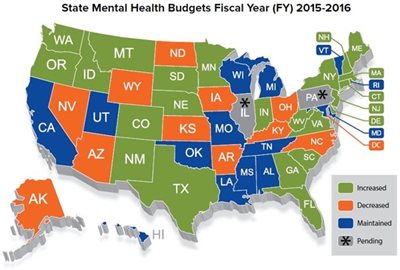
    According to mental health experts, the care these kids do get is often too little, too late. Unfortunately, state mental health services are often woefully underfunded by the federal government, and even less goes into preventative care and early intervention.

    Source: NAMI

    Early intervention is important. Children with severe mental illnesses who receive prompt intensive care tend to fare much better than those who have to wait due to money issues or a simple lack of programs in the area.

    “The research has shown that the earlier we can intervene, particularly with evidence-based interventions, the better outcomes we see later on,” said New York psychologist Danielle Rannazzisi, PhD. “The early years of childhood lay a foundation for future academic, social, emotional, and behavioral success.”

    Many states were forced to make severe cuts to mental health services during the recession of 2007 to 2009. That funding never recovered, and funding for mental health has been cut further under the Trump administration. Without that funding, states can’t afford to provide the care needed by kids like Daniel.

    View the original article at thefix.com

  • 15 Million Americans Are Battling Alcohol Use Disorder

    15 Million Americans Are Battling Alcohol Use Disorder

    Over an eight-year period, alcohol-related emergency room visits increased 47%.

    As a new year kicks off, some may be rethinking their relationship with alcohol. 

    In fact, according to the National Institutes of Health, greater than 15 million people in the US are living with alcohol use disorder.  

    The most recent numbers come from a study that examined data from 2006 to 2014 and found that alcohol-related emergency room visits increased to 5 million, up 47%. Of those, the biggest increase was in women ages 45 to 64. 

    One such woman is Teena Richardson of Seattle, who nearly lost her husband and two adult children due to her drinking habits. 

    “I wasn’t drinking wine anymore,” she told Fox 17. “It had escalated to hard alcohol. I wanted to get the buzz as fast as I could get it, and I wanted to hide it so that nobody knew.”


    Dr. Eric Shipley, medical director of Overlake Medical Center in Seattle, told Fox that despite these increasing numbers, people aren’t willing to cut out alcohol. 


    “If I went to somebody and said, ‘You could eliminate 15% of emergency room visits; would you do it?’ And they’d be, like, ‘Absolutely.’ Well, that means cutting out alcohol. ‘No, no, we’re not going there,” he said. 

    According to Fox 17, 88,000 people die each year of alcohol-related causes. This makes it the third leading preventable cause of death, with smoking and obesity coming in ahead.  

    “It’s one of the most dangerous drugs there is,” Dr. Harris Stratyner, a New York psychologist, told Fox 17. “It’s a little slower to kill you. It might take 10 years before it causes cirrhosis, but it’s gonna kill you.”

    For those who choose to seek treatment, there are a number of options for help. For Richardson, it took a few tries to find what worked. She tried outpatient therapy and 12-step programs before going to a 10-day aversion therapy program at Schick Shadel Hospital in Seattle. 


    Erick Davis, the medical director at Schick Shadel, said the goal is to take away the craving for alcohol. 

    “What we do is we pair the experience of nausea with the thought, smell, taste and sight of alcohol,” he told Fox.

    For Richardson, it worked, and she has been in recovery for seven years. 

    “Now I’m present, and I’m mindful of where I came from,” she told Fox. “And the test of alcoholism gave me a testimony. I’m on the other side of it.”

    View the original article at thefix.com

  • Winter Is Coming

    Winter Is Coming

    Then I heard it. I’ll never forget it. The worst sound I’ve ever heard in my life. My mom began to wail. No words, just tones of sadness and helplessness.

    I used to wonder why a lot of people seek treatment around the winter time. And it’s weird because for people in recovery, the winter is usually the time they go back out. The drop in temperature does something crazy to an addict like me. I used to love getting high in the winter. Today it reminds me of the first time I came out as an addict.

    November 2013. That’s when I told my family I was shooting up Dilaudid and smoking crack, and that I couldn’t stop. The walls had finally caved in. I couldn’t hold a job any longer, I was thieving just enough to keep my car legal and on the road with enough left over to support my habit. I had lost a lot of weight because the only food I was taking in was whatever I was stealing out of the 7-Eleven before or after getting right. My diet consisted of string cheese, blueberry Red Bull, and the cigarettes I scooped out of their ashtrays. I had a routine of hitting them either late at night or first thing in the morning. I needed the ash for the cans I was using to smoke crack. I had two cups filled with cigarette ash in my car at all times. It smelled like shit. I was too scared to keep a crack pipe on me or the chore boy to go along with it, so I kept soda cans and ash on deck, ready to go whenever I scored.

    If you knew me growing up, you’d remember me as a generally happy kid. Aside from the slight anger issues and ADHD, I was usually smiling and filled with joy. The criminal lifestyle I adopted while blooming into a career dope-fiend slowly took that away from me. My eyes were no longer clear, and my voice always sounded like I just woke up; there simply was no life to me. I was a shell of a man. My default look resembled a man who was just informed that he had three days to live. Hopeless, defeated, weak and suicidal.

    Over time, I forgot how to keep up with my hygiene. Drugs had a funny way of making me neglect my self-care. There’s no way in hell I’m paying for a $12 haircut, that’s damn near half a pill. I was starting to lose my mind. The crimes I was committing and situations I had been getting myself into were affecting me. Sleep was out of the question. Whether it was from the crack or the insomnia, I’m not sure. Probably a combination of both.

    I am a firm believer and supporter of men and women in recovery who now suffer from PTSD because I know firsthand the horrors that go along with being a really good junkie; the shit we do, the things we see, the things we endure or narrowly escape. It’s hard to come back from that after doing it for so long to survive. I totally understand how when we finally get sober it’s a struggle to let go of certain character defects. Those defects were critical survival skills. 

    I told my brother first. That November, right before winter, I remember losing my job because my boss caught me on camera taking out his MacBook Pro along with some power tools we kept in our warehouse. He told me he wasn’t going to press charges but I knew they were coming. You can smell the police sometimes. I had run out of ideas and was in so much pain emotionally. I was dopesick and needed a fix, with no one to call and nothing to steal. My bright idea was to confess to my brother that I had been using for however many years, explain to him what withdrawing is, and proceed to ask him to buy me drugs. How low can I go? Let me tell you.

    I called him and told him the deal and he was in my driveway in 20 minutes. I explained to him that I wanted to tell Mom but first I had to get right. He was devastated. He loved me. He knew something was up this whole time but couldn’t believe just how bad it was. There were tears rolling down both of our faces. He told me he’ll do whatever he can to help but then we go straight to Mom. At this point I didn’t care, I was minutes away from my next fix.

    The fucked-up thing about this whole situation is that my brother is the complete opposite of me. He is the purest man I know. He shits integrity and pisses excellence on a daily fucking basis. I remember watching him cry the first time he got drunk. It was his 21st birthday and he believed he was letting so many people down. Fast forward to a cold night in November. Now I got him hitting an ATM and taking him to one of the most notorious drug dealers on our side of town.

    I got my pills, I got right, and I lay down. I wasn’t man enough to tell my mom after we got home so I hid under the covers like the bitch I was. My brother came in and asked me when I was going to tell her. I didn’t care anymore because I had a pill waiting for me hidden in the closet, along with a 40 piece of crack I fronted from the dopeman when I was getting the pills. It’s weird, I got what I wanted and I instantly forgot about all the pain and turmoil I’ve been through, like I’m ready to continue this shit show of a drug binge.

    I conceded and told him to tell Mom himself. I threw the covers back over my head and curled into a fetal position. I could hear them whispering in the living room. I couldn’t make out any words but just the tones they were using sounded sad and concerned. Like sitting in the waiting room of a hospital and overhearing doctors talk about something serious, knowing the prognosis is death. This was serious.

    Then I heard it. I’ll never forget it. The worst sound I’ve ever heard in my life. My mom began to wail. No words, just tones of sadness and helplessness. The kind you hear at a funeral when a wife is mourning over her dead husband and finally breaks down as she reaches the casket to glance at the lifeless love of her life. My mom sounded like she just received news that her first born child was murdered. At least that’s how I felt. I instantly began to cry. What the fuck am I doing to my family right now?! I am such a piece of shit. I just want to die. I also want to take a huge hit of that rock right about now too.

    I heard footsteps coming to the door. I knew it was my mom and I didn’t know what to expect. I know how my mom walks. I know what it sounds like to hear her roam around her house. I know it well because usually it’s 3 or 4 in the morning and my ear is under the door listening for her night in and night out while I get high in my room. The fervency in her footsteps caught me off guard. I never heard her walk this way before. I began to tremble. She comes into the room and sits right on my bed, wraps her arms around me and pulls me close to her. With fear in her voice, she says, “I don’t care what it takes, I don’t care how we do it, but I will do whatever it takes, Eli. We will beat this! I will not lose you like I lost your father. We will do this together and figure this out. I love you.” Tears fall as I type this out for you right now, but the tears I shed that night hurt worse than any pain I have ever felt.

    Neither of us could have predicted what was to transpire over the next few years. Her words of “doing this together,” although noble and very motherly, amount to nothing if I do nothing for my recovery. This journey was mine to take and mine alone. My mom can’t get me sober. Her prayers can’t get me sober. Neither can my brother’s. Recovery is up to me.

    Now don’t get me wrong, I have been blessed. My family are not spectators in my recovery, they support me in their own way. At times they have had to give me the “hard no” and love me from a distance. But I have always felt their touch. I’m one of the lucky ones. It’s not like that for a lot of my junkie friends, especially the ones that have undergone a geographical change to seek treatment. I know firsthand the lengths my family members have gone to understand me and encourage me along the way and for that, I will forever love them.

    That was the beginning of my journey. I didn’t attempt to get sober until a few months later but I will never forget that night.

    The dialog was started. The truth came out. The jig was up. The smell of police was in the air and Christmas was right around the corner. Santa would bring a lot of heartbreak that year and for a few more years after that. But the truth came out. The yarn would finally begin to unravel and I would begin the most important fight of my life.

    The fight for my life.

    Today I’m sober. Today in this moment I am alive, I am happy, I am free… Life isn’t perfect, but I am in love with living and I have a purpose.

    My name is Eli and I am an addict. Until the day I spoke those words aloud, I was a dead man walking. One day at a time, I do the things necessary to stay alive one more day. 

    If nobody told you today that they love you, fuck it, there’s always tomorrow.

    View the original article at thefix.com

  • Bam Margera Shares His Rehab Struggles Through Social Media

    Bam Margera Shares His Rehab Struggles Through Social Media

    The long-struggling skateboard star aired his frustrations with rehab on the Internet, letting all his fans see how tough rehab can be.

    Bam Margera, the former star of Jackass, is struggling with the confines of his rehabilitation. As reported in The Fix, Bam entered rehab for a third time on January 2, 2019.

    Margera has struggled with drugs and alcohol since his youth, and the death of close friends from addiction has been a destructive force in his life. Ryan Dunn, a co-star of Jackass and one of Margera’s best friends, died in an alcohol-fueled, fiery car crash in Pennsylvania on June 20, 2011, alongside his friend Zachary Hartwell.

    Bam Margera has taken to Instagram to filter his emotions while in rehab this third time. “Writing is one thing to do in rehab,” is the caption of the below post, published in Livewire:

    Dear Cocksuckers,

    I have spent enough time grieving over Ryan Dunn through alcohol. I’m 39 years old, the party is over. I don’t plan on drinking anymore. I have wasted too much time at the bar and all my friends who needed decades of help are now sober. I would like to join the sober parade. I hear the stories of other rehab patients telling me about there [sic] weeks or months of horrible detox. Well guess how many days of detox I had? ZERO!

    I am sick of people always thinking I’m drunk, crazy or fucked up. So if you plan on calling me to tell me that, you can go fuck yourself instead. I’m not going to suck anyone’s dick to stay on [skateboard company] Element and or prove that I am sober. I am sober. So keep printing BAM [skateboard] decks or don’t. Plant a tree or go bite the big one, every day is Earth day!

    Margera’s next Instagram post was as direct and emphatic:

    To whom it may concern,

    1. I don’t do well with not being allowed to Facetime my wife and kid
    2. I don’t do well with not being able to answer important calls with important people
    3. I don’t do well with not being able to go with everyone else to an outside AA meeting.
    4. I don’t do well with not being allowed to use the gym.

    I don’t understand why I can’t go on the Interweb like everyone else.

    1. My eyes hurt from reading, my wrist hurts from writing, ’cause there is nothing else to do.

    Recovery often involves relapse and it definitely involves struggling through identity and pain, so perhaps Margera’s open discussion of his personal issues is one step closer toward health and sobriety. 

    View the original article at thefix.com

  • Trump Administration Finally Adds Drug Czar – But Will He Be Able to Do His Job?

    Trump Administration Finally Adds Drug Czar – But Will He Be Able to Do His Job?

    Jim Carroll will serve as Trump’s “drug czar,” taking over responsibilities largely led by Trump advisors Kellyanne Conway and Katy Talento.

    One of the hundreds of key jobs with agencies in Donald Trump’s White House that have gone unfilled since his inauguration now has an occupant. STAT has reported that Jim Carroll will serve as Trump’s “drug czar” at the Office of National Drug Control Policy (ONDCP), a role he has maintained as acting director since April 2018.

    But as both Politico and STAT noted, Carroll may have the title but not necessarily the reins of ONDCP policy, as decision-making on the national opioid crisis has been largely led by Trump advisors Kellyanne Conway and Katy Talento. The White House’s Office of Science and Technology Policy has also gained a director in former University of Oklahoma professor Kelvin Droegemeier, who filled a seat left empty since January 2017.

    Their appointments by a lame-duck Congress on January 2 coincide with a tumultuous period for the administration, which is in the midst of a partial government shutdown and a House under Democratic control. Putting Carroll in charge of the ONDCP may end a glaring absence in the direction of opioid policy while, as STAT noted, 70,000 Americans die each year from overdose-related deaths.

    But as STAT also noted, Carroll is a former commonwealth attorney for Fairfax Virginia who has held several positions within the Trump administration, including stints with the Justice and Treasury Departments, and has also worked for the Ford Motor Company.

    He lacks any public health experience beyond his appointment as acting director, though the White House stated that the majority of Carroll’s cases in Virginia were drug-related, and he worked with attorneys dealing with substance abuse issues at the Virginia State Bar.

    Carroll is also taking the helm of an office that has been marked by a general lack of cohesiveness since Trump took office. The loss of several key personnel, including a press secretary and communications director, who were replaced by inexperienced staffers – including 24-year-old Taylor Weyeneth, a former campaign worker who served as deputy chief of staff – and controversy over the nomination of Rep. Tom Marino, who reportedly pushed a bill that would weaken the Drug Enforcement Administration’s ability to regulate opioid distributors suspected of misconduct – has left employees at the DEA feeling rudderless, according to officials cited by STAT.

    Policy direction has been largely left to Conway, who has drawn fire for statements about drug dependency that have been perceived as ill-informed or insensitive. She told ABC’s This Week in 2017 that “will” is a key component to battling the opioid epidemic and informed Fox News that same year that “the best way to stop people from dying from overdoses . . . is by not starting in the first place.” Conway was later excoriated on social media for advising young people to choose ice cream and French fries over fentanyl.

    The other administration appointment, Kelvin Droegemeier, faces a similar uphill battle at the Office of Science and Technology Policy. The agency has also lost a significant number of staffers, and the Trump administration has maintained a skeptical stance on issues of climate change. The appointment of Droegemeier, a former meteorologist, has been praised by science advocates, but as with Carroll, it remains unclear as to how much he’ll be able to accomplish in his new position.

    View the original article at thefix.com

  • For Some Millennials, Access to Mental Health Care Can Be Problematic

    For Some Millennials, Access to Mental Health Care Can Be Problematic

    Millennials have been found to have the highest stress levels of any generation, but barriers like a lack of health insurance are preventing them from getting treatment.

    Aishia Correll, 27, grew up in a world where therapy was not an option. So, when the Philadelphia woman began struggling with her mental health, she turned to painting instead.

    But now, Correll tells the Bristol Herald Courier, she is a health care strategist and is working to increase access and affordability for mental health care, especially for millennials, women of color and the LGBTQ community.

    Correll’s areas of focus are in need. According to a 2018 survey by the American Psychological Association, millennials and Generation Z are at a higher likelihood of rating their mental health as fair or poor in comparison to other generations. In the same survey, millennials were found to have the highest stress levels of all generations.

    However, the survey also revealed that millennials and other young adults were more likely to seek out professional mental health care than older generations. In fact, over one-third of millennials and Generation Z said they were receiving treatment or therapy from a mental health professional.

    The Bristol Herald Courier also reports that since 2014, millennials have continually reported the highest stress levels. In Philadelphia specifically, one barrier to treatment is not having health insurance. According to a Pew report from 2014, 22% of those ages 18-34 in Philadelphia had no health insurance.

    Jennifer Schwartz, inaugural director of Drexel University’s Psychological Services Center and an associate professor in the department of psychology, tells the Bristol Herald Courier that without insurance, therapy can cost anywhere from $75 to $200 for one session.

    At Drexel, Schwartz states, patients are offered a sliding scale price that is based on income, and services are provided by doctoral students.

    “We have a large demand for our services, bigger than we could possibly provide,” Schwartz said. “We do get people who call us and are upset by the lack of services that they’ve been able to locate and access.”

    According to executive director of the Black Women’s Health Alliance, Brenda Shelton-Dunston, this issue is even bigger for millennial women of color.

    “There is a void in mental-health availability and access to mental-health prevention and support services for women of color in Philadelphia,” she told the Herald Courier.

    According to Correll, one solution could be services focused on millennials and located in the right areas.

    In the meantime, she is continuing to turn to art as a means of therapy and is hoping to provide a space for others to do the same through her creation of a “healing” art gallery in North Philadelphia.

    “I didn’t see that my family had a place like that,” she said. “I want to make sure I have a place like that.”

    View the original article at thefix.com

  • How Bullying Affects Mental Health

    How Bullying Affects Mental Health

    A new study examined the long-term health consequences of bullying.

    Bullying can lead to long-term brain changes in victims and leave them at increased risk of depression, anxiety and hyperactivity, according to a new study. 

    The study, published in the journal Molecular Psychiatry, examined the brain scans of 628 teens ages 14-19 who were also asked whether or not they were bullied.  About 30 reported that they had been victims of chronic bullying, according to Medical News Today

    The brain scans showed that the teens who had been chronically bullied had lower volume in two areas of their brains: the caudate and the putamen. The putamen regulates movements and can affect learning, while the caudate processes memories. The caudate is important for learning and helps individuals use past experiences to make decisions. These changes contributed to increased depression and anxiety in people who were bullied, according to Erin Burke Quinlan, a project coordinator for the study. 

    “Although not classically considered relevant to anxiety, the importance of structural changes in the putamen and caudate to the development of anxiety most likely lies in their contribution to related behaviors such as reward sensitivity, motivation, conditioning, attention, and emotional processing,” she said. 

    Study authors noted that while the changes occurred from bullying, earlier interventions could help prevent long-term health consequences from bullying. 

    “These data suggest that the experience of chronic peer victimization during adolescence might induce psychopathology-relevant deviations from normative brain development. Early peer victimization interventions could prevent such pathological changes,” they wrote

    Although previous studies have shown that bullying has long-term health implications, this is the first study to show how it affects the brain structure in victims. 

    “Chronic peer victimization has long-term impacts on mental health; however, the biological mediators of this adverse relationship are unknown,” the study authors wrote.

    A 2015 review published in the Archives of Disease in Childhood found that bullying can have an array of health and social consequences

    “This review considers the importance of bullying as a major risk factor for poor physical and mental health and reduced adaptation to adult roles including forming lasting relationships, integrating into work and being economically independent,” the authors wrote. 

    Health providers and others who work with kids should pay more attention to bullying and not accept it as normal childhood behavior, the authors wrote. 

    “Bullying by peers has been mostly ignored by health professionals but should be considered as a significant risk factor and safeguarding issue,” they said.

    View the original article at thefix.com

  • Your Body Processes Alcohol Differently As You Age

    Your Body Processes Alcohol Differently As You Age

    Experts detail the way our bodies process alcohol as we age.

    Hard partying might seem like a young person’s game, but experts warn that people need to be conscious of their alcohol intake as they get older, because aging changes how the body processes alcohol and the reasons why people drink. 

    “You may not realize it, but as we age, we become more vulnerable to developing an alcohol use disorder, more commonly known as alcoholism,” Brad Lander wrote in a blog post for The Ohio State University Wexner Medical Center and Ohio State’s College of Medicine, where he is a psychologist and addiction medicine specialist.

    Biology is partially to blame, Lander said. As people get older, the body breaks down alcohol more slowly, so alcohol stays in the body for longer. At the same time, tolerance for alcohol decreases. 

    “Even if you don’t develop an alcohol use disorder, it’s important to know that your body processes alcohol less efficiently the older you get,” he wrote. 

    Another risk for older adults who drink is that alcohol will interact with medications they are on, causing unintended side affects. 

    “[Alcohol] also can decrease the effectiveness of some medications and highly accelerate others, including over-the-counter medications such as aspirin, acetaminophen, sleeping pills and others,” Lander wrote. 

    In addition, many older adults might drink alone as a way to deal with isolation or depression, he noted. 

    “The reasons why people are drinking may change as they grow older,” he said. “Chances are, younger and middle-aged people are more likely to drink in social gatherings or celebrating with family and friends, while seniors may drink more to seek relief from the boredom, loneliness and grief that are common with aging.”

    Although the amount people can drink will vary, Lander said that on average a senior shouldn’t have more than seven drinks in a week or three drinks in a sitting. Drinking more than that can lead to health complications including increased risk of falls, worsening of chronic health conditions like diabetes or heart disease and increased risk of dementia. 

    Lander pointed out that even among people who follow these guidelines, about 2% will develop an alcohol use disorder. 

    Lander suggested that older adults start by being more mindful of when and why they are drinking. They should also eat food when they drink in order to slow alcohol absorption. 

    “A lot of drinking is ‘thoughtless,’ so simply ask yourself, ‘Do I really want a (or another) drink?’” Lander wrote. “Stand up to peer pressure to drink. Remember, you don’t have to drink.” 

    View the original article at thefix.com