Category: Addiction News

  • How Do I Find an Inpatient Rehab Near Me?

    How Do I Find an Inpatient Rehab Near Me?

    Inpatient rehab provides a safe, comfortable environment free of judgement. You receive constant care from highly trained personnel, as well as learning new coping skills and tools to live a healthier life after rehab.

    Chances are, if you find yourself turning to Google to search “inpatient rehabs near me,” you’ve come to a point of realization:

    You need help.

    Ask yourself these questions:

    Do I feel incomplete without drugs or alcohol?

    Can I get through my day without it?

    Have I strained relationships, or my career, due to my addiction?

    Have I continued to drink or use despite repeated negative consequences?

    If you answered “yes” to any of these questions, going to an inpatient rehab (near you, or across the globe) might be the first crucial step to finding recovery.

    Do I Need Inpatient Rehab?

    Coming to terms with your addiction and admitting you have a problem can be very difficult. Due to the stigma surrounding addiction, many people find themselves lying about their use and denying their addiction to friends and family members. This can be especially frustrating for loved ones, because most people can see right through the lies and denial.

    The person suffering from the addiction is often the last person to see it for themselves, and even when they do know they have a problem, it doesn’t mean that they want help right away. Due to the potential years of denial, admitting your misgivings can be that much more difficult. Some other signs that you may be ready for inpatient rehab are as follows:

    • You drink or use while operating a vehicle
    • Your friends, family and other loved ones have reached out to express concern
    • You lie about your use
    • You have withdrawal symptoms when you stop using
    • You’ve tried to stop on your own, but quickly pick back up again
    • You have been arrested and/or sent to jail
    • You want to stop using but do not know where to start

    Do any of these sound familiar? Making the decision to enroll in an inpatient rehab is going to be one of the best you’ve made in your life. When searching for “inpatient rehabs near me,” there are many important factors to keep in mind.

    What is Inpatient Rehab?

    First of all, it is important to understand exactly what inpatient rehabs are, so that you know what to expect once you arrive. Also known as residential rehab, inpatient rehab offers 24/7 focus, care, and medical supervision to not only get people through the initial detox process, but to also to help them understand how to reshape their lives once they’ve gotten addiction under control.

    Inpatient rehab provides a safe, comfortable environment free of judgement. You receive constant care from highly trained personnel, as well as learning new coping skills and tools to live a healthier life after rehab. There is also potential for camaraderie with the peers in inpatient rehab at the same time as you.

    Once you complete treatment and get back to your life, inpatient rehabs will also generally offer an aftercare recommendation aimed to help you live a healthy life without relapse. The length of stay at inpatient rehab varies based on the severity of your addiction, but it generally lasts anywhere from 30 to 90 days.

    What are the Benefits of Inpatient Rehab?

    Overcoming addiction is much more than just kicking a bad habit or abstaining from your substance of choice. Many people think that all they need to do is stop taking drugs or alcohol in order to be better, but that soon proves to not be true. Once withdrawal symptoms and cravings kick in, it is easy to go back to old ways. People suffering from addiction hear it all the time from family and friends: “Why don’t you just stop?” It is because addiction actually chemically wires the brain a certain way, and reversing that process may require medical attention in order to be successful. This is why becoming sober alone is extremely difficult, and why inpatient rehabs can prove to be very beneficial to recovery.

    Around the Clock Care

    When you are in an inpatient rehab facility, there are staff on-hand to assist you every hour of every day. This can include therapists, recovery mentors or medical staff. There is always someone around to help you through a difficult day, listen to any issues you may be having, or assist you medically should any withdrawal symptoms prove to be too difficult to handle alone. All of this allows for better accountability, as well as people to relate to.

    Often times, staff at inpatient rehab centers are in recovery themselves. This is especially true for recovery mentors, coaches, or alumni if the treatment center offers an alumni program. These staff members are available all day to talk with you and give you valuable advice.

    Being able to open up and relate to people is an important part of recovery, as it is very comforting to know you are not alone.

    Comfortable Detox

    When someone enters an inpatient rehab, one of the very first things they need to do is go through the detox process. This is one of the most feared parts of the recovery process, since the withdrawal symptoms that present themselves are very uncomfortable and can often be painful or scary. While not everyone requires detox, for some it is life or death.

    Addiction chemically wires your brain to become addicted to a certain substance. When that substance is no longer being supplied to the body, your brain will essentially go into a type of panic-mode, represented as withdrawal symptoms, in order to convince you to do just about anything to get your hands on the substance again. Once the substance has been detoxed out of the body, your brain will begin to rewire itself, learning that it doesn’t actually need that substance in order to survive.

    Withdrawal symptoms during the detox process may include:

    • Muscle pain
    • Vomiting
    • Nausea
    • Diarrhea
    • Sweatiness
    • Anxiety
    • Insomnia
    • Seizures
    • Delirium tremens
    • Changes in appetite
    • Increased heart rate
    • Hallucinations

    During this time, cravings can be at an all-time high and is when sobriety efforts are given up on if someone tries to go through it alone. Going through the detox process in an inpatient rehab will be much more comfortable, since the goal is to get you into therapy as soon as possible. Medications to help ease withdrawal symptoms are available so that you can better focus on therapy. In addition, some inpatient rehabs offer medications to curb cravings, as well as medications that prevent you from getting high should you use after leaving treatment.

    Some medications that may be used during or after the detox process are:

    • Suboxone
    • Buprenorphine
    • Naltrexone
    • Vivitrol
    • Methadone
    • Medications to relieve anxiety such as valium
    • Medications to help you sleep such as chloral hydrate

    A Fresh Start

    When you enter an inpatient rehab, it offers you seclusion and isolation from your normal environment. You are away from the stress of your normal triggers, which allows you the time to learn proper coping skills and stress management before returning to them. Some people recommend against choosing a treatment center from the “inpatient rehabs near me” search results, since you are still in your normal environment and could more easily leave or cave into temptation. Getting away to another city or state can be even more beneficial to allowing you to escape your stressors and give you a fresh, new start and gain a perspective that you haven’t yet been able to achieve at home.

    Inpatient Rehabs vs Outpatient Rehabs

    When searching for inpatient rehabs near me, you may come across some outpatient rehab options, as well. Outpatient rehab may offer more convenience, a lower cost and a smaller disruption to your life. However, that does not mean it is the better choice for you. It is important to know the difference between these and understand why inpatient rehab might better serve your needs for long lasting recovery.

    Why is Inpatient Rehab Better?

    Outpatient rehab facilities offer many of their own benefits. These can include many things, such as cost, convenience and the ability to still live your normal routine. If you have children or a demanding job, it can be very tempting to choose an outpatient rehab over one of the many inpatient rehabs available. However, your addiction has likely led you to a life that you do not enjoy living. It is important to be able to step away from this life and begin new, healthy habits and hobbies.

    Outpatient rehab also offers ample opportunity to abandon sobriety and give into cravings. You are in your normal environment, so you know exactly how to go about getting the substances you need. You are still around family and friends who you have learned how to manipulate, and nothing much will really change.

    Outpatient rehab is a good choice for people with less severe addictions, or people who have already been through inpatient rehab and need ongoing care.

    Levels of Inpatient Rehab

    Once you have come to the decision that you need to enroll in inpatient rehab, another difficult decision will present itself: Which one do I choose? This is a difficult decision, since no two addictions are the same. However, in general, there are two types of inpatient rehabs to first choose from. These include standard inpatient rehabs and luxury inpatient rehabs. The difference between them largely has to do with their cost, type of amenities, and setting.

    Standard Inpatient Rehabs

    If you are on a tighter budget, a standard inpatient rehab might be right for you. These types of treatment centers do not have resort-like accommodations, neither are they necessarily located in particularly serene settings. However, they do offer an acceptable level of care and can meet most needs. They usually do not offer many of the upscale benefits that luxury inpatient rehabs offer, but they may offer basic amenities such as a fitness center or nutrition coaching.

    Standard inpatient rehabs are also more cost-efficient for most people. If your insurance does not cover residential treatment for whatever reason, standard inpatient rehab will still give you an acceptable level of care at a more affordable price point.

    Luxury Inpatient Rehabs

    Luxury inpatient rehabs offer a much more upscale, serene environment as opposed to standard inpatient rehabs. They are usually located along beautiful coastlines, in the country or mountains to give that extra feeling of relaxation and seclusion. A beautiful environment to wake up to every day offers additional stress release and a sense of peace.

    Luxury rehabs are much more expensive than standard rehabs, however, the level of care and service comes along with the price.

    They also offer five-star accomodations like turndown service, laundry service, upgraded rooms and bathrooms, massages, swimming pools, private rooms, gourmet chefs, and more. In addition to traditional therapy, luxury inpatient rehabs may also offer additional holistic therapies, such as:

    • Acupuncture
    • Life coaching
    • Meditation
    • Massage therapy
    • Yoga
    • Equine therapy

    The Cost of Inpatient Rehabs

    The cost of inpatient rehab is one of the most important factors to consider when choosing the treatment center that is right for you. Every rehab varies in cost; some are free, while some can be very expensive. Most inpatient rehabs offer 24/7 admissions consultants you can call who will help you find out whether or not the center is covered on your health plan. Some may even go as far as talking with your health plan or insurance company for the best possible rate. Many rehabs offer financial aid or payment plans if you do not have medical insurance, or if the inpatient rehab you like best is not covered by your plan.

    When considering the cost of inpatient rehab, it is very common to become sticker shocked and abandon your efforts. However, there are a few things to keep in mind. In the long run, the cost of treatment is far less than the cost of your addiction. Consider how much money you have spent on your substance of choice. Consider how much money you have lost as a result of losing your job. Consider how much money you have spent sorting out legal issues as a result of your addiction.

    Is the cost of inpatient rehab worth getting your life back?

    For example: If you drink a 6-pack of beer everyday, it will cost you around $10 a day. This is on the low end of the typical amount someone experiencing severe active alcohol addiction will drink. This is $300 a month, $3,600 a year and $18,000 over 5 years. This does not include any money spent at bars, spent on juggling legal issues or jobs lost during this time. In the long run, treatment is far less expensive.

    Which Inpatient Rehab is Right for Me?

    Deciding which inpatient rehab to enroll in goes much deeper than finding one that fits your budget. Making sure you find a center you can afford is just one of the first steps of choosing a rehab. There are plenty of other factors to consider, such as location, types of therapy offered and whether or not the rehab offers a certain type of specialization.

    There is not just one clear cut path for all people suffering from addiction to follow. Addictions vary in length, severity, type of preferred substance, past traumas and consequences that addiction has presented. This is why there are so many different types of inpatient rehabs; there are so many different types of people with different types of needs.

    Location

    As of now, you may have been searching for “inpatient rehabs near me.” This means that location of the rehab could be of great importance to you. Staying near home can be a good option for some, however, considering an inpatient rehab that is away from home can be just good for your recovery, as well. In some cases, it can prove to be even better.

    Treatment near you

    If you decide to receive residential treatment near home, there are many pros and cons. A benefit for staying near home can mean that you have better access to your support system, such as your family and close friends. If you have children or a spouse, they can more easily visit you and be there for you in this time of need. Support is absolutely crucial during recovery, and for some people, staying physically near their support system can be important. Alternatively, some people may choose to separate themselves from their normal environment, and find that phone calls and few (or no) visits from loved ones could suffice just fine.

    A downside of staying at an inpatient rehab near home is the ability to easily abandon your recovery efforts. Since you are in a familiar place, you may be more inclined to walk away and give into temptations than you would be in an unfamiliar place. Some people may choose to stay near home due to various responsibilities and other logistical reasons, while some people may choose to take the time to separate themselves completely and focus solely on their recovery. Another downside is not having access to new experiences and treatments near you. You may want to go to a beach location or mountain location away from home, or meet new people who are not in your usual environment. All of these can help shape your recovery in a different way.

    Types of Therapy

    When choosing an inpatient rehab, you may also want to consider the types of therapy that the treatment center offers. There are many different types of modalities, and finding the right one for you can make all the difference.

    12-Step Program

    The 12-step program is one of the oldest therapies for addiction recovery. Invented by two men suffering from alcoholism, it was designed to help former alcoholics through the process of learning to live their lives without alcohol abuse. According to the National Institute on Drug Abuse, three key ideas predominate:

    1. Acceptance, which includes the realization that drug addiction is a chronic, progressive disease over which one has no control, that life has become unmanageable because of drugs, that willpower alone is insufficient to overcome the problem, and that abstinence is the only alternative
    2. Surrender, which involves giving oneself over to a higher power, accepting the fellowship and support structure of other recovering addicted individuals, and following the recovery activities laid out by the 12-step program
    3. Active involvement in 12-step meetings and related activities. While the efficacy of 12-step programs (and 12-step facilitation) in treating alcohol dependence has been established, the research on its usefulness for other forms of substance abuse is more preliminary, but the treatment appears promising for helping others with substance use disorders sustain recovery.

    Dual Diagnosis Treatment.

    More often than not, addiction is a symptom of a larger underlying cause. This root cause can be anything, such as a past trauma or experience. Addiction also presents itself alongside many other mental health disorders, such as:

    • Anxiety
    • Depression
    • Obsessive Compulsive Disorder
    • Schizophrenia
    • Post Traumatic Stress Disorder
    • And many more

    It is important to receive treatment for both disorders, rather than just one. If you treat your addiction without also receiving help for your depression, it may exacerbate the other and vice versa. Finding an inpatient rehab that treats both will help you achieve sustained recovery.

    Holistic Treatment

    You may find that holistic therapy, used alongside evidence-based therapy, can make a positive difference in your recovery efforts. Being able to align your mind, body and spirit has proven to help drastically reduce stress and anxiety. Whenever a negative thought or emotion pops up, holistic therapy can teach you how to deal with those thoughts, why they come, how to replace those thoughts, or how to talk yourself out of them. This can be helpful when a craving or trigger presents itself.

    Family Program

    Many inpatient rehabs consider addiction to be a family disease. Family is one of the most important things in life, so you may find that attending a treatment center with a good family program is important to you. This can include family therapy sessions, as well as keeping the family closely informed on your progress. Families can also be involved in the aftercare recommendation with the therapist, being able to set up boundaries and learning what to do should a relapse occur.

    Behavioral Therapy

    Dialectical Behavior Therapy (DBT)

    DBT involves changing negative patterns of behavior, such as self-harm, suicidal ideation, and substance abuse. According to PsychCentral, this approach is designed to help people increase their emotional and cognitive regulation by learning about the triggers that lead to reactive states and helping to assess which coping skills to apply in the sequence of events, thoughts, feelings, and behaviors to help avoid undesired reactions.

    Cognitive Behavioral Therapy (CBT)

    CBT involves focusing on changing unhelpful cognitive distortions (e.g. thoughts, beliefs, and attitudes) and behaviors, improving emotional regulation, and the development of personal coping strategies that target solving current problems. According to the US National Library of Medicine National Institutes of Health, it was originally designed to treat depression, but its use has been expanded to include treatment of a number of mental health conditions, including anxiety and substance abuse.

    Specializations

    You may find that you would like to attend an inpatient rehab that offers a specialization. This can include such things as programs specifically designed for your substance of choice, a women’s only inpatient rehab, a treatment center catered toward the LGBTQ+ community, or other types of peer groups. If you have a certain hobby that you enjoy, finding a treatment center that offers this hobby can make your stay much more comfortable and enjoyable. This can be such things as art therapy, sports, hiking, knitting, bowling or anything else you might enjoy.
    View the original article at thefix.com

  • Prison Consultants Accused Of Helping Convicts "Scam" Their Way Into Rehab Programs

    Prison Consultants Accused Of Helping Convicts "Scam" Their Way Into Rehab Programs

    Residential drug abuse program (RDAP) fraud is causing an already-crowded program to become even more difficult to enter as waiting lists grow.

    An entire industry of “prison consultants” have been reportedly helping individuals entering the prison system to fake their way into prison drug rehabilitation programs for many years, according to a report from The San Francisco Chronicle.

    This problem was brought to light recently when a Connecticut grand jury indicted three of these consultants, who are accused of coaching convicts who should have been ineligible for the Residential Drug Abuse Program (RDAP) on how to get in.

    Programs like RDAP are designed to help inmates with substance use disorders to detox and begin their recovery journey, rewarding them with a reduced sentence if the program is completed.

    The prison consultants in the Connecticut case are accused of telling individuals without substance abuse problems to arrive at prison while intoxicated and then fake withdrawal symptoms. This type of fraud has been an open secret for years, according to current and former prison consultants.

    However, this is the first time that anyone has been charged for facilitating RDAP fraud. 

    Prison consultants, often former inmates or prison employees, charge thousands of dollars for “insider knowledge” about how to best survive a stint behind bars. My Federal Prison Consultant president and retired federal Bureau of Prisons employee Jack Donson compared the industry to the “Wild West.”

    According to the website for National Prison and Sentencing Consultants, Inc., much of what they do is helping defendants and their lawyers keep sentences short.

    “Our singular goal is to reduce the amount of time our clients spend in federal prison,” the website reads. “NPSC works with federal defendants and their attorneys with federal plea agreement review, federal sentencing guideline calculations, pre-sentence investigation report review and analysis, sentence mitigation, prison designation and RDAP assistance and analysis.”

    Though much of the advice given by these consultants is perfectly legal, it appears that there is an increasing problem with instruction on how to cheat the system.

    RDAP fraud is causing an already-crowded program to become even more difficult to enter as waiting lists grow.

    Close to 10% of the prison population participated in RDAP in 2018 while thousands more waited their turn in the hopes of getting up to a year knocked off of their sentence. Plus, graduates can spend the last six months of their remaining sentence in a halfway house.

    According to former federal prosecutor Christopher Mattei, RDAPs are being used more and more by individuals convicted of white-collar crimes—a trend that could damage the credibility of the program and the justice system as a whole.

    “It undermines the public’s confidence that all people when they go before a court for sentencing will be treated fairly,” Mattei said on the issue. “People who know how to game the system know how to get the benefits, whereas people who are struggling with addiction don’t know all the angles to play.”

    View the original article at thefix.com

  • Doctors Are Cutting Back On Prescribing Opioids

    Doctors Are Cutting Back On Prescribing Opioids

    The number of doctors starting patients on opioid prescriptions also significantly declined.

    While overdose-related deaths from prescription opioids have more than quintupled over the past two decades, some encouraging news regarding the number of new opioid prescriptions written during a portion of that period has surfaced in a new study.

    Time cited research that examined national claims data culled from Blue Cross Blue Shield, which showed that the number of new opioid prescriptions issued per month dropped by 54% between 2012 and 2017—while the number of doctors issuing opioid prescriptions to patients for the first time also declined by a significant number.

    But as the study authors noted, these lower numbers were tempered by the number of physicians who continued to prescribe opioids during this time period, which was often at higher doses and for longer periods of time than the recommended limits suggested for first-time patients by the Centers for Disease Control and Prevention (CDC) in 2016.

    Those guidelines served as the focal point for the study, which was conducted by researchers from Harvard Medical School’s Department of Health Care Policy and Brigham and Women’s Hospital’s Department of Medicine, and published in the New England Journal of Medicine.

    Issued as the opioid epidemic began to reach critical numbers across the country, the CDC urged physicians to either abstain from using opioids as the first course of pain treatment, or to issue three-day supplies of opioid prescriptions at the lowest dose to first-time patients. 

    From there, researchers focused on the monthly incidence of new opioid prescriptions, which they determined was the percentage of Blue Cross Blue Shield members who were receiving an opioid prescription for either the first time ever, or for the first time in the previous six months.

    Their review of the data found that the number of new prescriptions dropped by more than half between 2012 and 2017, while the number of doctors prescribing opioids—either for the first time or to those who hadn’t received a prescription in the previous six months—declined from 114,043 to 80,462.

    “On one hand, we are very much encouraged,” said Nicole Maestas, an associate professor at Harvard Medical School and co-author of the study, to Time. “The study does suggest that every month, fewer people are being started on opioids, which means that the risk of developing opioid addictions and other adverse outcomes is lower because of that. Our enthusiasm is a bit tempered, however. One group of providers didn’t seem to get the message.”

    Maestas was referring to doctors who continued to prescribe opioids after the CDC issued the guidelines. Among that group, they found that 57% were prescribing them to first-time patients for longer than the three-day recommended period, and at higher doses. Of that group, 80% were primary care doctors in private practice.

    The study also raised another area of concern for Maestas and her team—it highlighted the possibility that doctors were not prescribing opioids for patients whose level of pain required such drugs. About 30% of the doctors whose prescriptions were included in the study time period did not prescribe opioids at all to people who had not used them.

    As Time noted, the authors were not able to determine if those patients were given other options for pain management, and suggested that in some cases, pain was under-managed rather than over-prescribed.

    Ultimately, the researchers hope that their findings will help hone future prescription guidelines.

    “It’s good news that some providers are changing their behavior, but not all providers are,” said Maestas. “The data suggests that some could use additional education around this issue.”

    View the original article at thefix.com

  • Judge: Insurer Discriminated Against People With Mental Illness, Addiction

    Judge: Insurer Discriminated Against People With Mental Illness, Addiction

    People attempting to access mental health treatment are still being denied coverage at twice the rate of those seeking physical healthcare.

    A federal court has ruled that one of the largest health insurance companies in the U.S. has been discriminating against people with mental illness and addiction disorders by failing to apply coverage standards equally across physical and mental ailments. U.S. Chief Magistrate Judge Joseph C. Spero issued a “blistering” 106-page ruling stating that United Behavioral Health, a subsidiary of UnitedHealth Group, effectively discriminated against thousands of people seeking treatment for these issues from 2011 to 2017, according to The Los Angeles Times.

    The Mental Health Parity and Addiction Equity Act in 2008 made it illegal for insurers to apply different criteria to patients experiencing mental health issues than those experiencing physical health issues when determining what to cover. Unfortunately, people attempting to access mental health treatment are still being denied coverage at twice the rate of those seeking physical healthcare.

    According to the report by Anita Raghavan, the blame for this rests on a lack of enforcement of the 2008 law by the overstretched Employee Benefits Security Administration (EBSA).

    Labor Secretary R. Alexander Acosta wrote in a 2018 report that this small division of the Department of Labor has only 400 investigators and 100 benefit advisors working to keep track of about 5 million health benefit plans across the country.

    In the space of two years, the EBSA was only able to issue 136 citations to health insurance companies for violating the Mental Health Parity and Addiction Equity Act. To make matters worse, the agency can’t assess civil monetary penalties to deter future violators.

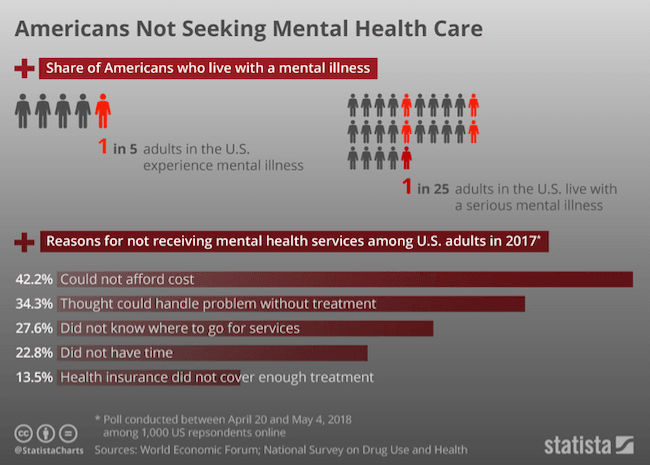
    The inability to get coverage for mental health issues have left many without desperately needed treatment. This is such a common problem that the National Alliance on Mental Illness (NAMI) has a guide for what individuals can do if they’ve been denied such coverage.

    This includes a list of “commonly denied types of care,” which appears to include all levels of care from diagnosis and common psychotherapy, “intermediate” care like outpatient or partial inpatient treatment, and full residential hospitalization.

    Source: Statista/National Survey on Drug Use and Health

    Meanwhile, reports of families struggling to get the appropriate care for mentally ill family members proliferate. In September 2018, WFYI did a story on Matthew Timion and his fight to get coverage for treatment that his adopted son desperately needed.

    “He was cutting himself and he’s hearing voices and he is threatening to run away and kill me,” Timion said. “The insurance company says, ‘Well, he hasn’t done that in three or four days now, he’s good to go home.’ And the hospital said, ‘No, he has to stay.’”

    The problem has become so severe that parents are increasingly resorting to giving up custody of their children because once they do, the state will be forced to pay for the necessary mental health treatment. Adoptive parents call this decision “gut-wrenching,” but without health insurance coverage for expensive treatment plans, they often have little choice.

    View the original article at thefix.com

  • Black Lawmakers Push Back On Legalization In New York

    Black Lawmakers Push Back On Legalization In New York

    Lawmakers want to ensure that Black Americans will benefit from legalization after years of being disproportionately affected by marijuana legislation.

    In New York, efforts to legalize recreational marijuana are facing an unexpected hurdle, as black lawmakers vow to withhold support if the legislation does not do enough to ensure that minorities will benefit from the legal cannabis industry. 

    Assembly majority leader, Crystal Peoples-Stokes, the first black woman to serve in that role, told The New York Times that none of the 10 states that have legalized cannabis have done enough to make up for decades of marijuana arrests and incarceration that have disproportionately affected African Americans. 

    “I haven’t seen anyone do it correctly,” she said.

    Although Gov. Andrew Cuomo’s proposal has promised a “social and economic equity plan,” Peoples-Stokes said it is lacking in specifics. 

    “They thought we were going to trust that at the end of the day, these communities would be invested in. But that’s not something I want to trust,” she said. “If it’s not required in the statute, then it won’t happen.”

    The governor’s counsel, Alphonso David, noted that including too much detail in the legislation may not stand the test of time. 

    “Some people are looking for a level of detail that may not be appropriate for legislation, and we have to be careful how we implement the legislation so we don’t have to change it every few years,” said David.

    Gov. Cuomo wanted marijuana legalization to happen quickly enough to be included in the state’s budget, which will be passed in April. Initially, this seemed likely, but given the opposition, Cuomo said he is “no longer confident” about meeting that deadline. 

    Peoples-Stokes agreed. “It’s not going to go the way it looks now,” she said. 

    The assemblywoman has introduced an alternative to Cuomo’s legalization bill. Peoples-Stokes’ plan would prioritize licenses for marijuana businesses in communities that have been disproportionately affected by marijuana prohibition, including communities of color.

    In addition, her bill calls for half of marijuana revenue to be directed toward community supports, including job training. 

    Although no state has written social justice plans into marijuana legalization, efforts to prioritize minority business owners are springing up around the country

    “We actually do have to overcorrect. People from our communities, black and brown communities, were the one first ones to be criminalized. Why shouldn’t we be the first ones to benefit?” Kassandra Frederique, the New York state director of the Drug Policy Alliance, told USA Today.

    View the original article at thefix.com

  • Students "Take Back" Billboards To Reduce Alcohol Advertising

    Students "Take Back" Billboards To Reduce Alcohol Advertising

    Students at the school said that alcohol use among teens is universally accepted so their anti-drinking campaign is necessary. 

    A school in California is trying to reduce the number of alcohol advertisements that its students see by purchasing billboard ad space and replacing alcohol ads with messages that encourage kids to avoid drinking. 

    A nonprofit associated with Roosevelt High in Fresno purchased the ad space and replaced it with an ad showing teens who chose education over alcohol. There are plans for at least one more billboard in Fresno. 

    Fresno Unified Superintendent Bob Nelson told ABC30, “For folks that are making good choices and prioritizing education over drugs and alcohol that you have some like-minded colleagues. So kids finding each other and willing to say hey I’m not willing to let anything get in my way of college is a really strong message.”

    The billboard that is up now shows eight students from Roosevelt High with the caption “I choose my education over alcohol.” 

    Students at the school said that alcohol use among teens is universally accepted, so taking a dramatic stance with something as visible as billboard is important. 

    Sophomore Nicole Lee said, “When we go to parties, my uncles would give my cousins drinks when they’re 18, so you’re basically breaking the law. I came to a point where I’m taking a stand so I’m going to do something to change that.” 

    Christina Garcia, another sophomore, agreed that talking about the dangers of alcohol for teens is important. 

    “Coming from me as a youth I have friends that say drinking is this and drinking is my life and OK it’s your life but what about your life. You’re just going to throw away your life for alcohol,” she said.

    Despite the experiences of teens at Roosevelt High, researchers have found that teen drinking rates are actually decreasing. According to researchers who conducted the Monitoring The Future survey, which looks at substance use among middle and high school students, teen drinking peaked in 1997 and has decreased 60% since then. 

    Last year, binge drinking among seniors in high school decreased by 2.8%. Fourteen percent of high school seniors reported that they had engaged in binge drinking in the prior two weeks. 

    At the same time, vaping of nicotine and marijuana has increased dramatically among teens, worrying health providers. More than 7% of teens reported that they had vaped marijuana in the past 30 days, while the percent of teens who had vaped nicotine doubled to 21%.  

    View the original article at thefix.com

  • Whole Foods CEO Would Like to See Marijuana Sold in Supermarkets

    Whole Foods CEO Would Like to See Marijuana Sold in Supermarkets

    Whole Foods already sells some cannabis-based products like organic hemp seeds and cannabinoid supplements.

    John Mackey, the co-founder and current CEO of Whole Foods Market, told an audience in Texas that if the state legalized cannabis, he would support efforts to sell it in supermarkets.

    Mackey, who was speaking at a staged conversation with the Texas Tribune, said that “chances are good” for cannabis sales in grocery stores like his natural and organic food chain, which has more than 450 locations in North America and the United Kingdom.

    When asked for an estimated time frame on when cannabis might be available on his shelves, Mackey noted that the decision lay with “the market and the government regulations.”

    As High Times noted, Mackey’s comments about cannabis in grocery stores were actually prompted by a question from an audience member about whether insects would ever be offered as an alternative protein source at Whole Foods. Mackey said that his stores would consider that option before adding his comments about legalization efforts in the Lone Star State.

    “If cannabis is ever passed in Texas, chances are good that grocery stores will be selling that, too,” he said. “You just never know what happens over time with markets. They change and evolve.”

    Mackey did not voice an opinion as to what cannabis-related products would be sold at his stores – Whole Foods already sells some cannabis-based products like organic hemp seeds and cannabinoid supplements – and concluded his thoughts on the possibility by stating, “Let’s see what happens with the market and government regulations over time.”

    Legal sale of marijuana is currently restricted in Texas, though low-THC cannabis is available to patients who have been diagnosed with “intractable” epilepsy as part of the Texas Compassionate Use Act of 2015. Three organizations were licensed to dispense cannabis in 2017, per the act’s requirements.

    House Bill 1365, which was introduced by Texas state representative Eddie Lucio III (D-Brownsville) in February 2019, would expand the Compassionate Use Act to allow treatment for cancer, autism, PTSD and other forms of epilepsy, and would expand the kinds of cannabis available to patients to include vaporizations, tinctures and lotions, but not smokeable cannabis.

    High Times also noted that Whole Foods is not the only food retailer to consider stocking cannabis. The United Bodegas of America has expressed its desire for New York Governor Andrew Cuomo to allow bodegas – the small, independent grocery/convenience and wine stores that are located throughout New York City and other major metropolises – to sell cannabis. 

    View the original article at thefix.com

  • The Ugly Side of Dating in 12-Step Programs

    The Ugly Side of Dating in 12-Step Programs

    When someone acts perfectly, their best selves, when that’s what they present to us, we often fall for it. I wasn’t special or not special. I was typical.

    Recently I was in a relationship with a guy I met in the program. We’d been together about four months, on again-off again. Really twice on, twice off.

    The first breakup wasn’t pretty — we’d had an argument one evening and when we parted he wasn’t happy. I’d say he was disappointed, but it was more than that. But after years of working my AA program, my “people pleaser” was quick to reassure him we were “good.” In fact, while the argument wasn’t really that bad and could have even been food for growth, his anger had frightened me. I’m eleven years sober, he had four years. I thought the recipe was for love, not disaster.

    The truth is: I’d been on the fence about him since we met.

    On our first date, he told me that he’d threatened to kill someone during a relapse. This left me feeling unsettled, but when I told my friends and therapist, I learned it was apparently really, really bad. I thought well, it was a relapse, not the type of thing he would do sober. I remembered him also telling me of a breakup that had happened when he was still using. Maybe all of his negative behavior was when he was using. I’d been through this before with sober men, and it was altogether confusing. An ex had gotten physical with a few women before I knew him, and I assumed it was while he was drinking. I learned at the end of our relationship that it was actually during a dry period. 

    I sound so judgmental. I guess we all have to be, to some extent, while we’re choosing who and who not to date. But apparently I’m not judgmental enough. I ended up dating the man who’d threatened someone’s life, and now here we were, post-fight, all my protective feelings swirling around inside me. I hate it when people say they were a hot mess, because it implies that they are or were hot, which is a little too narcissistic for my taste, so let’s just say I was a mess. (Not that I’m completely free of narcissism, but I choose to believe in the good in myself and focus on my character defects one at a time, rather than bundling them together.) 

    I’d like to say I was fine, but really I wasn’t fine. I was going to act like I was, though, to maintain the status quo. In other words, I’d said everything was okay, so I’d act like it was. Acting as if is a skill I learned fairly early in sobriety, and it had served me well.

    The morning after the fight I awoke to a long Facebook messenger message, really a few long messages from him, clustered together. This was the guy I was dating exclusively, and sleeping with, and basically in a “sober” relationship with. His messages were angry and spiteful. I’d thought all was okay enough to at least be civil to one another, but no such luck. And I felt sick about it. 

    I can’t remember if we spoke after the messages, but I don’t think we did. I was livid and hurt, an ugly combination of emotions. I broke up with him. Over messenger. The way we loved, we died.

    The Resurrection

    Until he started love-bombing me. I call it “The Resurrection.” It started with things he was going to give me, restaurants he wanted to take me to. He gifted me with a very personal family heirloom… and on and on. After about a month, I caved. Our second-round first date was at a park near my home. When this guy was on, he was on. We ended up kissing at my place, just kissing, and I was falling in love like I never had with him before. When someone acts perfectly, their best selves, when that’s what they present to us, we often fall for it. I wasn’t special or not special. I was typical. 

    The love affair lasted about two days, and then the old him reappeared: not listening well, an underlying frustration, a continuation of great and comforting sex (that’s where the connection stemmed from). All in all, except for the sex, nothing very exciting. Except I’m leaving out my behavior in the whole episode. Knowing I didn’t feel as strongly about him as he did about me, I should have ended it the first time around.

    Then the second time, about a month in, we went to a couple of galleries and walked around on a Friday night when everyone in New York City, like us, was mulling around for free. I wasn’t in a very good mood; my insecurity and self-hatred were getting the best of me. We had an argument — again, not so bad — but he got too angry for the situation.

    I woke up the next morning, upset and out of sorts, and called my sponsor, as I had a few times during our courtship. I asked her if I should keep my date with him that night. For the third time, she suggested I take a break from seeing him, but I didn’t listen. Suggestions are just that, I told myself, and at 11 years sober, who was I to have to listen to my sponsor.

    I went over to his place around six that evening. We took a taxi to a restaurant we liked, and the whole ride there was awkward, with short bursts of forced conversation. It got worse at the restaurant and culminated in me telling him I didn’t have the same feelings for him that he had for me. Read: My Part. I shouldn’t have gone in the first place, should have broken up with him the night before (as I didn’t hesitate to mention during what I now realize was a fight from the minute I set foot in his apartment).

    But then his anger moved in, like a dark cloud.

    “I’m breaking up with you, bitch,” he said and slammed his hand on the table. He started to walk out, which I feared would leave me stranded, far from home, with no means of getting back to my warm apartment and my sweet cat. At times of high stress, I, like so many others, go to the worst place, a place of abandonment and rejection. And as much as he really might have been rejecting me, I knew in my heart I had left the relationship months ago.

    I ended up begging him to let me ride home with him — that feeling of being stranded, scared, and alone that reminds me of all the reasons I drank and drugged — and we ended up sharing a taxi back to his apartment so I could take the subway the rest of the way home. During the 45-minute ride he alternated between yelling at me and saying he wasn’t going to be mean to me any longer, an agreement he broke countless times during the drive. He spewed hate at me while I mainly stayed silent and looked out the window. And then he said the most danger-filled and threatening thing anyone’s ever said to me: “if you think this is bad, try pouring alcohol and coke on it.”

    The moral? I should have left sort-of-well-enough-alone. After I knew who he was, I never should have gone back and dated him the second time. Or, if I am honest with myself, the first. I’m glad I got out before something really awful happened, though I remain worried that he might stalk me. I don’t know if that’s his style, but he did tell me that I had reason to be terrified of him. He said there are only a few people in the city who he hates, and they are scared of him.

    I’m dating again and it’s hard. I’ve had difficult breakups, in and out of sobriety, but this has to be the worst. It’s an all-time low; the one that leaves you with the most vile taste in your mouth. I don’t even know if I want to publish this, for fear he might read it, for fear you might. I’m going to go with HP on this one — pray like there’s no tomorrow, pray to be of service, to learn what HP has brought me in offering me this experience which I have embraced and then, finally, un-embraced, and to affirm that whatever happens, I’ll be taken care of.

    View the original article at thefix.com

  • Why Do Schools Have More Police On Campus Than Mental Health Staff?

    Why Do Schools Have More Police On Campus Than Mental Health Staff?

    On average, schools had just 1 counselor per 444 students, according to a report from the ACLU.

    In schools across the nation, students are more likely to see police officers than nurses or counselors, according to a new report.

    In fact, a third of public school students are enrolled in schools with a police officer but without a counselor, nurse, psychologist or social worker. 

    Using data form the U.S. Department of Education, the American Civil Liberties Union (ACLU) compiled a report, “Cops and No Counselors: How the Lack of School Mental Health Staff is Harming Students.”

    The ACLU found that mental health access is sparse in schools, as more funding is directed toward police and other security. 

    The report points out that the suicide rate among teens increased 70% between 2006 and 2016, and school is often the first and more accessible option for teens who need help. 

    “Today’s school children are experiencing record levels of depression and anxiety, alongside multiple forms of trauma,” the report reads. “School counselors, nurses, social workers, and psychologists are frequently the first to see children who are sick, stressed, traumatized, may act out, or may hurt themselves or others. This is especially true in low-income districts where other resources are scarce. Students are 21 times more likely to visit school-based health centers for treatment than anywhere else.”

    Schools with adequate mental health care see improved attendance, better graduation rates and fewer disciplinary problems, the reported noted.

    Yet, on average, schools had just 1 counselor per 444 students—something Eric Sparks, assistant director of the American School Counselor Association, says is absurd. 

    “It’s physically impossible for them to have an impact on students with developmental needs,” he said. “We have many schools where students don’t have access to a school counselor and some schools don’t have a school counselor.”

    On the other hand, the presence of police can contribute to the school-to-prison pipeline, the report authors argue. 

    “Schools are under-resourced and students are overcriminalized,” report authors wrote. 

    However, executive director of the National Association of School Resource Officers, Mo Canady, told CNN that tying the issue of police presence and lack of counselors together is a false comparison. 

    ”It doesn’t need to be one or the other, we need counselors and mental health specialists,” said Canady.

    “We definitely need specifically trained [school resource officers] to stand shoulder-to shoulder with mental health specialists. We need folks in there who are not afraid to be vulnerable and engage with students, listen to their concerns and just be real with them.”

    View the original article at thefix.com

  • Deregulating Buprenorphine Could Save Thousands Of Lives, Physicians Say

    Deregulating Buprenorphine Could Save Thousands Of Lives, Physicians Say

    Fewer than 7% of US physicians currently have the DEA waivers necessary to prescribe buprenorphine.

    An opinion piece by two physicians published in STAT Tuesday argues that deregulation of the opioid addiction treatment drug, buprenorphine, could save tens of thousands of lives every year.

    The authors, University of Rochester Professor Kevin Fiscella and Sarah E. Wakeman, director of the Massachusetts General Hospital Substance Use Disorders Initiative, strongly believe that making it as easy to prescribe buprenorphine as OxyContin or fentanyl is essential to the fight to end the opioid epidemic in the U.S.

    According to Fiscella and Wakeman, less than 7% of physicians in the country currently have the DEA waivers necessary to prescribe buprenorphine.

    Buprenorphine and methadone are currently the only approved drug therapies for opioid addiction disorders and is considered much safer than prescription opioids used to treat pain.

    However, doctors and nurse practitioners must jump through extra hoops in order to obtain permission to prescribe buprenorphine, while all DEA-licensed physicians are allowed to prescribe OxyContin and fentanyl.

    According to the Florida Academy of Physician Assistants (FAPA), all physician assistants need only to take a three-hour course in order to obtain a DEA license allowing them to prescribe controlled substances, including opioids. In contrast, physician assistants must go through 24 hours of training in order to prescribe buprenorphine on top of the training for the standard DEA license.

    An increasing number of studies have found that the over-prescription of OxyContin and, more recently, the misuse of the incredibly potent opioid fentanyl together have fueled an epidemic that killed close to 50,000 people in 2017 and likely more in 2018. So why, Fiscella and Wakeman ask, is a safer opioid that is approved to treat opioid addiction more difficult to prescribe?

    In order to prescribe buprenorphine, medical professionals must complete extra training, apply for a specially marked license, and agree to allow the DEA to inspect their patient records. All of these extra steps both increase stigma against addiction disorders and place unnecessary barriers in front of what is widely considered to be effective treatment for this massive problem.

    “Patients often experience barriers trying to fill prescriptions for buprenorphine—told they cannot fill it if the “X” is missing from the prescriber’s license number—or feel shamed when filling buprenorphine prescriptions,” the authors wrote. “Some feel embarrassed telling other doctors they are taking buprenorphine.”

    Fiscella and Wakeman conclude that deregulating buprenorphine—essentially making it as easy to prescribe as OxyContin and fentanyl—would increase treatment rates for opioid addiction and cause deaths from overdose to plummet. They cite policy in France which implemented this kind of deregulation in 1995 and resulted in a whopping 80% decrease in opioid overdoses.

    “[E]ven if deregulation of buprenorphine prescribing led to ‘just’ a 50% decrease, that would mean 20,000 fewer deaths.”

    View the original article at thefix.com