Tag: Answer Addiction

This is a custom tag page for Life.

  • 6 ways to apply mindfulness to your digital habits

    6 ways to apply mindfulness to your digital habits

    6 ways to apply mindfulness to your digital habits

    The average person checks their smartphone 150 times a day and our smartphone habits increasingly remove us from the present moment and leave us hopelessly distracted. Here are six ways you can apply more mindfulness to your digital habits, starting from now.

    #1 Limit your source consumption

    With the vast amount of information that is available on our smartphones, tablets and computers it’s certainly difficult to keep up with it all. You’re in effect consuming a huge amount of data, information, news, messages and entertainment all in very short periods of time.

    This proliferation of sources is what’s causing you to stay online for a longer amount of time than you need to. By reducing the amount of time you spend on specific sources and then moving on to something else once your mind begins to tire, you’re relieving yourself from the overload of information that you’ve been trying to keep up with.

    #2 Find the time to unplug

    We all get caught up with the continuous checking and responding to emails – that’s a given. The flooding of incoming phone calls and text messages on top don’t help and don’t give us the chance to make time for ourselves.

    Finding the time to unplug and stay in the present moment is essential because it will allow you to do one thing at a time and acknowledge the reasons why you’re doing it. Planning and sticking to schedules will also help you not wander around online aimlessly.

    #3 Decrease your social media usage

    Using social media with limitations is definitely a good idea. However with the increase in connections, followers and friends lists, you may begin to feel left out if you aren’t always connected and engaged with what’s happening around the world.

    Simply not giving in to social media, and being mindful of the amount of time it is consuming each day, can help you stay connected to the real world, giving you the space in your life to develop real relationships not virtual ones.

    #4 Take a moment

    Whilst you are browsing the internet on your smartphone, tablet or computer and end up waiting for a page to load, instead of opening up a new tab, just take a minute to relax in the moment. You can use the time that you find yourself waiting to meditate for a few minutes and observe the flow of your breath. Start to notice your breathing and the things you don’t always acknowledge by staying rooted in the present.

    #5 Develop a sense of digital awareness

    Become aware of your relationship with your digital devices and your state of mind when you are interacting with them. When you receive messages, texts, tweets and Facebook notifications, stay aware of how you feel when you have read them. What kind of feelings arise when you browse the internet? Or when you are multitasking online? Or when someone ‘likes’ or comments on one of your posts?

    Becoming non-judgmental and an objective observer of your emotions when you’re using technology will help you stay mindful, giving you choices in your relationship with technology rather than becoming a reactor to everything you see.

    #6 Utilise those mindfulness triggers

    Each time your digital devices ring or beep, they’re trying to distract you. But instead of seeing these alerts as a distraction, you can use them as an aid to become mindful of the present moment. So whenever you hear your phone bleep or ring from incoming messages, emails and calls, use them as mindfulness triggers to stay in the present moment. Realise the simplicity of the now and get out of your thinking mind for that brief moment.

    Coming back to your natural state of being when you are using technology is possible with mindfulness. Don’t just let your digital devices distract you from life but instead allow them to become gentle guides that direct you towards a life where you can live in the present moment.

    View the original article at itstimetologoff.com

  • The Social Media Paradox: It Sells us Connection but Sucks Our Attention

    The Social Media Paradox: It Sells us Connection but Sucks Our Attention

    The Social Media Paradox: It Sells us Connection but Sucks Our Attention

    Social media networks say they are all about connecting people. But they have warped into distraction engines which suck our attention – taking us away from those we could be connecting with – and spawning the logging-off, or digital detox, movement.

    Why did we join Facebook in the first place? It almost certainly wasn’t to watch, like and share streams of viral videos, which the newsfeed has overwhelmingly evolved into. Why did we join Twitter? It wasn’t to have circular arguments, in a medium stripped of nuance of expression. We didn’t join Instagram to get more anxious about our body image either.

    These are the downsides of social media that were unexpected. Yet these downsides have clearly existed for some time, and only until very recently have they been in any way acknowledged by the infant, but giant, companies.

    The social media message sold is connectivity but, rather than meaningfully enhancing this, platforms absorb our attention while pursuing an approach of growth at any cost. It’s claimed that users will benefit because they will be able to become closer to those that matter in their lives. But that connectivity is of little commercial value to platforms who rely on advertising revenue. User data is what is essentially sold to advertisers, who in turn want consumers to look at their products – ultimately this data and the subsequent consumption of our attention is the real value.

    “The ugly truth is that we believe in connecting people so deeply that anything that allows us to connect more people more often is *de facto* good. It is perhaps the only area where the metrics do tell the true story as far as we are concerned.”

    Facebook VP Andrew Bosworth in memo to Facebook staff

    Likes don’t equal connection

    This inconvenient truth has run rampant in recent years. The first major departure from enhanced connectivity was Facebook’s introduction of the Like button in 2009. This opened the door for viral publishers to enter that platform, and subsequently grow incredible amounts of traffic quickly – even at the expense of truth and credibility.

    A market of hyperbole and fake news became inflated, but Facebook offered little meaningful resistance. Rather than making meaningful connections and having conversations, users were now increasingly distracted by publishers that were focused on attention absorption, often with a single-minded focus on stirring prospective audience’s emotions. Since its inception until only January this year, the cluttering of the newsfeed with everything but updates from close friends has generally increased.

    Second social media revolution

    Meanwhile, around 2012, there was a second social media revolution – a proliferation in usage of social apps specifically designed for mobile devices with no desktop version. Instagram, which had existed since 2010, released its Android version in 2012 and rapidly grew its user base. Snapchat and Tinder were also released around this time. It’s no coincidence that the stirrings of the first digital detox movement began around this time too.

    Tinder expresses a mission of connection, but its free version makes more money the more users use it.

    The paradox of connectivity vs. attention is perhaps best illustrated by Tinder. This is an application that is supposed to enhance people’s likelihood of getting into a relationship. While there are many interpretations of what it can deliver, Tinder runs on a ‘freemium’ model of people either paying for a subscription or being served advertising as they swipe through potential matches.

    But given Tinder will make more money via showing users more advertising, it means holding user attention on the platform for longer on the platform is the best option. Therefore, though connecting to a potential soulmate is what’s offered, it’s actually our attention that’s being sold.

    We must think to ourselves – is social media really helping us make deeper and more meaningful connections in contrast to our time and attention spent on the platform? If it isn’t, then perhaps it really is time to quit social media and take a digital detox.

    View the original article at itstimetologoff.com

  • Think Our Technology Addiction Isn’t Bad For Our Mental Health? The Evidence is Overwhelming

    Think Our Technology Addiction Isn’t Bad For Our Mental Health? The Evidence is Overwhelming

    Think Our Technology Addiction Isn’t Bad For Our Mental Health? The Evidence is Overwhelming

    A common accusation directed at selfie-crazed youngsters is that they are a generation of narcissists. It’s true that social media did appear to have been emphasising the ‘individualism’ that has been a feature of Western culture since the 1960s. But this was only the case until around 2008 – since then the trend has actually been going down.

    Young people, it would seem, are struggling more than ever with a crisis of confidence and anxiety. Why? Firstly, the 2008-2009 Financial Crisis delivered a reality check to young people’s prospects, knocking their belief that getting a good career was easy and their future guaranteed. The second factor is linked to our increasing use of technology.

    The ‘Selfie Generation’

    It’s not surprising that there are increasing worries about body image and anxiety with the proliferation of ‘the perfect self.’ For every pristine looking prom queen and football captain out there, there are scores of young people who don’t feel quite as confident about their looks. Instead, they’ll be watching, ‘lurking’ as it is often labelled, as their good looking and popular peers gather hundreds of likes and comments of ‘SO HOT!’ for beach photos, selfies or them on nights out.

    How can this scenario be beneficial for these social media lurkers? Heavy smartphone and social media usage have links to depression, and Instagram has been highlighted as the worst of the major social networks for teen’s mental health.

    #StatusOfMind, a study by The Royal Society for Public Health, surveyed nearly 1,500 14-24 year old’s opinions on various social media applications, asking them to what extent each of the social media platforms they use made certain health-related factors better or worse.

    YouTube did rather well, scoring positively in helping the group with issues like anxiety, depression and self-expression, although like all the apps it was seen as detrimental to sleep. However, YouTube was the only network from five with a positive weighted score. Twitter was neutral, while Facebook, Snapchat and Instagram – notably all networks for which photos are a core component – all scored negatively. Instagram scored very negatively for FoMo, bullying, body image, anxiety and loneliness. As one respondent summed it up: “Instagram easily makes girls and women feel as if their bodies aren’t good enough as people add filters and edit their pictures in order for them to look ‘perfect’.”

    The Empirical Evidence

    This is far from a one-off UK study either. An article in Depression and Anxiety Journal called Association between Social Media use and depression among US young adults, concluded:

    “…social media use was significantly associated with increased depression. Given the proliferation of social media, identifying the mechanisms and direction of this association is critical for informing interventions that address social media use and depression.”

    The paper cites numerous other papers including “They Are Happier and Having Better Lives than I Am”: The Impact of Using Facebook on Perceptions of Others’ Lives, Facebook Use Predicts Declines in Subjective Well-Being in Young Adults and Facebook’s emotional consequences: Why Facebook causes a decrease in mood and why people still use it. What’s striking about these particular citations is that the titles already make conclusions; there is no ambiguity about the findings.

    Psychologist Jean M. Twenge makes a similar statement in the title of her book iGen: Why Today’s Super-Connected Kids Are Growing Up Less Rebellious, More Tolerant, Less Happy and Completely Unprepared for Adulthood. ‘iGen’ is defined by Twenge as a generation that was born between 1995-2012. While the millenials had a lot of digital access, iGen are the first generation that has grown up with the almost ubiquitous availability of Internet use.

    Young Women Are The Most Prone

    Young women and teenage girls are the most likely to suffer from anxieties around body image, and they are also the group with the highest smartphone and social media use. On average, 18-24 year old women in the United Kingdom are now spending 85+ hours a month with their screens – a significant increase on men at the same age and any other age group. Meanwhile, more than a third of 14-15 year old girls are reporting to feel psychologically distressed and are far more likely to do so than boys of the same age.

    But where is the greatest source of this anxiety? YouTube star Zoe ‘Zoella’ Sugg sums it up rather well in her introduction to her bestselling novel Girl Online. She lists her Top Ten Reasons for Teenage Girls Getting Anxious, the second half of which are all focused on body image and exacerbated by social media:

    #1 You’re supposed to look perfect all of the time

    #2 This coincides with your hormones deciding to go bonkers.

    #3 Which leads to the spottiest time of your entire life (making number 1 totally impossible)

    #4 Which also coincides with the first time you’ve had the freedom to buy chocolate whenever you like (making number 3 even worse!)

    #5 Suddenly everyone cares about what you wear

    #6 And what you wear has to look perfect too

    #7 Then you’re supposed to know how to pose like a supermodel

    #8 So you can take a selfie in your outfit of the day

    #9 Which you then have to post on social media for all your friends to see

    #10 You’re supposed to be wildly attractive to the opposite sex (while dealing with all of the above!)

    These rises in depression and anxiety amongst young people are often said to be caused by alternative factors: more intense exam pressures, an unreliable job market, and risk of sizeable debt. Perhaps also an increased awareness and an acceptance that mental health is as important as physical health has enabled a greater reporting of it too.

    But while these all sound credible, they do not correlate like the sudden burst of these feelings and the rise of smartphone usage with social media’s second wave. This new epidemic is not a scare story invented by the media. It’s being featured the world over in empirical studies that consistently make the same conclusions: high social media usage is bad for mental health.

    View the original article at itstimetologoff.com

  • Parenting With Screens: Making Tech Invisible at Home

    Parenting With Screens: Making Tech Invisible at Home

    Parenting With Screens: Making Tech Invisible at Home

    My wife and I have a new rule in our household: we don’t look at our devices in front of our kids. This wasn’t always the case. Although we have always kept technology out of the hands of our kids (the only time they get an iPad is on an airplane) we always felt free to use our devices ourselves, even when the kids were around.

    For most of our children’s early childhood, I would be regularly staring down at a screen. Maybe I was reading a book on my kindle app, or downloading music to practice on my guitar, reading the news, catching up on social media, or staying connected to the office. This is the great (and terrible) thing about mobile technology, there is always something to be done.

    We did have a “no devices at the table” rule. But there always seemed to be exceptions to the rule. After all, it is hard to have a dinner conversation nowadays that doesn’t relate to something online. Maybe it was a funny story or video that we saw, a question that we needed to google the answer to, or a schedule or weather forecast that needed to be consulted. There is always a good reason for the phones to find their way into our hands, even when we’re at the dinner table.

    Smartphone addiction

    I was motivated to make a change when my 7-year-old son expressed an interest in a little game called Rider. He had played it on a friend’s device and he asked me if I would download it. I did download it, not so my son could play it, but so I could see what kinds of games my son was getting into when I wasn’t around. The game is pretty harmless and fun, but very addictive.

    One day, my son was looking over my shoulder while I was looking at my phone and he saw that I had Rider on the phone. His eyes lit up with excitement. From that day forward, my son’s relationship with my phone changed dramatically. Every time I pulled out my phone, he wanted to be near it. And he was constantly begging and pleading to be allowed to play Rider. The breaking point was one day when we were at the beach. This is a normal weekend activity for us. But this time it was different. My son refused to play in the sand or the sea and couldn’t enjoy the beach, he could only point at the bag where my phone was and plead with me to be given access.

    Of course I said no. “We will never play video games when we are out at the beach,” I explained. But I knew this wasn’t enough. The phone had to disappear. So I went home and discussed with my wife who, being far less addicted to technology than I am, was only too happy that I had seen the light. So we set course on a new path: we would keep our devices hidden from our kids.

    Analogue Alternatives

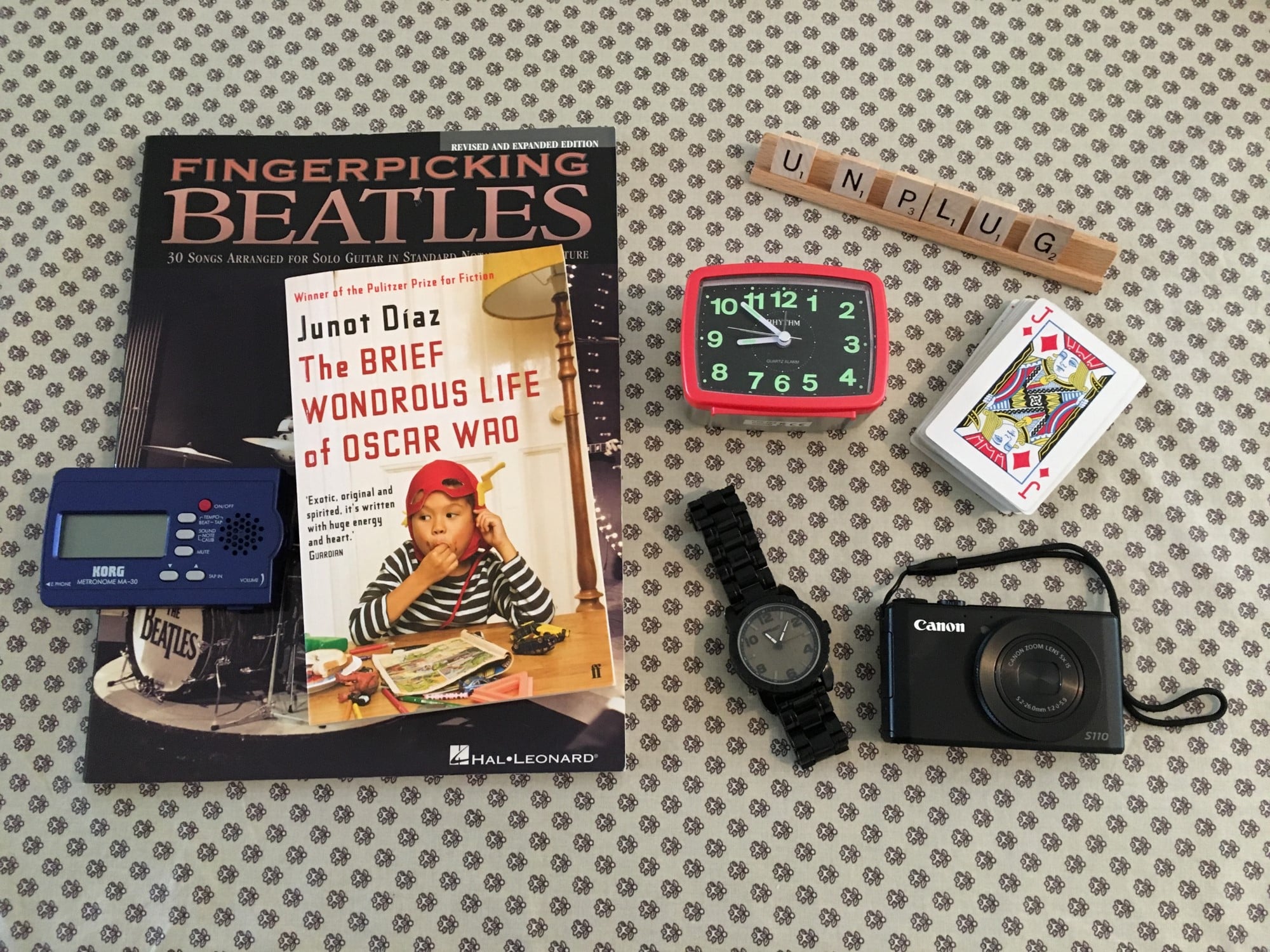
    As a result we have to use all kinds of ancient ‘single-function’ artefacts to get things done in front of the kids, analogue cameras, wristwatches, alarm clocks – books! To be clear, it’s not that we don’t use mobile technology . . . we do. We just try to hide it as much as possible in the house. If we need to look something up, or send a text or an email, or anything else on a device, we have to slip away into another room. My kids might wonder why their parents are spending a lot more time in the bathroom now! But we get done what we need to get done and when we come out we are more present. It seems to work for us.

    View the original article at itstimetologoff.com

  • We’re Misusing Technology in the Workplace – and It’s Stressing Us Out

    We’re Misusing Technology in the Workplace – and It’s Stressing Us Out

    We’re Misusing Technology in the Workplace – and It’s Stressing Us Out

    Email, web chat, social media, smartphones. The modern workplace can’t do without these things. Just imagine a working environment where all of them were suddenly banned. Employees would be shocked. Some might even take to Twitter to complain about their backward looking employer. 

    But it might actually be better for our productivity. Many workplace practitioners are expressing doubts on the unrestricted nature of technology in the workplace – and the myriad of distractions that it brings. 

    Unrestricted Email

    Let’s take email as an example. Information workers are, on average in 2018, receiving well over 100 emails a day and sending 40.  Assuming that it takes two minutes to compose and send an email, then the average information worker is already spending at least 20% of their working life simply tending to email.

    Two minutes is of course a very conservative estimate. Very few people would spend so little time on a message if it was going up their chain. Additionally, it takes fairly strong discipline to tend to email in blocks of time – most people respond throughout the day. 

    Now, to get into a high state of productivity (often referred to as deep work or flow) a person needs about twenty minutes to focus. But if you spread the forty distractions of email responses throughout the day, then a state of flow is very unlikely to be achieved. 

    What a bizarre state of affairs! Why does everyone in a company need an email address? Why do they need to send and receive messages at such a pace that simply no one can keep up? For the most part, they don’t. Email responses are all too often a waste of time. Hours can be spent fuming over a misread line and stewing up a response, which could have easily been resolved with a simple chat. 

    Living out of your work inbox provides the same sort of intermittent variable reward that we see with social media, and even slot machines. You check it, just to see what’s come in. If the incoming email is good, we may well respond and be satisfied. If it isn’t, it’s likely to lead to more stress. Of course, many people don’t turn their notifications off either, so these will flash up onscreen or rumble in our pocket, demanding to be attended to.  This, ultimately, can change our working habits into becoming hooked on email.

    Then there’s the seeming necessity of people to take their mobile phones into meetings. Largely done to either continue to receive and reply to email, or just surf the web during the meeting if the employee simply gets bored. Well, unsurprisingly, this is devastating for employee attention and engagement. 

    Rising Stress in the Workplace

    In a high paced, high tech work environment, everyone wants a response RIGHT NOW. But it is impossible for everything to move at that speed, particularly when so many requests are unnecessary in the first place. It’s having quite the toll on employee productivity, and, worse still, their stress levels and their mental health.

    What’s the consequence of all this pushing around of shallow information? Psychologists have warned that email notifications are a toxic source of stress – with people in jobs such as marketing and media finding themselves under the most pressure. Unwritten organisational etiquette, such as rapid and out of hours responses are contributing to the problem.

    Meanwhile, it has been found that simply having a smartphone nearby can reduce cognitive ability. It’s informational lure is clearly having an effect on our ability to think clearly in the moment.

    These are not good trends. It’s time employers took proper heed of the onslaught; a rethinking of the barrage of unrestricted email, and a reduction of smartphone usage when employee attention should be focused on the task at hand.

    View the original article at itstimetologoff.com

  • Is Our Internet Addiction Wrecking Family Life?

    Is Our Internet Addiction Wrecking Family Life?

    Is Our Internet Addiction Wrecking Family Life?

    Our children’s relationship with tech is an uncomfortable subject. With the huge opportunity for learning and connectivity comes a multitude of concerns for parents. Kids can become so absorbed in their mobile phones and devices that it can affect their relationships, make them more distracted and impact their mental health.

    Why is this? Well, much of today’s technology is addictive by design. Mobile phone applications send notifications, offer intermittent variable rewards and have a particualr incentive to get users to spend more time on them. When teen girls reach 18, they’re apparently spending upwards of 85 hours a month on their smartphones.

    Perhaps the most troubling effect on younger people’s technology use is the correlation between it and the rise in mental health problems. It may be that opening up about mental health has less of a stigma attached to it, but the empirical evidence that too much tech – particularly social media – can lead to mental health issues appears very clear. Instagram in particular, can create problems around body image and cyber bullying.

    But this problem isn’t just about young people. The average time spent for all UK adults on smartphone screens is about 65 hours a month – more than two hours a day. While the kids are busy on messaging apps, games and social media, their parents have the same level of access – and indeed appetite – for these things. But they also have the additional burden of unrestricted work email, which can be sent to them at any time – even when they’re on holiday.

    Parents are no less susceptible to the addictive qualities of their technology and the effect of this is that relationships with their children can really suffer. A recent BBC article ‘I wish my mum’s phone was never invented‘ featured a Louisana class where children were asked about an invention that they didn’t like. 4 out of the 21 students wrote about mobile phones. One wrote:

    “If I had to tell you what invention I don’t like, I would say that I don’t like the phone. I don’t like the phone because my parents are using their phones every day. A phone is sometimes a really bad habit. I hate my mom’s phone and I wish she never had one. That is a invention that I don’t like”.

    Furthermore, a study published in May 2017 found that many parent-child relationships were impacted by ‘technoference.’ Family relationships were found to be suffering when adults were prioritising interacting with their phones at a time when they should have had their attention focused on their children.

    In her book Reclaiming Conversation, Sherry Turkle documents a father-daughter relationship spending time together at a camp. The father can’t fathom the notion of not taking his phone on the trip, and while he is there spends large amounts of time documenting it and sharing it on social media. While much of the posting is indeed about his relationship with his daughter, and they look like they’re having a lovely time, he is actually spending the majority of his time on his phone doing the uploading and interacting. His daughter sits next to him, silently. The act of sharing his time spent with his daughter on social media is distracting him from spending quality time with her.

    Constant checking of email, social media and the other apps that chime and buzz away on our phones is for most of us a familiar feature of life at home. But for the sake of our relationships, maybe it’s time we weaned ourselves off more at home and back into a more analogue world?

    View the original article at itstimetologoff.com

  • Avoiding a Rut: 4 Ways to Make Addiction Recovery Interesting

    Avoiding a Rut: 4 Ways to Make Addiction Recovery Interesting

    Addiction recovery is a tough and arduous process. Going from addiction to a successful recovery takes hard work, persistence, and staying true to yourself and your own goals. There are many ways to make addiction recovery interesting; we want to go over a handful of them with you now. Sometimes when there are too many failures or not enough engagement in interesting and purposeful activities, a person can find themselves beginning to turn back to old habits, ones which are harmful and destructive that they genuinely intend to avoid.  So, here are some addiction recovery tips that will help you reach your goal.

    Common Addiction Recovery Tips

    Set Goals

    You should first go over your original purpose and decision for being clean. What was it that made you feel interested in achieving this state? What was your goal and reason for being clean? Why did you decide to live a drug-free life? What was the drive behind it all, to be a sober person? Ask yourself these questions, think about it on your own, write them down, or tell a friend, but do it until you feel rejuvenated and inspired to remain clean and to achieve your goal of being a sober individual, leading a drug-free life.

    For example, “I want to be a sober individual.” Or, “I want to lead a drug-free life, inspiring others that they can recover from addiction.” Or another example could be “No longer dependent on drugs, rehabilitated from drug-use, and surrounded by people who are clean.”

    President Abraham Lincoln provides us with a wonderful quote for reminding us of sticking to and achieving our goals: “Always bear in mind that your resolution to success is more important than any other one thing.”

    Whatever your goal is, it is good to figure it out and work it out until it is clear and precise, you can look at it every day until you have achieved it.

    Engage in New and Old Activities

    There are probably things you have wanted to do for a long time but never did. For example, if you wanted to become a bookworm, you could set a target for achieving that. “I want to read one and a half books a month.” Then you can figure out what that is going to take. How long does it take you to read a book? How many books can you finish in a month, while still enjoying it? What genres of books do you want to read? Maybe write a list of books you want to read in the year and check them off as you finish them.

    There are probably activities you always wanted to do but never tried or never learned. Or perhaps, you need to go out and find some activities you didn’t even know existed and participate in them.

    “Far and away the best prize that life has to offer is the chance to work hard at work worth doing.” – President Teddy Roosevelt

    Whatever activity or activities you decide to do, have fun, try to learn something, and keep busy. You might find that you have an undiscovered passion or an untapped talent!

    Schedule, Plan, and Do

    An excellent way to stay inspired, keep entertained, and achieve your goals is to plan out and schedule your time so that you can do things that are interesting and accomplish things that you want to.

    “Have patience with all things, but chiefly have patience with yourself. Do not lose courage in considering your imperfections, but instantly set about remedying them – every day, begin the task anew.” – Saint Francis de Sales

    Write out a daily list of things you want to do and check off what you get done. Get a calendar or scheduling book and clock in your favorite activities, new activities you never tried, exercise time, or events you want to attend. This will help you to keep busy, stay on track, keep life interesting, and, most importantly, achieve your goal.

    Volunteer

    Volunteering is a great way to develop a deeper sense of purpose in your life or to give back if you feel the desire to do so, plus helping others makes you feel good about yourself and your life. Being able to help another person is often thought of as Man’s greatest ability.

    Physicist Albert Einstein has a quote that could apply to volunteering when recovering from addiction, “In the middle of difficulty lies opportunity.”

    If there is a group or activity or area in life you feel passionate about, you can find out if there is something you can do to help them, there are plenty of opportunities that exist, you just have to search a bit.

    The other great thing about volunteering is you get to meet new people while creating a change in the world, making a difference in others’ lives is inspiring and satisfying.

    Addiction Recovery Tips and Quotes

    There are many addiction recovery tips and addiction quotes which can help make recovery more inspiring and keep you motivated. You can surround yourself with these quotes so that you see them every day.   Or, you can make a book of them to write them down in and look at whenever you need inspiration, keeping a favorite in your car and one in your home, these are all different ways you can be reminded of your goal and fire yourself up.

    Some more inspirational recovery quotes:

    “Life is very interesting… in the end, some of your greatest pains become your greatest strengths.” – Actress and recovering addict Drew Barrymore

    “As human beings, our greatness lies not so much in being able to remake the world… as in being able to remake ourselves.” – Mahatma Gandhi

    “Determine that the thing can and shall be done, and then we shall find the way.” – President Abraham Lincoln

    “Courage is not having the strength to go on; it is going on when you don’t have the strength.” – President Teddy Roosevelt

    “The ultimate measure of a man is not where he stands in moments of comfort and convenience but where he stands at times of challenge and controversy.” – Civil rights leader Dr. Martin Luther King Jr.

    There are many ways to have an inspirational recovery; reviewing your original purpose, setting goals, engaging in activities, scheduling, volunteering, and looking at motivational quotes, following addiction recovery tips, you can keep yourself interested and avoid the dangers of turning back to addiction.

    View the original article at

  • Top 10 Reasons for Seeking Treatment for Addiction

    Top 10 Reasons for Seeking Treatment for Addiction

    There are many reasons for seeking treatment for addiction. Here, we will discuss some of the reasons you may have finally accepted the fact that you indeed do need professional help to recover from your drug or alcohol dependence. One of your reasons for seeking treatment for addiction could be:

    1. The fear of losing your life has become too great to ignore.
    2. You’ve become the kind of person you wouldn’t normally want to be around.
    3. Nothing else has worked; rehabilitation is probably your only choice.
    4. The exhausting cycle of quitting alone only to relapse again.
    5. You miss the things that give life meanings.
    6. You miss the healthy life you see other people living.
    7. The economics of addiction has cost you dearly.
    8. Treatment might be your only hope for rebuilding relationships broken by addiction.
    9. You desire a greater spiritual connection.
    10. You’re too exhausted to continue running from the fear of consequences.

    Some people called it “The breaking point.” In the world of addiction, it’s referred to as “reaching the bottom.” At this point, you or your loved one feel as if you’ve sunk about as low as you possibly can in life. The emotional, and sometimes physical, pain associated with reaching the bottom is so unbearable that it pushes many addicts to do what they’ve avoided all along…admitting there’s a problem and seeking treatment for addiction. The circumstances that cause you or a loved one to feel as if the bottom has been reached are likely to be very different from what causes another addict to feel the same way. Just like no two people suffer the exact same consequences of addiction, there are often different reasons for reaching the point of feeling completely beaten down by it.

    Hitting bottom is a heart-wrenching, scary situation that’s likely to be remembered as one of the all-time low points in your life or the life of your loved ones. But, when you take advantage of this situation and use it to its full potential, reaching the bottom can become the turning point that saves your life.Many people who reach this low point in their lives and eventually come to realize that the only way to get back on their feet is through treatment. This is a moment most families, friends, and loved ones of addicts wait for. If you or a loved one have reached a point of feeling broken by addiction, reaching out for help can be the best move you make on your own behalf or the behalf of someone you care about.

    Circumstances for Seeking Treatment for Addiction

    These top ten circumstances which are leading people to seeking treatment for addiction are just a handful among many. But if you see yourself or a loved one in one or more of these situations, reach out for help so you can return to a life of hope and happiness through sobriety. Let the discovery of yourself or someone you love in these circumstances be the nudge you need for seeking treatment for addiction.

    At one point or another, many drug and alcohol addicts experience a close call. The knowledge that you’ve teetered on the edge and ultimately cheated death may provide a temporary sense of invincibility, but as the experience repeats itself, it eventually creates a profound fear of losing your life. Seeking treatment for addiction at a professional rehab center has saved many lives and can save yours or your loved one’s life, as well.

    Addiction Side Effects Continue to Worsen

    Addiction leads to severe consequences in the user’s life, and death is certainly one of them. Although the side effects of addiction often go unnoticed early on, as substance abuse continues these side effects become more pronounced. You or your loved one may experience health symptoms that range from mild and irritating, such as sleeplessness, irritability and dry mouth. As the addiction continues, more serious health symptoms will develop, such as accelerated heartbeat, hallucinations, and an increased risk of heart attack, stroke, or organ failure.

    But health problems aren’t the only things that cause death for substance abusers. People who are high on drugs or alcohol often place themselves in high-risk situations where they can easily sustain harm from another person.

    Risky behavior and carelessness can cause you or someone you love to accidentally overdose or sustain fatal injuries at the hands of someone else who frequents the area or group of people where your drugs are obtained.

    Hopes and Dreams Fall by the Wayside

    We all have aspirations, hopes, and dreams we wish to fulfill in our lifetimes. When substance abuse and addiction become the focus of life, most of these dreams and hopes fall by the wayside. As this occurs, it’s only natural for someone’s outlook on life to change. The side effects of substance abuse lead to definite changes in personality, and these alterations can be compounded by the changes that occur due to the hopelessness and desperation of addiction.

    When there’s little to nothing that’s positive in your life or your loved one’s life, it’s understandable that hopelessness can eventually turn into bitterness and negativity. Then, one day, a glance in the mirror or some other type of awakening puts you face to face with the realization that you or someone you love has become the person that would normally be avoided at all costs.

    Losing Self-Respect

    Becoming the type of person you can’t stand can be the catalyst for many addicts to seek treatment. As much as you wish it to be true, love, begging, bargaining, and threatening are not enough to instantly bring back the person that addiction stole from you, but professional treatment and rehabilitation can help you or a loved one find your way back to being the kind of person you know you can be.

    Staying sober for more than a day, or even several hours is a struggle for many addicts. In an effort to become sober alone, you or someone you love may have begged and pleaded or made bargains and threats you’d never have otherwise considered or resorted to. Engaging in these types of behaviors often compounds the difficulties and side effects of substance abuse because there’s simply no way to reason with addiction. A threat or bargain is made, but the addict can’t or won’t do their part to maintain it. In the end, this is a setup for failure that leaves you and your loved ones feeling frustrated and defeated.

    The vicious cycle that results from these tactics can make sobriety seem unattainable. Many addicts who’ve tried to quit on their own and failed believe that if they can’t do it alone, no one else can help them. But this couldn’t be further from the truth. The reason quitting alone, begging, bargaining, and threatening doesn’t work is that these tactics are all void of the support and care that’s a necessary part of recovering from addiction.

    Are You Stronger Than Your Addiction?

    No matter how much you love the person who’s suffering from addiction, they still need the supervision and care of a professional trained to deal with the different facets of addiction and even with seeking treatment for addiction. The care and treatment they provide throughout detoxification and recovery provide the components that are missing in those other ineffective tactics. All hope for recovery and a life of sobriety aren’t lost; they’re just not obtained through pleading, bargaining, and threatening.

    There’s nothing worse than the feeling of failure, and addiction is riddled with one failure after another. It’s likely that you or your loved one have attempted to quit drugs or alcohol at one time or another. You may have even been acting under the assumption that doing so would be easy. But then an attempt is made to quit alone and the withdrawal symptoms that quickly develop show you or your loved one that addiction is stronger than the desire to quit.

    Those who try to stop abusing drugs or alcohol without the benefits of professional help face a much higher risk of relapse than those who obtain it. This has nothing to do with weakness, personality defects, or character flaws. Addiction is a disease that alters the brain, causing the body to rely on the substance of choice in order to feel as if it can function normally. When you or a loved one attempts to quit cold turkey, the brain sends signals to the body, alerting it that something has gone wrong and a fix is needed to feel better again. These feelings can lead to repeated relapse and the belief that it will never again be possible to live a sober life.

    Finding Meaning in Your Life Again

    When you or a loved one are stuck in addiction, anything that isn’t directly related to using drugs or drinking alcohol begins to sound and feel like a chore. The activities you used to engage in with enthusiasm become boring and dis-interesting.

    The people who brought meaning to your life are now obstacles standing in the way between you and your next fix. The little things that once meant a lot have long since been forgotten.

    Somewhere along the way, you or someone you love might catch a glimpse of another person’s life and see the things you’re missing out on. Addiction will tell you that you no longer need these things and people, you only need your substance of choice. But, as you draw nearer to hitting rock bottom, the realization that important things and people are no longer part of your life can create a sadness and emptiness that’s overwhelming.

    Reaching this point gives you or someone you love the chance to work your way back to the kind of life you used to find meaningful. As you break free from addiction through the effective and compassionate program of a professional treatment center, you will slowly become reacquainted with the things that gave your life meaning. In fact, through treatment and sobriety, you will gain insight into greater meaning in life, as well as joy and fulfillment.  Seeking treatment for addiction is your first step.

    Restoring Your Health by Seeking Treatment for Addiction

    Health is something we take for granted until it’s compromised. No matter what your substance of choice is, with prolonged use, you will experience side effects that compromise your physical and emotional health. It’s possible you or your loved one may not even realize the toll addiction has taken until other people are observed living a healthy life and enjoying a lifestyle that promotes good health.

    Although the side effects are different for various substances, there are similarities in the risks addicts face. Drug and alcohol abuse increases the risk of developing potentially fatal diseases, such as heart disease, lung disease, stroke, organ failure, or contracting a contagious disease like HIV/AIDS or hepatitis C. Developing symptoms of poor health makes it hard to handle day-to-day tasks, and can even impact the ability to get the next fix.

    Health can be restored and physical and mental illnesses caused by substance abuse can be treated once you or someone you love gets appropriate help. Upon entering a professional addiction treatment center, you or your loved one will undergo health assessments that provide the healthcare staff with important information that allows them to treat the health issues caused by or exacerbating addiction. Working towards restoring the best possible physical and emotional health is an instrumental part of recovering from addiction and beginning a life of sobriety.

    Money is No Excuse

    Most anything can be used as an excuse to continue abusing drugs or alcohol, including the cost of treatment. “That rehab center is too expensive!” is merely a convenient response that allows you or someone you love to continue abusing drugs or alcohol. In reality, addiction is more costly than any form of professional treatment that might be pursued.

    Some addicts spend hundreds or thousands of dollars weekly to feed their addiction. Even those who abuse less expensive drugs can rack up large expenditures over the course of a year. When weighed against the expense of professional addictions treatment, the cost of continuing to abuse drugs or alcohol doesn’t stand a chance.

    In addition to money that’s thrown away purchasing drugs or alcohol, there are other ways you or someone you love can feel the pressures of financial problems due to addiction.

    One of the common social side effects of continued addiction is the loss of employment. Many addicts don’t show up for work, or they arrive high on drugs and unable to safely perform their jobs. Poor performance, lack of attendance, and aggressive, erratic behavior can lead to being fired. Under these circumstances, if the addict continues to use financial resources to buy drugs or alcohol, they put themselves and their families at risk of losing their car and home. The financial cost of addiction can be tremendous, and it often leads to another high price you or someone you love might pay for continuing to feed your addiction.

    Addiction is a “Family Disease”

    Even the strongest of relationships will eventually crumble under the tremendous weight of addiction. Initially, you or your loved one may not care if friends and family members begin to distance themselves from you. You might find it irritating, but substance abuse will prevent it from becoming an issue by convincing you that you don’t need those people anyway. The fact is, we all need loving, caring, positive people in our lives.

    Addiction is referred to as a family disease because it affects more than just the addict. Partners, spouses, parents, and children also suffer the effects of substance abuse, exhibiting the strains and pressures in different ways. Countless families have been torn apart by addiction, leaving members feeling as if the damage is irreparable. In some cases, you or your loved one might even become emotionally or physically abusive toward those around you.

    Although it’s impossible to see it through the eyes of addiction, from the outside, it’s easy to understand why the loved ones of addicts become fed up, exhausted, and too stressed out to stick around. The longer the addiction progresses, the more victims it pulls into its downward spiral. Often the only way to have any hope of repairing these broken relationships is through seeking treatment for addiction. During treatment, the counseling you participate in individually and with family members can help rebuild the trust that’s needed as a foundation for any long-lasting relationship.

    Reconnecting with Your Spirituality

    Some addicts report having a spiritual awakening when they reach a low point in their life. This experience may or may not pertain to a specific religion or belief, and that’s not important. Hitting rock bottom can lead you or a loved one to the point in which you desire a greater spiritual connection. As this desire manifests and grows, it can become the one single circumstance that causes seeking treatment for addiction, even when nothing else worked.

    The peace of mind and connection many people feel with the world around them is taken away by the power of addiction. Stress and anxiety over getting the next fix take the place of peace, making it impossible to relax and calm down. The disconnect you or your loved one may feel from those around you results in hopelessness and a sense of being alone in the world.

    The desire to form a greater spiritual connection helps restore peace of mind and the feeling that you have a place in the world around you. Effective addiction treatment helps your mind reach a state where you can begin to focus on spiritual beliefs and participate in activities that encourage a spiritual journey.

    Is Fear Your Constant Companion?

    Fear is a constant companion to those who’ve succumbed to drug or alcohol addiction. There is the fear that the next drug or alcohol fix won’t be obtained. Finding yourself at serious risk of harm can make you fear for your life. As your family falls apart and your health begins to suffer, you face the fears of multiple consequences too great for any one person to bear. Eventually, substance abuse becomes a way to run from these fears, resulting in a vicious cycle that repeats over and over again.

    If you or your loved one are exhausted from running from the consequences of addiction, seeking treatment for addiction can provide the relief and rest that’s needed. Becoming free from drugs or alcohol and healing emotionally and physically can help you or someone you love regain the strength and confidence needed to face down these fears. Initially, the thought of entering a rehabilitation center can be scary, too. But you or your loved one will be met with the compassion, care, and understanding of professionals who understand what you’ve been dealing with and what you need to overcome.

    At the bottom of addiction, it is often hard to remember life before drugs or alcohol, or even get a glimpse of who you or your loved one used to be. But, one moment in time or a series of events that leads you to make a painful realization can be enough to jar you or a loved one awake long enough to know that seeking help is the only hope. When the fear of giving up the substance of choice is overshadowed by the fear of what will happen with continued use, it’s time to listen to that small voice inside.

    Gain Health, Happiness, and Hope Once Again Through Recovery

    Where there are defeat and hopelessness from addiction, seeking treatment for addiction for yourself or a loved one can provide new hope. Where there are pain and sickness caused by the consequences of addiction, professional treatment can lead you to heal and health. It is possible to get back the life you lost and have the chance to build new dreams for the future. Reach out to someone for help on behalf of a loved one or for yourself. The life you or your loved one deserve to live is within reach with the support, personalized care, and the compassionate guidance of a professional rehabilitation team.

    Don’t allow the moment to pass; if you’ve read this far, you’re seeking the health, happiness, and hope that can be attained through sobriety. You or your loved one can take the first step on the path toward sober living if you reach out today. Someone is waiting to help you or the one you love to find your way back after hitting bottom.

    View the original article at

  • The Power of Food: How to Harness it During Recovery

    The Power of Food: How to Harness it During Recovery

    Food has been known for centuries as one of the most powerful healing tools for man. There have been a lot of recent complications added to our foods.  It has been changed around for the worse, and we have used chemicals which should not be ingested on our foods.  The soil which holds the nutrients that our plants need has been destroyed.  Plus, our foods are being taken apart in a lab and reconstructed with harmful and unfitting substances.  With this in mind, how do we harness the power of food in addiction recovery?

    It sounds like a Dystopia, but we do still have access to healthy, whole, as-nature-intended foods. Healthy, Organic plants which have minimal interference and healthy soil, unpolluted air and water, and animals which are humanely treated with open space, healthy foods that their bodies require and also provided with unpolluted water and air, and from which unnecessary drugs are kept away – these are the foods which heal.

    The power of food can change your life around.  It can prevent disease, improve memory, and support overall good health. When a person feels healthy and vibrant they are less likely to use addictive substances.   So, you might say food acts a preventative measure.  When it comes to food in addiction recovery, one needs to know what food items that are presented as food aren’t healthy to consume, and which foods bring health, vitality, and the ability to heal.

    What Does GMO Mean?

    GMO stands for Genetically Modified Organism. These are foods which have been made in a lab and are chemically altered; they can add or remove anything from the food product, for example, the first FDA approved GMO produce item was a tomato, with intended abilities to stop it from naturally rotting, the tomato had pig genes structured into it.

    There has not been sufficient research on GMO foods; we don’t know the effects they have when eaten over many years. GMO products can become way out of hand, to the point that we’re not aware of what we are producing and it’s capabilities. For example, many GMO products are created to be “pest”-resistant, but scientists don’t know all of the capabilities that the new product has, i.e., the GMO “Superweed” which is very hard to kill.

    GMOs don’t allow the body to function correctly, they have been linked to the widespread killings of frogs, earthworms, and fisheries among others, they have also contributed to soil erosion. Needless to say, GMOs are potentially dangerous and should be avoided.

    It is unfortunate that all kinds of our foods are Genetically Modified (GM). Over 80% of the US’s packaged foods contain GMOs.

    Some common Genetically Modified “foods” are in most of our food items, some of these well-used ingredient items are:

    • Soy
    • Corn
    • Rice
    • Wheat
    • Canola
    • Cotton Seed Oil

    Most “foods” offered to us are GMO food items. Besides being added to processed foods, they are added to seemingly healthy substances such as vitamins. GMOs are covertly added to most things we eat since there is no requirement for labeling and we don’t even know what it is we are consuming as anything can be added to it, and its DNA is changed around.  This can have a big impact on the power of food in addiction recovery.  If the food isn’t supplying much-needed nutrition, the person doesn’t get the results they hope for.

    GMO is also overtly and covertly promoted, for example, Oprah helped put out a commercial showing a family eating together a big meal, stated to be healthy and it was a GMO meal.

    At this point, we need to know what foods are GMO and what foods aren’t, we can do this by finding foods which are labeled “Non-GMO,” asking local farmers, and buying Organic.

    What Is Non-GMO?

    Non-GMO is any food which is not genetically modified. You know what is in it, as the ingredients are what they say they are. Many foods are labeled or certified as Non-GMO.  These are important to learn so you can find foods without genetic modification – whether DNA has been taken out, DNA structure has been changed, or DNA of other plants or animals have been added to its DNA, creating a new and unknown food item, disguised under the same name as the actual food.

    Just because something is Non-GM doesn’t mean that it isn’t sprayed with herbicides, pesticides, and insecticides which are all risks to health. For example, high levels of herbicides can lead to congenital disabilities, immune weakness, behavioral delays and other potential dangers such as the development of cancer. Which is why the next best option up from Non-GMO is Organic.

    Organic vs. GMO

    Organic Certified foods are those natural foods which have not been Genetically Modified (are Non-GMO) and which aren’t sprayed with chemicals, like herbicides, pesticides, and insecticides.

    This is the best you can find unless you can get Organic, Local, Sustainable and as with animals, Humane.

    Local would be foods grown nearby, generally from individual farmers rather than big corporations.

    Sustainable means you are not destroying the land and the food while you are growing so it can be used continually to produce more, and the soil is healthy. It is based on studying the balance and relationship of the ecosystem and factoring that into farming practices.

    Humane standards vary as do certifications; however, if you can find a farmer who takes care of the animals he raises without the widely spread physical abuse that large companies practice on their livestock, and you study the different standards and certifications, then you can recognize humane meats.

    Organic foods provide optimal health benefits. They help to fight disease in humans, protect crops, preserve soil, reduce pollution and is the way our fruits, herbs, and vegetables have been grown throughout history.

    When looking at produce, you can spot which are Organic and sometimes you can detect which ones are Genetically Modified. There are stickers with a code, and if a five digit code begins with the digit nine, then this signifies it is Organic.

    It is currently not mandatory to label GMO, however, sometimes there is a five digit code that is labeled with an 8, and that indicates GM. Although, GMOs are also classified under other codes.

    Learn More About Food in Addiction Recovery

    Knowing what foods are Organic VS. GMO is the first step to eating a healthy diet which can support you in healing and be energizing during recovery.  Learn more about the power of >food in addiction recovery today by calling our toll-free number.

    View the original article at

  • Recovering Addicts:  Don’t Expect a Relapse

    Recovering Addicts: Don’t Expect a Relapse

    When people suffer from drug or alcohol addiction, they feel as though they are completely trapped into that substance and that there is absolutely nothing that they can do about how intensively and terribly they are addicted. When people suffer and struggle with an addiction to drugs or alcohol, they really do feel as though it is the end of the line for them, and that they have run out of effective solutions that can help them kick their habit. They feel as though because they spent so much time abusing drugs or alcohol that, even if they do get clean, they will ultimately end up relapsing, in the long run. This is the wrong attitude for an individual receiving addiction treatment. Don’t expect a relapse when you return to your everyday life. You must keep a positive attitude and apply what you have learned in rehab.

    Causes of Addiction Relapse

    Going through an addiction relapse is definitely a hot button issue in drug and alcohol addiction recovery, and this concern is such that people really do feel like they are doing something that is particularly difficult and potentially deadly. Don’t expect to relapse but if you do, what does it mean?

    Recovering addicts overthink relapse constantly and get much too concerned that it is definitely going to happen. If you expect to relapse, it will ultimately set you up for failure in the long run. Relapse is one of those things that might happen, and it might not, but you cannot expect to relapse. Doing this is not going to help your chances of remaining in recovery.

    There are five causes of relapse. These are:

    1. Stress
    2. People
    3. Places
    4. Senses
    5. Emotions

    If a recovering individual is able to control and dictate all of those things, then they are able to put themselves in a situation where they have much more control and direction over their sobriety.  They actually have the ability to direct and focus themselves on their path of abstinence and stability. Don’t expect a relapse; Remain thinking positive throughout your recovery.

    Don’t Expect a Relapse: Think Positive and Use These Tips

    Try to maintain a life that is not stressful so you can experience a degree of safety, stability, and peace of mind. Try to avoid stressful situations that you know will make you want to drink or do drugs in an attempt to feel better. Put yourself around the right people and not the wrong ones. You can no longer associate with friends who use drugs or drink alcohol. The temptation will be with you constantly to do the same. Cravings will happen and it will be too easy to relapse. If you can stay out of your old, “stomping grounds” so to speak, you won’t be tempted to use substances. You must avoid triggers whatever they may be that will be detrimental to your recovery. Try to keep your emotions under control. Remaining calm in all situations is hard to ask of anyone. Bad things happen in life along with disappointments. Learn to control your emotions without relapsing.

    Contact Best Drug Rehabilitation

    For more information on relapse and recovery, call Best Drug Rehabilitation today.  We can help you choose the right program for your needs.

    View the original article at