Tag: anxiety disorder

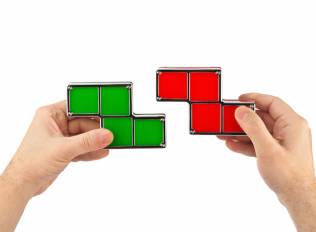
  • Can Tetris Help Alleviate Anxiety?

    Can Tetris Help Alleviate Anxiety?

    Researchers explored whether the classic game could have positive effects on those battling anxiety.

    Could an old-school video game help ease your anxiety? New research points to yes. 

    According to NPR, Kate Sweeny, a psychologist at the University of California, Riverside, conducted research into whether the game Tetris can have positive effects for those struggling with anxiety. 

    The premise of the game is to rotate and adjust moving tiles so they fit into a flat line at the bottom of the screen.

    “Years of my life were lost disappearing into a game of Tetris on my Nintendo system,” Sweeny told NPR.

    The game, according to Sweeny, can help ease anxiety by allowing players to enter a state psychologists call “flow.”

    “The state of flow is one where you’re completely absorbed or engaged in some kind of activity,” Sweeny told NPR. “You lose your self-awareness, and time is just flying by.”

    In conducting the study, Sweeny’s team focused on people who were waiting for “uncertain, potentially life-altering news” with the idea that playing Tetris could help their minds focus elsewhere for a period of time.

    Specifically, they took a group of 300 college students and told them their peers would be rating how attractive they were. 

    “I know, it’s kind of cruel, but we found it’s a really effective way to get people stressed out,” Sweeny told NPR.

    While the students were waiting for the results, they were instructed to play Tetris. There were three levels of difficulty assigned to different students: one slow, easy and boring; one fast, challenging and frustrating; and one classic version, meaning the game is adjusted based on the player’s ability. 

    While players still reported varying degrees of worry, the group that played the classic version reported slightly increased levels of positive emotions and slightly decreased levels of negative ones. 

    “It wasn’t a huge difference, but we think it’s noticeable,” Sweeny told NPR. “And over time, it can add up.”

    Games aren’t the only way to reach a state of flow, according to Elizabeth Dunn, a psychologist at the University of British Columbia who studies happiness.

    “Think of the activity that grabs your attention and doesn’t let it go,” Dunn told NPR. “For me, it’s mountain biking.” 

    While Dunn was not involved in the research, she says the results were not surprising.

    “I can’t say I found this study particularly surprising at all,” she told NPR. “Mostly because, based on previous research, it’s hard to find a situation where the experience of flow isn’t a good thing.”

    Dunn also noted that the research indicates “that even in tough moments, we should push ourselves to do something challenging to get us out of the moment.”

    View the original article at thefix.com

  • How To Tell If A Child Is Battling Anxiety

    How To Tell If A Child Is Battling Anxiety

    Though child anxiety can sometimes take longer to diagnose, it is very treatable once diagnosed.

    What initially appears as bad behavior in children can actually be signs of an underlying issue — anxiety disorders. 

    According to the Washington Post, anxiety disorders are increasing in youth, especially during the school year.

    A study recently published in the Journal of Developmental and Behavioral Pediatrics makes the estimate that about 2 million children and adolescents in the U.S. have a diagnosable anxiety disorder. 

    When it comes to anxiety in children, it can be difficult to diagnose since it can present as negative behaviors. 

    “We tend to think of anxious children as these delicate little butterflies, but when kids are scared, they can be ferocious about trying to escape or avoid anxiety-provoking situations,” Eileen Kennedy-Moore, child psychologist and author of Kid Confidence, told the Post

    Susan Newman, psychologist and author of The Book of No, explains that sometimes children can have feelings of anxiety for the first time and don’t always know how to react.  

    “Children today are stressed on so many fronts: challenged socially, academically, having to cope with physical changes and development, the demands and influence of social media, trying to fit in and be accepted. It’s no wonder they show evidence of anxiety,” Newman told the Post. “Parents should ask questions about anything they notice or want to understand to show their interest and love for their child. Children want to be heard and listened to, even if they tell you to stop being nosy.”

    When it comes to anxiety in children, there are some warning signs, though all children differ. One, according to the Post, is psychosomatic complaints. 

    “Kids don’t usually come home from school saying, ‘I felt really anxious at school today,’ but they do say things like, ‘I have a terrible stomachache; I can’t go back to school tomorrow,’” the Post notes. “Frequent stomach aches, headaches and unexplained muscle aches and pains can all be symptoms of anxiety.”

    Other signs include anger and irritability, sadness, isolation and avoidance, fatigue, poor concentration, school refusal and frequent questions.

    Just like signs of anxiety can differ from child to child, so can triggers. Triggers can include genetics, academic pressure, bullying, big transitions, loss and violence or abuse. 

    Though child anxiety can sometimes take longer to diagnose, it is very treatable when that diagnosis is made, according to the Post. Through identifying triggers and learning coping skills, children and parents can learn to take control of anxiety. 

    “A pediatrician is a good first stop to rule out or diagnose possible medical issues and to refer a licensed mental health practitioner who specializes in working with children,” the Post reads. “Cognitive behavioral therapy and dialectical behavioral therapy can be very effective treatment options for children with anxiety.”

    View the original article at thefix.com

  • Emma Stone Talks Anxiety, Panic Attacks

    Emma Stone Talks Anxiety, Panic Attacks

    “You don’t have to be actor to overcome anxiety. You just have to find that thing within you that you are drawn to.”

    Emma Stone can vividly remember her first panic attack at age seven. 

    “I was sitting at a friend’s house and all of a sudden I was absolutely convinced that the house was on fire,” Stone recalled. “I was just sitting in her bedroom and obviously the house wasn’t on fire but there was nothing in me that didn’t think I was going to die.”

    On Monday, October 1, the actress sat down with Dr. Harold S. Koplewicz for a 30-minute conversation at the Child Mind Institute in New York City. She discussed her history of anxiety, beginning with the panic attack. Stone went on to describe how she would visit the nurse daily during second grade, where she would then call her mom. 

    “I had deep separation anxiety,” she told Koplewicz.

    Stone’s mother decided to take her to therapy and was informed her daughter had generalized anxiety disorder and panic disorder, ABC News reports. However, she chose not to tell her daughter, which is something Stone says she has appreciated. 

    “I am very grateful I didn’t know that I had a disorder,” Stone said. “I wanted to be an actor and there weren’t a lot of actors who spoke about having panic attacks.”

    Stone described how in therapy, she came up with a book called, I Am Bigger Than My Anxiety. She says she drew photos inside of “a little green monster that sits on my shoulder.” In the book, the monster — her anxiety — would increase in size if she listened and decrease if she didn’t.

    A few years after her first panic attack, at age 11, Stone says she began acting in improv and realized “my feelings could be productive.”

    She says she also kept involved in the local children’s theater which was helpful in managing anxiety.

    “I believe the people who have anxiety and depression are very, very sensitive and very, very smart,” she said. “Because the world is hard and scary and there’s a lot that goes on and if you’re very attuned to it, it can be crippling. But if you don’t let it cripple you and use it for something productive, it’s like a superpower.”

    Today, Stone says, she manages her anxiety disorder through therapy, medication, the company of others and staying busy. She also avoids social media. 

    “That would send me into a spin,” she said. “I don’t need to be getting constant feedback on who I am.”

    For anyone battling anxiety, Stone says the key is finding somewhere else to shift your focus. 

    “You don’t have to be actor to overcome anxiety, you don’t have to be a writer to overcome it,” she told Koplewicz. “You just have to find that thing within you that you are drawn to.”

    View the original article at thefix.com