A music addiction is cheaper than alcohol and drugs. And not only that, it’s healthy, invigorating, fun, and liberating.
I was a disheveled and bedraggled disaster of a person back in the winter of 2012. I lived for alcohol. If beer was the entrée, crack-cocaine was my digestif. But after an intervention and rehab, I’ve been sober nine years now. I never could’ve done it without music.
Even though I had spent most of my career working in the music industry as a producer for MTV News, music wasn’t really a significant part of my life during the worst of my drinking days. But when I was a teen and again now, music has been of utmost importance. Now as an adult I realize music is better than sex.
It’s better than drugs. And it’s better than alcohol. It’s a natural high. If given a choice between music and drugs, I choose music. Starting with punk.
A Youth in Revolt
“Where do you go now when you’re only 15?” Rancid, “Roots Radical,” off the 1994 album And Out Come the Wolves
I’ve always felt like a bit of an outcast. As someone who struggles with the dual diagnosis of addiction and bipolar disorder, in a way, I am. But I’m proud to be an outcast, and my punk rock upbringing only reaffirmed that being different is cool.
In the spring of 1995, March 9th to be exact — 26 years ago — I experienced my very first punk show. It was Rancid with the Lunachicks at the Metro in Chicago. I still have the ticket stub. I was 15. And in that crowd of about 1,000, I felt like I belonged. I had found my tribe. It was a moment that would transport me on a decades-long excursion, one that finds my punk rock heart still beating now and forever.
I often think in retrospect that maybe there were signs and signals of my bipolar status as I grew up. I was in fact different from the others. And I was experiencing bouts of depression inside the halls and walls of high school. Freshman and sophomore years in particular I did not fit in. I was the quiet kid who had barely any friends. I didn’t belong to a social clique like everyone else. I was a rebel in disguise. Until I found punk rock. Then I let it all hang out.
“Once a punk, always a punk.”
Rock ‘n’ Roll High School
I am a Catholic school refugee. Punk was my escape from the horrific bullying I experienced in high school. Back then, the kids from the suburbs threw keggers. We city kids — I had three or four punk rock friends — were pretty much sober, save for smoking the occasional bowl of weed if we had any. We were definitely overwhelmingly the minority at school as there were probably only five or so of us in a school of 1,400. For the most part, though, we found our own fun at music venues like the Fireside Bowl and the Metro. We went to shows every weekend at the now-defunct Fireside – the CBGB or punk mecca of Chicago that used to host $5 punk and ska shows almost every night.
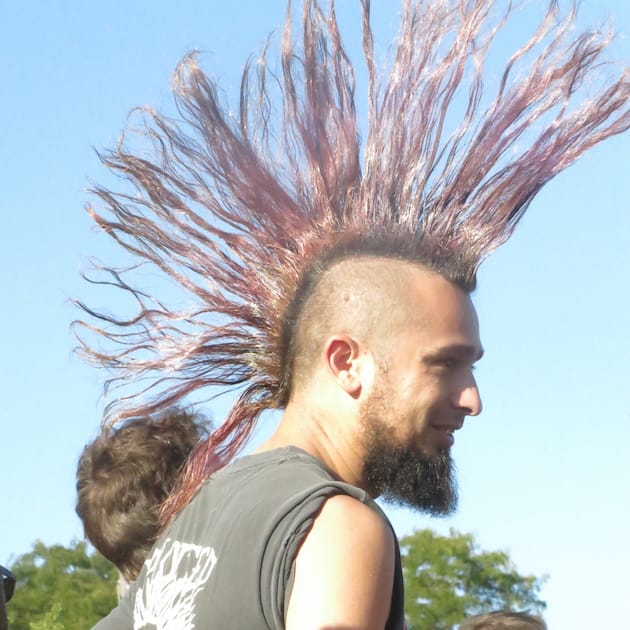
The Fireside was dilapidated but charming. It was a rundown bowling alley in a rough neighborhood with a small stage in the corner. You couldn’t actually bowl there and the ceiling felt like it was going to cave in. It was a smoke-filled room with a beer-soaked carpet. Punks sported colorful mohawks, and silver-studded motorcycle jackets. Every show was $5.
My few friends and I practically lived at the Fireside. We also drove to punk shows all over the city and suburbs of Chicago – from VFW Halls to church basements to punk houses.
The Fireside has since been fixed up and has become a working bowling alley with no live music. A casualty of my youth. But it was a cathedral of music for me when it was still a working club. After every show, we would cruise Lake Shore Drive blasting The Clash or The Ramones. I felt so comfortable in my own skin during those halcyon days.
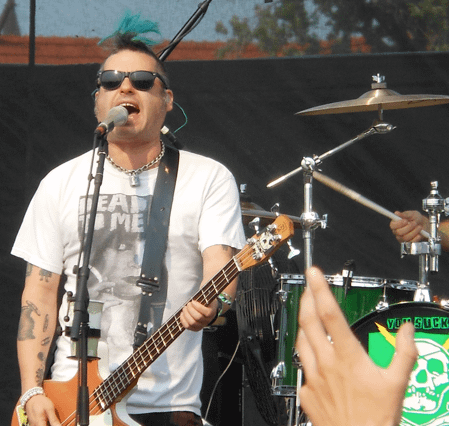
Fat Mike of NOFX at Riot Fest in Chicago, 2012
Punk Up the Volume
Punk isn’t just a style of music, it’s a dynamic idea. It’s about grassroots activism and power to the people. It’s about sticking up for the little guy, empowering the youth, lifting up the poor, and welcoming the ostracized.
Punk is inherently anti-establishment. Punk values celebrate that which is abnormal. It is also about pointing out hypocrisy in politics and standing up against politicians who wield too much power and influence, and are racist, homophobic, transphobic, and xenophobic.
Everyone is welcome under the umbrella of punk rock. And if you are a musician, they say all you need to play punk is three chords and a bad attitude. Fast and loud is punk at its core.
They say “once a punk, always a punk” and it’s true.
Punk was and still is sacred and liturgical to me. The music mollified my depression and made me feel a sense of belonging. I went wherever punk rock took me. My ethos — developed through the lens of the punk aesthetic — still pulses through my punk rock veins. It is entrenched in every fiber of my being.
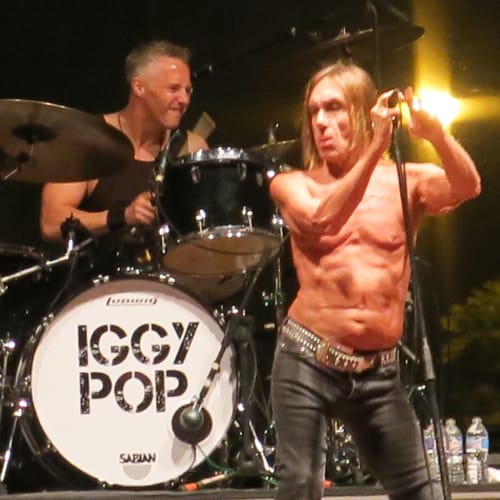
Godfather of Punk Iggy Pop at Riot Fest in Chicago, 2015
A New Day
Now, whether it’s on Spotify on the subway or on vinyl at home, I listen to music intently two to three hours a day. Music is my TV. It’s not just on in the background; I give it my full, undivided attention.
I started collecting vinyl about eight years ago right around the time I got sober and I have since amassed more than 100 record albums. There’s a reason why people in audiophile circles refer to vinyl as “black crack.” It’s addictive.
I’m glad I’m addicted to something abstract, something that is not a substance. A music addiction is cheaper than alcohol and drugs. And not only that, it’s healthy, invigorating, fun, and liberating.
And while my music taste continues to evolve, I’m still a punk rocker through and through. My love affair with punk may have started 26 years ago, but it soldiers on today, even though I mostly listen to indie rock and jazz these days. I recently started bleaching my hair again, platinum blonde as I had when I was a punker back in high school. It’s fun and it also hides the greys.
Looking back on my musical self, I knew there was a reason why I can feel the music. Why tiny little flourishes of notes or guitar riffs or drumbeats can make my entire body tingle instantly. Why lyrics speak to me like the Bible and the sound of a needle dropping and popping on a record fills me with anticipation
Punk is a movement that lives inside me. It surrounds me. It grounds me. Fifteen or 41 years-old, I’m a punk rocker for life. I’d rather be a punk rocker than an active alcoholic. I’m a proud music addict. I get my fix every day.
Please enjoy and subscribe to this Spotify playlist I made of old-school punk anthems and new classics. It’s by no means comprehensive, but it’s pretty close.
The pandemic continues to affect virtually every aspect of American life, and that, sadly, also includes those suffering with an addiction – including opioids.
It’s holiday season, 2020. Undoubtedly, a different kind of festive season than normal for many Americans, but… it’s still the holidays, nonetheless.
However, for many families, there’ll be empty places at the dinner table this year – loved ones missing not because of the dreaded and awful coronavirus pandemic that continues to tragically affect the U.S., but from fatal opioid drug overdoses, part of a national epidemic that was here long before COVID-19 ever became part of our vocabulary.
Take a few moments out of this day to look back at the statistical data for the U.S. opioid epidemic, and you’ll see the highest peak in opioid-related fatal overdoses was during the first half of 2017 – in virtually every state across the nation. Only 3 short years ago, U.S. citizens were dying at a rate of around 130 every single day.
It’s difficult to fully comprehend, but it happened – surely, we’d never see such death rates again (we’ll get to the dreaded “corona” shortly, which is now, more tragically, taking many more lives per day).
Back to the opioid epidemic.
A range of pain-killing medications, arguably misbranded by Big Pharma, were being prescribed freely across the U.S. in a practice that went on for over 20 years, leaving thousands upon thousands unknowingly dependent on powerful narcotics, and with a chronic medical condition – opioid use disorder (OUD).
Like the layered tragedy of a Shakespeare play, just when you thought things were actually looking up (as the national rate of opioid-related deaths began to noticeably fall), along came a global accident-waiting-to-happen – the COVID-19 pandemic.
Take a further few moments to access everyone’s favorite search engine, type in “US Covid Latest 2020,” and you’ll see the latest statistics about how badly the nation has been hit by the pandemic. Over 335,000 deaths, and still rising.
However, the pandemic continues to affect virtually every aspect of American life, and that, sadly, also includes those suffering with an addiction – including opioids.
In Beaver County, Pennsylvania, District Attorney David Lozier recently spoke about how his region is being affected by the virus in terms of the detrimental impact on people’s mental wellbeing, including rates of opioid use and addiction:
“COVID has sucked the wind out of every other issue. Now this year, the [drug overdose] numbers are going up like 2016 and the first half of 2017. We’re seeing an increase in domestic violence, Childline and child abuse calls, a worsening mental health picture, and worsening drug and alcohol pictures. The people who need support services or who are in treatment… It’s all been by phone. They haven’t had the in-person contact they need.”
So it begs the question – what exactly is the current status of addiction recovery in Pennsylvania?
To answer this, we first need to look at how Pennsylvania stood last year (2019 seems a remarkably long time ago now, doesn’t it?) with respect to substance addiction rates and addiction treatment levels, and how the state stands now, after around half a year of severe socio-economic disruption, including mandatory lockdowns and long periods of social isolation for its residents.
How COVID-19 Has Radically Altered Addiction Recovery
2019:
According to the Substance Abuse and Mental Health Services Administration (SAMHSA), in 2019, Pennsylvania rehab centers saw more than 19,000 admissions. There’s little doubt, the fight against the opioid epidemic was still being fought (a situation destined to last many years). However, many thousands of Pennsylvania residents were still becoming addicted to the prescriptions written out by their family doctor.
According to a research study by the Perelman School of Medicine at the University of Pennsylvania, in Philadelphia, it was found that excessive, high-dose opioid prescriptions were still being routinely prescribed following common, minor day-patient surgeries – at a strength strictly advised against by the Centers for Disease Control & Prevention (CDC), for the purpose of reducing the number of opioid-related fatal overdoses.
So how was the level of access to opioid addiction treatment at this time?
In short – increasing. For example, under the Blue Guardian program in Lehigh County, PA, police and other first responders would notify the program when they had responded to an opioid overdose. Later, an officer and a certified recovery specialist would visit the person to follow up and discuss their treatment options.
This hands-on approach was highly successful, as confirmed by Layne Turner, Lehigh County’s drug and alcohol administrator. She stated that, “Of the 52 individual face-to-face meetings, 34 individuals entered treatment. The lesson learned is when the face-to-face contacts are made, 65% of the time individuals enter treatment.”
Clearly, the state of Pennsylvania was moving in the right direction when it came to accessing and providing opioid addiction treatment for opioid abusers and addicts. In fact, a rate of 65% is far, far higher than the national average for the numbers of drug addicts who make it into such treatment. In 2019, that national rate stood at a lowly 10-13%.
When you consider that recent estimates say one-fifth of U.S. citizens who have clinical depression or an anxiety disorder will also have a substance use disorder (SUD), like OUD, you quickly understand that the very last thing the nation needed in fighting addiction was the soon-to-arrive COVID-19 pandemic, with its resulting lockdowns and isolation.
“The concerns we have are related to the big challenges people are facing right now with COVID: isolation and uncertainty resulting in very high levels of stress.” Nora Volkow, Director of the National Institute for Drug Abuse
2020:
The (first) year of the COVID-19 pandemic arrived, leading to the “isolation and uncertainty” and “very high levels of stress” quoted above. Fatal drug overdoses – not just from opioids, but now including cocaine and methamphetamine – are spiking alarmingly across the nation.
Just like any other U.S. industry, the addiction treatment field has been hit hard, with many rehab centers, including those in Pennsylvania, facing financial collapse if things don’t improve soon. Many treatment centers report clients not making their scheduled treatment appointments – either the simple fear of coronavirus infection, or, worryingly, because more and more of those in recovery are experiencing overdoses and relapses.
In an effort to meet the changing conditions, addiction treatment centers have also had to invest in new “telemedicine” technology to be able to provide services, where clients receive counseling and other treatment via their computer screens.
Nonprofits have struggled to treat their clients. In a recent survey, 44% of members from the National Council for Behavioral Health say they will easily run out of money in the next 6 months.
Interestingly, if you look at the 2019-related paragraphs above, you’ll see words like “admissions,” “individual face-to-face meetings,” “right direction, “access” and “contact.” All of these are being heard less and less, if at all, for many recovering addicts in 2020.
The sad proof of this lies in the national rise in fatal drug overdoses, as described by the American Medical Association in its updated Issue Brief (October, 2020), which reports that more than 40 states have “reported increases [around 18% – nearly a fifth] in opioid-related mortality, as well as ongoing concerns for those with a mental illness or substance use disorder.”
And, lo and behold, guess what? Yes, sadly, Pennsylvania is again one of those 40.
Addiction Recovery = Hope
However gloomy-sounding this article may appear at first glance, there is a distinctly positive and hopeful side.
The sphere of addiction treatment, providing long-term, sustainable recovery for OUD sufferers and those with other SUDs, is recovering itself, and this is happening in a number of essential ways:
More and more of Pennsylvania’s facilities and clinics are becoming accustomed to the necessary COVID-19 protocols and regulations required in running their treatment options, from residential care, to Partial-Hospitalization Programs (PHPs), Outpatient Programs, and their own counseling sessions and group support meetings.
Telemedicine technology, with the addiction experts looking on, is growing, expanding and even researching its own effectiveness as a method of healthcare provision for those with SUDs and mental health issues.
As for the telemedicine “patient,” they are becoming more accustomed to accessing their treatment, care and support online, just like the vast numbers of those in AA and NA when virtually “attending” their own 12-Step meetings.
If you’re looking for Pennsylvania’s online 12-Step meetings, the links for these are provided here:
Finally, the use of Medically Assisted Treatment (MAT), such as the provision of methadone and other MAT drugs for opioid replacement, has had its own regulations relaxed, thus increasing its range of access to those who need it.
Dr. Mark Fuller, the Medical Director of Addiction Medicine at the Center of Inclusion Health, part of the Allegheny Health Network in Pittsburg, PA, recently stated, “Some folks say that the opposite of addiction is connection – connecting with a therapist, or other friends in recovery, or your 12-step meeting. Those connections are a really powerful part of recovery and really a key step in helping people stay clean and sober.”
How many of Pennsylvania’s reported 800 licensed drug abuse and addiction treatment centers, both nonprofit and for-profit, will survive 2021 remains to be seen. Without the vital professional connections these treatment centers provide, and without the social “recovery community” connections referred to by Dr. Mark Fuller in the quote above, there will clearly be fewer inspiring stories of real addiction recovery happening across the state during this year of coronavirus.
However, for now, with the excellent strategies listed above, the vast field of addiction treatment – just like the rest of us – is starting to get to grips with the strong and undeniable challenges that lie ahead.
One gift of sobriety, along with holding down a job and not losing my kids to the courts, is that I now get to do something I really love, dancing—safely.
For Mary.
I got sober here almost thirty years ago. That’s what struck me last December 31, as I danced my butt off in the basement of St. Anthony of Padua’s Roman Catholic Church on Sullivan Street in New York City, welcoming in the New Year with a mob of sober drunks. Yes, here I was dancing under the influence of something more heady than Moet this New Year’s Eve, surrounded by mylar waterfall curtains, and the familiar pull down shades of AA’s Twelve Steps and Twelve Traditions, changing color with every turn of the disco ball.
In the fall of 1991 I was sitting in the second of sixteen rows of folding chairs, a box of Kleenex on my lap, flanked by massive columns that supported both church above and my shaky sobriety below. Now here in the countdown to midnight, voguing to Madonna with a Woodstock hippie in pajamas, I realized this was the very spot I had counted my first 90 days without a drink or a drug decades ago. This was where the Soho Group of Alcoholics Anonymous met, and still meets today. Flash back to me in gold tights and a green suede mini skirt, crushing on a rockabilly cat across the aisle. Thank you Johnny Cash wannabe in the stretched T, you kept me coming back to AA for that first year—you and my sponsor Cindy, the big sis I never had. After the meeting, Cindy and I would hit the Malibu Diner on 23rd Street for oversized Greek salads with extra dressing and bottomless cups of decaf. Cindy taught me how to stay away from the first drink and how to smudge a make-up pencil to get that smoky eye look. From September to December, 1991, the Soho Group, the boy with the ducktail, and my glamourous sponsor, poured the pillars of my foundation for a life lived without mood-altering substances, one-day-at-a-time.
. . .
Around midnight on December 31, 2019, wearing frames I’d picked up at the dollar store that flashed “2020” in three speeds, I felt safe—safe and happy raving with a few hundred personalities swigging seltzer. In my drinking days, going out dancing never felt safe. There was the time I fell off the stage GoGo dancing on the boardwalk at Coney Island, and once I walked home alone over the Brooklyn Bridge, at 3AM, in a red sundress. I meant to take a cab, and had even tucked a twenty dollar bill in my bra for that purpose, but I ended up spending it on more vodka cranberries instead. Staggering barefoot in the pre-dawn down an unlit staircase onto the off ramp of the Brooklyn Bridge, heels in hand, fear overtook me and I started running. For blocks and blocks I ran down the middle of the street, where it felt safer, where I could spot shadows lurking between cars, all the way home, until I reached my building—relieved, ashamed and baffled by my behavior. Scared of waking my landlord, I tiptoed up three flights—this was not new—but every creaky step betrayed me. I dreaded passing Babe the next morning, sitting on the bench in his dooryard, combing the supermarket circulars. He was less like a landlord you write a check out to on the first of the month, and more like an Italian uncle who would scold you for parking too far from the curb, or wasting money buying coffee out, instead of brewing it at home. I knew Babe always heard my key in the lock as dawn broke over South Brooklyn, and I knew he saw those empty bottles of Chianti, tucked under tomato cans in the recycling bin.
. . .
Yes, now I felt safe—here clasping hands with a little girl and her sober mom, twirling around a church cellar at the Soho Group’s New Year’s Eve Dance. I felt safe, happy and damn lucky to be back here on the very spot that I had clung to for that first year, that spot where I first surrendered to sobriety and felt safe, as I cupped warm urn coffee, and took it all in, in small sips. Tonight I knew where I was, and I knew I’d get home safely. I knew I’d remember everything the next day, without remorse or a sour stomach.
“Some don’t make it back.” I’ve heard that said often in the rooms of A.A. After sobering up in my mid twenties at the Soho Group, I stayed alcohol-free for thirteen years, making Brooklyn Heights my home group for years, until just after the birth of my first son. The promise of A.A. as “a bridge back to life” had come true. I had a life: a husband, a house, and now a fat baby at the baptismal font. But I was doing zero maintenance on that bridge—my connection back to AA was crumbling. I’d drifted. I’d moved deeper into Brooklyn with my non-alcoholic husband and away from my homegroup. I’d lost touch with my sponsor and most of my sober friends. And then it happened. I slipped. But I was one of the super lucky ones. I didn’t have a full out sloppy slip, with blackouts and benders and smash-ups with the family KIA. It started with just a sip. In my mind I’d decided it was safe to start taking communion wine with my wafer at Sunday mass. No matter that countless practicing Episcopalians take the host but pass on that sip from the silver chalice. And for years, this was the extent of my drinking, one sneaky sip I looked forward to on Sunday mornings. Then other things happened. I’d heard that beer was good for breast-feeding. I latched onto that rumor, like a babe at the breast. I started downing O’Douls “non-alcoholic” ale at our weekly mommy nights. When I went to my dentist for a routine filling, I insisted he tap the tank of laughing gas, when novocaine would have numbed well enough. I remember that buzz which settled over me in the dentist’s chair. Relief, I thought. From everything.
Soon after I woke up and realized my marriage was over. I was a wreck. Day drinking seemed like an option. A friend offered me a mimosa in her home. I took one sip—panicked—snuck to her bathroom and poured the rest down the drain. Soon after that, I climbed up one flight of stairs over a fish store and entered a crowded room with flies circling. I started counting days, for the second time around. At forty-eight, I was a humbled newcomer again. My sponsor was twelve years my junior. It was awkward, yes, but it felt honest and right to reset my sobriety clock. And thanks in large part to these no-nonsense oldtimers of Old Park Slope Caton, my kids have never seen me drunk.
. . .
In my twenties, before I poured that last bottle of Four Roses whiskey down the kitchen sink, my twin loves were drinking and dancing. I started drinking fairly late, at 19, when I’d help myself to my father’s scotch, put on his headphones, raise the volume on his Ohm speakers, and burn rubber to The Gap Band. Booze and boogie shoes quickly became my dream couple, allowing me to float in a fantasy stupor where all care and self-doubt slipped away. From there I went on to be a “maniac on the dance floor”—a self-destructive eighties girl flash dancing her way through four years of college—squeezing that last cup of beer from a warm keg.
For fun, my alcoholic brain sometimes likes to play this game where I remember fondly (but falsely) occasions where liquor paired perfectly with certain activities like ball games with Budweiser, or tailgate parties with pina coladas, picnics with blushing Zinfandels, or art gallery openings with jugs of Gallo red. But the winner of this stagger-down-memory-lane game is always dancing with drinking. Evenings out started the same: plug in the hot rollers, mix a cocktail, and get down while dolling up, still in my underwear, to the Saturday night line-up of DJs on WBLS and Hot97. A whiskey sour next to my make-up mirror was the kick-off. Stepping out an hour later, with coral lips and cat eyes, and Run-DMC in my head, I felt just fine. And that’s how it went, in my twenties. But over time, nights out ended in close calls with questionable characters and near scrapes in unknown neighborhoods. Every one of those nights, however, had started out just fine. From Halloween dance parties in Bushwick lofts with Solo cups of mystery punch, to doing the twist on the Coney Island Boardwalk while taking nips from a hip flask of Jack Daniels, it was always a good time. Until it wasn’t—until someone flicked a cigarette and started a fire, or until I fell off the band stage on that Coney Island boardwalk.
. . .
If only evenings could have ended as safe and fun as they had started out. It really only ever felt safe to drink at the start of my drinking, as a teen, in front of my dad’s turntable, moving to Stevie Wonder coming from his Koss headphones, in the safety of my childhood home. And if only my drinking and dancing partner Mary was still here. Mary, who dared me to put down my rum and Coke and never-finished Times crossword, and climb up onto the bar with her at Peter McManus Pub in Chelsea. Dear, departed drinking playmate and party girl Mary. Quirky, curly-haired writer Mary, in rhinestone glasses and GoGo boots. Loyal friend Mary, who helped me through heartbreaks and hangovers. Subversive yet wholesome Mary from Michigan, who baked soda bread, wrote thank you notes, remembered nieces’ birthdays and snorted lines of heroin. I never made the connection between her non-stop runny nose and her habit until years later, when her boyfriend called me to say he’d found Mary dead from an overdose. I pictured her slumped in a fake Queen Anne armchair, pale as parchment, her dark curls against floral upholstery. She was forty-six.
Indeed, I danced my way through my drinking twenties, but I was hardly dancing with the stars. I was working as a waitress at the LoneStar Roadhouse near Times Square. At closing time I’d do lines at the end of the bar with the manager, and once, with a customer who talked me into leaving with him. I went home with this grown man who, as it turned out, still lived with his parents somewhere way the hell out on Long Island. I remember feeling increasingly unsafe passing exit after exit on the LIE, riding unbelted in the death seat of a stranger’s Toyota. I remember turning up the volume on the radio and singing along to Chaka Khan: “I’m Every Woman… It’s all in MEEE…” Any drug that can delude you into believing you’ve got the pipes of a 10-time Grammy Award winner, well, that’s a great drug. Until it isn’t. He led me to a mattress on the floor of his parents garage. I’ve heard it said in the rooms of A.A. that God watches out for children and drunks. Which maybe explains how I got myself out of that one—while still fully clothed—and was able to call a cab to take me all the way home in those pre-Lyft late-eighties.
. . .
One gift of sobriety, along with holding down a job and not losing my kids to the courts, is that I now get to do something I really love, dancing—safely. I’ve hit many an A.A. group anniversary, where I’ve joined Friends of Bill W. on subterranean church linoleum, cleared for dancing. I still start getting ready at five, with my own creation: The Magoo (cranberry juice, sparkling water and two wedges of lime, served up in a fancy glass.) I still tune into WBLS. I wear less make-up now, but still move to the music. At six I head out to scoop a friend in my KIA beater. The koolest legend, Kool D.J. Red Alert, is blowin’ it up over the airwaves and through my car speakers. I pull up, safety-belted and chair dancing in the driver’s seat. My date is tall and her dress is short and sparkly. “Damn girl, who’s your target? These all gotta watch out!” Beatrice has all the head boss and eye looks as Mary. And a wit just like Mary’s too, drier than a Wasa cracker or top-shelf vermouth. It’s going to be a fun night, I think. Throw your hands up.
I really love Alcoholics Anonymous group anniversaries. They are feel good phenomena that pretty much follow the same format: a meeting, followed by a potluck, then sometimes, dancing. I gravitate to the ones where there’s dancing. Everyone shows up bathed and beaming to celebrate the founding of their “homegroup,” the group they most regularly attend, where they know other people, and are known in return. Sober drunks with sixty years and sixty days come to these. A church basement or parish hall is dressed up in balloons and crepe garland; Hershey kisses scatter folding tables, covered in plastic cloths. The speakers are often old-timers with good stories to tell, pulling in outrageous details of their “drunkalogues” or firsthand details about the group’s early days. The dinner spread is legit. A line of volunteers dish out baked ziti, collards and fried fish from foil casseroles set up over sternos. Urn coffee and birthday cake for dessert. I’ve developed a taste for those giant sheet cakes with piped icing. The ritual of eating that 2” square of cake, along with every alcoholic in the room eating theirs, is a highlight for sure. A centered feeling comes over me as I lick frosting off a plastic fork under twinkle lights. I am safe. And this is fun. Details may vary from group to group, but every space feels hallowed on these nights. The people who populate it are thankful for their lives, freed from the hamster wheel of addiction, just for today.
Then dancing happens. I bring the DJ a bottle of Poland Spring and I’m “setting it off” to one-hit-hip-hop wonder Strafe, while folks are still on the food line. When the clean up crew starts collecting cola cans and rolling up tablecloths, I’m still on the linoleum with any takers I can pull up off their folding chairs. I can’t say Beatrice and I have shut down every A.A. party from northern Manhattan to the outer banks of Brooklyn, but the bulletin board of Alcoholic Anonymous’ Intergroup is a good place to start for leads on sober dance happenings.
We head home a little after eleven. DJ Chuck Chillout has pulled out his airhorn. I drop Beatrice off, she bends into the passenger window and smirks: “I had a great time tonight. Maria N. gets a second date.”
. . .
Group anniversaries and sober New Year’s Eve parties aside, I dance mostly on my yoga mat, to the line-up of Saturday Night DJs on WBLS, or to my own ‘80s Hip Hop and New Wave playlists. I’m still self-conscious when I share in meetings, or read at open mics, or take my top off to new a lover, but at home or in public, I’m comfortable on the dance floor, even if I’m the only one dancing. I don’t claim to quite find my Nasty with Miss Jackson anymore, but even well into middle age, and without a craft beer in hand, dancing still brings on my happy—more than ever. Clear-headed, I tap into that elusive “conscious contact” with my higher power. I feel everything in the present moment—neurons firing through my fingertips, the beat beneath my bare feet. I am a consenting adult at my own one-woman rave, enjoying this gift of sobriety: a healthy body doing what it loves, and hurting no one, especially not itself. Of course, when I’m out dancing, there’s the bonus of connection with other abstaining alcoholics. Doing the Electric Slide with fifty friends of Bill—in-sync, or close enough—well, It’s Electric.
. . .
“We drank alone. But we don’t get sober—then stay sober—alone.”
It’s 1:30AM and I’m still on the dance floor, throwing hands up with oldtimers and seven-year-olds. The Woodstock hippie shuffles in his drawstring polar fleece, cotton wadded in his ears. But no amount of cotton can drown out the cheer that went up at the stroke of midnight and echoes even now.If it’s in the cards, in twenty years, on New Year’s Eve, 2040, I’ll be 75 and I’ll be here, surrounded by these poured cement columns, getting what’s left of my groove on with a beautiful group of sober drunks.
. . .
Where can you go to dance yourself happy? For one thing, the International Conference of Young People in Alcoholics Anonymous of New York City (ICYPAA NYC) throws a serenity dance cruise on the Hudson in July. But if AA dances aren’t your thing, consider “Conscious clubbing,” a term coined by Samantha Moyo, founder of Morning Gloryville, a sober breakfast rave phenomenon launched in East London in 2013, and which has spread to cities worldwide. Some Morning Gloryville events have been postponed due to the COVID-19 outbreak, but online raves are happening right now. And LOOSID a sober social network, with a mission to make sobriety fun, puts out playlists, and pairs subscribers to events of interest too.
Tonight, still sheltering-in-place here in The Baked Apple, New York City—one hot spot of the COVID-19 pandemic—Beatrice invited me to Reprieve, a clean & sober non-stop dance party. I registered for free through Eventbrite and joined the dance floor, courtesy of Zoom. By the end of it we were doing backbends over our sofas to Total Eclipse of the Heart. Before signing off, I reached out to Beatrice in the comment thread : “Let’s do it again,” I typed. “Totes.” she typed back. Sure, I’ll return this Saturday night to dance with sober drunks. It looks like it’ll just become the latest turn in my healthy sober dance move.
“We consider addiction a disease of isolation…Now we’re isolating all these people and expecting them to pick up the phone, get online, that sort of thing — and it may not work out as well.”
Before the coronavirus became a pandemic, Emma went to an Alcoholics Anonymous meeting every week in the Boston area and to another support group at her methadone clinic. She said she felt safe, secure and never judged.
“No one is thinking, ‘Oh, my God. She did that?’” said Emma, “’cause they’ve been there.”
Now, with AA and other 12-step groups moving online, and the methadone clinic shifting to phone meetings and appointments, Emma said she is feeling more isolated. (KHN is not using her last name because she still uses illegal drugs sometimes.) Emma said the coronavirus may make it harder to stay in recovery.
“Maybe I’m old fashioned,” said Emma, “but the whole point of going to a meeting is to be around people and be social and feel connected, and I’d be totally missing that if I did it online.”
While it’s safer to stay home to avoid getting and spreading COVID-19, addiction specialists acknowledge Emma’s concern: Doing so may increase feelings of depression and anxiety among people in recovery — and those are underlying causes of drug and alcohol use and addiction.
“We consider addiction a disease of isolation,” said Dr. Marvin Seppala, chief medical officer at the Hazelden Betty Ford Foundation. “Now we’re isolating all these people and expecting them to pick up the phone, get online, that sort of thing — and it may not work out as well.”
Emma has another frustration: If the methadone clinic isn’t allowing gatherings, why is she still required to show up daily and wait in line for her dose of the pink liquid medication?
The answer is in tangled rules for methadone dispensing. The federal government has loosened them during the pandemic — so that patients don’t all have to make a daily trip to the methadone clinic, even if they are sick. But patients say clinics have been slow to adopt the new rules.
Mark Parrino, president of the American Association for the Treatment of Opioid Dependence, said he issued guidelines to members late last week about how to operate during pandemics. He recommended that clinics stop collecting urine samples to test for drug use. Many patients can now get a 14- to 28-day supply of their addiction treatment medication so they can make fewer trips to methadone or buprenorphine clinics.
“But there has to be caution about giving significant take-home medication to patients who are clinically unstable or actively still using other drugs,” Parrino said, “because that could lead to more problems.”
The new rules have a downside for clinics: Programs will lose money during the pandemic as fewer patients make daily visits, although Medicare and some other providers are adjusting reimbursements based on the new stay-at-home guidelines.
And for active drug users, being alone when taking high levels of opioids increases the risk of a fatal overdose.
These are just some of the challenges that emerge as the public health crisis of addiction collides with the global pandemic of COVID-19. Doctors worry deaths will escalate unless people struggling with excessive drug and alcohol use and those in recovery — as well as addiction treatment programs — quickly change the way they do business.
But treatment options are becoming even scarcer during the pandemic.
“It’s shutting down everything,” said John, a homeless man who’s wandering the streets of Boston while he waits for a detox bed. (KHN is not including his last name because he still buys illegal drugs.) “Detoxes are closing their doors and halfway houses,” he said. “It’s really affecting people getting help.”
Adding to the scarcity of treatment options: Some inpatient and outpatient programs are not accepting new patients because they aren’t yet prepared to operate under the physical distancing rules. In many residential treatment facilities, bedrooms and bathrooms for patients are shared, and most daily activities happen in groups — those are all settings that would increase the risk of transmitting the novel coronavirus.
“If somebody were to become symptomatic or were to spread within a unit, it would have a significant impact,” said Lisa Blanchard, vice president of clinical services at Spectrum Health Systems. Spectrum runs two detox and residential treatment programs in Massachusetts. Its facilities and programs are all still accepting patients.
Seppala said inpatient programs at Hazelden Betty Ford are open, but with new precautions. All patients, staff and visitors have their temperature checked daily and are monitored for other COVID-19 symptoms. Intensive outpatient programs will run on virtual platforms online for the immediate future. Some insurers cover online and telehealth addiction treatment, but not all do.
Seppala worried that all the disruptions — canceled meetings, the search for new support networks and fear of the coronavirus — will be dangerous for people in recovery.
“That can really drive people to an elevated level of anxiety,” he said, “and anxiety certainly can result in relapse.”
Doctors say some people with a history of drug and alcohol use may be more susceptible to COVID-19 because they are more likely to have weak immune systems and have existing infections such as hepatitis C or HIV.
“They also have very high rates of nicotine addiction and smoking, and high rates of chronic lung disease,” said Dr. Peter Friedmann, president of the Massachusetts Society of Addiction Medicine. “Those [are] things we’ve seen in the outbreak in China [that] put folks at higher risk for more severe respiratory complications of this virus.”
Counselors and street outreach workers are redoubling their efforts to explain the pandemic and all the related dangers to people living on the streets. Kristin Doneski, who runs One Stop, a needle exchange and outreach program in Gloucester, Massachusetts, worried it won’t be clear when some drug users have COVID-19.
“When folks are in withdrawal, a lot of those symptoms can kind of mask some of the COVID-19 stuff,” said Doneski. “So people might not be taking some of their [symptoms seriously], because they think it’s just withdrawal and they’ve experienced it before.”
Doneski is concerned that doctors and nurses evaluating drug users will also mistake a case of COVID-19 for withdrawal.
During the coronavirus pandemic, needle exchange programs are changing their procedures; some have stopped allowing people to gather inside for services, safety supplies, food and support.
There’s also a lot of fear about how quickly the coronavirus could spread through communities of drug users who’ve lost their homes.
“It’s scary to see how this will pan out,” said Meredith Cunniff, a nurse from Quincy, Massachusetts, who is in recovery for an opioid use disorder. “How do you wash your hands and practice social distancing if you’re living in a tent?”
This story is part of a partnership that includes WBUR, NPR and Kaiser Health News.
Overdose survivors need more than a second (or third) chance: they need a parachute. When you’re in free fall, a little more time isn’t much help.
Perhaps everything that is terrible is, in the deepest sense, something that wants our love.
Rilke
The overdose epidemic in the U.S. has been called “the greatest public health crisis of our time.” It’s also our greatest opportunity.
The opioid crisis is an identity crisis: it’s a challenge to how we see ourselves. Do we truly believe that we are all in this together? One answer leads us deeper into despair. The other, into a hopeful future.
It’s been said that “doing more things faster is no substitute for doing the right things.” What are the “right things,” the measures that can resolve the crisis, not just postpone it? The right actions come from the right thoughts. Those thoughts come from feelings, and feelings are never right or wrong. But there are some feelings we are born with. They are our birthright. And one of them is love.
The Kindness of Strangers
Hatred never ceases by hatred, but by love alone is healed.
The Buddha
Behind the opioid epidemic is a prevailing lack of compassion, of caring about everyone equally. At the heart (or lack of it) of this societal disease is rampant inequality. The social determinants of health: stress, unemployment, lack of support, poor health care, etc. are major drivers of addiction. Many authors promote this view, including Gabor Mate, Bruce Alexander, Sam Quinones, Robert Putnam, and Harry Nelson.
Our increasing fragmentation affects everyone, poor or rich.
Drug overdose is the leading cause of death for Americans under the age of fifty…
Our material lives may be outwardly prosperous, but our psychological and spiritual lives are in freefall. What is driving us to self-destruction? There are many factors, all with one unifying theme: we are no longer living in community with one another and, consequently, we are lonely.
Francie Hart Broghammer
We all hunger for the same thing. The question is this: do we love our neighbor as ourselves? That’s not just a commandment; it’s a requirement. How do we rebuild community? First, by taking full responsibility for the fallout of not being one.
For Whom the Boom Tolls
Compassion is not a relationship between the healer and the wounded. It’s a relationship between equals. Compassion becomes real when we recognize our shared humanity.
Pema Chodron
I live in Asheville, a city that has recently, like the opioid crisis, exploded. Tourism is at an all-time high, and Asheville has appeared in dozens of destination top ten lists. It has also been ranked second in the country in gentrification.
Asheville sits in the heart of Appalachia, where the opioid crisis is at its worst. In 2017, North Carolina had the second highest increase in opioid deaths in the country. The Blue Ridge Parkway runs through town and I spend a lot of time there, mostly foraging. That’s where last summer, for the first time, I found not mushrooms, but needles.
Despite the crisis, the city just spent six months trying to shut down the local syringe exchange. The same thing is happening in other cities. In Asheville, the exchange had been operating without incident for over two years — until the houseless (a.k.a., homeless) in adjacent areas were kicked out to make way for new development.
Addiction depends on denial. What if development is the real addiction? Will we face up to the dark side of gentrification or just try to make it “go away?”
If a canary dies in a coal mine, you don’t blame the canary. Yet blaming the victim is exactly what we’ve been doing.
Blue Ridge Parkway, 8/20/18
License to Ill
A man came to the Rabbi and said, “Rebbe, my son has turned against me. What should I do?” The rabbi said, “love him even more.”
Hasidic story
Most people by now have heard that naloxone (Narcan) can prevent a deadly overdose. So many Americans are dying — often from a mix of drugs, but mainly due to opioids — that naloxone should be as ubiquitous as aspirin. Everyone using a drug that may contain opioids should carry it like an EPI pen. And with the increasing prevalence of fentanyl, a single dose may not be enough. Everyone should know how to tell how much naloxone to give someone in the midst of an overdose. This should be basic, universal knowledge.
But keeping someone alive is just the beginning. In fact, while naloxone may be physically safe, it does have one significant side effect: precipitated withdrawal. And not helping someone through it is like catching them from falling only to drop them from higher up.
A Devil’s Bargain
Be kind, for everyone you meet is fighting a hard battle.
Ian Maclaren
As one response coordinator describes it, precipitated withdrawal is like “the worst flu you’ve had… times 100.” For some, the feeling is so bad that they find themselves dying, so to speak, to use again.
To the uninformed, it is inconceivable that someone who nearly died from a drug would run out that very same day and buy more of it. Narcan works by binding to opioid receptors, blocking the effect of narcotics like heroin. In drug users with a physical dependency, it also has the effect of causing severe withdrawal symptoms. This all but guarantees that the first thing a user will think of after their overdose is reversed is getting another fix…
Christopher Moraff
Naloxone is not just a “bandaid on a bullet hole.” It can feel like ripping open a wound. For “withdrawal is the very situation that [users] are seeking to avoid in the first place.”
“A dose of naloxone,” according to the Chief Medical Officer for a Connecticut health agency, “is a chance. But if it’s not coupled with immediate offers of treatment, it may be a slim chance that leaves the revived individual running back to the same dealer who sold them their last lethal dose.”
Overdose survivors need more than a second (or third) chance: they need a parachute. When you’re in free fall, a little more time isn’t much help.
Back on the Chain Gang
Without forgiveness, our lives are chained, forced to carry the sufferings of the past and repeat them with no release.
Jack Kornfield
“They’re usually very angry when we bring them around,” says one responder. “One kid yelled at me, ‘You think this will make me stop doing drugs?’” Indeed, one substance abuse specialist in Ohio says that 67% of people revived with naloxone in her area use again within 24 hours. NPR reports that “about 30 percent of those revived with Narcan at Boston Medical Center have been revived there more than once… and about 10 percent of patients more than three times. Those statistics are in line with what’s seen in ERs elsewhere, public health officials say.”
According to a former agent for the DEA, one woman in Ohio, within 24 hours of being revived for the the sixth time, was using again. In the first half of 2017, one man in North Carolina was revived fourteen times.
To be clear, I am not saying naloxone provides a safety net that encourages people to take bigger chances. Studies have shown that naloxone does not increase drug use any more than free condoms increase sex. Nor am I saying we should place limits on the number of times we revive people.
What I am saying is that naloxone is no miracle drug. When you “come to,” the problem remains. Overdose survivors are 24 times more likely than the general population to die in the following year. One study found that for those revived with naloxone, nearly one in ten are dead within a year, the majority within the first month. Follow up is critical. But even that is not enough.
Not by Locks Alone
Few things can help an individual more than to place responsibility on him, and to let him know that you trust him.
Booker T. Washington
In June of 2019, New Jersey became the first state to allow paramedics to administer buprenorphine along with naloxone to ease the pain of withdrawal. Buprenorphine is the drug that, like methadone, is used in opioid replacement therapy. But this measure will, according to one expert, “make a meaningful difference only if rescued individuals are linked immediately to ongoing treatment and agree to participate in that treatment.”
“Immediate” is key. And at least one hospital in New Jersey has been making that link, through state-paid recovery coaches, since 2017. A coach might work with someone “for weeks or months.” And the cost to taxpayers of helping people in this way is surely far less than the cost of leaving them on their own.
Unfortunately, however, getting people into treatment is not enough. Not all treatment is good treatment. In fact, much of it is worse than doing nothing at all.
Under the Rug
Beware of all enterprises that require new clothes, and not rather a new wearer of clothes.
Thoreau
People usually go to rehab for 28 days, maybe a month and a half. In most cases, the treatment fails, if you regard failure as return to use. A study reported in the Irish Medical Journal found that 91% of people who go through rehab are using again within a year; 80% in the first month.
“Most honest program directors,” says veteran addiction expert Julia Ross, “will admit to 90% relapse rates, and I assume that if they admit to 90%, it’s probably worse.” Drug courts are no better. A national study of seventy-six drug courts found a reduction in the rate of rearrest of only 10 percent.
Moreover, when people come out of abstinence-based rehab, their tolerance has gone way down, so they are more likely to overdose. This is a common reason why fentanyl is killing people: it’s much stronger than they are expecting, especially in an opioid-naïve state. Making fentanyl test strips available can help prevent overdose, but that still doesn’t deal with the basic issue of why they’re using in the first place. What pain are they killing?
Zero Tolerance
Winning isn’t everything; it’s the only thing.
Henry “Red” Sanders
I watched my grandmother die a very slow death. At 90 years old, after three cancers, open heart surgery, and several strokes, she still fought tooth and nail. Christopher Ryan, author of Civilized to Death, compares our approach to death to the final minutes of an NBA basketball game. We drag it out. We go for quantity instead of quality. Is that also our approach to addiction? As long as they don’t die, we’re OK. This is similar to abstinence-based approaches to addiction treatment: As long as you don’t use, you’re OK. This amounts to saying, “it’s more important to look good than to feel good.”
To be clear: I’m not saying we should just let our neighbors die. I’m saying we need to do more than just keep people alive; not less. We need to treat the cause, not just the symptom.
Spare the Prod
If you want to be heard, whisper.
Author Unknown
The overdose crisis is part of a larger epidemic of despair. The facade of America as the “land of opportunity” is failing. Asheville today is “booming.” For whom? Are we saving lives or just saving face?
Fortunately, Asheville has begun to address its weak spots, and we now have three needle exchanges. We all need to look in the mirror and face where we — as a community, as a country — are really at. Because not doing so is killing us. Whether we die quickly from overdose or slowly from alcoholism, cancer, or depression, we are ALL canaries in a coal mine. And you can’t just rake the canary over the coals.
It’s one thing to save lives. But throwing someone into withdrawal without providing detox support or throwing them out of treatment because they’ve relapsed is like hitting a child to make them stop hitting other children. Such heavy-handed measures only perpetuate a cycle of abuse. Even a magic bullet leaves a wound.
Sticks and Phones
Can you love people and lead them without imposing your will?
…leading and not trying to control: this is the supreme virtue.
The Tao Te Ching
There’s a reason our greatest leaders practice nonviolence. If all we do is arm people with naloxone, if we fight firearms with firearms, the conflict will only escalate. Stronger opioids are already requiring stronger antidotes.
With this approach, we may win a few battles, but we will lose the war. You can’t win when you see this as a war to begin with. Because you can’t force someone out of addiction any more than you can force them to stay alive. Force is what causes addiction.
In 2015, Victoria Siegel, 18, died of a methadone overdose precipitated by cyberbullying. We worry about bullying in schools. What about parental bullying — or governmental? Some of us are aware of the alarming incidence of domestic violence. How many of us recognize how our culture is inherently abusive, our very way of life?
Sometimes we forget that we are treating people, not diseases. We are bio-psycho-social beings. We have feelings. If addiction comes from pain, and pain comes from hurt, then we need to reduce hurt, not just harm.
A Dying Shame
You cannot be lonely if you like the person you’re alone with.
Wayne Dyer
We will not end drug abuse until we end human abuse. We will not end human abuse until we end abusive thinking, because violence starts with what you think. A saying often attributed to Martin Luther King Jr. is that “you can have no influence over those for whom you have underlying contempt.” As long as I think, “you’re not good enough; this is all your fault,” or I say that to myself, addiction has a foothold.
The blame game has no winners. “We’ve lost what it means to just be ourselves and for that to be ok and for that to be enough. So we find ways to self-medicate,” says Rev. Shannon Spencer. People will use painkillers as long as the pain is killing them, for there are few emotions more agonizing than shame.
We Are Faminy
I don’t remember now how many days we stayed—long enough to hear David sing often and tease us about white people’s music, which, according to him, is only about “love.” He observed that the Hopi have many songs about water, which they consider the rarest and most precious of resources, and then asked, with feigned innocence, if white people sang so often about love because it was equally rare in our world.
Peter Coyote
To many, opioids feel like the opposite of shame. One user describes the feeling as “like being hugged by Jesus.” Indeed, “the very essence of the opiate high,” according to Gabor Mate, is that it feels “like a warm soft hug.” This is the feeling of unconditional acceptance and support, or love.
We live in a culture where love is the one thing we sorely lack. Millions of people are starving for just a few drops of it. If only for a few moments, we desperately need to feel like we’re OK, that someone wants us to be here, as we truly are. Like they say, it is rain that grows flowers, not thunder.
Inside, we know we’re not just here to feed The System. We know it should be feeding us. We should not be starving. We should not have to be forced, or force ourselves, to do anything. People need to be supported to decide for themselves what healing looks like for them and to approach it in their own time.
The Emperor in the Room
Opioids are like guns handed out in a suicide ward; they have certainly made the total epidemic much worse, but they are not the cause of the underlying depression.
Anne Case and Angus Deaton
To solve the drug problem, we need to focus on more than drugs. Otherwise, we are shooting the messenger. Drugs are like the emperor’s clothes; it’s time to look at who’s wearing them.
Like Dr. Jekyll and Mr. Hyde, opioids and their antagonists are two sides of the same coin. Focusing on either is like looking for your keys under the streetlamp when you know you dropped them further up the street. There is an “upstream” issue here. That issue is our domination-based, “have to” culture. If we stick to our guns, if we continue to be violent, inside and out, we will continue to die.
Whether we kill another person, the planet, or ourselves, we are a culture committing suicide. We are overdosing on “progress.” We are addicted to things far more insidious than opioids; you’re looking at one.
Progress isn’t progress when it’s in the wrong direction. The direction we’re going is apart. The direction we need to go is back together.
Only the Lonely
Humanity’s current crisis may not, at its root, be an economic crisis or an environmental crisis. It may well be a crisis of consciousness, a crisis in how see ourselves and the world around.
Peter Russell
If you’re in the right place at the right time, armed with enough naloxone, you can save a life. But what about an hour later, or the next day? You might get someone into treatment, but what about after that? A person that susceptible to overdose can scarcely be left alone. And that aloneness is the real problem. In fact, it’s how addiction starts.
The connection between social isolation and addiction shows up on many levels, from treatment to prevention. The most obvious is that you can get naloxone into the hands of every drug user, but it will do them no good if they overdose alone.
Human beings may be the most social animals on earth. Social isolation can drive us to despair, addiction, and even suicide. Loneliness is self-reinforcing and can lead to shame, for it can mean “I don’t deserve to be loved.” This can be the underlying emotional pain that comes back during withdrawal, whether from an opioid or from someone withholding their affection. And that lack of affection could be the primary cause of addiction.
Fatal Attraction
If one has a friend, what need has one of medicines?
Bhartrihari
There can be no healing without community. “This unique American moment asks not for a call to arms, but for a call to neighborliness.” (Francie Hart Broghammer)
No amount of “care” can substitute for the watchful eye of loving family, friends, or neighbors. No amount of “treatment” can make up for how we treat each other. It truly takes a village.
Ultimately, it’s not drugs that are killing us; they are just finishing us off. Whether or not we beat the horse, we’re already practically dead. Something has weakened us enough to succumb to drugs. It’s the same thing that allows dealers to intentionally make some of their merchandise deadly, or if it’s naloxone, to jack up their prices.
What our culture is most addicted to is exploitation. It’s what the system is set up for. It compels us not to care. As Ken Eisold says, “The loss of community is not a problem that can be dealt with through psychotherapy,” for what needs rehabilitation is our society. There’s something wrong “with the village.”
The greatest tool I know for rebuilding community is Nonviolent Communication (NVC). The best approach I’ve encountered for addressing the disconnection inherent in addiction is SeekHealing.
We are the Medicine
At the root of the opioid epidemic are deeper questions that we have to ask about society. What kind of society do we want to live in? Do we want to live in a society where we believe every life truly matters? Do we want to live in a society where we all chip in, recognizing that we are vulnerable in some way, whether it’s to addiction or loneliness or other conditions, and that we are stronger when we come together, when we recognize our interdependence, and when we help each other?
As tragic as the opioid epidemic is, if it can move us in a direction of shared understanding about our interdependence, if it can help us address these deeper social roots of disease, then I believe that we will have used it ultimately to improve ourselves to become stronger as a country.
Vivek Murthy
To make it out of this crisis, we need to look at the big picture. As writer David Dobbs puts it, “trying to understand mental illness without accounting for the power of social connection is like studying planetary motion without accounting for gravity.” If we only look at addiction on an individual level, we are missing the forest for the trees. If you don’t heal the forest, it gets harder and harder to heal each tree.
It’s especially hard to heal when you’re continually cut down. In this culture of mutual exploitation, we treat each other like truffula trees. We factory-farm humans and clear-cut them for fuel. We do it to each other and we do it to ourselves. All to feed the machine, the matrix. To race into space, we’re melting our wings.
Saving lives, then, is only the beginning. It’s the tip of the iceberg. Because it is we, not “they,” who have an addiction. This isn’t about how we use drugs; it’s about how we use each other. Because ultimately, there are no others. We are not just a bunch of individuals. We are one, interdependent whole. Our greatest public health crisis is that we’ve forgotten who we are.
The Opposite of Addiction
Sometimes out of really horrible things come really beautiful things.
Anthony Kiedis
This crisis is an opportunity, a wake-up call. If we take responsibility for it, there’s no limit to what we can do. It’s said that anything is possible if it doesn’t matter who gets credit for it. The same is true of blame.
We are all in this together. That’s the bottom line. There is but one answer to this crisis, and we each carry it at the bottom of our heart.
The conventional response to climate change is like the conventional response to addiction: “Well, you’re just going to have to try harder to stop.” I understand climate change as a symptom of a much deeper malady that is inherent to civilization as we know it.
In the fall of 2011, a small protest began in New York City that would later become known as the “Occupy Wall Street” movement; it later emerged in major cities around the world. Among the many leading voices to provide an analysis of the economic crisis that preceded the movement was author Charles Eisenstein.
Eisenstein had been writing about a variety of crises afflicting postmodern society for years, but his views on the perils of capitalism and the growing ecological and climate issues resonated strongly with the people involved with the Occupy movement.
Perhaps to humanize, or just to make sense of many of the complex, broad, and intertwining topics he writes about, Eisenstein relies heavily on the power of storytelling, and often uses analogies. One analogy he regularly comes back to is the phenomenology of addiction. Though he does not personally identify as having an addiction (at least in the conventional, pathologized sense), his writing indicates his deep understanding of the myriad ways that addiction may be the best metaphor we have for understanding some of society’s greatest ills.
Eisenstein recently published his sixth book, Climate: A New Story, and agreed to an interview with The Fix:
The Fix: Your writing has often relied on the phenomenology of addiction as a metaphor for the harms of capitalism, and now in Climate: A New Story you rely on the metaphor again to help explain the global climate crisis. Why do you often come back to the metaphor of addiction?
Charles Eisenstein: In the popular media, we hear things like “our addiction to fossil fuels,” and it’s usually used in disparaging terms, which taps into the general prejudice people often use against addicts, too. But I like to take the metaphor seriously – if we are addicted to fossil fuels, what is the underlying need that drives the addiction that the fossil fuels aren’t actually meeting? Fossil fuel consumption, of course, is a symptom of the addiction to economic growth. Or the addiction to consumption; accumulating more and more stuff – bigger and bigger houses, and so on.
What is addiction, in your view?
Addiction, in my view, is the result of an attempt to meet a genuine need with something that does not actually meet the need. You’re using a substitute for what you really want, so no amount of it will be enough to meet the real need.
One should ask then, what drives such an addiction? Well, we have to look at the unmet needs of our society. One of those is certainly the need for community, which has broken down even in the course of my lifetime, but especially in the last century or two. When I was a kid growing up in a suburban neighborhood, we had community. Everybody on the street knew everybody else, and all the kids knew each other, and we all pretty much knew what was going on in everyone’s lives. All the families talked with each other, and we had neighborhood volleyball games, and all the kids were playing stickball in the church parking lot.
Years later, when I resettled in suburbia for a brief time, after I started having kids, it was a totally different scene. You didn’t see packs of kids roaming around on bikes. The playground in the park, in the middle of the sub-development, was empty most of the time. The neighbors didn’t really know each other. I remember when one neighbor got a divorce and no one even knew about it until six months later. We had no community. We were simply living in proximity to each other.
How did you first come to learn about addiction, and what perspective are you hoping to bring through your writing?
I guess I just picked up little bits and pieces of it from the popular culture. I came of age in the mid-eighties/early-nineties, and at that time, there was certainly mention of addiction as a disease in the media. I read some books that had an impact, like Whiskey Children, which was a really beautiful book, but really, my understanding of addiction is part of a more comprehensive worldview.
I’m looking at the ways in which we are at war with nature, and at war with each other, and at war with parts of ourselves, and how addiction fits into that pattern. I’ve never identified as an addict; I don’t have that kind of story. But, like most people, I saw people around me suffering from addiction and what it did to their lives. My views on addiction are part of a larger program of ending the war against the self, which is a reflection of the war on nature. And that’s why I’m attracted to using addiction as a metaphor.
Our society likes to wage war on problematic areas – the “War on Drugs” is an obvious one, but we’ve also had the “War on Poverty,” the “War on Terror,” and so on.
Dealing with an addiction is not about fighting yourself – [it’s] finding an enemy and overcoming that enemy. That is the near universal template of problem-solving in our culture. Find the disease. Find the germ. Find the weed. Find the bug. Find the criminal. Find the bad guy. Find the terrorist – kill him. Find a bad thing in yourself. Destroy it, overcome it. That’s a recipe for endless war. If the conditions that breed disease, weeds, terrorism, crime, and addiction remain present, then fighting the symptom while leaving the cause untouched is a recipe for endless war. I am a peace worker. I want the war to end.
The first step in 12-step programs is to admit powerlessness over addiction. Another way of viewing this in terms of “internal warfare” is the paradox of “surrendering to win.”
I have a soft spot in my heart for 12-step programs. My ex-wife had been an addict, and she got tremendous value from being a member. She had this book of daily meditations called Just for Today that she would read. For her it was a source of not only comfort, but also inspiration and strength.
The principle of the first step is one that I find most aligned with my understanding of addiction. “We realized we were powerless over our addiction.” That’s a key insight. Because in the mindset of fighting the addiction, the implicit solution is, “My willpower will overcome my desire. My willpower will overcome my craving.” The problem with that is that willpower is finite, and the unmet need is an infinite generator of craving. You can resist it for a while, but then you’re going to have that moment of weakness and the willpower disintegrates. And you have a binge, because the unmet desire isn’t met.
How does the climate crisis resemble this paradox of the failure of willpower to overcome addiction?
This is obviously a society in pain. When looking at climate change, the conventional response to it looks a lot like the kind of ignorant conventional response to addiction, which essentially is, “Well, you’re just going to have to try harder to stop.” But it doesn’t look at the underlying causes. I understand climate change as a symptom of a much deeper malady that is inherent to civilization as we know it.
What are the underlying causes?
The idea that there is a linear direction of our ascent to dominance over nature. That is what needs to change. In my new book, I weave different threads of that narrative. One is our perspective of nature as an instrument for human utility, as a resource. This view might compel us to do something about climate change, because otherwise bad things will happen to us. But that separation from nature is part of the problem; that kind of relationship to nature, where it is an object for our use. That is part of what has distanced us, and isolated us, and cut off our intimate connections with the soil, and water, and plants and animals around us, that makes us feel so lonely and so in need of compensating for that lost connection with more and more stuff.
And yet it is often said that in order to surrender, one must hit “rock bottom.”
What “rock bottom” is varies from person to person, and the more love that someone has had in their life, the higher their bottom is going to be. One way to look at it is then, of course, how do we raise the bottom for the people and the planet that we love? Why is it that for one person, rock bottom is when their spouse walks out for a day, or they go to jail for a night? Yet, for another person it’s smoking their last cigarette through their tracheostomy hole after they’ve already gotten lung cancer and emphysema.
That’s a really important question, which I look at in my Sacred Economics. I look at the question of how do we get out of our addiction to debt? How do we raise the bottom before everything is consumed in order to service the debt? Which is what’s happening. That’s what drives the entire world destroying machine – the debt-based financial system. So how do we raise bottom? In the economic context, the question becomes, “What functions can we reclaim that have been lost to the money economy?”
What have we as a society lost because of our economic pursuits?
We are not separate individuals that can thrive as long as our quantifiable needs are met. We are in relation to all beings. As our relationships to other people and to nature are truncated, we suffer a hunger, a loss of our “being-ness,” if you will. We then seek to compensate for that loss through many addictions, but especially through acquisition – adding more and more onto this narrow, cramped, separate self in futile compensation for the loss of connections to people and to nature.
To make matters worse, the growth economy destroys community, because with economic growth we meet more and more of our needs through the money economy – we purchase more like that’s what economic growth is. It’s the expansion of the realm of monetized interests, and that expansion comes at the expense of the gift realm, the realm of reciprocity, of people helping each other, taking care of each other’s kids, sharing, sharing meals, creating our own fun instead of purchasing fun, creating our own entertainment, our own recreation. Helping each other out with projects, borrowing things from each other instead of renting them.
When all of those communal functions are converted into owning, or renting it, or hiring someone to do it, the economy grows. But our connectedness withers and our felt connectedness to each other disappears, and we’re left even more lonely. So that’s maybe another hallmark of an addiction, is that the results of the addictive habit strengthen the wound from which the addiction is coming. They make your life worse so then you need even more of the things that fuel the addiction.
How do we stop fueling the addiction then?
Our story of the world that told us who we were – how to live life, how to be human, what was important, and what we served – is falling apart. And not only our story, but the systems that are built on that story are not working very well anymore, either. We have a crisis – not only is it a crisis of meaning, but it’s also a crisis of our being, because we are storytelling creatures, and our weave of stories is also a weave of our identity. Until we emerge with a new story, and regain our relational identification with all beings, we will remain stuck in the downward spiral of addiction.
I’ve had to correct parents whose first line to any policymaker is “my kid was from a good family, not just some homeless person.”
“I never thought I would end up here, but here I am. I choose to create beauty in the space left in this world that my daughter used to occupy” – Lettie Micheletto, mother of Megan McPhail, 1987-2014.
Lettie Micheletto never thought she’d find herself on the steps of the General Assembly advocating for better treatment of people who use drugs. Neither did Shantae Owens, Tanya Smith, or Kathy Williams, all parents united by the loss of a child to drug poisoning. Stunned and grieving, these parents nevertheless possess a raw passion that makes them a force to be reckoned with. Like so many others across the country, they are mobilizing to demand change to how society treats people who use drugs and to memorialize the children they have lost.
Undeniably, there is power behind directly impacted parents. In my years as a lobbyist for drug policy reform, I’ve seen the hardest, most tough-on-drugs legislators dissolve under the gentle tears of a mother pleading for reform. There is a connection between legislators and parents that no lobbyist or well-executed advocacy campaign could dream of forging alone. But at the same time, there are challenges to working with new, often unpredictable allies. So I thought I’d lay out, from my own experience, the top benefits and challenges of involving parents in harm reduction advocacy.
Benefit #1: Effectiveness
Parents who have lost a child to the drug war are a potent force for change. They have drive, motivation, and a unique ability to elicit sympathy. Nothing changes hearts and minds quite like a compelling, emotional story of personal loss. In some states, efforts to change drug policy have been led almost entirely by parent groups. In Georgia, parents rallied to pass one of the country’s most progressive 911 Good Samaritan laws. In Florida, a coalition of moms has been the driving force behind expansion of naloxone access. In Iowa and Illinois, parents are leading efforts to legalize syringe exchange programs. Everywhere, parents are standing up to declare that their children are more than just statistics.
“If no one speaks up for our children and sheds the truth on the fact that they were bright, wonderful kids who had an illness that they simply couldn’t battle, nothing will change,” says Tanya Smith, who helped advocate for a Georgia’s 911 Medical Amnesty Law in 2014 after her daughter, Taylor, died of a reaction to methamphetamine the year prior.
Parents can unravel the false narrative of drug users as inherently deviant or immoral and paint a true, complex portrait of people who use drugs and people who love them. They can show the devastation of loss on families and communities. Most importantly, they can help battle the number one obstacle to meaningful reform – stigma.
Benefit #2: New Allies
Most movements start with a small group of people with similar ideas who are passionate about reform. But in order to evoke lasting change on a macro level, movements need to expand – and that means welcoming new allies into the fold. This isn’t always easy. New allies don’t have the institutional history and knowledge of the movement. Sometimes they have more social or political power than the original group of activists, which is good for expanding influence, but can threaten to hijack the founders’ original intent. The harm reduction movement has seen a lot of this dynamic as it has grown in recent years, accruing allies such as faith leaders, recovery communities, first responders, public health professionals and impacted parents. There have been some growing pains and continued debate over the allies’ role, but the expansion has led to wider conversations about harm reduction and more advocacy wins. Parent advocates have played a large role in bringing conversations about harm reduction into homes and communities that were previously silent on drugs.
Benefit #3 Finding an Outlet for Grief
For many parents who have lost a child, simply getting through each day can be an enormous challenge. But pain can also be a powerful agent of change. Lettie Micheletto lost her 27-year-old daughter, Megan, to heroin poisoning in 2014. Since then, she has been part of bringing awareness about drug laws to other parents.
“About six months after Megan’s death I crawled out from under my rock and began to work with a local coalition in my hometown to help educate and bring awareness of the opioid epidemic,” says Micheletto. “I am obsessed with spreading the message and talking to everyone I can, everywhere I go. I have many friends who have lost children, other family members or friends to overdose. It is a nightmare that many people live and many others ignore.”
Thanks to Micheletto’s efforts, a North Carolina lawmaker recently included $100,000 in the state budget to raise awareness about the state’s 911 Good Samaritan law. For many parents, advocacy creates a much-needed opportunity to channel grief into purpose.
Challenge #1 Working with Newbies
Though there are many advantages to working with parent advocates, these efforts are not without challenge. Of course many parents are or have been involved with drug use themselves, but it seems the majority of parent advocates today had little knowledge of drugs, drug policy or harm reduction until it impacted their children. In many cases, they didn’t even know their child was experimenting with drugs until after his or her death. Then suddenly they are thrust into a world of grief and new concepts that seems foreign and daunting. They want to act, but they lack institutional knowledge of harm reduction, drug policy and the criminal justice system. This can create some very uncomfortable situations.
Some of my most memorable face-palm moments have come from bringing well-meaning, but very green parents to advocate at the legislature. I’ve spent many an afternoon with parents trying to explain the problems with involuntary commitment laws or to untangle the save-the-user but kill-the-dealer narrative. I’ve had to correct parents whose first line to any policymaker is “my kid was from a good family, not just some homeless person.” Sometimes step one is just to teach the parents to stop using stigmatizing language like “addict” to describe their own child.
It takes patience to educate a parent who has been steeped in stigmatizing attitudes towards people who use drugs until the problem hit home and to help change the way they think about drugs and drug policy. There are so many wonderful parent advocates today who understand harm reduction and how all of us – users, sellers and people who have never touched illicit drugs – are caught up in the net that has killed so many people. They didn’t all start out with that knowledge, but by meeting them where they are at, we can get them there.
Challenge #2 White Power
It is frequently pointed out that the rhetoric around drug policy has softened since opioids started killing children from white, affluent communities. Certainly the majority of parent advocates who appear in the news are white and middle-class. And while there is nothing wrong with parents of any race or class becoming vocal advocates for reform, the stark homogeneity of media coverage doesn’t reflect the rapidly changing demographics of drug-related deaths, especially around opioids. According to the Centers for Disease Control, from 2015 to 2016 the age-adjusted rate of drug overdose deaths involving any opioid rose by 25.9% among whites in the United States, but 32.6% among Hispanics, 36.4% among Asian/Pacific Islanders, and a whopping 56.1% among black Americans.
Diversity is an important, and often missing component to parent advocacy. Correcting this can mean making the extra effort to pro-actively reach out to under-represented groups and create space for their voices. Out in rural Brunswick County, North Carolina, Kathy Williams and Alex Murillo are teaming up to do just that. Kathy Williams lost her 32-year-old daughter, Kirby, to an overdose in 2016. The following year she helped found B.A.C.K. O.F.F., an organization of feisty families who are fed up with losing their kids and have started to organize for change. Kathy and Alex are working to welcome Hispanic families into the group.
“We had two recent deaths in the Hispanic community due to drugs,” says Murillo, who lost his 19-year-old nephew last year to an overdose. “I want to help get the Hispanic community involved in education around drugs, but it’s hard because parents won’t admit there is a problem. Here, if a child dies of an overdose, the parent will say they died in their sleep.”
Overcoming cultural and even language differences to organize a diverse group of parent advocates can be difficult. Many of us, myself included, don’t do this as often as we should. But that extra effort can go a long way to showing policy-makers the true breadth and complexity of drug use.
Shantae Owens, a parent advocate from New York, lost his 19-year-old son to heroin poisoning in 2017. “Whether it’s a white kid from Richmond or a black kid from New York, we need to put aside our differences and come together to solve a common problem,” says Owens. “The longer we keep looking at the one thing that separates us, the more people will die.”
Shantae, Alex, Kathy, Lettie, and Tanya are among thousands of family members across the country united by tragedy, but also by strength. They may not have wanted or imagined ending up in this place, but they are here, creating beauty in the space where their loved ones used to be.