Tag: driving while high

  • Colorado Still Struggling With Marijuana Field Sobriety Tests

    Colorado Still Struggling With Marijuana Field Sobriety Tests

    Traffic fatalities involving drivers with marijuana in their system have risen as proper impairment testing continues to be an issue in the state.

    As Colorado marks the fifth anniversary of legalizing recreational marijuana, the problem of impaired driving—and how to properly test for impairment—remains as elusive as it was in 2014.

    As an article in the Routt County daily newspaper Steamboat Pilot & Today noted, according to state law an individual is under the influence if more than five nanograms of THC is present in their bloodstream. But how to properly and legally test drivers remains out of the reach of police in the Centennial State, and users have expressed concern that if a method is discovered, they could test over the limit even if they are not legally impaired.

    As a 2016-2017 report from the Substance Abuse and Mental Health Services Administration (SAMHSA) found, twice as many Coloradans smoke marijuana than residents of other states, and the number of adults in that demographic has risen since 2014.

    Traffic fatalities involving drivers with marijuana in their system have also risen from 75 in 2014 to 139 in 2017. Statistics like these fuel the call for impairment testing, but the facts behind the latter data also underscore the challenges inherent to such a test.

    The problem arises from the fact that the number of Colorado drivers involved in a traffic fatality who tested above the legal limit for THC has actually dropped, from 52 in 2016 to 35 the following year.

    As Reason noted, this may be due to the fact that THC remains detectable in a user’s system for up to 30 days, and drivers who test positive at the time of a crash may not, in fact, be legally impaired.

    THC Lingers

    As the Pilot & Today article stated, police are aware of this conflict. While field sobriety tests for alcohol impairment can be accurate at a rate between 91 and 94%, detecting marijuana impairment depends largely on blood tests.

    “There is no go-to tool that is considered reliable across the board to determine if someone is impaired by marijuana,” said former assistant district attorney of Routt County Matt Karzen in the article, who noted that most cases stem from a plea deal in which drivers plead guilty to driving while impaired, a traffic infraction which usually results in a fine and revoked driving privileges for 90 days—far less than a DUI conviction.

    Marijuana advocates and law enforcement alike see this information as proof positive for more accurate means of measuring marijuana impairment, but efforts by lawmakers in Colorado have come up short; a bill proposed in 2019 would have empowered officers with the full right to determine impairment through a combination of field sobriety tests—observation and coordination tests—and blood testing. The bill was met with opposition and currently remains postponed until a February 2020 review.

    5-Nanogram Limit

    Legal representatives like Karzen and police officers have been encouraged to pursue impairment cases in which the individual is both clearly impaired—as the Pilot & Today noted, those exhibiting memory loss, poor driving or if marijuana smoke is evident. These signs, along with a blood test above the legal limit, are the best possible indicators at the moment for driving impairment.

    “I’m very uncomfortable proceeding with a criminal prosecution on impaired driving based only on the five-nanogram limit,” said Karzen.

    View the original article at thefix.com

  • San Diego Considers Cannabis Cafes

    San Diego Considers Cannabis Cafes

    Opponents of the idea cite drugged driving as a reason not to open the cafes.

    Officials in San Diego are gathering information and debating whether the city should allow establishments where patrons could purchase and consume legal marijuana products. 

    “When we have a cool place like this where people can gather and participate in the legal market, that’s ultimately going to take people away from the illicit market and bring revenue back to the city,” Dallin Young, board member for the Association for Cannabis Professionals, told The San Diego Economic Development Committee last week, according to NBC News San Diego

    City Councilmembers asked the city’s independent budget analyst to research the benefits and drawbacks of cannabis cafes. However, some councilmembers are concerned that the cafes would draw more resources than they would bring in.

    Scott Chipman, a representative of San Diegans for Safe Neighborhoods, said that the cafes would open the door for many problems. “There’s a big concern with drug-impaired driving,” he told the committee. “The economic benefit would be far outweighed by the cost.” 

    Chipman says that the data shows this to be true. According to federal data, states that have legalized cannabis have seen a 6% increase in traffic accidents, for example.

    “They’re spending way more on pot enforcement, impaired driving, medical bills and other things than the economic revenue and taxes coming in,” Chipman said. 

    Despite that, some California towns and cities are approving cannabis cafes. Although the California legalization legislation prohibits public use, the cafes would be an exception. 

    West Hollywood issued approval for cannabis cafes that will begin operation this year, according to Eater

    “We’re totally stoked the city is excited about our concept, and can’t wait to bring it to life. West Hollywood’s nightlife has it all, save for one thing: the world’s best cannabis restaurant and lounge,” said Kirk Cartozian, who is a founder of The Antidote, which will be an edibles-only lounge. “Did we say we’re totally ecstatic about this?”

    According to Leafly, there were only nine cannabis cafes operating in the nation in 2018. Many of those are in San Francisco, a city that has been an early adopter of the idea, according to Charles Pappas, a medical cannabis commissioner. 

    “San Francisco has the best regulations of anywhere,” he said. 

    Pappas said that concerns over drugged driving are misplaced in a society that has already accepted that adults can consume some mind-altering substances, namely alcohol, in public. 

    “If bars are safe why can’t lounges be safe? A lounge owner can say, ‘OK you’ve smoked enough, that’s it.’ Just like a bar,” he said. 

    View the original article at thefix.com

  • States Struggle To Address Issue Of Driving While High On Cannabis

    States Struggle To Address Issue Of Driving While High On Cannabis

    Federal legalization could be on the horizon, yet so far no one has come up with a definitive method to determine if someone is too high to drive.

    As more states legalize both medical and recreational marijuana, authorities are struggling to determine the best way to address the issue of driving while high. Unlike alcohol, cannabis can stay in a person’s system for weeks after the last time they used – long after the high has subsided and they are no longer impaired. Blood and urine tests are therefore considered by many to be unreliable methods for determining if a driver is intoxicated. 

    Marijuana legalization will likely be a key issue in 2019 as Democrats line up to enter the 2020 presidential race. Ten states have now legalized recreational cannabis, and even conservative states like Utah and Oklahoma are starting to pass medical marijuana laws. Federal legalization could be on the horizon, yet so far no one has come up with a definitive method to determine if someone has taken too much of the drug to be able to drive safely.

    “You can’t legalize a substance and not have a coherent policy for controlling driving under the influence of that substance,” says Rand Corp. assistant policy researcher Steven Davenport. 

    Yet many states are relying on police officers to perform field sobriety tests as their only means of determining if someone is high on cannabis behind the wheel. According to Kaiser Health News, California police are given 16 hours of training on recognizing the influence of various drugs, including cannabis.

    The coordinator of this program, Glenn Glazer, claims that California officers are “very used” to recognizing marijuana intoxication, but as Davenport points out, field tests are subjective by nature.

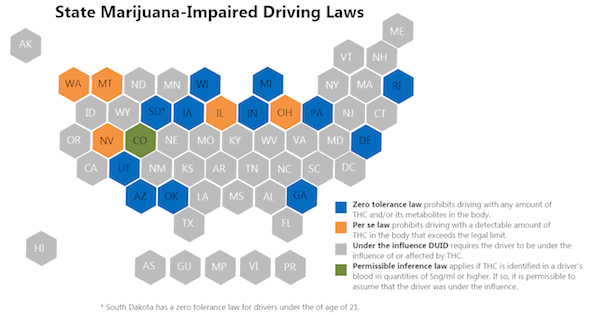
    According to the National Conference of State Legislators, the majority of states with some kind of legalized marijuana have “zero tolerance” laws on the books for driving while high, meaning that any amount of THC and/or its metabolites found in a driver’s system is grounds for legal action. This presents a serious problem when these chemicals can stay in a person’s system for a full month after they last used. 

    Source: NCSL

    Others have “per se” laws similar to the blood alcohol limit. However, cannabis researchers have repeatedly pointed out that finding a limit for cannabis-related compounds in the blood is much more complicated than with alcohol. There is no clear, linear relationship between THC levels in the blood and intoxication.

    Keith Humphreys, a psychiatry professor and drug policy expert at Stanford University in California, believes that the number these states have picked for their legal limit is arbitrary, saying they “made it up.” 

    “We don’t really have good evidence — even if we know someone has been using — [to gauge] what their level of impairment is,” says Humphreys.

    Coming up with a solution won’t be an easy task, but people are trying. In late 2017, an app was released that calculates the user’s reaction time. Cannabis often slows reaction time and impairs one’s ability to focus, making driving while high a dangerous endeavor. After Washington State and Colorado legalized recreational marijuana, highway collisions rose by 3%, according to the Highway Loss Data Institute

    The app, called DRUID, is far from a perfect system for detecting intoxication, but if a blood, urine or breathalyzer test can’t be developed soon, field tests and human judgment may be all police have to rely on.

    “The idea that you could come up with a completely objective test of performance … is ambitious,” says Carnegie Mellon University drug policy researcher Jonathan Caulkins.

    View the original article at thefix.com

  • Massive Study On Driving High To Take Place In California

    Massive Study On Driving High To Take Place In California

    The study aims to give law enforcement more accurate parameters in which to determine a driver’s intoxication level after using marijuana.

    As marijuana gains legal status in more states, one of the central concerns among legal, law enforcement and medical professionals remains how cannabis use may impact driving.

    Studies vary as to whether driving under the influence of alcohol or pot presents more of a danger, which has prompted institutions like the University of California-San Diego to seek hard data on the subject.

    As High Times has reported, the school’s Center for Medicinal Cannabis Research (CMCR) is currently recruiting individuals to participate in its hands-on study of cannabis’ impact on driving, which requires them to ingest smokeable marijuana before using the center’s driving simulator.

    The goal is to provide both police and laboratories with more accurate parameters on which to determine a driver’s intoxication level after using marijuana.

    The study, which according to High Times, is the largest of its kind to date, requires potential candidates to make an initial appointment with researchers to determine eligibility.

    If accepted, the participant is paid $50, and returns for a full day assessment, during which they are given a joint to smoke; the study involves a variety of joints rolled on the site, as High Times indicates, and with varying amounts of THC, including ones with none of the psychoactive agent at all.

    Participants then use the center’s driving simulator and complete iPad-based performance assessments, which focus on memory, attention and motor skills. A field sobriety test is then given before blood and saliva samples are collected from them. Once all the data has been obtained, participants are paid an additional $180.

    The goal of the study is not to determine if one’s driving can be impaired by using marijuana, but rather, to determine the duration and level of impairment.

    “If you smoked this morning, are you impaired throughout the day?” said Tom Marcotte, co-director of the CMCR. “Are you impaired for a couple of hours? Or are you not impaired? We’re trying to answer that.”

    Ultimately, the researchers hope to improve field sobriety tests for marijuana use, which in their current form are used by law enforcement but considered unreliable in regard to determining THC levels in breath or fluid samples. In some cases, field sobriety tests cannot be used as evidence to determine whether a driver was impaired while behind the wheel.

    View the original article at thefix.com