Tag: legal marijuana

  • Restaurant That Sedated Lobsters With Weed Under Investigation

    Restaurant That Sedated Lobsters With Weed Under Investigation

    “I feel bad that when lobsters come here there is no exit strategy,” said the owner of Charlotte’s Legendary Lobster Pound.

    Would you like your lobster baked or stoned?

    A beloved eatery in Maine is drawing attention—from national press as well as from state investigators—for smoking up its crustaceans with cannabis before boiling them as part of a questionably effective effort to soothe the lobsters’ last moments. 

    “I feel bad that when lobsters come here there is no exit strategy,” Charlotte Gill, owner of Charlotte’s Legendary Lobster Pound, told the Portland Press Herald. “It’s a unique place and you get to do such unique things but at the expense of this little creature. I’ve really been trying to figure out how to make it better.”

    Of course, it’s not even clear how much lobsters can feel pain or if they can actually get high, and the whole endeavor raises some nagging legal—and scientific—questions.

    “I’m not aware of any actual studies on this and haven’t done any myself, though it sounds interesting,” Robert Bayer, director of the University of Maine’s Lobster Institute, told the Maine paper. “When you put them in boiling water, the primitive nervous system that does exist is destroyed so quickly they’re unlikely to feel anything at all.”

    But, earlier this year, Switzerland banned boiling lobsters in light of studies suggesting the pinchy shellfish might feel some pain. New Zealand nixed the practice almost two decades ago. 

    Gill is a licensed marijuana grower, so she’s been cultivating the crustaceans’ cannabis at home, according to the New York Times. But that effort raised red flags with the state health department, prompting regulators to send her a notice politely pointing out that the marijuana is supposed to be grown for her, not for her lobsters.

    At the same time, the Maine Health Inspection Program has launched an investigation into the Southwest Harbor restaurant and its “high-end lobster,” but as of Friday they hadn’t issued any findings.

    Despite the catchy name and the smoky additive, Gill offered reassurances that the plant’s active ingredient wouldn’t actually make it through to human consumers, after the animals are cooked. 

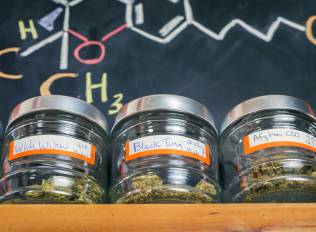
    “THC breaks down completely by 392 degrees,” she said, “therefore we will use both steam as well as a heat process that will expose the meat to a 420 degree extended temperature, in order to ensure there is no possibility of carryover effect.”

    View the original article at thefix.com

  • Harm Reduction Program Offers Cannabis As Alternative To Hard Drugs

    Harm Reduction Program Offers Cannabis As Alternative To Hard Drugs

    The Canadian program also offers free fentanyl testing strips and naloxone training.

    A Canadian harm reduction program is hitting the local opioid addiction crisis from a unique angle—by providing cannabis at little to no cost as an alternative to street drugs.

    The High Hopes Foundation, based in Vancouver, Canada—also home to North America’s first legal supervised injection site (SIF)—is the country’s first “full-time cannabis harm reduction program,” CTV News reports.

    While this isn’t the first recovery program to feature cannabis as a treatment, it’s still a rather novel idea that some consider controversial. But Sarah Blyth, president of High Hopes, says the program is a realistic approach to attacking the most potent addictions.

    “It’s not always possible for people to just completely come off all drugs, because they’ve got trauma. They have pain. They need something,” Blyth said last August, according to CBC. “Opiates may not be the best option for everyone so we’re trying to give them the options we have available.”

    High Hopes offers free or low-cost cannabis and CBD oils to people trying to wean off drugs like opioids, which have been a big problem in Canada as well.

    According to CTV News, nearly 4,000 Canadians died of opioid overdose in 2017; about 1,400 of them were in British Columbia, the province that Vancouver resides in.

    The foundation also offers free fentanyl testing strips and naloxone training. According to Blyth, the majority of illicit drug samples analyzed by the Vancouver Overdose Prevention Society tested positive for fentanyl, which raises the risk of overdose.

    The cannabis program, established last year, started out by collecting cannabis donations from registered patients or dispensaries. Once Canada’s marijuana legalization law goes into effect this October, perhaps High Hopes will have an easier time procuring legal cannabis.

    “What we are doing is not fully legal but we see it helps and we are desperate to help people. Watching people die isn’t okay,” said Blyth.

    The program’s goal is to give people with addictions an alternative to using potentially dangerous street drugs. Blyth noted that many are just seeking relief for pain, anxiety or inflammation. “It gives them a way to have an alternative to the drugs that they’re getting on the street,” said Blyth, who is also the founder of the Overdose Prevention Society. “It’s safe, it can reduce pain.”

    View the original article at thefix.com

  • Congresswoman On Mission To Increase Diversity In Marijuana Industry

    Congresswoman On Mission To Increase Diversity In Marijuana Industry

    Congresswoman Barbara Lee has introduced first-of-its-kind legislation to directly address diversity in the marijuana industry.

    California Rep. Barbara Lee wants to add some diversity to the overwhelmingly white marijuana industry, a fact that was apparent after a Maryland dispensary named a strain “Strange Fruit.”

    The name is a reference to a Billie Holiday song in which “strange fruit” referred to the bodies of black Americans who had been lynched and left to hang on the branches of trees.

    The controversy came to light after a black woman visiting the dispensary was appalled that someone thought “Strange Fruit” was an appropriate name for a pot strain and called Shanita Penny, the president of the board of directors of the Minority Cannabis Business Association.

    “Do you think if a black person were in charge of marketing or at the table that ‘Strange Fruit’ would’ve gotten on the shelves?” asked Penny.

    America’s pot industry is, indeed, largely white. A BuzzFeed analysis of storefront marijuana businesses across the country revealed that less than 1% of dispensaries are owned by black Americans. A different report found that only 19% of marijuana businesses have minority investors.

    Lee told Rolling Stone that she is introducing the RESPECT Resolution, first-of-its-kind legislation to directly address diversity in the marijuana industry. It will likely not become a bill, but instead remain a resolution because the federal government will probably allow state and local governments to decide and enforce their own policies surrounding marijuana.

    With RESPECT, Lee hopes to have states expunge the records of all those incarcerated for non-violent marijuana-related offenses. These people would also be allowed to participate in the new marijuana industry, a distinction that is important for states like Illinois where you can’t get a medical marijuana card if you have a felony—even if that felony was for having medical marijuana.

    Lee also wants to do away with fees to get marijuana licenses, which can be as high as $10,000 in the state of New York.

    Increasing support for the legalization of marijuana is bringing America’s decades-long war on pot to a close, but Lee believes there’s a long way to go to heal the damage caused by the racial disparity in the enforcement of such laws.

    “[Marijuana] has really been a driving force for mass incarceration,” Lee explained. “So we’re looking at ways to begin to unravel this and bring some justice to these people who deserve justice. They’ve been unfairly incarcerated.”

    View the original article at thefix.com