Tag: marijuana legalization

  • Does Having A Marijuana Dispensary Nearby Increase Teen Drug Use?

    Does Having A Marijuana Dispensary Nearby Increase Teen Drug Use?

    A new study explored how factors like proximity, price and product variety might influence adolescents to use marijuana.

    Despite the increased availability of marijuana dispensaries, teens aren’t any more likely to smoke weed, a new study revealed. According to High Times, researchers from the University of California San Diego Department of Family Medicine and Public Health examined how factors like proximity, price and product variety might influence adolescents to use marijuana.

    “There was no evidence supporting the associations of medical marijuana availability, price, or product variety around school with adolescents’ marijuana use and susceptibility to use,” the study’s authors wrote.

    The number of dispensaries in any given neighborhood, nor a dispensary’s proximity to a school appeared to be contributing factors to teen marijuana use, the report indicated.

    “Neither the product price nor the product variety in the dispensary nearest to school was associated with marijuana use or susceptibility to use,” the report added. “The results were robust to different specifications of medical marijuana measures.”

    Little to no research has been conducted on the possible connection between marijuana dispensaries and cannabis use, the researchers said, which makes their study as necessary as it is unique.

    By contrast, there exists a significant amount of research in regards to the link between drug and alcohol availability, and teenagers’ choices to smoke or drink.

    “Despite the strong relationship between retail outlets and alcohol and tobacco use documented by a number of studies, examination of the associations of medical marijuana dispensaries with marijuana use remains limited,” they wrote.

    The study’s authors examined the responses of more than 46,000 8th, 10th and 12th graders (across 117 schools) who participated in the 2015-16 California Student Tobacco Survey.

    “For now, there appears to be no basis for the argument that legalizing medical marijuana has increased teens’ use of the drug,” Deborah Hasin, a professor of epidemiology at Columbia’s Mailman School of Public Health, concluded earlier this year.

    Hasin cited a report that examined teen marijuana use between 1991 and 2014, which compared teen pot use before and after medical marijuana was legalized in a given state.

    Still, not everyone is convinced, PBS reported: a chorus of counselors, parents, physicians, and public health experts continue to sound off about the threat that legal marijuana poses for teenagers.

    “Colorado and other states where marijuana is legal have crafted regulations holding dispensaries accountable for selling their products to minors, and sent out educational messages aimed at preventing kids from gaining access to marijuana,” PBS noted.

    Colorado pediatrician Christian Thurstone says that he’s observed a steadily growing marijuana addiction rate among teenagers ever since 2010, when private companies were given the green light to market and sell medical marijuana.

    In fact, even if the number of teenagers using pot remained flat year over year in Colorado, Thurstone said, the rate of teenagers seeking addiction treatment would climb no matter what.

    Unfortunately, not enough recovery resources exist for teenagers, PBS noted, claiming that only one in 10 people with an addiction ever seek treatment.

    “We just need more [treatment options],” Thurstone said. “We’re just scratching the surface, but we may be doing better than one in 10.”

    You can read more about the impact of medicinal cannabis and why “Big Pharma” is panicking because of it over at cbdoilroom.com in their article “Why Big Pharma Is Panicking Over CBD Oil’s Proliferation“.

    View the original article at thefix.com

  • World's First Marijuana "Breathalyzer" Is On The Way But Will It Work?

    World's First Marijuana "Breathalyzer" Is On The Way But Will It Work?

    The breath analysis test can reportedly detect THC and alcohol.

    A breathalyzer that can determine whether a driver has smoked marijuana might be rolling out in cities as soon as this fall, according to Newsweek.

    The Oakland, California-based company, Hound Labs, says it has developed the world’s first marijuana breath analysis test, which could be leveraged by police departments in all the same ways alcohol breathalyzers are.

    With more and more states legalizing weed, law enforcement officials have become worried about individuals driving when they’re high, Newsweek noted.

    Unfortunately, police officers don’t have an accurate roadside test to tell if a driver has consumed weed. That’s why the marijuana breathalyzer could be a game-changer, says Hound Labs CEO Mike Lynn.

    “We are trying to make the establishment of impairment around marijuana rational and to balance fairness and safety,” he noted, explaining that the device will detect THC, the main psychoactive ingredient in cannabis. 

    Unlike alcohol, however, timing is crucial when it comes to measuring marijuana impairment. With alcohol, a driver is considered impaired with a blood-alcohol level of 0.8; with marijuana, it’s not so clear-cut. Many experts agree that there is a two-hour window during which the full effects of THC will show up.

    “When you find THC in breath, you can be pretty darn sure that somebody smoked pot in the last couple of hours,” Lynn said. “And we don’t want to have people driving during that time period or, frankly, at a work site in a construction zone.” (In addition to THC, the device can detect alcohol, too.)

    For many law enforcement officials, the device couldn’t come at a better time. Right now, THC can only be detected through blood tests—and even then, it remains in the system much longer than other substances.

    “Unlike alcohol, THC can remain detectable in the blood stream for days or weeks, when any impairment wears off in a matter of hours,” said Taylor West, former director of the National Cannabis Industry Association. “So [what] all those numbers really tell us is that, since legal adult-use sales began, a larger number of people are consuming cannabis and then, at some point… [are] driving a car.” The new device would help police zero in on the drivers who are truly putting themselves and others at risk.

    Some critics remain skeptical that devices like the breathalyzer or Canada’s saliva-testing device will work at all. For one, new research has revealed that THC levels “don’t line up in a straightforward way with how impaired people are,” Live Science reported.

    Toxicologist Marilyn Huestis argues that the largest problem isn’t determining how far over the line someone has gone with marijuana so much as where that line even exists.

    “I used to be someone who thought [that] if we could just get a good limit, that would work,” she said. “But [with] all the work on chronic, frequent users, we realized there’s no one number that’s going to distinguish impairment.” 

    View the original article at thefix.com

  • New York Takes Big Step Towards Legalizing Recreational Marijuana

    New York Takes Big Step Towards Legalizing Recreational Marijuana

    Governor Cuomo’s big move could pave the way for New York to become the 10th US state to legalize recreational marijuana.

    Governor Andrew Cuomo made a big step towards legalizing marijuana for adult use on Thursday as he pulled together a group to write the bill, Vox reports.

    The proposal is based on the recommendations of New York’s Department of Health regarding the legalization and regulation of marijuana.

    “As we work to implement the report’s recommendations through legislation, we must thoroughly consider all aspects of a regulated marijuana program, including its impact on public health, criminal justice and State revenue, and mitigate any potential risks associated with it,” wrote Cuomo in a statement.

    Heading up the group writing the bill is Alphonso David, counsel to the governor, who is getting feedback from officials as well as a panel including public safety, public health, and economic experts. If the state’s legislature is satisfied with the resulting bill, they will sign it into law and make New York officially the tenth state to legalize recreational marijuana.

    Cuomo’s proposal is a welcome one to the New York Health Department. In a 75-page report, the department concluded that legalization would be a net positive.

    “Numerous [New York state] agencies and subject matter experts in the fields of public health, mental health, substance use, public safety, transportation, and economics worked in developing this assessment,” officials wrote in the report. “No insurmountable obstacles to regulation of marijuana were raised.”

    The report also backed up key points that marijuana legalization advocates have extolled for decades: the criminalization of marijuana has done nothing to stem its use, marijuana law disproportionately targets “low-income communities of color,” and that the state would not only be able to protect consumers with regulations but reap huge tax revenues as well. The report estimates this amount to be anywhere from $248.1 million to $677.7 million a year.

    However, the report also makes sure to mention the precautions the state should take in legalizing, including remaining vigilant of the effects of usage among its citizens.

    “A regulated marijuana program should monitor and document patterns of use to evaluate the impact of legalization on use,” the report outlined.

    It also warned of the risks of marijuana, including addiction and driving while impaired.

    View the original article at thefix.com

  • California Says “No” to Mixing Marijuana & Alcohol in Public

    California Says “No” to Mixing Marijuana & Alcohol in Public

    California state regulators have drawn a line in the sand for businesses that wish to sell marijuana and alcohol in the same location.

    California state regulators have temporarily dashed hopes for bars and pubs where people can consume alcohol and marijuana at the same time, according to High Times.

    The Golden State issued an industry advisory on July 25, which listed frequently asked questions of the state’s Department of Alcoholic Beverage Control (ABC). The advisory drew a clear line in the sand between alcohol and cannabis in the state, making it illegal to sell the two together.

    “The MAUCRSA (Business and Professions Code section 26054) states that the holder of a license issued under the MAUCRSA ‘shall not sell alcoholic beverages or tobacco products on or at any premises licensed under this division,’” the memo stated.

    The ABC also says beverages that blend the two substances together, such as marijuana-infused cocktails or Canada’s newly infamous “cannabis beer” will be illegal in the state. Cannabidiol (CBD) is out of the question for ABC licensees, too.

    “It does not matter if the CBD comes from industrial hemp or from cannabis,” the memo said. “This also includes non-alcoholic beverage products and edibles. It is thus prohibited… regardless of source, in the manufacture or production of any alcoholic beverage, including using it in mixed drinks or cocktails.” 

    State regulators added that businesses licensed to sell alcohol won’t be allowed to permit their patrons to bring (and use) their own marijuana on the premises, either. No cannabis products, including vaporizers and edibles, can be consumed in public, under California law.

    “The restriction applies at all times, even after hours or during private functions,” the High Times story explained. “That means food, wine, and cannabis pairing events are not allowed at ABC licensed establishments.”

    Interestingly enough, California’s Cannabis Portal site observed that the memo’s guidelines won’t stop any of it from happening: “There are many bars and pubs that [currently] turn a blind eye to such behavior, and did well before recreational marijuana was legalized in California.”

    Additionally, the existence of Denver Initiative 300 (a pilot program that allows public pot consumption in Denver) suggests that attitudes could eventually shift in the opposite direction in California. 

    Since its legalization in November 2016, the laws around marijuana use have been as controversial as they have been somewhat ambiguous.

    While “there has been some lack of clarity” in how and where marijuana can be consumed, a Marijuana Moment article hinted that there is “perhaps a bit of willful ignorance” among businesses and entrepreneurs.

    Even the advisory itself says that it’s not the “be-all and end-all” on the subject and is, instead, meant to simply provide some better clarification: “This is not intended to be a comprehensive review of what may be permitted or prohibited,” the memo cautioned. “You should obtain independent legal advice before engaging in business involving either alcoholic beverages or cannabis, and you should not act in reliance on any information presented herein.”

    And while the ABC prohibits anyone from mixing alcohol and weed, there are no stipulations that prevent a person from holding licenses to sell both alcohol and cannabis.

    View the original article at thefix.com

  • Device To Test Drivers For Cannabis Impairment Approved In Canada

    Device To Test Drivers For Cannabis Impairment Approved In Canada

    After legalizing cannabis in June, Canada’s government is cracking down on drugged driving.

    Our neighbor to the north has settled on a method that law enforcement officers will use to test motorists for cannabis impairment.

    Canada became the first major economy, and the second country in the world after Uruguay, to legalize cannabis this past June. With legal sales to begin on October 17, it appears that Canada won’t have to wait for a reliable test that can detect cannabis impairment in motorists.

    Immediately following the decision to legalize (with Bill C-45), Canada made major changes to its impaired driving laws with Bill C-46, High Times noted.

    This included the use of roadside drug tests, but now, the government has approved a specific device for the job—the Dräger DrugTest 5000, a roadside saliva drug test device that analyzes a mouth swab for the presence of THC.

    The device was approved by Canada’s Attorney General Jody Wilson-Raybould, following a review of its effectiveness by an independent panel of traffic safety experts and toxicologists.

    According to the Los Angeles Times, the device—already in use in Germany and the UK—tests for the presence of cannabis, cocaine, opiates, methamphetamine, amphetamine, methadone and benzodiazepines, but does not measure the level of intoxication.

    Gauging if someone is “high” on cannabis is more complex than testing for alcohol intoxication. It’s uniquely difficult to test for impairment from cannabis because THC can remain in a person’s system for weeks, therefore its presence does not necessarily indicate that a person is impaired.

    This has presented a challenge as more federal and local governments choose to legalize cannabis in some form.

    While the Dräger device does not specify impairment, neither does Bill C-46, which gives police officers broad discretion when it comes to motorists who come up positive for THC. They are allowed to charge a driver with drug-impaired driving “based solely on the presence of THC,” High Times reported.

    However, officers will still need “reasonable grounds of suspected drug activity” to administer a drug test on a driver.

    The Canadian government will continue to invest in improving drug testing to counteract drugged driving. According to High Times, the national government has allotted $81 million over five years to purchase drug-testing devices and toward training police officers on how to use them.

    View the original article at thefix.com

  • Utah Medical Marijuana Vote Creates Rift Among Mormons

    Utah Medical Marijuana Vote Creates Rift Among Mormons

    As the vote nears, Church policy looms large in a state where more than 60% of residents identify as Mormon.

    When Brian Stoll fractured his back in college, he was put on opioid painkillers to manage his discomfort. The pills helped, but Stoll was wary of becoming addicted. He wanted a more natural pain relief method, and he found it in marijuana

    “Marijuana is a gift from God,” Stoll told the Los Angeles Times.

    However, when Stoll wanted to get married he had to make a choice: continue using cannabis to treat his pain, or get married in the church where he and his fiancée wanted to wed.

    As Mormons, the couple needed to be in good standing with the church in order to be married in the temple, and because marijuana was an illegal drug, Stoll’s use of it was against church teaching. 

    “This was devastating… I had to choose between my health and my fiancée,” Stoll said. “It seemed asinine that if I lived in another state, I wouldn’t have to make such a difficult decision.”

    Stoll stopped smoking pot and began taking Tramadol—an opioid painkiller—every day. It helps with his pain, but leaves him feeling drowsy. Even his wife Rachael, said that Stoll was better off when he could use cannabis. Because of that, husband and wife are both advocating for the legalization of medical marijuana in Utah. 

    “As a family, we need this to become law,” Rachael said. “We pray for this.”

    Voters in Utah are consider legalizing medical marijuana in November. As the vote nears, church policy looms large in a state where more than 60% of residents identify as Mormon.

    According to polling, two-thirds of voters are in favor of medical marijuana, but the leadership of the Mormon church has taken a less enthusiastic stance.

    In April, the church praised the Utah Medical Association for “cautioning that the proposed Utah marijuana initiative would compromise the health and safety of Utah communities.”

    Utah was among the first states to ban marijuana in the early 1900s, reportedly after Mormon missionaries tried the drug in Mexico. 

    The state’s governor, Gary Herbert, a Republican and a member of the Mormon church, has said that he has reservations about legalizing medical cannabis. 

    “I am concerned about this initiative because of the lack of medical science on the safety, efficacy and proper dosage for compounds found in cannabis,” Herbert said in an email to the LA Times. “We should have clinical studies—just like we do for any other FDA-approved medicine. We need to isolate what helps and heals from what harms.”

    People like Stoll, however, wholeheartedly hope that the measure passes, legalizing marijuana and making its use acceptable in the eyes of the church. 

    “This is something that if I drive east or west—to Colorado or Nevada—is 100% legal and helpful to my situation,” Stoll said. “We’re not talking about recreational. This is simply for medical.”

    View the original article at thefix.com

  • Employment Rights For Legal Marijuana Users Addressed In New Bill

    Employment Rights For Legal Marijuana Users Addressed In New Bill

    Under the proposed legislation, federal employees living in pot-friendly states won’t be penalized for their cannabis use.

    New legislation proposed in the House of Representatives would protect federal employees from getting fired for using cannabis.

    The bipartisan bill—the Fairness in Federal Drug Testing Under State Laws Act—was introduced by Rep. Charlie Crist and Rep. Drew Ferguson last Thursday (July 26) and referred to the Committee on Oversight and Government Reform, according to Marijuana Moment.

    The legislation would shield federal employees “whose residence is in a State where that individual’s private use of marijuana is not prohibited” from being denied employment or being “subject to any other adverse personnel action” as a result of a positive cannabis test, according to the bill’s text, obtained by Marijuana Moment.

    The bill applies to employees of the federal government “across departments and agencies,” but not those involving “top secret clearance or access to a highly sensitive program.”

    However, if there is “probable cause to believe that the individual is under the influence of marijuana” in the workplace, they may be terminated.

    Tom Angell of Marijuana Moment notes that Rep. Crist previously proposed a measure to protect military veterans from being fired for cannabis use that is legal under state law.

    However, the measure became one of nearly three dozen amendments having to do with cannabis policy that Republican leadership in the House has blocked from being voted on, as Angell reported in early July.

    As more states approve cannabis for either medical or adult use, the rules around it when it comes to things like jobs or housing can get hazy.   

    NORML—the National Organization for the Reform of Marijuana Laws—provides a Model Workplace Policy for Cannabis on its website to help employers navigate this new territory. This guide gives a comprehensive background of cannabis and its effects.

    The difficult thing about enforcing DUI laws or anti-drug policies in the workplace with cannabis is the fact that its compounds may remain in a person’s system for days or even weeks after its use.

    As a result, a positive test result from a standard urinalysis test would not “provide an employer with any indication as to whether the substance may have been ingested while their employee was on the job,” the guide explains.

    This complicates an employer’s ability to determine whether an employee has violated policy by using on the job.

    There has yet to be a standard test for cannabis impairment, which presents a challenge for law enforcement as well. 

    As NPR reported last summer, “Despite the increasingly legal use of cannabis in many states, cops still don’t have the equivalent of a reliable alcohol breathalyzer or blood test—a chemically based way of estimating what the drug is doing in the brain.”

    View the original article at thefix.com

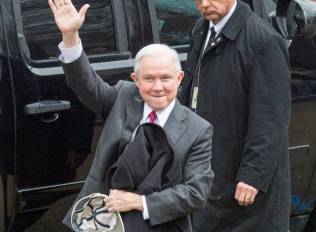
  • Jeff Sessions: DOJ Won't Back Down On Marijuana Laws

    Jeff Sessions: DOJ Won't Back Down On Marijuana Laws

    “States have a right to set their own laws and will do so, and we will follow the federal law,” Sessions said.

    At a Boston press conference about a federal sting operation that busted about two dozen people on immigration fraud, reporters went a bit off topic and asked U.S. Attorney General Jeff Sessions about individual states’ rights to create and enforce their own marijuana laws.

    Sessions was clear in his anti-marijuana stance, affirming that under his purview the Department of Justice will follow federal marijuana laws. “States have a right to set their own laws and will do so, and we will follow the federal law,” Sessions responded to the question.

    Earlier this year, Sessions wrote a memo that reversed a decision by the Obama-era Department of Justice to be more hands-off when it comes to states that have legalized marijuana. “The previous issuance of guidance undermines the rule of law and the ability of our local, state, tribal, and federal law enforcement partners to carry out this mission,” he wrote.

    The question at the Boston press conference was pertinent because two years ago, the state of Massachusetts legalized marijuana, but as of now still has not set up systems for its retail sale and purchase in the state. If Sessions goes after Massachusetts dispensaries, it would be disastrous for such a budding industry.

    “The American republic will not be better if there are marijuana sales on every street corner,” Sessions expanded on his answer.

    The sentiment was reflective of a statement the attorney general made during a 2016 Senate hearing: “Good people don’t smoke marijuana.”

    Despite the threats he’s made about marijuana, Massachusetts cannabis regulators are not worried. They’re confident even after they start retailing marijuana in their state, that the federal government will not intrude.

    Steve Hoffman, the chairperson of the Cannabis Control Commision, believes that a recent statement from one of Sessions’ federal attorneys, Andrew Lelling, seems to suggest that federal policy still resembles the previous hands-off policy.

    Federal focus around marijuana enforcement, according to Lelling, is focused on three things: making sure marijuana isn’t being passed to illegal markets, making sure it isn’t being distributed to minors, and cracking down on criminals seeking to transport marijuana across state lines.

    Hoffman is confident that the measures Massachusetts is putting in place will address these three priorities and thus the state will not draw Sessions’ ire.

    View the original article at thefix.com

  • Massive Study On Driving High To Take Place In California

    Massive Study On Driving High To Take Place In California

    The study aims to give law enforcement more accurate parameters in which to determine a driver’s intoxication level after using marijuana.

    As marijuana gains legal status in more states, one of the central concerns among legal, law enforcement and medical professionals remains how cannabis use may impact driving.

    Studies vary as to whether driving under the influence of alcohol or pot presents more of a danger, which has prompted institutions like the University of California-San Diego to seek hard data on the subject.

    As High Times has reported, the school’s Center for Medicinal Cannabis Research (CMCR) is currently recruiting individuals to participate in its hands-on study of cannabis’ impact on driving, which requires them to ingest smokeable marijuana before using the center’s driving simulator.

    The goal is to provide both police and laboratories with more accurate parameters on which to determine a driver’s intoxication level after using marijuana.

    The study, which according to High Times, is the largest of its kind to date, requires potential candidates to make an initial appointment with researchers to determine eligibility.

    If accepted, the participant is paid $50, and returns for a full day assessment, during which they are given a joint to smoke; the study involves a variety of joints rolled on the site, as High Times indicates, and with varying amounts of THC, including ones with none of the psychoactive agent at all.

    Participants then use the center’s driving simulator and complete iPad-based performance assessments, which focus on memory, attention and motor skills. A field sobriety test is then given before blood and saliva samples are collected from them. Once all the data has been obtained, participants are paid an additional $180.

    The goal of the study is not to determine if one’s driving can be impaired by using marijuana, but rather, to determine the duration and level of impairment.

    “If you smoked this morning, are you impaired throughout the day?” said Tom Marcotte, co-director of the CMCR. “Are you impaired for a couple of hours? Or are you not impaired? We’re trying to answer that.”

    Ultimately, the researchers hope to improve field sobriety tests for marijuana use, which in their current form are used by law enforcement but considered unreliable in regard to determining THC levels in breath or fluid samples. In some cases, field sobriety tests cannot be used as evidence to determine whether a driver was impaired while behind the wheel.

    View the original article at thefix.com

  • Is Law Enforcement More Effective Thanks to Legal Marijuana?

    Is Law Enforcement More Effective Thanks to Legal Marijuana?

    Researchers examined the impact weed legalization has had on crime trends.

    While marijuana legalization remains a contentious issue for many throughout the U.S., Washington and Colorado may have proven that in some aspects it is positive.

    According to The Washington Post, researchers at Washington State University have concluded that legal pot has “produced some demonstrable and persistent benefit” to police departments.

    “Our models show no negative effects of legalization and, instead, indicate that crime clearance rates for at least some types of crime are increasing faster in states that legalized than in those that did not,” researchers said.

    Police departments in states where weed has been legalized have apparently been able to focus on other, more serious types of crime, rather than getting bogged down with “low-level marijuana enforcement.”

    The Post describes “crime clearance” as when authorities have “identified and arrested a suspect and referred him to the judicial system for prosecution.”

    Using available FBI data, the Washington State researchers analyzed the clearance rates in both Colorado and Washington between the years 2010 and 2015. In order to see what impact weed legalization had on crime trends, researchers looked at clearance rates after November 2012 in Colorado and December 2012 for Washington (when weed, respectively, became legal).

    The Post did, however, note that both states’ “recreational markets” did not open until 2014. Both states experienced falling clearance rates before weed legalization, showing that “the decline stabilized in Colorado and began to reverse itself in Colorado,” with the Post adding that “no similar shift happened in the country as a whole.”

    It wasn’t until legalization that those numbers took a sudden shift in the other direction.

    Still, while researchers say the data can’t conclusively prove that legalization was the primary influence on those crime clearance rates, there were no other demonstrable changes in policing strategies during that same time. Instead, researchers can only say that legalization had a “plausible” impact on clearance rates. 

    Property-crime clearance rates showed a “dramatic reversal” in Colorado after weed became legal. Researchers also noticed that the clearance rates of other types of crime, such as burglary and motor-vehicle theft, spiked soon after legalization. By contrast, researchers said, national trends remained essentially flat.

    “While there were both immediate and longer term differences between states which legalized and the rest of the country in terms of crime clearance rates,” the authors said, “the long-term differences are much more pronounced, especially in Colorado.”

    In some ways, that’s all the proof that legalization advocates need to hear when it comes to the efficacy of how police departments use their resources.

    “Our results suggest that, just as marijuana legalization proponents argued, the legalization of marijuana influence police outcomes, which in the context of this article is modeled as improvements in clearance rates,” researchers said.

    Additionally, researchers found no other crimes in Colorado or Washington upon which legalization seemed to have a negative impact on clearance rates, suggesting that the case for legalizing weed is, from a law enforcement perspective, as remarkable as it is promising. 

    View the original article at thefix.com