Tag: News

  • US Health Chief Announces Support For Needle Exchange Programs

    US Health Chief Announces Support For Needle Exchange Programs

    The Health Secretary’s reversal on needle exchange programs may be related to a new 2030 deadline related to HIV.

    Speaking at the National HIV Prevention Conference on Tuesday, Health and Human Services Secretary Alex Azar expressed support for needle exchange programs as a way to stop the spread of HIV.

    Republicans like Azar have largely resisted these programs, believing that they will encourage drug use—but evidence to the contrary appears to have convinced the HHS Secretary otherwise.

    “Syringe services programs aren’t necessarily the first thing that comes to mind when you think about a Republican health secretary, but we’re in a battle between sickness and health, between life and death,” Azar said during his speech according to The Hill. “The public health evidence for targeted interventions here is strong, and supporting communities when they need to use these tools means fewer infections and healthier lives for our fellow Americans.”

    Needle exchange programs have existed for years, but are as important as ever with the national opioid crisis. These programs have reduced the spread of dangerous viruses such as HIV and hepatitis C through intravenous drug use. The first such program in the U.S. was established in 1988 in Tacoma, Washington, and was rewarded with a 60% reduction in new hepatitis B and C cases.

    Studies over the decades have also consistently found that these services do not increase the number of intravenous drug users. At the same time, needle exchange programs cost significantly less than treating new cases of HIV and hepatitis.

    However, the larger Trump administration still opposes these programs as well as safe injection sites where individuals can use drugs without fear of arrest, and in the presence of medical professionals who both provide clean equipment and are ready to save lives in case of an overdose.

    In February, the Department of Justice sued Safehouse, a non-profit organization based in Philadelphia, to prevent them from opening the country’s first safe injection site.

    Azar’s reversal on needle exchange programs may be related to a new 2030 deadline related to HIV. Earlier this month, the Trump administration revealed its 2020 budget proposal, which included a request for $291 million for an ambitious plan to end the “HIV epidemic” in a decade.

    “For the first time in modern history, America has the ability to end the epidemic, with the availability of biomedical interventions such as antiretroviral therapy and pre-exposure prophylaxis (PrEP),” the budget plan reads.

    With Azar’s statements at the National HIV Prevention Conference, it appears that needle exchange programs could become a part of these efforts. Most of the $291 million requested will be given to the Centers for Disease Control and Prevention (CDC), which supports and helps to fund these services.
    View the original article at thefix.com

  • "Wear Your Meds" Buttons Help Fight Stigma Against Mental Health

    "Wear Your Meds" Buttons Help Fight Stigma Against Mental Health

    Creator Laura Weiss hopes her pinback buttons can spark conversations and break down the stigma surrounding mental illness.

    When Lauren Weiss took control of her mental health and began taking medication for bipolar disorder, she knew that she wanted to be an advocate for mental illness. Weiss studies advertising at Miami Ad School in New York City, so it was natural that she searched for a quick, engaging visual cue to open conversations about her condition. 

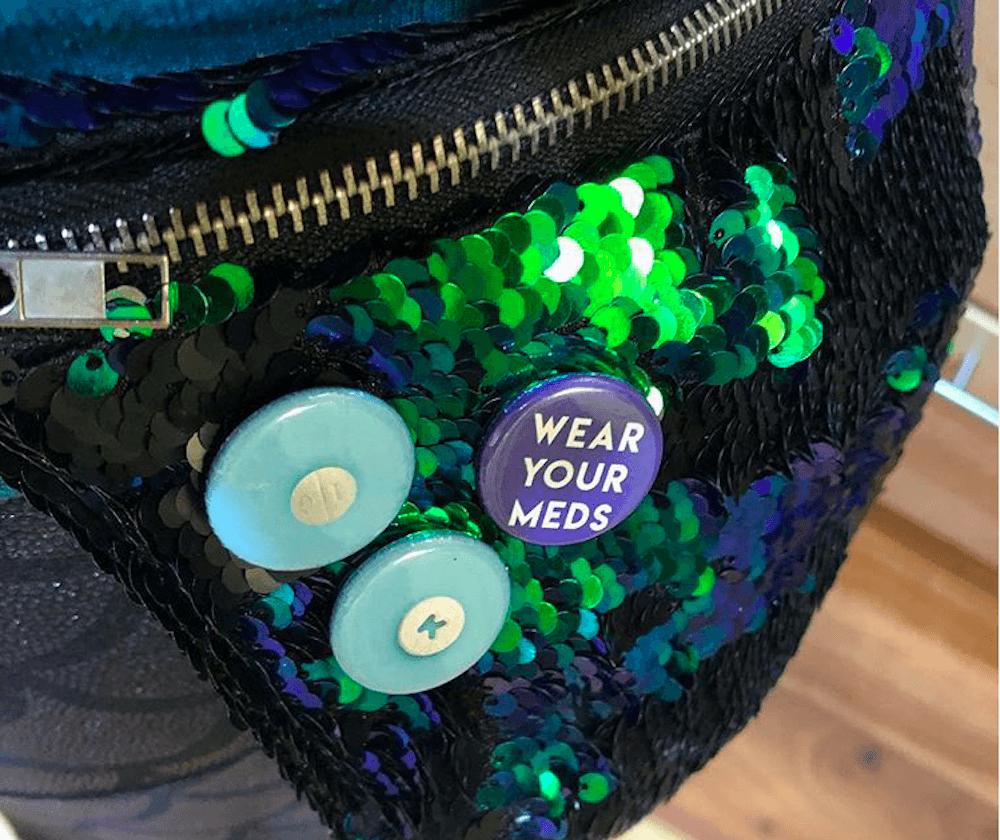
    Weiss designed pinback buttons depicting common psychiatric medications, like Xanax and lithium. Another button proclaims “Wear Your Meds,” summing up the mission of her project. Weiss told Fast Company that the buttons, which started as a class project, are a way to spark a conversation around mental health. 

    “[It’s a] symbol that represents the story you want to tell, and a gateway into your personal story,” she said. “I know that not everybody wants to be an activist about mental health. With something like the buttons, I think it’s a little more accessible for people who maybe are open to sharing their story, but don’t want to be shouting about it on the streets. They can have this button, and it’s an easy way for people to see it and maybe ask about it.”

    Weiss said that she doesn’t expect everyone to be comfortable broadcasting what medications they are on. Some people have said to her that they are afraid they would be fired or otherwise discriminated against if they were open about their mental health condition and the medications that they are taking. 

    However, she said the buttons allow people who are interested in sharing their story to help break down stigma. 

    “People like me who are talking about this from a position of privilege, in a community where we can feel safe talking about it, are the people who ultimately have to do the heavy lifting and have to do the work around this in order for that stigma to start to be lifted for people in communities that don’t feel comfortable talking about it right now,” she said. 

    Weiss is now selling the buttons online, with proceeds to benefit the National Alliance on Mental Illness. 

    “When you ‘wear your heart on your sleeve,’ it means you’re being honest, open, and vulnerable. When you wear your meds on your sleeve, you’re doing the same,” her website reads. 

    Weiss’ buttons depict 14 different pills commonly used for treating mental health conditions: Zoloft, Lithium, Adderall, Ativan, Klonopin, Desyrel, Lexapro, Lamictal, Effexor, Cymbalta, Celexa, Wellbutrin, Xanax, and Prozac.

    View the original article at thefix.com

  • Jenna Jameson Credits Sobriety With Weight Loss

    Jenna Jameson Credits Sobriety With Weight Loss

    “Sobriety is a game changer, not only are you bright, clear and capable… your gut says bye bye!” Jameson said in an Instagram post. 

    Adult film star Jenna Jameson shared a “Transformation Tuesday” picture on Instagram this week, showing how sobriety and a renewed focus on health have transformed her body. 

    “It’s important we talk about the aftermath of new sobriety,” she wrote on an Instagram post. “Raw feelings, fear, unsure how to deal with all the changes. The good far outweighs anything, that’s for sure. But this shows the effects of alcohol on your body. Sobriety is a game changer, not only are you bright, clear and capable… your gut says bye bye! #Sobriety and #keto for the win!”

    Last fall, Jameson posted a similar side-by-side photo to celebrate three years sober. She has also been open about her 80-pound weight loss

    “Today is an important day for me in my recovery. 3 years. I can’t begin to explain what sobriety has brought to my life. But I will try,” Jameson wrote in September. “Yes, I’m not the intensely self centered ‘the world owes me something’ woman anymore. I am now the ‘What can I do for the world’ woman. Sobriety has taught me a lot about myself, my coping mechanisms that I ignored came bubbling to the surface quickly after getting sober.”

    She continued, “That scared me. Everything I knew was wrong. Everything I believed in was hurting me, not helping. Meetings and leaning on my Sober friends… made things bearable the first year. I was surviving. Sober. It was shocking at first, but now it’s my new normal.”

    She said that sobriety and a keto diet have helped her transform her body after giving birth to her daughter in 2017. 

    “My weight loss has solidified my toughness and strength,” she wrote last year. “I know I am capable of beautiful things and these are the qualities I want to teach my daughter. No matter what life throws at you, you can overcome and flourish. 3 years. 3 whole years. I am grateful. Just for today.”

    Jameson hasn’t been very open about her addiction, but there are reports that she abused alcohol and pills. Her Instagram posts include the hashtags #AA and #NA, suggesting that she’s part of a 12-step fellowship. 

    Throughout her weight loss and recovery journeys, Jameson has learned to use healthier coping mechanisms rather than relying on substances. 

    “I think back to the way I used to run… run as far and as fast as I could, and I pray to God I never feel that emptiness again,” she wrote. 

    View the original article at thefix.com

  • Opioid Lawsuits Pile Up Against Family Behind Purdue Pharma

    Opioid Lawsuits Pile Up Against Family Behind Purdue Pharma

    A string of lawsuits seeks to hold the Sackler family, who own Purdue Pharma, responsible for the opioid crisis.

    The Sackler family is withdrawing from the public sphere, including ending their philanthropic initiatives, as legal pressure rises to hold them responsible for the opioid crisis.

    Their charity arm, the Sackler Trust, has historically donated millions but announced it was ceasing all such activity now that they’re receiving bad press and alleging that “false allegations” are being made against them.

    “The current press attention that these legal cases in the United States is generating has created immense pressure on the scientific, medical, educational and arts institutions here in the U.K., large and small, that I am so proud to support. This attention is distracting them from the important work that they do,” said Sackler Trust chairwoman Theresa Sackler. “The Trustees of the Sackler Trust have taken the difficult decision to temporarily pause all new philanthropic giving, while still honoring existing commitments. I remain fully committed to all the causes the Sackler Trust supports, but at this moment it is the better course for the Trust to halt all new giving until we can be confident that it will not be a distraction for institutions that are applying for grants.”

    Purdue Pharma is the manufacturer of the opioid painkiller OxyContin, a drug for which they stand accused of downplaying the negative effects of while encouraging doctors to prescribe as much as possible in the name of profit.

    According to the Centers for Disease Control, opioids caused about 218,000 American deaths between 1999 and 2017. A recent study found that people are now more likely die from an opioid overdose than in a car accident. The Sacklers say they recognize that action needs to be taken.

    “We recognize that more needs to be done and that’s why we launched a long-term initiative that continues to build as we pursue a range of solutions that we believe will have a meaningful impact,” wrote Theresa Sackler.

    The Sacklers have suspended a $1.3 million grant to the United Kingdom’ National Portrait Gallery as to “avoid being a distraction.” Some other organizations, like the art gallery Tate, the Guggenheim, and the hedge fund Hildene Capital Management, have cut ties to the Sacklers preemptively.

    “The weight on my conscience led me to terminate the relationship,” said hedge fund manager Brett Jefferson.

    Some have called for removing the Sacklers’ name from buildings they funded, including Harvard University’s Arthur M. Sackler Museum and the Smithsonian’s Arthur M. Sackler Gallery, which were funded by the Sacklers long before the invention of OxyContin. Spokespeople for both museums have said they are not going to remove the Sackler name from their buildings.

    “Museums (are) white washing the reputation of a family that is directly responsible for the deaths of hundreds of thousands of people … But the tide is turning against them,” said L.A. Kauffman of accountability group Sackler PAIN.

    View the original article at thefix.com

  • "Teen Wolf" Star Colton Haynes Marks Sober Milestone

    "Teen Wolf" Star Colton Haynes Marks Sober Milestone

    “Teen Wolf” star Colton Haynes turned to substance abuse after falling on hard times but is now cleaning up his act.

    Colton Haynes has achieved six months sober after going on a week-long bender to help cope with his divorce as well as the death of his mother in the same year. Recently, he told Attitude Magazine about his sober journey, which included four months of rehab.

    Haynes’ week-long bender came after he divorced Jeff Leatham, his husband of less than one year, and his mother, Dana, dying of cirrhosis of the liver within 2018. However, his struggles with substance abuse began long beforehand, as early as 2016 when he came out as gay.

    “I came out, and in a way, my downward spiral started,” Haynes said. “I felt extremely free but at the same time the amount of attention I was getting was making me spin out of control.”

    But he really hit bottom in 2018.

    “At that point, I fell apart. My brain broke,” Haynes recalled. “I was doing a massive comedy for a studio, showed up to work and got fired on the first day. They said I looked as if I had ‘dead in my eyes’ and I did.”

    He continued to spiral into darkness.

    “I was drowning in my own s–t,” Haynes confessed.

    He hit his rock bottom during his week-long bender.

    “I locked myself in a hotel room at the Waldorf Astoria in Beverly Hills for seven days and was found in my room with these insane bruises all over my body,” he recounted. “It looked as if somebody had beaten the s–t out of me. I couldn’t walk, so I was falling everywhere. I almost ruptured my kidney, ended up in the hospital, ended up in 5150 psych hold. I was on such a destructive path that I could not function.”

    He ended up with partial vision loss in one eye and suffered two seizures, which inspired him to seek treatment.

    “I’m always going to be in recovery,” he said. “There are so many people struggling out there, but not a lot of them talk about it. Life is much more beautiful than I could have imagined.”

    In the past, Haynes has revealed his struggles with mental health in his published diary entries.

    View the original article at thefix.com

  • Washington Raises Legal Smoking Age To 21

    Washington Raises Legal Smoking Age To 21

    Washington joins states such as California, Hawaii, Maine and Massachusetts who have also increased the legal smoking age to 21.

    This week, Washington became the eighth state to change the legal age to purchase cigarettes to 21. 

    On Wednesday (March 27), the Washington Senate passed a bill that raised the minimum age for buying cigarettes, tobacco, and electronic smoking devices, including vapes, according to The Herald.

    “This bill is about saving lives,” said Democratic state Senator Patty Kuderer, who says that raising the smoking age not only prevents lifelong use, but will also save the state “millions of dollars in health care costs.”

    Republican state Senator Phil Fortunato said that the bill did not make sense if the legal age of adulthood is 18. “Either you are an adult and intelligent enough to make your own decisions at 18, or not,” he said. “This is a personal freedom issue.”

    People under 21 will still be able to purchase tobacco and electronic smoking devices on tribal lands in the state—something that many lawmakers, including Republican state Senator Doug Ericksen objected to.

    “Why create a two-tier system,” he said. “Let’s have one fair standard for all of Washington.”

    California, Hawaii, Maine, Massachusetts, New Jersey, Oregon and Virginia all have a minimum age of 21 for purchasing tobacco and smoking products. Many cities have also adopted the measure, according to the Campaign for Tobacco Free Kids, which advocates for increasing the smoking age. 

    “Nearly all smokers start as kids or young adults, and these age groups are heavily targeted by the tobacco industry,” the group writes. “Increasing the tobacco age to 21 will help to prevent young people from ever starting to smoke and to reduce the deaths, disease and health care costs caused by tobacco use.”

    In Hawaii, a lawmaker has presented an even more drastic proposal, trying to raise the minimum smoking age to 100 by 2034. 

    “In my view, you are taking people who are enslaved from a horrific addiction, and freeing people from horrific enslavement. We, as legislators, have a duty to do things to save people’s lives. If we don’t ban cigarettes, we are killing people,” Representative Richard Creagan told the Hawaii Tribune-Herald.

    Although rates of cigarette use are decreasing among teens, more young people are using electronic cigarettes, which pose health risks. The FDA is even considering a medication to help kids quit vaping.

    Matthew L. Myers, who is the president of the Campaign for Tobacco-Free Kids, told CNN, “The FDA has concluded that the level of addiction it is seeing among youthful e-cigarette users is so disturbing and so unprecedented that it needs to at least ask whether we need a solution that goes beyond what we ever did with cigarettes.”

    View the original article at thefix.com

  • Edibles, Legal Pot ER Visits Increase In Colorado

    Edibles, Legal Pot ER Visits Increase In Colorado

    Although edibles make up only 0.32% of legal cannabis sales in the state, they were blamed for 10.7% of emergency room visits. 

    Since Colorado legalized recreational marijuana in 2012, cannabis-related emergency room visits have nearly tripled, and people who used edibles were more likely to end up in the hospital than people who smoked pot.

    The findings were part of a study published this week in the Annals of Internal Medicine. Looking at data from one hospital in Colorado, researchers found that although edibles make up only 0.32% of legal cannabis sales in the state, they were blamed for 10.7% of emergency room visits. 

    People who took edibles were also more likely to report serious psychotic symptoms: 18% of people who went to the ER after eating edibles reported these symptoms, compared with just 10% of people who went to the ER after smoking. 

    Lead author Andrew Monte told Rolling Stone that people who took edibles were more likely to end up in the ER because any adverse effects they experienced were likely to last longer than adverse effects in people who smoked cannabis. 

    “My initial hypothesis was that people were stacking doses and getting too high of a dose,” he said. “But after analyzing these data, I actually think it is that adverse symptoms from edible consumption last longer than when people smoke. This leads to more opportunity to say, ‘I need to go to the ER.’”

    The executive director of NORML, Erik Altieri, told Rolling Stone that since the research only looked at one hospital in one state, people shouldn’t draw universal conclusions from it. He said that overall, emergency room visits caused by marijuana are rare, and usually not very serious. 

    “While we support increased public education and enhanced labeling to inform consumers about how to responsibly consume edibles and in what doses, it is important to note that the overwhelming majority of ER cases related solely to marijuana result in the patient simply being hydrated and let go in an hour or two,” he said. 

    Still, with marijuana being legalized in more places and edibles being widely available, some people urge public caution until there is more research into the effects and potential dangers of edibles. In Canada, researchers believe that an elderly man experienced a heart attack after eating a lollipop laced with cannabis. 

    “The outcome of this case is important with new marijuana legalization—hopefully with marijuana use no longer criminalized, more research into the cardiovascular side effects will emerge,” researchers wrote in the Canadian Journal of Cardiology

    View the original article at thefix.com

  • Avicii's Family Launches Foundation For Mental Health Awareness

    Avicii's Family Launches Foundation For Mental Health Awareness

    “Tim wanted to make a difference. Starting a foundation in his name is our way to honor his memory and continue to act in his spirit,” his family said.

    The family of the late DJ/producer Avicii announced that it has launched a foundation to raise money and awareness for a variety of causes, including mental health and suicide prevention.

    Rolling Stone reported that the Tim Bergling Foundation will pay tribute to the late musician, who died of an apparent suicide in 2018, by supporting those causes and addressing global and national issues in his native country of Sweden.

    In a statement, the family said, “Tim wanted to make a difference. Starting a foundation in his name is our way to honor his memory and continue to act in his spirit.”

    In addition to supporting mental health issues, the Tim Bergling Foundation – which takes its moniker from Avicii’s real name – hopes to also bring attention to worldwide issues like climate change, development assistance, nature conservation, and endangered species as well as initiatives that are inherent to Sweden.

    The effort echoes the charitable work done by Avicii during his lifetime, which included support for Feeding America, the FEED Foundation,  (RED) and Sweden’s Radiohjalpen.

    Arguably one of the most popular and successful electronic dance music (EDM) artists of the last two decades, Avicii rose to global fame on the strength of his Top 5 hit “Wake Me Up” in 2013, and according to Variety, placed regularly on Forbes’ “Highest-Paid DJs” list.

    At the height of his fame, Avicii stepped away from live performing, citing stress, anxiety and illness as the reasons for his decision. He also suffered from health issues, including pancreatitis caused by excessive drinking, which required the removal of his gall bladder and appendix in 2014. 

    “The decision I made might seem odd to some, but everyone is different and for me, this was the right one,” he wrote on social media after announcing his retirement.

    On April 20, 2018, Avicii was found dead while on vacation in Muscat, Oman. An autopsy found “no criminal suspicion” in his death, but TMZ reported quotes from sources that indicated that the DJ had taken his own life with a shard of glass from a bottle.

    His family released a statement shortly after his death that stated in part that Avicii “really struggled with thoughts about Meaning, Life, Happiness. He could not go on any longer. He wanted to find peace.”

    View the original article at thefix.com

  • Former DEA Official Now A Paid Consultant For Purdue Pharma

    Former DEA Official Now A Paid Consultant For Purdue Pharma

    Insiders wonder if the former DEA official anticipated becoming a paid consultant for Big Pharma when she was with the agency.

    Demetra Ashley, former acting assistant administrator and senior official for the U.S. Drug Enforcement Administration (DEA), is currently a paid consultant for one of the top opioid drug manufacturers in the country, according to NBC News sources.

    As acting assistant administrator, Ashley warned the Senate in 2017 that a “robust regulatory program” would be needed in order to prevent the misuse of controlled prescription drugs such as Purdue Pharma’s OxyContin and other opioid medications.

    She specifically called out the over-prescribing of these drugs as “inextricably linked with the threat the United States faces from the trafficking of heroin, illicit fentanyl and fentanyl analogues,” and by extension, the entire opioid epidemic.

    At the same Senate hearing, Ashley argued for a law that made it very difficult for the DEA to use immediate suspension orders against companies like Purdue Pharma to either be revised or repealed.

    The Ensuring Patient Access and Effective Drug Enforcement Act, passed in 2016, made it nearly impossible for the DEA to take urgent action against a drug company when it “represents an imminent danger to public health or safety,” she said.

    Now, she is being paid by Purdue to advise them via her new consulting firm, Dashley Consulting, LLC. Purdue is currently facing around 2,000 lawsuits for its alleged role in the opioid epidemic via deceptive marketing tactics and encouraging doctors to over-prescribe OxyContin and similar drugs.

    After decades of specializing in preventing the diversion of prescription drugs, some are questioning whether Ashley did all she could to combat the alleged role of Purdue Pharma and other companies in the opioid epidemic and whether her new consulting position is a violation of ethics.

    While there is nothing technically illegal about this, Washington University law professor and government ethics expert Kathleen Clark says that Ashley’s new role with Purdue raises questions about “whether the prospect of a payday after leaving government tainted the actions of the regulator while still in government.”

    “Did this person act differently in government because they anticipated or wanted to get the payday from these very powerful economic actors who have huge amounts at stake?” Clark asks.

    When contacted by NBC News, Ashley did not confirm or deny consulting for Purdue Pharma, but acknowledged that she has “been consulting for members of the industry” since June 2018, three months after she retired from the DEA.

    She also confirmed that she has been subpoenaed as part of a consolidated lawsuit against opioid companies because of her former role in the DEA.

    View the original article at thefix.com

  • Hailey Baldwin: Mental Health Should Be A Top Priority

    Hailey Baldwin: Mental Health Should Be A Top Priority

    “There’s a lot of different levels of self-care, like eating right, drinking water and working out. It’s really good for your mentality,” Baldwin said.

    Many are concerned about Justin Bieber after he spoke out earlier this month on social media about struggling with depression and asking fans for their prayers.

    Now his wife Hailey Baldwin has told People that mental health “should be number one, and it falls to the side a lot.”

    As Baldwin explained, “I think there’s more attention on mental health these days, and I see why and get why. I think you have to know what works for you.”

    Baldwin also spoke of the benefits of the beach, and she and Bieber spent some time by the ocean while speculation swirled about Bieber’s mental state. Baldwin felt that spending time at the beach can be “grounding. The sound of the ocean, being in the sun – there are so many things that are healthy about the beach to me.”

    Baldwin added, “There’s a lot of different levels of self-care, like eating right, drinking water and working out. It’s really good for your mentality.”

    While Baldwin wasn’t speaking directly about Bieber’s mental health, a source close to the couple said, “Justin is still receiving treatment, but is doing okay. He is very, very focused on getting better. He wants to be in a great place for his own and Hailey’s sake. He is still confident that he will get there.”

    The source added that Baldwin is putting no pressure on Bieber to get better. “She only wants him to focus on his mental health.”

    In addition to admitting he was “struggling a lot,” Bieber also wrote on his Instagram post that he’s “just feeling super disconnected and weird.”

    But he also showed his determination to get better when he added, “I always bounce back so I’m not worried, just want to reach out and ask for you guys to pray for me. God is faithful and ur prayers really work, thanks…the most human season I’ve ever been in facing my stuff head on.”

    Baldwin and Bieber have postponed their plans to have a more formal at the altar wedding while the singer gets help and heals. The source close to the couple concludes that “there are so many people who love and care for him and are helping him deal with what he needs to deal with. Hailey is definitely one of those people.”

    View the original article at thefix.com