Tag: News

  • 15 Million Americans Are Battling Alcohol Use Disorder

    15 Million Americans Are Battling Alcohol Use Disorder

    Over an eight-year period, alcohol-related emergency room visits increased 47%.

    As a new year kicks off, some may be rethinking their relationship with alcohol. 

    In fact, according to the National Institutes of Health, greater than 15 million people in the US are living with alcohol use disorder.  

    The most recent numbers come from a study that examined data from 2006 to 2014 and found that alcohol-related emergency room visits increased to 5 million, up 47%. Of those, the biggest increase was in women ages 45 to 64. 

    One such woman is Teena Richardson of Seattle, who nearly lost her husband and two adult children due to her drinking habits. 

    “I wasn’t drinking wine anymore,” she told Fox 17. “It had escalated to hard alcohol. I wanted to get the buzz as fast as I could get it, and I wanted to hide it so that nobody knew.”


    Dr. Eric Shipley, medical director of Overlake Medical Center in Seattle, told Fox that despite these increasing numbers, people aren’t willing to cut out alcohol. 


    “If I went to somebody and said, ‘You could eliminate 15% of emergency room visits; would you do it?’ And they’d be, like, ‘Absolutely.’ Well, that means cutting out alcohol. ‘No, no, we’re not going there,” he said. 

    According to Fox 17, 88,000 people die each year of alcohol-related causes. This makes it the third leading preventable cause of death, with smoking and obesity coming in ahead.  

    “It’s one of the most dangerous drugs there is,” Dr. Harris Stratyner, a New York psychologist, told Fox 17. “It’s a little slower to kill you. It might take 10 years before it causes cirrhosis, but it’s gonna kill you.”

    For those who choose to seek treatment, there are a number of options for help. For Richardson, it took a few tries to find what worked. She tried outpatient therapy and 12-step programs before going to a 10-day aversion therapy program at Schick Shadel Hospital in Seattle. 


    Erick Davis, the medical director at Schick Shadel, said the goal is to take away the craving for alcohol. 

    “What we do is we pair the experience of nausea with the thought, smell, taste and sight of alcohol,” he told Fox.

    For Richardson, it worked, and she has been in recovery for seven years. 

    “Now I’m present, and I’m mindful of where I came from,” she told Fox. “And the test of alcoholism gave me a testimony. I’m on the other side of it.”


    View the original article at thefix.com

  • Bam Margera Shares His Rehab Struggles Through Social Media

    Bam Margera Shares His Rehab Struggles Through Social Media

    The long-struggling skateboard star aired his frustrations with rehab on the Internet, letting all his fans see how tough rehab can be.

    Bam Margera, the former star of Jackass, is struggling with the confines of his rehabilitation. As reported in The Fix, Bam entered rehab for a third time on January 2, 2019.

    Margera has struggled with drugs and alcohol since his youth, and the death of close friends from addiction has been a destructive force in his life. Ryan Dunn, a co-star of Jackass and one of Margera’s best friends, died in an alcohol-fueled, fiery car crash in Pennsylvania on June 20, 2011, alongside his friend Zachary Hartwell.

    Bam Margera has taken to Instagram to filter his emotions while in rehab this third time. “Writing is one thing to do in rehab,” is the caption of the below post, published in Livewire:

    Dear Cocksuckers,

    I have spent enough time grieving over Ryan Dunn through alcohol. I’m 39 years old, the party is over. I don’t plan on drinking anymore. I have wasted too much time at the bar and all my friends who needed decades of help are now sober. I would like to join the sober parade. I hear the stories of other rehab patients telling me about there [sic] weeks or months of horrible detox. Well guess how many days of detox I had? ZERO!

    I am sick of people always thinking I’m drunk, crazy or fucked up. So if you plan on calling me to tell me that, you can go fuck yourself instead. I’m not going to suck anyone’s dick to stay on [skateboard company] Element and or prove that I am sober. I am sober. So keep printing BAM [skateboard] decks or don’t. Plant a tree or go bite the big one, every day is Earth day!

    Margera’s next Instagram post was as direct and emphatic:

    To whom it may concern,

    1. I don’t do well with not being allowed to Facetime my wife and kid
    2. I don’t do well with not being able to answer important calls with important people
    3. I don’t do well with not being able to go with everyone else to an outside AA meeting.
    4. I don’t do well with not being allowed to use the gym.

    I don’t understand why I can’t go on the Interweb like everyone else.

    1. My eyes hurt from reading, my wrist hurts from writing, ’cause there is nothing else to do.

    Recovery often involves relapse and it definitely involves struggling through identity and pain, so perhaps Margera’s open discussion of his personal issues is one step closer toward health and sobriety. 

    View the original article at thefix.com

  • Trump Administration Finally Adds Drug Czar – But Will He Be Able to Do His Job?

    Trump Administration Finally Adds Drug Czar – But Will He Be Able to Do His Job?

    Jim Carroll will serve as Trump’s “drug czar,” taking over responsibilities largely led by Trump advisors Kellyanne Conway and Katy Talento.

    One of the hundreds of key jobs with agencies in Donald Trump’s White House that have gone unfilled since his inauguration now has an occupant. STAT has reported that Jim Carroll will serve as Trump’s “drug czar” at the Office of National Drug Control Policy (ONDCP), a role he has maintained as acting director since April 2018.

    But as both Politico and STAT noted, Carroll may have the title but not necessarily the reins of ONDCP policy, as decision-making on the national opioid crisis has been largely led by Trump advisors Kellyanne Conway and Katy Talento. The White House’s Office of Science and Technology Policy has also gained a director in former University of Oklahoma professor Kelvin Droegemeier, who filled a seat left empty since January 2017.

    Their appointments by a lame-duck Congress on January 2 coincide with a tumultuous period for the administration, which is in the midst of a partial government shutdown and a House under Democratic control. Putting Carroll in charge of the ONDCP may end a glaring absence in the direction of opioid policy while, as STAT noted, 70,000 Americans die each year from overdose-related deaths.

    But as STAT also noted, Carroll is a former commonwealth attorney for Fairfax Virginia who has held several positions within the Trump administration, including stints with the Justice and Treasury Departments, and has also worked for the Ford Motor Company.

    He lacks any public health experience beyond his appointment as acting director, though the White House stated that the majority of Carroll’s cases in Virginia were drug-related, and he worked with attorneys dealing with substance abuse issues at the Virginia State Bar.

    Carroll is also taking the helm of an office that has been marked by a general lack of cohesiveness since Trump took office. The loss of several key personnel, including a press secretary and communications director, who were replaced by inexperienced staffers – including 24-year-old Taylor Weyeneth, a former campaign worker who served as deputy chief of staff – and controversy over the nomination of Rep. Tom Marino, who reportedly pushed a bill that would weaken the Drug Enforcement Administration’s ability to regulate opioid distributors suspected of misconduct – has left employees at the DEA feeling rudderless, according to officials cited by STAT.

    Policy direction has been largely left to Conway, who has drawn fire for statements about drug dependency that have been perceived as ill-informed or insensitive. She told ABC’s This Week in 2017 that “will” is a key component to battling the opioid epidemic and informed Fox News that same year that “the best way to stop people from dying from overdoses . . . is by not starting in the first place.” Conway was later excoriated on social media for advising young people to choose ice cream and French fries over fentanyl.

    The other administration appointment, Kelvin Droegemeier, faces a similar uphill battle at the Office of Science and Technology Policy. The agency has also lost a significant number of staffers, and the Trump administration has maintained a skeptical stance on issues of climate change. The appointment of Droegemeier, a former meteorologist, has been praised by science advocates, but as with Carroll, it remains unclear as to how much he’ll be able to accomplish in his new position.

    View the original article at thefix.com

  • For Some Millennials, Access to Mental Health Care Can Be Problematic

    For Some Millennials, Access to Mental Health Care Can Be Problematic

    Millennials have been found to have the highest stress levels of any generation, but barriers like a lack of health insurance are preventing them from getting treatment.

    Aishia Correll, 27, grew up in a world where therapy was not an option. So, when the Philadelphia woman began struggling with her mental health, she turned to painting instead.

    But now, Correll tells the Bristol Herald Courier, she is a health care strategist and is working to increase access and affordability for mental health care, especially for millennials, women of color and the LGBTQ community.

    Correll’s areas of focus are in need. According to a 2018 survey by the American Psychological Association, millennials and Generation Z are at a higher likelihood of rating their mental health as fair or poor in comparison to other generations. In the same survey, millennials were found to have the highest stress levels of all generations.

    However, the survey also revealed that millennials and other young adults were more likely to seek out professional mental health care than older generations. In fact, over one-third of millennials and Generation Z said they were receiving treatment or therapy from a mental health professional.

    The Bristol Herald Courier also reports that since 2014, millennials have continually reported the highest stress levels. In Philadelphia specifically, one barrier to treatment is not having health insurance. According to a Pew report from 2014, 22% of those ages 18-34 in Philadelphia had no health insurance.

    Jennifer Schwartz, inaugural director of Drexel University’s Psychological Services Center and an associate professor in the department of psychology, tells the Bristol Herald Courier that without insurance, therapy can cost anywhere from $75 to $200 for one session.

    At Drexel, Schwartz states, patients are offered a sliding scale price that is based on income, and services are provided by doctoral students.

    “We have a large demand for our services, bigger than we could possibly provide,” Schwartz said. “We do get people who call us and are upset by the lack of services that they’ve been able to locate and access.”

    According to executive director of the Black Women’s Health Alliance, Brenda Shelton-Dunston, this issue is even bigger for millennial women of color.

    “There is a void in mental-health availability and access to mental-health prevention and support services for women of color in Philadelphia,” she told the Herald Courier.

    According to Correll, one solution could be services focused on millennials and located in the right areas.

    In the meantime, she is continuing to turn to art as a means of therapy and is hoping to provide a space for others to do the same through her creation of a “healing” art gallery in North Philadelphia.

    “I didn’t see that my family had a place like that,” she said. “I want to make sure I have a place like that.”

    View the original article at thefix.com

  • How Bullying Affects Mental Health

    How Bullying Affects Mental Health

    A new study examined the long-term health consequences of bullying.

    Bullying can lead to long-term brain changes in victims and leave them at increased risk of depression, anxiety and hyperactivity, according to a new study. 

    The study, published in the journal Molecular Psychiatry, examined the brain scans of 628 teens ages 14-19 who were also asked whether or not they were bullied.  About 30 reported that they had been victims of chronic bullying, according to Medical News Today

    The brain scans showed that the teens who had been chronically bullied had lower volume in two areas of their brains: the caudate and the putamen. The putamen regulates movements and can affect learning, while the caudate processes memories. The caudate is important for learning and helps individuals use past experiences to make decisions. These changes contributed to increased depression and anxiety in people who were bullied, according to Erin Burke Quinlan, a project coordinator for the study. 

    “Although not classically considered relevant to anxiety, the importance of structural changes in the putamen and caudate to the development of anxiety most likely lies in their contribution to related behaviors such as reward sensitivity, motivation, conditioning, attention, and emotional processing,” she said. 

    Study authors noted that while the changes occurred from bullying, earlier interventions could help prevent long-term health consequences from bullying. 

    “These data suggest that the experience of chronic peer victimization during adolescence might induce psychopathology-relevant deviations from normative brain development. Early peer victimization interventions could prevent such pathological changes,” they wrote

    Although previous studies have shown that bullying has long-term health implications, this is the first study to show how it affects the brain structure in victims. 

    “Chronic peer victimization has long-term impacts on mental health; however, the biological mediators of this adverse relationship are unknown,” the study authors wrote.

    A 2015 review published in the Archives of Disease in Childhood found that bullying can have an array of health and social consequences

    “This review considers the importance of bullying as a major risk factor for poor physical and mental health and reduced adaptation to adult roles including forming lasting relationships, integrating into work and being economically independent,” the authors wrote. 

    Health providers and others who work with kids should pay more attention to bullying and not accept it as normal childhood behavior, the authors wrote. 

    “Bullying by peers has been mostly ignored by health professionals but should be considered as a significant risk factor and safeguarding issue,” they said.

    View the original article at thefix.com

  • Your Body Processes Alcohol Differently As You Age

    Your Body Processes Alcohol Differently As You Age

    Experts detail the way our bodies process alcohol as we age.

    Hard partying might seem like a young person’s game, but experts warn that people need to be conscious of their alcohol intake as they get older, because aging changes how the body processes alcohol and the reasons why people drink. 

    “You may not realize it, but as we age, we become more vulnerable to developing an alcohol use disorder, more commonly known as alcoholism,” Brad Lander wrote in a blog post for The Ohio State University Wexner Medical Center and Ohio State’s College of Medicine, where he is a psychologist and addiction medicine specialist.

    Biology is partially to blame, Lander said. As people get older, the body breaks down alcohol more slowly, so alcohol stays in the body for longer. At the same time, tolerance for alcohol decreases. 

    “Even if you don’t develop an alcohol use disorder, it’s important to know that your body processes alcohol less efficiently the older you get,” he wrote. 

    Another risk for older adults who drink is that alcohol will interact with medications they are on, causing unintended side affects. 

    “[Alcohol] also can decrease the effectiveness of some medications and highly accelerate others, including over-the-counter medications such as aspirin, acetaminophen, sleeping pills and others,” Lander wrote. 

    In addition, many older adults might drink alone as a way to deal with isolation or depression, he noted. 

    “The reasons why people are drinking may change as they grow older,” he said. “Chances are, younger and middle-aged people are more likely to drink in social gatherings or celebrating with family and friends, while seniors may drink more to seek relief from the boredom, loneliness and grief that are common with aging.”

    Although the amount people can drink will vary, Lander said that on average a senior shouldn’t have more than seven drinks in a week or three drinks in a sitting. Drinking more than that can lead to health complications including increased risk of falls, worsening of chronic health conditions like diabetes or heart disease and increased risk of dementia. 

    Lander pointed out that even among people who follow these guidelines, about 2% will develop an alcohol use disorder. 

    Lander suggested that older adults start by being more mindful of when and why they are drinking. They should also eat food when they drink in order to slow alcohol absorption. 

    “A lot of drinking is ‘thoughtless,’ so simply ask yourself, ‘Do I really want a (or another) drink?’” Lander wrote. “Stand up to peer pressure to drink. Remember, you don’t have to drink.” 

    View the original article at thefix.com

  • States Struggle To Address Issue Of Driving While High On Cannabis

    States Struggle To Address Issue Of Driving While High On Cannabis

    Federal legalization could be on the horizon, yet so far no one has come up with a definitive method to determine if someone is too high to drive.

    As more states legalize both medical and recreational marijuana, authorities are struggling to determine the best way to address the issue of driving while high. Unlike alcohol, cannabis can stay in a person’s system for weeks after the last time they used – long after the high has subsided and they are no longer impaired. Blood and urine tests are therefore considered by many to be unreliable methods for determining if a driver is intoxicated. 

    Marijuana legalization will likely be a key issue in 2019 as Democrats line up to enter the 2020 presidential race. Ten states have now legalized recreational cannabis, and even conservative states like Utah and Oklahoma are starting to pass medical marijuana laws. Federal legalization could be on the horizon, yet so far no one has come up with a definitive method to determine if someone has taken too much of the drug to be able to drive safely.

    “You can’t legalize a substance and not have a coherent policy for controlling driving under the influence of that substance,” says Rand Corp. assistant policy researcher Steven Davenport. 

    Yet many states are relying on police officers to perform field sobriety tests as their only means of determining if someone is high on cannabis behind the wheel. According to Kaiser Health News, California police are given 16 hours of training on recognizing the influence of various drugs, including cannabis.

    The coordinator of this program, Glenn Glazer, claims that California officers are “very used” to recognizing marijuana intoxication, but as Davenport points out, field tests are subjective by nature.

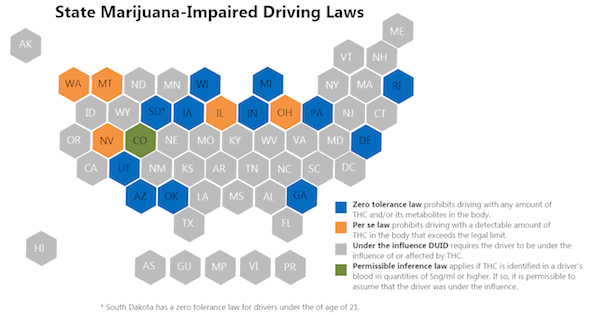
    According to the National Conference of State Legislators, the majority of states with some kind of legalized marijuana have “zero tolerance” laws on the books for driving while high, meaning that any amount of THC and/or its metabolites found in a driver’s system is grounds for legal action. This presents a serious problem when these chemicals can stay in a person’s system for a full month after they last used. 

    Source: NCSL

    Others have “per se” laws similar to the blood alcohol limit. However, cannabis researchers have repeatedly pointed out that finding a limit for cannabis-related compounds in the blood is much more complicated than with alcohol. There is no clear, linear relationship between THC levels in the blood and intoxication.

    Keith Humphreys, a psychiatry professor and drug policy expert at Stanford University in California, believes that the number these states have picked for their legal limit is arbitrary, saying they “made it up.” 

    “We don’t really have good evidence — even if we know someone has been using — [to gauge] what their level of impairment is,” says Humphreys.

    Coming up with a solution won’t be an easy task, but people are trying. In late 2017, an app was released that calculates the user’s reaction time. Cannabis often slows reaction time and impairs one’s ability to focus, making driving while high a dangerous endeavor. After Washington State and Colorado legalized recreational marijuana, highway collisions rose by 3%, according to the Highway Loss Data Institute

    The app, called DRUID, is far from a perfect system for detecting intoxication, but if a blood, urine or breathalyzer test can’t be developed soon, field tests and human judgment may be all police have to rely on.

    “The idea that you could come up with a completely objective test of performance … is ambitious,” says Carnegie Mellon University drug policy researcher Jonathan Caulkins.

    View the original article at thefix.com

  • Depression Changes How We Use Language

    Depression Changes How We Use Language

    Researchers studied an online forum for mental health issues to examine how people with symptoms of depression used language.

    Depression can change both the content and style of the language that people use, according to a study published in the journal of Clinical Psychological Science

    The study compared the use of language in online forums dedicated to addressing depression, anxiety and suicidal ideation. It found that absolutist words — like never, always, completely and nothing — were 50% more frequent in forums dealing with depression than in control forums. In groups for people with suicidal ideation, absolutist language was 80% higher than in control groups, according to JSTOR Daily

    “Absolutist thinking is considered a cognitive distortion by most cognitive therapies for anxiety and depression,” study authors wrote. 

    However, the increased use of absolutist language wasn’t limited to people who are currently clinically depressed. 

    “We found elevated levels of absolutist words in depression recovery forums. This suggests that absolutist thinking may be a vulnerability factor,” study authors wrote

    The use of absolutist words was more closely connected to depression than the use of negative words like “sad,” “frustrated” or “upset.” However, people in the depression forums did use these negative words more frequently than people in the control forums, according to JSTOR

    Another interesting finding, which had been previously identified, is that people with depression were more likely to use first-person singular pronouns and less likely to use third-person pronouns. This could suggest that people with depression are isolated or focused on themselves. Which pronouns someone uses can predict the presence of depression more reliably than negative words, according to one study

    “We know that rumination (dwelling on personal problems) and social isolation are common features of depression,” Mohammed Al-Mosaiwi wrote for JSTOR. “However, we don’t know whether these findings reflect differences in attention or thinking style. Does depression cause people to focus on themselves, or do people who focus on themselves get symptoms of depression?”

    Last year, researchers developed an algorithm that could predict depression by evaluating a person’s speech or texts. 

    Tuka Alhanai, first author of the paper outlining the technology, told MIT News that in the future it could be an important diagnostic tool.

    “We call it ‘context-free’ because you’re not putting any constraints into the types of questions you’re looking for and the type of responses to those questions,” Alhanai said. “If you want to deploy [depression-detection] models in a scalable way … you want to minimize the amount of constraints you have on the data you’re using. You want to deploy it in any regular conversation and have the model pick up, from the natural interaction, the state of the individual.”

    View the original article at thefix.com

  • Idris Elba's Daughter Details Helping Mom With Mental Health

    Idris Elba's Daughter Details Helping Mom With Mental Health

    Isan Elba’s mother Hanne is living with bipolar disorder and depression. 

    British actor Idris Elba has had a remarkable acting career, from playing Heimdall in Thor and Roland in The Dark Tower, to being hailed People’s Sexiest Man Alive.

    Elba’s daughter, 17-year-old Isan, is also successful in her own right as an ambassador to the Golden Globes, and she’s using her position to raise awareness about mental health.

    As People explains, Isan’s ambassador role is a personal one because her mother, Hanne “Kim” Norgaard, suffers from mental illness, specifically bipolar disorder, depression and anxiety.

    At a luncheon in Beverly Hills, Isan explained, “It was only about two years ago that my mom opened up to me. I’m not going to lie, it’s a struggle every day. It’s a learning lesson for me, but it’s hard. Mental health is something that’s hard to deal with. We just sat down and talked about it, and I think that was better for her, talking about it and talking about it with someone who means the most in her life and just getting that out.”

    Once Isan learned what her mother was going through, “It was like, ‘Whoa.’ . . . It was definitely a learning curve. I’m so much closer to my mom now because I know what she’s going through.”

    At the luncheon, the Hollywood Foreign Press Association made the announcement that $50,000 would be donated to the Boris Lawrence Henson Foundation in Isan’s name. As the Henson Foundation website states, their goal “is to eradicate the stigma around mental health issues in the African-American community.”

    “Mental health, specifically among African Americans and my peers in particular, is something I really want to be more vocal about,” Isan said. “There’s this perceived stigma and I’ve seen friends struggle. We need to empower young people to not be afraid to ask for help.”

    Isan told Variety, “Being able to have this platform, and talk about something that I care about that hits home, was really like, ‘Yes, I have to do this.’ It’s something I care about and like I said, using your influence to talk about something you care about or an issue that needs to be fixed, I thought it was the perfect opportunity.”

    Isan also explained that after the luncheon, “[She] will still continue to advocate for mental health. And in the African-American community and among teenagers, because I’m both, and it’s such taboo in both communities.”

    View the original article at thefix.com

  • Heroin-Related "Wound Botulism" Found in San Diego

    Heroin-Related "Wound Botulism" Found in San Diego

    Nine people have been hospitalized with the heroin-related illness in California.

    An outbreak of a rare and life-threatening illness linked to black tar heroin use was discovered in San Diego, prompting health officials in the Southern California city to launch an investigation while warning doctors and IV users alike to be aware of the condition.

    The Centers for Disease Control (CDC) reported that nine cases of wound botulism, which is caused by a toxic bacterium entering the body through a wound, were discovered between 2017 and 2018, which resulted in one fatality and intensive care treatment for all nine individuals.

    Though the number of cases may seem relatively small, only 20 cases of wound botulism are reported per year for the whole of the United States, so the situation was cause for alarm for both state and national health care officials.

    According to the CDC report, two patients with a history of using black tar heroin — so called because of its dark, sticky appearance, caused by crude and often contaminated processing — were believed to have contracted wound botulism though IV drug use.

    The County of San Diego Public Health Services (COSD) issued an alert through the California Health Alert Network to notify Southern California doctors of the situation. A subsequent investigation by the COSD and the California Department of Health eventually found nine patients – eight confirmed and one probable – by April of 2018.

    All nine were IV drug users, and seven reported using black tar heroin. Of the latter number, six reportedly injected the drug through “skin popping,” or injecting the drug under the skin.

    Symptoms of wound botulism typically manifest several days after injecting the contaminated drugs and may include double or blurred vision, slurred speech, dry mouth and muscle weakness.

    If left unchecked, it can result in labored breathing and even paralysis. However, many of these symptoms coincide with signs of opioid use or overdose, and in four of the cases, the individuals were initially diagnosed with drug intoxication, and two were treated with the overdose reversal drug naloxone. 

    Eventually, all of the patients were diagnosed with wound botulism and treated with heptavalent botulism antitoxin (BAT), and eight were transferred to long-term care facilities; the ninth patient declined further treatment. One of the eight died after nine days in long-term care.

    The COSD issued health alerts in 2017 and 2018 notifying health care providers to inform IV drug users about the risks of contracting wound botulism and asking them to carefully observe patients reporting IV drug use history for symptoms. One day after the 2018 alert, clinicians reported additional cases of suspected wound botulism for two hospitalized patients.

    The CDC’s report concluded with a request for heightened awareness of the condition for both doctors and IV drug users, in light of the national opioid crisis.

    Dr. Sayone Thihalolipavan, the deputy public health officer for San Diego County, reiterated the need for careful observation of IV drug patients.

    “Even if they’re seeking treatment, providers might not be recognizing it for what it is,” he said. “Patients can think they’re feeling out of whack due to the drug itself and not realize that the drug is actually contaminated.”

    View the original article at thefix.com