Tag: News

  • Paul Manafort Is Depressed in Jail, Lawyers Say

    Paul Manafort Is Depressed in Jail, Lawyers Say

    Manafort has been in jail for more than six months, after a judge revoked his bail in June.

    Paul Manafort, the former Trump campaign chairman, is not faring well in jail, where he is being held while he awaits his sentencing in February on charges of financial fraud and conspiracy, according to his lawyers. 

    “He . . . suffers from depression and anxiety and, due to the facility’s visitation regulations, has had very little contact with his family,” Manafort’s lawyers wrote in court filings that were reported by The New York Post. Because he is so high profile, Manafort is being held in solitary confinement, which has “taken a toll on his physical and mental health,” his lawyers said. 

    In addition to depression and anxiety, Manafort is also battling gout, an arthritic inflammation of the joints that is usually associated with a heavy diet that includes red meats, seafood and alcohol. 

    “For several months Mr. Manafort has suffered from severe gout, at times confining him to a wheelchair,” the lawyers wrote. In October, Manafort appeared at a court date in a wheelchair, with his foot bandaged.

    His lawyer, Kevin Downing, asked the judge to sentence Manafort quickly, so he could be moved from a detention center to a federal prison. Downing told the judge that Manafort has “significant” health issues that were made worse by the “terms of his confinement.”

    Manafort has been in jail for more than six months, after a judge revoked his bail in June. He could face years in federal prison from his convictions. 

    In July, a judge ordered that Manafort be moved from one facility that was reportedly giving him special treatment to a city jail in Alexandria, Virginia. 

    “On the monitored prison phone calls, Manafort has mentioned that he is being treated like a ‘VIP,’” a court filing by special counsel Robert Mueller’s team alleged. “Among the unique privileges Manafort enjoys at the jail are a private, self-contained living unit, which is larger than other inmates’ units, his own bathroom and shower facility, his own personal telephone and his own workspace to prepare for trial. Manafort is also not required to wear a prison uniform.”

    Manafort was even able to send emails from the facility. 

    “In order to exchange emails, he reads and composes emails on a second laptop that is shuttled in and out of the facility by his team. When the team takes the laptop from the jail, it re-connects to the internet and Manafort’s emails are transmitted,” court documents showed. 

    Manafort was in the news again this week after his lawyers accidentally released paperwork that appears to show he met with a Russian spy when he was working on the Trump campaign. 

    View the original article at thefix.com

  • Teens Who Share Drugs May Face Conviction, Prison Sentencing

    Teens Who Share Drugs May Face Conviction, Prison Sentencing

    Though laws vary in regard to culpability, 20 states regard drug delivery resulting in death as a crime. 

    A new feature on Psychology Today highlights an alarming possibility for parents and teenagers: Sharing drugs with friends can be considered legal grounds for a charge of dealing that can carry a prison sentence.

    The feature references a New York Times article that details hundreds of cases of fatal overdoses in 36 states; many of these involved deaths that led to charges of homicide against friends and relatives, even though the deaths were considered unintentional.  

    Psychology Today advised a conversation with parents of teenagers to inform them about the possible legal consequences of sharing drugs.

    Though laws vary in regard to culpability, the New York Times feature links to a list from the Drug Policy Alliance of 20 states that regard drug delivery resulting in death as a crime. Other states impose charges of manslaughter, homicide and murder on overdose-related cases.

    Regardless of the final charge, cases involving accidental overdose deaths that resulted in prosecution or arrest doubled between 2015 and 2017; in the state of Minnesota, the number quadrupled over a decade.

    The Psychology Today and New York Times articles both emphasized the fact that distribution of drugs that results in a death can result in criminal charges and imprisonment.

    The Times cited a case of a 21-year-old in Minnesota who allegedly brought a synthetic drug to a party where 11 people overdosed, including a friend who died from cardiac arrest. The individual who brought the drug, and who claimed he was not aware of its illegal status, pled guilty to third-degree murder and was sentenced to nearly 10 years.

    The Minnesota case also highlights the broad definition of distribution or dealing that is employed by several states. Sharing or giving away drugs with no exchange of money can be considered distribution; even borrowing money from another person to purchase drugs which results in an overdose death can bring a prosecution charge. Though defendants may argue that they did not force the situation in which a fatal overdose occurred, prosecutors take the position that the drugs caused a death, regardless of intent.

    “Some family has lost an innocent life,” said Peter Kilmartin, attorney general of Rhode Island, in the New York Times piece. “That victim no longer has a voice.”

    The Psychology Today feature that connects the two stories advocates for direct communication about sharing drugs with teenagers. “Open a dialogue with your child about drug sharing and the new legal consequences,” wrote the story’s author, Sean Grover, LCSW. Involving family members or representatives from a child’s school is also suggested.

    View the original article at thefix.com

  • NYPD Gears Up To Address Pot Legalization Downside

    NYPD Gears Up To Address Pot Legalization Downside

    The city’s police commissioner is sending NYPD officials to other pot-legal states to gauge what the city is in for when marijuana becomes legal.  

    The New York Police Department is gearing up for the effects of legal marijuana without knowing exactly what those effects will be. The top of the NYPD chain has some specific concerns for the future of pot in New York: underage consumption and dangerous marijuana grow houses.

    As reported in The New York Post, NYPD Commissioner James O’Neill told radio host John Catsimatidis’ AM 970 show, The Cats Roundtable, “We have to make sure that we’re able to address people that are under 21 that are using marijuana to make sure there are sanctions for that and also to keep young people safe.”

    Colorado has made pot smoking legal, and data from possible changes in use is beginning to be compiled and distributed. The CDPHE Behavioral Risk Factor Surveillance System survey reported that underage marijuana use did not increase after pot was made legal. However, Colorado kids felt their peers were using much more marijuana than before the law passed.

    Commissioner O’Neill is taking the reigns in investigating the possible ramifications for legal pot in New York. “I’m concerned about the gray and the black markets for marijuana,” O’Neill said. “We sent people from the NYPD out to Colorado and Washington and [California] to take a look at what’s happening out there.”

    Governor Cuomo has said he still has questions and concerns about legalizing marijuana for recreational use. Cuomo is putting his trust in the process of working with a panel of experts, including law enforcement and health officials who have determined that legalization can be safe for the city. Governor Cuomo’s position on legalized pot has been colored by watching the neighboring states of Massachusetts and New Jersey legalize marijuana or begin the process.

    O’Neill remains concerned. “There’s a proposal out there that people are going to be able to grow their own marijuana in their houses,” he said. “We really really have to get this right.”

    O’Neill noted the 2016 explosion of a marijuana grow house in the Bronx that killed a fire chief when he was hit in the head with debris from the explosion. Commissioner O’Neill cited this house fire and subsequent death as a factor “that makes people unsafe.”

    O’Neill also worried about the need to retire marijuana-trained drug dogs and the concurrent difficulty of detecting THC among stoned drivers. “I’m concerned about driving while under the influence of marijuana,” the New York Post reported the commissioner saying. “Right now there is no instant test.”

    View the original article at thefix.com

  • Iggy Azalea Talks Anxiety

    Iggy Azalea Talks Anxiety

    The Aussie rapper opened up about anxiety on social media.

    Australian rapper Iggy Azalea is one of many celebrities who talks about her anxiety on social media.

    In the last several months, she’s made several confessions about being antsy, and in the new year, she’s opened up about her struggles again, this time with a good combination of humor and optimism.

    In the new year, Azalea revealed on Twitter that she’s moving as well as wrapping up her new album, “[which] is giving me anxiety. But; the good kind? Sorta.”

    Yet as she also tweeted, “All my life I’ve never been scared to fall in heels because I know I have cankles & you can’t break me.”

    Like many celebrities, social media can be a double-edged sword for Azalea. Several months ago she explained on her Instagram story that public scrutiny of her love life “gives me crazy anxiety and makes me feel like I can’t have normal in passing conversations with people because everything ends up being some ‘story’ for the internet.”

    At the same time, Azalea has also used social media as a way to deal with anxiety. Earlier this year she posted on Twitter, “Say what you want about me posting pictures on instagram but honestly, it gives me something else creative i can focus on  . . . when sometimes im in a dark place or i feel stagnant . . . and maybe it’s silly, but it really has been helping me lately to feel more positive and just keep my mind in a creative space constantly thinking of new visual things and color palates. Im really glad ive got something i can do without needing permission.”

    Azalea has been open with the public about her mental health struggles in the past, telling Billboard that she was inspired by Demi Lovato to get help. She’s also written a song about her mental challenges, “Savior,” which she performed live as a duet with Lovato.

    Yet as she heads into the new year, Azalea feels a lot more optimistic about her future and is “excited” because she signed “my new deal/partnership! 2.7 mil, can sign others, own my masters + 100% independent – I’m feeling like such a bossy grown ass b***h today!”

    Her last tweet can be interpreted in several different ways, but perhaps it’s a message that she wants to concentrate on her mental wellness: “Time to get back to ME.”

    View the original article at thefix.com

  • Are Young People Who Self-Harm More Likely To Commit Violent Crimes?

    Are Young People Who Self-Harm More Likely To Commit Violent Crimes?

    A new study examined whether adolescents who self-harm have a higher risk of hurting others. 

    New research has determined that a predilection for self-harm in adolescence and early adulthood may also foretell a risk for harming others. Data culled from a long-term study on twins from preschool age until their early 20s suggested that individuals who reported harming themselves were three times more likely to commit violent crimes than those that did not.

    Negative experiences during childhood, including mistreatment and low self-control, appeared to increase the odds of a self-harmer becoming a “dual harmer,” as the study labeled such individuals, as well as developing a dependency on alcohol and/or drugs.

    “We know that some individuals who self-harm also inflict harm on others,” said study author Leah Richmond-Rakerd of Duke University. “What has not been clear is whether there are early-life characteristics or experiences that increase the risk of violent offending among individuals who self-harm.” 

    The results of the study, published in the American Journal of Psychiatry, examined data compiled on more than 2,200 twins born in the United Kingdom between 1994 and 1995 who took part in the Environmental (E-Risk) Longitudinal Twin Study, which examined childhood behavior disorders in its subjects between the ages of five and 18.

    Beginning at age 18, the E-Risk study asked participants to report any experience with self-harm since the age of 12 as well as violent behaviors and any criminal records accrued between the ages of 10 and 22. Additional childhood experiences, including family psychiatry, maltreatment and low self-control, were also reviewed for the study.

    Of the 2,049 participants in the study, 13.4% met the criteria for self-harm, while 19.4% matched criteria for violent crime. Among the individuals who presented as dual harmers, there were higher incidents of low self-control and maltreatment; as US News and World Report noted, genetics and family history did not appear to impact the likelihood of self-harm or dual harm.

    “Our study suggests that dual-harming adolescents have experienced self-control difficulties and been victims of violence from a young age,” said Richmond-Rakerd. Other clinical characteristics exhibited by dual harmers included “higher lethality behaviors,” such as hanging or drowning, and acts of self-aggression, such as hitting themselves with objects or banging their heads against a wall and aggression towards others. Self-harmers, by comparison, appeared to engage in lower-lethality methods like cutting.

    Dual harmers also appeared to have a greater chance of exhibiting psychotic symptoms and meeting criteria for drug or alcohol dependency. As Richmond-Rakerd noted, early determination of the chance of dual harm behavior among self-harming young people through a “treatment-oriented, rather than punishment-oriented approach” could “guide interventions that prevent and reduce interpersonal violence.”

    View the original article at thefix.com

  • New York Times Apologizes For "Demonizing" Moms With Crack Addiction

    New York Times Apologizes For "Demonizing" Moms With Crack Addiction

    In their apology, the Times’ editorial board acknowledged the negative impact of their stigmatizing coverage of black mothers with crack addiction during the crack epidemic. 

    When Suzanne Sellers gave birth to her son in 1995, she tested positive for drugs, having become addicted to the crack cocaine that was an epidemic in poor black communities. Despite getting clean, Sellers was coerced into signing away her parental rights, she said. 

    “I had been sober for over two years at the time I was coerced to sign away my parental rights, despite numerous accomplishments and evidence of a rehabilitated life,” Sellers wrote in an opinion column for The New York Times. “Being black was used against me. Yet there were other factors that compounded the racism and unjust treatment, including my being a woman who was poor, with an unstable living situation, unmarried and, of course, a drug user.”

    Sellers was writing about her experience after being featured in an opinion piece in which the Times’ editorial board detailed the ways that the coverage of mothers addicted to cocaine —particularly crack cocaine — contributed to the erosion of a woman’s right to choose and stigmatized a generation of mostly black babies born to mothers who were using drugs.  

    “Americans were told on the nightly news that crack exposure in the womb destroyed the unique brain functions that distinguish human beings from animals — an observation that no one had ever connected to the chemically identical powdered form of the drug that affluent whites were shoveling up their noses,” the editorial board wrote. 

    “News organizations shoulder much of the blame for the moral panic that cast mothers with crack addictions as irretrievably depraved and the worst enemies of their children,” the board wrote. “The New York Times, The Washington Post, Time, Newsweek and others further demonized black women ‘addicts’ by wrongly reporting that they were giving birth to a generation of neurologically damaged children who were less than fully human and who would bankrupt the schools and social service agencies once they came of age.”

    Sellers said that the paper’s recognition of the dangers of this type of coverage was appreciated.  

    “I want to thank The New York Times for its apology for how it demonized mothers like me,” Sellers wrote. “The apology is welcomed, and it gives me hope.”

    Sellers called on society to do better today, especially in regards to dealing with mothers and children affected by opioid addiction. 

    “In 2019, no longer should weak science, poorly informed crusaders and racist attitudes continue to shape public policy,” she wrote. 

    “American citizens, including drug users, have rights. My rights were violated numerous times during my child welfare case, and my family was wrongfully torn apart. When families are wrongfully torn apart, the results are devastating. When the fundamental relationship of every human being — the relationship of a child with his or her mother — is severed, the effects can be irreversible.”

    Today, Sellers has resumed contact with both her children, who are now adults. She leads her own consulting firm and a nonprofit, Families Organizing for Child Welfare Justice, and is a homeowner with three master’s degrees.

    “I list my accomplishments not to ‘toot my own horn’ but to show that people can and do recover from drug addiction,” she wrote. 

    View the original article at thefix.com

  • Josh Brolin Shares Drunk Photo To Celebrate Sobriety

    Josh Brolin Shares Drunk Photo To Celebrate Sobriety

    The Avengers actor described a harrowing, alcohol-fueled night on Instagram to celebrate a major sober milestone.

    Actor Josh Brolin, who has starred in movies ranging from The Goonies to No Country for Old Men to Deadpool 2, took to Instagram this week to celebrate five years of sobriety in an unusual way: sharing a photo from a drunk night out. 

    Brolin posted the photo, along with a lengthy caption. 

    “Drunk: when you think you’re having a rip roaring time and the next morning you wake up and your brain has broken into a frenzied beehive and your body is shattered shards of sharp glass desperately searching for what fits where and your spirit is being eaten by worms with great white bloodied teeth and your heart has shriveled into a black prune churning your intestines to the point where dysentery feels attractive,” he wrote.

    Brolin continued, “And you can’t remember anything you did so you roll out of bed over last night’s urine and you dial your best friend’s phone number because you recall him lifting you over his head, your whole self, before you hit and broke through the drywall and, you think, a large aquarium and the phone on the other end rings and he picks it up, that clambering for a phone, the clumsiness of a hardline, and you say: ‘What did I do last night?!’ and he answers, after a great pause: ‘…Dude…’. #5years.” 

    Brolin quit drinking and smoking five years ago. He had just had enough, he told The New York Times last summer

    “There’s something that happens to me when I drink that all moral code disappears,” he said. “So it’s like if I were to take that drink . . . after about halfway through, I would start thinking about jumping out that window . . . not to kill myself, but just because there must be somebody down there to catch me, and I wonder if I can pull it off or if I could land on that van. It just seemed like fun.”

    Despite the fact that he is more in control now that he is sober, he still tries to channel some of the spontaneity and levity that drinking brought to him, he said. 

    “I want to live more drunk. I want to live drunkenly. I just don’t want to take the drink.”

    Brolin told the Times that in recovery he’s also trying to overcome the codependent patterns in his love life. His past relationships, he said, had an unhealthy focus, which he described: “I’m going to find out all your needs and all your insecurities, and all that, and then I’m going to play on that. Like, you need a daddy? I’ll be your daddy. I’ll be your hero.”

    His dynamic with his current wife, Kathryn, is much healthier, he said. 

    “She doesn’t need me. She never needed me.”

    View the original article at thefix.com

  • Kamala Harris Pushes For Marijuana Legalization In New Book

    Kamala Harris Pushes For Marijuana Legalization In New Book

    The California senator discusses her stance on prohibition, de-scheduling and the need for the war on drugs to be dismantled in her new book.

    More and more democratic politicians are getting on board with marijuana legalization, according to Forbes

    Sen. Kamala Harris (D-CA) is one of them, as she discusses the topic in her new book, The Truths We Hold: An American Journey.

    “Something else it’s past time we get done is dismantling the failed war on drugs—starting with legalizing marijuana,” Harris writes in the book. 

    “We need to legalize marijuana and regulate it,” she adds. “And we need to expunge nonviolent marijuana-related offenses from the records of millions of people who have been arrested and incarcerated so they can get on with their lives.”

    Though she is for marijuana legalization, Harris says that legalization should be done with caution. Because of the Schedule I status of the drug, she states, there has not been enough research on the effects. She also states that some solution needs to be put in place when it comes to driving under the influence of marijuana.

    Harris also touches on other drugs as a whole, writing, “”We also need to stop treating drug addiction like a public safety crisis instead of what it is: a public health crisis.” 

    “When someone is suffering from addiction, their situation is made worse, not better, by involvement in the criminal justice system,” she adds.

    Despite her support now, Harris has not always been supportive of marijuana legalization. According to Forbes, Harris laughed during a 2014 interview when a journalist raised a question about legalization.

    Two years later, in 2016, she also refused to support California’s cannabis legalization ballot measure. 

    However, with a possible presidential run on the horizon, Harris has gotten behind legalization. In May 2018, according to Forbes, Harris agreed to co-sponsor a bill that would remove marijuana from the Controlled Substances Act as well as withhold federal funding from states with “discriminatory cannabis enforcement.”

    “Right now in this country people are being arrested, being prosecuted, and end up spending time in jail or prison all because of their use of a drug that otherwise should be considered legal,” she said at that point.

    According to The Washington Examiner, at that time she also added that race plays a role when it comes to consequences of marijuana use.

    “It’s the smart thing to do. It’s the right thing to do. And I know this as a former prosecutor. I know it as a senator,” Harris said. “The fact is marijuana laws are not applied and enforced the same way for all people. African-Americans use marijuana at roughly the same rate as whites, but are approximately four times more likely to be arrested for possession. That’s just not fair.”

    View the original article at thefix.com

  • Washington State To Pardon Thousands Of Pot Possession Charges

    Washington State To Pardon Thousands Of Pot Possession Charges

    The governor’s office says about 3,500 citizens qualify for the pardon according to the plan, called the Marijuana Justice Initiative.

    Governor Jay Inslee of the state of Washington announced he is offering to pardon thousands of people charged with only a misdemeanor marijuana charge, which will help citizens who would otherwise be dogged with these minor crimes as they seek employment or look for housing.

    The caveat is that the charge must be a state charge between January 1, 1998 and December 5, 2012, not a local ordinance. The December date marks the day marijuana possession was legalized in the state. The governor’s office says about 3,500 citizens qualify for the pardon according to the plan, called the Marijuana Justice Initiative.

    “We shouldn’t be punishing people for something that is no longer illegal behavior in the state of Washington,” said Inslee, believing that there is great support for the initiative.

    Inslee has always been enthusiastic about legal marijuana in his state. Last year on television, the governor bragged to host Bill Maher that “we’ve got the best weed in the United States of America.”

    Those who need the pardon can apply on the website of the governor’s office. Those who receive one will have the charge scrubbed from public criminal records; however, a copy will be retained for law enforcement knowledge only. To have the court records scrubbed as well, a petition can be made to the court that ruled over the charges.

    Some regard the moves to be good publicity for a possible presidential campaign.

    “While it’s a wonderful gesture, it won’t pardon everybody,” said Seattle Hempfest General Manager Sharon Whitson. “They really do need to look at it all the way up the scale.”

    Inslee agrees the initiative doesn’t do enough but claims it’s a good first step. He said citizens should urge other local authorities to follow his lead. His advisers claim that Inslee is looking into more comprehensive legislation for pardoning remaining marijuana offenders as well.

    A bill that was proposed in 2017 that would require all courts to hear any requests to clear these crimes did not pass. The city of Seattle, however, has begun to follow suit, vacating around 542 Seattle citizens of these charges.

    View the original article at thefix.com

  • Parents Give Up Custody Of Adopted Kids To Get Them Mental Health Help

    Parents Give Up Custody Of Adopted Kids To Get Them Mental Health Help

    “To this day, it is the most gut-wrenching thing I’ve ever had to do in my life,” said one parent who gave up custody of his child.

    Every year, adoptive parents find themselves with no choice other than to give up custody of their mentally ill children to the state. This issue is outlined in a recent profile done by NPR about a family that was torn apart because the state of Illinois failed to provide the care they were supposed to give to an adopted child. 

    Daniel Hoy endured severe neglect as an infant before he was adopted by Toni and Jim Hoy when he was still a baby. In spite of a happy childhood, Daniel began to exhibit signs of severe mental illness after he entered the public school system at age 10. He began to experience bouts of violent behavior, attacking classmates and his siblings due to his severe anxiety and PTSD.

    When intensive inpatient care was recommended, the Hoys’ health insurance company denied coverage for the $100,000 per year treatment plan. Although states are supposed to cover mental health treatment for any children adopted through the government, Illinois also denied the family coverage for the desperately needed program.

    Eventually, after Daniel threw his brother down the stairs, state authorities gave Toni and Jim an ultimatum. They could either take Daniel home and be charged with child endangerment the next time he harmed one of his siblings or leave him in the hospital, lose custody and be charged with neglect.

    If Daniel was in the custody of the state of Illinois, the government would be forced to give him the recommended $100,000 treatment. Desperate and out of options, Toni and Jim abandoned their little boy. 

    “To this day, it is the most gut-wrenching thing I’ve ever had to do in my life,” Jim told NPR. “. . . I was crying terribly. . . . But it was the only way we figured we could keep the family safe.”

    The Hoys had to sue the state of Illinois in order to force them to cover the treatment, but by the time he was back in the family, he was 15 years old. 

    This has been a problem for thousands of other families across the US who find that the child they adopted has mental health issues. A study by the Government Accountability Office published in 2003 found that there are around 12,000 cases like this each year. More recent figures are not available as only one third of US states keep track of how many kids are given up in order to ensure they get proper mental health care.

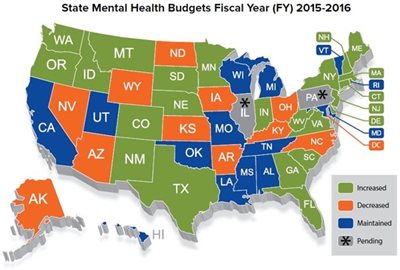
    According to mental health experts, the care these kids do get is often too little, too late. Unfortunately, state mental health services are often woefully underfunded by the federal government, and even less goes into preventative care and early intervention.

    Source: NAMI

    Early intervention is important. Children with severe mental illnesses who receive prompt intensive care tend to fare much better than those who have to wait due to money issues or a simple lack of programs in the area.

    “The research has shown that the earlier we can intervene, particularly with evidence-based interventions, the better outcomes we see later on,” said New York psychologist Danielle Rannazzisi, PhD. “The early years of childhood lay a foundation for future academic, social, emotional, and behavioral success.”

    Many states were forced to make severe cuts to mental health services during the recession of 2007 to 2009. That funding never recovered, and funding for mental health has been cut further under the Trump administration. Without that funding, states can’t afford to provide the care needed by kids like Daniel.

    View the original article at thefix.com