Tag: overprescribing

  • Benzodiazepines: Another Prescription Drug Problem

    Benzodiazepines: Another Prescription Drug Problem

    Even taking benzodiazepines in adherence to a prescribing physician’s instructions can lead to dependence.

    May 30, 2019
    This tip sheet, originally published in 2018, has been updated to include more recent statistics and additional information.

    Benzodiazepines, a class of anti-anxiety drugs, are commonly-prescribed medications with the potential for abuse, addiction and overdose. Sound familiar? The parallels to the opioid epidemic are apparent; some physicians have taken to calling it “our other prescription drug problem” as they warn of potential dangers.

    “People don’t appreciate that benzodiazepines are addictive and that people abuse them,” said Dr. Anna Lembke, a psychiatry professor at Stanford Medical School. In a phone call with Journalist’s Resource, she said that, just as with alcohol, benzodiazepines can be taken to achieve a state of intoxication.

    Lembke is the program director for the Stanford University Addiction Medicine Fellowship and chief of the Stanford Addiction Medicine Dual Diagnosis Clinic. She has published research in JAMA Psychiatry, Molecular Psychiatry, the Journal of Substance Abuse Treatment, Addiction and other journals. In 2016 she published Drug Dealer, MD: How Doctors Were Duped, Patients Got Hooked, and Why It’s So Hard to Stop, a book on the prescription drug epidemic. Journalist’s Resource spoke with Lembke to learn more about the drugs and factors that have spurred current prescribing trends.

    For context, a few recent studies put numbers to these trends: A new study that focuses on Sweden finds that benzodiazepines and benzodiazepine-related drug prescriptions increased 22 percent from 2006 to 2013 among individuals aged 24 and younger.

    A study published in 2016 in the American Journal of Public Health finds that from 1996 to 2013, the number of adults in the United States filling a prescription for benzodiazepines increased 67 percent, from 8.1 million to 13.5 million. The death rate for overdoses involving benzodiazepines also increased in this time period, from 0.58 per 100,000 adults to 3.07.

    What Are Benzodiazepines?

    Benzodiazepines are a class of drugs with sedative and anti-anxiety effects. A few of the most commonly prescribed benzodiazepines include diazepam (brand name: Valium), alprazolam (brand name: Xanax; street names: bars, xannies), clonazepam (brand name: Klonopin) and lorazepam (brand name: Ativan). These drugs differ with respect to how long they take to start working and how long they last, but all have similar effects, since they work by the same mechanism.

    How Do They Work?

    Benzodiazepines bind to gamma-aminobutyric acid (GABA) receptors in the brain. GABA is an inhibitory neurotransmitter; in other words, it inhibits brain activity. Turning the power down in the brain feels like sleepiness and calm.

    What Are They Prescribed For?

    They can be prescribed for a number of concerns, including anxiety, insomnia and seizures.

    How Can They Be Dangerous?

    Benzodiazepines are accompanied by a number of side effects, including tolerance (reduced sensitivity) for the drug, cognitive impairment, anterograde amnesia (the inability to remember events that occurred after taking the drug), increased risk of Alzheimer’s disease, increased risk of falls (particularly among the elderly, who, according to a study in JAMA Psychiatry, comprise the age group in the U.S. most likely to use the drugs, and use them over the long term), and, most notably, dependence, abuse and overdose. Benzodiazepines are similar to opioids, cannabinoids, and the club drug gamma-hydroxybutyrate (GHB) insofar as the same neural mechanism underlies their addictiveness, according to research published in Nature.

    Even taking benzodiazepines in adherence to a prescribing physician’s instructions can lead to dependence. Withdrawal symptoms are likely among patients who have taken benzodiazepines continuously for longer than a few weeks, according to a study published in Australian Prescriber.

    For people who are looking to discontinue their use of benzodiazepines, Lembke noted that withdrawal could be potentially life threatening. “You can have full-blown seizures and die just from the withdrawal,” she said.

    “The way that they’re prescribed and continued is contrary to the evidence in the medical literature,” Lembke said. She noted that the evidence indicates benzodiazepines are effective and useful only in the short term, and typically at low doses. “There’s no evidence that benzodiazepines taken long term work for anxiety,” she said. “Nonetheless, it is common practice to prescribe and continue those prescriptions for months to years to decades. Somehow there’s a disconnect between the evidence and what the practice is.”

    Given These Risks, Why Are Prescriptions on the Rise?

    “No one knows for sure,” Lembke said. She did, however, offer a few possible explanations.

    She mentioned changes over the past three decades in the way healthcare is delivered.

    As more physicians have shifted from private practice into integrated health care centers, they might feel pressure to adhere to standard protocols or perform procedures and prescribe pills like benzodiazepines, because “that’s what pays.”

    She added that the way medicine is currently practiced separates patients into parts: “Patients have a different doctor for every body part … The right hand doesn’t know what the left hand is prescribing.”

    Frequent changes in insurance coverage, or churn, means that individuals bounce from one coverage source (and care provider) to another. This eliminates the possibility of a sustained, caring and trusting relationship that might allow for more efficacious, long-term health interventions, Lembke added.

    Other changes to the health care system have also occurred: “In many ways, doctors are like waiters and patients are customers,” Lembke explained, adding that some doctors feel the need to respond to patients’ requests and provide short-term relief or “customer satisfaction.”

    A cultural shift might be at work here, too, “Patients expect it,” Lembke said. “We now think pain in any form is dangerous … We’ve also got a whole generation of individuals raised on Prozac, Adderall, Xanax thinking there isn’t anything wrong with using chemicals to change the way you feel.”

    Benzodiazepines and Opioids

    As Lembke pointed out, rising pharmaceutical use isn’t limited to benzodiazepines. And as the United States grapples with widespread opioid use, research points to a dangerous link between these drugs and benzodiazepines.

    A study of over 300,000 patients receiving opioid prescriptions between 2001 and 2013 finds that by 2013, 17 percent also received benzodiazepine prescriptions — up from 9 percent in 2001.

    Moreover, a study that looked at U.S. veterans who received opioid prescriptions finds that those who received benzodiazepines as well experienced increased risk of drug overdose death; the risk increased along with the dose. Another study finds that the overdose death rate among patients receiving opioids and benzodiazepines was 10 times higher than among those receiving opioids alone.

    According to statistics from the National Institute of Drug Abuse (NIDA), from 1999 to 2017, there was a 10-fold increase in the number of overdose deaths involving benzodiazepines in the United States — a rise from 1,135 in 1999 to 11,537 in 2017. Most of the increase has been driven by the use of benzodiazepines in combination with opioids (since 2014, the number of overdose deaths involving benzodiazepines but not any opioids has held steady). As opioids contribute increasingly to benzodiazepine overdose deaths, benzodiazepines too are increasingly present in opioid overdose deaths — the powerful combination of drugs is present in over 30 percent of opioid overdoses, NIDA reports.
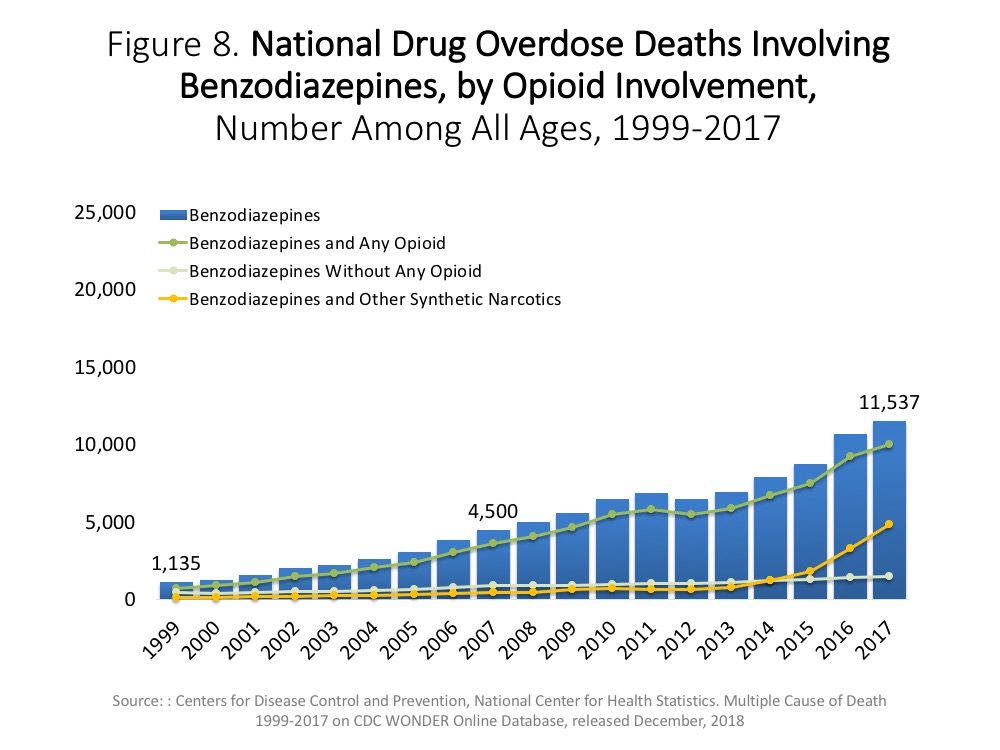
    cdc benzodiazepine overdose stats

    Benzodiazepine abuse on its own can lead to overdose and death, but overdose deaths typically occur in combination with other substances — generally other central nervous system depressants, which, like benzodiazepines, can lead to the life-threatening effect of slowed or stopped breathing.

    In August 2016, the Food and Drug Administration issued a requirement that opioids and benzodiazepines carry a black-box warning about the risks associated with using these substances together.

    Now that you have the background, here are some story ideas, courtesy of Lembke:

    Look into the latest wave of benzodiazepines: super-potent, designer, synthetic varieties made in illicit labs.

    Investigate the growth of benzodiazepine-related patient advocacy organizations as a phenomenon.

    Probe Big Pharma’s role in prescription trends and look at socioeconomic variations in benzodiazepine prescriptions (e.g., Medicaid prescribing rates).

    Journalist’s Resource also has explainers on other drugs, including fentanyl and meth.

    This photo, property of the United States Department of Justice, was obtained from Wikimedia Commons and used under a Creative Commons license.

    This article first appeared on Journalist’s Resource and is republished here under a Creative Commons license.

  • Benzos Need To Be Part Of Overdose Discussions

    Benzos Need To Be Part Of Overdose Discussions

    Even under a doctor’s supervision, benzodiazepines can be dangerous and highly addictive.

    With much of the national discourse and resources directed at the opioid epidemic, doctors are warning that people need to be aware of the dangers of benzodiazepines. 

    Dr. Chinazo O. Cunningham, a professor at the Albert Einstein College of Medicine, told CNN that benzos—which include Xanax, Ativan and Kolonpin—are contributing to the overdose crisis in the country. 

    The Opioid and … Overdose Epidemic

    “It’s really not ‘the opioid overdose epidemic’ but the ‘opioid and …’ overdose epidemic,” Cunningham said. “It’s not just one substance, here. The focus has been on opioids but we need to expand the way that we’re thinking about it.”

    Dr. Sumit Agarwal, of Boston’s Brigham and Women’s Hospital, has seen benzo prescriptions become much more widespread for a variety of patients. 

    “I think most of our attention has been on the opioid epidemic and for good reason, but I think benzodiazepines have flown under the radar,” Agarwal said.

    Cunningham has conducted research that shows that the amount of benzodiazepine medicine in a prescription doubled between 1996 and 2013. During the same period, overall prescribing of benzos increased 67%.

    ”I think many of us feel that if we don’t turn our attention to benzodiazepines, if we ignore this pattern that we’re beginning to see, we may very well find ourselves in the same position that we have with opioids,” said Cunningham. 

    Benzo Access

    Dr. Anna Lembke, medical director of addiction medicine at Stanford University, said that benzos are becoming part of the culture in a way that can be dangerous. That’s in part because of easy access to the powerful drugs. 

    “There’s increased availability and increased access, not just through prescriptions but through illicit sources,” she said. “You’ve got this popularization of Xanax in culture and in music, and the availability (of benzodiazepines) on the dark web—all of that is part of the growing problem.”

    Lembke pointed out that even when they are used under a doctor’s supervision, benzos can be very dangerous and highly addictive. 

    “The problem is in the long term, they lead to more problems than they solve,” she said. “People develop a tolerance, and they need more and more to get the same effect. They develop a dependence, finding when they don’t take them their anxiety is worse. And they think, ‘Oh, I need it because I have an anxiety disorder,’ but in many instances they’re actually medicating withdrawal from the last dose, so you can get into this vicious cycle. If they worked long term there would be nothing wrong with it, but they don’t and then they cause all kinds of harm.”

    View the original article at thefix.com

  • Doctor Receives 20-Year Sentence For Reckless Opioid Prescribing

    Doctor Receives 20-Year Sentence For Reckless Opioid Prescribing

    The Manhattan doctor was convicted on 10 counts of unlawful distribution of oxycodone without legitimate medical purpose.

    A family doctor based in Manhattan’s Upper East Side was sentenced to 20 years in prison on Tuesday (April 30) for recklessly prescribing opioid painkillers that played a role in one patient’s fatal overdose.

    Dr. Martin Tesher, 83, was convicted in July of 10 counts of unlawful distribution of oxycodone without legitimate medical purpose to five patients, including 27-year-old Nicholas Benedetto.

    In March of 2016, two days after visiting Tesher and receiving prescriptions for oxycodone and fentanyl patches, Benedetto fatally overdosed on the drugs.

    According to SILive.com, one month before his death, Benedetto’s mother called Tesher asking him to stop giving her son prescriptions because he needed treatment. She told authorities that her son was smoking the fentanyl patches.

    Tesher prescribed oxycodone and fentanyl patches to Benedetto and four other patients “after he learned, or had reason to believe, that these patients were addicted to drugs,” according to the Justice Department.

    An expert witness testified that none of them “had verified medical conditions that would require the prescription of Schedule II opioids.”

    Benedetto, while under the doctor’s care, tested positive for cocaine, heroin, morphine and methadone in addition to the oxycodone and fentanyl prescribed by Tesher.

    Twenty years was the minimum sentence Tesher faced for his crime. The maximum was life in prison.

    “In the midst of an unprecedented opioid epidemic, Dr. Tesher used his medical skills to harm, not heal and in doing so he cost a young man his life,” said U.S. Eastern District Attorney Richard Donoghue. “Such criminal conduct is an utter betrayal of the trust our society places in doctors and it warrants the severe sentence imposed today.”

    The DOJ has recently cracked down on health care providers and drug companies accused of playing a role in fueling the opioid crisis.

    Also last month, 60 people were indicted for the illegal prescribing of painkillers including doctors, pharmacists, nurse practitioners and other licensed medical professionals.

    According to the Washington Post, the indictment included “doctors who prosecutors said traded sex for prescriptions and a dentist who unnecessarily pulled teeth from patients to justify giving them opioids.”

    View the original article at thefix.com

  • Opioid Prescriptions Drop Drastically In Ohio

    Opioid Prescriptions Drop Drastically In Ohio

    Ohio’s prescription drug monitoring program played a major role in the state’s success. 

    In Ohio, a state that has been ravaged by opioid addiction, the number of opioid prescriptions has decreased by 41% since 2012, according to new data. 

    “We all have a role to play in battling this public health crisis, and this continued downward trend in opioid prescriptions demonstrates that Ohio’s prescribers are making significant progress in their efforts to prevent addiction,” Governor Mike DeWine said in a statement reported by 13 ABC News.

    “When this crisis first emerged, prescribers were led to believe that opioids were not addictive, but we know today that is not the case. It is encouraging to see such substantial progress to limit opioid prescriptions to stop painkiller abuse and diversion.”

    The data was drawn from the State of Ohio Board of Pharmacy’s Ohio Automated Rx Reporting System, which monitors prescriptions being written and filled. The reporting system also showed that “doctor shopping” had decreased dramatically in the state—down 89% last year alone. 

    Steven Schierholt, executive director of the Ohio Board of Pharmacy, told the Sandusky Register last year that the prescription reporting system is an important part of monitoring the drug crisis. 

    “In order to fight our way out of this issue, we have to do so with the help of the prescribers,” he said. “There’s too much of a correlation between prescription drugs and illegal drug use to be ignored. Our goal is to provide physicians with the tools to be a part of the solution.”

    The monitoring system was established in 2006, but in 2015 it became mandatory for prescribers to use it. 

    “If you’re a prescriber you can check this system and see what controlled substance prescriptions a patient has been prescribed. That information makes for a better interact[ion] between pharmacy, doctor and patients,” Schierholt said. 

    He added that part of the reason the Ohio prescription drug monitoring program has been so successful is because it is easy to use. 

    “Now if you’re sitting with your physician she [can] see your [prescription] history with a click of button,” he said. “We know a doctor’s time is valuable and want to make it easy to check.”

    However, some data suggests that prescription drug monitoring is no longer an effective way to reduce overdose deaths, since many people have turned to illicit opioids as prescription pills become harder to access. 

    One study found that the opioid epidemic will continue to get worse if policy continues to focus only on prescription drug abuse. 

    “This study demonstrates that initiatives focused on the prescription opioid supply are insufficient to bend the curve of opioid overdose deaths in the short and medium term,” said Dr. Marc Larochelle of the Grayken Center for Addiction at Boston Medical Center in a press release. “We need policy, public health and health care delivery efforts to amplify harm reduction efforts and access to evidence-based treatment.”

    View the original article at thefix.com

  • Former Commissioner Blames FDA For Opioid Crisis: "No One Stopped It"

    Former Commissioner Blames FDA For Opioid Crisis: "No One Stopped It"

    “There are no studies on the safety or efficacy of opioids for long-term use,” said former FDA commissioner David Kessler in a recent “60 Minutes” interview.

    The former Food and Drug Administration commissioner expressed regret that the agency allowed drug companies to promote the idea that opioid painkillers were safe for long-term use in a recent 60 Minutes interview.

    Dr. David Kessler was FDA commissioner during the ’90s, when Purdue Pharma’s prescription opioid OxyContin was approved. Shortly after, Purdue began an aggressive marketing campaign to both prescribers and consumers, including chronic pain patients. 

    In 2001, the FDA changed the indication on the label for prescription opioids to say that it was safe for long-term use, allowing drug companies to market them as such. However, Dr. Kessler now says that there were no studies on the long-term effects of regular, ongoing opioid use at the time.

    “There are no studies on the safety or efficacy of opioids for long-term use,” said Kessler in the interview. “The rigorous kind of scientific research the agency should be relying on is not there.”

    The former commissioner also appears to regret allowing the methods of the OxyContin marketing campaign, which were unprecedented in the prescription drug market. Soon, companies like Purdue were convincing doctors to prescribe more pills at higher doses — something that experts believe fueled the current epidemic of opioid-related addiction and overdoses.

    Dr. Kessler is now on retainer by cities and counties that are suing Perdue Pharma and other drug companies for the damage caused by the opioid crisis. He officially left the FDA before the drugs were proclaimed safe for extended use, but laments that no one stopped it from happening.

    “You have a system of pharmaceutical promotion that changed the way medicine practiced and no one, all right, stopped it,” he said. He later blames this on understaffing in the FDA marketing department.

    Current FDA Commissioner Dr. Scott Gottlieb declined to be interviewed, instead providing a written statement.

    “Many mistakes were made along the way,” it reads. “While the agency followed the law in approving and regulating opioids, we at the FDA include ourselves among those that should have acted sooner.”

    On another 60 Minutes segment three days later, drug manufacturer Ed Thompson indicted “his own industry” and agreed with Dr. Kessler’s assessment that the label change was what sparked the opioid epidemic.

    “The root cause of this epidemic is the FDA’s illegal approval of opioids for the treatment of chronic pain,” Thompson said. “Without question, they start the fire.”

    Thompson himself is now suing the FDA in an attempt to force the administration to change the label on prescription opioids once again to say that it’s only safe for short-term use. As a maker of these drugs, he stands to lose billions if he’s successful. Thompson is going ahead with the suit, however, refusing to sell what he calls “snake oil” to consumers.

    “You’re using high-dose, long-duration opioids when they’ve never been designed to do that,” he explained to the 60 Minutes host. “There’s no evidence that they’re effective. There’s extreme evidence of harms and deaths when you use them.”

    View the original article at thefix.com

  • Death Certificate Project Goes Too Far, Addiction Specialist Says

    Death Certificate Project Goes Too Far, Addiction Specialist Says

    “Scaring providers into not prescribing opioids, I think that is not the ethically appropriate way to go forward,” said one addiction expert.

    Dr. Ako Jacintho, a family practitioner in San Francisco, says that he saw the opioid epidemic coming. His patients were asking for stronger medications and more pills. Instead of filling their requests, Jacintho trained as an addiction specialist, hoping to head off the problem, according to NPR

    However, that hasn’t protected him from an investigation that the California Medical Board is conducting into possible misuse of prescriptions. Jacintho received a letter from the board as part of the Death Certificate Project, which is examining death records in the state and seeking information from doctors who wrote prescriptions that may have contributed to fatal overdoses. 

    In Jacintho’s case, the board wanted to know about a 2012 methadone prescription that he wrote for a patient who later fatally overdosed on methadone and Benadryl. Jacintho reviewed the patient’s records—which the medical board had requested—but stuck by his decision to use methadone to treat the patient’s pain. 

    “If they’re looking for clinicians who are overprescribing, I’m the wrong doctor,” he said.

    Jacintho said that it’s especially unfair to look at prescribing practices from seven years ago in light of our new understanding of opioids. In 2012, when he wrote the prescription, doctors were told to treat pain aggressively, even by the California Medical Board’s own recommendations. 

    “It actually says that no physician will receive disciplinary action for prescribing opioids to patients with intractable pain,” Jacintho said. ”This person had intractable pain.”

    The letter from the board alleged that Jacintho prescribed toxic levels of the medication, but the doctor argues that it’s not that clear cut. “Toxicity is a very subjective word. What’s a toxic level for someone may not be a toxic level for someone else.”

    After the letter, Jacintho further reduced the amount of opioids that he prescribes to patients, something that worries Dr. Phillip Coffin, director of substance use research at the San Francisco Department of Public Health.

    “It’s like leaving a pair of scissors in an abdomen after surgery. If you’re just going to discontinue opioids, basically you’re ripping out the scissors and telling the person: ‘Good luck.’ Let them deal with the intestinal perforation on their own,” he said. “Scaring providers into not prescribing opioids, I think that is not the ethically appropriate way to go forward.”

    Kim Kirchmeyer, executive director of the medical board, said that most of the doctors who have received letters have not faced disciplinary action, although formal complaints have been filed against 25 doctors. She said that despite concern the death certificate project will continue, systematically working through records from previous years. 

    “If we save one life through this project, that is meeting the mission of the board, and that makes this project so worth it,” she said.

    View the original article at thefix.com

  • Doctor Accused Of Prescribing Pills Linked To Overdose Deaths

    Doctor Accused Of Prescribing Pills Linked To Overdose Deaths

    The doctor’s prescription writing was allegedly so extreme that a local CVS stopped accepting prescriptions he wrote. 

    There’s a lot of attention on the so-called “third wave” of the opioid epidemic, synthetic opioids, but the arrest of a California doctor this week for allegedly illegally distributing prescription pills shows that medications are still a dangerous part of the epidemic.

    Orange County doctor Dzung Ahn Pham, 57, who owns Irvine Village Urgent Care was arrested on Tuesday for allegedly providing prescriptions to patients whom he never actually examined, according to a press release issued by the U.S. Attorney’s Office.

    He is facing two charges of illegally distributing oxycodone. At least five people who reportedly received medications from Pham overdosed, and another man who was allegedly using pills from Pham was involved in a fatal car accident.  

    “This case clearly and tragically illustrates the dangers of drug dealers armed with prescription pads,” United States Attorney Nick Hanna said in the press release. “This doctor is accused of flooding Southern California with huge quantities of opioids and other dangerous narcotics by writing prescriptions for drugs he knew would be diverted to the street. Prosecutors in my office, working with their law enforcement partners, will tirelessly pursue everyone involved in the trafficking of opioids as part of our persistent and ongoing efforts to stop the trail of misery that follows these dangerous drugs.”

    Pham’s prescription writing was allegedly so extreme that a local CVS stopped accepting prescriptions he wrote. 

    According to an affidavit, Pham provided medications including Adderall, oxycodone, tramadol, sSuboxone, norco, soma, alprazolam, and hydrocodone bitartrate-acetaminophen to patients who requested them via text message. At least 84 patients had prescriptions within a day or two after sending texts. 

    Last summer, undercover agents from the Drug Enforcement Administration also reportedly received pills from Pham, including a “Holy Trinity, [which] is the combined use of an opioid (such as hydrocodone), a benzodiazepine (such as Valium), and carisoprodol (a muscle relaxer like Soma),” according to the press release. The doctor then reportedly sent the undercover agent to a specific pharmacy that still accepted his prescriptions. 

    The pill mill operation was reportedly lucrative for Pham, who is believed to have deposited more than $5 million into personal accounts over the past five years. He also reportedly deposited $1.7 million into a business account. Investigators say he was charging $100-$150 per visit; it’s not clear how patients who requested prescriptions via text were charged. 

    William D. Bodner, DEA Los Angeles Associate Special Agent in Charge, said that targeting doctors who write prescriptions irresponsibly is a priority. 

    “This arrest should serve as a warning to any physician who utilizes their position to traffic opioids,” he said.

    View the original article at thefix.com

  • Nurse Prescribed Patient 51 Pills Per Day, Kept License

    Nurse Prescribed Patient 51 Pills Per Day, Kept License

    The nurse practitioner was the ninth most heavy-handed opioid prescriber in Tennessee.

    Forty opioid pills, four muscle relaxers, six Xanax and an Ambien in a day would likely do more harm than good for even the sickest of patients, but that’s the amount that a Tennessee nurse prescribed a patient eight years ago, exceeding today’s opioid recommendations by more than 31 times.

    And yet, the nurse is still licensed to prescribe today. 

    Christina Collins, a nurse practitioner near Knoxville, was the ninth most heavy-handed opioid prescriber in Tennessee, and officials now say that she must have known that her patients were not taking the pills as she prescribed them. 

    “In short, Mrs. Collins was a machine that dispensed prescriptions without regard for any professional responsibility,” Mary Katherine Bratton, a Tennessee Health Department attorney, wrote in state documents analyzed by The Tennessean. “Her own lawyers argued that Mrs. Collins engaged in patient-led prescribing, simply giving patients whatever dangerous drugs they requested.”

    Last year, officials attempted to have Collins’ license revoked, but the state nursing board opted to instead put her on professional probation, which means she can still write prescriptions. She still works as a nurse in the Knoxville area.

    However, the state’s health department and attorney general are now appealing that decision in a move that a spokesperson called “rare but not unprecedented.” 

    Collins and her lawyer claim that despite doing things like telling one patient to wear three fentanyl patches at once in addition to taking other medications, Collins thought she was giving good medical advice at the time the prescriptions were written. 

    “She became a victim of her environment and the medical community and the ideas that were floating around out there at that time period,” said Eric Vinsant, her lawyer. “This case stretches from 2011 and 2012, which was a time before Tennessee really began looking at the prescribing of opioids and other controlled substances for pain, and there was really a very limited amount of guidance for practitioners on what was expected and what were best practices.”

    Vinsant added that there was “no real evidence” that Collins’ pills were resold on the black market. 

    During a hearing with the nursing board last year, Collins said that she left the clinic she was with at the time when she became suspicious that Dr. Frank McNiel, who ran the clinic, was overprescribing. McNiel surrendered his medical license. 

    “When I initially started there … obviously I did not think that there was anything below the standard of care or anything wrong with the patients or the prescriptions they were taking,” Collins said, according to a transcript of the hearing. “If I were looking at doses like that in today’s time after the guidelines and everything that I’ve learned, yeah, I would think that was very high amounts.”

    View the original article at thefix.com

  • Doctor Who Made 6K A Day For Prescribing Oxy: "I Was A Scapegoat"

    Doctor Who Made 6K A Day For Prescribing Oxy: "I Was A Scapegoat"

    “When I started treating people with chronic non-cancer pain. I felt it was unethical and discriminatory to limit the dose of medication.”

    Florida physician Barry Schultz was convicted to 157 years in prison for illegally prescribing enormous amounts of opioids to his patients.

    Now he calls himself a “scapegoat” for the pharmaceutical companies who produce, distribute and advocate for the prescription of opioids.

    Mallinckrodt pharmaceutical company was the provider of opioids in Schultz’s practice. The company eventually paid a fine for its part. Mallinckrodt provided 500 million oxycodone pills to the state of Florida, which has a population of 20 million people.

    Even after Mallinckrodt’s own internal investigation concluded that Dr. Schultz’s prescriptions had “a suspicious pattern indicating diversion” the company continued to supply him with opioids.

    Barry Schultz interviewed from prison with 60 Minutes to announce that he was a “scapegoat” for those really to blame—the opioid manufacturers.

    State Attorney Dave Aronberg’s office prosecuted Barry Schultz. Aronberg blamed Florida’s lax laws at the time for fueling the opioid overdose crisis. Pain clinics in Florida allowed patients to visit, pick up pills, and pay in cash. As a result, people from other states began coming to Florida to obtain opioids, creating a frenzy where waiting rooms would be overflowing.

    This was the kind of pain clinic that Schultz operated in Delray Beach, Florida. DEA records show in 2010 that Dr. Schultz was prescribing some patients as many as 100 pills a day, and making more than $6,000 a day from prescribing opioids.

    Despite this, Dr. Schultz refuses to take responsibility for his actions. “When I started treating people with chronic non-cancer pain,” he told 60 Minutes, “I felt it was unethical and discriminatory to limit the dose of medication. And if I had known that the overdose incidents had increased dramatically the way it had, I would have moderated my approach.”

    Carol Tain’s son David died in 2010 of an opioid overdose from pills prescribed by Dr. Schultz for pain management after a car accident. Tain’s mother considers Dr. Schultz responsible for her son’s death.

    “He didn’t even examine him. He hadn’t seen him in four-and-a-half years,” Tain said to 60 Minutes of the doctor’s prescriptions for her son. “He just—just wrote—wrote out these scripts… As far as I’m concerned, he’s a murderer and—and not a doctor. He murdered my son. He – he didn’t need a gun. He used his pen to murder my son.”

    View the original article at thefix.com

  • Doctor Stands By Writing More Than 300k Opioid Prescriptions

    Doctor Stands By Writing More Than 300k Opioid Prescriptions

    “I was never charged or ever investigated because I didn’t commit any crimes. I prescribed narcotics to people in pain.”

    When Dr. Katherine Hoover was working at a pain clinic in West Virginia between 2002 and 2010, she wrote more than 335,130 prescriptions for painkillers, which breaks down to 130 prescriptions each day, seven days per week. 

    Despite the outrageous numbers, Hoover recently told NBC News that she stands by her actions and she didn’t do anything wrong. 

    “I was never charged or ever investigated because I didn’t commit any crimes,” Hoover said in a telephone interview. “I prescribed narcotics to people in pain. I did everything I could to help people have a better life, which I told the FBI. Every prescription I wrote was justified for the person who had gotten it.”

    Despite the fact that she practiced in the state with the highest rates of opioid overdose deaths, Hoover sees no connection between her actions and the crisis. 

    “That’s not because of doctors,” Hoover said. “It’s actually gotten worse since they forced doctors out of business who do their best to treat pain patients. … The first and real problem in our country is the high rate of suicide and the distress people are in. That’s the epidemic that we need to start looking at.”

    Hoover began working at Mountain Medical Care Center, a private clinic in Williamson, West Virginia that was reportedly known for easily giving out prescriptions.

    Each morning, cash patients would line up outside the clinic, where first-time patients paid $450 to see a doctor, and returning patients paid $150 to the receptionist to write a refill for their prescriptions. In 2009 alone the clinic took in more than $4.6 million in cash, according to court documents. 

    “They called it ‘Pilliamson,’ instead of Williamson,” Mingo County Prosecuting Attorney Michael Sparks told The Charleston Gazette in 2011. “It was an open secret, you might say.” 

    In 2010, federal authorities shut down the clinic. The office manager and another doctor who worked at the clinic were charged with crimes including selling narcotics prescriptions, but Hoover was never charged. She received a civil penalty of about $90,000 and reportedly fled to the Bahamas.

    Over the past eight years, according to NBC, Hoover has been reportedly elusive with her whereabouts, although she is still engaging in lawsuits, including with a dry dock company that she says wrecked her yacht. 

    Speaking with NBC, Hoover said that her doing time in jail would not solve anything. 

    “We need to stop putting people in jail,” she said. “Our jails are full of innocent people. This needs to be addressed as a public health problem. Everybody in our society is addicted to something.”

    View the original article at thefix.com