Tag: Purdue Pharma

  • Purdue Pharma Reportedly Worried About Losing Money To Rivals Amid Oxy Panic

    Purdue Pharma Reportedly Worried About Losing Money To Rivals Amid Oxy Panic

    A new report details the early rivalry among opioid drug makers who sought to follow in the profitable footsteps of Purdue Pharma.

    As Purdue Pharma came under fire from federal investigators for unscrupulous advertising practices, the company was reportedly concerned about losing market share to other drug manufacturers, according to internal documents. 

    “Market research as well as reports from the sales force indicates that methadone use is increasing in both the management of cancer pain and non-malignant pain due to its low cost,” an internal Purdue memo from 1999 said, according to a report by Kaiser Health News

    OxyContin was brought to market in 1996, and by 1999 Purdue was planning to expand sales into the non-cancer market, setting the stage for marketing practices that would later land the company in lawsuits across the country for false and misleading advertising.

    As part of the planned expansion, Purdue reportedly analyzed the market for pain medications in internal documents. 

    According to these internal documents, one competitor that Purdue was most concerned about was Janssen Pharmaceuticals, the maker of Duragesic, a fentanyl patch.

    Purdue noted that Janssen, a part of Johnson & Johnson, was making “slow but steady” progress in marketing the patches.

    In fact, Janssen tripled its advertising spending between 1998 and 1999 as regulators and clinicians first became aware of the dangers of OxyContin. Marketing materials from that time included the claims that the patch “has less potential for abuse than other currently available opioids.”

    By 2000, the Food and Drug Administration noted that Janssen had disseminated “false or misleading” advertising, including that safety claim.

    Despite Purdue’s own claims about the safety of its drugs, the company was allegedly quick to acknowledge the trouble that the competition was in. 

    “It has been reported that Janssen sales representatives are using improper techniques to capitalize on the negative press surrounding OxyContin tablets and the issue of abuse and diversion,” Purdue marketing materials noted in 2002. 

    At the same time, Purdue noted that methadone was claiming market share for pain patients, despite the 2006 FDA warning of deaths and dangerous side effects in “newly starting methadone for pain control and in patients who have switched to methadone after being treated for pain with other strong narcotic pain relievers.” 

    In a statement to Kaiser Health News, Janssen said that the marketing procedures for the fentanyl patch were “appropriate and responsible,” and that the company “acted quickly to investigate and successfully resolve FDA’s inquiries.”

    Janssen stopped “actively marketing” Duragesic in 2008. 

    Purdue has also denied false or misleading advertising, telling Kaiser, “We vigorously deny these allegations and look forward to the opportunity to present our defense” in a series of lawsuits. 

    View the original article at thefix.com

  • Purdue Pharma Knew About Oxy Misuse Early On, Report Finds

    Purdue Pharma Knew About Oxy Misuse Early On, Report Finds

    The report also alleges that in 1999 company officials learned of a call to a pharmacy describing “OxyContin as the hottest thing on the street—forget Vicodin.”

    Purdue Pharma reportedly knew that the opioid pill OxyContin was being snorted and sold on the street as early as 1999, just three years after the medication’s release.

    However, the company reportedly kept quiet about this knowledge and continued marketing the drug as a safer pain-relief pill.

    The New York Times obtained a confidential Justice Department report that was compiled in the early 2000s, leading up to Purdue’s settlement with the federal government in 2007.

    Purdue executives have testified in Congress that they did now know that the product was being abused until the United States attorney in Maine issued a warning in 2000. 

    “Everyone was taken by surprise by what happened,” Purdue’s top medical officer, Dr. Paul D. Goldenheim, testified in 2001. “We launched OxyContin in 1996, and for the first four years on the market, we did not hear of any particular problem.” 

    However, the Justice Department report shows that this is not true.  

    “We have in fact picked up references to abuse of our opioid products on the internet,” Purdue Pharma’s general counsel, Howard R. Udell, wrote in early 1999 to another company official.

    The report also alleges that in 1999 company officials learned of a call to a pharmacy describing “OxyContin as the hottest thing on the street—forget Vicodin.”

    Federal prosecutors also found the words “street value,” “crush,” or “snort” in 117 internal notes that recorded meetings between Purdue representatives and doctors before 2000.

    The report’s findings were so alarming that prosecutors recommended that felony charges be brought against three of Purdue’s executives. However, Justice Department officials under George W. Bush did not support that and ended up brokering a settlement in 2007 that avoided felony criminal charges and allowed Purdue to continue selling OxyContin

    Now, some people see this as a missed opportunity. 

    “It would have been a turning point,” said Terrance Woodworth, a former Drug Enforcement Administration official who investigated Purdue Pharma in the early 2000s. “It would have sent a message to the entire drug industry.”

    However, another former DEA official told The New York Times that U.S. Attorney John Brownlee ultimately felt that accepting a deal would be best because Purdue had so many resources available to aid in its defense, including the expertise of Rudy Giuliani, who helped craft the deal for Purdue. 

    “He told me he was outgunned,” Joseph Rannazzisi said. 

    Brownlee has said that he felt the deal reached in 2007 was appropriate, but that he thought it would trigger tighter oversight of Purdue, something that did not happen. 

    “I didn’t feel as a lawyer I could be in a position to bar anyone from getting OxyContin. Faced with that decision, I was just simply not prepared to take it off the market. I didn’t feel like that was my role,” he said. “My role was to address prior criminal conduct. Hold them accountable. Fine them. Make sure the public knew what they did.”

    View the original article at thefix.com

  • Massachusetts Sues Purdue Pharma Over Opioid Crisis

    Massachusetts Sues Purdue Pharma Over Opioid Crisis

    Sixteen individuals are named in the lawsuit, including a few members of the Sackler family.

    The state of Massachusetts is suing 16 current and former Purdue Pharma board members and executives for their alleged role in the continuing opioid crisis.

    Massachusetts Attorney General Maura Healey says this is the first lawsuit brought on by a state that directly names executives and directors in connection with opioid-related deaths. 

    The BBC reports that Judy Lewent, a non-executive director of GlaxoSmithKline, is named in the charges for her involvement with the board of Purdue Pharma until 2014.

    Lewent currently serves as a director in GlaxoSmithKline (GSK), one of the six largest British pharmaceutical companies. In 2012, GSK pleaded guilty to promotion of drugs for unapproved uses, failure to report safety data, and kickbacks to physicians in the United States. The company was sentenced to pay a $3 billion settlement—the largest settlement for a drug company at that time.

    Sixteen individuals are named in the Massachusetts lawsuit, including a few members of the Sackler family.

    Purdue Pharma is owned by the descendants of Raymond and Mortimer Sackler who earned their fortune off of the drug OxyContin, which their company, Purdue Pharma, still produces.

    The Massachusetts lawsuit claims that Purdue Pharma “created the [opioid] epidemic and profited from it through a web of illegal deceit.”

    Judy Lewent was tagged as one “who oversaw and engaged in a deadly, deceptive scheme to sell opioids in Massachusetts.”

    AG Healey addressed the lawsuit in a press conference, “We found that Purdue misled doctors, patients, and the public about the real risks of their dangerous opioids, including OxyContin. Their strategy was simple: The more drugs they sold, the more money they made—and the more people died.” 

    Purdue Pharma “vigorously denies the allegations,” while GlaxoSmithKline declined to “comment on legal matters faced by another company,” according to the BBC.

    Purdue told the BBC, “The Attorney General claims Purdue acted improperly by communicating with prescribers about scientific and medical information that FDA (Food and Drug Administration) has expressly considered and continues to approve. We believe it is inappropriate for the Commonwealth [of Massachusetts] to substitute its judgment for the judgment of the regulatory, scientific and medical experts at FDA.”

    The company added that it shared “the Attorney General’s concern about the opioid crisis,” and that its “opioid medications account for less than 2% of total opioid prescriptions.”

    The state of Minnesota also recently filed a lawsuit against Purdue Pharma over the marketing of OxyContin.

    Purdue Pharma has recently stopped the marketing of opioid-based drugs in Canada, Westfair reported. Purdue already pulled marketing for these drugs in the U.S. back in February. Canada has asked drug companies to suspend marketing and advertising of opioid-based drugs.

    View the original article at thefix.com

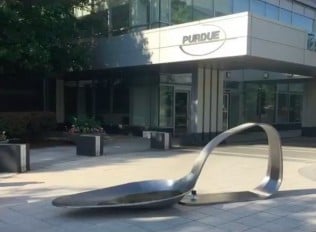
  • Massive Drug Spoon Sculpture Dropped At Purdue Pharma HQ

    Massive Drug Spoon Sculpture Dropped At Purdue Pharma HQ

    The message behind the guerrilla art exhibit is to call attention to the potential danger of prescription opioids.

    A gallery owner was arrested Friday morning (June 22) after placing a sculpture of a massive steel spoon at the headquarters of Purdue Pharma, the maker of OxyContin.

    Fernando Louis Alvarez was arrested and charged with obstruction of free passage, a criminal misdemeanor. The sculpture was displayed in front of the Stamford, Connecticut office for about two hours until it was hauled away by city workers.

    The 800-pound, 10.5-foot-long work of “guerrilla art” appears burnt and bent at the handle, a sight familiar to people who heat up and inject heroin. The artist, Domenic Esposito, of Westwood, Massachusetts, described how his family was affected by his brother Danny’s nearly 14-year addiction to heroin, which began with OxyContin and Percocet.

    “My mom would call me in a panic… screaming she found another burnt spoon. This is a story thousands of families go through. He’s lucky to be alive,” he said, according to the Hartford Courant.

    “The spoon has always been an albatross for my family. It’s kind of an emotional symbol, a dark symbol for me,” he added.

    The message behind the art exhibit is to call attention to the potential danger of prescription opioids, and to call on the federal government to “step in and do something,” Esposito said. Danny has been sober for the last four months.

    Purdue Pharma is among several pharmaceutical companies being targeted by lawsuits across cities, counties, and states that believe these entities had a hand in worsening the opioid crisis. Purdue, specifically, is accused of using deceptive marketing and downplaying the risk of addiction to promote OxyContin.

    The company has since announced that it will no longer market OxyContin to doctors, and just last week, laid off its entire sales team.

    Purdue released a statement on Friday regarding Esposito’s sculpture: “We share the protestors’ concern about the opioid crisis, and respect their right to peacefully express themselves. Purdue is committed to working collaboratively with those affected by this public health crisis on meaningful solutions to help stem the tide of opioid-related overdose deaths.”

    The night of the guerrilla art display, Alvarez hosted the opening of a full exhibit on the opioid crisis at his art gallery in Stamford.

    The spoon has reportedly been submitted as evidence.

    View the original article at thefix.com