A UK study commissioned by the National Trust found that children spend half the time playing outside than their parents did.
The National Trust research showed that children are playing outside for an average of just over four hours a week, comparing unfavourably with 8.2 hours for their parents when they were children.
American children also spend 35% less time playing outside freely than their parents did. 65% of parents surveyed said they played outside every day during their childhood, while only 30% of their children do the same today.
Children are restricted in going outside by their parents
Research found that primary-age children in Britain are losing the freedom to play independently and typically are not allowed to play outside on their own until two years older than their parents’ generation were.
While their parents were allowed to play outside unsupervised by the age of nine on average, today’s children are 11 by the time they reach the same milestone, according to the study, which says not enough adventurous play could affect children’s long-term physical and mental health.
“The reasons are different, with social changes, safety fears, technology and traffic growth all arguably playing a part. However, the end result for all too many children is the same: boredom, isolation, inactivity and poorer mental and physical health. The consequences for their development and wellbeing should not be underestimated.”
Dr Tim Gill, Chair UK PLay Safety Forum
This image below shows very clearly how the boundaries for the areas children are allowed to explore on their own have been gradually narrowing over time.
Map showing how far four generations of kids were allowed to go outside
Children get huge benefits from exploring and outdoor play
Playing outdoors, and roaming and exploring, allows children to develop self-confidence, independence and self-esteem. They also become aware of limits, boundaries and challenge in their play.
When children are used to playing outdoors, they are more likely to:
try new activities
engage with others
solve problems
explore the natural environment
make friends
show resilience
Screentime has replaced outdoor play
The average American child spends about 4 to 7 minutes a day playing outside and over 7 hours a day in front of a screen.
Parents, who are concerned about the amount of time their children are spending on screen-based activities, could consider reviewing the amount of time they let their children play outside. If children’s physical horizons are narrowed then they are likely to try and expand them digitally.
Simple steps to encourage outdoor play include;
Invite their friends to play outside.
Provide safe places to play and explore.
Agree boundaries to roam and extend those with age.
Send children on simple age-appropriate errands to encourage independence
Get outside toys and games.
Make an outdoor activity jar.
Design a nature scavenger hunt in your neighbourhood.
Gently monitor the amount of time your children are spending outside and set incremental targets to increase it. Replace your focus with getting them off screens to a focus on spending more time in nature – turn your attention to the positive habit change you want to see.
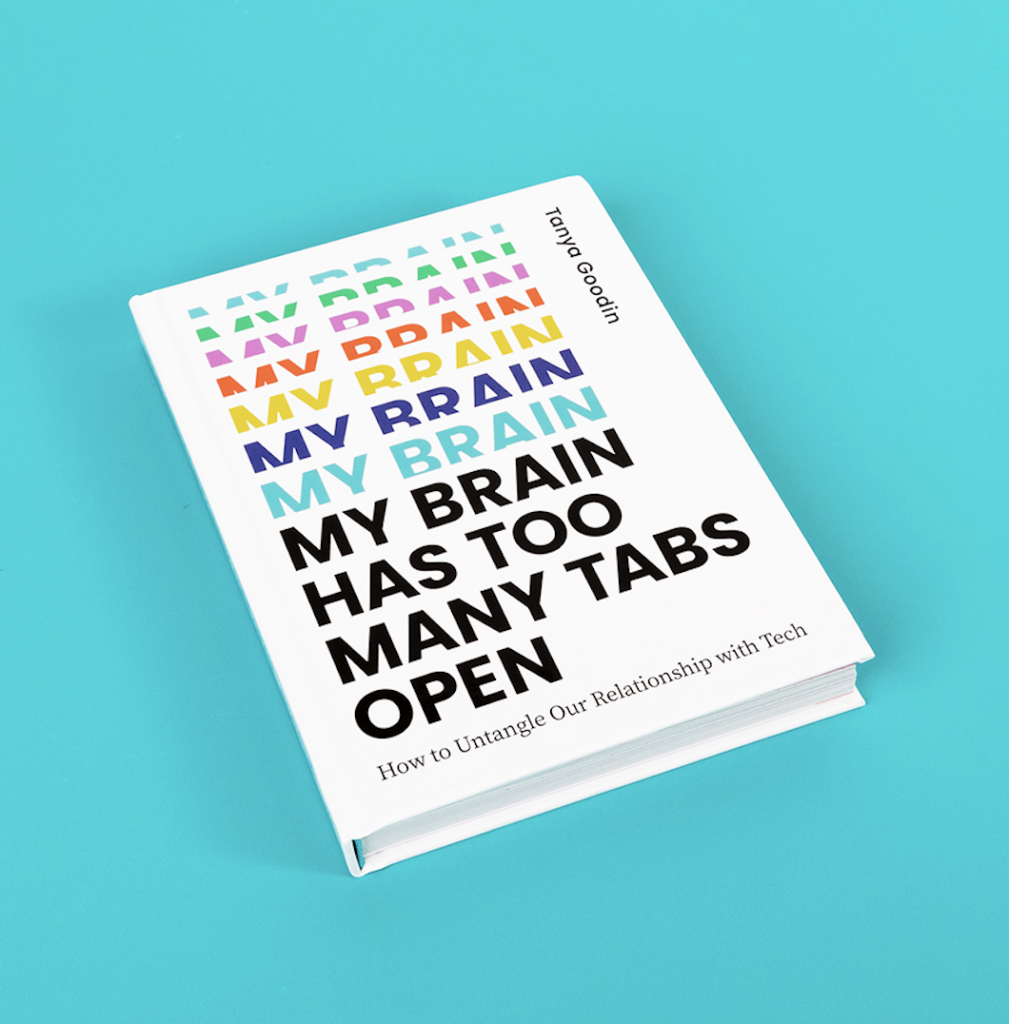
My Brain Has Too Many Tabs Open
For more about how the digital world is impacting our wellbeing. Out now on Amazon and in all good bookshops.
Social media addiction is on the rise with more and more people struggling to stop endlessly scrolling through their feeds. Could ‘slowcial media’ be the answer to using social media intentionally and avoiding some of the harmful side-effects?
What is slowcial media?
Slowcial media is all about slowing down the rush to connect with tech and making it intentional, meaningful and mindful. It can be applied to the ways in which we use social media – or it can be applied to a whole new type of tech which focuses on mindfulness and meaningful connection.
“Slowcial Media: Platforms that foster unhurried and meaningful connection between humans”.
Urban Dictionary
In that sense, slowcial media can be compared to other ‘slow’ cultural movements to slow down life’s pace, such as the slow food movement or slow fashion, both of which ask for considered consumption, thinking about the sources of products, and emphasising sustainability.
The slow movement is thought to have begun in 1986 when Carlo Petrini protested against the opening of a McDonald’s restaurant near the world-famous Spanish Steps in Rome. His protest sparked the creation of the slow food movement which over time developed into the full-blown slow subculture.
“It is a cultural revolution against the notion that faster is always better. The Slow philosophy is not about doing everything at a snail’s pace. It’s about seeking to do everything at the right speed. Savouring the hours and minutes rather than just counting them. Doing everything as well as possible, instead of as fast as possible. It’s about quality over quantity in everything from work to food to parenting.”
The attention economy and persuasive tech encourages us to use social media at break-neck speed, scrolling from one feed and account to another, FOMO making us worry that we might be missing out. But, we can learn to use social media intentionally and mindfully if we follow a few simple rules:
Set limits for time spent online.
Set an intention before you connect with social media – what’s your purpose in using it?
Keep checking in with how social media makes you feel.
Use social media to be inspired and informed – follow accounts that celebrate achievement, not appearance.
Reply thoughtfully to online interactions, pause before responding.
Put hurdles and obstacles in place to make you slow down before you use apps.
Your hurdles and obstacles can be very personal and specific to you. Some ideas; putting your phone in another room, uninstalling social media apps at certain times, leaving messages for yourself on the home screen of your phone. Think creatively about how you can design behavioural nudges like these to ensure you’re being mindful about your use.
Of course, it’s not just about using social media apps in a way that’s more intentional. There are a range of other apps which exist purely for the purpose of developing mindfulness and meaningful connection. Some ideas might be;
Headspace – an app for everyday mindfulness and meditation.
Freedom – an app and website blocker, to enable you to focus and be productive.
Reflection – a journalling-focused app that guides a meaningful reflection practice.
Forest – another app to help focus, but this one plants a tree in the real-world if you meet your goals.
The slowcial media action plan
Here’s our simple plan to help you reap the benefits of a more slowcial approach
Use existing social media and other apps mindfully.
Prune notifications and alerts that distract you.
Set an intention every time you use an app that might be encouraging you to be mindless.
Look for alternatives that encourage meaningful connection.
If you want to try out a full disconnection from tech to slow down, check out all the resources on our website for how to do a digital detox.
For more about using tech intentionally pick up our new book: My Brain Has Too Many Tabs Open. Available to order here.
A Week off Social Media Reduces Depression and Anxiety
A new study has revealed that taking just a week off social media can reduce depression and anxiety and increase a sense of wellbeing.
The University of Bath study found that people who took a break from apps such as TikTok, Instagram, Twitter and Facebook for just seven days reported an increased sense of wellbeing.
How did the study work?
Researchers split their sample of 154 people aged 18 to 72 into two groups. One group was banned from social media while the other was not. On average, participants used social media for eight hours a week.
Participants were quizzed before the study on their baseline levels of anxiety and depression, and their sense of wellbeing, using three widely-used tests;
To measure their wellbeing they were asked to rate their agreement with statements like “I’ve been feeling optimistic about the future” and “I’ve been thinking clearly”.
To measure depression they were asked questions such as “how often during the past two weeks were you bothered by little interest or pleasure in doing things?”
Their anxiety was monitored using the General Anxiety Disorder Scale, which asks how often a person is bothered by feeling nervous or on edge, or an inability to stop worrying.
What did the results show?
Those who took a one-week break from social media saw their wellbeing climb from an average of 46 to55.93 on The Warwick-Edinburgh Mental Well-being Scale.
Levels of depression in this group dropped from 7.46 to 4.84 on the Patient Health Questionnaire-8 while anxiety fell from 6.92 to 5.94 on the scale.
Lead author Dr Jeff Lambert, of the University of Bath’s Department for Health, said the changes represented a moderate improvement in depression and wellbeing, and a small improvement in anxiety.
“Many of our participants reported positive effects from being off social media with improved mood and less anxiety overall. This suggests that even just a small break can have an impact.”
Dr Jeff Lambert, Department for Health, University of Bath
The ‘chicken and egg’ relationship between social media and mental health has still not been established however. ie whether social media use leads to mental health problems, or whether pre-existing feelings of low self-worth drives people to social media as a means of validation.
In the UK the number of adults using social media increased from 45% in 2011 to 71% in 2021. Among 16 to 44-year-olds, as many as 97% use social media and scrolling is the most frequent online activity performed.
The researchers say that in future they hope to study the impact of stopping social media use on specific parts of the population, such as younger people and those with physical and mental health conditions. They also hope to follow up with people beyond one week to see if the benefits of the social media break have a lasting effect.
What steps can we take to improve our own wellbeing?
#1 Log off
Logging off for either a small or longer period of time would seem to be a good idea, as suggested by this study and many others.
#2 Cut down
If logging-off completely isn’t feasible, then cutting down on the amount of time spent on social media (particularly the time spent passively scrolling) is also linked to improvements in mental health.
#3 Be more mindful
A mindful approach, which takes a note of how we are feeling before and after episodes on apps, is also recommended to monitor the unique impact it may be having on our own wellbeing. Checking in with ourselves from time to time and asking the question “how does this make me feel?” is top on our list of strategies to build a healthier relationship.
My Brain Has Too Many Tabs Open
For more about how the digital world is impacting our wellbeing. Out now on Amazon and in all good bookshops.
In-person meetings generate more ideas, and more creative ones, than video meetings which produce fewer ideas overall. Those are the findings from a new study of more than 600 people highlighting the challenges and downsides of using tech to work remotely, as opposed to collaborating face-to-face.
Videoconferencing inhibits creative ideas
In the study, carried out by researchers at Columbia and Stanford,more than 600 people worked in pairs for five minutes – either in person or virtually – to try and come up with ideas for how to creatively use bubble wrap or a Frisbee. Then they had a minute to pick their best idea to put forward. Judges scored the creativity of their ideas — based on novelty and value.
They found pairs working on Zoom came up with fewer ideas.
The Zoom pairs also came up with ideas scored as ‘less creative’ by the judges.
Exactly the same effect was seen in studies of 1,490 engineers who paired up to brainstorm during workshops at a multinational telecommunications company.
The researchers had a few ideas about what might happening when Zoom is killing creativity in scenarios like this.
Why? The ‘shared space’
In an in-person collaboration one thing that’s often overlooked is that team members are in the same shared physical space and share the same visual cues from their environment – and each other – that can generate ideas. In a virtual meeting, their eyes tend to focus on their screens and they ignore their own environment, which “constrains the associative process underlying idea generation,” say the researchers.
In the study, the pairs on Zoom calls spent more time looking at their partner and less time looking at the room they were in, and remembered fewer unexpected props (a large house plant or a bowl of lemons) in the room compared to in-person pairs.
Why? Moving less
Move more if you want to be more creative – go for a walk.
One thing we all know is that people move less when they meet virtually staring at a screen, and movement has specifically been shown to enhance creativity. One 2014 Stanford study found for example that a person’s creative output increased by an average of 60 percent when walking (as opposed to sitting).
“Staying still hinders creativity”
PROFESSOR Jeremy Bailenson, Stanford UNIVERSITY
During in-person meetings or even phone calls, we can look around, walk around, multitask and use our hands – all of that movement isn’t just more relaxing than staring fixedly at a screen, it also stimulates creativity.
If you find Zoom is killing your creativity, take these steps
#1 Match the medium to the task
Video calls are useful for large teams working remotely to check in and share information and they’re used more and more because of the cost savings in getting people working in different locations together. But this research shows they’re not suited for creativity and ideas generation. For effective brainstorming – meet in person.
#2 Move more
Movement of all types has been shown to help with idea generating and problem solving. If Zoom is killing creativity in your team, why not all go for a walking meeting in the park? Adding in contact with a green space will also give your ideas a boost.
#3 Step away from screens more
It’s not just the time on screens during brainstorming that might be impacting our creativity. Filling our heads with a non-stop stream of news, communication and entertainment doesn’t give us our brains any time to wander and get into the state of flow that’s conducive to problem solving. Spend less time looking at a screen and you may find that your ideas flow too.
My Brain Has Too Many Tabs Open
For more about how the digital world is impacting our work and productivity (and our home, and love lives). Out now on Amazon and in all good bookshops.
If you’re pondering whether time away from your phone is worth it, here are five good reasons to do a digital detox;
#1 Your Sleep Will Improve
Experts disagree on exactly what it is about sleep and screens that causes a problem. Some say it’s the blue-light producing screens that interferes with our body clock and keeps our brain and body alert. Others say it’s the activities we’re carrying out on screens that are stimulating – like gaming or watching videos which can increase bursts of adrenalin and dopamine. But most experts agree on one thing – sleep and screens are not good bedfellows. So taking part in a digital detox is almost certainly going to lead to deeper and more restful sleep.
#2 Anxiety and Depression Will Lessen
Some quite recent research found that just a week off all forms of social media reduced depression and anxiety. And a study from as far back as 2015 found the same effect with those taking a complete break from Facebook for a week feeling 55% less stressed. Frankly, we’re yet to come across a study that finds that people who take a break from social media feel worse. That’s one of the most compelling reasons to do a digital detox we can think of.
#3 Your Relationships Will Deepen
In new book My Brain Has Too Many Tabs Open author Tanya Goodin writes about the ways in which our digital habits are impacting our relationships. From phubbing to sharenting, from technoference to trolling. The many ways in which the digital world is negatively affecting how we relate to each other are multiplying. And yet, the number and quality of our closest relationships is the best predictor of our health and longevity. Taking part in a digital detox, and using that time to focus on those you care about will reap rewards in every area of your life.
One of the best reasons to do a digital detox – to spend time with friends.
#4 You Will Escape the 24:7 Bad News Cycle
A relentless non-stop stream of all the bad news in the world is wearing on all our mental health. And the digital world is designed to emphasise the negative, so it’s specifically hard to escape bad news online. Putting down your screens to take a break from bad news – and maybe seek out some good news instead – will make you feel a lot better.
#5 You Can Get Outside More
The time we’re all spending in green spaces has been sadly reducing over the past few decades. But nature is a great healer and time outside helps with both our mental and physical health; reducing blood pressure, alleviating stress and improving sleep. Use your time off your smartphone to get outside and get strolling instead of scrolling – your body and mind will thank you.
My Brain Has Too Many Tabs Open
For more about how the digital world is impacting our lives, and how and why to take a break. Out now on Amazon and in all good bookshops.
But what does digital wellbeing actually mean? And is it something that’s possible to achieve in an attention-based digital economy?
The UNESCO Council sets as its definition of digital wellbeing;
“The enhancement and improvement of human well-being, in the intermediate and long term, through the use of digital media,”
UNESCO, Forum for Well-being in Digital Media
Here are Our 7 Principles of Digital Wellbeing
#1 Keeping Safe and Being Well
You should be able to use and explore the digital world and keep safe. More than that, your experiences should positively enhance your mental health rather than detract from it.
#2 Achieving Your Goals
Using the digital world should help you to achieve your personal goals; whether that’s in education, in being informed about the world about you, to be entertained or to connect.
#3 Self-expression
Self-expression through creativity is crucialfor the development of our identity, confidence and belonging. Self-expression helps us communicate our feelings in a positive way and the digital environment should enable us to do that.
#4 Connecting With Others
One of the most important benefits of digital spaces is the way in which they allow us to connect with others. The desire for connection is a fundamental human need and we should be able to connect in a way that enhances our lives.
Digital wellbeing should help us build good mental health and resilience
#5 Being Inspired
Seeing how others are expressing themselves and impacting the world can inspire and motivate us – digital wellbeing means finding sources of inspiration online.
#6 Growing Your Skills
Learning new skills and accessing education online enhances our sense of digital wellbeing.
#7 Having Impact
A feeling that we are making a difference, impacting others and effecting positive change, should form part of digital wellbeing.
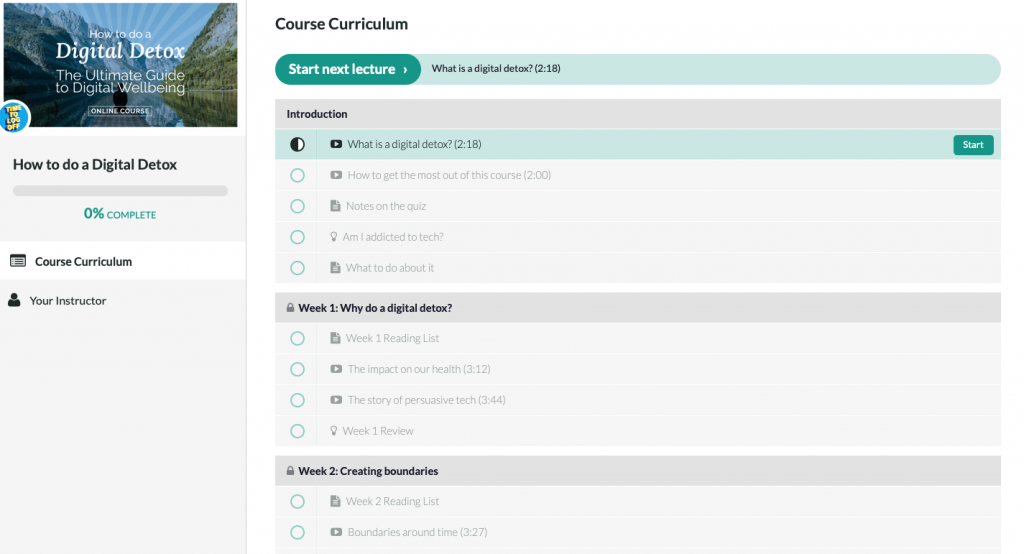
Try Our Ultimate Guide to Digital Wellbeing
If you want to explore digital wellbeing more, the ultimate guide to digital wellbeing is in our online course.
Who is the digital wellbeing course for?
This course is designed for anyone who struggles in their relationship with technology. It’s for you if you:
Are desperate for a break from working but can never seem to log off
Waste too much time endlessly scrolling
Struggle with sleep/ concentration or creativity
Want to learn easy techniques to help you switch off from tech
You can start it whenever you like and work through it at your own pace.
What’s included?
The course is designed to be six weeks long (but you can take it at your own speed), and in that time we guide you through four weeks of learning about technology addiction and methods to help you log off, followed by a two week digital detox, which we support you through. You get:
13x videos from founder, Tanya Goodin, explaining the content and motivating you along the journey
2x quizzes to help you quantify the extent of any tech addiction at the beginning of the course and to assess your change at the end
Curated weekly reading lists
Weekly quizzes to ascertain your understanding
3x downloadable resources unique to the course, which you can use beyond the course to help keep you on track
In the meantime, use these seven principles as a reference to ensure the digital world is enhancing, not detracting from your life, and your health and wellbeing.
If you’re pondering whether time away from your phone is worth it, here are five good reasons to do a digital detox;
#1 Your Sleep Will Improve
Experts disagree on exactly what it is about sleep and screens that causes a problem. Some say it’s the blue-light producing screens that interfere with our body clock and keep our brain and body alert. Others say it’s the activities we’re carrying out on screens that are stimulating – like gaming or watching videos which can increase bursts of adrenalin and dopamine. But most experts agree on one thing – sleep and screens are not good bedfellows. So taking part in a digital detox is almost certainly going to lead to deeper and more restful sleep.
#2 Anxiety and Depression Will Lessen
Some quite recent research found that just a week off from all forms of social media reduced depression and anxiety. And a study from as far back as 2015 found the same effect with those taking a complete break from Facebook for a week feeling 55% less stressed. Frankly, we’re yet to come across a study that finds that people who take a break from social media feel worse. That’s one of the most compelling reasons to do a digital detox we can think of.
#3 Your Relationships Will Deepen
In the new book, My Brain Has Too Many Tabs Open author Tanya Goodin writes about the ways in which our digital habits are impacting our relationships. From phubbing to sharenting, from technoference to trolling. The many ways in which the digital world is negatively affecting how we relate to each other are multiplying. And yet, the number and quality of our closest relationships are the best predictors of our health and longevity. Taking part in a digital detox, and using that time to focus on those you care about will reap rewards in every area of your life.
#4 You Will Escape the 24:7 Bad News Cycle
A relentless non-stop stream of all the bad news in the world is wearing on our mental health. And the digital world is designed to emphasise the negative, so it’s specifically hard to escape bad news online. Putting down your screens to take a break from bad news – and maybe seek out some good news instead – will make you feel a lot better.
#5 You Can Get Outside More
The time we’re all spending in green spaces has been sadly reducing over the past few decades. But nature is a great healer and time outside helps with both our mental and physical health; reducing blood pressure, alleviating stress and improving sleep. Use your time off your smartphone to get outside and get strolling instead of scrolling – your body and mind will thank you.
A Week off Social Media Reduces Depression and Anxiety
A new study has revealed that taking just a week off social media can reduce depression and anxiety and increase a sense of wellbeing.
The University of Bath study found that people who took a break from apps such as TikTok, Instagram, Twitter and Facebook for just seven days reported an increased sense of wellbeing.
How did the study work?
Researchers split their sample of 154 people aged 18 to 72 into two groups. One group was banned from social media while the other was not. On average, participants used social media for eight hours a week.
Participants were quizzed before the study on their baseline levels of anxiety and depression, and their sense of wellbeing, using three widely-used tests;
To measure their wellbeing they were asked to rate their agreement with statements like “I’ve been feeling optimistic about the future” and “I’ve been thinking clearly”.
To measure depression they were asked questions such as “how often during the past two weeks were you bothered by little interest or pleasure in doing things?”
Their anxiety was monitored using the General Anxiety Disorder Scale, which asks how often a person is bothered by feeling nervous or on edge, or an inability to stop worrying.
What did the results show?
Those who took a one-week break from social media saw their wellbeing climb from an average of 46 to55.93 on The Warwick-Edinburgh Mental Well-being Scale.
Levels of depression in this group dropped from 7.46 to 4.84 on the Patient Health Questionnaire-8 while anxiety fell from 6.92 to 5.94 on the scale.
Lead author Dr Jeff Lambert, of the University of Bath’s Department for Health, said the changes represented a moderate improvement in depression and wellbeing, and a small improvement in anxiety.
“Many of our participants reported positive effects from being off social media with improved mood and less anxiety overall. This suggests that even just a small break can have an impact.”
Dr Jeff Lambert, Department for Health, University of Bath
The ‘chicken and egg’ relationship between social media and mental health has still not been established however. ie whether social media use leads to mental health problems, or whether pre-existing feelings of low self-worth drives people to social media as a means of validation.
In the UK the number of adults using social media increased from 45% in 2011 to 71% in 2021. Among 16 to 44-year-olds, as many as 97% use social media and scrolling is the most frequent online activity performed.
The researchers say that in future they hope to study the impact of stopping social media use on specific parts of the population, such as younger people and those with physical and mental health conditions. They also hope to follow up with people beyond one week to see if the benefits of the social media break have a lasting effect.
What steps can we take to improve our own wellbeing?
#1 Log off
Logging off for either a small or longer period of time would seem to be a good idea, as suggested by this study and many others.
#2 Cut down
If logging-off completely isn’t feasible, then cutting down on the amount of time spent on social media (particularly the time spent passively scrolling) is also linked to improvements in mental health.
#3 Be more mindful
A mindful approach, which takes a note of how we are feeling before and after episodes on apps, is also recommended to monitor the unique impact it may be having on our own wellbeing. Checking in with ourselves from time to time and asking the question “how does this make me feel?” is top on our list of strategies to build a healthier relationship.
My Brain Has Too Many Tabs Open
For more about how the digital world is impacting our wellbeing. Out now on Amazon and in all good bookshops.
In-person meetings generate more ideas, and more creative ones, than video meetings which produce fewer ideas overall. Those are the findings from a new study of more than 600 people highlighting the challenges and downsides of using tech to work remotely, as opposed to collaborating face-to-face.
Videoconferencing inhibits creative ideas
In the study, carried out by researchers at Columbia and Stanford,more than 600 people worked in pairs for five minutes – either in person or virtually – to try and come up with ideas for how to creatively use bubble wrap or a Frisbee. Then they had a minute to pick their best idea to put forward. Judges scored the creativity of their ideas — based on novelty and value.
They found pairs working on Zoom came up with fewer ideas.
The Zoom pairs also came up with ideas scored as ‘less creative’ by the judges.
Exactly the same effect was seen in studies of 1,490 engineers who paired up to brainstorm during workshops at a multinational telecommunications company.
The researchers had a few ideas about what might happening when Zoom is killing creativity in scenarios like this.
Why? The ‘shared space’
In an in-person collaboration one thing that’s often overlooked is that team members are in the same shared physical space and share the same visual cues from their environment – and each other – that can generate ideas. In a virtual meeting, their eyes tend to focus on their screens and they ignore their own environment, which “constrains the associative process underlying idea generation,” say the researchers.
In the study, the pairs on Zoom calls spent more time looking at their partner and less time looking at the room they were in, and remembered fewer unexpected props (a large house plant or a bowl of lemons) in the room compared to in-person pairs.
Why? Moving less
Move more if you want to be more creative – go for a walk.
One thing we all know is that people move less when they meet virtually staring at a screen, and movement has specifically been shown to enhance creativity. One 2014 Stanford study found for example that a person’s creative output increased by an average of 60 percent when walking (as opposed to sitting).
“Staying still hinders creativity”
PROFESSOR Jeremy Bailenson, Stanford UNIVERSITY
During in-person meetings or even phone calls, we can look around, walk around, multitask and use our hands – all of that movement isn’t just more relaxing than staring fixedly at a screen, it also stimulates creativity.
If you find Zoom is killing your creativity, take these steps
#1 Match the medium to the task
Video calls are useful for large teams working remotely to check in and share information and they’re used more and more because of the cost savings in getting people working in different locations together. But this research shows they’re not suited for creativity and ideas generation. For effective brainstorming – meet in person.
#2 Move more
Movement of all types has been shown to help with idea generating and problem solving. If Zoom is killing creativity in your team, why not all go for a walking meeting in the park? Adding in contact with a green space will also give your ideas a boost.
#3 Step away from screens more
It’s not just the time on screens during brainstorming that might be impacting our creativity. Filling our heads with a non-stop stream of news, communication and entertainment doesn’t give us our brains any time to wander and get into the state of flow that’s conducive to problem solving. Spend less time looking at a screen and you may find that your ideas flow too.
My Brain Has Too Many Tabs Open
For more about how the digital world is impacting our work and productivity (and our home, and love lives). Out now on Amazon and in all good bookshops.
The digital environment isn’t all bad, but our time spent in it is dominated by a small number of large platforms that use sophisticated manipulation techniques to keep us on screens. Amazon, Instagram, Snapchat, Facebook, Twitter and TikTok are all built around these techniques. It’s called persuasive technology.
All these companies are part of what’s been called the attention economy, an online environment that treats our human focus and attention as a commodity and where each company or platform is vying to keep more and more of it focused on their products, apps and platforms.
But what exactly is persuasive tech? And, more importantly, what do we need to do if we don’t want to be manipulated by it? Here’s our starter guide on how persuasive technology works.
#1 What is persuasive technology and where did it come from?
Persuasive technology was pioneered largely by one man, Professor BJ Fogg, at Stanford University in the late 1990s. He began formulating the principles of persuasion in technology while studying for his doctorate in psychology. In 1998 he founded the Stanford Persuasive Tech Lab, subsequently re-renamed the ‘Behavior Design Lab‘, for the study and promotion of technologies which can change and/or modify human behaviour.
“In written form, my model looks like this:
B=MAP
Here’s the simplest way to explain it: “Behavior (B) happens when Motivation (M), Ability (A), and a Prompt (P) come together at the same moment.”
BJ Fogg ‘Fogg Behavior Model’
All the features of persuasive tech use the three factors of Fogg’s ‘Behavior Model’ to manipulate their users – motivation, ability, and prompts – and get them behaving in the way they want.
Motivation – a desire to connect with other people (social media) or a desire for a product (online shopping) for example.
Ability – the ability to actually do what the technology or app wants us to do (click on a button, input a credit card, share a post).
Prompts – features like banners, app badges, sounds and notifications, ‘prompting’ us what to do.
Good examples are those red numbers on our app icons ( ‘badges’) or the banners that pop up on our phone lock and home screens. They all get us going back and reconnecting with an app, even when we had no desire to use that app right now – or were happily doing something else.
Fogg’s influence can be seen everywhere in Big Tech. The co-founder of Instagram was a student of his and there are now numerous former students of his lab working in tech. His 2007 ‘Facebook class’, which encouraged students to design and launch Facebook apps at rapid speed, made many of his students millionaires before they’d even finished the course at Stanford.
#2 What makes persuasive technology work so well?
Persuasive tech works so brilliantly because it manipulates human psychology and exploits our weaknesses (and sometimes also our strengths) to make us do its bidding.
We tend respond to urgent alerts, for example, because as humans we are primed to recognise danger and warnings (all app badge notifications tend to be red, the classic warning colour). This tendency to be hyper-alert to dangers and threats in our environment is what kept us alive in our hunter-gatherer days and our brains haven’t changed much since then, though the world around us has.
We’re also primed as humans to seek out human connection and to look for signs of approval from those around us (another tendency that kept us safe – keeping us within a larger group). Signs of approval from those around us ‘reward’ our primitive brains with bursts of dopamine – the feel good brain hormone.
Persuasive technology is now mostly built using artificial intelligence (AI) which can work at break-neck speed to track how each of us is responding in real-time to different prompts and techniques and then refine and hone the tricks that work best on our unique psychology. You might be immune to red badge icons on apps for example, but particularly susceptible to app banners on your home screen. Or, you might respond very speedily to the type of messages telling you what you’ve missed on an app while you’ve been away from it.
Of course, people trying to ‘sell’ a product or service have always used human psychology to manipulate their customers into buying. But what is happening now is on a huge scale with billions of dollars invested in it and with computing power more powerful than anything seen before in our history.
#3 What harm is persuasive tech doing to all of us?
Persuasive technology is manipulating human behaviour on a global scale and with that has come many unintended consequences. At its most basic level it’s causing us to waste hours of time on social media. At its most concerning it’s changing society by manipulating our opinions, our world views, our view of ourselves and our bodies and facilitating the spread of damaging misinformation online.
Wasting our time
Scrolling through social media may seem benign and spending just a little bit more time than we really intended to may not seem much of a problem. But evidence is building that these apps are wasting hours and hours of our days and causing us to scroll aimlessly for those tiny brain rewards, neglecting important areas of our lives. We now spend an average of nearly two and a half hours a day on social media – up from an hour and a half in 2012 just ten years ago.
Changing society
The unintended consequences and societal changes are the most concerning aspect of persuasive technology. Some scientists believe that the increasing time on social media is causing widespread mental health damage for example. And disinformation spread by anti-vaxxers or climate-change deniers has done real damage to society and to the planet. YouTube’s recommendation engine, built around persuasive technology, has been found to amplify outrage, conspiracy theories, and extremism to keep us watching.
BJ Fogg actually warned about the damage persuasive technology could potentially do at some point in the future. This video was put together by him and his students as far back as 2006.
The inventor of persuasive technology warns about its use.
#4 What can we do about it?
If we don’t want to be manipulated by Big Tech and persuasive technology we need to take back control. We need to put our scrolling and viewing habits firmly back under the charge our own conscious decision-making abilities, rather than blindly allow ourselves to go down internet rabbit holes designed to ensnare us. Here are some suggestions;
Turn off notifications – persuasive tech isn’t magic. The prompts only work if you can see or hear them (or feel them if you have vibration mode on). Turn off as many as possible on your devices so you choose when to engage with your apps – not Big Tech.
Cull social media apps – be ruthless and eliminate as many as possible. We have very little good news, and lots of bad, on what these apps are doing to us. Use them sparingly.
Be wise to emotional triggers – sharing of disinformation and propaganda largely relies on stirring up strong emotions. Be very careful if a post or video makes you feel very angry or indignant. Resist the temptation to share outrage.
Use anti-distraction tools – digital wellbeing tools and apps have developed a lot in the past few years as persuasive tech has been more widely discussed. Apps like Forest and Freedom will help you stay focused.
For more about how persuasive tech and the attention economy and how to resist it, without switching off completely – pick up a copy of our new book: My Brain Has Too Many Tabs Open. Available to order here.