Author: The Fix

  • Gloria Harrison: True Recovery Is the Healing of the Human Spirit

    Although Gloria experienced trauma, violence, and institutionalized oppression, she never gave up hope. Now, in recovery, she is a counselor and staunch recovery advocate. 

    True recovery is the healing of the human spirit.
    It is a profound recognition that we not only have the right to live
    but the right to be happy, to experience the joy of life.
    Recovery is possible if only you believe in your own self-worth.

    -Gloria Harrison

    Although the dream of achieving recovery from substance use disorders is difficult today for people outside of the Caucasian, straight, male normative bubble, there is no question that progress has been made. If you want to know how difficult it was to get help and compassionate support in the past, you just have to ask Gloria Harrison. Her story is a stark reminder of how far we have come and how far we still must go.

    As a young gay African American girl growing up in a Queens household overrun with drug abuse and childhood trauma, it is not surprising that she ended up becoming an addict who spent years homeless on the streets of New York. However, when you hear Gloria’s story, what is shocking is the brutality of the reactions she received when she reached out for help. At every turn, as a girl and a young woman, she was knocked down, put behind bars in prisons, and sent to terribly oppressive institutions.

    Gloria’s story is heartbreaking while also being an inspiration. Although she spent so much time downtrodden and beaten, she never gave up hope; her dream of recovery allowed her to transcend the bars of historical oppression.

    Today, as an active member of Voices of Community Activists & Leaders (VOCAL-NY), she fights to help people who experience what she suffered in the past. She is also a Certified Recovery Specialist in New York, and despite four of her twenty clients dying from drug overdoses during the COVID-19 pandemic, she continues to show up and give back, working with the Harlem United Harm Reduction Coalition and, as a Hepatitis C survivor, with Frosted (the Foundation for Research on Sexually Transmitted Diseases).

    Before delving into Gloria’s powerful and heartbreaking story, I must admit that it was not easy for me to decide to write this article. As a white Jewish male in long-term recovery, I was not sure that I was the proper person to recount her story for The Fix. Gloria’s passion and driving desire to have her story told, however, shifted my perspective.

    From my years in recovery, where I have worked a spiritual program, I know that sometimes when doors open for you, it is your role to walk through them with courage and faith.

    A Cold Childhood of Rejection and Confusion

    Like any child, Gloria dreamed of being born into the loving arms of a healthy family. However, in the 1950s in Queens, when you were born into a broken family where heavy responsibilities and constant loss embittered her mother, the arms were more than a little overwhelmed. The landscape of Gloria’s birth was cold and bleak.

    She does not believe that her family was self-destructive by nature. As she tells me, “We didn’t come into this world with intentions of trying to kill ourselves.” However, addiction and alcoholism plagued so many people living in the projects. It was the dark secret of their lives that was kept hidden and never discussed. Over many decades, more family members succumbed to the disease than survived. Although some managed to struggle onward, addiction became the tenor of the shadows that were their lives.

    Gloria’s mother had a temper and a judgmental streak. However, she was not an alcoholic or an addict. Gloria does remember the stories her mother told her of a difficult childhood. Here was a woman who overcame a terrifying case of polio as a teenager to become a singer. Despite these victories, her life became shrouded in the darkness of disappointment and despair.
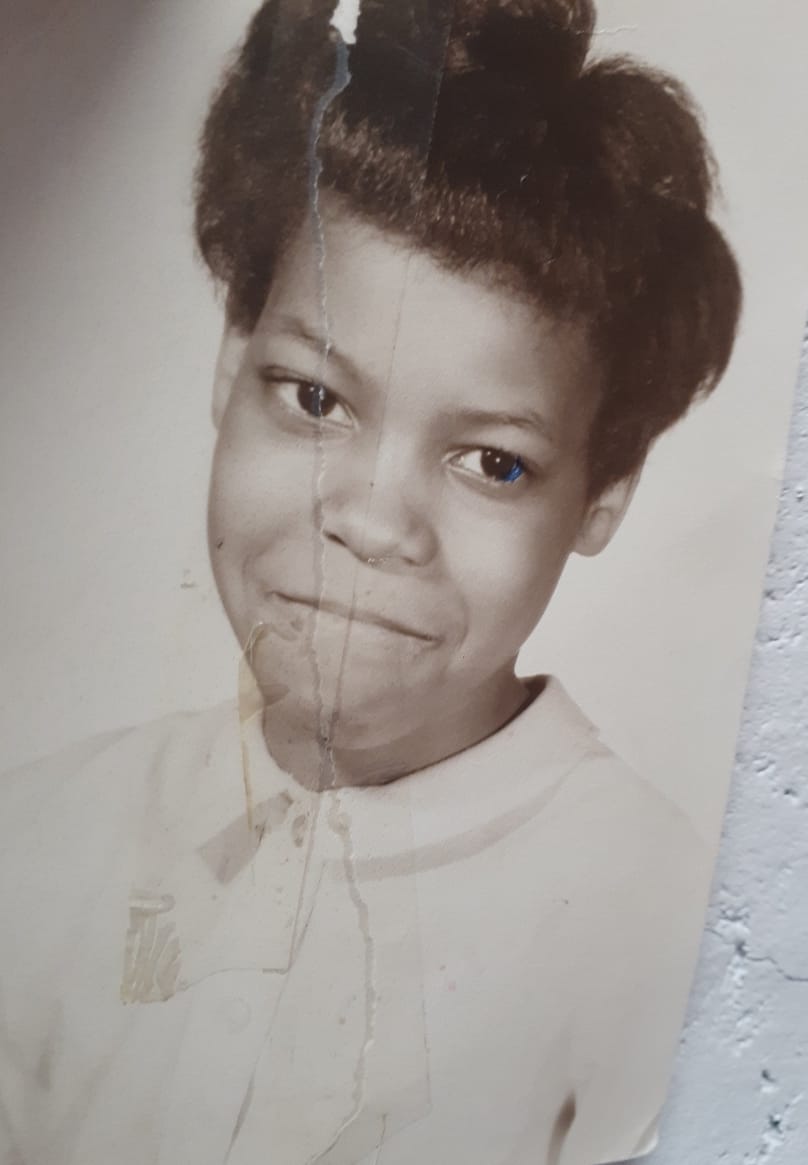
    Gloria Harrison: True Recovery Is the Healing of the Human Spirit

    In 1963, as a pre-teen, Gloria dreamed of going to the March on Washington with Martin Luther King, Jr., and the leaders of the Civil Rights Movement. Her mother even bought her a red beanie like the militant tam worn by the Black Panthers. Proudly wearing this sign of her awakening, Gloria went from house to house in Astoria, Queens, asking for donations to help her get to Washington, D.C. for the march. She raised $25 in change and proudly brought it home to show her mother.

    Excited, she did not realize it was the beginning of a long line of slaps in the face. Her mother refused to let her little girl go on her own to such an event. She was protective of her child. However, Gloria’s mom promised to open a bank account for her and deposit the money. Gloria could use it when she got older for the next march or a future demonstration. Gloria never got to turn this dream into a reality because her life quickly went from bad to worse.

    At thirteen, Gloria found herself in a mish-mash of confusing feelings and responsibilities. She knew she liked girls more than boys from a very early age, not just as friends. Awakening to her true self, Gloria felt worried and overwhelmed. If she was gay, how would anyone in her life ever love her or accept her?

    The pressure of this realization demanded an escape, mainly after her mother started to suspect that something was off with her daughter. At one point, she accused her daughter of being a “dirty lesbo” and threw a kitchen knife at her. Gloria didn’t know what to do. She tried to run away but realized she had nowhere to go. The only easy escape she could find was the common escape in her family: Drugs seemed the only option left on the table.

    The High Price of Addiction = The Shattering of Family Life

    In the mid-sixties, Gloria had nowhere to turn as a young gay African American teen. There were no counselors in her rundown public high school, and the usual suspects overwhelmed the teachers. Although the hippies were fighting the war in Vietnam on television, they did not reach out to troubled kids in the projects. Heck, most of them never left Manhattan, except for a day at the Brooklyn Zoo or Prospect Park. The Stonewall Riots of 1969 were far away, and Gay Rights was not part of almost anyone’s lexicon. Gloria had no options.

    What she did have was an aunt that shot heroin in her house with her drug-dealing boyfriend. She remembers when she first saw a bag of heroin, and she believed her cousin who told her the white powder was sugar. Sugar was expensive, and her mom seldom gave it to her brothers and sisters. Why was it in the living room in a little baggie?

    Later, she saw the white powder surrounded by used needles and cotton balls, and bloody rags. She quickly learned the truth, and she loved what the drug did to her aunt and the others. It was like it took all their cares away and made them super happy. Given such a recognition, Gloria’s initial interest sunk into a deeper fascination.

    At 14, she started shooting heroin with her aunt, and that first hit was like utter magic. It enveloped her in a warm bubble where nothing mattered, and everything was fine. Within weeks, Gloria was hanging out in shooting galleries with a devil may care attitude. As she told me, “I have always been a loner even when I was using drugs, and I always walked alone. I never associated with people who used drugs, except to get more for myself.”

    Consequences of the Escape = Institutions, Jails, and Homelessness

    Realizing that her daughter was doing drugs, Gloria’s mother decided to send her away. Gloria believes the drugs were a secondary cause. At her core, her mother could not understand Gloria’s sexuality. She hoped to find a program that would get her clean and turn her straight.

    It is essential to understand that nobody else in Gloria’s family was sent away to an institution for doing drugs. Nobody else’s addiction became a reason for institutionalization. Still, Gloria knows her mother loved her. After all, she has become her mother’s number one contact with life outside of her nursing home today.

    Also, Gloria sometimes wonders if the choice to send her away saved her life. Later, she still spent years homeless on the streets of Queens, Manhattan, the Bronx, and Brooklyn. Of the five boroughs of New York City, only Staten Island was spared her presence in the later depths of her addiction. However, being an addict as a teenager, the dangers are even more deadly.

    When her mother sent her away at fourteen, Gloria ended up in a string of the most hardcore institutions in the state of New York. She spent the first two years in the draconian cells of the Rockefeller Program. Referred to in a study in The Journal of Social History as “The Attila The Hun Law,” these ultra-punitive measures took freedom away from and punished even the youngest offenders. Gloria barely remembers the details of what happened.

    After two years in the Rockefeller Program, she was released and immediately relapsed. Quickly arrested, she was sent to Rikers Island long before her eighteenth birthday and put on Methadone. Although the year and a half at Rikers Island was bad, it was nothing compared to Albany, where they placed her in isolation for two months. The only time she saw another human face was when she was given her Methadone in the morning. During mealtimes, she was fed through a slot in her cell.

    Gloria says she went close to going insane. She cannot recall all the details of what happened next, but she does know that she spent an additional two in Raybrook. A state hospital built to house tuberculosis patients; it closed its doors in the early 1960s. In 1971, the state opened this dank facility as a “drug addiction treatment facility” for female inmates. Gloria does remember getting lots of Methadone, but she does not recall even a day of treatment.

    Losing Hope and Sinking into Homeless Drug Addiction in the Big Apple

    After Raybrook, she ended up in the Bedford Hills prison for a couple of years. By now, she was in her twenties, and her addiction kept her separate from her family. Gloria had lost hope of a reconciliation that would only came many years later.

    When she was released from Bedford Hills in 1982, nobody paid attention to her anymore. She became one more invisible homeless drug addict on the streets of the Big Apple. Being gay did not matter; being black did not matter, even being a woman did not matter; what mattered was that she was strung out with no money and no help and nothing to spare.

    Although she found a woman to love, and they protected each other when not scrambling to get high, she felt she had nothing. She bounced around from park bench to homeless shelter to street corners for ten years. There was trauma and violence, and extreme abuse. Although Gloria acknowledges that it happened, she will not talk about it.

    Later, after they found the path of recovery, her partner relapsed after being together for fifteen years. She went back to using, and Gloria stayed sober. It happens all the time. The question is, how did Gloria get sober in the first place?

    Embracing Education Led to Freedom from Addiction and Homelessness

    In the early 1990s, after a decade addicted on the streets, Gloria had had enough. Through the NEW (Non-traditional Employment for Women) Program in NYC, she discovered a way out. For the first time, it felt like people believed in her. Supported by the program, she took on a joint apprenticeship at the New York District College for Carpenters. Ever since she was a child, Gloria had been good with her hands.

    In the program, Gloria thrived, learning welding, sheet rocking, floor tiling, carpentry, and window installation. Later, she is proud to say that she helped repair some historical churches in Manhattan while also being part of a crew that built a skyscraper on Roosevelt Island and revamped La Guardia Airport. For a long time, work was the heart of this woman’s salvation.

    With a smile, Gloria says, “I loved that work. Those days were very exciting, and I realized that I could succeed in life at a higher level despite having a drug problem and once being a drug addict. Oh, how I wish I was out there now, working hard. There’s nothing better than tearing down old buildings and putting up something new.”

    Beyond dedicating herself to work, Gloria also focused on her recovery. She also managed to reconnect with her mother. Addiction was still commonplace in the projects, and too many family members had succumbed to the disease. She could not return to that world. Instead, Gloria chose to focus on her recovery, finding meaning in 12-Step meetings and a new family.

    Talking about her recovery without violating the traditions of the program, Gloria explains, “I didn’t want to take any chances, so I made sure I had two sponsors. Before making a choice, I studied each one. I saw how they carried themselves in the meetings and the people they chose to spend time with. I made sure they were walking the walk so that I could learn from them. Since I was very particular, I didn’t take chances. I knew the stakes were high. Thus, I often stayed to myself, keeping the focus on my recovery.”

    From Forging a Life to Embracing a Path of Recovery 24/7

    As she got older and the decades passed, Gloria embraced a 24/7 path of recovery. No longer able to do hard physical labor, she became a drug counselor. In that role, she advocates for harm reduction, needle exchange, prison reform, and decriminalization. Given her experience, she knew people would listen to her voice. Gloria did more than just get treatment after learning that she had caught Hepatitis C in the 1980s when she was sharing needles. She got certified in HCV and HIV counseling, helping others to learn how to help themselves.

    Today, Gloria Harrison is very active with VOCAL-NY. As highlighted on the organization’s website, “Since 1999, VOCAL-NY has been building power to end AIDS, the drug war, mass incarceration & homelessness.” Working hard for causes she believes in, Gloria constantly sends out petitions and pamphlets, educating people about how to vote against the stigma against addicts, injustices in the homeless population, and the horror of mass incarceration. One day at a time, she hopes to help change the country for the better.

    However, Gloria also knows that the path to recovery is easier today for facing all the “absurd barriers” that she faced as a young girl. Back in the day, being a woman and being gay, and being black were all barriers to recovery. Today, the tenor of the recovery industry has changed as the tenor of the country slowly changes as well. Every night, Gloria Harrison pictures young girls in trouble today like herself way back when. She prays for these troubled souls, hoping their path to recovery and healing will be easier than she experienced.

    A Final Word from Gloria

    (When Gloria communicates via text, she wants to make sure she is heard.)

    GOOD MORNING, FRIEND. I HOPE YOU ARE WELL-RESTED. I AM GRATEFUL. I LOVE THE STORY.

    I NEED TO MAKE SOMETHING CLEAR. MY MOTHER HAD A MENTAL AND PHYSICAL ILLNESS. SHE HAD POLIO AT THE AGE OF FOURTEEN BUT THAT DIDN’T STOP HER. SHE WENT THROUGH SO MUCH, AND I LOVE THE GROUND SHE WALKS ON. I BELIEVE THAT SHE WAS ASHAMED OF MY LIFESTYLE, BUT, AT THE SAME TIME, SHE LOVED ME. SHE GAVE ME HER STRENGTH & DETERMINATION. SHE GAVE ME HER NAME. SHE RAISED HER LIFE UP OVER HER DISABILITIES. SHE BECAME A STAR IN THE SKY FOR ALL AROUND HER.

    BEING THAT MY MOTHER WASN’T EDUCATED OR FINISHED SCHOOL, SHE DIDN’T KNOW ABOUT THE ROCKEFELLER PROGRAM. SHE ONLY WANTED TO SAVE HER TRUSTED SERVANT AND RESCUE HER BELOVED CHILD. SHE NEEDS ME NOW AND I AM ABLE TO HELP BECAUSE I WAS ABLE TO TURN MY LIFE AROUND COMPLETELY. SHE TRUSTS ME TODAY TO WATCH OVER HER WELLBEING, AND I FEEL BLESSED TO BE HER BELOVED CHILD AND TRUSTED SERVANT AGAIN. AS YOU HAVE MENTIONED TO ME, THE PATH OF RECOVERY IS THE PATH OF REDEMPTION.

    Postscript: A big thank from both Gloria and John to Ahbra Schiff for making this happen.
    View the original article at thefix.com

  • Everything Harder Than Everyone Else

    “Part of ultrarunning is a desire to be different. And for the drug addict, too, there is a deep need to separate ourselves from the crowd.”

    Where does hedonism end and endurance begin? That was the question that rose to the surface of the excitingly murky book I was writing, Everything Harder Than Everyone Else. A follow-up to my addiction memoir, Woman of Substances, this new book looked at some of the key drivers of addictive behavior—impulsivity, agitation, a death wish desire to drive the body into the ground—and the ways in which some people channeled them into extreme pursuits.

    I interviewed a bare-knuckle boxer, a deathmatch wrestler, a flesh-hook suspension artist, a porn star-turned-MMA fighter, and more; all of them what I came to term “natural-born leg-jigglers.” Some copped to having been diagnosed with ADHD, and many had a history of trauma, but I wasn’t interested in pathologizing people. I wanted to celebrate the extreme measures they’d gone to, to quiet what ultra-runner Charlie Engle called “squirrels in the brain.”

    Personally, I have a strong aversion to running. With combat sports—my preferred punishment—you smash through stray thoughts before they have time to take root. With running, there’s no escaping the infernal looping of your mind. Your circular breathing becomes a backing track for your horrible mantras, whether they are as blandly tedious as, you could stop, you could stop. you could stop, or something more castigating. No wonder runners’ bodies look like anxiety made flesh. No wonder their faces have the jittery eyes of whippets.

    So when Charlie, whose running feats have been made him an outlier in the sport, told me, “I myself don’t like it as much as you might think,” I was pretty intrigued.

    When we spoke for the book, Charlie was bustling around his kitchen in Raleigh, North Carolina, reheating his coffee. It’s a fair guess to say he’s the sort of guy who’d have to reheat his coffee a lot.

    As the story goes, he was eleven years old when he swung himself into a boxcar on a moving freight train, to experience escapism. So began a life of running that no destination could ever satisfy.

    Everything Harder Than Everyone Else

    Charlie, who’s now fifty-nine, said something about validation early in our conversation that I wound up repeating to everyone I interviewed after him, to watch them nod in recognition. We’d been talking about his crack years, before he pledged his life to endurance races—the six-day benders in which he’d wind up in strange motel rooms with well-appointed women from bad neighborhoods, and smoke until he came to with his wallet missing.

    “Part of ultrarunning is a desire to be different,” he told me. “And for the drug addict, too, there is a deep need to separate ourselves from the crowd. Street people would tell me, ‘You could smoke more crack than anybody I’ve ever seen,’ and there was a weird, ‘Yeah, that’s right!’ There’s still a part of me that wants to be validated through doing things that other people can’t.”

    Charlie has completed some of the world’s most inhospitable races. At 56, he ran 27 hours straight to celebrate his 27 years of sobriety. If his biggest fear is being “average, at best,” then he’s moving mountains to avoid it.

    It helps that he’s goal-oriented in the extreme. In fact, you might call him a high achiever. Even in his drug-bingeing years, which culminated in his car being shot at by dealers, Charlie was the top salesman at the fitness club where he worked.

    When he began using drugs—before he’d even hit his teens—they distracted him from his antsiness. He’s noticed a similar restlessness in endurance athletes that comes from a fear of missing out. If there’s a race he doesn’t take part in, he tortures himself that it was surely the best ever. He took control of this fear by starting to plan his own expeditions, which couldn’t be topped.

    “I need the physical release of running and the burning off of extra fuel,” he said. “I am that guy with a ball for every space on the roulette wheel. When I start running, all the balls are bouncing and making that chaotic clattering noise. Three or four miles into the run, they all find their slot.”

    Even before he quit drugs, Charlie ran. He ran to prove to himself he could. He ran to shake off the day. He ran as a punishment of sorts. He craved depletion. “Running was a convenient and reliable way to purge. I felt badly about my behavior, even if very often my behavior didn’t technically hurt anybody else.”

    A common hypothesis is that former drug users who hurl themselves into sport are trading one addiction for another. Maybe so—both pursuits activate the same reward pathways, and when a person gives up one dopaminergic behavior, such as taking drugs, they are likely to seek stimulation elsewhere. In the clinical field, it’s known as cross-addiction.

    Some people in my book with histories of addiction wound up doing combat sports or bodybuilding, but it’s long-distance running that seems to be the most prevalent lifestyle swap. High-wire memoirs about this switch include Charlie’s Running Man; Mishka Shubaly’s The Long Run; Rich Roll’s Finding Ultra; Catra Corbett’s Reborn on the Run; and Caleb Daniloff’s Running Ransom Road.

    Perhaps it’s the singularity of the experience: the solitary pursuit of a goal, the intoxicating feeling of being an outlier, the meditative quality of the rhythmic movement, the adrenaline rush of triumph; and on the flipside, the self-flagellation that might last as long as a three-day bender. The long-term effects of running can shorten the lifespan, and there have been fatalities mid-race, but they’re tempered by the “runner’s high.” As well as endorphins and serotonin, there’s a boost in anandamide, an endocannabinoid named for the Sanskrit word ananda, meaning “bliss.”

    Another commonality in endurance racing is hallucinating. This, combined with runners under stress being forced to drill down to the very essence of self, reminds me of the ego death that psychedelic pilgrims pursue, in order that the shell of our constructed identity might fall away.

    For Charlie, part of the attraction is the pursuit of novelty and the chasing of firsts, even though he knows by now that the intensity of that initial high can never be replicated. That explains why he takes such pleasure in the planning of his expeditions. “The absolute best I ever felt in relation to drugs was actually the acquisition of the drug … the idea of what it can be,” he told me. “Once the binge starts, it’s all downhill from there. In a way, running is the same because there’s this weird idea that you’re going to enter a hundred-miler and this time it’s not gonna hurt so much…”

    To run an ultra takes a real dedication to suffering. Races have names such as Triple Brutal Extreme Triathlon and Hurt 100. In his book The Rise of the Ultra Runners, Adharanand Finn writes about the hellscapes in race marketing materials that appear irresistible to this breed. “The runners look more like survivors of some near-apocalyptic disaster than sportsmen and women,” he wrote. “It is telling that these are the images they choose to advertise the race. People want to experience this despair, they want to get this close to their own self-destruction.”

    I think about a transcontinental US odyssey that Charlie planned, in which he would run 18 hours a day for six weeks. At one point, as he was icing his ankle and beating himself up for losing sensation in his toes, one of the film crew asked him, “Do you consider yourself a compassionate person?”

    Charlie looked up. “Yeah. I try to be.”

    “Do you feel any compassion at all for yourself?”

    Perhaps the psychology of ultrarunners is uncomplicated: they simply prioritize the goal above the body. The meat cage is a mule to be driven, and is viewed dispassionately, whether that be for practical purposes, or from lack of self-regard, or a bit of both.

    “Balance is overrated,” Charlie assured—and that’s something he says when giving keynotes to alpha types. “Very few people who’ve actually accomplished anything big, like writing a book or running a marathon or whatever it is, have balance in their lives. If you’re not obsessed with it, then why are you doing it? I don’t even understand how someone can do it just a little bit, whatever it is.”

    When he first quit drugs, Charlie felt like taking a knife and surgically removing the addict, so strong was his rejection of that part of his identity. It took three years to figure out that the “addict self” had plenty to offer: tenacity, ingenuity, problem-solving, and stamina. Perfect for the all-or-nothing world of endurance.

    Excerpted from Everything Harder Than Everyone Else: Why Some of Us Push Ourselves to Extremes by Jenny Valentish. Available from Amazon, Barnes & Noble, and Bookshop.org.

    View the original article at thefix.com

  • Chapter 6: The Thrush’s Song

    Shauna Shepard, who works as a receptionist in the local health clinic, visited with me on my back porch. She shared why she drifted into substance abuse, and how she struggled to get — and remain — sober.

    After a man in my small Vermont town who had a heroin addiction committed suicide, I began asking questions about addiction. Numerous people shared their experiences with me — from medical workers to the local police to people in recovery. Shauna Shepard, who works as a receptionist in the local health clinic, visited with me on my back porch. She shared why she drifted into substance abuse, and how she struggled to get — and remain — sober.

    “Drugs,” Shauna finally said after a long silence, tapping her cigarette on the ashtray. “Drugs are really good. That’s the problem. When you’re using, it’s hard to imagine a life without them. For a long time, I didn’t know how to deal with my feelings any other way. It’s still hard for me to understand that getting high isn’t an option anymore.”

    I nodded; I knew all too well how using could be a carapace, a place to tuck in and hide, where you could pretend your life wasn’t unraveling.

    “You can go weeks, months, even years without using, and then you smell something or hear a certain song on the radio, or you see somebody, and — bam! — the cravings come right back. If you don’t keep your eye on that shit, it’ll get you.”

    “It? You mean cravings for drugs? Or your past?”

    “Both,” she said emphatically. “I mean, fuck. Emotions don’t go away. If you bury them, everything comes crashing out when someone asks you for a fucking pen, and they get the last six months of shit because they walked in at the wrong time.”

    I laughed. “So much shit can happen in six months.”

    She nodded, but she wasn’t smiling.

    I rubbed a fingertip around the edge of the saucer, staring at the ashes sprinkled over its center. “What’s it like for you to be sober?”

    “It’s harder. But it’s better. My job is good, and I want to keep it. I have money the day after I get paid. I’ve got my therapist and my doctor on speed dial. I have Vivitrol. But I still crave drugs. I don’t talk to anyone who uses. It’s easy for that shit to happen. You gotta be on your game.”

    “At least to me, you seem impressively aware of your game.”

    With one hand, she waved away my words. “I have terrible days, too. Just awful days. But if my mom can bury two kids and not have a drug issue, I should be able to do it. When my brother shot himself, his girlfriend was right there. She’s now married and has two kids. That’s just freaking amazing. If she can stay clean, then I should be able to stay sober, too.”

    “Can I reiterate my admiration again? So many people are just talk.”

    Shauna laughed. “Sometimes I downplay my trauma, but it made me who I am. I change my own oil, take out the garbage. I run the Weedwacker and stack firewood. I’ve repaired both mufflers on my car, just because I could.” Her jaw tightened. “But I don’t want to be taken advantage of.” She told me how one night, she left her house key in the outside lock. “When I woke up next morning and realized what I had done, I was so relieved to have survived. I told myself, See, you’re not going to fucking die.”

    “You’re afraid here? In small town Vermont?”

    “I always lock up at night. Always have, always will.” Cupping her hands around the lighter to shield the flame from the wind, she bent her head sideways and lit another cigarette.

    “I lock up, too. I have a restraining order against my ex.”

    She tapped her lighter on the table. “So you know.”

    “I do. I get it.”

    *

    As the dusk drifted in and the warm afternoon gave way to a crisp fall evening, our conversation wound down.

    Shauna continued, “I still feel like I have a long way to go. But I feel lucky. I mean, in my addiction I never had sex for money or drugs. I never had to pick out of the dumpster. My rock bottom wasn’t as low as others. I’m thankful for that.”

    I thought of my own gratitude for how well things had worked out for me, despite my drinking problem; I had my daughters and house, my work and my health.

    Our tabby cat Acer pushed his small pink nose against the window screen and meowed for his dinner. My daughter Gabriela usually fed him and his brother around this time.

    “It’s getting cold,” Shauna said, zipping up her jacket.

    “Just one more question. What advice would you give someone struggling with addiction?”

    Shauna stared up at the porch ceiling painted the pale blue of forget-me-not blossoms, a New England tradition. She paused for so long that I was about to thank her and cut off our talk when she looked back at me.

    “Recovery,” she offered, “is possible. That’s all.”

    “Oh . . .” I shivered. “It’s warm in the house. Come in, please. I’ll make tea.”

    She shook her head. “Thanks, but I should go. I’ve got to feed the dogs.” She glanced at Acer sitting on the windowsill. “Looks like your cat is hungry, too.”

    “Thank you again.”

    We walked to the edge of the driveway. Then, after an awkward pause, we stepped forward and embraced. She was so much taller than me that I barely reached her shoulders.

    When Shauna left, I gathered my two balls of yarn and my half-knit sweater and went inside the kitchen. I fed the cats who rubbed against my ankles, mewling with hunger. From the refrigerator, I pulled out the red enamel pan of leftover lentil and carrot soup I’d made earlier that week and set it on the stove to warm.

    Then I stepped out on the front steps to watch for my daughters to return home. Last summer, I had painted these steps dandelion yellow, a hardware store deal for a can of paint mistakenly mixed. Standing there, my bare feet pressed together, I wrapped my cardigan around my torso. Shauna and I had much more in common than locking doors at night. Why had I revealed nothing about my own struggle with addiction?

    *

    I wandered into the garden and snapped a few cucumbers from the prickly vines. Finally, I saw my daughters running on the other side of the cemetery, racing each other home, ponytails bobbing. As they rushed up the path, I unlatched the garden gate and held up the cucumbers.

    “Cukes. Yum. Did you put the soup on?” Molly asked, panting.

    “Ten minutes ago.” Together we walked up the steps. The girls untied their shoes on the back porch.

    “We saw the bald eagles by the reservoir again,” Gabriela said.

    “What luck. I wonder if they’re nesting there.”

    Molly opened the kitchen door, and the girls walked into our house. Before I headed in, too, I lined up my family’s shoes beneath the overhang. Through the glass door, I saw Molly cradling Acer against her chest, his hind paws in Gabriela’s hands as the two of them cooed over their beloved cat.

    Hidden in the thicket behind our house, the hermit thrush — a plain brown bird, small enough to fit in the palm of my hand — trilled its rippling melody, those unseen pearls of sound.

    In the center of the table where Shauna and I had sat that afternoon, the saucer was empty, save for crumbles of common garden dirt and a scattering of ashes. When I wasn’t looking, Shauna must have gathered her crushed cigarette butts. I grasped the saucer to dump the ashes and dirt over the railing then abruptly paused, wondering: If I had lived Shauna’s life, would I have had the strength to get sober? And if I had, would I have risked that sobriety for a stranger?

    In the kitchen, my daughters joked with each other, setting the table, the bowls and spoons clattering. The refrigerator opened and closed; the faucet ran. I stood in the dusk, my breath stirring that dusty ash.

    Excerpted from Unstitched: My Journey to Understand Opioid Addiction and How People and Communities Can Heal, available at Amazon and elsewhere.

    View the original article at thefix.com

  • Havana syndrome fits the pattern of psychosomatic illness – but that doesn’t mean the symptoms aren’t real

    Mass psychogenic illness is a condition whereby people in a group feel sick because they think they have been exposed to something dangerous – even though there has been no actual exposure.

    In early September 2021, a CIA agent was evacuated from Serbia in the latest case of what the world now knows as “Havana syndrome.”

    Like most people, I first heard about Havana syndrome in the summer of 2017. Cuba was allegedly attacking employees of the U.S. Embassy in Havana in their homes and hotel rooms using a mysterious weapon. The victims reported a variety of symptoms, including headaches, dizziness, hearing loss, fatigue, mental fog and difficulty concentrating after hearing an eerie sound.

    Over the next year and a half, many theories were put forward regarding the symptoms and how a weapon may have caused them. Despite the lack of hard evidence, many experts suggested that a weapon of some sort was causing the symptoms.

    I am an emeritus professor of neurology who studies the inner ear, and my clinical focus is on dizziness and hearing loss. When news of these events broke, I was baffled. But after reading descriptions of the patients’ symptoms and test results, I began to doubt that some mysterious weapon was the cause.

    I have seen patients with the same symptoms as the embassy employees on a regular basis in my Dizziness Clinic at the University of California, Los Angeles. Most have psychosomatic symptoms – meaning the symptoms are real but arise from stress or emotional causes, not external ones. With a little reassurance and some treatments to lessen their symptoms, they get better.

    The available data on Havana syndrome matches closely with mass psychogenic illness – more commonly known as mass hysteria. So what is really happening with so–called Havana syndrome?

    A mysterious illness

    In late December 2016, an otherwise healthy undercover agent in his 30s arrived at the clinic of the U.S. Embassy in Cuba complaining of headaches, difficulty hearing and acute pain in his ear. The symptoms themselves were not alarming, but the agent reported that they developed after he heard “a beam of sound” that “seemed to have been directed at his home”.

    As word of the presumed attack spread, other people in the embassy community reported similar experiences. A former CIA officer who was in Cuba at the time later noted that the first patient “was lobbying, if not coercing, people to report symptoms and to connect the dots.”

    Patients from the U.S. Embassy were first sent to ear, nose and throat doctors at the University of Miami and then to brain specialists in Philadelphia. Physicians examined the embassy patients using a range of tests to measure hearing, balance and cognition. They also took MRIs of the patients’ brains. In the 21 patients examined, 15 to 18 experienced sleep disturbances and headaches as well as cognitive, auditory, balance and visual dysfunction. Despite these symptoms, brain MRIs and hearing tests were normal.

    A flurry of articles appeared in the media, many accepting the notion of an attack.

    From Cuba, Havana syndrome began to spread around the globe to embassies in China, Russia, Germany and Austria, and even to the streets of Washington.

    The Associated Press released a recording of the sound in Cuba, and biologists identified it as the call of a species of Cuban cricket.

    A sonic or microwave weapon?

    Initially, many experts and some of the physicians suggested that some sort of sonic weapon was to blame. The Miami team’s study in 2018 reported that 19 patients had dizziness caused by damage to the inner ear from some type of sonic weapon.

    This hypothesis has for the most part been discredited due to flaws in the studies, the fact there is no evidence that any sonic weapon could selectively damage the brain and nothing else, and because biologists identified the sounds in recordings of the supposed weapon to be a Cuban species of cricket.

    Some people have also proposed an alternative idea: a microwave radiation weapon.

    This hypothesis gained credibility when in December 2020, the National Academy of Science released a report concluding that “pulsed radiofrequency energy” was a likely cause for symptoms in at least some of the patients.

    If someone is exposed to high energy microwaves, they may sometimes briefly hear sounds. There is no actual sound, but in what is called the Frey effect, neurons in a person’s ear or brain are directly stimulated by microwaves and the person may “hear” a noise. These effects, though, are nothing like the sounds the victims described, and the simple fact that the sounds were recorded by several victims eliminates microwaves as the source. While directed energy weapons do exist, none that I know of could explain the symptoms or sounds reported by the embassy patients.

    Despite all these stories and theories, there is a problem: No physician has found a medical cause for the symptoms. And after five years of extensive searching, no evidence of a weapon has been found.

    Havana syndrome fits the pattern of psychosomatic illness – but that doesn’t mean the symptoms aren’t real
    Mass psychogenic illness – more commonly known as mass hysteria – is a well-documented phenomenon throughout history, as seen in this painting of an outbreak of dancing mania in the Middle Ages. Pieter Brueghel the Younger/WikimediaCommons

    Mass psychogenic illness

    Mass psychogenic illness is a condition whereby people in a group feel sick because they think they have been exposed to something dangerous – even though there has been no actual exposure. For example, as telephones became widely available at the turn of the 20th century, numerous telephone operators became sick with concussion-like symptoms attributed to “acoustic shock.” But despite decades of reports, no research has ever confirmed the existence of acoustic shock.

    I believe it is much more likely that mass psychogenic illness – not an energy weapon – is behind Havana syndrome.

    Mass psychogenic illness typically begins in a stressful environment. Sometimes it starts when an individual with an unrelated illness believes something mysterious caused their symptoms. This person then spreads the idea to the people around them and even to other groups, and it is often amplified by overzealous health workers and the mass media. Well-documented cases of mass psychogenic illness – like the dancing plagues of the Middle Ages – have occurred for centuries and continue to occur on a regular basis around the world. The symptoms are real, the result of changes in brain connections and chemistry. They can also last for years.

    The story of Havana syndrome looks to me like a textbook case of mass psychogenic illness. It started from a single undercover agent in Cuba – a person in what I imagine is a very stressful situation. This person had real symptoms, but blamed them on something mysterious – the strange sound he heard. He then told his colleagues at the embassy, and the idea spread. With the help of the media and medical community, the idea solidified and spread around the world. It checks all the boxes.

    Interestingly, the December 2020 National Academy of Science report concluded that mass psychogenic illness was a reasonable explanation for the patients’ symptoms, particularly the chronic symptoms, but that it lacked “patient-level data” to make such a diagnosis.

    The Cuban government itself has been investigating the supposed attacks over the years as well. The most detailed report, released on Sept. 13, 2021, concludes that there is no evidence of directed energy weapons and says that psychological causes are the only ones that cannot be dismissed.

    While not as sensational as the idea of a new secret weapon, mass psychogenic illness has historical precedents and can explain the wide variety of symptoms, lack of brain or ear damage and the subsequent spread around the world.

    [Understand new developments in science, health and technology, each week.Subscribe to The Conversation’s science newsletter.]The Conversation

    Robert Baloh, Professor of Neurology, University of California, Los Angeles

    This article is republished from The Conversation under a Creative Commons license. Read the original article.

  • Dear William: A Father's Memoir of Addiction, Recovery, Love, and Loss

    The last time David Magee saw his son alive, William told him to write their family’s story in the hopes of helping others. Days later, David found William dead from an accidental drug overdose.

    The officer standing in the doorway raised his arm when I stepped forward, blocking my entrance to my son’s apartment. I tried to peer over his blue-uniformed shoulder to gaze around the corner to where the body of my son sat on the couch. My precious William—I saw him take his first breaths at birth, and I’d cried as I looked down at him and pledged to keep him safe forever. Now, within a day of his final breath, I wanted to see him again.

    “Please,” I said to the officer.

    “Listen,” he said, and I dragged my eyes from straining to see William to the officer’s face. His brown eyes were stern but not unkind. “You don’t want to see this.”

    “I do,” I said. “It’s my son.”

    He glanced over his shoulder, then back at me. “Death isn’t pretty,” he said. “He’s bloated. His bowels turned loose. That’s what happens when people die and are left alone for a day or more.”

    I didn’t say anything. I couldn’t.

    “And there’s something else,” he said.

    “What?”

    “He’s still got a $20 bill rolled up in his hand used for whatever he was snorting.”

    I felt the pavement beneath my feet seem to tilt. I reached to steady myself on the splintered doorjamb one of the officers had forced open with a crowbar just minutes before.

    At his hip, the officer’s radio squawked. I knew the ambulance would be here soon. “Your son—we found him with his iPad in his lap. It looks like he was checking his email to see what time he was due at work in the morning.”

    Yes, William was proud of holding down that job at the Apple Store. He was trying to turn things around.

    “It’s typical, really,” the officer continued. “That’s how addicts are. Snorting a fix while hoping to do right and get to work the next day. It’s always about the moment.”

    This past year, William had been the chief trainer at the Apple Store, and he’d been talking again about heading to law school, the old dream seeming possible once more now that he was sober. He seemed to have put the troubles of the previous year, with his fits and starts in treatment, behind him. They’d kicked William out of one center in Colorado because he drank a bottle of cough syrup. Another center tossed him out because he and a fellow rehabber successfully schemed over two weeks to purchase one fentanyl pill each from someone in the community with a dental appointment. They swallowed their pills in secret, but glassy eyes ratted them out to other patients, who alerted counselors. When asked, William confessed, hoping the admission might move the counselors to give him a second chance. But they sent him packing back to Nashville, where his rehab treatment had begun. One counselor advised us to let William go homeless. “We’ll drop him off at the Salvation Army with his clothing and $10,” he said. “Often, that’s what it takes.”

    We knew that kind of tough-love, hit-rock-bottom stance might be right, but our parental training couldn’t stomach abandoning our son to sleep at the Salvation Army. Instead, my wife and I drove five hours from our home in Mississippi to Nashville to pick him up. He was fidgety but he hugged us firmly, looking into our eyes. We took him to dinner at Ruth’s Chris Steak House, and, Lord, it felt good to see his broad smile, our twenty-two-year-old son adoring us with warm, brown eyes. We told stories and laughed and smiled and swore the bites of rib eye drenched in hot butter were the best we’d ever had.

    The next morning, after deep sleep at a Hampton Inn under a thick white comforter with the air conditioner turned down so low William chuckled that he could see his breath, we found a substance treatment program willing to give him another chance.

    “This dance from one treatment center to another isn’t unusual,” a counselor explained at intake. “Parents drop their child off for a thirty-day treatment and assume it’s going to be thirty days. But that’s just the tip of the iceberg.” My wife and I exchanged a look; that’s exactly what we’d thought the first time we got William treatment. Thirty days and we’d have our boy home, safe and healthy.

    The counselor continued, “If opiates and benzos are involved, it often takes eight or nine thirty-day stays before they find the rhythm of sobriety and self-assuredness. The hard part for them is staying alive that long.”

    When we left William in Nashville for that first thirty-day treatment, weeks before Thanksgiving, we imagined we’d have him home for Christmas. In early December, we bought presents that we expected to share, sitting around the tree with our family of five blissfully together. But William needed more treatment. Thanksgiving turned into Christmas, and Christmas turned into the new year, and the new year turned into spring. We missed William so much, but finally, the treatment was beginning to stick. We saw progress in William’s eyes during rare visits, the hollowness carved by substances slowly refilling with remnants of his soul.

    Now, when parents ask me how they can tell if their kid is on drugs, I say, “Look into their eyes.” Eyes reveal the truth, and eyes cannot hide lies and pain. In William’s eyes, we saw hopeful glimmers that matched improved posture and demeanor. Progress, however, can become the addict’s worst enemy since renewed strength signals opportunity. Addicts go to rehab because substances knocked them down, yet once they are out of treatment and are feeling more confident, they forget just how quickly they can be knocked down again.

    Yet we, too, were feeling confident about William’s prospects. He’d always been scrappy, a hard worker. In college, he ran the four-hundred-meter hurdles in the Southeastern Conference Outdoor Track and Field Championships, despite the fact that he had short legs for a college hurdler. He overcame that by being determined, confident, and quick. And all the time he was competing at the Division 1 level, he was an A student in the Honors College. He’d set his mind on law school and people had told us that with his resumé he could get into most any law school in America.

    During that year after his graduation, in 2012, when William was in and out of treatment, I decided to quit my job as a newspaper editor to spend more time with him. I wanted to keep an eye on his progress and be there if he started to slide, so I visited him in Nashville every other week. He worried I was throwing my career away, but I would throw away anything to help him. Also, I had a plan. Instead of the daily grind of editing a newspaper, I thought quitting might provide the opportunity to return to a book project I’d abandoned. The Greatest Fight Ever was my take on the John L. Sullivan versus Jake Kilrain bare-knuckle boxing match of the late 1800s. The Sullivan-Kilrain fight was an epic heavyweight championship held in South Mississippi, lasting seventy-five rounds in sultry July heat, part showmanship theater and part brute brawl. I had researched the story for years and was once excited about explaining its role in the playing—and hyping—of sports today. I enjoyed sharing anecdotes over the years, like how the mayor of New Orleans served as a referee. Or that the notorious Midwestern gunslinger Bat Masterson took bets ringside on the fight, which set the standard for sports’ bigger-than-life culture that continues today.

    I had written other books by then, including some that found commercial success, but looking back at them from a distance, I judged none to be as excellent and useful as they could have been. I wanted the Sullivan-Kilrain fight story to change that. But William noticed as we visited that my enthusiasm for the story had evaporated. I wasn’t spending time crafting the manuscript.

    “You need to finish your book,” William said that April when I visited him in Nashville. We were eating breakfast at a café known for pancakes, but I was devouring bacon and eggs as William wrestled with a waffle doused with jelly.

    “I’m trying,” I said between sips of coffee. “It’s easy to tell a story, but it’s more difficult to tell a good story. That’s what I’m working at.”

    “You are a good writer. You can do it if you get focused.”

    “It’s hard to immerse yourself in a championship boxing match from the 1800s when you and your family are in the fight of a lifetime,” I said.

    William looked at me over his jelly-slathered waffle. He knew I wasn’t just referring to his struggles. I was referring to my own as well. Two years earlier, I’d almost destroyed our family completely through a string of spectacularly bad decisions, and we, individually and collectively, were fragile.

    “William,” I said. “I’m worried about you. I’m worried about me. I’m worried about all of us.”

    We hadn’t talked so much about my own self-immolation. But now William turned to me. “I’m sorry if the mistakes I’ve made were what made it worse for you. I mean—” he looked off and took a breath. “For so long, I thought drugs were for fun, and I didn’t realize how deep I was in. And then it was too late. I needed them. I’m sorry for making it harder on you and Mom.”

    “No, William, don’t put that on yourself. I caused my own problems. And I want to apologize to you too. I’m sorry for when you struggled in college and I was so caught up in my own life or career that I wasn’t there when you needed me. I failed you.”

    We went on that way for a while, saying the things that had burdened us, the things we’d needed to say for a long time. That weekend was our best, most direct connection in years. I was glad to sit beside my son over coffee and a breakfast we could live without for conversation we’d been dying for, glad I’d quit a decent editing job, glad even to stop pretending I was writing a book that no longer held my interest.

    “Maybe there’s another book you should be writing, Dad,” he said.

    “About sports?”

    “About us.”

    I looked at his plate, the waffle barely eaten. I looked at his eyes, shining with encouragement.

    “Do you ever think maybe other people could learn something from hearing about our story? I mean, when we were growing up, no one would have looked at our family, this all-American family that pretty much lacked for nothing, and predict how bad we’d crash. But maybe hearing what happened to us could help people. Maybe that’s the story you should tell.”

    “Maybe we should tell it together,” I said after a bite.

    “I’m not ready yet,” he said. “But one day, we’ll do it.”

    “Yes,” I said, clutching his hand in mine. “One day, we’ll do it.”

    We said goodbye then and told each other we loved each other, and I walked to my car.

    “Dad,” William called out.

    “Yeah?” I turned over my shoulder.

    “Make sure you finish that book,” he said.

    I stopped. “What book? The Greatest Fight Ever?”

    He smiled and waved goodbye.

    I wiped tears away, then drove home.

    That was the last time I ever saw my firstborn child.

    Five sleeps later, William died. He didn’t plan on dying. But the early days of sobriety can be the loneliest days. And it’s never hard for an addict to find an excuse.
     

    Excerpted from Dear William: A Father’s Memoir of Addiction, Recovery, Love, and Loss by David Magee, available November 2, 2021 at Amazon and elsewhere.

    View the original article at thefix.com

  • Individual dietary choices can add – or take away – minutes, hours and years of life

    Eating more fruits, vegetables and nuts can make a meaningful impact on a person’s health – and the planet’s too.

    Vegetarian and vegan options have become standard fare in the American diet, from upscale restaurants to fast-food chains. And many people know that the food choices they make affect their own health as well as that of the planet.

    But on a daily basis, it’s hard to know how much individual choices, such as buying mixed greens at the grocery store or ordering chicken wings at a sports bar, might translate to overall personal and environmental health. That’s the gap we hope to fill with our research.

    We are part of a team of researchers with expertise in food sustainability and environmental life cycle assessment, epidemiology and environmental health and nutrition. We are working to gain a deeper understanding beyond the often overly simplistic animal-versus-plant diet debate and to identify environmentally sustainable foods that also promote human health.

    Building on this multi-disciplinary expertise, we combined 15 nutritional health-based dietary risk factors with 18 environmental indicators to evaluate, classify and prioritize more than 5,800 individual foods.

    Ultimately, we wanted to know: Are drastic dietary changes required to improve our individual health and reduce environmental impacts? And does the entire population need to become vegan to make a meaningful difference for human health and that of the planet?

    Putting hard numbers on food choices

    In our new study in the research journal Nature Food, we provide some of the first concrete numbers for the health burden of various food choices. We analyzed the individual foods based on their composition to calculate each food item’s net benefits or impacts.

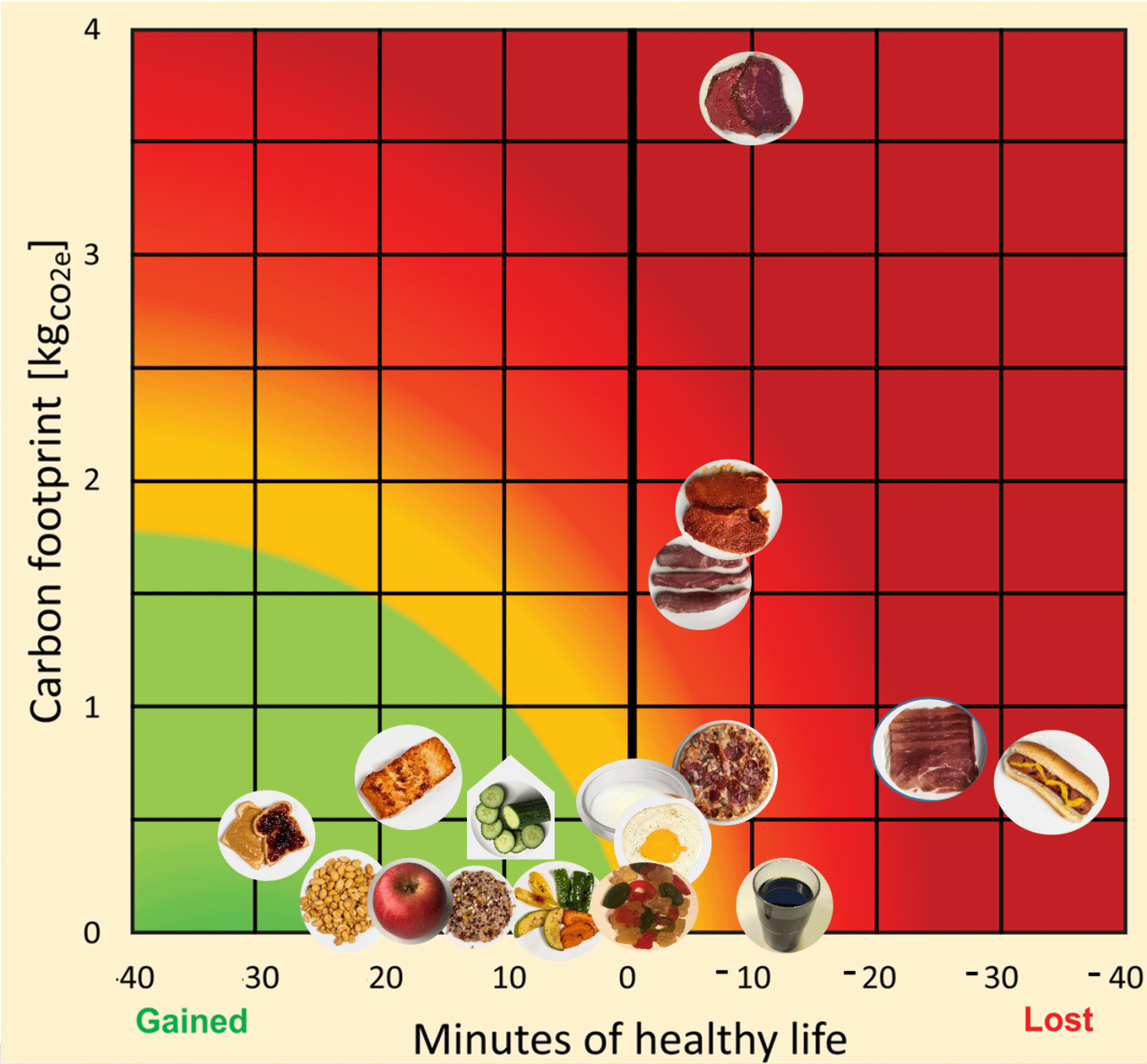
    The Health Nutritional Index that we developed turns this information into minutes of life lost or gained per serving size of each food item consumed. For instance, we found that eating one hot dog costs a person 36 minutes of “healthy” life. In comparison, we found that eating a serving size of 30 grams of nuts and seeds provides a gain of 25 minutes of healthy life – that is, an increase in good-quality and disease-free life expectancy.

    Our study also showed that substituting only 10% of daily caloric intake of beef and processed meats for a diverse mix of whole grains, fruits, vegetables, nuts, legumes and select seafood could reduce, on average, the dietary carbon footprint of a U.S. consumer by one-third and add 48 healthy minutes of life per day. This is a substantial improvement for such a limited dietary change.

    Individual dietary choices can add – or take away – minutes, hours and years of life
    Relative positions of select foods, from apples to hot dogs, are shown on a carbon footprint versus nutritional health map. Foods scoring well, shown in green, have beneficial effects on human health and a low environmental footprint. (Austin Thomason/Michigan Photography and University of Michigan, CC BY-ND)

    How did we crunch the numbers?

    We based our Health Nutritional Index on a large epidemiological study called the Global Burden of Disease, a comprehensive global study and database that was developed with the help of more than 7,000 researchers around the world. The Global Burden of Disease determines the risks and benefits associated with multiple environmental, metabolic and behavioral factors – including 15 dietary risk factors.

    Our team took that population-level epidemiological data and adapted it down to the level of individual foods. Taking into account more than 6,000 risk estimates specific to each age, gender, disease and risk, and the fact that there are about a half-million minutes in a year, we calculated the health burden that comes with consuming one gram’s worth of food for each of the dietary risk factors.

    For example, we found that, on average, 0.45 minutes are lost per gram of any processed meat that a person eats in the U.S. We then multiplied this number by the corresponding food profiles that we previously developed. Going back to the example of a hot dog, the 61 grams of processed meat in a hot dog sandwich results in 27 minutes of healthy life lost due to this amount of processed meat alone. Then, when considering the other risk factors, like the sodium and trans fatty acids inside the hot dog – counterbalanced by the benefit of its polyunsaturated fat and fibers – we arrived at the final value of 36 minutes of healthy life lost per hot dog.

    We repeated this calculation for more than 5,800 foods and mixed dishes. We then compared scores from the health indices with 18 different environmental metrics, including carbon footprint, water use and air pollution-induced human health impacts. Finally, using this health and environmental nexus, we color-coded each food item as green, yellow or red. Like a traffic light, green foods have beneficial effects on health and a low environmental impact and should be increased in the diet, while red foods should be reduced.

    Where do we go from here?

    Our study allowed us to identify certain priority actions that people can take to both improve their health and reduce their environmental footprint.

    When it comes to environmental sustainability, we found striking variations both within and between animal-based and plant-based foods. For the “red” foods, beef has the largest carbon footprint across its entire life cycle – twice as high as pork or lamb and four times that of poultry and dairy. From a health standpoint, eliminating processed meat and reducing overall sodium consumption provides the largest gain in healthy life compared with all other food types.

    Individual dietary choices can add – or take away – minutes, hours and years of life
    Beef consumption had the highest negative environmental impacts, and processed meat had the most important overall adverse health effects. (ID 35528731 © Ikonoklastfotografie | Dreamstime.com)

    Therefore, people might consider eating less of foods that are high in processed meat and beef, followed by pork and lamb. And notably, among plant-based foods, greenhouse-grown vegetables scored poorly on environmental impacts due to the combustion emissions from heating.

    Foods that people might consider increasing are those that have high beneficial effects on health and low environmental impacts. We observed a lot of flexibility among these “green” choices, including whole grains, fruits, vegetables, nuts, legumes and low-environmental impact fish and seafood. These items also offer options for all income levels, tastes and cultures.

    Our study also shows that when it comes to food sustainability, it is not sufficient to only consider the amount of greenhouse gases emitted – the so-called carbon footprint. Water-saving techniques, such as drip irrigation and the reuse of gray water – or domestic wastewater such as that from sinks and showers – can also make important steps toward lowering the water footprint of food production.

    A limitation of our study is that the epidemiological data does not enable us to differentiate within the same food group, such as the health benefits of a watermelon versus an apple. In addition, individual foods always need to be considered within the context of one’s individual diet, considering the maximum level above which foods are not any more beneficial – one cannot live forever by just increasing fruit consumption.

    At the same time, our Health Nutrient Index has the potential to be regularly adapted, incorporating new knowledge and data as they become available. And it can be customized worldwide, as has already been done in Switzerland.

    It was encouraging to see how small, targeted changes could make such a meaningful difference for both health and environmental sustainability – one meal at a time.

    [You’re smart and curious about the world. So are The Conversation’s authors and editors. You can get our highlights each weekend.]

    The Conversation

    Olivier Jolliet, Professor of Environmental Health Sciences, University of Michigan and Katerina S. Stylianou, Research Associate in Environmental Health Sciences, University of Michigan

    This article is republished from The Conversation under a Creative Commons license. Read the original article.

  • Why using fear to promote COVID-19 vaccination and mask wearing could backfire

    While the pandemic stakes might justify using hard-hitting strategies, the nation’s social and political context right now might cause fear tactics to backfire.

    You probably still remember public service ads that scared you: The cigarette smoker with throat cancer. The victims of a drunk driver. The guy who neglected his cholesterol lying in a morgue with a toe tag.

    With new, highly transmissible variants of SARS-CoV-2 now spreading, some health professionals have started calling for the use of similar fear-based strategies to persuade people to follow social distancing rules and get vaccinated.

    There is compelling evidence that fear can change behavior, and there have been ethical arguments that using fear can be justified, particularly when threats are severe. As public health professors with expertise in history and ethics, we have been open in some situations to using fear in ways that help individuals understand the gravity of a crisis without creating stigma.

    But while the pandemic stakes might justify using hard-hitting strategies, the nation’s social and political context right now might cause it to backfire.

    Fear as a strategy has waxed and waned

    Fear can be a powerful motivator, and it can create strong, lasting memories. Public health officials’ willingness to use it to help change behavior in public health campaigns has waxed and waned for more than a century.

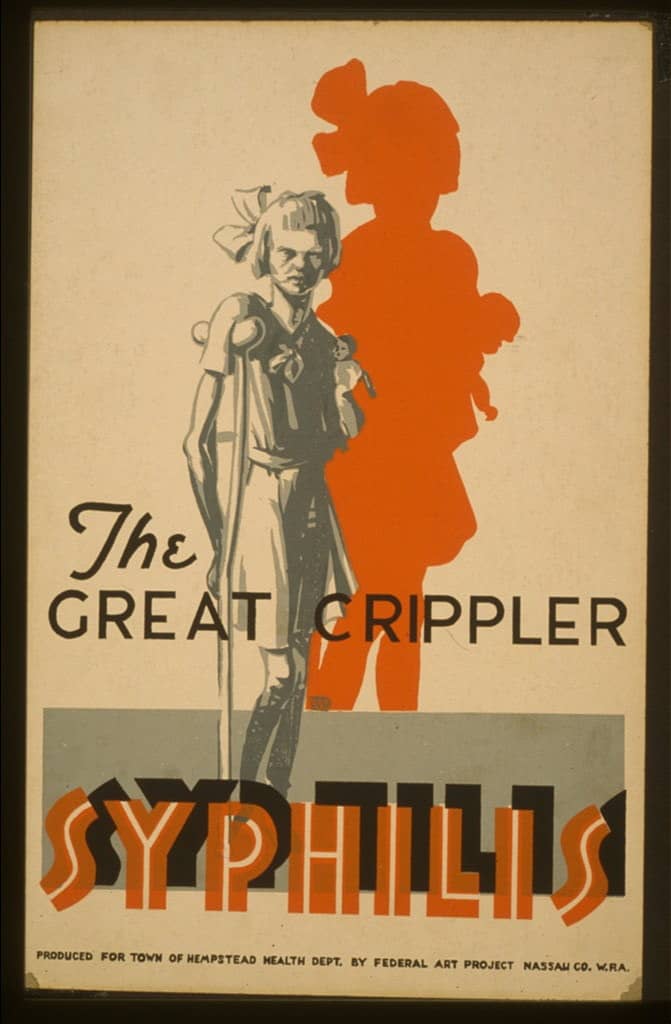
    From the late 19th century into the early 1920s, public health campaigns commonly sought to stir fear. Common tropes included flies menacing babies, immigrants represented as a microbial pestilence at the gates of the country, voluptuous female bodies with barely concealed skeletal faces who threatened to weaken a generation of troops with syphilis. The key theme was using fear to control harm from others.

    Why using fear to promote COVID-19 vaccination and mask wearing could backfire
    Library of Congress

    Following World War II, epidemiological data emerged as the foundation of public health, and use of fear fell out of favor. The primary focus at the time was the rise of chronic “lifestyle” diseases, such as heart disease. Early behavioral research concluded fear backfired. An early, influential study, for example, suggested that when people became anxious about behavior, they might tune out or even engage more in dangerous behaviors, like smoking or drinking, to cope with the anxiety stimulated by fear-based messaging.

    But by the 1960s, health officials were trying to change behaviors related to smoking, eating and exercise, and they grappled with the limits of data and logic as tools to help the public. They turned again to scare tactics to try to deliver a gut punch. It was not enough to know that some behaviors were deadly. We had to react emotionally.

    Although there were concerns about using fear to manipulate people, leading ethicists began to argue that it could help people understand what was in their self-interest. A bit of a scare could help cut through the noise created by industries that made fat, sugar and tobacco alluring. It could help make population-level statistics personal.

    Why using fear to promote COVID-19 vaccination and mask wearing could backfire
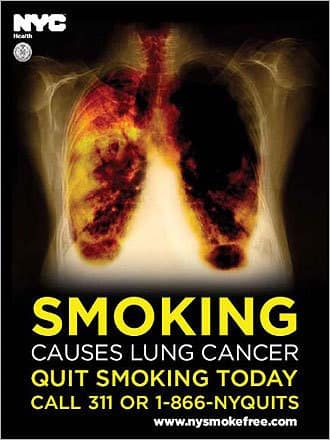
    NYC Health

    Anti-tobacco campaigns were the first to show the devastating toll of smoking. They used graphic images of diseased lungs, of smokers gasping for breath through tracheotomies and eating through tubes, of clogged arteries and failing hearts. Those campaigns worked.

    And then came AIDS. Fear of the disease was hard to untangle from fear of those who suffered the most: gay men, sex workers, drug users, and the black and brown communities. The challenge was to destigmatize, to promote the human rights of those who only stood to be further marginalized if shunned and shamed. When it came to public health campaigns, human rights advocates argued, fear stigmatized and undermined the effort.

    When obesity became a public health crisis, and youth smoking rates and vaping experimentation were sounding alarm bells, public health campaigns once again adopted fear to try to shatter complacency. Obesity campaigns sought to stir parental dread about youth obesity. Evidence of the effectiveness of this fear-based approach mounted.

    Evidence, ethics and politics

    So, why not use fear to drive up vaccination rates and the use of masks, lockdowns and distancing now, at this moment of national fatigue? Why not sear into the national imagination images of makeshift morgues or of people dying alone, intubated in overwhelmed hospitals?

    Before we can answer these questions, we must first ask two others: Would fear be ethically acceptable in the context of COVID-19, and would it work?

    For people in high-risk groups – those who are older or have underlying conditions that put them at high risk for severe illness or death – the evidence on fear-based appeals suggests that hard-hitting campaigns can work. The strongest case for the efficacy of fear-based appeals comes from smoking: Emotional PSAs put out by organizations like the American Cancer Society beginning in the 1960s proved to be a powerful antidote to tobacco sales ads. Anti-tobacco crusaders found in fear a way to appeal to individuals’ self-interests.

    At this political moment, however, there are other considerations.

    Health officials have faced armed protesters outside their offices and homes. Many people seem to have lost the capacity to distinguish truth from falsehood.

    By instilling fear that government will go too far and erode civil liberties, some groups developed an effective political tool for overriding rationality in the face of science, even the evidence-based recommendations supporting face masks as protection against the coronavirus.

    Reliance on fear for public health messaging now could further erode trust in public health officials and scientists at a critical juncture.

    The nation desperately needs a strategy that can help break through pandemic denialism and through the politically charged environment, with its threatening and at times hysterical rhetoric that has created opposition to sound public health measures.

    Even if ethically warranted, fear-based tactics may be dismissed as just one more example of political manipulation and could carry as much risk as benefit.

    Instead, public health officials should boldly urge and, as they have during other crisis periods in the past, emphasize what has been sorely lacking: consistent, credible communication of the science at the national level.

    Amy Lauren Fairchild, Dean and Professor, College of Public Health, The Ohio State University and Ronald Bayer, Professor Sociomedical Sciences, Columbia University

    This article is republished from The Conversation under a Creative Commons license. Read the original article.

  • The ‘Grief Pandemic’ Will Torment Americans for Years

    The optimism generated by vaccines and falling infection rates has blinded many Americans to the deep sorrow and depression of those around them.

    Cassandra Rollins’ daughter was still conscious when the ambulance took her away.

    Shalondra Rollins, 38, was struggling to breathe as covid overwhelmed her lungs. But before the doors closed, she asked for her cellphone, so she could call her family from the hospital.

    It was April 7, 2020 — the last time Rollins would see her daughter or hear her voice.

    The hospital rang an hour later to say she was gone. A chaplain later told Rollins that Shalondra had died on a gurney in the hallway. Rollins was left to break the news to Shalondra’s children, ages 13 and 15.

    More than a year later, Rollins said, the grief is unrelenting.

    Rollins has suffered panic attacks and depression that make it hard to get out of bed. She often startles when the phone rings, fearing that someone else is hurt or dead. If her other daughters don’t pick up when she calls, Rollins phones their neighbors to check on them.

    “You would think that as time passes it would get better,” said Rollins, 57, of Jackson, Mississippi. “Sometimes, it is even harder. … This wound right here, time don’t heal it.”

    With nearly 600,000 in the U.S. lost to covid-19 — now a leading cause of death — researchers estimate that more than 5 million Americans are in mourning, including more than 43,000 children who have lost a parent.

    The pandemic — and the political battles and economic devastation that have accompanied it — have inflicted unique forms of torment on mourners, making it harder to move ahead with their lives than with a typical loss, said sociologist Holly Prigerson, co-director of the Cornell Center for Research on End-of-Life Care.

    The scale and complexity of pandemic-related grief have created a public health burden that could deplete Americans’ physical and mental health for years, leading to more depression, substance misuse, suicidal thinking, sleep disturbances, heart disease, cancer, high blood pressure and impaired immune function.

    “Unequivocally, grief is a public health issue,” said Prigerson, who lost her mother to covid in January. “You could call it the grief pandemic.”

    Like many other mourners, Rollins has struggled with feelings of guilt, regret and helplessness — for the loss of her daughter as well as Rollins’ only son, Tyler, who died by suicide seven months earlier.

    “I was there to see my mom close her eyes and leave this world,” said Rollins, who was first interviewed by KHN a year ago in a story about covid’s disproportionate effects on communities of color. “The hardest part is that my kids died alone. If it weren’t for this covid, I could have been right there with her” in the ambulance and emergency room. “I could have held her hand.”

    The pandemic has prevented many families from gathering and holding funerals, even after deaths caused by conditions other than covid. Prigerson’s research shows that families of patients who die in hospital intensive care units are seven times more likely to develop post-traumatic stress disorder than loved ones of people who die in home hospice.

    The polarized political climate has even pitted some family members against one another, with some insisting that the pandemic is a hoax and that loved ones must have died from influenza, rather than covid. People in grief say they’re angry at relatives, neighbors and fellow Americans who failed to take the coronavirus seriously, or who still don’t appreciate how many people have suffered.

    “People holler about not being able to have a birthday party,” Rollins said. “We couldn’t even have a funeral.”

    Indeed, the optimism generated by vaccines and falling infection rates has blinded many Americans to the deep sorrow and depression of those around them. Some mourners say they will continue wearing their face masks — even in places where mandates have been removed — as a memorial to those lost.

    “People say, ‘I can’t wait until life gets back to normal,’” said Heidi Diaz Goff, 30, of the Los Angeles area, who lost her 72-year-old father to covid. “My life will never be normal again.”

    Many of those grieving say celebrating the end of the pandemic feels not just premature, but insulting to their loved ones’ memories.

    “Grief is invisible in many ways,” said Tashel Bordere, a University of Missouri assistant professor of human development and family science who studies bereavement, particularly in the Black community. “When a loss is invisible and people can’t see it, they may not say ‘I’m sorry for your loss,’ because they don’t know it’s occurred.”

    Communities of color, which have experienced disproportionately higher rates of death and job loss from covid, are now carrying a heavier burden.

    Black children are more likely than white children to lose a parent to covid. Even before the pandemic, the combination of higher infant and maternal mortality rates, a greater incidence of chronic disease and shorter life expectancies made Black people more likely than others to be grieving a close family member at any point in their lives.

    Rollins said everyone she knows has lost someone to covid.

    “You wake up every morning, and it’s another day they’re not here,” Rollins said. “You go to bed at night, and it’s the same thing.”

    A Lifetime of Loss

    Rollins has been battered by hardships and loss since childhood.

    She was the youngest of 11 children raised in the segregated South. Rollins was 5 years old when her older sister Cora, whom she called “Coral,” was stabbed to death at a nightclub, according to news reports. Although Cora’s husband was charged with murder, he was set free after a mistrial.

    Rollins gave birth to Shalondra at age 17, and the two were especially close. “We grew up together,” Rollins said.

    Just a few months after Shalondra was born, Rollins’ older sister Christine was fatally shot during an argument with another woman. Rollins and her mother helped raise two of the children Christine left behind.

    Heartbreak is all too common in the Black community, Bordere said. The accumulated trauma — from violence to chronic illness and racial discrimination — can have a weathering effect, making it harder for people to recover.

    “It’s hard to recover from any one experience, because every day there is another loss,” Bordere said. “Grief impacts our ability to think. It impacts our energy levels. Grief doesn’t just show up in tears. It shows up in fatigue, in working less.”

    Rollins hoped her children would overcome the obstacles of growing up Black in Mississippi. Shalondra earned an associate’s degree in early childhood education and loved her job as an assistant teacher to kids with special needs. Shalondra, who had been a second mother to her younger siblings, also adopted a cousin’s stepdaughter after the child’s mother died, raising the girl alongside her two children.

    Rollins’ son, Tyler, enlisted in the Army after high school, hoping to follow in the footsteps of other men in the family who had military careers.

    Yet the hardest losses of Rollins’ life were still to come. In 2019, Tyler killed himself at age 20, leaving behind a wife and unborn child.

    “When you see two Army men walking up to your door,” Rollins said, “that’s unexplainable.”

    Tyler’s daughter was born the day Shalondra died.

    “They called to tell me the baby was born, and I had to tell them about Shalondra,” Rollins said. “I don’t know how to celebrate.”

    Shalondra’s death from covid changed her daughters’ lives in multiple ways.

    The girls lost their mother, but also the routines that might help mourners adjust to a catastrophic loss. The girls moved in with their grandmother, who lives in their school district. But they have not set foot in a classroom for more than a year, spending their days in virtual school, rather than with friends.

    Shalondra’s death eroded their financial security as well, by taking away her income. Rollins, who worked as a substitute teacher before the pandemic, hasn’t had a job since local schools shut down. She owns her own home and receives unemployment insurance, she said, but money is tight.

    Makalin Odie, 14, said her mother, as a teacher, would have made online learning easier. “It would be very different with my mom here.”

    The girls especially miss their mom on holidays.

    “My mom always loved birthdays,” said Alana Odie, 16. “I know that if my mom were here my 16th birthday would have been really special.”

    Asked what she loved most about her mother, Alana replied, “I miss everything about her.”

    Grief Complicated by Illness

    The trauma also has taken a toll on Alana and Makalin’s health. Both teens have begun taking medications for high blood pressure. Alana has been on diabetes medication since before her mom died.

    Mental and physical health problems are common after a major loss. “The mental health consequences of the pandemic are real,” Prigerson said. “There are going to be all sorts of ripple effects.”

    The stress of losing a loved one to covid increases the risk for prolonged grief disorder, also known as complicated grief, which can lead to serious illness, increase the risk of domestic violence and steer marriages and relationships to fall apart, said Ashton Verdery, an associate professor of sociology and demography at Penn State.

    People who lose a spouse have a roughly 30% higher risk of death over the following year, a phenomenon known as the “the widowhood effect.” Similar risks are seen in people who lose a child or sibling, Verdery said.

    Grief can lead to “broken-heart syndrome,” a temporary condition in which the heart’s main pumping chamber changes shape, affecting its ability to pump blood effectively, Verdery said.

    From final farewells to funerals, the pandemic has robbed mourners of nearly everything that helps people cope with catastrophic loss, while piling on additional insults, said the Rev. Alicia Parker, minister of comfort at New Covenant Church of Philadelphia.

    “It may be harder for them for many years to come,” Parker said. “We don’t know the fallout yet, because we are still in the middle of it.”

    Rollins said she would have liked to arrange a big funeral for Shalondra. Because of restrictions on social gatherings, the family held a small graveside service instead.

    Funerals are important cultural traditions, allowing loved ones to give and receive support for a shared loss, Parker said.

    “When someone dies, people bring food for you, they talk about your loved one, the pastor may come to the house,” Parker said. “People come from out of town. What happens when people can’t come to your home and people can’t support you? Calling on the phone is not the same.”

    While many people are afraid to acknowledge depression, because of the stigma of mental illness, mourners know they can cry and wail at a funeral without being judged, Parker said.

    “What happens in the African American house stays in the house,” Parker said. “There’s a lot of things we don’t talk about or share about.”

    Funerals play an important psychological role in helping mourners process their loss, Bordere said. The ritual helps mourners move from denying that a loved one is gone to accepting “a new normal in which they will continue their life in the physical absence of the cared-about person.” In many cases, death from covid comes suddenly, depriving people of a chance to mentally prepare for loss. While some families were able to talk to loved ones through FaceTime or similar technologies, many others were unable to say goodbye.

    Funerals and burial rites are especially important in the Black community and others that have been marginalized, Bordere said.

    “You spare no expense at a Black funeral,” Bordere said. “The broader culture may have devalued this person, but the funeral validates this person’s worth in a society that constantly tries to dehumanize them.”

    In the early days of the pandemic, funeral directors afraid of spreading the coronavirus did not allow families to provide clothing for their loved ones’ burials, Parker said. So beloved parents and grandparents were buried in whatever they died in, such as undershirts or hospital gowns.

    “They bag them and double-bag them and put them in the ground,” Parker said. “It is an indignity.”

    Coping With Loss

    Every day, something reminds Rollins of her losses.

    April brought the first anniversary of Shalondra’s death. May brought Teacher Appreciation Week.

    Yet Rollins said the memory of her children keeps her going.

    When she begins to cry and thinks she will never stop, one thought pulls her from the darkness: “I know they would want me to be happy. I try to live on that.”

    Subscribe to KHN’s free Morning Briefing.

    View the original article at thefix.com

  • Addiction and Estrangement

    Remarkably, a tense relationship with a sister or brother in adolescence may contribute to substance abuse.

    Addiction can roil relationships with abuse, betrayal, and domestic violence, placing great stress on a family. Typically, parents and siblings who try to help or manage a family member’s addiction find themselves sapped of emotional energy and drained of financial resources. My survey shows as many as 10 percent of respondents suspect that a sibling is hiding an addiction.

    I wonder: Does the addiction produce family problems, or do a dysfunctional family’s issues result in addiction? It sounds like a chicken‑and‑egg question. I suppose at this moment the sequence of events doesn’t really matter to me. What I need is guidance on helping my brother conquer his alcoholism.

    Typically, when it comes to addiction, many experts advise using “tough love” to change behavior—promoting someone’s welfare by enforcing certain constraints on them or requiring them to take responsibility for their actions. The family uses relationships as leverage, threatening to expel the member who is addicted. The message of this model is explicit: “If you don’t shape up, we will cut you off.”

    Tough love relies on solid, established relationships; otherwise, the family member at risk may feel he or she has nothing to lose. My relationship with Scott is tenuous, anything but solid. He has lived without me for decades, and if I try tough love, he could easily revert to our former state of estrangement.

    I wonder if there might be another way.

    Possible Causes of Addiction

    Addiction is a complex phenomenon involving physiological, sociological, and psychological variables, and each user reflects some combination of these factors. In Scott’s case, because alcoholism doesn’t run in our family, I don’t think he has a biological predisposition to drink. I suspect my brother’s drinking results from other origins.

    Current research identifies unexpected influences that also may be at the root of addictive behavior, including emotional trauma, a hostile environment, and a lack of sufficient emotional connections. Addictive behavior may be closely tied to isolation and estrangement. Human beings have a natural and innate need to bond with others and belong to a social circle. When trauma disturbs the ability to attach and connect, a victim often seeks relief from pain through drugs, gambling, pornography, or some other vice.

    Canadian psychologist Dr. Bruce Alexander conducted a controversial study in the 1970s and 1980s that challenged earlier conclusions on the fundamental nature of addiction. Users, his research suggests, may be trying to address the absence of connection in their lives by drinking and/or using drugs. Working with rats, he found that isolated animals had nothing better to do than use drugs; rats placed in a more engaging environment avoided drug use.

    Similar results emerged when veterans of the war in Vietnam returned home. Some 20 percent of American troops were using heroin while in Vietnam, and psychologists feared that hundreds of thousands of soldiers would resume their lives in the United States as junkies. However, a study in the Archives of General Psychiatry reported that 95 percent simply stopped using, without rehab or agonizing withdrawal, when they returned home.

    These studies indicate that addiction is not just about brain chemistry. The environment in which the user lives is a factor. Addiction may, in part, be an adaptation to a lonely, disconnected, or dangerous life. Re‑ markably, a tense relationship with a sister or brother in adolescence may contribute to substance abuse. A 2012 study reported in the Journal of Marriage and Family entitled “Sibling Relationships and Influences in Childhood and Adolescence” found that tense sibling relationships make people more likely to use substances and to be depressed and anxious as teenagers.

    Those who grow up in homes where loving care is inconsistent, unstable, or absent do not develop the crucial neural wiring for emotional resilience, according to Dr. Gabor Maté, author of In the Realm of Hungry Ghosts, who is an expert in childhood development and trauma and has conducted extensive research in a medical practice for the underserved in downtown Vancouver. Children who are not consistently loved in their young lives often develop a sense that the world is an unsafe place and that people cannot be trusted. Maté suggests that emotional trauma and loss may lie at the core of addiction. Addiction and Estrangement

    A loving family fosters resilience in children, immunizing them from whatever challenges the world may bring. Dr. Maté has found high rates of childhood trauma among the addicts with whom he works, leading him to conclude that emotional damage in childhood may drive some people to use drugs to correct their dysregulated brain waves. “When you don’t have love and connection in your life when you are very, very young,” he explains, “then those important brain circuits just don’t develop properly. And under conditions of abuse, things just don’t develop properly and their brains then are susceptible then when they do the drugs.” He explains that drugs make these people with dysregulated brain waves feel normal, and even loved. “As one patient said to me,” he says, “when she did heroin for the first time, ‘it felt like a warm soft hug, just like a mother hugging a baby.’”

    Dr. Maté defines addiction broadly, having seen a wide variety of addicted behaviors among his patients. Substance abuse and pornography, for example, are widely accepted as addictions. For people damaged in childhood, he suggests that shopping, chronic overeating or dieting, incessantly checking the cell phone, amassing wealth or power or ultramarathon medals are ways of coping with pain.

    In a TED Talk, Dr. Maté, who was born to Jewish parents in Budapest just before the Germans occupied Hungary, identifies his own childhood traumas as a source of his addiction: spending thousands of dollars on a collection of classical CDs. He admits to having ignored his family—even neglecting patients in labor—when preoccupied with buying music. His obsessions with work and music, which he characterizes as addictions, have affected his children. “My kids get the same message that they’re not wanted,” he explains. “We pass on the trauma and we pass on the suffering, unconsciously, from one generation to the next. There are many, many ways to fill this emptiness . . . but the emptiness always goes back to what we didn’t get when we were very small.”

    That statement hits home. Though my brother and I didn’t live as Jews in a Nazi‑occupied country, we derivatively experienced the pain our mother suffered after her expulsion from Germany and the murder of her parents. Our mother’s childhood traumas resulted in her depression and absorption in the past and inhibited her ability to nurture her children.

    Still, in the end, it’s impossible to determine precisely the source of an addiction problem. Maybe it doesn’t matter anyway. The real question is, What can I do about it?
     

    Excerpted from BROTHERS, SISTERS, STRANGERS: Sibling Estrangement and the Road to Reconciliation by Fern Schumer Chapman, published by Viking Books, an imprint of Penguin Publishing Group, a division of Penguin Random House, LLC. Copyright © 2021 by Fern Schumer Chapman. Available now.

    View the original article at thefix.com

  • The End

    The End

    With each sip I take, my brain and body scream “you freaking alcoholic,” and I know at that moment I can no longer do this.

    The last drink I have is a flute of champagne.

    It’s New Year’s Eve.

    My husband reserves a special room for us at a nearby hotel. He buys an imperial bottle of Moet, a misplaced purchase for this particular occasion. We’re making a last ditch effort at saving our marriage. A gala’s going on in the ballroom below, where we journey to join the revelers.

    Lights twinkle, streamers hang, and chandeliers glisten.

    I hardly notice.

    The band plays songs that were once my favorites.

    I hardly hear. 

    Hoards of gleeful couples celebrate around us.

    We dance with them, pretending to have a good time.

    But I know the end is creeping near.

    My husband’s been having an affair with a woman half his age. He hasn’t come clean yet, but my gut knows something’s going on. So I bleach my hair a sassier shade of blond, starve myself in hopes of losing the weight I know he hates, turn myself inside out to get him to notice me again.

    But mostly I drink.

    Because of my Catholic upbringing, I have a list of rules I follow.

    My commandments of drinking. I only have three. Ten is too many.

    1) No drinking before 5:00. I watch the clock tick away the minutes. It drives me crazy.

    2) No drinking on Tuesdays or Thursdays. I break this all the time. It’s impossible not to.

    3) No hard liquor. Only wine and beer. I feel safe drinking those.

    Anything else means, well, I’ve become my parents.

    Or even worse, his. I can’t bear to go there.

    One night, when he takes off for a weekend conference, or so he says, I get so stinking drunk after tucking my daughter in for the night, I puke all over our pinewood floor. All over those rich amber boards I spent hours resurfacing with him, splattering my guts out next to our once sexually active and gleaming brass bed.

    Tarnished now from months of disuse.

    The following morning, my five-year-old daughter, with sleep encircling her concerned eyes, stands there staring at me, her bare feet immersed in clumps of yellow. The scrambled eggs I managed to whip up the night before are scattered across our bedroom floor, reeking so bad, I’m certain I’ll start retching again. I look down at the mess I made with little recollection of how it got there, then peer at my daughter, her eyes oozing the compassion of an old soul as she says, “Oh Mommy. Are you sick?” Shame grips every part of my trembling body. Its menacing hands, a vice around my pounding head. I can’t bear to look in her eyes. The fear of not remembering how I’ve gotten here is palpable. Every morsel of its terror is strewn across my barf-laden tongue and I’m certain my daughter knows the secret I’ve kept from myself and others for years.

    You’re an alcoholic. You can’t hide it anymore.

    Every last thread of that warm cloak of denial gets ripped away, and here I am, gazing into the eyes of my five-year old daughter who’s come to yank me out of my misery.

    It takes me two more months to quit.

    Two months of dragging my body, heavy with remorse, out of that tarnished brass bed to send my daughter off to school. Then crawling back into it and staying there, succumbing to the disjointed sleep of depression. Until the bus drops her off hours later, as her little finger, filled with endless kindergarten stories, pokes me awake.

    Each poke like being smacked in the face with my failures as a mother.

    The EndAnd then New Year’s Eve shows up and I dress in a slinky black outfit, a color fitting my descending mood, a dress I buy to win him back. The husband who twelve years before drives hundreds of miles to pursue this wayward woman, wooing me over a dinner I painstakingly prepare, as I allow myself to wonder if he in fact, may be the one. We dine on the roof of the 3rd floor apartment I rent on 23rd and Walnut, in the heart of Philadelphia where I work as a chef, and where I tell him over a bottle of crisp chardonnay that I might be an alcoholic. He laughs, and convinces me I’m not. He knows what alcoholics look like. Growing up with two of them, he assures me I am nothing at all like his parents.

    His mother, a sensuous woman with flaming hair and lips to match, passes out in the car on late afternoons after spending hours carousing with her best friend, a woman he’s grown to despise. Coming home from school, day after day, he finds her slumped on the bench seat of their black Buick sedan, dragging her into the house to make dinner for him and his little brother and sister, watching as she staggers around their kitchen. His father, a noted attorney in his early years, drinks until he can’t see and rarely comes home for supper. He loses his prestigious position in the law firm he fought to get into, and gets half his jaw removed from the mouth cancer he contracts from his unrestrained drinking. He dies at 52, a lonely and miserable man.

    “I know what alcoholics look like,” he says. “You’re not one of them.”

    I grab onto his reassurance and hold it tight.

    And with that we polish off the second bottle of chardonnay, crawl back through the kitchen window and slither onto the black and white checkered tile floor, in a haze of lust and booze, before we creep our way into my tousled and beckoning bed. It takes me another twelve years to hit bottom, to peek into the eyes of the only child I bring into this world, reflecting the shame I’ve carted around most of my life.

    So on New Year’s Eve, we make our way up in the hotel elevator. After crooning Auld Lang Syne with the crowd of other booze-laden partiers still hanging on to the evening’s festivities, as the bitter taste of letting go of something so dear, so close to my heart, seeps into my psyche. A woman who totters next to me still sings the song, with red stilettos dangling from her fingers. Her drunken haze reflects in my eyes as she nearly slides down the elevator wall.

    At that moment, I see myself.

    The realization reluctantly stumbles down the hall with me, knowing that gleaming bottle of Moet waits with open arms in the silver bucket we crammed with ice before leaving the room. Ripping off the foil encasing the lip of the bottle, my husband quickly unfastens the wire cage and pops the cork that hits the ceiling of our fancy room. Surely an omen for what follows. He carefully pours the sparkling wine, usually a favorite of mine, into two leaded flutes huddling atop our nightstand, making sure to divide this liquid gold evenly into the tall, slim goblets that leave rings at night’s end. We lift our glasses and make a toast, to the New Year and to us, though our eyes quickly break the connection, telling a different story.

    As soon as the bubbles hit my lips, from the wine that always evokes such tangible joy and plasters my tongue with memories, I know the gig’s up. It tastes like poison. I force myself to drink more, a distinctly foreign concept, coercing a smile that squirms across my face. I nearly gag as I continue to shove the bubbly liquid down my throat, not wanting to hurt my husband’s feelings, who spent half a week’s pay on this desperate celebration. But with each sip I take, my brain and body scream you freaking alcoholic, and I know at that moment I can no longer do this. When I put down that glass, on this fateful New Year’s Eve, I know I’ll never bring another ounce of liquor to my lips.

    I’m done.

    There’s no turning back.

    And as we tuck ourselves into bed, I keep it to myself. 

    Each kiss that night is loaded with self-loathing and disgust. 

    Those twelve years of knowing squeezes tightly into a fist of shame.

    Little does my husband know, if he climbs on top of me,

    he’ll be making love to death itself. 

    Instead, I turn the other way and cry myself silently to sleep.

    Your days of drinking have finally come to an end.

    And you can’t help but wonder…

    will your marriage follow?


    Excerpted from STUMBLING HOME: Life Before and After That Last Drink by Carol Weis, now available on Amazon.

    View the original article at thefix.com