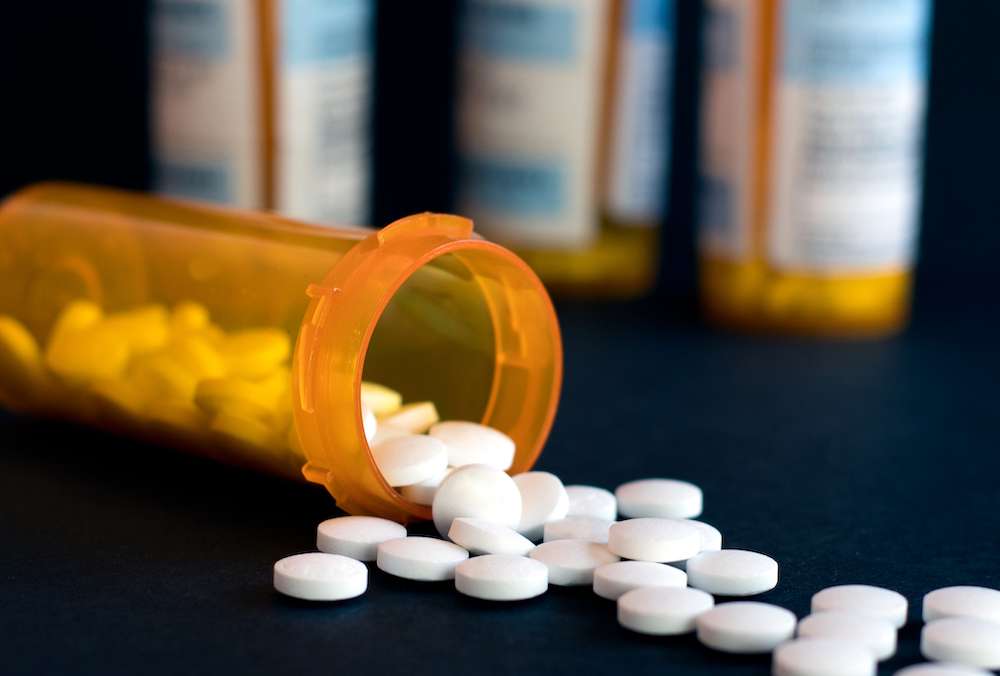
Relaxing privacy rules about patients’ addiction histories could save lives, the administration argues.
The Trump administration could soon weaken patient privacy laws for people who have received treatment for addiction. The intent is to stop doctors and other types of treatment centers from unknowingly providing prescription pain pills or other addictive drugs to patients who have a history of addiction.
The proposed change would let medical providers add addiction treatments into patients’ standard medical records. Health Secretary Alex Azar hopes to make changes to the rules because he believes they prevent doctors and other health care professionals from getting crucial information that patients themselves have already agreed to share.
These regulations “serve as a barrier to safe, coordinated care for patients,” Azar argued. “The information is currently so tightly restricted that even with the patient’s consent to share information, some health care providers are unwilling to record needed information on a patient’s health or treatment.”
Jessie’s Law
To bolster his point, Azar pointed to Jessie’s Law, which gets its namesake from a patient named Jessica Grubb. She was prescribed oxycodone after knee surgery despite having told her doctors about her history of addiction and died from an overdose the night she was released from the hospital.
Similar laws have been bandied about in the halls of Congress. Despite initial bipartisan support, the bills lost steam in the Senate.
Avoiding Stigma
Not everyone sees eye-to-eye with Azar’s point of view. Opioid abuse advocacy groups, such as the American Association for the Treatment of Opioid Dependence and the Legal Action Center, have voiced concerns regarding involuntarily including such information on patient medical records.
In their view, some patients might dodge the much-needed treatments in order to avoid the heavy stigma that comes with addiction treatment. According to these groups, just 10% of Americans suffering from substance use disorder sought treatment last year, and that number could be even lower if such regulations were passed.
But Azar’s camp remains unconvinced in the face of an increasingly concerning epidemic.
“All of the changes that we are proposing still are premised on patient consent,” said Azar.
Having this information be accessible is crucial “to determine whether a patient was receiving treatment for opioid use disorder,” Azar argued. “And that is information that could save a patient’s life.”
I’ll get high to hide my pain and as an excuse. It’s stupid, just plain stupid. I’ve never known drugs to help anyone. It’s so crazy to hate it so much but to do it still. I don’t understand that insanity.
The “Hollywood Madam” lives today with scores of noisy exotic birds in the small town of Pahrump, Nevada. Remembering her prison days, she now dedicates herself to freeing macaws from their cages.
When Fleiss was arrested in 1993 for charges including attempted pandering, her escort service employed 500 beautiful girls-next-door who were like porn stars in the bedroom. They charged clients what today would be almost $3,000 a night, and Fleiss grew rich by keeping 40 percent of those earnings. Partying hard and living in the fast lane led to struggles with addiction.
Although she never served time for her work in the sex industry, a federal tax evasion case led to 20 months in prison in Dublin, California. While incarcerated, she longed for her freedom; this longing served as the genesis of her efforts with macaw rescue.
We recently got the inside scoop from Heidi on prison, reality TV, addiction, and her mission to free birds.
The Fix: Today, your passion is providing freedom to dozens of macaws, beautiful parrot-like exotic birds that you live with on the outskirts of Pahrump, Nevada. You describe how seeing a caged bird reminded you of your experience in prison. Is being of service to these birds who once were forced to live in boxes a reflection of personal redemption?
Heidi Fleiss: You pretty much got it. After prison, I did see the world differently. I saw a beautiful macaw in a cage, and it really bothered me. I asked the owner when was the last time it was out of its cage. She said, “I don’t know. Maybe 20 or 30 years.” The bird actually had dust on it. I realized I could not go on with my life, knowing that bird was still in that cage. It seemed so awful to have wings and be stuck in a cage, of all things. Imagine 45 years in a basement with another 45 years to go.
It has never been properly addressed. We are a civilized society. How can we do this? The subjugation of this species is selfish and self-absorbed. It’s a tortuous, bleak existence. It’s so painful for them because their bodies aren’t meant for sedentary lives. They struggle with this lonely, painful existence. Do you really think these animals with wings are on this earth to say bad words and to dance for us? It’s disgusting, and everybody should find it offensive. Are we really that selfish?
Before prison, I never paid attention to or cared about a bird in a cage. I lived with this one rich boyfriend, and we had lots of birds in cages. I’d walk by them every day, and I looked at them like I looked at pictures on the wall. It didn’t matter. Now that I’m aware, I can’t ignore it. I have to be proactive. I rescue them from parrot prison and give them a life outside of a cage. (In the background, macaws screech loudly.) They need to have some other option beyond living and dying in a cage. Today, I am that option. I did not want to do this with my life. I still do not want to do this, but somebody has to do it.
In terms of your attempts to maintain your sobriety, you say, “I struggle. I struggle with my addiction. And it’s tough because I’ll be doing so well. And I don’t know what will make me flip.” When you have fallen off the proverbial wagon in the past, what triggered you? What tools do you use today to avoid such triggers?
I am just coming off of a slip right now. I’m barely off of one. Obviously, there are some personal demons that I can’t confront. Sometimes I cannot accept the mistakes that I’ve made. Dealing with a relapse seems easier than continuing to deal with the pain. I’ll get high to hide my pain and as an excuse. It’s stupid, just plain stupid. I’ve never known drugs to help anyone. It’s so crazy to hate it so much but to do it still. I don’t understand that insanity.
Was the business a pure money-making venture for you? How many of the women involved in the sex business view it purely as a money-making business, and how many of the women struggle with substance use or behavioral disorders like love addiction and sex addiction? Do you think a madam is to a sex addict what a dealer is to a drug addict?
Absolutely not. In any professional field, whether it’s the medical industry or the legal industry or education or the sex industry, you’re going to find the same amount of problems: sex addiction, drug addiction, hang-ups from being molested, or this and that. You’re going to find just about the same ratio that I went through in the sex industry with just about any of these other professions. You really will.
As for the sex addiction question, that’s the man’s point of view. They think the women do it because they love it. They don’t do it because they love it. They do it for money. And they are introduced to a world they would never have experienced otherwise. Who else gets to spend a summer yachting on the French Riviera? The people that worked for me traveled the world, and many had incredible, unique experiences. It’s very hard for people to understand the world that I was in. When you are dealing with the wealthiest people in the world, what happens is rare and beyond expectation. A million dollars is nothing to a billionaire. It’s hard to fathom that kind of life when it’s combined with having a good time.
You don’t have to have a golden pussy to get a hundred thousand dollars. It has nothing to do with that. Rather, it’s about the circles you travel in, and I was able to access the people with that kind of money. That’s what it’s all about, and it’s really hard to understand the way money works at that level. All that stuff was a long time ago, it was a lot of fun, but it seems silly now to me, particularly in light of what I do today.
Speaking to Vice, you said that the public humiliation you experienced on Celebrity Rehab with Dr. Drew was actually therapeutic. Can you help us understand how it was therapeutic to have dirty laundry aired on national television?
When I was asked to do that show, I was like no way. I’m not going to be humiliated on television. You have to be a real idiot to do that show. There’s no way on earth. I turned it down, and then they contacted me again. I changed my mind. I don’t know why I decided to do it, but it was probably the five hundred thousand dollars. It turned out to be one of the best experiences of my life, and I wish they would start doing that show again.
Really?
Yes.
Why?
I think it’s really helpful to people both on and off the show. Yes, you’re watching someone else’s train wreck, but that’s what we always do. I don’t think it’s any more exploitive than anything else. You learn when you watch other people that you’re not alone whatever you’re going through and that there might be a way out.
Dr. Drew is a genuine person and a great guy. He truly cares, and I found him to be one hundred percent sincere. He’s the real deal. He’s not a fraud or a phony. Ever since I first met him when I was 27 and sent to my first rehab, he’s been a consistently wonderful guy.
You are famously quoted as saying, “I was too lazy in bed to be a prostitute.” Did this laziness change when crystal meth entered the picture? Was your sexual relationship with Tom Sizemore as charged and powerful as Celebrity Rehab with Dr. Drew made it out to be?
I hate crystal meth. It still plagues me. I don’t see it as a sex drug. I think if you connect with someone, you connect with someone. I did crystal meth before and after I was with Tom, and I didn’t have these freakily intense sexual relationships. If you do not want to sleep with someone, drugs certainly do help. They really help.
Personally, when it comes to sex, I don’t want to see anyone disrobe in front of me again. When it comes to sex, I’m done. I don’t want to have sex ever again. And this is from someone who’s slept with everything and everyone. I slept with a guy who rode on the Queen Mary when it was a ship, and I’ve only known it to be a tourist attraction. I’m not saying that I’m a new virgin or anything, but I don’t even want to have sex ever again. It doesn’t matter to me at all.
Do you think people can be addicted to sex? What about addicted to love? Do you believe that you have suffered from sex addiction or love addiction?
I definitely have never had a sex addiction. I’ve had a sex drive, and I’ve had lots of sex, it’s never dominated my life. I’ve felt that I’ve got to get laid or I got to have sex or my life will fall apart. That’s not me. Mind you, I’ve had mornings where I’ve woken up and looked over to find someone in my bed, and I have to ask myself, “Is that a boy or a girl?” Never ever has sex been the driving force in my life. I think the word “addiction” can mean a lot of things. People always talk about moderation, but I don’t believe in any of that. If you want to ruin your life, just do drugs.
Love addiction can be co-dependency. I know women who do not feel complete unless they have a man in their life. I also know girls who go out at night with one purpose in mind. If they don’t get laid, then no matter what happens, it’s not a good night. It’s only good if they get laid. Father complexes and mother complexes drive those behaviors. They feed off of abandonment issues and get even complex.
Also, my girls were not sex addicts or love addicts. They were prostitutes, and they were professionals. I went for the best. I wanted the cover of Seventeen magazine. None of them were underage, but I wanted the girls that looked like cheerleaders. I wanted the girls that knew how to fuck like a porn star but looked like the girl next door. (The squawking of the macaws intensifies.)
You once lived a life that most people cannot even imagine. You told Vice about the parties at your house in the Hollywood Hills, saying, “They didn’t have sex for money at my house, but they would come to hang out. It was social… You’ve got people like Jack Nicholson and Mick Jagger partying at your house… I remember coming home, and Prince was dancing in my living room.” Do you miss those days?
I remember walking out of my bedroom to see Prince dancing in my living room. I thought it was way cool, and I couldn’t even stick around to enjoy it. I had to go to a Beverly Hills Hotel bungalow to check in so I could manage my business. It was too loud at my house to get anything done. There were a lot of good times, but I also worked hard.
Do I miss it? (There is a pause as a macaw screeches in the background.) Look, when you’re young and a girl in Los Angeles, it’s hard to do any better than I did. For a long time, I had the best of everything: food, sex, drugs, people, clubs, hotels, and more. I was having a good time, and it seemed like the party never ends.
As a woman gets older, it’s harder and different. When those things don’t work anymore, it changes you. The only thing I miss about Los Angeles today is there’s a lot of opportunity there. I don’t miss that life even when these birds are driving me crazy. I’ve had a great life and good times, but saving these birds right now is the only thing that matters to me.
(This interview was edited for length and clarity.)
Midwest states were among those with the lowest overdose death rates in the country.
Statistics from the CDC show that drug overdose death rates in the United States rose nearly 10% between 2016 and 2017, with the highest death rates occurring in the Midwest, Mid-Atlantic and Southern regions of the country.
Though all points in the U.S. saw significant increases during this time period, three states experienced the highest overdose death rates—West Virginia, Ohio, and Kentucky—as well as the District of Columbia. Opioids were involved in more than half of the overdose fatalities.
As shown by the CDC data, drug overdose deaths in the United States rose 9.6% between 2016 and 2017; the death toll from drug overdoses reached 70,237. Opioids were involved in 67.8% of those deaths, and of that number, the CDC stated that synthetic opioids other than methadone were the primary cause of death.
Big Increases
Twenty-three states saw what the CDC described as “significant” increases in drug overdose deaths during this time period, including Alabama, California, Illinois, Maine, New York and Wisconsin. Though certain states had substantially high increases from 2016 to 2017—death rates in Maine rose 19.9% during this period—the number of deaths per year in these states were actually lower on a year-to-year basis than other states.
For example, Ohio’s death rate percentage between 2016 and 2017 was 18.4%, but the actual number of deaths in that state during those years, when adjusted for age and size of population, was significantly higher in the Buckeye State (4,329 per 100,000 in 2016 and 5,111 in 2017) than in Maine (353 per 100,000 in 2016 and 424 in 2017).
When age and number of residents was factored into the individual states’ rates, Ohio ranked second in highest death rates, with 46.3 deaths per 100,000 residents in 2017; it was preceded by West Virginia (57.8 per 100,000) and followed by the District of Columbia (44 per 100,000)—which actually saw a decrease, percentage wise, between 2016 and 2017—and Kentucky (37.2 per 100,000).
The Lowest Death Rates
The states with the lowest death rates in 2017 were North Dakota, Nebraska and South Dakota, each of which either dropped or experienced death rates below 6% between 2016 and 2017.
Response to the epidemic by state-run agencies has made improvements in death rates for 2018 and beyond.
The New York Times noted that areas in Ohio, including the city of Dayton, have utilized federal and state grants to help reduce opioid prescriptions, expand access to the opioid overdose reversal drug, naloxone, and increase addiction treatment to residents and prison inmates. As a result, emergency room visits dropped by more than 60% between January 2017 and June of 2018.
A new study found that people with a specific gene mutation and stressful lives were more likely to use drugs or alcohol before they were 15.
People who have a specific gene mutation and who experience adverse experience early in life increase their risk for alcoholism and drug use, according to a study released this week.
The study, published in the journal Alcoholism: Clinical and Experimental Research, found that a mutation of the gene COMT, which helps the body manage dopamine, is connected with increased risk for alcoholism and drug use when people with the mutation experience early childhood adversity.
The research was conducted at the University of Oklahoma.
“Early-life adversity doesn’t make everyone an alcoholic,” study author William R. Lovallo, of the University of Oklahoma College of Medicine said in a news release. “But this study showed that people with this genetic mutation are going to have a higher risk for addiction when they had a stressful life growing up.”
A Look at the Gene Mutation
People with the mutation were more affected by stress, which might include events like divorce, abuse or distant parents. People with the mutation and stressful lives were more likely to use drugs or alcohol before they were 15, a major risk factor for future drug use.
Lovallo explained, “This one random mutation makes a difference in how the COMT gene works fine in one person but not as well in another person. There is no such thing as a gene for addiction, but there are genes that respond to our environment in ways that put us at risk. You have to have the right combination to develop the risk factors.”
Lovallo has been researching addiction and risk factors for more than 20 years.
“Addiction is a real health problem, and to be making progress toward understanding it is one of the most exciting and worthwhile things I’ve ever done,” he said.
Environment & Genetics
Identifying a specific gene that increases the risk factors for addiction is a major triumph, he said. The interplay of genetics and environmental factors can help us better understand addiction and who is most at risk for developing substance use disorders, he said.
“Many of us know people who drink alcohol moderately and never have any problems. And we know people who drink a little and then go down the path toward alcoholism,” Lovallo said. “What’s the difference between going down that path and not going down that path? Now we have a better understanding that it’s not just exposure to alcohol or drugs that leads to problems; there is a genetic component.”
Endo and Allergan will still face ongoing litigation with dozens of other municipalities.
Two drug makers have settled with two Ohio counties ahead of an upcoming federal opioid trial in Cleveland.
Endo International and Allergan will pay a combined $15 million in damages to Cuyahoga and Summit counties in Ohio. Both companies avoided admitting any wrongdoing.
The settlement comes ahead of a landmark trial slated to start Oct. 21—which will hear arguments by local governments, Native American tribes and more from around the country alleging that the drug companies fueled the opioid crisis.
Right now, other major drug manufacturers and distributors including Purdue Pharma, Teva, Johnson & Johnson, McKesson, and AmerisourceBergen will still proceed to trial in the fall, according to STAT News.
Although Endo settled, the company faces ongoing litigation with other municipalities, including more than 2,300 cases filed by counties and cities.
The Deal
Endo’s deal with the Ohio counties indicates that the company could settle its suits globally for about $1.8 billion, according to FiercePharma. That’s lower than the $4 billion in settlements that was initially predicted for the company. One analyst said that the lower-than-expected settlement amount indicates that drug manufacturers may be “out of the woods.”
After the settlement was announced, Endo and other pharmaceutical stocks were trading higher, indicating that investors were pleased with the settlement amount. Although Allergan did not comment on the settlement, Matthew Maletta, Endo’s executive vice president and chief legal officer said that the agreement was a “favorable outcome.”
One analyst, John Leppard, said that the settlement amount from Endo was likely calculated based on what the company thought it would cost to go to trial.
The agreement “appears designed only to spare Endo the expense of the bellwether trial, rather than satisfying their overall potential costs in a comprehensive resolution of government-related opioid claims with the approximately 2,000 cities and counties party to the multi-district litigation,” he wrote. “The cash portion of this settlement appears intended to reflect Endo’s estimated costs of having to participate in the bellwether trial itself, rather than their overall liability or culpability.”
In addition to the $10 million cash settlement, Endo agreed to provide the counties with up to $1 million of the drugs Vasostrict and Adrenalin free of charge. Vasostrict is a hormone used to treat diabetes, blood pressure and other conditions. Adrenalin is used in EpiPens.
The settlement could be an indication of the amounts that other pharmaceutical companies may settle for ahead of thousands of other upcoming lawsuits.
The CDC has identified 94 cases of pulmonary illnesses associated with vaping over the past couple of months.
The Centers for Disease Control and Prevention (CDC) is currently investigating an outbreak of “severe lung illness associated with vaping,” according to an agency statement.
They have reportedly identified “94 possible cases of severe lung illness associated with vaping” across 14 states from June 28 to August 15 of this year.
“CDC is providing consultation to the departments of health in Wisconsin, Illinois, California, Indiana, and Minnesota about a cluster of pulmonary illnesses linked to e-cigarette product use, or ‘vaping,’ primarily among adolescents and young adults,” the statement reads. “Additional states have alerted CDC to possible (not confirmed) cases and investigations into these cases are ongoing.”
Although the CDC has not yet concluded that vaping was the cause of each or any of the 94 cases identified, they have not found evidence that the illnesses were caused by an infectious disease.
Spike In Severe Lung Illnesses
According to Live Science, all of the patients have reported vaping either nicotine or cannabis products, and the most likely explanation for the sudden spike in severe lung illnesses would therefore be a toxic chemical found in e-cigarette devices. Boston University School of Public Health Professor Dr. Michael Siegel believes that this chemical is likely a “contaminant that is present in certain formulations of cannabis products” that may have been sold outside of legal means.
It may be difficult to determine exactly what is causing these illnesses due to the fact that the U.S. Food and Drug Administration (FDA) does not actively regulate vaping devices. Multiple recent studies have found evidence that e-cigarette vapor contains a number of chemicals harmful to the lungs and possibly other parts of the body as the agents enter the bloodstream.
A report released by the National Academies of Science, Engineering and Medicine in 2018 that reviewed over 800 studies on the subject “concluded that e-cigarettes both contain and emit a number of potentially toxic substances,” according to the American Lung Association.
In spite of increasing warnings from scientific organizations and government agencies, e-cigarette use continues to rise, particularly among young people. A report released in late 2018 found that the rate of vaping among high school students jumped by 78% in a single year.
This led American Cancer Society vice president for Tobacco Control, Cliff Douglas, to urge the FDA to “act as aggressively and expeditiously as possible to stem this dangerous turn of events.”
The CDC investigation is ongoing and the public will be updated with new information as it becomes available.
Former pitcher Octavio Dotel and ex-infielder Luis Castillo—both Dominican-born and both World Series Winners in 2011 and 2003, respectively—were accused by authorities of helping to launder profits from a drug ring overseen by César “The Abuser” Peralta, whom authorities said is in charge of one of the “most important drug trafficking structures in the Caribbean.”
Dotel was taken into custody in the Dominican Republic on Monday (Aug. 19), while Castillo remained at home in Florida; both men have claimed no involvement with Peralta’s organization.
Laundering Profits
The implications were announced by the attorney general of the Dominican Republic, Jean Alain Rodríguez, on Wednesday (Aug. 21). CNN noted that while charges against the two former MLB players remain unspecified, both were accused of laundering profits from Peralta’s drug operation as part of a larger network of businesses and individuals, including family members.
“Eighteen other people are linked to this network, including athletes and baseball players Octavio Dotel and Luis Castillo,” said Rodriguez at a news conference. He added that Dominican authorities, in conjunction with the FBI and Drug Enforcement Administration (DEA), were cooperating in the search for Peralta and the 18 aforementioned individuals.
The New York Times stated that the investigation by Dominican officials has already seized a 1,050-kilogram shipment of drugs from South America that was linked to Peralta’s alleged ring.
Castillo Speaks
Castillo responded to the accusation on social media, where he wrote, “The truth is my country no longer works, my God, do you think that after making millions in Baseball I am going to dirty my hands with drugs?”
Castillo’s attorney, Darren Heitner, told CNN that he “simply lack[ed] any information whatsoever” about the allegations against his client, and claimed that the Dominican attorney general’s office hung up on him when he called to inquire about the indictment.
Neither news organization listed a comment from Dotel.
Castillo was a three-time All-Star and Gold Glove second baseman whose 15-year major league career included a World Series title as part of the Florida Marlins in 2003 and stints with the Minnesota Twins and New York Mets.
Dotel held the record for playing for the largest number of teams—13 between 1999 and 2013. He earned his World Series ring as a member of the St. Louis Cardinals in 2011. Two years later, he also claimed the World Baseball Classic title as part of the Dominican team.
“If ur in the middle of the dark times…I promise you it doesn’t have to last forever,” Haynes wrote on Instagram.
Actor Colton Haynes shared photos of his hospitalization for substance use disorder to celebrate the progress he has made on his mental health and well-being.
His Instagram post included photos from when Haynes was hospitalized a year ago following a bender.
“Throwback,” wrote the actor, best known for his role in Teen Wolf. “I don’t want worrying about if I look hot or not on Instagram to be my legacy. I don’t want to skirt around the truth to please other people or to gain economic success. I have far more important things to say than what magazine I just shot for or what tv show I’m a part of (Although I’m very thankful I still get to do what I love).”
Priorities
Haynes said that his experience with addiction, depression and anxiety helped him define his priorities.
“I no longer want to project a curated life,” he wrote. “I get immense joy when someone comes up to me & says that my willingness to open up about depression, anxiety, alcoholism, & addiction has helped them in some way.”
After being hospitalized last year following his divorce and the death of his mother, Haynes began opening up about his demons. He said in his post that the past year has been about learning to acknowledge his struggles and still live a healthy life.
“I’ve struggled the past year with trying to find my voice and where I fit in & that has been the most beautiful struggle I’ve ever had to go through,” Haynes wrote.
He realized, through that struggle, that he had a larger purpose than projecting a perfect image.
“Worrying about what time to post on social media so I can maximize my likes or being mad at myself that I don’t look the same way I did when I was addicted to pills is a complete waste of why I was put on this earth,” he wrote. “I’m posting these photos to let y’all in on my truth. I’m so grateful to be where I am now ( a year after these photos were taken) but man these times were dark. I’m a human being with flaws just like you.”
Haynes ended with a positive message for anyone who is still struggling with addiction or mental illness.
“If ur in the middle of the dark times…I promise you it doesn’t have to last forever,” he wrote. “Love ya’ll.”
While Belushi’s family and friends would prefer that “Wired” be forgotten, the book provides a fascinating glimpse into how we didn’t understand addiction and harshly judged people who struggled with it.
“Woodward – that cocksucker!”
You can’t blame Jim Belushi for being upset. In fact, many of John Belushi’s friends and family members were infuriated with the book Wired, which was written by Bob Woodward, the legendary Watergate reporter.
Published by Simon and Schuster two years after Belushi’s death from an overdose, Wired was a stark and frightening portrait of drug addiction, but those close to Belushi felt its focus was too narrow, that it didn’t contain any of Belushi’s humanity or good qualities. Woodward put together the cold hard facts of Belushi’s addiction and piled up a number of horror stories, without capturing the whole picture of who the man really was.
“Exploitation, pulp trash” – Dan Akroyd Describing Wired
A swift counter attack on the book came from Belushi’s widow, Judy Jacklin. Dan Aykroyd denounced the book as “exploitation, pulp trash,” and Al Franken told Variety, “I hated Woodward’s book because I don’t believe he made an honest attempt to understand John, who despite his sometimes gruff exterior was a gentle soul. My former partner Tom Davis put it this way: ‘It’s as if someone did your college yearbook and called it ‘Puked.’ And all it did was say who puked, when they puked and what they puked. But no one learned any history, read Dostoevsky for the first time, or fell in love.’”
The controversy made Wired a major best-seller, and the people close to Belushi, who spent untold hours telling all to Woodward, felt burned and betrayed. Woodward was seemingly befuddled by the controversy, and many found his obtuseness infuriating. Woodward told Peoplehe was sorry that Jacklin was upset, but “what is important is that Judy is not alleging inaccuracy.”
While Belushi’s family and friends would prefer that Wired be forgotten, the book provides a fascinating glimpse into how many of us, like Woodward, didn’t understand the nature of addiction and harshly judged people who struggled with it.
Today, the rise and fall of John Belushi would be written differently, and much more sympathetically.
Robin Williams once joked that if you remember the seventies, you weren’t there. Not only was it an exciting time for comedy, but many in the entertainment business were out of their minds on cocaine. No one thought the high times would ever end.
Belushi: A Regular Guy Who Became a Star
John Belushi was a regular guy who became a star, thanks to the success of Saturday Night Live and Animal House. He was relatable and appealing. The public loved him.
But his private life was more complicated. Belushi could be brusque and awful, and like many people with addiction, there was a terrible Mr. Hyde that came out when he used. But just as frequently he was kind, decent, and generous.
Despite his talent and confidence as a performer, offstage Belushi was vulnerable and unsure of himself. Bernie Brillstein, Belushi’s manager, once said that the comedian was “sometimes good, sometimes bad, sometimes in need of a swift kick in the ass, more often in need of a hug.”
When Belushi died at age 33, it shocked the public. In the pre-internet, pre-TMZ eighties, Belushi’s addiction to cocaine and heroin was mostly hidden from the public.
Belushi’s death hit hard. He was a major counterculture hero and a whole generation felt the loss. It was also a big indicator that the seventies were finally over. As Paul Schrader, screenwriter of Taxi Driver and American Gigolo, told journalist Peter Biskind, “The game was up. Some people quit right away, but the feeling was, the rules have changed.”
In the world of journalism, Bob Woodward was a major star in his own right. He came from the same hometown as Belushi, Wheaton, Illinois, and his reporting on Watergate turned him and his partner Carl Bernstein into household names. He was portrayed by Robert Redford in the big screen adaptation of All the President’s Men, further cementing his legendary status.
Was His Death a Sting Operation Gone Bad?
As a political writer, drugs and the Hollywood fast lane were not in Woodward’s usual wheelhouse, but when Judy Jacklin reached out shortly after her husband’s death, he was intrigued. Jacklin felt there was more to her husband’s death than a simple drug overdose, and she believed Woodward, who was already admired by the counterculture for bringing down Nixon, could get to the bottom of it.
Michael Dare, a former dealer and film critic who knew Belushi well, started asking around to find out what happened. There was apparently a rumor going around that Belushi’s death was “a sting operation gone bad.” Cathy Smith was a groupie who sold heroin to Belushi and gave him the speedball injections that killed him; some believed she was an informer for the LAPD.
Robin Williams and Robert DeNiro were with Belushi briefly at about 2 a.m. the morning he died, and some suspected the LAPD were hoping to set up a big bust where all three would get nailed. According to the rumor, the drugs that killed Belushi were given to Smith by the police. Dare even claimed he heard that a cop “prepared the scene the way he wanted it to be found, then went down the block and waited for the body to be discovered.”
Woodward never found any evidence of this, “not even as a wacko theory,” Dare said, and in retrospect the theory does seem ludicrous. But this was the primary reason Jacklin reached out to Woodward in the first place, and Wired is the result: a hard rebuke to that “wacko theory.” (Where Deep Throat told Woodward to “follow the money,” Dare told the reporter to “follow the drugs,” which he probably now regrets.)
As far as personalities, Woodward and Belushi couldn’t have been any less alike. Many who worked with Woodward found him cold, aloof, an uptight authoritarian workaholic without much of a sense of humor. In other words, he was the wrong person to write Belushi’s story from the get-go. But could be disarming, and many people confused the real Woodward with the version of him they knew from the big screen: Redford-as-Woodward.
In fact, when one of Belushi’s friends, Anne Beatts, was contacted by Woodward, “my secretary thought it was Robert Redford on the phone. Woodward was so charming, such a good listener, and we were so impressed meeting him. It was like, would Robert Redford lie to you?”
Woodward was so good at getting sensitive information out of people, most of Belushi’s friends didn’t catch on to him until it was too late. (“None of us knew what he was really up to,” Aykroyd recalled.) In hindsight, Belushi’s peers realized they were naïve. Considering Woodward helped topple the White House, what made them think he could be trusted not to reveal anything they didn’t want to see in print?
Woodward Wasn’t the Best Person to Write About Belushi…or Addiction
There were other reasons why Woodward wasn’t the best person to capture a complicated personality like Belushi, or the complexities of addiction. Jacklin said that he took a complicated story “and made it very simple,” and one of Woodward’s colleagues told Rolling Stone that he “isn’t all that introspective. He’s a wonderful machine for gathering facts. He’s not good at insight…He wanted to go beyond the facts, and the gray areas were too immense…the facts about Belushi became his only refuge.”
What was especially infuriating to Belushi’s survivors was that Woodward blamed the Hollywood system and many close to him for enabling his death. But for Woodward, who was accustomed to tackling American corruption, condemning Hollywood came naturally: “There was no friendship and a safety net in that circle to save him,” Woodward told journalist Alicia Shepard. “I think it would have been morally offensive for me to try to please.”
Bernie Brillstein was one of Belushi’s peers who objected to Woodward’s characterization of show business. In his memoir, he wrote, “Woodward blamed John’s death on what he thought was a morally corrupt business that indulges its stars with reckless disregard for their well-being because so much money is on the line. That really offends me. We’d have to be scum. Inhuman. No amount of money in my pocket would have made me ignore John’s health for my own gain.”
When celebrities like Belushi needed help, it was a different world. In the early eighties, we didn’t have rehabs on every corner or TV shows like Intervention. The underlying causes of addiction were not well understood by most doctors, and treatment options were still in the dark ages. (There’s speculation in Wired that Belushi’s addiction and mood swings could have been from a chemical imbalance like “manic depression,” but he was apparently never diagnosed.)
Belushi’s Death Signaled a Need for More Addiction Treatment
“We’d talked about institutionalizing Belushi but never did,” Brillstein explained. “The choices at the time were limited to hospital psychiatric wards and white-bread joints for alcoholics. Belushi’s death, perhaps the first high-profile cocaine casualty of the ‘80s, certainly signaled a need for drug rehab centers.” (The Betty Ford Center opened the same year Belushi died.)
Aykroyd added, “Intervention back then was not a tool that was used. Today if we had a problem like this, we’d get six to ten people together, we’d get the guy in the room, sit them down and say, ‘It’s gonna stop. You’re going into rehab and that’s it.’ Back then that was not a technique that was wide-spread.” For a while, Belushi had a sober companion hired from the Secret Service who did a good job keeping the drugs away, but it was a triple overtime job that wasn’t sustainable.
Years after the Wired fall-out, Jacklin and Tanner Colby wrote an authorized Belushi biography, and it’s fascinating to read both books back to back because together they give you a good idea of the intense highs and lows of John’s life. Jacklin’s book gives you the good memories, the brilliance of Belushi’s comedy, and the good side of his personality. Then when you pick up Wired, you realize what terrible, terrifying lows Belushi sank to in his addiction.
If Belushi had lived, he would be 70 today. His comedy still stands the test of time, but he had so much more to give. Not long after he died, a fan left a note on his grave: “He could have given us a lot more laughs, but NOOOOOOOOOO….”
If any good came from Belushi’s passing, it was that it scared a lot of people straight. SNL producer Bob Tischler recalled in the book Live From New York, “When John died, it changed me. I gave up doing drugs. And I haven’t done any since.”
He Made Us Laugh, and Now He Can Make Us Think
And while many felt that Wired gave an incomplete picture of Belushi’s life and legacy, Woodward definitely got one thing right: “Nonetheless, his best and most definitive legacy is his work. He made us laugh, and now he can make us think.”
Or as Brillstein summarized, “Four years of television, seven movies, and we’re still talking about him. Isn’t that amazing?”
A Texas man was let off the hook because the state could not prove whether he had pot or hemp.
When Donte Chazz Williams went to court earlier this month for charges related to his possession of two grams of marijuana, he was afraid that he would be going to jail, or at the very least end up on probation.
Instead, a Houston-area district attorney dismissed the charges against Williams, scribbling a note that the plants seized from Williams’ car could be either marijuana—which is illegal—or hemp, which is legal in most of the country due to changes to the 2018 Farm Bill. Distinguishing which plants are psychoactive and which are not would require expensive and time-consuming lab testing that the DA wasn’t interested in pursuing.
“I feel lucky, for real,” Williams told NBC News. “Now I don’t have to do anything but go find myself a job.”
Many defendants like Williams have been surprised to find that their marijuana-related charges are being dropped, because without lab tests, law enforcement can no longer prove that a substance is marijuana and not legal hemp.
“That’s crazy,” Williams said. “It actually blew my mind.”
Prior to 2018, since both marijuana and hemp were illegal, proving that something came from the cannabis plant (the species that marijuana and hemp both fall under) involved a simple analysis.
Burden Of Proof
However, now that hemp—defined by the government as having no more than 0.3% of THC—is legal, law enforcement is faced with the task of proving how much THC is in a plant, which is a much more involved lab process.
“Everyone is struggling here,” said Peter Stout, president of the Houston Forensic Science Center in Texas.
Because of that, many states and counties have stopped prosecuting minor marijuana offenses, to avoid the expense and time needed for analysis.
Duffie Stone, president of the National District Attorneys Association, said distinguishing between hemp and marijuana is a nationwide issue. “This problem will exist in just about every state you talk to,” he said.
Phil Archer, a state attorney in Florida, said this confusion is unavoidable if hemp is legal. Archer no longer pursues marijuana cases, ever since Florida’s new hemp law took effect July 1st.
“If you want to have a hemp industry, there’s no way to get around this issue,” he said. “I would say a majority of circuits are handling it in same way.”
For defendants and defense attorneys, including Mitch Stone, president of the Florida Association of Criminal Defense Lawyers, the change to hemp policies has provided an easy defense.
“State attorneys don’t want to be dragged into court by defense lawyers to defend a case where they can’t prove that their decisions were lawful,” he said.