Nighttime used to be dark. Now, however, it’s lit up by electric lights, television screens and smartphones. Our bodies, and in particular our sleep cycles, are suffering as a result.
45% of people admit to checking their phone after they have gone to bed, wreaking havoc with their sleep schedule. However, even if you’re more regimented with yourself and don’t go on your phone in bed, your tech use in the hours leading up to the end of the day can also negatively impact your sleep.
The blue light emitted by screens is largely to blame. In fact, last year California declared October 10th to be an annual blue light awareness day, in efforts to address our absorption in our screens, and draw attention to the hazards of this.
Blue light alone isn’t bad. In fact, it stimulates the brain more than any other wavelength of light. However, it is this ability to boost our attention and alertness which makes it such a threat to our sleep schedules.
Our body has an internal clock. Made up of multiple individual 24 hour cycles (scientifically termed ‘circadian rhythms’), this is what coordinates our mental and physical systems in the body. For example, they tell our body when to produce digestive proteins according to when we typically eat.
Each of these rhythms contribute towards one central, principal, body-clock in the brain: the ‘circadian pacemaker’. Hence for us to function optimally, the individual circadian rhythms must be aligned.
However, the circadian pacemaker can be influenced by its external environment. For example, our sleep cycles are synchronised with daylight patterns: we know that darkness means it’s time to sleep.
Blue is a wavelength of light that belongs to daytime; blue light from the sun is what wakes us up in the mornings. Consequently, the blue light emitted from our screens tricks our brains into thinking its daytime. This heightens our alertness levels and makes us struggle to fall asleep, even if we are physically tired.
Messing with your sleep schedule has more adverse effects than just leaving you groggy. Harvard researchers linked diabetes and potentially obesity to shifting circadian rhythms. Furthermore, depression and cardiovascular problems have also been linked to not getting enough sleep, which can be brought on by over-exposure to blue light.
It is because of this that California held their second annual blue light awareness day earlier this month. The day encourages people to be more wary of the effects blue light can have on them, and to take measures to keep themselves healthy.
The best thing you can do for the sake of your sleep schedule is to avoid using electronic devices two, if not three, hours before you go to bed. This will allow sufficient time for your brain to wind down and to recognise that it is night time. Try to create a bedtime routine that doesn’t incorporate screens, and find ways to end the day other than watching TV or browsing social media.
If you really want to observe the effects of blue light on your sleep pattern, try a digital detox. Removing tech from your routine completely will show you just how much better you sleep without it, and encourage you to be more mindful of your use in the future.
There are filters you can get, and ‘night-shift’ mode, so that the blue light does not affect you so much, but it is a far more sustainable and healthy solution to address your screen use instead.
And ultimately, try to ensure that the majority of your blue light dosage is coming from actual daylight! Take a break from screens and get outside in the daytime. There is far more blue light in sunlight than emitted from our screens, so make the most of its energising and alertness-boosting properties in the daytime, and enjoy the dark at night.
It is estimated that 210 million people worldwide suffer from internet and social media addiction. This was only a 2017 estimate, before our world seemed to move online, as it has done this year. With so many of us trapped inside, unable to see friends in person and consequently resorting to social media out of boredom and a desire to connect, our usage patterns have indisputably gotten even unhealthier.
Social media addiction signs
Social media addiction is no easy thing to quantify, but there are some very clear signs – check off how many of these signs of social media addiction you are guilty of.
How many were applicable to you? If you recognised yourselves in any of these signs, don’t be alarmed. In fact, many of us will find ourselves exhibiting behaviour patterns and tendencies of someone addicted to social media, and all of these have a negative impact on our health and wellbeing.
So what can we do? Beating social media addiction is not something that can be done overnight; it requires a reevaluation of your digital-life balance, and this is something personal to you. However, whilst only you can figure this out, there are some steps you can take to reduce your use of and dependency on social media, and to help you take control back from the tiny tyrant that is the smartphone.
#1 Turn off notifications
It can be so difficult to detach yourself from social media when your phone lights up every minute with new notifications. So turn them off.
Notifications for when certain individuals have tweeted and so on are distracting enough, but so many people also get caught up watching their phone and counting ‘likes’. This is unhealthy and will only cause anxiety if you do this after making a post. After posting what you’d like to, I recommend leaving social media for a period of time so that you do not get rapped up by who is interacting with your post.
#2 Don’t have your phone by you whilst you sleep
It is not difficult to see how our phone’s wreak havoc with our sleep schedules. 45% of people choose to scroll through social media instead of sleep.
To combat this, place your phone on the other side of the room. If the phone is out of reach, we will be less tempted to check it. It is often an automatic reaction to reach for your phone and scroll through social media in bed. If you have to get out of bed to enable this, you will think about why you want your phone, and chances are that this will help you cut down on how much you use it at night.
#3 Remove your phone from your morning routine
Likewise, do not reach for your phone the moment you get out of bed. For a lot of us, the first thing we do in the morning is to check our phone. Avoid this! Not only does this exhibit an unhealthy dependency on our phones, the sudden huge quantity of content which will hit you as you scroll is too much for our tired mind to handle. This will overwhelm and distract us, and negatively impact our ability to focus for the day. Try not to touch it until you are at least settled into the day.
#4 Place less weight on your personal social media appearance
Easier said than done, I know. However, one of the big signs of social media addiction is that you spend a lot of time overthinking and over-planning your posts. This causes anxiety and stress. If you place less importance on how and what you post, you will be able to free up your mind from this stress.
#5 Opt for analogue alternatives
Fall back in love with your hobbies, or discover new ones. Set yourself time away from work and your phone to explore and enjoy non-screen based activities, such as arts and crafts, reading or exercising.
In giving yourself back time you would have spent scrolling, and dedicating it to yourself
#6 Digital detox
The best thing that you can do is learn to live without it. This doesn’t mean abandoning social media, it just means spending some time away from it completely. This is called a digital detox.
All of the tips mentioned above are steps towards a digital detox. However, the benefits of a total digital detox are unmatched by that of any other tip mentioned above. It is only when you remove social media from your daily routine that you realise how much more time you have for yourself in the day, and how much it frees up your mind.
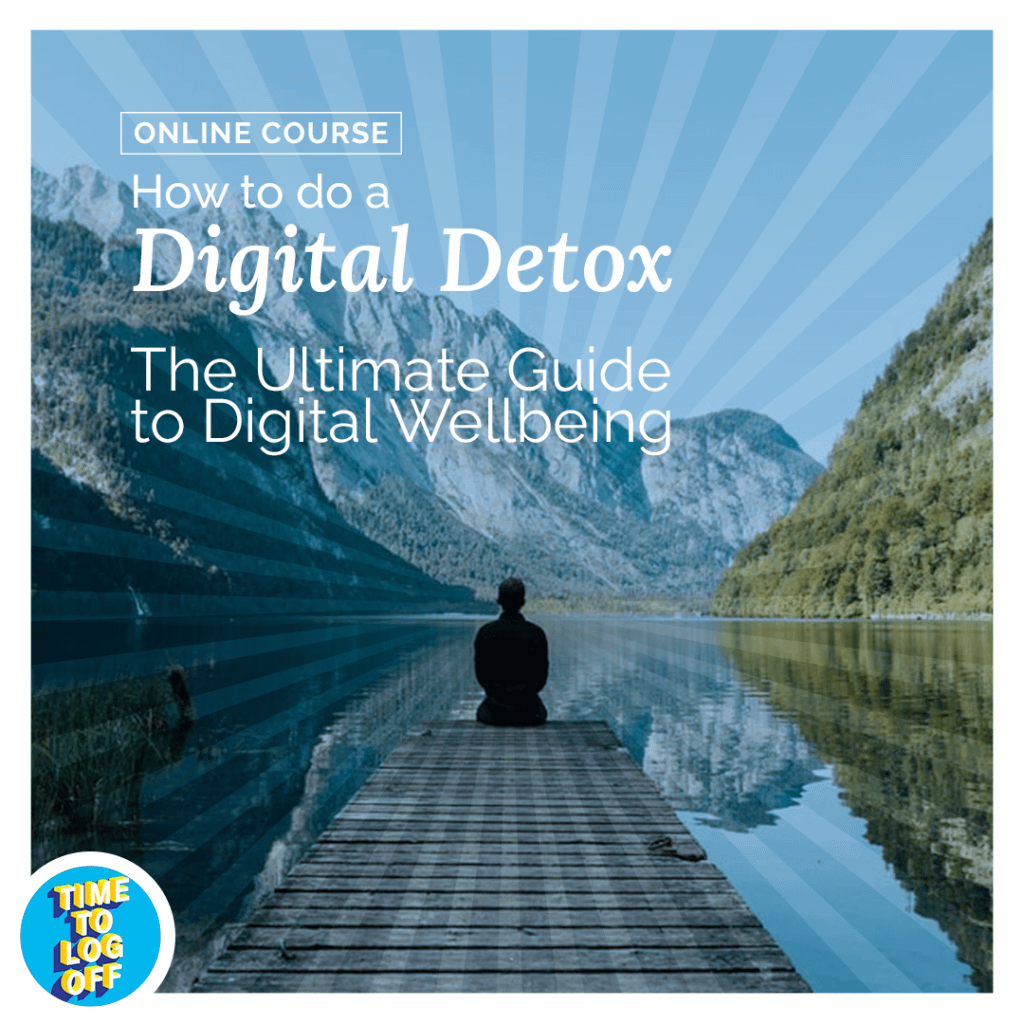
Try out our digital detox course if you’re serious about finding ways to deal with your social media addiction, it will walk you through the steps and strategies to get a better balance.
This past September we launched our very first digital detox course! For years now we have been advocating the need to switch off from the online world and rebalance our digital habits. During lockdown, this was amplified around the world as we relied on tech so much and many more people recognised their need to log off. 3/4 of Americans, when asked during the lockdown anyway, said that they would take a digital detox after they got let out. If you are regularly entering a doom-scroll-hole, losing time due to digital distraction, anxious about switching off from work, unable to take a proper break or stressed about by comparison culture on social media, then you too need a digital detox.
We heard the call for help from far and wide and built this course to fill the void which previously our talks, retreats and in-person workshops would have. This way we can reach even more people and help those all over the world.
Knowing you need to change your digital habits and achieving that goal are very different things. Our course, with its clear structure culminating with a guided digital detox to suit your life, is the perfect way to make that step and ensure that you can stick with it.
Here are some of the things you will get out of the course, and the reasons you should take it instead of going it alone:
#1 Learn about the ways we are addicted
For the first four weeks of the course our founder and host of the course, Tanya Goodin, will teach you all the ways that tech companies ensnare us, and how that has impacted us. From using the psychology of slot machines in ‘pull to refresh’ to randomising rewards in many social media apps, Silicon Valley is full of clever people keeping us logged on (as Tanya wrote about in her review of the Social Dilemma on this topic). Armed with all this intel you will find it easier (though by no means easy!) to stop when you begin to lose time, notice the addictive quality of the tech, and switch off.
#2 Tips on how to rebalance your life
Nebulous ideas such as ‘switching my phone off more’ are incredibly difficult to stick to. Those resolutions are often gone within the hour, let alone the week. Our course on the other hand is full of practical hacks to help you interweave your digital decluttering into your daily routine, reaping only the benefits.
#3 Regain control
Phones are addictive. It’s not our fault that our lives are becoming more and more dictated by them, and that even though smartphones are barely a decade old we can no longer leave the house without one. This course will help you to take back that control you gave to your phone, and let you control your life and choices around tech and digital wellbeing for once.
#4 Connect with a community of like-minded people
There is a comments section attached to all of the content in the course and we encourage the students to get involved. You can ask questions, offer advice or generally discuss how things are going for you and meet a whole new community of people who want to log off too.
#5 Take a guided detox
At the end of the course, for the last two weeks, you will take a guided digital detox. This is supported by the members of the Time To Log Off team, as well as other students. Though those two weeks, you can use the information you have learnt and the practical tips you have picked up in a practice run in your real life. This way you can decide what works and what doesn’t, bounce ideas off other students and end the six week course with a clear idea of how digital wellbeing and logging off will best suit your individual lifestyle.
In Pennsylvania, one community health center is working with new and expectant moms to tackle opioid dependency.
New and expectant mothers face unique challenges when seeking treatment for an opioid use disorder. On top of preparing for motherhood, expectant mothers often face barriers to accessing treatment, which typically involves taking safer opioids to reduce dependency over time. The approach is called medication assisted therapy, or MAT, and is a key component in most opioid treatment programs.
But with pregnant women, providers can be hesitant to administer opiate-based drugs.
According to a study out of Vanderbilt University, pregnant women are 20% more likely to be denied medication assisted therapy than non-pregnant women.
“In the beginning, I was so scared as a new provider to write my first prescription for medication assisted therapy to pregnant women,” said Dr. Linda Thomas-Hemak of the Wright Center for Community Health in Scranton, Pennsylvania.
The health center serves low-income individuals who are underinsured or lack insurance altogether, many of whom struggle with opioid misuse.
“Pennsylvania was hit particularly hard by the opiate epidemic that really has plagued, terrified and challenged America,” said Hemak, who is a board certified addiction medication specialist.
On this episode of the podcast, we speak with Dr. Hemak about whether medication assisted therapy is safe for new and expectant mothers and how the Wright Center is helping women overcome opioid dependency during pregnancy.
Direct Relief granted $50,000 to The Wright Center for its extraordinary work to address the opioid crisis. The grant from Direct Relief is part of a larger initiative, funded by the AmerisourceBergen Foundation, to advance innovative approaches that address prevention, education, and treatment of opioid addiction in rural communities across the U.S.
In addition to grant funding, Direct Relief is providing naloxone and related supplies. Since 2017, Direct Relief has distributed more than 1 million doses of Pfizer-donated naloxone and BD-donated needles and syringes to health centers, free and charitable clinics, and other treatment organizations.
Transcript:
When it comes to getting treatment for an opioid use disorder, pregnant women have an uphill battle.
Most patients undergoing opioid treatment are prescribed safer opioids that reduce dependency while limiting the risk of overdose and withdrawal.
This kind of treatment is called medication assisted therapy, or MAT.
But with pregnant women, providers can be hesitant to administer opioids.
According to a study out of Vanderbilt University, pregnant women are 20% less likely than non-pregnant women to be accepted for medication assisted therapy.
“In the beginning, I was so scared as a new provider to write my first prescription for medication assisted therapy to pregnant women,” said Dr. Linda Thomas-Hemak.
Hemak is a board-certified addiction medication specialist and CEO of the Wright Center in Scranton, Pennsylvania.
“Pennsylvania was hit particularly hard by the opiate epidemic that really has plagued, terrified and challenged America,” said Hemak who has been practicing in the state for several years.
In 2016, the health center launched a comprehensive opioid treatment program to address the growing crisis in their community. They quickly realized a number of patients were pregnant—and had specific needs, from prenatal care to job support. And so, a new program was born.
“The Healthy MOMS program is based on assisting mothers who are expecting babies or have recently had a child, up until the age of two,” explained Maria Kolcharno — the Wright Center’s director of addiction services and founder of the Healthy MOMS program.
“We have 144 moms, through the end of August, that we have served in the Healthy MOMS program and actively, we have enrolled 72.”
The program provides new and expectant moms with behavioral health services, housing assistance, educational support; providers have even been delivering groceries to moms’ homes during the pandemic.
But the crux of the program is medication assisted therapy.
Moms in the program are prescribed an opioid called buprenorphine—unlike heroin or oxycodone, the drug has a ceiling effect. If someone takes too much, it won’t suppress their breathing and cause an overdose.
Nonetheless, it’s chemically similar to heroin, which may raise eyebrows. But while some substances, like alcohol have been shown to harm a developing fetus, buprenorphine isn’t one of them.
“Clearly there are medications, like alcohol, that are teratogenic. And there’s medications like benzodiazepines that have strong evidence that they are probably teratogenic. When you look at the opioids that are used and even heroin, there is no teratogenic impacts of opiates on the developing fetus,” Dr. Hemak explained.
So, opioids like buprenorphine can be safe for pregnant women. What’s not safe is withdrawal.
If someone is abusing heroin, overdose is likely. In order to revive them, a reversal drug called Naloxone is used, which immediately sends the person into withdrawal.
But when a woman is pregnant and goes into withdrawal, it can cause distress to her baby, lead to premature birth, and even cause a miscarriage.
Which is also why these women can’t just stop taking opioids.
“Stopping cold a longstanding use of an opiate because you’re pregnant is a very bad idea and it is much safer for the baby and the moms to be transitioned from active opiate use to buprenorphine when pregnant,” explained Hemak.
Because buprenorphine has a ceiling effect and is released over a longer period of time, women are less likely to overdose on the drug.
Regardless, there’s still a risk their baby goes through withdrawal once they’re born. For newborns, withdrawal is called neonatal abstinence syndrome or NAS.
Babies may experience seizures, tremors, and trouble breastfeeding. Symptoms usually subside within a few weeks after birth.
Fortunately, the syndrome has been shown to be less severe in babies born from moms taking buprenorphine versus those using heroin or oxycodone.
That’s according to Kolcharno who has been comparing outcomes between her patients and those dependent on opioids, but not using medication assisted therapy.
“Babies born in the Healthy MOMS program, we’re finding, that are released from the hospital, have a better Apgar and Finnegan score, which is the measurement tool for NAS and correlates all the withdrawal symptoms to identify where this baby’s at,” said Kolcharno.
But NAS is not the only concern women have post-partum.
During and after delivery, doctors often prescribe women pain killers. For those with an opioid dependency, these drugs can trigger a relapse.
Dr. Thomas-Hemak says preventing this kind of scenario requires communication.
The Wright Center works with their local hospital to ensure OBGYNs are aware of patient’s substance use history.
“We want the doctor to know that this may be somebody that you’re really sensitive to when you’re offering postpartum pain management,” said Hemak.
That way, doctors know to tailor patients’ post-partum medication regimens. Instead of prescribing an opiate-based pain killer they can offer alternatives, like Ibuprofen or Advil.
Maintaining an open line of communication between addiction services and hospital providers also helps to reduce stigma.
Women with substance use disorders have long been subject to discriminatory practices by both providers and policy makers.
From denying them treatment to encouraging sterilization post-delivery, women struggling with opioid dependency can be hard-pressed to find patient-centered health care.
But Dr. Thomas-Hemak says, she’s learned to set her opinions aside.
“I think one of the magical transformations that happens when you do addiction medicine really well is, it’s never about telling patients what to do.”
It’s about allowing them to make informed choices, she says, and understanding it’s not always the choice you think is best.
This transcript has been edited for clarity and concision.
Mental health affects all of us. It is something that we all have, and that we all need to do our best to look after.
World Mental Health day, on Saturday 10th October, aims to raise awareness and show support for those who suffer from poor mental health. ¼ of people worldwide will have a mental health disorder in their lifetime, but every single one of us will suffer from poor mental health at some point.
Whilst often the way we feel is out of our control, it is important to check in on ourselves every now and then. Being able to work out what is wearing us down is an invaluable skill to have, because it allows us to address a source of our problems. Once identified, we can put in measures to better protect ourselves and our mental health.
One such area that often causes stress and discontent is our use of technology. We live in an increasingly digital world; over the past few months we have seen workplaces, social gatherings, sports classes, universities and so much more transition to online spaces, and most of these changes look like they will be sticking for some time.
It is indisputable that our digital habits have a toll on our mental health. We can all think of times where having such easy access to work emails on our smartphone, or being bombarded by calls and texts and expected to respond instantly has caused stress. Our love of social media batters our self confidence, and the unwavering stream of notifications popping up on our phone wreak havoc with our sleep schedules.
However, because our world is going online, we refuse to acknowledge this. We are a social species and we fear withdrawing from our online social spaces. Consequently, many of us view a digital detox as an isolating thing, banning us from interacting online. So even if in our self-evaluation we do identify our digital habits as having a negative impact on our health, we feel helpless.
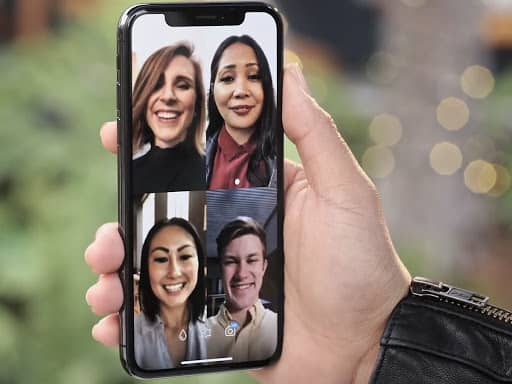
In reality, a digital detox has the opposite effect. Limiting screen use will make you value the time spent online with friends more. Instead of endlessly scrolling through social media, you will use the time you allow yourself on your tech to interact more personally, for example by video calling friends.
Digital detoxes have also been shown to reduce anxiety, encourage mindfulness and improve self-esteem. Furthermore, your sleep will benefit. Getting the right amount of sleep is essential for maintaining good mental health, and the reduced exposure to blue light, as well as the calming effect of not being online, will help you do just that.
Plus, the time not spent on your tech can now be used for other activities which will also lift your general mood. Try to go for a walk without your phone – beneficial for both cognitive skills and fitness – or take extra time to cook a delicious healthy meal.
There are different levels of digital detox you can embark on, from going completely cold turkey and banning all tech, to simply limiting your screen hours. It is up to you to pick one that works best around your work schedule and daily needs.
Whichever you choose for World Mental Health Day, we recommend keeping a journal to roughly note down your thoughts and feelings. Over the course of the digital detox, it is likely you will see a general improvement in mood. Having written evidence of that will remind you of the benefits that taking a digital detox has on your mental health.
Rebalance Your Relationship with Tech for World Mental Health Day
We all know that the way we use technology can and does have a negative impact on our mental health. With World Mental Health Day this Saturday (10th October), there has never been a better time to focus on our relationship with technology. Whether you came to this conclusion through watching an eye-opening show such as ‘The Social Dilemma‘, seeing how others use tech, or a slow realisation of your own dysfunction relationship during your tech-tethered lockdown, we all feel it. Yet few of us have the resources to deal with the impact. So, we have put together a list of resources to help you log off and mindfully connect this World Mental Health Day.
Articles
We have written many times about the impacts that the digital sphere, tech addiction and social media can have on our mental health. From the discussion on how parents can help their teenagers through this difficult time online, to advice for those teens themselves we have a huge library of articles on our website on how to prioritise your mental health. Some of our best would be:
Our Podcast is another great place to go to this World Mental Health to gain tips for logging off and get inspired by people from all walks of life, from celebs to academics. Here are some particularly mental health-relevant episodes:
Memes and Mental Health– In this episode, the man behind the meme account @NickCaveAndTheBadMemes sat down with our founder Tanya Goodin to discuss how he uses memes and his platform to support his own mental health and that of his audience too. We reviewed this one if you want a quick overview of what was discussed, but we would recommend you give it a proper listen- it’s worth it!
And an episode about the power of technology to benefit our mental health, and in this case to create real-world connection is the interview of Yes Theory’s Thomas Brag.
Perhaps our most comprehensive resources to help you rebalance your relationship with technology are our two books: Off and Stop Staring at Screens.
Both offer practical tips to help you log off and methods of enforcing a new digital detox friendly routine. That way you can maintain your new lifestyle well beyond World Mental Health Day!
Course
Finally, our most complete resource has to be our digital wellbeing course. It launched only last month and is full of up-to-date stats, advice and tools to help you log off and improve your mental health. It includes six weeks of video, reading lists and quizzes to help you understand the reasons behind your dependence. It also includes exclusive course resources to help you on your journey, a quiz to measure your progress and much more. The course finishes with a guided two-week digital detox which you can personalise to fit your life. If you find yourself scrolling endlessly through your phone with no real purpose, anxious about logging off from work, yearning for a proper break but unable to achieve it or stressed out about other’s perfect Insta-lives this course is for you.
Whichever you choose, we hope that these resources will help you, even a little, to log off and improve your mental health and digital wellbeing this World Mental Health Day.
Digital Detox for Teens: BBC Mimi on a Mission [review]
We were intrigued to find out about social media content creator Mimi Missfit’s new BBC iPlayer series, which investigates the need for a teen digital detox. In the series she takes seven teens from varied backgrounds (although mostly city kids) and together they camp for a week in the Cairngorms with celebrity guests joining them each day. Though the focus is placed more on nature and connection than the tech they are giving up, this show is a great first step to examine the relationships that iGen have with technology and how a digital detox for teens could potentially help them.
Are they all addicted?
We, think don’t we, that teenagers are the age group most incapable of switching off from devices? We believe that they are always distracted by likes and comments and that they can’t stop comparing themselves to those around them. This is certainly the case for some of the members of the group. Elise admits to only getting 2-3 hours of sleep a night and struggles to stay awake in school, due to her love of gaming (she has an all-time high record of 18.5 hrs on a game). She is not alone. 22% of 12-15 year olds say that watching too much TV has caused them to fall behind in their school work; another study showed that teenagers who spent more than 4 hours online per day were 3.5x more likely to get poor sleep – which is defined as less than 5 hours a night.
Yet in this group of seven are two teenagers who would seem to buck the ‘addicted teens’ trend – Shanzeh and Maddie. Shanzeh doesn’t even own a phone believing that she has enough to occupy her time without getting distracted by a phone. Maddie, on the other hand, does have a phone but doesn’t have social media believing that she doesn’t have strong enough self-confidence to manage the onslaught of negative comments.
Amy Hart
One of the celeb guests to the digital detox for teens is Amy Hart, best known for appearing on Love Island 2019. She and Mimi Missfit have both spoken out about the impact of social media on their mental health. At the opening of the show she read one message from her Instagram DMs as an example of her daily trolling: “F*** you, I hate you and every other girl like you. F*** you and your annoying voice, fix that you sl*t.” Though she says she tries not to let it get to her, the impact that continued attacks can have on an adult, let alone teens, must surely be huge.
What about their mental health?
Throughout the week, the teen group discuss the impact of social media on their lives with many describing a mental health impact. The show even brings along a therapist, Kemi, to help them with this. From eating disorders and bad poor image amongst a few of the boys, to a fear of Islamaphobia from Shanzeh there were many reasons given for needing to switch off (or in the latter case for never logging on). However, all admit to never previously logging off and when handing in their phones were anxious to be without them, one saying: “I love it and I hate it, I want to get away but I just can’t”. We know from research studies that early half of those aged 18-34 have said that their social media feeds made them feel unattractive, so the mental health impacts for this generation are well documented.
Connection
Our favourite part about this digital detox for teens is the focus on in-person connection. The survival guide Andy says “Friends that you make outdoors are friends for life… you can’t help but make REAL relationships”. Though we would not mandate a weeks camping in order to foster true connections we cannot support this sentiment of the importance of human connection more. On this teen digital detox, the kids are able to move away from the constant need to compare and have nuanced in-depth conversations that they say are rare in the outside world. We think this show is definitely worth a watch by you or the teen in your life.
All five episodes of Mimi on a Mission: Digital Detox land on BBC iPlayer on Saturday 26 September
If you want to embark on a similar journey but don’t have time to travel to Scotland for a week, why not try our new Digital Detox Online Course? You even get 50% off until October 7th!
How To Connect With Friends Whilst Avoiding Digital Burnout
One more Zoom ‘pub’ quiz and I might scream.
In Spring I enjoyed the novelty of group calls with my friends, and in Summer I had a healthy mix of spending long hours outside and socialising with friends via screens for a few hours in the evening.
However, with many of us returning remotely to work and university, socialising via screens is no longer feasible if we don’t want to spend upwards of 10 hours daily on a screen. So how do we maintain and enjoy our relationships without compromising our digital wellbeing and running the risk of getting digital burnout?
With many of us still shielding, and local lockdowns being threatened (if not imposed, even), seeing friends in real life is not always possible or responsible.
Yet it is indisputable that connecting with friends is crucial. The past six months have been challenging for all of us, and these challenges continue. Especially as the days get shorter and the dark and depressing weather rolls in, along with higher infection rates and risk, we need to find sustainable ways of keeping ourselves healthy and happy whilst preserving some kind of digital wellbeing.
Write a letter to a friend
Whilst instant messaging is an okay way to have a real time conversation with a friend, it has nothing on sending a letter. Writing a letter allows you to organise your thoughts, and really think about what you want to say. So rarely nowadays do we get to take our time in our correspondence – we are all used to typing hastily to get your words out before you receive the next message. With a letter, you can pause and breathe.
Furthermore, not only is letter-writing a fun and therapeutic activity, it makes the recipient feel good. I’m sure I’m not the only one whose face and whole attitude lights up whenever I receive post from a friend.
Phone call a friend
Nothing beats hearing the familiar voice of friends and family. Whilst seeing them via webcam every so often is nice, it is not necessary for every conversation, and you may find that your conversation is better when you don’t have a screen to focus on.
I like to combine the phone call with a walk. That way, I’m not distracted by anything other than where my feet take me. I have found that the sensation of wondering aimlessly whilst chatting with a friend has instilled a bit of carefree normality back into my routine, as well as providing a welcome break from a screen, a good breath of fresh air and a healthy amount of exercise.
Alternatively, you and your friend could pick a hobby to take up whilst talking. Choose something tactile, like arts and crafts, and chat to each other over the phone whilst you hone your skills and create your masterpieces. Then, at the end you can swap photos. It’s a nice way to engage in normal activities with friends without relying on a screen.
Opt for non-screen-based activities
If we are lucky enough to be able to spend time together with family friends, whether with our household or socially distanced with other friends, look for activities where you can get away from the screen. For example, instead of playing video games together, do some arts and crafts, or get outside. Why not swap movie night for an evening where you all cook and eat together? Board games and playing cards are underrated and underused forms of entertainment and really help maintain digital wellbeing.
Share skills and hobbies with each-other
Whilst we may still be keen to sign up to Zoom classes and pick up new hobbies, this only adds to our screen-time and increases the likelihood of digital burnout.
So instead of turning to virtual classes, turn to friends instead. Whether over phone call or in person, take it in turns to teach each other a new skill: whether it’s how to cook a certain dish, how to draw in a certain style or how to play clock patience. We have so much to learn and to share from each other, after all.
Embark on a digital detox together to maintain digital wellbeing
After months of relying on our tech so heavily, a digital detox is very much needed. This can seem daunting, however, so find a friend with whom you can take on the challenge together.
Call each other to discuss how it is going, and what you find difficult. Going through it together will motivate you and reduce FOMO, a common excuse for not partaking in a digital detox. On the other side, you will have accomplished something together and worked out the best way to connect without relying on screens.
I never realized I was the cause of my negative thinking by willfully trying to “make” my life happen then getting angry that everyone wasn’t doing what I wanted.
I used to work at this weird hotel and one of the door guys told me when he was in prison he kept going to solitary confinement until he was sitting there one day and realized he was the problem. I was still using then and thought to myself “Weird. I’m going to go get high in one of the rooms upstairs and think about that.” Well, now I get it. Left alone with me during this quarantine I realized I was the problem.
Unlike most people I was so excited for the quarantine because I cherish my alone time. I loved it! I cooked, I meditated, I read books and I did a bunch of writing. Auditions I would normally drive into the city for, I was able to do from my apartment, along with our podcast. I saved so much money in gas! I did service, and still went to meetings. I relaxed somewhat, and it seemed like a dream come true. A nice, long, staycation! Minus the complete panic over the economy, being worried about family members overseas, and my aging gracefully mother who would kill me if I called her elderly (she is). Then it happened…..
The negative thinking.
The repetitive, negative thinking.
Feeling like a victim.
Not of COVID-19, but of the past, alcoholism, and that thing that happened in 2004. Or 1997. Or the day before at Shoprite!
This has happened to me many, many times since sobriety and many, many times before that but there was always a PERSON, or a SITUATION that “caused” it. Honestly, I couldn’t even blame my boyfriend during the quarantine because he kept leaving and going to his office every day. I was alone, working from home, and doing whatever I wanted. I was having a great time!
I cleaned out everything! Put pictures in frames from 10 years ago! Cleaned out every drawer, closet, journal, and my entire bookcase. I donated books, clothes, shoes, and jewelry. But still – I was LOSING MY FUCKING MIND. Because unbeknownst to me I had not achieved emotional sobriety yet.
And I was addicted to negative thinking.
And it didn’t just happen – my realization of it just happened. I was sitting here alone with myself and my thoughts and realized I have still – after all this time – been people-pleasing. And doing it in large part to get what I want. I was like (subconsciously) “I want what I want and if I’m nice to people and do stuff for them – I AM GOING TO GET WHAT I WANT.”
Well, it took sitting here alone for months to realize once and for all – there’s a 3rd step and I wasn’t doing it, and people-pleasing doesn’t work. It’s always an inside job. Inside our own heads and hearts. For me, it’s only when I let go that I have seen the evidence of my higher power.
It’s so hard to trust.
Once again I am seeing “spiritual road signs” on the ground whenever I am outside exercising, via fallen tree branches. For some reason I get direction from these twigs and branches and lately they are all right or left turns. So it feels like something very different, and I believe emotional sobriety is the path I am meant to turn on. It’s something I never even really thought about but it makes so much sense now. I need to be sober in my head and heart, not just my body.
I mean I have heard so many people share about this – that they came for their drinking and stayed for their thinking. I have said it! And I meant it! I just didn’t realize I was the CAUSE of my negative thinking by willfully trying to “make” my life happen then getting angry everyone wasn’t doing what I wanted. So what do I do about this? Because I have realized that this negative thinking is toxic for me and my body and I can’t have that. I already had cancer once! And honestly and truly I value my sobriety more than anything. I am nothing without it. So this is the next layer of my stupid alcoholic onion. I want to grow. I know that my spiritual condition relies on daily maintenance and as I begin to train my thoughts to the positive it has become a moment to moment training. I had just been letting my thoughts go crazy all the time and I was too busy to realize it. It’s like early sobriety again – taking it moment by moment sometimes. I rage at someone in my mind and then say “No, no – let’s go with a different thought.” It’s so frustrating and tedious! I have made this analogy lately that came about from COVID-19 and the subsequent quarantine.
A positive one! Say it to myself all the time.
I wash my hands 30-50 times a day. At least 25!
I cook all the time and was a big hand-washer before all this – regardless I wash my hands a lot – right?
So why not do the spiritual work 30-50 times a day? If right now, that’s what I have to do to get my head sober then why not? Pray more. Meditate an additional time each day. Reach out to other alcoholics so I stop obsessing over myself – more often. Spiritual hand-wash all day long.
I can do more work! I started to do the Traditions with my sponsor.
I started to do what I did when I got cancer and beefed up my program.
This is bringing me to freedom – even though I feel a little beat up from all of this. Not as beat up as after cancer treatment or at the end of my drinking and drugging! And I am almost positive I don’t feel as beat up as that poor guy being in solitary confinement. But that’s what it has taken for me to realize I’m the problem.
So ultimately it has been people-pleasing and willfulness. This willfulness has come from a lack of trust in my higher power.
I have this beautiful higher power that has brought me so much peace and clarity – and I haven’t trusted the strength of that higher power. It’s like there’s been a higher power budget I thought I had to be on.
I can rely on my higher power to not only carry other people’s stuff but to guide me while I take care of myself around other people. I can worry about myself and my inner life and turn to my higher power to guide me where I will be the most useful next. I don’t need to manipulate anything.
My sponsor always says we can be happy. We can be happy, joyous, and free – and that we work so hard for that. So this new awareness is bringing freedom. Ah, what a place to be! Awareness!
It’s a beautiful thing.
A beautiful, uncomfortable, and freeing thing.
Sometimes freedom isn’t comfortable.
I am going to put that into my higher power’s hands, along with everything else in my head and heart.
There’s a lot to lose our minds over right now. Wasn’t there always? It’s not easy waking up and recovering. I am going to practice (one day at a time) not fighting anyone or anything and accepting that I am enough – as is. I don’t have to pick up a drink, drug or thought today and I don’t have to fight with myself, or anyone at Shoprite. I don’t even need to take care of anyone at Shoprite!
I can also practice being grateful that this quarantine helped me to remember an amazing lesson I learned at a weird hotel in 2003 from a poor guy who–I just realized–was probably recovering, just like me.
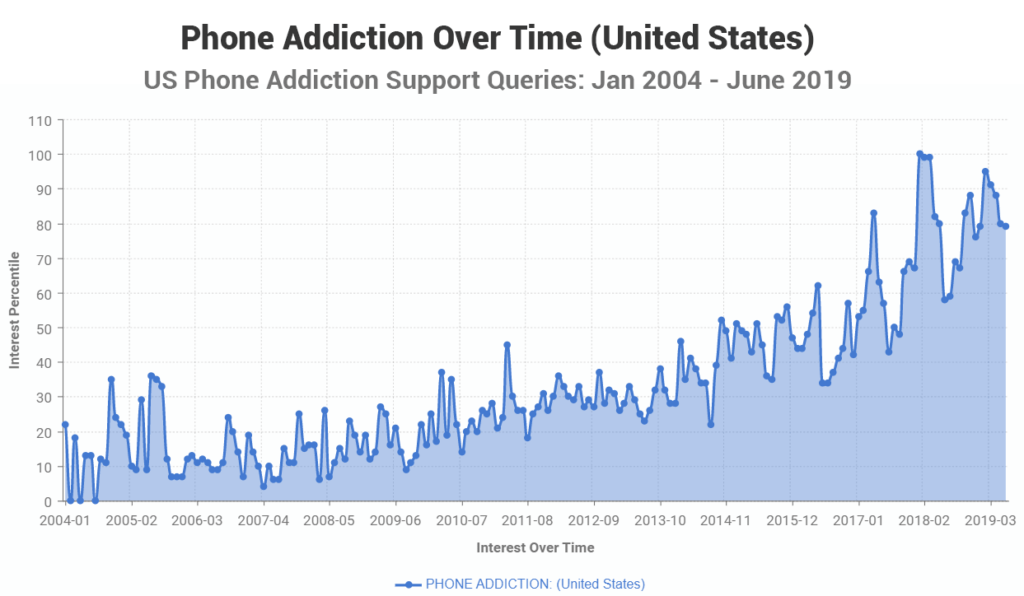
Our phones are our constant companions. We use them for work, to keep in touch with loved ones and to entertain ourselves on long commutes. A 2016 study found that on average, we touch tap or click on our phone screens 2617 times per day, a figure that can only have increased by 2020. So it is no wonder then that so many people admit to being addicted to their phones. Below you can see the increase in interest in searching on phone addiction in the last 15 years: increasing exponentially.
If so many people worldwide are searching for the topic it must mean they are experiencing negative side effects of this addiction in their daily life. However, in a world designed around phones, it can be difficult to gauge what’s ‘normal’ and what’s problematic. So we have put together 5 symptoms of phone addiction to help you decipher when you need to take steps to better your tech-life balance.
#1 Poor sleep
40% of adults look at their phone within 5 minutes of waking up- 65% of adults under 35. We know that longer time spent on technology each day has been definitively linked to shorter sleep and that 47% of adults miss out on sleep due to their phone usage. So, why are we still sleeping with our phone in our rooms- let alone our beds?! We have often talked about the benefits of sleeping without your phone- but it is not just us. 93.6% of study participants said that they would consider not sleeping with their phone again because of the positives they experienced.
#2 Eye strain
Symptoms of phone addiction are both physical and mental. Eye strain is one of the most common results of digital dependence with 73% of young adults feelings its effects. A 2018 study found that those who were shortsighted tended to use double the amount of phone data compared to those who didn’t need glasses- suggesting that phone addiction is correlated to excess phone usage. Once you begin to log off more often and look at the world around you instead of the small screen you will notice the difference!
#3 Nomophobia
Nomophobia (the fear of being without your phone) is one of the most common symptoms. Do you feel anxious if your phone is dead or if you leave it at home? If so you are suffering from this symptom. Start to combat it by deliberately leaving your phone at home and experiencing the world without it. Go to the shops, the park or to a friends house without it and see how you feel. Take back your independence step by step.
#4 Subconcious scrolling
In awkward situations, the modern go-to is to take out your phone and get lost down a scroll-hole. Even without consciously deciding to, we open our phones and instinctively click- often on social media. This passive consumption is bad for us, without engagement we are simply viewing others’ lives and losing the positives of connection. Delete apps you find yourself wasting time on, or regularly move them around your phone screen, so that there is one small layer of friction between you and the mindless activity. Introduce hurdles to stop it merely being instinctive.
#5 Phubbing
Perhaps the worst symptom of phone addiction, phubbing, is the action of snubbing someone by your phone activity. We all know how it feels to be on the receiving end of less than half of someone’s attention but we all do it. If you’re regularly ignoring your loved ones in favour of your phone you may need to reconsider your actions. Make a resolution not to phub in future. If the phone activity is so vital, excuse yourself and return to the conversation with your full attention. One way to ensure this is to leave your phone in a box or pocket for mealtimes, and whenever you are spending time with loved ones.
Keep reviewing these 5 symptoms to help you to work out the level of your potential phone addiction – and use our tips to help you log-off more.
If you’re struggling with phone addiction check out our new 6 week Digital Detox Online Course for more detailed information, curated content and direct support. Use the code NOW-50 for 50% off until October 7th 2020.




![Digital Detox for Teens: BBC Mimi on a Mission [review]](https://mljy6yc1jht2.i.optimole.com/tyFXexc-sPgyLmbl/w:auto/h:auto/q:mauto/process:573262/id:d9b7e31171616a220ebaf7fa05f7ebed/https://www.answeraddiction.com/digital-detox-for-teens-bbc-mimi-on-a-mission-review.jpg "Digital Detox for Teens: BBC Mimi on a Mission [review]")
![Digital Detox for Teens: BBC Mimi on a Mission [review]](https://mljy6yc1jht2.i.optimole.com/tyFXexc-ZF7KrbGv/w:auto/h:auto/q:mauto/process:573263/id:801e97beae0af0bf76b33ad96e665b9b/https://www.answeraddiction.com/digital-detox-for-teens-bbc-mimi-on-a-mission-review-1.jpg "Digital Detox for Teens: BBC Mimi on a Mission [review]")
![Digital Detox for Teens: BBC Mimi on a Mission [review]](https://mljy6yc1jht2.i.optimole.com/tyFXexc-1GacTYfU/w:auto/h:auto/q:mauto/process:573264/id:3aebcfb3a93c1c21fc95e46587fcbf73/https://www.answeraddiction.com/digital-detox-for-teens-bbc-mimi-on-a-mission-review.png "Digital Detox for Teens: BBC Mimi on a Mission [review]")