Category: Addiction News

  • Is Your Teen Smoking Pot? Here’s 5 Next Steps to Take

    Is Your Teen Smoking Pot? Here’s 5 Next Steps to Take

    Nearly 6% of American High School Seniors Use Pot Daily

    The discovery that your teenager is smoking pot can be upsetting. Whether you caught them in the act or they admitted it to you, the next steps that you take are critical for their long-term health and happiness. While teens have often been known to engage in rebellious acts over the years, those who experiment with marijuana frequently discover that they cannot stop as easily as they thought.

    According to the National Institute on Drug Abuse for Teens, nearly six percent of high school seniors admitting to using marijuana on a daily basis, and forty-five percent claimed that they had tried it in the past year.

    If you suspect that your teen may be smoking marijuana, here’s a few steps you should take to make sure that he or she does not face the consequences of becoming a chronic user.

    1. Confirm Your Suspicions

    Your first step is to find out for sure if your teen is actually using marijuana. Here are some signs that might suggest your teen is smoking pot:

    •  You find paraphernalia or smelled marijuana smoke on your teen
    •  Your  teen is hanging out with known users of the drug
    •  Your teen wears clothing or listens to music that glorifies pot
    •  Your teen exhibits signs of being under the influence, such as having memory lapses or   difficulty   holding a clear conversation

    If you suspect that your teen is using marijuana, you can confirm your suspicions by simply asking them if they are smoking or ingesting pot. Keep in mind, however, that your teen may lie if they believe that telling the truth will get them in trouble. In these instances, you may need to seek further proof of their marijuana use by having them take a drug test at home or in a professional setting.

    2. Open Up a Dialogue

    Ideally, you have been talking to your teen about drugs for several years. Now, you need to open up a deeper conversation about marijuana use. Begin by picking a time when you know that your teen is comfortable and open to talking. Try to avoid times when you are rushed, such as on the way to school since this conversation could turn into one that is more complex than you expected. You can also use techniques such as asking open-ended questions to make sure that this feels like a conversation and less like a lecture. Remember that your goal is to get your teen to open up about their marijuana use so that you can begin to work together on finding a solution to help them stop.

    3. Talk About the Risks for Teens

    One of the reasons for the increasing rates of teen marijuana use is that it is no longer depicted as dangerous in the media. Teens who read about the legalization of marijuana for medical and recreational purposes may begin to think that using the drug is low risk. While marijuana may be legal in certain states, the truth is that it is still illegal for teenagers to use. Marijuana also affects teenagers differently than it does adults, and your kid needs to know the facts.

    Gather some information about the risks of using marijuana for teens before you sit down with your child to talk about their use. For instance, you may put together a few facts about how marijuana affects the developing brain. Your teen may be surprised to discover that doing pot in their teen years could affect their ability to think and rationalize properly as adults.

    In addition the physical risks of marijuana use, your teen is also placing themselves in a risky situation. For example, your teen could face stiff fines and jail time if they are caught with marijuana in their possession. Chronic use may also be causing your teen to struggle in school, or they may have been kicked off of their sports team.

    4. Check for Other Forms of Drug Abuse

    Marijuana is often considered a gateway drug because kids who try it may be tempted to experiment with stronger substances to achieve different effects. Certain drugs, such as PCP, can also be mixed with marijuana to make the high more intense. If you know that your teen is smoking pot, then you should find out if there are other forms of substance abuse in your child’s history. While you can ask them if they are using other drugs, you may need to seek a professional evaluation if they are not forthcoming. Keep in mind that teens often mix pot with alcohol, which can lead to coexisting addictions that must be treated at the same time.

    5. Treat Any Underlying Causes

    Teens do drugs for a variety of reasons. While some teens may use marijuana once out of curiosity or due to peer pressure, those who use it more often are likely trying to mask other issues.

    For example, your teen may feel like using weed helps them to overcome their social anxiety. They may enjoy how it makes them feel cool or helps them to fit into a specific social group. Keep in mind that marijuana is not just used by kids who tend to get in trouble. Athletes, gifted students and popular kids are all vulnerable to falling prey to marijuana addiction, especially if they feel like it helps them to be a part of a group.

    Your teen may also use marijuana to deal with serious mental health issues, and this is more common if they have never been diagnosed. Teens with anxiety may feel as though the pot helps them to stay calm, and kids with ADHD may like how they think it helps them to stay focused. While you may know that marijuana does more harm than good for these conditions, your teen may need to work with a professional counselor to learn how to cope with their mental health issues in healthier ways.

    Conclusion

    Contrary to popular belief, marijuana is an addictive substance that has negative effects on a teenager’s health. When you suspect that your teen is smoking pot, be sure to take immediate action. With lots of talking and professional counseling, your teen can learn to live a happy life without relying upon substances to feel better.

    View the original article at

  • Trauma and Addiction Recovery Workbook [BOOK REVIEW]

    Trauma and Addiction Recovery Workbook [BOOK REVIEW]

    Trauma Is Personal

    Trauma isn’t just a buzzword in addiction treatment. It’s a reality that many men, women, young adults, and children face … every day. Trauma can take the form of a life-changing event. Psychology Today explains trauma as the result of ”any distressing or life-threatening event”. Trauma is usually caused by an external force that we cannot control:

    • A natural disaster
    • A person who forces us to do or witness something horrible
    • War
    • Terrorism or school shootings

    According to the Substance Abuse and Mental Health Services Administration (SAMHSA), research has shown that traumatic experiences are associated with both behavioral health and chronic physical health conditions, especially those traumatic events that occur during childhood. Still, trauma and addiction co-occur often and in all kinds of populations.

    How someone responds to a traumatic experience is personal. But there are some commonalities in the ways we cope as humans, and the ways that we can help. So, if you’ve been through trauma…you ARE NOT DOOMED to live with lasting negative effects. While difficulties and stress reactions are normal,you can address these challenges and explore healing.

    A Path to Healing

    Traumatic experiences can contribute to chronic physical and mental health conditions. But you can move through the pain and come out the other side. One way to do that is by reading a new book called, “Recovery from Trauma, Addiction, or Both” by Dr. Lisa M. Najavits.

    Herself the victim of a violent assault while in graduate school, the author’s personal empathy for trauma combined with trends in “Co-Occuring Disorders”, or the treatment of addiction and mental health disorders. Her latest book presents science-based self-help strategies that you can use no matter where you are in your recovery. Every chapter features testimonials from people who have “been there” before you. Plus, the text is designed to be worked through over time.

    Overall, I give this book a hearty “thumbs up.”

    Why I Recommend This Book

    As a workbook, “Recovery from Trauma, Addiction, or Both works to your advantage. First of all, it’s based on clinical practice. Dr. Najavits has been using evidence-based clinical skills for decades. The text include background reading for context. Then, Dr. Najavits has included reflection questions, surveys, exercises, and action points in every chapter.

    Second, you can advance at your own rate, or use the workbook as an adjunct to talk therapy. It is truly a tool that can move you towards becoming your best self. However, be fairly warned. There is a lot of work to do. And most of the time, you may not want to approach that work on your own.

    Still, if you are ready to work through trauma, this book will teach you how to:

    • Keep yourself safe and find support.
    • Set your own goals and make a plan to achieve them at your own pace.
    • Learn coping skills so that the future is better than the past.

    However, I personally think it best that you also commit to talk therapy. In my experience, scheduling regular, weekly appointments with a psychotherapist, addiction counselor, or a spiritual/religious guide is critical to moving forward. When we are hurt the most, we need a guide.

    When you’re ready to seek out professional support for treatment of addiction, trauma, or both, here are a list of possibilities.

    1. Rehabs. Search the SAMHSA website. For rehab that specialize in trauma AND addiction treatment. Or, call our number listed on this page for confidential information on where to get treatment.

    2. Professionals. Clinical psychiatrists or psychologists who have specialized in addiction treatment can offer suitable advice on resolving trauma and substance abuse issues. You can search the APA directory to find a psychotherapist and the APA directory to find a psychiatrist. Or, check with your State’s Department of Social Services to be connected to a licensed clinical social worker.

    3. Support Groups. These are non-formal meetings between people who share their experiences in order to gain positive result in recovery. The U.S. Veteran’s Association suggests the following support groups for trauma

    • Anxiety and Depression Association of America offers a list of support groups across the country for a number of different mental health conditions, including PTSD.
    • Sidran Institute Help Desk Help Desk locates support groups for people who have experienced trauma. Sidran does not offer clinical care or counseling services, but can help you locate care or support.
    • National Alliance on Mental Illness (NAMI) Information HelpLine provides support, referral and information on mental illness care. You may also find family support groups in a NAMI state or local affiliate online or by calling 1(800)950-NAMI (6264).

    What I Learned From This Book

    Because this book is easy-to-read, you can essentially open any chapter and take away some key learning moments for yourself. It’s workbook, so the process is highly personal. The three mostinteresting things that I learned from this book are:

    1. It’s best to treat trauma and addiction at the same time. It does not help to treat addiction first and then address trauma. You might actually be delaying healing or cause yourself unnecessary misery when you do this. Instead, a good treatment provider will address them both together.

    2. You can shop around for counselors. The therapeutic relationship is something you need to feel comfortable with. And not everyone will resonate with your own personal need. So, don’t feel like you need to do trauma work with the first person you come across. Instead, take your time and vet the person first. Ask for referrals. And do your homework.

    3. Re-living past trauma is not necessary to resolving it. Repeat that. This insight was MAJOR for me. Maybe I’ve seen to many movies with hypnotists…but I had a LARGE misconception about trauma work. So, just know that you do not need to smell, see, touch, or taste the past in order to live more comfortably in the moment. What a relief!

    Conclusion

    Clearly, the effects of traumatic events place a heavy burden on individuals, families, and communities. However, research and practice are combining to offer us new pathways forward.

    This book – Recovery from Trauma, Addiction, or Both … is worth buying. In fact, it might just be the best book you ever buy. Why?

    Because you are worth it! This book offers just the right kind of gentle guidance toward positive action that it takes to change your life. But only YOU CAN DO THE WORK. Why not spend the $12 and get started today?

    View the original article at

  • Help for Crack Withdrawal

    Help for Crack Withdrawal


    ARTICLE OVERVIEW: Crack is a highly addictive derivative of cocaine with dangerous health consequences. Withdrawal is tough, but not impossible. Your body and brain are going to need time to resume their natural chemistry. This article reviews what crack withdrawal is like, offers a basic timeline of withdrawal symptoms, and describes what happens during the process.

    ESTIMATED READING TIME: 10 minutes.

    TABLE OF CONTENTS:

    Crack and the Brain

    Let’s first take a look at how crack works.

    Crack raises levels of dopamine to get you high. Dopamine helps regulation of movement and is connected to the brain’s reward system. The brain naturally reproduces dopamine, storing it and recycling it for further use. But when you take crack, this system goes haywire. Here’s what happens.

    When you smoke crack, instead of recycling dopamine, cocaine causes large amount of dopamine to pile up. For a short time you will feel high, yet cravings can start even within minutes after the last take. The brain will seek out more because crack is so effective (but short-lived).

    So, when you quit crack, the body and brain must work heavily to readjust. The brain must learn how to naturally create and recycle dopamine again. Because of this, people often relapse. The uncomfortable withdrawal symptoms can be too much, and we slip back into using for relief.

    Is Crack Withdrawal Hard?

    The short answer is: yes, crack withdrawal is hard.

    Crack causes both physical and psychological dependence. And sometimes, withdrawal symptoms can be extremely difficult to handle. See the list of symptoms below. Mostly, symptoms are the opposite of how you feel when high. You feel fatigued, depressed, and really low.

    Plus, withdrawal can be intense. The severity of withdrawal is directly related to:

    • Dosing amounts.
    • The total amount of time you’ve been using.
    • Tolerance levels.
    • Your age.
    • Your overall mental state.

    For example, somebody who needs more crack to get high and has been using it for years will experience a harder withdrawal than someone who’s only been using it for a few weeks and takes it in small doses.

    Also, during your first weeks of crack detox, you will be at the highest risk of relapse. Detoxing is a very intensive and uncomfortable process. You must be psychologically ready to overcome its difficulties. This is why medical detox can help.

    Anyone going through crack withdrawal can benefit from medical help.

    Is Crack Withdrawal Dangerous?

    For the most part, crack withdrawal is not dangerous. However, medical symptoms can create complications, so it can be risky. In particular, you need medical supervision for the following symptoms:

    • Chest pains
    • Irregular heartbeat
    • Headaches
    • Seizures
    • Severe depression
    • Suicidal thinking

    So, with the risk of severe symptoms, can you quit crack cold turkey?

    When quitting cold turkey, there’s always a strong chance of relapse. It is very difficult to quit cold turkey on your own because cravings are so overwhelming. The experience is very uncomfortable. It can even trigger severe depression or suicidal thinking. If you or anyone you know is thinking about suicide, please call the National Suicide Prevention Lifeline at 1-800-273-TALK (8255).

    To repeat, there’s a risk of mental disorders during detox, whether through a properly supervised medical detox or if you try to quit on your own. Symptoms of depression are most common due to the fact that the brain produces less dopamine now being deprived from the crack. This depression can lead to suicidal ideation.

    A List of Crack Withdrawal Symptoms

    Crack withdrawal is different for everyone. You may not feel all the symptoms mentioned in the list below. Plus, your symptoms will not be at the same intensity level as others. Addiction is a very personal experience, manifesting in everyone differently. Thus, each of us reacts differently to withdrawal.

    Withdrawal symptoms are caused by drug dependence. However, in the case of crack, withdrawal does not necessarily need time to build up: withdrawal can occur as you’re coming down off the drug. Crack is a drug that makes people feel energetic, euphoric and full of grandeur delusions, so the crash can be a distressing, low state of mind.

    The following symptoms can be expected during crack withdrawal:

    • Aggression and violent incidents
    • Agitation
    • Anhedonia (the inability to feel pleasure)
    • Anxiety
    • Cravings
    • Depression and a lack of motivation
    • Exhaustion and fatigue
    • Feelings of paranoia
    • Flu-like symptoms
    • Irritability and restlessness
    • Musculoskeletal pains
    • Psychosis, hallucinations and other mental disturbances
    • Sleep disturbances and vivid nightmares
    • Suicidal thoughts

    If you’ve compulsively smoked crack, you’ve probably already felt these symptoms to a certain degree. When crack leaves a user’s body (which can happen within minutes), cravings start almost immediately. So, withdrawal often leads to immediate use. Most people take another hit before these withdrawal symptoms peak. Still, these symptoms are relatively minor compared with the symptoms that manifest when you quit for good.

    The Basic Timeline

    The following timeline provides you a general idea of what to expect when you want to quit crack for good.

    0-72 Hours. This is the most uncomfortable stage, the so-called the “crash” period. Your withdrawal symptoms will peak. Your body will go through major adjustments while restructuring its chemistry. It’s important to surround yourself by a team of medical professionals during this period.

    Week 1-2. During this period, your brain must adjust to a drug-free chemistry. People who use large amounts of cocaine may experience psychotic symptoms such as paranoia, disordered thoughts and hallucinations. You might feel extremely distressed and agitated or be a risk of harming yourself or others. These symptoms can be managed using anti-psychotic medications and will usually resolve within a week of quitting cocaine.

    Usually, strong crack cravings begin during this time, as well. Psychotherapies are necessary in order to reduce cravings and better understand your behavioral patterns. Talk therapy helps you develop a new lifestyle without the need for coke.

    Week 3-4. This period is commonly known as the “honeymoon phase”. You may begin to notice that your cravings are reduced and your mood is improved. The low feelings brought on by the initial withdrawal symptoms are no longer present. Instead, once again you might feel energetic and confident with a strong sensation to go back into normal life and make anew of yourself.

    Month 1-3. After the first month, most people begin to understand and manage their emotions. You’ll also start to develop emotional coping strategies after 4 weeks of abstinence. However,
    this does not mean that your troubles are behind you. Protracted withdrawal symptoms like poor impulse control can take time to even out. It should be noted that around 66% of those who go through this timeline relapse within three months afterwards. It’s highly suggested that treatment continues long after you get crack out of your system.

    Medicines that Help

    Currently, there are no FDA approved medicines for crack treatment. However, antidepressants or anti-psychotic medication may be prescribed. Additionally, scientists have been testing several promising medications, such as:

    • Baclofen
    • Disulfiram
    • Modafinil
    • Propranolol
    • Tiagabine
    • Topiramate
    • TA-CD

    These medications may have simply a placebo effect. The last item on this list is the TA-CD vaccine, shows promise, though. It stimulates production of cocaine-specific antibodies and prevents cocaine from entering the brain. In this way, the TA-CD vaccine may stop cocaine euphoric and reinforcing effects.

    Even though no approved medication are in use, you should always consult a medical professional during detox. Short term prescription use of antidepressants can help. Additionally, you may need anti-psychotic medication. Additionally, symptomatic relief can be provided to address withdrawal symptoms as they occur. In fact, a medical detox can help provide more than medications…a good detox clinic will provide mental and emotional support.

    Natural Remedies that Help

    There are a number of natural remedies people use to ease withdrawal and prevent relapse. These include:

    Exercise. Most treatment centers suggest exercising as it promotes natural dopamine to its natural levels and endorphins; thereby, helping counter the urge for cocaine.

    Herbal Remedies. Herbal remedies increase protein levels, which in turn reduce withdrawal symptoms and cravings. Studies have found that such is N-acetyl-cysteine, an amino acid, used for a variety of treatments and therapies.

    Distractions. Developing distractions is essential during recovery in order to keep your mind occupied. You’re going to need to form new habits in order to break old ones. This can be anything from writing regularly in a journal to painting or to just listening to music.

    Where to Go For Help

    In order to find help, you must first want it. By admitting you’re defeated, you’re allowing something new to happen. Then you’re on the path to seeking medical help.

    But where do you look?

    You’ll also want to reach out to family and friends. As you go about your recovery, you’re going to be in need of a support system. The people you can always reach out to when things get difficult. Furthermore, even after treatment when recovery is still ongoing, you’ll have people there when need be. If you’re a family member or friend of someone who’s addicted to crack there are a variety of options for you to seek help for your loved one.

    Or, you can give us a call. We’re always happy to help. The telephone number listed on this page will connect you to a helpline answered by American Addiction Centers (AAC). The helpline is offered at no cost and with no obligation to enter detox or addiction treatment. We can help discuss your treatment options, which can include detox. So, if you are ready to get help, reach out and pick up the phone.

    Your Questions

    Do you have a better idea of what to expect during withdrawal?

    Still have questions?

    If you have any further questions pertaining to crack withdrawal, we invite you to ask them below. If you have any advice to give for people currently going through withdrawal, we’d also love to hear from you. We try to provide a personal response to each comment and get back to your promptly.

    REFERENCE SOURCES:
    NIDA: DRUG FACTS: COCAINE
    NIDA: DRUGS, BRAINS, AND BEHAVIOR:THE SCIENCE OF ADDICTION
    NIH: U.S. NATIONAL LIBRARY OF MEDICINE: COCAINE WITHDRAWAL
    DETOXIFICATION AND SUBSTANCE ABUSE TREATMENT: A TREATMENT IMPROVEMENT PROTOCOL TIP 45
    Addiction Blog: Ready to stop doing crack? Ways to quit crack safely
    NCBI: SUBSTANCE ABUSE TREATMENT FOR PERSONS WITH CO-OCCURRING DISORDERS
    NCBI: IMAGING DOPAMINE’S ROLE IN DRUG ABUSE AND ADDICTION
    NIDA: UNDERSTANDING DRUG USE AND ADDICTION
    NCBI: TREATMENT FOR STIMULAND USE DISORDERS
    NIDA: PRINCIPLES OF DRUG ADDICTION TREATMENT: A RESEARCH-BASED GUIDE (THIRD EDITION)
    NCBI: NEW MEDICATIONS FOR THE TREATMENT OF COCAINE DEPENDENCE
    NCBI: IMPACT OF PHYSICAL EXERCISE ON SUBSTANCE USE DISORDERS: A META-ANALYSIS
    NCBI: N-ACETYLCYSTEINE IN PSYCHIATRY: CURRENT THERAPEUTIC EVIDENCE AND POTENTIAL MECHANISMS OF ACTION
    NIH: WHY IS IT SO HARD TO QUIT DRUGS?

    View the original article at

  • Top 10 Strongest Alcohols

    Top 10 Strongest Alcohols


    ARTICLE OVERVIEW: Alcohol acts as a depressant on the central nervous system and slows down brain function. Though all alcohol is potentially dangerous, it’s important to that understand some alcohol is more deadly than others. In this article, we’ve compiled a list of the strongest alcohols currently on the market. At the end of the article, we invite you to ask further questions.

    ESTIMATED READING TIME: Less than 10 minutes.

    Table of Contents:

    The general amount of alcohol contained within liquor is 40%.

    How Do We Measure the Strength of Alcohol?

    We measure the strength of an alcoholic drink based on its percentage of alcohol content. The general amount of alcohol contained within hard liquor is 40%.

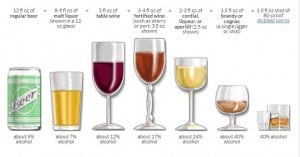
    Since much of the alcohol mentioned on this Top 10 list is much stronger than what we normally drink, it’s helpful to have something to compare it to. The following are your most typical alcoholic beverages and the percentage of alcohol each contains:

    • Beer, 4% to 5% alcohol content
    • Wine, 12% alcohol content
    • Fruit liquors, 28% to 32% alcohol content
    • Gin, 35% to 40% alcohol content
    • Vodka, 35% to 46% alcohol content
    • Rum, 40% to 46% alcohol content
    • Whiskey, 55% to 60% alcohol content

    The National Institutes on Alcoholism and Alcohol Abuse have created this graphic to help visualize the difference.

    However,, the alcohol percentages listed above are the average. What we’re about to list below are the ten strongest alcohols in the world. It’s vital to remember that drinking this amount of alcohol is very dangerous towards your health and well-being. Especially when getting behind the wheel.

    Every kind of alcohol sold on the market must be labeled under the Federal Alcohol Administration (FFA) Act. These labels will usually tell you the percentage of alcohol within each drink. Or, the label will give the “proof count”. For example, you purchase a whiskey which advertises itself as 100-proof. This is the doubled percentage of the alcohol content. Therefore, the whiskey you purchased has 50% alcohol within it.

    Alcohol addiction is a very serious disease and shouldn’t be left untreated. If you or anyone you love is struggling with alcohol addiction, you need to seek help as soon as possible. The longer you wait, the more time alcohol can ruin your life. Furthermore, if you happen to find any of the following alcohols within your liquor cabinet, it’s highly suggested you get rid of them. Again, these are the strongest alcohols the world has to offer and, likewise, the most dangerous.

    #10 – Absinthe (up to 72% Alcohol)

    Up until 2007, Absinthe was banned in the United States. This is primarily due to prior associations with the alcohol inflicting criminal-like behavior in those who drank it. Think mafia or just plain gangsters. Absinthe has psychoactive properties which caused seizures, thought to be caused by the grand wormwood plant – the source of Absinthe – and its production of thujone, a chemical which afflicts sleeplessness, convulsions, and hallucinations. It can be a serious danger and a lethal drug-of-choice.

    #9 – Bacardi 151 (75.5% Alcohol)

    Typically, people who drink Bacardi 151 do so through a variety of mixed drinks, such as combining it with fruit juice. . It is considerably one of the strongest rums ever created.

    However, this brand of Bacardi has been discontinued. The reason it’s no longer available for purchase is that people too often ignored the warnings of the drink being highly flammable. Due to this lack of inspection, many ended up exposing the bottle to open flames and experienced burns. If you still have a bottle of this lying around, it’s important to understand the fire safety risks involved with this alcohol.

    #8 – Devil Springs Vodka (80% Alcohol)

    Another highly flammable alcoholic beverage is Devil Springs Vodka. Coming in at 15 times stronger than your average beer, it comes to no surprise that this drink has found a market for abuse. It is especially popular with people and cultures who prefer vodka compared to other alcoholic beverages.

    As we climb the alcohol content ladder, it’s vital to remember that the stronger the alcohol is, the more dangerous it becomes to your health and the more susceptible the user ends up in terms of abusing it.

    #7 – Balkan 176 Vodka (88% Alcohol)

    An alcoholic drink so strong, it requires 13 health warnings on the bottle. The strongest drink made in Scandinavian, Balkan 176 is distilled three times over and is considered to be absolutely tasteless. This is dangerous, as without any pungent taste most associate with alcohol, this can leave the drinker consuming more and more, not realizing the potential harm he/she’s putting him/herself into.

    In fact, there are numerous reports of people experiencing alcohol poisoning and death due from drinking too much strong liquor in a short period of time.

    #6 – Pincer Vodka (88.8% Alcohol)

    Being the strongest alcohol Scotland produces, it comes to no surprise Pincer Vodka has similar qualities as Balkan 176. However, one major appeal of Pincer is the fact that it has such a low calorie count. So much so, there are people out there who claim they don’t get hangovers as bad as your average liquor.

    There is an obvious danger in this. One of the many qualities of alcohol that turns a social drinker off is the fact that they have to handle a hangover the next morning. Considering the calorie count of alcohol and what it can do to one’s health, it’s understandable that a responsible adult only drinks on occasions. However, since Pincer doesn’t offer these negative alternatives, there’s lies a stronger chance for abuse.

    #5 – River Antoine Royale Grenadian Rum (90% Alcohol)

    There’s a certain quality to River Antoine Royale Grenadian Rum. That is, the people who make it distill over a long period of time through an old, traditional pot stilling method. In turn, this gives it a very prominent flavor not usually found in alcohol with such a high percentage count.

    #4 – Bruichladdich X4+1 Quadrupled Whiskey (92% Alcohol)

    Balkan 176 Vodka is distilled three times over. But Bruichladdich X4 is distilled four times over, which is what gives it is name and appeal. Furthermore, it has a distinct taste which doesn’t match to most alcohols due to the fact that it’s aged in new oak casks.

    Due to the high level of alcohol content, we’re beginning to endeavor into very dangerous territory. This kind of alcohol can do serious harm to someone in a matter of minutes and it’s important to be aware of the fatal consequences alcohol can have if you’re not careful or properly prepared.

    #3 – Golden Grain (95% Alcohol)

    Golden Grain is made by the same people who make the next alcohol on this list and both drinks are actually very similar in appearance, taste, and effects they have on the user. It should be noted Golden Grain is illegal in certain parts of the United States.

    #2 – Everclear (95% Alcohol)

    Everclear was one of a kind when it came out, as no alcohol prior had could be labeled 190 proof. Furthermore, just like Pincer Vodka, it’s absolutely tasteless. As already mentioned, there are numerous dangers involved for those who decide to drink Everclear. Just as with all the alcohols on this list, addiction can happen much more quickly due to the fact that you need less of the drink to feel its effects.

    Furthermore, there are instances when an alcohol like Everclear is placed in someone’s drink without them realizing – a concept known as “drugging”. Inevitably, getting them much more inebriated than they intended to be or putting them in a dangerous position without their
    knowledge.

    #1 – Spirytus Rektyfikowany (96% Alcohol)

    Spirytus contains the most alcohol content by volume in the world. In fact, it’s not even legal in most states, due its potency. Though this alcohol is rare in the United States, it can be found in Poland or Eastern Europe, where it’s manufactured. Spirytus is without a doubt the most dangerous alcohol to intake and if you happen to run into it, or any of the other alcohols on our list, you should be aware of the risks this can have on your health.

    Alcohol’s Risk on Your Health

    Alcohol’s risk factors can be divided into two sections – the short term risks (those of which will appear either immediately or soon after drinking) and the long term risks (those of which will appear after drinking for months on end).

    The short term concerns primarily lie around over-drinking to the point of being incapable of inducing alcohol poisoning which can be fatal. Other health risks involved from short term use are:

    • Bluish tint to skin
    • Coma
    • Confusion
    • Loss of consciousness
    • Low body temperature
    • Seizures
    • Slow breathing
    • Vomiting

    Some people react to alcohol differently and even get sick from it, especially when they take too much of a beverage they can’t handle. If someone has a sensitivity to alcohol, they may feel the following:

    • Diarrhea
    • Facial flushing
    • Low blood pressure
    • Nausea
    • Worsening of asthma
    • Vomiting

    However, over time, people who drink alcohol frequently will develop a dependence. If this happens, they face the same health risks as the short term effects and more. These complications can include:

    • Brain and nerve damage
    • Cancer
    • Cardiomyopathy (damage to heart muscle)
    • Immune system dysfunction
    • Liver disease
    • Mental health issues (such as anxiety or depression)
    • Osteoporosis
    • Pancreatitis
    • Peripheral neuropathy
    • Stomach ulcers
    • Vitamin deficiency

    As you can see, an alcohol addiction is very serious and can have consequences on your health and well-being. If you or anyone you love is currently struggling with an alcohol addiction, it’s vital to seek out treatment as soon as possible.

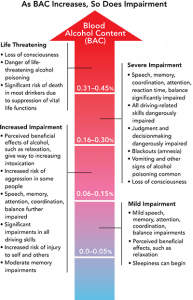
    Check out this NIAAA blood alcohol content chart for more.

    Basics for Alcohol Addiction Treatment

    If you think that you have a drinking problem, finding help can be a life changing experience. The goal of treating an alcohol addiction is to look at life through a new, clearer perspective. And to understand oneself without the use of drugs. Alcohol addiction treatment happens in two important stages; detox and continued treated.

    During detox, your body rids itself of alcohol’s chemicals and returns to its normal, organic functioning – a state known as homeostasis. If you’re a chronic drinker or have developed dependence on alcohol, you’re going to feel withdrawal symptoms. The severity of these symptoms and how long they last all depends on your level of addiction.

    A reputable treatment facility will give you a proper medical assessment which will determine your level of physical dependence. ALWAYS SEEK MEDICAL ATTENTION WHEN WITHDRAWING FROM ALCOHOL. Symptoms can become dangerous or life-threatening. Common withdrawal symptoms include:

    • Agitation
    • Anxiety
    • Depression
    • Difficulty concentrating
    • Disorientation
    • Fatigue
    • Headache
    • Heightened sensitivity to light and sound
    • Irritability
    • Jumpiness or shakiness
    • Mood swings
    • Nausea
    • Nightmares
    • Sweating
    • Transient hallucinations (in more serious cases)
    • Tremor
    • Vomiting

    After your body withdraws, you’re going to need to take the time address your thinking. Again, how long this will take and how difficult it will be all depends on your level of addiction. Generally speaking, most people go through intensive psychotherapy for an initial 3-6 month period. Ongoing weekly therapy then lasts upwards of a year or more.

    Where to Find Help

     If you’re unsure as to where to turn, there are a variety of options at your disposal. Here are some suggestions:

    If you’re looking to talk to someone immediately, check out the following helplines:

    • Drug Hotline 877-736-9802
    • National Council on Alcoholism and Drug Dependence HopeLine 1-800-475-HOPE (4673)
    • National Institute on Drug Abuse – Drug and Treatment Information 1-800-6224357
    • National Suicide Prevention Helpline 1-800-273-TALK (8255) or 800-SUICIDE (784-2433)
    • Substance Abuse Helpline (available 24/7) 1-800-923-4327

    Furthermore, you can always call us for more information on how to find the right treatment facility. The helpline number listed on this page will connect you to American Addiction Centers (AAC). The helpline is offered at no cost and with no obligation to enter treatment. Caring admissions consultants are standing by to discuss your treatment options. So, if you are ready to get help, reach out and pick up the phone.

    We’re happy to help!

    Your Questions

    If you have any further questions about the strongest alcohols or how to treat alcohol addiction, we invite you to ask them below. If you have any advice to give pertaining to these topics, we’d also love to hear from you. We try to reply to each question promptly and personally.

    View the original article at

  • Music Festivals | 5 Tips to Reduce Drug Harm & Stay Safe

    Music Festivals | 5 Tips to Reduce Drug Harm & Stay Safe


    ARTICLE OVERVIEW: Drugs and alcohol are part of festivals. This article presents five practical tips to reduce risk of harm, injury, or overdose.

    ESTIMATED READING TIME: Less than 10 minutes.

    Table of Contents:

    Why Do People Abuse Drugs at Festivals?

    The simple answer is simple: to keep the party going.

    In fact, people are looking to experience something apart from the every day. Often, they associate a good time with a sense of euphoria, preferably one that lasts for a long period of time. The body can’t naturally produce this kind of sensation on its own and, therefore, people turn to drugs to give it an extra boost. However, there’s more to it than just that.

    Peer pressure must also be considered. Admittedly, the festival scene has a lot of drug abusers within its culture. Recent studies have shown that the majority of festival attendees aged 18–30 report a history of illicit drug use. In addition to friend groups that normalize drug use, there’s also the pressure of the festival atmosphere itself. Particularly, if everyone around you is taking drugs, then there’s a group mind that makes it easier to join the crowd.

    To top it off, it’s not uncommon for people struggling with addiction to find themselves at these festivals. A common trait of addiction is compulsive behavior which leads individuals to places where a large amount of drugs can be obtained. There are multiple reasons for why a person facing addiction will want to obtain drugs at a festival, but a big one is they can get a hold of large quantities of drugs at one moment and, therefore, have a supply which lasts a long period of time.

    What Drugs Do People Abuse at Festivals?

    When observing drug trends amongst festival goers, the first thing you’ll notice is that most of them are taking or seeking out stimulants. It’s very unlikely someone at a festival will want a downer or central nervous depressant, as the mood of the scene is “up” and full of energy. A list of common stimulant drugs found at music festivals include:

    Adderall. Normally, Adderall is abused by college students looking to cram an entire week’s homework in just one night. However, this amphetamine medication has found popularity within the festival scene as well. When people are high on the drug, it gives them a boost of energy which lasts for a long period of time. This is perfect to keep the party going considering festivals go on for a long period of time and, often, the acts people want to see are one after another.

    Alcohol. When we drink, we tend to be much more relaxed and social due to its disinhibiting effects. It comes to no surprise that people in large, social environments are attracted to this substance. By letting the drink “get them loose”, they feel more likely to participate in festival’s various activities, namely dancing. The unfortunate truth is that festival goers are vulnerable to poisoning, especially when they mix alcohol with other drugs.

    Cocaine, Crack. Generally, people who take cocaine and/or crack will feel an intense euphoria and increased energy. In a festival setting, this might seem ideal considering the fact that music festivals go on for hours upon hours at a time. With that in mind, it can’t be forgotten that these stimulants don’t necessarily last that long in their high. Therefore, as a means of avoiding a crash, users tend to “binge” and take dose after dose in order to stay high.

    Hallucinogens, LSD (acid), Mushrooms, or Research Chemicals. Ever since the 1960s, hallucinogens have been a popular choice for festival goers. The prime reason for this is it changes the way in which the person perceives and witnesses the entire experience. Furthermore, hallucinogens are known for giving those who take them a great amount of energy for a long period of time. This is why psychodellic drugs are billed as an “ideal high” for those who want to stay up all day and night. However, hallucinogens can trigger mental illnesses in people who hadn’t previously experienced mental health complications.

    Marijuana. Unlike the other drugs on this list, marijuana is a central nervous system depressant – though effects vary by individual. Though marijuana isn’t as dangerous as the other drugs we’ve listed, it can onset mental complications and cause extreme anxiety.

    MDMA, Ecstasy, Molly. This is one of the most popular drugs within the festival and club scene and also one of the most dangerous when taken frequently. The thing about MDMA, ecstasy, and Molly are they’re highly stimulating drugs with very euphoric effects. Therefore, young people tend to overlook the bad and further seek out the thrill they bring to a festival atmosphere. Still, not only can these substances cause brain damage over time, but with too much of a dose, people can experience panic attacks or seizures. Dehydration is also a risk when taking these drugs.

    With all this in mind, we’ve laid out some tips for people who want to enjoy the music festival’s have to offer and avoid drugs. The purpose of these tips is not only to educate you on how to stay away from drugs during your time at the festival, but how to keep your body healthily going in order to fully enjoy the festival experience.

    Tip #1 – Know the Landscape

    Furthermore, it’s in your best interest to get oriented with the festival itself. This includes locations of specific areas of interest, such as medical tents or where to find help, if necessary. Know where to find First Aid. Also, check out whether or not the festival offers free drug testing. These services will take samples of drugs and run laboratory checks for substances like
    • Methamphetamine
    • Ketamine
    • Para-methoxyamphetamine (PMA)

    You’ll want to get an idea of the area itself and how to navigate through it. This way, when large crowds begin to form (and they will), you won’t have as much difficulty getting from one point to the next. And you’ll be keen on where to find medical aid if you or a friend needs it.

    Tip #2 – Educate Yourself

    One of the greatest things you can do before considering any psychoactive drug is to inform yourself on how the drug works and its dangers. Evaluate the risks. Be honest with yourself about the effects. What can possibly go wrong? How might you mitigate a “bad trip”, for example? Or, how does the drug interact with other drugs – even pharmaceuticals – that you’re currently taking?

    Much of the time, people who attend music festivals are unaware of the potential side effects of drug use. Often, you might spontanesouly decide to use based on curiosity or even compulsion. Risk taking might also be a part of the decision. By teaching yourself the reality of drug use, you won’t be curious. Instead, you’ll be fully aware of whatever a dealer has to offer and the dangers involved.

    If you’re looking for resources in which to inform yourself about the effects of psychoactive drugs, you can check out the following websites:

    Tip #3 – Drink Water and Lots of It

    A festival is bound to drain your energy – with or without drugs. You can look at going to a festival very similarly to doing a work out. You’re going to be sweating a lot, you’re going to need to push your body beyond its normal functioning, and you’re going naturally drain yourself. Water is a natural source of energy to provide yourself with.

    So, it’s important to stay hydrated. Though not every festival offers it, but some will have water stations. Know where these places are. Or, pack your water in by the gallons.

    It also helps if you plan out how much water you’re going to drink throughout a day. Some drugs impair your thirst reflex. But drinking too much water can increase the risk of electrolyte imbalance or brain swelling. Some drugs like MDMA causes the body to retain water. With this knowledge, coordinate how much water your body receives – which is vital for when you plan to use up a lot of energy.

    Tip #4 – Know When to Relax and Refuel

    The fierce party environment of a festival may propel you in to hyper mode. Festivals are set up in so people can enjoy themselves when they want to. Some people prefer seeing a live show in the afternoon while others do at night. With that in mind, it’s important not to drain yourself to see every act the festival has to offer.

    You’re going to drain yourself regardless. So, with that in mind, avoid trying to keep the party continuously going. If you don’t want stop and let the body’s naturally refuel, you will crash. Not only is this behavior unhealthy, it can lead to terrible consequences, especially if you drive home when the festival is over.

    For example, don’t be afraid to take breaks from dancing. We know you don’t want to step away from the music, but it’s vital you do it every now and again. By giving your body a chance to regenerate, you’re making a huge difference. You’re taking the time to allow your body to gain the energy it needs again to get back into the dancing groove. Additionally, fuel up with healthy food many times a day.

    Tip #5 – Bring a Friend and Stick Close

    By having a friend along for the festival experience, you’re giving yourself the opportunity to stay safe no matter what arises. A friend will not only always be there if things become unsafe, but s/he can support sobriety, if that’s what you’re aiming for. In fact, with someone else by your side who’s also drug-free, you’re less likely to give into peer pressure which spawns drug use.

    There’s always the chance you may accidentally separate from your friend during the festival. If this happens, you can always set up a spot to meet. So, scout out the festival’s environment at the beginning. By having a comprehensive idea of what the layout is, you and your friend can be sure never to get lost and know where to go if things go wrong.

    It’s Okay to Enjoy Yourself Without Drugs

    While at a music festival, you’re going to see a lot of people on drugs. The truth is, you’re also going to see a lot of people enjoying themselves on drugs. You may get the notion that you’re missing out on something. That maybe a hit or two of something isn’t so bad and can really give you the buzz you need to enjoy yourself.

    This is anything but true. You don’t need drugs to enjoy your time at a music festival!

    The consequences can outweigh the fun. Some of the risks include:

    • Cardiac problems
    • Dehydration
    • Dysphoria, or an extreme depression during a crash
    • Extreme fatigue
    • Lack of consciousness
    • Overdose
    • Panic Attacks
    • Risky sexual behavior

    When it comes to music festivals, people don’t often consider the long-term effects of their drug use. Rather, they focus solely on the moment and how much they can enjoy their time within this festival.

    You don’t have to be that person. You can have fun without drugs. You can find the energy to dance along to the music and be happy without taking drugs. You can be in a drug environment and stay drug free.

    This is especially important to people who have struggled with addiction in the part. When it comes to recovery, one of the biggest concerns most have is that of relapse. Relapse can happen at any point in life. Just because you’re in an environment where people use drugs to enjoy themselves doesn’t mean you have to as well. You know what addiction is like and you quit using for specific reasons.

    Stick to that reason, prepare for what’s in front of you, and be sure that you’re in a good place before you consider attending a festival.

    Your Questions

    We hope to have sincerely helped you plan for staying safe during a music festival. However, you might have a pressing question.

    If you have any further questions pertaining to how to stay safe and drug free during a festival, we invite you to ask them in the comments section below. If you have any advice to give to others on this topic, we’d also love to hear from you. We try to get back to each comment in a prompt and personal manner.

    Leave a Reply

    View the original article at

  • Change is Strange: Coping with Change in Addiction Recovery

    Change is Strange: Coping with Change in Addiction Recovery

    What Are “Changes”?

    For the past several months I have been experiencing a lot of change. But what does that mean? I’ve been asking some questions:

    • What do we mean by change?
    • How do we view change?
    • What does change do to us?

    Simply defined, change is, “the act of making or becoming different.”

    Those are small words for such an often series of tumultuous acts. Change can be sudden and unexpected, or it can be thought out and planned. But no matter how much we plan for change, it can throw us in a loop. We can feel lost. Anxiety and fear can take over. In sum, change is strange.

    Change is Strange: A First Hand Account

    Take for instance how I have spent my life’s work working in the behavioral health care field, most notably in the addiction and mental health arena. I’ve spent decades either teaching on the university level or helping others to change. I have worked with thousands of students as well as hundreds of families whose loved ones experience the maladies of abuse. This has included:

    • Chronic pain
    • Disordered eating
    • Disordered shopping
    • Compulsive gambling

    … other process disorders coupled with anxiety and depression. All the while, the name of the game is to motivate, facilitate, inspire them to change their behaviors. The goal is to fool those neuro tags and change the way one responds to life.

    Well, let me tell you first hand, “Change is strange”. I travel for work. Over the last few months, I have worked in London, New York, Fargo, Clovis, Mountainside, Long Beach and Malibu. I have changed some of the work I do from consulting at one place to consulting at a few others. Consulting means you go into a center with essentially clean eyes and knowledge about the subject matter you are asked to look at. As such, one becomes a partial part of something.

    As a consultant, one’s job is well defined. In my case, most of the time it centers around developing curriculum, training and working with others. As such, you must learn all about the entities and perspectives in the workplace. In other words, you must put yourself in their shoes. You must identity with and try to understand all the nuances of a treatment environment, even though you are not present all the time.

    Looking at Attachment

    This is a tightrope walk. I honor the professionals, the work they are doing, and their processes for accomplishing their goals. Nonetheless, in doing so, I find that I become attached to the people, places, and things I encounter.

    When a consulting job ends, there is a little hole inside of me that misses that place, that staff, those people.

    And so, faces and places change. I found this experience to be bittersweet, having learned tons about a new subject matter. Hence, whether it’s abrupt or planned, saying goodbye is difficult. Change is strange!

    Moving to a New Home Shakes Things Up

    Recently, my husband, dogs, and all our things were picked up and moved. The process has shaken up the molecules of knowing where everything is in its rightful place. It’s difficult to know where things are: from where silverware sits to where the best grocery store is to wondering, “Where did I put this or that?”.. to not knowing exactly where to go, what to do, or who to meet.

    My sense of direction, belonging, and trajectory have all been thrown into a clothes dryer and the dial turned up to maximum spin. I don’t know where I’m going to fall when the tumble dry finishes. Indeed, change is strange.

    Many of you know we have relocated to the desert. Mr. Wadas – my husband – as I affectionately call him, is happy as a clam after spending months making a new home. He can walk out onto our back patio and look up at the stars every night, see the harvest moon, and can play golf for a cheap ticket at the best clubs.

    As a former athletic director, moves are a way of life for him. He changed university colors many a time. As an athlete, he learned that there is always another game to play. If you lose one you get up the next day, dust yourself off, learn from the plays, train harder, and go back out. His mantra is:

    “Preparation plus opportunity equals success.”

    He rolls with the punches, another way of dealing with the emotional highs and lows of transition.

    How Being an ACOA Informs My Response to Change

    For me, the adult child of an alcoholic and the daughter of a Loretta Young-type mother who vacationed and moved constantly, change doesn’t settle well in my bones. In addition to this, I’m a woman who experienced many sudden deaths of close family.

    I don’t move.

    In WeHo, my previous residence, I only moved two doors down from our condo to a home. I fell in love with the city, learned, laughed, walked everywhere in the neighborhood feel of WeHo, met so many new people, volunteered at the Sheriff’s station, tripped in disbelief over a growing homeless population, protested the marijuana stores, made friends with the doormen at Sunset Marquis, experienced the vastness of the treatment and recovery industry, hiked up to Soul Cycle every morning, riding alongside artists, designers, celebrities, etc., and felt a strong sense of community. I felt energized, activated and secure with the sounds of La Cienega roaring in the background.

    And then life took some turns and we chose to move.

    I have been coming to the desert for more than 35 years. I know the streets, have a few professional friends here, and can find my way around. Still, I don’t know all the places. There is a flood of new faces. Yet, there is a familiarity in unfamiliarity.

    I Turn to the Tools of Recovery

    What I do have that I embrace are the tools of recovery for any environment in the world. As such, this means that:

    • I try six meetings and try six more.
    • I try six spinning studios and try six more instructors.
    • I use the telephone (I don’t know my landline number even that was switched).
    • I reach out to new and old friends, suiting up and showing up.
    • I trade Melrose Place for Lowes (really!)

    More than anything, it means feeling my feelings.

    I grieve the changes and welcome new beginnings. I shed some tears, write an article about FOMO (the fear of missing out), as I am missing all the L.A. events and its robust treatment community. It means facetiming with grandchildren instead of hugging in person.

    And in the process, I am finding my groove.

    This morning, as I see the desert sky come up… I am grateful. Grateful that I got to learn so much about chronic pain and how to work with families in that arena. I’m grateful for the synergy of the city, for learning about life in the fast lane, for traveling near and far in the pursuit of wellness, for learning from such great folks along the way from Sean Firtel to Brad Lamm, Jonathan Rauch, Jeffrey Merrick, James Flowers to Cole Rucker, Heather Hayes and Eve Ruff, Judith Landau, Denise Klein, Charlene Short Majors, Monica Phillips Priya Chaudri, Ed and Mary Ann Spatola, Dawn Hedgepath.

    There are so many more!

    How to Get Through Periods of Change

    So, now I am here in the desert, being gentle with myself. I realize that I am in the process of becoming. “Be gentle with your soul,” I say to others. Now I am saying that to myself.

    In this new chapter, the tools of recovery are important. Here they are:

    • Empathy
    • Establishing new rituals
    • Exercise
    • Feeling one’s feelings
    • Meetings
    • Nutrition
    • Peer Support
    • Professional consultation
    • Telephone calls

    So, if you are in the midst of doing something different – taking something out of your daily routine or adding something in – please remember it takes 60-90 days to change just one behavior. When you are trying to adjust, adapt, or learn about so many new things… let those neurons fire off and remember you are attaching to new ways of being.

    You will be OK.

    Change is strange! As John West, Co- Owner of The Guest House . hared on Facebook:

    “A shark in a fish tank will grow eight inches but in the ocean it will grow eight feet or more. The shark will never grow out of its environment. The same is true with you. Many times we are around small thinking so we don’t grow. Change your environment and watch yourself grow.”

    How are you growing today?

    How are you addressing change?

    Let me know and I will compile your wisdom and share with everyone.

    View the original article at

  • 7 Common Signs and Symptoms of Teen Drug Use

    7 Common Signs and Symptoms of Teen Drug Use

    Daily Drug Use Signals a Problem

    While there are some surveys that indicate drug abuse among teenagers is decreasing, that does not mean the problem has gone away. It’s still common for teens to experiment with drug use for the purpose of fitting in, escaping from reality, or simply out of curiosity.

    Could your teen be on the way to daily drug use? If you notice one or more of these seven signs of teen drug use in your child, it’s time to have a conversation with him or her and seek treatment if necessary.

    Signs of Teen Drug Use

    1. The Desire for Privacy Increases. 

    All teenagers want some private space and that is completely normal. For this reason, you should remember to knock before entering your teen’s room. However, when the need for privacy becomes extreme, it could be a sign of drug use. There are some distinct ways that this can manifest.

    For example, a teen who is attempting to hide their drug use might not answer openly to questions such as, “When will you be home?” or, “Who is going to the party?” Instead, s/he might become defensive and seek distance. So, when a child who typically responds to these questions openly begins to view them as an invasion of privacy, it is a sign that something may be wrong.

    2. Old Friends Fade Away and New Ones Take Over. 

    Childhood relationships don’t always make it through to adulthood. It’s a normal process if your child sees less of an old friend and begins to spend time with a new one. However, it becomes a concern if the entire crowd is replaced by new people.

    This potential symptom of drug use is even more concerning when your child does not want you to meet those new friends. They might even get angry when you mention an old friend. This is because they understand that you may pick up on signs that those new buddies are involved in something that’s not in their best interest.

    3. Hygiene and Clothing Habits Change. 

    Another sign that your teen is using drugs includes changes in dress or hygiene. For example, your child used to do a good job of taking a shower, brushing after meals, and using deodorant. Lately, that seems to happen a little less each week. At first, it was a shower skipped one night, then it becomes several days in between baths. Things like brushing the hair or even washing the face just aren’t important anymore.

    Teen drug use may manifest through other changes. For instance, even clothing choices may change. Perhaps your child used to take pride in creating outfits with matching pieces and made sure they were clean and free or any rips or tears. Now, it’s no big deal to step out in clothing that hasn’t seen the inside of a washing machine in some time.

    Less diligence with personal hygiene, including the clothing your teen wears, could mean that something else has become more important than being clean and looking good. That something could be one or more drugs.

    4. Former Interests Are Replaced With New Ones or Nothing at All. 

    Hobbies and other interests do change over time. Typically, the changes are gradual rather than happening in quick succession. If your teen’s interests quickly change and the new interests seem to draw the teen further away from family and former friends, drugs may be involved.

    You should also be concerned if those former interests are not replaced with anything at all. Apathy and lethargy can be symptoms of drug use.

    A child who no longer finds joy in prior interests and would rather spend their time isolated or sleeping could be developing a serious drug dependency.

    5. An Increased Need for Cash. 

    Your teen may get a certain allowance which they can spend as they wish. If they begin to ask for more money than usual, it’s possible they could be spending that money on drugs. They might even lie about what they need the money for. For example, they might ask for money to go see a movie but then not be able to present a ticket stub to you.

    If a teen with a drug abuse problem is not able to get the money they need to support their habit, they may resort to stealing money. If you notice cash missing from your wallet, this could be a sign of drug use.

    6. Things Disappear Around the House. 

    In addition to stealing money, teens addicted to drugs may also begin to steal items from their own house. Have you noticed any electronic devices, watches, jewelry, or other personal items missing from where they are normally stored? If so, it’s possible that your teen might have sold these items to raise money for drugs. When drug use becomes an addition, teens will do whatever it takes to get their hands on the drug. That includes stealing from people they love.

    Keep in mind that if you mention the missing items, your teen may hint around that someone else is to blame while also denying any involvement. Be especially concerned if the denial comes with what appears to be an inordinate amount of anger. People with something to hide are more prone to respond in this manner when others are getting a little too close to the secret.

    7. Grades and Attendance Have Declined.

    Although drugs are not the only reason why your teen may start skipping classes or failing to do coursework, it is one of the more common reasons. While you want to keep a cool head, lower grades and reports that your child is not attending classes should be taken seriously. If the underlying cause is drugs, taking action now will save your teen from larger problems later on in life.

    Teen Drug Use Can be Treated

    You love your teen. You want the best for your child. If you see any of these symptoms developing, don’t write them off as being a natural part of adolescence.

    Talk to your teen and find out if drugs are involved.

    If your teen is taking drugs, know that help is available. Seek professional help for your teen and for yourself. With the aid of the right program, it’s possible for your teenager to recover from drug abuse and enjoy a productive life.

    View the original article at

  • Does Football Promote and Encourage Binge Drinking?

    Does Football Promote and Encourage Binge Drinking?

    Football and Binge Drinking

    Whether in the stands or the media, the consumption of alcohol is ever-present and widely celebrated in the world of sport. And with the 2018 World Cup providing the most recent example, it raises the question, does football promote binge drinking?

    If this year’s World Cup has taught us anything, it’s that football and drinking still very much go hand-in-hand. Amid all the excitement and heartache throughout the tournament, alcohol maintained a very active presence in the media. Granted, much of it was due to the huge amounts of beer being thrown in the air to celebrate goals being
    scored, but it’s clear that binge drinking was being given the green light for such a special occasion.

    In this post, we’ll discuss the role of alcohol in football fandom and whether or not it encourages people to have “one too many”.

    Alcohol Sponsorship in Football

    For many years now, a wide range of beer and spirit brands have sponsored football teams and tournaments. Prime examples include Liverpool featuring the Carlsberg logo on their shirts, and the English League Cup spending several years under the mantle of “The Carling Cup”.

    And while alcohol sponsorship on team shirts is substantially less common these days — with gambling and apps seemingly taking its place — there’s still a great deal of it being featured on pitch-side banners, as well as in pre and post-match television ads.

    Although it would definitely be a reach to suggest that sponsorship in football alone is responsible for widespread binge-drinking, it’s safe to say that it’s established a link between the two. For many, this has been enough to promote the idea that:

    Football is more enjoyable while under the influence.

    Are We Ignoring the Obvious?

    Considering that we live in an era where the awareness and treatment of alcohol addiction is held in such high regard, it’s surprising that the dangers of excessive drinking are somewhat ignored when it comes to football. And while it’s fair to say companies aren’t forcing their customers to drink in excess, the encouragement from advertising is a massive influence.

    It’s especially worrying when you consider how many young fans associate football with alcohol consumption, and develop a binge drinking habit early on, due to the established routine of getting drunk.

    The Impact of Binge Drinking

    The definition of binge drinking is consuming a large amount of alcohol in a short period of time. Your body can only process one unit of alcohol per hour, which is worrying, because the average pint of lager contains 2-3 units.

    A football match lasts for ninety minutes (plus 15 minutes for halftime), and, during this time, it’s safe to say the average fan will polish off several drinks.

    Binge drinking can severely impact your mood and mental health, and it’s often the catalyst that fuels violent or hostile situations during football matches. When alcohol is flooded into your system over such a short period of time, it can also harm your liver and kidneys, especially if you binge drink on a regular basis.

    Signs of a Problem

    The definition of binge drinking is to consume lots of alcohol (6 units or more) in a short space of time, or drinking with the intention of getting drunk. For some, this will occur once or twice a month and have no long-lasting problems, but for others, binge drinking can become a regular or even daily habit. Here are some of the signs that your binge drinking is developing into a more serious problem:

    1. You Can’t Consume Only a Small Amount of Drinks.

    One of the most common signs of problem drinking is an inability just to have one or two drinks. Drinking a lot of alcohol because you are unable to stop once you’ve started is not only a sign of a binge drinking problem, but it’s also a red flag for alcohol dependence.

    2. Drinking with the Intention of Getting Drunk.

    There’s a big difference between having a few drinks and ending up drunk and going out with the sole intention of getting drunk. Regularly drinking to the point of intoxication can be harmful for several reasons, so it’s not something that you should aim to achieve and definitely shouldn’t be your reason for drinking alcohol.

    3. Drinking Quick.

    While many people like to sit down and enjoy a cold beer, a glass of wine with some food, or a tasty cocktail at a bar, there are others who finish or ‘down’ their drinks as quickly as possible. This is a common tactic of a binge drinker as it allows them to get drunk as quickly as possible and alcohol is simply treated as a means to an end, rather than an ingredient of an enjoyable beverage.

    4. Drastic Personality Change.

    The overindulgence of alcohol can often bring out a different side of people, causing them to act in ways that can potentially put themselves or others in danger. For example, when someone is sober, the concept of drinking and driving would seem ludicrous. However, they might be able to justify getting behind the wheel after a period of heavy drinking.

    5. Aggression and Violence.

    Several studies have revealed a link between binge drinking and aggressive or violent behaviour. Alcohol can massively influence how you respond to certain situations. So when you’re drinking, things can get out of control due to aggressive behavior. Combine that with other drunk people and there’s a recipe for aggravation and altercations.

    What You Can Do About It

    When it comes to excessive binge drinking the first and most important step is recognising that there’s a problem. Then, depending on the severity of the issue, a decision needs to be made about how you can go about reducing your intake and attitude towards alcohol. Everyone is different and will respond positively to different solutions. If you or someone you know is having problems with binge drinking then one of the following is advisable:

    Remove Yourself from Toxic Environments.

    Regular binge drinking isn’t necessarily a sign of alcoholism or alcohol dependency, in many cases, it’s simply down to the fact that you’re spending too much time in environments that promote the consumption of alcohol. The best way to remedy the situation could simply be a case of not going out for a while or avoiding hangouts such as bars and clubs, but it may require more drastic action such as not socialising with friends who insist on binge drinking regularly.

    Try to Detox.

    Binge drinking often occurs when you get into the routine of going out every weekend. Detoxing is not only a great way to give your body a much-needed rest from boozing, but it also allows you to break the habit and reduce the likelihood of you slipping back into a binge drinking routine.

    Seek the Help of Professionals

    Drinking alcohol to excess on a regular basis can have a severe impact on your physical and mental health, and if you’re struggling to reduce or give up drinking then you should seek professional help. Your doctor will be able to provide advice and guidance regarding any health issues you may be experiencing due to alcohol. However, if you’re looking for detox treatments and sobriety guidance then your best bet is a specialist rehab or addiction clinic.

    In Conclusion

    Whether or not football promotes binge drinking will always be a matter of opinion, but the environment and atmosphere it creates for fans is an undeniable influence. An influence, of any nature, can be enough to turn “a few drinks” into a bout of binge drinking. For the average fan, this may only be once every so often, but, for those who
    watch every game at the pub, it could develop into a serious condition.

    View the original article at

  • Taking Care of an Addict? 5 Tips to Love Yourself First

    Taking Care of an Addict? 5 Tips to Love Yourself First

    This article is short on purpose.

    The tips herein are straight from experience. And, the advice offered is practical and straight forward. If you have any questions, or would like to chat with the author, please send us a comment at the end of the page. Amanda extends her compassion to our readers, and often respond to personal comments within a few days of notification.

    Does This Sound Familiar?

    I am in love with an addict and I try to do anything I can to make sure they are okay.

    If this statement sounds like you, then it is clear that you are not putting yourself first in your own life. Most of us who are in love with an addict are people who are used to being people pleasers and taking care of others. This role for some people starts before they fall in love with an addict. It can seem normal and feel comfortable to choose a spouse or loved one that needs so much of your time and attention because most co-addicts are caretakers by nature.

    In order to break the cycle, you must do the following;

    1. Admit that you are a co-addict and codependent.

    2. Acknowledge and affirm that you want to change.

    3. Find a support person, this can be a trusted friend, therapist or support group that will hold you accountable to this change you want to make.

    4. Write a list of all of the things you do for the addict that you know you should not be doing and then make a list of things that you know you should be doing for yourself.

    5. Start with the first thing on each list and work on them simultaneously. Do not move on to the next point on either list until you have completed successfully the prior action step.

    When it becomes second nature to take care of someone else’s needs before your own, it may take time and practice to undo those impulses. It is important that you take one action step from each list and work on them together so that you have one action that you should not be doing and replace it with something that you know you should be doing. It can be the simplest of tasks.

    For example, from list one, you can stop checking your phone at night for calls from the addict who has not come home and from list two, you could do five minutes of meditation instead.  The purpose here is to replace one habit and replace it with a positive action that is rooted in self-love and self-care.

    Take Care of Yourself First (Instead of the Addict)

    The most important part of loving yourself first is admitting that you are NOT doing it. If you can have a real and honest dialogue with your inner self, then you can start taking the action steps. It is the most empowering feeling to start the process and give you the attention and love you deserve. It can be scary to let go but it will start to feel very good to release the illusion of control you have over the addict and start to take control back of the only thing you can in your life—and that is you!

    View the original article at

  • Horse Riding as Therapy in Addiction Treatment

    Horse Riding as Therapy in Addiction Treatment

    Equine Therapy: Does It Help Address Addiction?

    Yes, equine therapy be used to help address issues related to addiction. It helps us shift emotional and mental patterns, and discover new ways of being. While relatively new, this type of therapy has been shown to have many widespread benefits for both mental and emotional health.

    How?

    Well, to begin, addiction is a complicated disease. It affects the mind, body, and soul…so overcoming cravings and patterns to use drug or alcohol can be constant struggle, one that requires effort. This why we have to be active in our sobriety, not passive, even when we rack up some time in recovery.

    Getting there initially can be the hardest part of the journey. The pull towards drugs or alcohol can be powerful, and it isn’t uncommon that people face many false starts on the road to recovery. Relapses are almost expected, as drug or alcohol use has an allure when we first quit. What that means may be poorly understood by those around the sufferer.

    Even those in the scientific community are learning more about the recovery process every day.

    When a relapse occurs, or when we’re first trying to get sober, we may feel helpless and hopeless. The guilt, both of the addiction itself and the things we have done while in the throes of it, can make the urge to self-medicate all the more tempting.

    Sometimes, talk therapy can feel theoretical. Equine therapy forces you to step into the moment. You change your focus from yourself to another living creature.

    That is why utilizing multiple therapeutic approaches to addiction recovery are so effective. While going to voluntary, “peer-supported” meetings are an awesome way to hold yourself accountable and find acceptance among others who know your struggles, sometimes a 12-step approach isn’t quite enough.

    Dealing with the intense emotional core of addiction takes a professional, and you have many options to choose from. Therapy, counselor-led support groups, psychologist/psychiatrist combos, inpatient treatments, outpatient treatments—they are all proven to be excellent choices. A more experimental—but still highly praised—option to consider is equine therapy.

    What Is Equine Therapy?

    Equine therapy is riding and caring for horses in a therapeutic setting as part of a larger mental health program. During your time in equine therapy, you will bond with a horse, help care for their needs, feed them, brush them, saddle them, clean their stall, ride them and otherwise become connected to the animal on a deeper level.

    How does this help you recover from an addiction? It all starts with an external focus.

    Addiction is a selfish disease. It eats away at you from the inside, making you self-obsessed. So much of your life becomes about the addiction itself, whether it is when you can get your next fix, or how you will hide behavior from those around you.

    When you are coming off of drugs or alcohol, you have that same internal obsession. You are trying not to think about using. You are trying to put forward a certain attitude and appearance. You are stuck in your own head as you battle with the demons that kept you using for so long.

    Equine therapy forces you to move your focus to another living creature. Other animal forms of therapy that exist for addicts are the use of companion animals/support animals, such as cats and dogs. In addition to being larger than us, horses are highly feeling, intelligent animals. Their riders can become very attached to them and able to connect on many levels. Trust is built during both riding and caring for a horse, on both sides.

    Equine Therapy For Other Disorders

    Horse therapy has been used for other disorders as well, including in the treatment of mental health issues in children and teens. Autism Spectrum Disorder (ASD), ADD/ADHD, Obsessive Compulsive Disorder, depression, anxiety, personality disorders and more can all benefit from time spent in equine therapy.

    As addiction can often overlap with the above other conditions, making this an effective form of therapeutic intervention that can be added to additional treatments being received by the sufferer.

    What You Will Get From Equine Therapy

    Equine therapy provides its own set of benefits. It is fun and enjoyable. It can be highly relaxing. It gives the mind something to focus on. It heals the body and helps build strength. It offers immediate emotional feedback from the horse, a highly empathetic creature.

    The rider will also learn things about themselves they never knew. They will find discipline and consistency in their activities. They will have time to sort out their own thoughts and emotions in a safe space, on their own time. They will even be able to learn to create and maintain healthy, trusting relationships in an environment meant to help them grow emotionally.

    How To Find Equine Therapy In My Area

    Many stables offer the ability to ride horses that they keep. However, those are not the programs that are catered directly to those needing assistance with addiction or mental health issues and should be a secondary source of interaction with horses.

    PATH International is a great, official source for information and finding an equine therapy program in your area. They are a network of licensed and trained mental health providers who use equine therapy as part of their overall treatment recommendations.

    Once you have found a provider that works for you, it is wise to speak to them about how their program works. Some will offer a staff of therapists in different specialties that work with you alongside the equine therapy.

    Others will have you continue treatment for your addiction and mental health with your own therapist or doctor, in addition to your equine therapy. This combination is a great option for those who have already established a relationship with a provider and want to continue working with them while adding equine therapy to their treatment plan.

    Equine therapy is an amazing, if somewhat experimental, method of treating addiction. It has been shown to have many widespread benefits for mental and emotional health. If you have been struggling with your path to sobriety, maybe equine therapy is the missing puzzle piece.

    View the original article at